Visitor Counter

hitwebcounter web counter
Visitors Since Blog Created in March 2010

Click Below to:

Add Blog to Favorites

Coyotes-Wolves-Cougars.blogspot.com

Grizzly bears, black bears, wolves, coyotes, cougars/ mountain lions,bobcats, wolverines, lynx, foxes, fishers and martens are the suite of carnivores that originally inhabited North America after the Pleistocene extinctions. This site invites research, commentary, point/counterpoint on that suite of native animals (predator and prey) that inhabited The Americas circa 1500-at the initial point of European exploration and subsequent colonization. Landscape ecology, journal accounts of explorers and frontiersmen, genetic evaluations of museum animals, peer reviewed 20th and 21st century research on various aspects of our "Wild America" as well as subjective commentary from expert and layman alike. All of the above being revealed and discussed with the underlying goal of one day seeing our Continent rewilded.....Where big enough swaths of open space exist with connective corridors to other large forest, meadow, mountain, valley, prairie, desert and chaparral wildlands.....Thereby enabling all of our historic fauna, including man, to live in a sustainable and healthy environment. - Blogger Rick

Subscribe via email to get updates

Enter your email address:

Receive New Posting Alerts

(A Maximum of One Alert Per Day)

Friday, January 28, 2011

Our good friend Frank Vicente of Wild Dog Foundation doing strong work in the New York region educating folks on how to live alongside coyotes

Learning to live alongside coyotes
By Yudith Ho
Coyote sightings have become a norm in and around Riverdale and on Saturday, Frank Vincenti, president of the Wild Dog Foundation, a non-profit wildlife education group, set out to explain how to live in harmony with them. As part of a presentation he gave in Central Park called Balancing Urban Ecology or Conflict in the Concrete Jungle, Mr. Vincenti discussed reasons coyotes have come and how to keep them at bay. The animals were first spotted in New York State in the 1920s and in the Bronx at Woodlawn Cemetery in 1995, he said. He said that Riverdale's coyote population is most likely stable and consists of one family group that lives in Van Cortlandt Park and looks for rats and other rodents at night."Most of the sightings are in the middle of the night and fleetingly," he said later in an interview, adding that Van Cortlandt Park is "probably their whole  territory … that's what I've seen in other urban areas."
At the talk he said that while several attacks were reported last summer in Rye Brook, N.Y., just 15 miles from the Bronx, where coyotes, one of them rabid, injured two children ­— such occurrences are actually quite rare. As part of his presentation Mr. Vincenti said that it is when humans feed or initiate contact with coyotes that they begin to approach people for handouts. "As much as I love them — and I do — coyotes really want nothing to do with us," he said. The first step to keeping coyotes at bay, Mr. Vincenti said, is to prevent habituation by securing garbage and not leaving pet food outside. This helps keep coyotes and other wildlife from trespassing into yards in search of food. The second is to prevent habituation by training coyotes to fear humans. "When you see an inquisitive coyote, stomp your foot and make loud noises and chase them away," Mr. Vincenti said. "Coyotes understand when you assert dominance." The third is for pet owners to be responsible by keeping pets indoors at night and only taking them on leashed walks outside.
 "What makes me so angry is that almost every incident involving a dog is preventable," he said. "The owners usually have ample warning, but when tragedy happens, they want the coyotes removed." A study by Pace University shows that while coyotes rarely harm humans, we represent their most common cause of death, followed by roads and mange, Mr. Vincenti said. "Coyotes have chosen the big city, so can we be good neighbors ourselves?" he asked.
Mr. Vincenti gives presentations about coyotes and other wild dogs around the city because he hopes that a better understanding of wildlife will help communities coexist peacefully with them. "The bottom line is: a fed coyote is a dead coyote. So keep them wild," he said. He also said they deserve a thank you for eating up rats and other pests.

Wednesday, January 26, 2011

As Polar Ice continues to shrink and become fragmented, Polar Bears are expending more and more energy to survive.................As a result, cubs are not reaching maturity,,,,,,,,,,,,,adult bears are losing body mass..................does not bode well for perpetuation of the species

Researchers Witness Polar Bear's Epic Search For Ice


Scientists studying polar bears around the Beaufort Sea, north of Alaska, were amazed to witness one polar bear that swam continuously for more than nine days, covering some 426 miles, in search of sea ice. The scientists said this endurance feat could be the result of climate change.
Polar bears are known to swim between land and sea ice floes to hunt seals. But the researchers said that increased sea ice melts push polar bears to swim much farther, risking their own health and future generations. In their findings, published in Polar Biology, researchers from the US Geological Survey (USGS) revealed the first evidence of long distance swimming by polar bears.  "This bear swam continuously for 232 hours and 687 km and through waters that were 2-6 degrees C," said research zoologist George M. Durner. "We are in awe that an animal that spends most of its time on the surface of sea ice could swim constantly for so long in water so cold. It is truly an amazing feat."

Although bears have been observed in open water before, this is the first time one's entire journey has been followed. The bear, which was outfitted with a GPS collar, was tracked by researchers for two months as it sought out hunting grounds.
By following data transmitted by the collar and from a temperature logger implanted beneath the bear's skin, the researchers were able to determine when the bear was in the water. The study shows that the epic adventure came at a very high cost to the bear. "This individual lost 22% of her body fat in two months and her yearling cub," said Durner. "It was simply more energetically costly for the yearling than the adult to make this long distance swim," he explained.
The conditions in the Beaufort Sea have become more and more difficult for polar bears, and swimming for long distances between land and sea ice puts cubs at risk. "In prior decades, before 1995, low-concentration sea ice persisted during summers over the continental shelf in the Beaufort Sea," said Durner. "This means that the distances, and costs to bears, to swim between isolated ice floes or between sea ice and land was relatively small." "The extensive summer melt that appears to be typical now in the Beaufort Sea has likely increased the cost of swimming by polar bears," he said.
Polar bears live entirely within the Arctic Circle and subsist on a calorie-rich diet of ringed seals to survive the frozen conditions. The bears hunt their prey on frozen sea ice -- a habitat that constantly changes along with temperatures. "This dependency on sea ice potentially makes polar bears one of the most at-risk large mammals to climate change," Said Durner. The International Union for the Conservation of Nature (IUCN) red list identifies polar bears as a vulnerable species, citing global climate change as a "substantial threat" to their habitat.

Timber Wolf Alliance Educator Mike Cromley spoke recently about the return of the Wolf to Michigan over the past 40 years............Always good to hear this story of restoration repeated again and again............Gives all of us hope that it can be repeated across the entire Continent

Expert shared insights on wolves in northern Michigan at Harbor Springs event last week

Expert shared insights on wolves in northern Michigan at Harbor Springs event last week


By KATE BASSETTHARBOR LIGHT NEWSPAPER
Almost seven decades ago, the sound of a timber wolf's howl became nothing more than a ghost trail on the wind in the woods of northern Michigan. Soon after the state was incorporated, a law-- the sixth on Michigan's legislative books-- was created to rid the wild of wolves, deemed destructive and dangerous by the European settlers.Now protected, the howls of the Canis Lupus, known as "brother" to many Native American tribes, are slowly returning to this land. There are close to 600 wolves the Upper Peninsula, and just recently have made the return to dens below the bridge.
"A lot of people 'blame' the DNR (Department of Natural Resources) for bringing the wolves back to Michigan. That's not true. They have migrated back naturally," said Mike Cromley, an educator with the Timber Wolf Alliance, a Wisconsin-based non-profit organization dedicated to teaching people about the wolves.Cromley gave a talk last week at The Outfitter in Harbor Springs as part of the store's on-going monthly lecture series. He spoke passionately to the 70-plus members of the audience about the devastating way wolves were treated in the past, and why their return is worth celebrating today."For a time, the only timber wolves left in the country were in Minnesota. They had been completely eradicated in Michigan and Wisconsin. There were none out west."
According to the DNR's management and recovery plan, gray wolf numbers were around 112 in the Upper Peninsula in 1996-1997. Since then, they have been repopulating and migrating. As Michigan pack numbers are typically between 5-7 wolves, and packs do not share hunting territories. Timber wolves already were known to have crossed the Straits of Mackinac on occasion during the winter months, however, it is only recently that the Michigan Department of Natural Resources confirmed the existence of wolves living in the Lower Peninsula.
"The DNR is responsible for meeting federal laws because timber wolves are on the endangered species list. The DNR waited until they had absolute proof to acknowledge wolves are living below the bridge, because it is their job to protect them," Cromley said.
In order to make an official statement saying wolves returned, the DNR required sightings to include scat, tracks, and a photograph with a recognizable location (to allow the DNR to go to the spot and measure the surrounding trees in order to determine the size of the possible wolf, as many photos turn out to be coyotes, which are much smaller).
"I was told years ago that we (northern lower Michigan) were going to be a transit area. While the wolves have been coming down and playing around on the ice for some time now, they always went back north. But wolves don't need ice to migrate. They can swim up to seven miles. I live in a very rural area, and three out of the last five years, I have heard howling. In 2004, a radio-collared wolf was shot in Presque Isle. Last spring, a tourist in Mackinaw videoed a wolf walking along the shoreline east of Mackinaw City. However, there was still no proof of an actual population.
"The DNR set (no-harm) traps in an attempt to catch an adult wolf to radio collar it. They didn't get one of those. What they caught instead was a male pup, too small for a collar. They ear-tagged him, and the next wolves that were caught were two female pups-- 41 and 48-pounds each-- and both of those pups are now radio collared."
The acknowledged five member wolf pack has a range that runs roughly from I-75 to the University of Michigan Biological Station on Douglas Lake, Cromley said. Wolves will not inbreed, and if there are pups born next spring, the original three pups will migrate.
Again Cromley stressed part of the reason the DNR was hesitant to acknowledge the presence of wolves below the bridge was to protect the young pack, Cromley said.
"There is still a certain element of fear within agriculture, and hunters are scared the wolves will destroy the deer population. Fear can lead people to kill wolves. However, what we'll notice is a drop in the coyote population. Wolves will also feed on fox, squirrel, groundhogs, and their second favorite source of food-- beaver-- but they will probably only take down five-seven deer a year. There are 600 wolves in the U.P. and if you multiply that by seven, you still get a number dramatically less than the 6,000 deer that are killed each year by cars and trucks."
"Wolves, by nature, are actually extremely poor hunters," Cromley added. "They only hunt in packs, and even then, they are only successful one-fourth of the time. Deer that fall prey to wolves are old, weak, or diseased, and of course in the spring, wolves will take a fawn. If anything, wolves help restore a natural balance. They will help create healthier wildlife populations."
Showing images of a wolf being collared in the U.P. sitting calmly beside a DNR officer, Cromley said the animal was only masked not drugged, a testament to its docile nature.
"Don't forget that wolves are canines. A healthy wolf is benign and totally harmless to us. For years there has been a $5,000 reward in Canada for anyone who can prove a human has been attacked by a healthy wolf, and no one has ever claimed that money. "
He said farmers have long feared wolves as predators, making today's wolves vulnerable to lore that has already passed judgement against them.
"If a farmer can prove his livestock was taken by a wolf, he will be paid by the state to recoup the cost of said animal. Several years ago, of the 40 reported livestock kill cases, four were actually attributed to wolves, and those animals may have been dead before the wolves reached them."
The DNR takes saliva samples from carcasses to determine if wolves were involved in livestock deaths, but what they typically end up finding is DNA that matches coyotes, cougars, or dogs.
Cromley said parents who attend the programs he puts on for elementary age children have sometimes expressed concern wondering if wolves are a danger to children. He said that a child in close contact with a wolf would likely never know it was there, although the wolf would be well aware a human was in the area.
"Small dogs and cats may, on occasion, fall prey to a wolf. But they realize people are better killers. They stay away from us."
Many members of the audience recounted possible sightings of their own, which Cromley said was entirely possible. He gave the audience very specific ways to determine sightings or tracks, as well as information on what to do should they come across evidence of a wolf.
"From a distance, it is extremely difficult to tell the difference between coyotes and wolves. Coyotes are much smaller, and wolves have extremely long legs. A coyote could run under a deer, while a wolf would run into it. Coyotes also have pointy ears, and wolf ears are rounded. Wolves also have wider snouts.
Cromley said he always carries a camera "just in case" and told the audience if they ever find tracks they should call the DNR immediately and give the exact location of the sighting.
"They have to know where the wolves are in order to protect them," he said.
He stressed that while the resurgence of the timber wolf is exciting, the connection to wolves of the past and those of the future remains a delicate.
"The future of the wolf population is up to you. How people react to the wolves, how much they learn about them, that will determine if the wolves have a chance in Michigan. That's part of the reason the Timber Wolf Alliance speaks to elementary school children. We want to impact the future, and also, we want children to go home and tell their parents what they've learned

Missouri continues to get prospecting Cougars in from the Dakotas..........Might a female be in the mix and at some point soon, a breeding population to establish itself?

More mountain lions sighted in Missouri


Published: Wednesday, January 26, 2011 10:48 AM CST
The Missouri Department of Conservation (MDC) has confirmed a mountain lion sighting in western St. Louis County. Garrett Jensen, of Chesterfield, recently contacted MDC with photographs taken Jan. 12 from a trail camera showing a mountain lion in a wooded area.

"We have examined the photos and visited the location," said Jeff Beringer, MDC resource scientist and member of the Department's Mountain Lion Response Team. "While we did not find further evidence, such as tracks, we can confirm that the photos are of a mountain lion at the reported location. We don't know anything else about this cat other than it was here."

This is the third confirmed report of a mountain lion in Missouri since November. A landowner in Platte County contacted MDC in late November with photographs of a mountain lion in a tree on his property. On Jan. 2, a hunter shot a mountain lion while hunting raccoons in rural Ray County.

"The three reports over the past several months bring our total number of confirmed reports over the past 16 years to just 13," said Rex Martensen. Martensen is on the Mountain Lion Response Team and supervises MDC's wildlife damage control program. He has hunted mountain lions in Colorado and has worked with cougar biologists in South Dakota and New Mexico.


"We get hundreds of calls and emails from people who claim to have seen a mountain lion," said Martensen. "When there is some type of evidence we investigate. More than 90 percent of these investigations turn out to be bobcats, house cats, or dogs. Our investigations involving claims of pets or livestock being attacked by mountain lions typically turn out to be the work of dogs. We have no documented cases in Missouri of mountain lions attacking livestock, people or pets."

He added that mountain lions are nocturnal, secretive and generally avoid contact with humans.

"To date, we have no evidence to suggest that a breeding population of mountain lions exists in Missouri," added Beringer, "In states where even small populations of these big cats exist, there is plenty of hard evidence. Florida, for example, has a population of only 100 mountain lions, yet several are killed by automobiles each year. They also have other clear, hard evidence like tracks, scat, and kill sites."

Beringer explained that mountain lions seen in Missouri are probably young males roaming from other states in search of territory.

"Young males seek new territories at about 18 months of age," explained Beringer. "With most births peaking in the spring, young males typically begin roaming in their second fall and winter. And it makes sense that these big cats could roam into Missouri from the west and use the Missouri River corridor to cross the state without being easily detected. These three recent confirmed reports, along with one in Callaway County in 2003 and one in Clay County in 2002, have all been pretty close to the Missouri River."

Mountain lions (Puma concolor), also called cougars, panthers and pumas, were present in Missouri before pioneer settlement. The last documented Missouri mountain lion was killed in the Bootheel in 1927. The closest populations of mountain lions to Missouri are in South Dakota and a small population in northwest Nebraska.


Beringer said that MDC has never stocked or released mountain lions in Missouri and has no plans to do so.

He added that there are 32 people in Missouri with permits to keep captive mountain lions and MDC maintains records of these animals' DNA and identifying microchips.

Mountain lions are protected under the Wildlife Code of Missouri. The Code does allow the killing of any mountain lion attacking or killing livestock or domestic animals, or threatening human safety. The incident must be reported to the MDC immediately and the intact carcass, including the pelt, must be surrendered to the MDC within 24 hours.

To report a sighting, physical evidence or other mountain-lion incident, contact a local MDC office or conservation agent, or email the Mountain Lion Response Team at mountain.lion@mdc.mo.gov.


Previous

Tuesday, January 25, 2011

Our good friend Roland Kays who is the Curator of mammals at the New York State Museum embarking on an exciting study in and around Albany, NY to determine how Fishers in the East are thriving both in rural and urban environs..................while Fishers in the Western States are endangered.....................Way to go Roland......Great stuff!

Albany's Urban Weasels

By ROLAND KAYS
Roland Kays
Roland Kays, curator of mammals at the New York State Museum, writes from Albany,  where he is comparing the behavior of fishers in urban and wild settings.

This winter I'm on the track of an urban weasel in Albany — the fisher. These six-to-13-pound members of the weasel family started moving into urban areas 10 years ago, and have been quietly hunting their squirrel and rabbit dinners here ever since.
Scott LaPoint holding a tranquilized male fisher with a tracking collar.Roland Kays Scott LaPoint holding a tranquilized male fisher with a tracking collar.
The story of the fisher in the Northeast United States is one of resilience and recovery. They have gone from near extinction at the peak of the fur trade to a burgeoning modern population that has recovered most of its historic range in New England, and is now pushing south along the Appalachian Mountains. Initially biologists considered fishers to be strict "wilderness animals," partly because they survived the 19th-century trapper's zeal only by hiding in the most remote areas. Recovery began with a 1930s trapping ban, but continued even after trapping seasons were reopened in the Northeast a few decades later. By the 1980s fishers were found in a variety of forested areas, not just wilderness. With carefully managed trapping seasons, Northeast fishers expanded their populations in all directions.
Unfortunately, all is not well on the Western front — fisher populations in California, Oregon and Washington are fragile despite an ongoing trapping ban there. The contrast between Eastern and Western fishers could not have been more stark than in 2000, when conservation groups sued to have the Western fisher listed as an endangered species, and we got our first camera-trap photograph of an Eastern fisher moving through suburban Albany. In a century the Northeastern fisher had gone from wilderness animal to suburban predator, while its cousins in California struggled to maintain their populations even in wild forests.

The urban site has four times the density of roads and 15 times the population density of the wild site.Scott LaPoint The urban study site has four times the density of roads and 15 times the population density of the wild site.
How have Eastern fishers done it? Certainly the regrowth of Eastern forests over the last century has helped provide better habitat, but for these "wilderness animals" to move into urban areas there must also be some change in their behavior. Compared with the typical evolutionary time scale, humans cause such rapid change to environments that species are challenged to adapt. Those that don't adapt go extinct. The wrath of saws and guns in the Northeast in the late 1800s extirpated species like wolves, cougars and elk, and brought others, like beavers, martens, and fishers, to the brink. Even turkeys, deer and raccoons were hit hard by human persecution at this time. But the conservation and game management movements arose and gave surviving species a chance to recover and time to adapt.
Given the continued trouble faced by Western fishers, the question of how Eastern fishers have successfully adapted was timely. This is the topic of my fieldwork this winter, teaming with my graduate student, Scott LaPoint. Scott is from Argyle, N.Y., with undergraduate and master's work at Paul Smith's College and the SUNY College of Environmental Sciences and Forestry, respectively. After a stint working for another fisher research project in California, he came back to New York to conduct his Ph.D. field research, earning his degree through the prestigious Max Planck Institute at the University of Konstanz, Germany (academic life can be convoluted).
Our approach is to document the ecology and behavior of fishers living in the urban forests of the Capital District, a triangle of suburban development with Albany, SchenecAn aerial photograph of the wild study site in upstate New York.tady and Troy, N.Y., as its points. In particular, we want to see how the animals move through and connect the small forest fragments, avoiding speeding cars and still finding enough food. We will then contrast this with what we find in a population of "wild" fishers living about 20 miles away in the forests around Grafton Lakes State Park and Pittstown State Forest.
Scott LaPoint An aerial photograph of the wild study site in upstate New York.
You can't exactly go out to your backyard and watch fisher behavior. They do their best to avoid people, coming out at night and moving quickly and quietly through the forest. Furthermore, your presence would change their behavior, and also alert the prey they are trying to sneak up on. Over the next few weeks Scott and I will be opening the biologist's toolbox wide to peer into their lives without affecting their behavior. We are deploying small GPS tracking collars to see exactly where the animals go, and tiny three-axis accelerometers to characterize their behavior. We use motion-sensitive camera traps to document their prey populations and monitor key movement corridors. Finally, we follow their tracks in the snow to see for ourselves what they did the night before, what and how they hunt, where they sleep, and with whom. The fieldwork is challenging, but gives us a well-rounded view on how this weasel has adapted to urban forests.

Nikon Cameras sponsors Coyote kill weeks in Upstate NY providing prizes for those culling the most songdogs....................This is truly an unsettling marketing effort from one of our largest camera firms.................They should hear from us that predator killing does not depress coyote populations over the long haul.............and in fact can grow those populations because of increased fertility by remaining animals................

Save The Deer Herd – Celebrate Coyote Hunting Week

Save The Deer Herd – Celebrate Coyote Hunting Week
Coyote Week
Save The Herd - Celebrate Coyote Week
Nikon Hunting
Nikon Hunting
Melville, NY - Nikon will celebrate the hunter's conservation efforts of preserving local deer populations January 20-30, 2011 by declaring it Coyote Week. During Coyote Week hunters have the opportunity to watch videos, learn coyote hunting tips and enter to win a sweet coyote hunting prize package, exclusively at Nikonhunting.com. For 10 days, hunters and shooters can log onto Nikonhunting.com and watch videos from Nikon's own coyote hunters.
Videos range from calling techniques, set ups and how to effectively preserve deer populations by culling coyote populations.
A great coyote hunting prize package is at stake, from world-class optics to Columbia's best hunting jacket to calls. Hunters and shooters can also enter to win a Coyote Special Riflescope as well as a Coyote Hunting Prize Package (up to a $2,000 value) on Facebook. www.facebook.com/nikonhunting. Nikon Inc. is the U.S. distributor of Nikon sports and recreational optics, world-renowned Nikon 35mm cameras, digital cameras, speedlights and accessories, Nikkor lenses and electronic imaging products.
Coyote Hunting
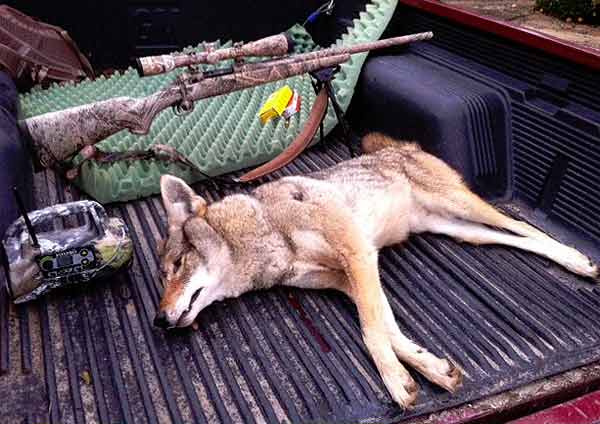
Coyote taken with Savage 22 250 with Nikon 4.5-14X40 BDC
For more information on Nikon's full line of Riflescopes, Binoculars, Spotting Scopes, Fieldscopes and Laser Rangefinders, please contact: Nikon Sport Optics, 1300 Walt Whitman Rd., Melville, NY 11747-3064, or call 1-800-645-6687. www.nikonhunting.com.

Our new friend Carol Vinzant, checking in about more information on the Coyote spotted in Queens(which in fact is part of Long Island, NY)....................Check out her animaltourism.com site(scroll to bottom of the posting below)

---------- Forwarded message ----------
From: Rick Meril <rick.meril@gmail.com>
Date: Tue, Jan 25, 2011 at 7:51 PM
Subject: Re: queens coyote
To: Carol Vinzant <carol@carolvinzant.com>


Carol..............thank you so much for getting in touch and tapping into my blog........I did communicate with Frank Vicente of http://www.wilddog.org/ this morning and suggested he email Dr Paul Curtis-Wildlife Specialist in the Dept of Natural Resources at Cornell University....................pdc1@cornell.edu
Paul is regularly a source for New York tv, radio and newspapers as it relates to coyote spottings and commentary....................
Stay in touch and if you would like to provide blog readers with your link, I will pass it along.

On Tue, Jan 25, 2011 at 10:38 AM, Carol Vinzant <carol@carolvinzant.com> wrote:
Hi Rick--
I'm a fan and regular follower of your Coyotes, Wolves, Cougars blog and often link to it. 
I edit a site that's about where people can go to see animals in the wild or in sanctuaries or wildlife rehab centers. I'm a small-time wildlife rehabber myself and sent your Queens coyote post along to Bobby Horvath. He's the big rehabber in NYC, the one the city calls when they get a coyote or hawk. 
It would be a huge deal to have that coyote in Queens--that's actually part of Long Island where there haven't been coywolves before. He sent it along to Frank Vincenti from wilddog.org, who wrote to me asking how to get in touch with the person who saw the coyote. Could you pass on the info--either to him or through me. I've cc'd him here.

Carol Vinzant


Dear Carol,
I don't mean to intrude but I am a friend of Bob and Cathy Horvath and my group is called the Wild Dog Foundation and currently educate the public on coexisting with coyotes having just completed my second lecture on the animals in Central Park this past weekend.
Bob made me aware of the photo of a coyote allegedly in Queens, I've been investigating sightings. I was wondering if you have any further information on the photographer or who I can pursue or maybe help me get talks in the community.
thank you,
sincerely,
Frank Vincenti
Wild Dog Foundation
http://www.wilddog.org/ 


212-979-5327
207 East 5th Street
New York, NY 10003


Monday, January 24, 2011

Think about what the headline of the article below saids about humans tolerance for Bears.............."Hunting may be best way to ensure their future"..................Can you imagine if some other alien species was in control of this planet and they published this type article about humans: "HUNTING HUMANS MAY BE BEST WAY TO ENSURE THEIR FUTURE".............We would call these aliens barbaric and evil creatures for suggesting that killing us was the optimum way that we would persist...................I get hunting on some level.............but to rationalize that this is the best way for wolves, bears, cougars, coyotes and wolverines to stick around is by having hunting seasons for them suggests that we have to benefit economically(hunting fees) for another species to occupy this planet in peace---Sad, but historically true!

Hunting Florida's black bears may be best way to ensure their future

Bear populations chart
Poll: Should Florida let black bears be hunted?
  • Some Florida hunters and wildlife experts say hunting will manage a growing black-bear population encroaching on urban areas. But eco-activists say bears' populations remain too small to warrant hunting. Should bears be hunted?


    The way to ensure that black bears remain healthy and appreciated in Central Florida may be to hunt them.

    Such a possibility could soon become part of a wrenching debate arising from experts' recent conclusion that Florida's largest land mammal no longer faces extinction and can join black bears in 30 other states as a game species.

    At the same time, long-standing worries about the bears' fate are being shaded by questions of how many are enough before Orlando-area suburbanites begin to think of them as vermin.

    As a vivid symbol of Florida's wild side, the black bear evokes wildly different feelings from people. Is that a living version of Winnie the Pooh or Smokey Bear pressing its cuddly mug against the kitchen window? Or a fearsome beast that can rip limbs from trees with claws powered by testosterone and Popeye-like forearms?

    Come June, the Florida Fish and Wildlife Conservation Commission is to decide whether to take the bear off the state's threatened-species list, which shields it from hunting and, to a lesser degree, land development.

    "I'm sure it's not going to be a popular one for FWC to make, but they are eventually going to," predicts Daryle Blankenship, an outdoorsman who lives near Titusville and expects to hunt the animals one day. "If you don't control their population, all you are going to end up with is a bunch of sick, skinny bears."


    Not so, says Doria Gordon, the Nature Conservancy's conservation-science director in Florida. Bears are still imperiled by too little habitat and a lack of genetic mixing because they are cut off from each other. And by their ongoing slaughter on Florida roads."I don't think Florida black bears can sustain hunting," Gordon said.

    Whatever the bear's future, its recovery in recent decades has stunned leading researchers and mystified residents of suburbs north of Orlando. Increasingly, homeowners' yards are home to the shy creatures, which are pushing out from the Wekiva and St. Johns river basins and nearby Ocala National Forest.

    Florida's bear population is thought to have totaled about 11,500 before Europeans settled in the state. But by the 1950s, unlimited hunting and deforestation had slashed the head count to as few as 500. Hunting was stopped in most parts of the state in 1971. Three years later, with the Florida population down to an estimated 300 bears, the species was declared threatened except in parts of North Florida. And even there, hunting was closed after 62 bears were killed during the 1993-94 season.

    Florida authorities finally banned the sport not because the animals were skittering toward extinction — their numbers had already begun to rebound — but because a poll had found that 61 percent of Floridians were opposed to shooting bears, compared with only 11 percent in favor.

    State officials, still mindful of that lopsided result, are updating Florida's bear-management plan in such a way that it can accommodate both the growing number of bears and complaints about them and the likelihood that most residents remain opposed to hunting.

    "We know we don't operate in a bubble," said David Telesco, Florida's bear-management coordinator.

    A draft of the plan does not call for hunting; instead, it recommends that Floridians consider it as a way to control the state's bear population.

    Florida is home to as many as 3,500 bears. Nearly a third belong to a single group that thrives in the rich habitat of the Ocala forest and along the Wekiva and St. Johns rivers. Biologists think the most intense hunting could occur there.

    Michael R. Pelton, emeritus professor of wildlife at the University of Tennessee, said Florida's situation is not unusual. Black-bear populations are stable or growing in all 41 of the states in which they are found, he said.

    "In the '70s, when we were doing our research, we never dreamed they would respond as positively," Pelton said.

    Having survived the worst of times in federally protected woods, the bears began to multiply after hunting was restricted or banned and additional forests were restored and preserved.

    Until the 1980s, researchers had fretted over the "carrying capacity" of those forests; that is, their ability to sustain bears. But since then, they have begun worrying about "cultural carrying capacity," or the ability of humans to tolerate bears.

    Central Florida's cultural carrying capacity has increasingly been tested in recent years as home construction has spread closer to the Wekiva and St. Johns rivers and as the number of bears has climbed. The area leads the state by far in calls about nuisance bears, with more than 2,000 last year alone.

    Not all of those callers would favor hunting, however.

    For example, a bear smashed into the garage of Amanda Cox soon after her family moved into a house near the Wekiva in 2007.

    "The lady on the phone said, 'Bang some pots and pans,' " Cox said. "I said, 'So my kids are supposed to take pots and pans in their backpacks on the way to the bus?' "

    But then Cox noticed that her neighbors were savvy about how to avoid bears, keeping household garbage and even children's snack wrappers out of their reach, and exchanging e-mail alerts to keep others informed.

    "It's such a cool experience for my kids to see wild bears," Cox says now. "It would be really sad if they hunted them. We've invaded their space; it's their woods back there."

    There would be far more bears roaming the Wekiva-Ocala corridor except that drivers have been hitting and killing 8 percent of them a year on average. Even so, the area's bear population continues to grow 1 percent to 2 percent annually, state biologist Walter McCown says.

    That steady growth is probably the reason that some bears, pressured by the group's dominant males to find new turf, are attempting to adapt to Orlando's suburbs.

    "They eat such a variety of food," McCown noted, "and they are very tolerant of humans — more than humans are tolerant of them."

    As such, Florida bears are catching up with those in New Jersey, where state officials oversaw a controversial six-day hunt last month.

    "There was no other viable option to reduce the population," said Larry Ragonese, spokesman for the New Jersey Department of Environmental Protection. "Last year, I think there were 43 cases of bears actually breaking into people's houses."

    The Sierra Club criticized the New Jersey hunt as a simple appeasement of hunting advocates who supported the 2009 election of Gov. Chris Christie and as a way to make rural development easier.

    "It's hard to sell a condo to somebody from Brooklyn if they see a black bear," said Jeff Tittel, that state's Sierra director. He said his state chapter would likely back hunting if it was designed to handle problem bears and occurred in concert with aggressive public education.

    Perhaps the most controversial aspect of hunting is whether it would reduce the number of bear complaints.

    Laurie Macdonald, Florida director for Defenders of Wildlife, said bears become a nuisance when people are careless with their household garbage, pet food and other tasty temptations.

    In 1993, her group started the Habitat for Bears Campaign, which sent volunteers knocking on Florida doors with information about how to coexist with the animals. Such efforts, she said, would reduce bear complaints more effectively than would hunters.

    John Wooding, one of the most experienced bear biologists in Florida, worries that the wily animals are so driven by their stomachs that public education won't be enough.

    "They're going to quit being so visible if somebody out there is shooting at them," said Wooding, who works in North Carolina. "I think it's in the bears' interest to be a little more low-key. If they were to hurt somebody badly and fall out of favor with the public, it would be much harder to generate interest in their conservation."


    By Kevin Spear

    Female birds stay more fertile later in life if their male partners started breeding early in life...............might suggest that the males were disease free,,,,,,,,,,might suggest that these males bring more experience to nestling survival

    Biological Clock Ticks Slower for Female Birds Who Choose Good Mates

    — In birds as in people, female fertility declines with age. But some female birds can slow the ticking of their biological clocks by choosing the right mates, says a new study.
      Female birds become progressively less fertile as age takes its toll, said co-author Josh Auld of the National Evolutionary Synthesis Center in Durham, North Carolina. Older females lay fewer eggs, and they lay them later in the season -- at a time when less food is available for their chicks, he explained.
      But despite abundant evidence of fading fertility in females, scientists know little about the role played by their mates. "The thought was that males didn't matter," Auld said.
      To find out if males factor into female fertility, the authors took advantage of a long-term data set of birds known as blue tits. Since the late 1970s, scientists have studied thousands of these blue and yellow forest birds on the French island of Corsica. Blue tits breed once a year, and often with a different mate each season. By attaching ID bands to the birds' ankles and monitoring their nests, scientists are able to keep track of who mates with whom, how many eggs they lay and when, and how the fledglings fair over time.
      When the authors analyzed lifetime data for nearly 600 females and 600 males from 1979 to 2007, they found a surprise: how fast a female's fertility fades with age depends partly on her partners. The important thing for females is not the age or identity of her mates, they discovered, but her partners' paternal past. "The 'history' of the male matters," said co-author Anne Charmantier of France's National Center for Scientific Research, also known by its French initials CNRS. Female fertility declined less quickly for females whose mates became first-time fathers young. "Females that repeatedly pair with early-reproducing males are better off. They don't age as fast," Auld said.
      Males who got a head start on fatherhood -- within their first year of life -- may be healthier or more experienced mates than dads that delayed. "Males that start breeding early may be in better condition, or have lower parasite load," Charmantier said. Healthier or more experienced males may also be better partners in parenting, such that time takes less of a toll on mom. "The male helps the female build the nest, and he brings her food while she's laying and incubating the eggs. He also helps care for the hatchlings," Auld said.

      U. of Georgia Research stating that animal migrations help reduce the spread of disease and may even dilute the impacts of certain diseases-----the migration reduces the pathogens in a particular area so when the animals return to that region, germs have been reduced significantly .....................all types of important implications for both human and animal diseases as temps warm and migration routes blocked by our industrialization

      Long-Distance Migration May Help Reduce Infectious Disease Risks for Many Animal Species

      — It's a common assumption that animal migration, like human travel across the globe, can transport pathogens long distances, in some cases increasing disease risks to humans. West Nile Virus, for example, spread rapidly along the East coast of the U.S., most likely due to the movements of migratory birds.
      But in a paper just published in the journal Science, researchers in the University of Georgia Odum School of Ecology report that in some cases, animal migrations could actually help reduce the spread and prevalence of disease and may even promote the evolution of less-virulent disease strains.
      Every year, billions of animals migrate, some taking months to travel thousands of miles across the globe. Along the way, they can encounter a broad range of pathogens while using different habitats and resources. Stopover points, where animals rest and refuel, are often shared by multiple species in large aggregations, allowing diseases to spread among them.

      But, according to Odum School associate professor Sonia Altizer and her co-authors, Odum School postdoctoral associates Rebecca Bartel and Barbara Han, migration can also help limit the spread of some pathogens. Some kinds of parasites have transmission stages that can build up in the environment where host animals live, and migration allows the hosts to periodically escape these parasite-laden habitats. While hosts are gone, parasite numbers become greatly reduced so that the migrating animals find a largely disease-free habitat when they return. Long migratory journeys can also weed infected animals from the population: imagine running a marathon with the flu. This not only prevents those individuals from spreading disease to others, it also helps to eliminate some of the most virulent strains of pathogens.

      "By placing disease in an ecological context," said Odum School dean John Gittleman, "you not only see counterintuitive patterns but also understand advantages to disease transmission. This is a classic example of disease ecology at its best."

      Altizer's long-term research on monarch butterflies and a protozoan parasite that infects them provides an excellent demonstration of migration's effects on the spread of infectious disease. Monarchs in eastern North America migrate long distances, from as far north as Canada, to central Mexico, where they spend the winter. Monarchs in other parts of the world migrate shorter distances. In locations with mild year-round climates, such as southern Florida and Hawaii, monarchs do not migrate at all. Work by Altizer and others in her lab showed that parasite prevalence is lowest in the eastern North American population, which migrates the farthest distance, and highest in non-migratory populations. This could be because infected monarchs do not migrate successfully, as suggested by tethered-flight experiments with captive butterflies, or because parasites build up in habitats where monarchs breed year-round. Other work showed that parasites isolated from monarchs that flew the longest were less virulent than those found in monarchs that flew shorter distances or didn't migrate at all, suggesting that monarchs with highly virulent parasites didn't survive the longest migrations.

      "Taken together, these findings tell us that migration is important for keeping monarch populations healthy -- a result that could apply to many other migratory animal species," said Altizer.

      But for monarchs, and many other species, migration is now considered an endangered phenomenon. Deforestation, urbanization and the spread of agriculture have eliminated many stopover sites, and artificial barriers such as dams and fences have blocked migration routes for other species. These changes can artificially elevate animal densities and facilitate contact between wildlife, livestock and humans, increasing the risk that pathogens will spread across species. As co-author Han noted, "A lot of migratory species are unfairly blamed for spreading infections to humans, but there are just as many examples suggesting the opposite -- that humans are responsible for creating conditions that increase disease in migratory species."
      And as the climate warms, species like the monarch may no longer need to undertake the arduous migratory journey to their wintering grounds. With food resources available year-round, some species may shorten or give up their migrations altogether -- prolonging their exposure to parasites in the environment, raising the rates of infection and favoring the evolution of more virulent disease strains. "Migration is a strategy that has evolved over millions of years in response to selection pressures driven by resources, predators and lethal parasitic infections -- any changes to this strategy could translate to changes in disease dynamics," said Han.

      "There is an urgent need for more study of pathogen dynamics in migratory species and how human activities affect those dynamics," Altizer said. The paper concludes with an outline of challenges and questions for future research. "We need to learn more in order to make decisions about the conservation and management of wildlife and to predict and mitigate the effects of future outbreaks of infectious diseases."

      Sunday, January 23, 2011

      Exotic Shrimp "blows up" the natural cycle of life in Flathead Lake in Montana.............Introduced to be prey to the exotic lake trout(two fatal exotic introductions into this lake)....................now the native Bull trout suffers at the Lake Trout hands.............now the shrimp have overwhelmed the largest zooplankton, leaving smaller zooplankton the job of eating algae(and they are not doing nearly as good a job as their larger cousins) ...........end result is that water quality deteriorating as algae bloom blossums!...................introducing non native plants and animals wrought with peril for our ecosystems!!!!


      How Non-Native Shrimp Transformed The Ecosystem at Montana's Flathead Lake

      A recent study highlights how the introduction of the opossum shrimp in the 1960s and 1970s created a ripple effect in Flathead Lake that continues today. It's a thorough survey of how a single wildlife management decision can change an entire ecosystem.

      By Brendon Bosworth, 
      Flathead Lake. Photo by Flickr user <a target=
      Flathead Lake. Photo by Flickr user endbradley.
      The opossum shrimp, mysis diluviana, is a seemingly innocuous creature. So named because females have a pouch on their underside in which they store their developing eggs and offspring, these shrimp are less than in inch in size. But, as detailed in a recent paper published in the Proceedings of the National Academy of Sciences, the nonnative crustaceans have had a major impact on Montana's Flathead Lake, altering the entire food web and increasing the amount of algae in the lake.
      The growth of algae increased by 21 percent in 1986, the same year the shrimp population hit its peak, according to the researchers. It has not declined since. This represents a "whopping change" for a lake like Flathead, which is characterized by low nutrient levels and low plant growth, says study co-author Jack Stanford, director of the Flathead Lake Biological Station. "And it wasn't caused by pollution; it was caused by the change in the food web." This sea change began with fisheries managers, who introduced mysis into five lakes upstream from Flathead between 1968 and 1976. They assumed the shrimp would provide food for kokanee salmon, which had been planted in the lake system, along with other nonnative species, in the 1920s, according to the study. Instead, it turned out the mysis were hungry for the kokanee's food: large types of zooplankton called cladocerans, also known as water fleas.
      The mysis population boomed in 1985, hitting its apex in 1986. It then backed off considerably and now fluctuates around roughly one third of its peak level, according to the study. During the boom, the shrimp devoured the kokanee's food source and triggered a major change in the delicate ecosystem: an explosion in lake trout numbers.
      Popular sports fish and fierce fish-eating predators, lake trout were introduced 80 years before the mysis set their spiny legs into Flathead, according to the study. However, since young lake trout feed at the bottom of the lake, where there had previously been little food, their numbers had remained low. Mysis dwell on the bottom of the lake during the day, only migrating upward at night to feed, so they are an easy source of food for young lake trout. "The baby mysids hatch out at the same time the baby lake trout are looking for forage – and there they are," says Stanford. He says the increasing number of intermediate size lake trout preyed on the remaining kokanee juveniles and "just hammered them." After the mysis explosion kokanee disappeared, bull trout declined, and lake trout came to be the dominant top predator, according to the study. This led to an increase in algal production because the shrimp ate up larger zooplankton, decreasing their levels and allowing smaller types of zooplankton to proliferate, Stanford explains. He says this changed the way the zooplankton "mow the lawn," or consume algae: smaller zooplankton are less efficient consumers and allow algae room to grow.
      Native Trout Under Threat
      The current population of lake trout is roughly 400,000, says Barry Hansen, a fisheries biologist with the Confederated Salish and Kootenai Tribes and study co-author.
      Together with Montana Fish, Wildlife and Parks the CSKT is responsible for managing the fisheries of the Flathead Lake and River System and protecting threatened native fish species, including bull trout and westslope cutthroat trout.
      "All the evidence, which is very strong, shows that lake trout are the limiting factor for bull trout," says Hansen. He says the bull trout numbers have remained the same since 2000, even though regulations for the predatory lake trout have been liberalized and the CSKT has subsidized fishing contests (Mack Days) to help curb the lake trout population. Last year these contests harvested 49,000 lake trout, but this hasn't put a large enough dent in the population, says Hansen. The CSKT is currently working on an environmental assessment, which will provide a template for future management work, says Tom McDonald, division manager for CSKT's Fish, Wildlife, Recreation and Conservation Division.
      Hansen says the CSKT is looking at a range of lake trout reduction targets, between 25 percent and 75 percent. The Mack Days contests will continue, while additional methods for curbing the population could include putting a bounty on lake trout, allowing commercial fishing, or making use of trap nets or gillnets – with the catch likely donated to food banks, he says.
      Flathead Saved by its Pristine Source, For Now
      Despite high levels of algae, Flathead is still far cleaner than other lakes close to heavily urbanized and agricultural areas, because most of the water that feeds into the lake comes out of the pristine Glacier National Park and its surroundings, explains Stanford. If there were more nutrients, such as phosphorous and nitrogen, in the lake, this would also stimulate algal growth, he says. While phosphorous levels are declining, because of an upgrade to the local sewage treatment plant, nutrient loads will need to be kept low in future, especially as the valley fills up with people, he says. At the same time, the amount of nitrogen in the atmosphere, much of which ends up in lakes and rivers, is increasing around the globe, as a result of "cars, fires, and wood burning of all sorts." "We're seeing dramatic increases in nitrogen loading," he says. "So when the phosphorous loading trend reverses and catches up that'll be the big problem, assuming we don't get zebra mussel [an invasive species that has taken over the Great Lakes] or a really bad invader."

      While the future might hold unexpected outcomes, for now fisheries managers have their hands full dealing with the legacy of shrimp and a misinformed decision from the past. 


      My friend John in New York City alerted me to the fact that Queens, New York has a prospecting Coyote looking for a mate...................The only locale in the entire USA devoid of coyotes is Long, Island, NY............a few short miles from Queens....................Only a matter of time until our coyotes head out on the Northern State or Southern State Parkways and colonize Long Island

      Meet Lonely E. Coyote.
      A reddish-colored coyote has moved into Queens, and like most city singletons, it's looking for a mate. The majestic creature was recently photographed among the gravestones of Calvary Cemetery in Woodside.
      It's probably a yearling born last spring who got kicked out of his parents' home in December to make room for a new crop of cubs, said wildlife expert Paul Curtis, of Cornell University. Now it's on the hunt for a partner to start a family of its own. The mostly carnivorous creatures are no threat to humans unless they're have rabies, but keep an eye on your pet dogs, Curtis warned.

      Marcelo Barrera
      Photographer Marcelo Barrera was shocked when the animal zipped past his car. "He looked healthy enough to me, but frightened," he said.

      Our good friend and frequent contributor, Frank Carbone sent me these pictures from Southeastern New York State where he moved a deer from the roadway where it was killed back into the woods................Keeping the carcass off the road likely saved vultures, hawks, eagles, coyotes, foxes and other predators from the same type collision death.......................the "kill" being scavenged by coyotes and vultures..........................I encourage you to check out Frank's website at http://www.outdoorliaisons.com ............all types of interesting outdoor information as well as consumer protection data for you to download.


      From: Frank Carbone Jr. <forthebirds39@verizon.net>
      To: Meril, Rick
      Sent: Sun Jan 23 07:04:34 2011
      Subject: road-kill recycle
      Rick,
      here's the pics as promised.
      they would've been there last nite but windows live mail had a problem with the number of photos.

      the following creatures utilize a road-killed deer carcass here - black and turkey vultures, red-tail hawks, coywolves, red and gray fox etc.
      carcasses left on and along the road shoulder are a death trap for some of those who feed on them and can't get out of the way.
      and the way the country is headed - homo sapiens will be competing for a spot on top of the list again. 
      peace to all,
      , , Frank
      ps – the experts say more than 70,000 deer are hit by cars in NYS every year.
      this is only my second experiment with road kill here.
      View album
      This album has 8 photos and will be available on SkyDrive until 4/23/2011.
      View albumView albumView albumView albumView album
      View albumView album


      Please visit my website at http://www.outdoorliaisons.com/

      Saturday, January 22, 2011

      1805-1807 Expedition led by Explorer Zeb Pike through Louisiana and on up the Misssissippi and beyond-----Vast herds of Bison and their "companions", Wolves!

      Pike, Zebulon Montgomery, 1779-1813
      Title:An Account of Expeditions to the Sources of the Mississippi, and Through the Western Parts of Louisiana, to the Sources of the Arkansaw, Kans, La Platte, and Pierre Jaun, Rivers
      Source:Pike, Zebulon. An Account of Expeditions to the Sources of the Mississippi, and Through the Western Parts of Louisiana, to the Sources of the Arkansaw, Kans, La Platte, and Pierre Jaun, Rivers; Performed by Order of the Government of the United States duing the Years 1805, 1806, and 1807, and a Tour through the Interior Parts of New Spain, when Conducted through These Provinces, by Order of the Captain General, in the Year 1807. By Major Z.M. Pike.
      16th October, Thursday.Early o horseback; proceeded up the creek some distance in search of or party, but, at, twelve o'clock crosses to our two buffaloes; found a great many wolves at them, notwithstanding the precaution taken to keep them off. Cooked some marrow bones and again mounted our horsed, and proceeded down the creek to their junction. Finding nothing of the party, I began to be seriously alarmed of their safety. Killed two more buffalo, made our encampment and feasted sumptuously on the marrow-bones.
      The herd of buffalo being divided into separate bands covered the prairie with dust, and first charged on, the one side then to the other, , as the pursuit of the horsemen impelled them: the report and smoke from: the guns, added to the pleasure of the scene, which in part compensated for our detention.

      6th November, Thursday.-Marched early, but was detained two or three hours, by the cows, which we killed. The cow buffalo, was equal to any meat I ever saw, and we feasted sumptuously on the' choice morsels. I will not attempt to describe the droves of animals we now on our route; suffice it to say, that the face of the prairie was covered with them, on each side of the river; their numbers exceeded imagination. Distance 16 mile

      The more road kills there are, the more Bald Eagles and other predators are themselves targets and victims of our 60-80mph highway travel

      Report: More bald eagles die on Michigan roads

      Associated Press

      Lansing— State and federal officials are cautioning motorists to be more aware of the presence of bald eagles on Michigan roads.  The number of eagles killed by cars is on the rise over the past six years in the state, according to a joint news release from the Michigan wildlife officials and the U.S. Fish and Wildlife Service.
      In addition to catching and eating fish, eagles commonly feed on dead animals, meaning they're often around road corridors where they scavenge on large road-kill such as deer, coyote, fox or raccoon.
      "The bald eagle tells one of our nation's most revered conservation success stories, and although this species has recovered to sustainable levels, we must keep in mind that as numbers rise, so does the risk for mortality due to human interactions," said Jack Dingledine, an official with the Fish and Wildlife Service's East Lansing field office.
      The wildlife officials said eagles' scavenging behavior tends to increase during the winter months when ice develops on lakes and rivers, making foraging for fish more difficult. They said eagles sometimes feel threatened by the approach of vehicles and attempt to escape, leading them to cross the roadway into the path of oncoming traffic.
      "There is no one solution that will completely eliminate vehicle-caused mortality in Michigan," Dingledine said in the statement. "But efforts from all sides, including help from the driving public, can reduce vehicle-caused eagle mortality."

      Dallas area residents are waking up to the bocats in their midst...........similar concerned reactions as Westchester, County NY residents are having to coyotes..............."we want woods and fields, but no wildlife"............every report connotes that the "Bobs" and "Songdogs" are in the wrong.................put away your bird feeders................put your garbage out in the morning rather than at night................make your yard unwelcome.................but no trapping and killing!

      Bobcat sightings on the rise in Collin County

      ALLEN - Photos of bobcats taken over a back porch at an Allen home highlight fears as sightings in Collin County appear to be increasing.
      Amy Locurto and her family have seen bobcats behind their house for the 10 years they have lived in Allen. But, on Wednesday, the bobcats came closer than ever before. Locurto saw an entire family of bobcats right at her back door.

      "He literally jumped from the ground to the top of that fence and caught a bird," she said of the sighting.

      Locurto's backyard is filled with wildlife, but she said she's never seen bobcats so close to her house, and definitely not in a pack of four. That day, she grabbed her camera and started snapping.

      "When you see that many together as a pack that's when I get concerned," she said. "And it's mating season, so there's going to be more soon. I'm afraid they're going to come back to my house and have their babies."

      The Allen mother has two children and so does her neighbor, Naomi Calle. Both of them are concerned for their children and pets.

      "We're worried about our children being able to play in the back yard," Calle said. "They can't really do that any more safely without us being out there and making sure there's no wildlife."

      Locurto called animal control after discovering the bobcats. But, when an officer arrived, the big cats were gone.

      "I want my children to walk in the backyard and not have to worry about four bobcats," she said.

      Allen police, who oversee animal control, said their city has a healthy bobcat population. But, there's little animal control can do because their priority is dealing with domesticated animals. The city loans out traps, but their officers don't do the trapping.

      Bobcat attacks on humans are very rare.
      There are 12 different subspecies of bobcats. The ones found in Texas are called Mearns. Fully grown, they stand close to three feet tall and weigh 20 to 30 pounds on average. They generally are more active in the middle of the night and right before dawn. They prey on small animals like rabbits, squirrels, fish and insects.

      Friday, January 21, 2011

      Our friends Joe Butera and Mollie Matteson sent me this disturbing OUTDOORS MAGAZINE article entitled: BEAT THE COLD;KILL A COYOTE.............The hunting and fishing magazines seem to feel that they have to preach "annihilation to their shrinking readership so as to keep them feeling macho and masculine..................Is that the message that is going to attract younger people to hunt?.................NO F---K--G WAY!(pardon my French on this ...........ticks me off..............I am in airports weekly around the USA and every single hunting mag preaches KILL COYOTES, BEARS, COUGARS, WOLVES.................The justification for this................"they are bloodthirsty predators"....................Well, Jeez, Louise,,,,,,,,,,,,,what does that make us then with our high powered weapons and killing equipment...............choir boys????????????????


      From: Mollie Matteson
      Conservation Advocate
      Center for Biological Diversity
      Northeast Field Office
      PO Box 188
      Richmond, VT 05477
      802-434-2388 (office)
      802-318-1487 (cell)
      mmatteson@biologicaldiversity.org
      http://www.biologicaldiversity.org/
      Beat the Cold: Kill a Coyote(as printed in Outdoors Magazne)
      With temperatures predicted to drop well below zero over the next three days across the East, many people are preparing for a weekend of watching football and sitting by a fireplace.  Devout predator hunters are taking a different view though, and to them the impending temperatures are a reason for celebration.
      The colder the better, said Bill Savage, a coyote hunting specialist from the Tug Hill Region of New York. My best days coyote hunting are when the temperature never gets above zero.  If it gets as cold as they say it will well,  lets just say I am like a kid in a candy store.
      Bob Howe, the owner of Pine Grove Lodge in Bingham, Maine, has a simple explanation for this phenomenon. In essence, in the colder weather a coyote needs to expend more energy to stay warm. This means they need to feed more, and the hunters who have their baits set will reap the rewards.  Everybody thinks coyotes will only hit the bait in the evening or at night, but that time around noon can also be very productive, said Howe. Two of his hunters experienced this first hand earlier today when they both killed coyotes hitting baits a few minutes past 11:00 a.m.
      Coyote hunting in the extreme cold does take some special preparation.  Gun actions can freeze and calls can act and sound differently than in warmer conditions. Plus, there are the inherent dangers that come with below-zero temperatures. For those willing to pay the price though the rewards cant be beat.
      For more information and predator hunting tricks, check out the March issue of Outdoors Magazine with a special insert When Hunters Become The Hunted�detailing the methods some of the East's best use to put fur in the shed.

      British Columbians as a whole do not support trophy hunting...............And there are some areas of Canada where a majoritiy of hunters feel that predator hunting should not be allowed............Vancouver Island, which had the densest Cougar population inB.C. is now plummeting due to uncontrolled hunting

      B.C. cougar population at risk from trophy hunters, loss of habitat: study

      Province yields to hunting lobby in its management of the cats, author says

      By Judith Lavoie
      Trophy hunting and habitat loss are putting B.C.'s cougar population at risk and provincial policies do not adequately protect the big cats, says a new report by three scientists from the Raincoast Conservation Foundation.  The study was released Wednesday in anticipation of the province shortly publishing its first cougar management plan, which is under internal review.  For now, the province has no central planning document for cougars and relies on hunting regulations to safeguard populations, the study says.
      Because cougars are elusive and mysterious they are difficult to count, so the province has no firm numbers on which to base a hunt, said Chris Darimont, Raincoast science director and one of the report's authors.  "That means even the best management plan in the world for cougar hunting is fundamentally flawed," Darimont said.
      "Also, most British Columbians are opposed to hunting animals except for sustenance. ... In other jurisdictions it has been found that even most hunters don't support hunting carnivores for sport," he said.
      Natural Resource Operations Ministry spokesman David Currie said the cougar management plan has not yet gone through an internal ministry review and it is not known when it will be released.  So far, there has been no public participation in the plan, Currie said.  "The cougar management plan addresses hunting and harvest management and looks at habitat requirements for cougars. It does not address the ethics of trophy hunting," he said.
      Provincial figures show an average of 257 cougars are killed each year by hunters and an average of 50 a year are killed because of conflict with humans.  Trends indicate cougar populations are declining and Vancouver Island, where there was previously one of the more dense cougar populations in the province, is now assumed to have dipped from an estimate of 1,200 in 1979 to between 300 and 400 in 2001, according to unpublished provincial figures.
      Cougar trophy hunts continue to be held on Vancouver Island. Hunts are usually held with hounds that tree the cougar. Radio collars then send a message to the waiting hunter, who shoots the cougar out of the tree.--certainly not fair chase..........dogs should not be allowed in the hunt--blogger Rick 
      "Conservation and management of B.C. cougars ought to consider commonly held ethical values of British Columbians regarding biodiversity conservation and the welfare of individual cougars," said Corinna Wainwright, one of the authors of the report.  Report author Paul Paquet, Raincoast senior scientist and a mammalian carnivore expert, said research and education should form the basis of conservation plans. Instead, the province manages populations to meet pressure from lobby groups such as the trophy hunting industry and public safety concerns, he said.  "I don't think any species should be hunted if we don't know the numbers," he said.  "At present, provincial laws, regulations and practices for conserving and managing cougars fail to address the ... growing threats to survival that cougars now face," he said.