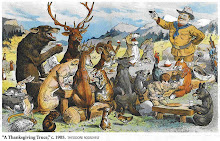
Moose will soon be killed in two national parks in Newfoundland, with officials saying the population of the animals is destroying forests and habitat for other species.Later this year, hunting for moose will be allowed for the first time in Gros Morne National Park in western Newfoundland, and Terra Nova National Park in eastern Newfoundland.
Parks Canada said it was forced to take action because of destruction that moose have caused to habitat for other species."More and more you can see areas — not just small forest stands or individual, small clumps of trees but huge landscapes - that are starting to be essentially denuded of mature forest," said Peter Deering, a conservation manager at Gros Morne National Park. "Bird communities will change. Small mammal communities will change. Even species of other shrubs and forest plants that grow on the forest floor will change," he said.
No numbers have been determined for the hunt, which will be held in conjunction with the annual hunt across the island this fall.Parks Canada tracked the health of its forests for years before making the decision.
"Their numbers have increased spectacularly since [introduction in the early 20th century] because they lack a primary predator, there are no common moose diseases here, and the boreal forest provides an ideal habitat," Parks Canada said in a statement.
Officials said that areas once dominated by trees are converting to grassland, and the diversity in the woods is "dramatically decreasing."Parks Canada said similar measures have successfully been taken involving deer in protected areas in Ontario and B.C.
The move is not a surprise. In its own literature distributed to park patrons in recent years, Parks Canada has warned of moose overpopulation and its effects on habitat. Last year, the Crown agency said a cull was in the works.
As many as 150,000 moose have been estimated to roam the woods and bogs of Newfoundland, with about 5,000 moose believed to be in Gros Morne alone.
The provincial government has come under fire for moose management policies, particularly involving moose-vehicle collisions. A class action lawsuit has been launched on behalf of victims of such crashes
Thursday, October 27, 2011
Newrfoundland(Canada) Moose are overunning the Forests of the region--no Wolves and Cougars to keep them in check............introduced to this region in the early 20th century, Parks Canada said it was forced to take action because of destruction that moose have caused to habitat for other species........."More and more you can see areas — not just small forest stands or individual, small clumps of trees but huge landscapes - that are starting to be essentially denuded of mature forest," said Peter Deering, a conservation manager at Gros Morne National Park............ "Bird communities will change............ Small mammal communities will change............. Even species of other shrubs and forest plants that grow on the forest floor will change," he said.


Wednesday, October 26, 2011
Quebec, Canada residents are very concerned about the health of the remaining Woodland Caribou in their Province.
New Poll Indicates Quebecer's are Concerned about Endangered Woodland Caribou
NEMASKA, Eeyou Istchee - A recent poll by Leger Marketing on Quebecers perceptions and attitudes and opinions about woodland caribou sheds light on the importance of this endangered species to the po
Among a survey sample of Crees and non-Cree residents of Northern Quebec and Quebecers based in the south, the key findings of the poll reveal:
- The vast majority of survey respondents (88-92%) consider it important for Canada to protect endangered species
While general knowledge of woodland caribou is low, particularly among residents in the south, the vast majority of respondents (87-92%) believe that the government of Quebec should share information on the status of woodland caribou before making decisions about resource development in their territory
In general, 63% of survey respondents believe that the government of Quebec places to much emphasis on economic development and jobs not enough concern for the environment
When placed in the context of protecting endangered woodland caribou, 86% of Quebecers are in favour of placing moratoriums on current plans in critical habitat in order to allow for alternative plans to be developed, with 65% favouring a reduction in forestry activities at the expense of economic activity if necessary
Overall, those surveyed appear to believe that the government of Quebec too readily caters to the needs to large corporations with respect to resource development projects. In contrast, just over half the respondents believe that, as a society, we tend to heed the concerns raised by environmental groups with respect to development. With the contrast of these two questions, it is not surprising to find that 85% of participants believe that it is possible for compromise solutions to be found between economic activity and concerns over the environment.
Context of the Poll
The Crees have been actively working to protect endangered woodland caribou in their traditional territory (Eeyou Istchee). In 2009, the Ministry of Natural Resources and Wildlife (MNRW) approved a series of forestry roads designed to access the last remaining large undisturbed forests in Eeyou Istchee. These forests also make up the last remaining habitat of the woodland caribou south of the commercial forest limit. In response, the Grand Council of the Crees (Eeyou Istchee) called for a moratorium on development activities in these areas until the government of Quebec met its obligations under Quebec and federal endangered species laws and implemented a caribou protection/recovery management plan.
These forestry roads were also submitted for environmental assessment under the Environmental Quality Act and section 22 of the James Bay and Northern Quebec Agreement. Through the course of these environmental assessments, the Provincial Review Committee observed that the MNRW did not provide information on status of the woodland caribou herds that would be affected by these roads; moreover the MNRW has yet to put in place a caribou protection/recovery plan that could mitigate the impacts of these proposed forestry activities. As a result, the Provincial Review Committee has suspended its decision on these projects until the government of Quebec has a plan in place that addresses the woodland caribou issue.
To date, the MNRW has not been willing to publically release any information regarding the status of woodland caribou or their habitat in Eeyou Istchee. In an attempt to alert Quebecers to the perilous situation of the woodland caribou in Eeyou Istchee, the Cree Regional Authority commissioned a study by Global Forest Watch Canada to assess the rate of human intervention into the woodland caribou range in James Bay. The study concluded, "There are escalating anthropogenic-caused disturbances within the habitat of the woodland caribou of the James Bay region of northern Québec, but there are large areas of protection and restoration opportunities remaining.�� Unfortunately these remaining areas of protection and restoration opportunity are in the path of the proposed forestry roads that are currently under environmental assessment.
The Crees believe that decisions on the future of caribou in Eeyou Istchee should be made in an open and transparent fashion with full disclosure of all available information. This poll indicates that Quebecers hold similar beliefs and are concerned about endangered species and woodland carou and about the how the government has been managing development in the north.
Is the Pine Bark Beetle infestation in the Intermountain West adversely impacting how Elk utilize the Medicine Bow National Forest in Wyoming???..............Has the dying Pine trees impacted how hunters utilize the forest?...........Major impacts to consider include: (1) the ability of elk to move through the landscape due to fallen logs, increased vegetation regeneration or beetle kill management activities, (2) the ability of hunters to access elk hunting areas, (3) a loss of hiding cover, (4) increased harvest availability to hunters due to new logging roads constructed for harvesting of trees, (5) increased cripple loss due to longer shots and tougher tracking conditions, (6) decreased harvest availability by hunters due to closed roads and fallen trees, and/or (7) increased degradation of forest ecosystem health and wildlife habitat due to higher numbers of elk and a loss of hunter participation in beetle kill areas.
The most successful Grizzly rewilding Researcher in the World, Yellowstones' Chris Servheen, is in the process of a "recounting" the Yellowstone Griz population...........Servheen is a true conservationist but many feel he might end up wrongly upping the Griz population from the now stated 600 bears to a revised 843...............This would increase the number of bears that could be hunted in the planned 2012 Yellowstone Grizzly hunt.............Of course, all of the Wyoming Game & Fish folks think that the bear population is currently greatly undercounted and is cheering on the population modeling study that Servheen and his staff are in the process of completing................Can the Griz withstand the hunting pressure coming if the count is revised upward?.................Does the demise of the cutthroat trout and whitebark pine, two critical foodstuffs of the bears put a far too high pressure on their long term survival.?..........First law of management is to "do no harm" without careful evaluation of all consequences.................Is "do no harm" in effect for Yellowstone Grizzlies?
Tuesday, October 25, 2011
Black Bears adapting to acorn shortages in the Western North Carolina woodlands are wandering into human settlements in the region......The state does not capture and remove bears anymore,,,,,,,, there's simply nowhere to put them.......... Additionally, it is impossible to catch hundreds of bears......... The bottom-line on the issue, at least according to the state biologist and the region's other bear experts?........ We've got to learn how to live with black bears,,,,,,not feed them,,,,,not to put out bird food and dog food ,,,,, to slow down and watch out for bears on the highway, and do those other easy, sensible things that will allow bears and humans to peacefully coexist
Bear encounters: Bears on the prowl for food lead to increased sightings
by Quintin EllisonA bad year for acorns in the higher elevations, coupled with a poor berry crop region wide, has resulted in an influx of black bears into areas where the majority of mountain residents live: the cities, towns and mountainside developments of Western North Carolina.
Hungry bears are looking for acorns, moving into lower elevations in their hunt for food before hibernating for the winter. This has bear and human encounters in WNC tracking on a record pace this year."This year is an anomaly because of the acorn crop. There almost none (high) in the mountains," said biologist Mike Carraway of the N.C. Wildlife Resources Commission. "The bears are looking for food."
As hungry bears descend from the highlands, motorists are hitting and killing bears on the highway more than ever, particularly in such traditional bear habitat as the Pigeon River Gorge where Interstate 40 cuts through national forest lands.The Wildlife Resources Commission reports cars have hit and killed more than a dozen black bears in WNC in the last couple of weeks alone. In all 12 months of last year, 10 bears were killed after being struck by motorists.
Additionally, phone calls about "nuisance" bears to North Carolina's wildlife offices are numbering in the hundreds, well above what's usually received, Carraway said. The state has received 300 calls so far this year, with the previous high for an entire year standing at about 400, he said.
The state does not capture and remove bears anymore: there's simply nowhere to put them. Additionally, "we can't catch hundreds of bears," Carraway said. The bottom-line on the issue, at least according to the state biologist and the region's other bear experts? We've got to learn how to live with black bears. And to not feed them, to put up bird food and dog food as needed, to slow down and watch out for bears on the highway, and do those other easy, sensible things that will allow bears and humans to peacefully coexist.
Why so many?
The sheer numbers of bears now in the mountains are compounding the problem. Conservation efforts to help black bears in WNC thrive have proven successful, which is terrific, except that right now all of them are converging into the lower elevations in a desperate hunt for food.
"There's a lot of mobility in and out of the park," said Bob Miller of the Great Smoky Mountains National Park. "It's the fall shuffle. But, normally this time of year, there would have been a good acorn crop (in the Smokies) they could have camped out on. They are headed to apple orchards, and so on."
There have been the same issues, an increase in human and bear encounters, in east Tennessee, Miller said. Camper and bear encounters are down in the Smokies, because the bears have moved on — two backcountry campsites were closed because of bear activity, but park officials probably will reopen those soon, Miller said.
Plus, mother bears responded to a great acorn crop last year by having more cubs than normal this spring. Which is likely why so many local newspapers in recent days are running reader-donated photographs of a mother bears and their young — the mothers are trying to find food to save the cubs from starvation.
Another wisconsin Cougar in Wisconsin..........
Trail Camera Captures Cougar Outside Mauston
DNR: Photo Is First Confirmed Sighting Of Cougar In Juneau County
MAUSTON, Wis. -- The state Department of Natural Resources said a photo of a cougar taken in Juneau County is legitimate.The agency said two DNR wildlife biologists verified the photo, taken by a trail camera Sunday night.
The DNR said the photo shows a young adult cougar moving against a nighttime background of native grasses.
The camera was located more than two miles north of Mauston. DNR officials learned of the photo on Friday. The landowner hadn't checked the camera for several days, but a time stamp established when the photo was taken.
DNR wildlife biologist Adrian Wydeven said it's likely a male cougar in search of new territory.
It's the seventh time a trail camera has captured a cougar in Wisconsin, although three of the instances probably involved the same cougar.
Missouri has deer like Manhattan has rats--out of control and coyotes are not a sinking agent!
According to the Insurance Information Institute, there are nearly 100,000 deer in Missouri. The animals aren't just in the woods.\
"Deer are very adaptable to a number of situations. They can be found in woodlands, they can be found in heavily farmed areas, they can be found in urban areas. And this is one reason why they are so numerous," explained Skalicky
Deer have found their way into Springfield neighborhoods. The lack of predators and abundance of food have helped deer to multiply fast. "An overpopulation of deer is not the best of things for Missouri and it's not good for the deer either," said Skalicky. "When deer numbers get concentrated, they can easily spread diseases from one deer to another and also their food source disappears."
Deer can also get in the roads and cause severe damage, potentially thousands of dollars worth of damage. On Friday before noon, three vehicles were taken to Hammer's Autoworks in Springfield after hitting deer. "Deer are going to be coming from the ditches and the side roads. You always want to glance around, make sure that you don't see anything moving. They can come from everywhere and anywhere though," said Nate Lillich, one of the owners of Hammer's Autoworks."They are in their mating season which means bucks are chasing does, there's a lot of movement," said Skalicky. "All deer are feeding heavily at this time of year because instinctually they know winter is coming on. They are fattening up."
The weather and even construction can motivate deer to travel."There are deer that actually migrate into the city when they are scared. Especially on your major highways, on 65, on James River," said Lillich. "When they are doing road construction, if that's a place where deer usually are, they are being scared out by the machinery and the construction crews."If deer come in your path, the experts say just to hit it.
"If you see a deer and you are going to hit it, please do not try to swerve and miss it. You are better off hitting a deer," explained Lillich. "You do not want to go into a ditch; you do not want to hit a tree. You will do more damage to your vehicle and more damage to yourself. So unfortunately, the deer is the best thing you can hit."
To control the deer population, hunting is encouraged. The 2011-2012 Archery Deer and Turkey Hunting season is from September 15 to November 11, and from November 23 to January 15, 2012.
Early youth Firearms season is from November 5-6 and shortly after that from November 12-22 the entire state will be able to hunt with firearms.
Monday, October 24, 2011
4th oregon wolf Pack patrolling the Snake River Wildlife Mgmt Area in Northeast Oregon, bordering the Idaho Hells Canyon National Recreation Area
Snake River wolf pack 4th confirmed in Oregon

LA GRANDE, Ore. - Biologists have confirmed reports from hunters of a new wolf pack in Hells Canyon on Oregon's border with Idaho.
The Oregon Department of Fish and Wildlife surveyed the area last week after receiving reports and trail camera photographs from hunters indicating wolves were in the area.Tracks from at least five different wolves were documented on Thursday.
"These public wolf reports from Oregon's outdoor enthusiasts really help us target our survey efforts and make the best use of limited resources." said Russ Morgan, ODFW wolf program coordinator.
The new wolf pack is using the Snake River wildlife management unit of northeast Oregon, which borders Idaho and includes the Hells Canyon National Recreation Area and Wilderness.
The confirmation of the Snake River pack marks the fourth wolf pack confirmed in Oregon since the mid-2000s, when wolves began returning to the state from Idaho.
Epic wolf hunt caught on camera in Alberta, Canada............click on link below to view
The extraordinary endurance hunting of grey wolves has been recorded by BBC filmmakers in Alberta, Canada.
http://www.bbc.co.uk/go/em/fr/-/nature/15385364
http://www.bbc.co.uk/go/em/fr/-/nature/15385364
Sunday, October 23, 2011
Brooks Fahy of PREDATOR DEFENSE sent me this informative article that quotes Duane Diefenbach(Professoor of Wildlife Ecology, Penn State) definitive conclusion that Coyotes are not sinking the Deer population in Pennsylvania:......." Fawn-predation rates were normal here(since 2002), and I don't have any evidence that anything has changed since then — no available data, such as changes in hunter-success rates in harvesting deer, suggest that coyote predation is increasing..... "If it is, then hunters should be harvesting fewer young deer, and we are not seeing that"........""Peoples' natural reaction to hearing and seeing coyotes, and knowing that they are everywhere in Pennsylvania, is to wonder how many fawns they kill, but I don't know what we would learn if we conducted another fawn-survival study, especially because of what we already know about deer-coyote ecology"........ "I am advising a graduate student right now who is evaluating the assumptions and methods that we use to track and monitor deer-population trends in this state"........ "His research is focused on the validity of the model we use to manage deer"...... "All of his work done so far — both in the field and with computer simulations — doesn't show any evidence of a decline in deer numbers because we are not recruiting fawns into the population."..............Blog readers, like in most of the USA, we need wolves and cougars back on the ground eating their share of deeer so as to help regenerate our woodlands and prairies back into a state of health!
Coyotes Not Decimating Deer Numbers According to Expert
UNIVERSITY PARK – It's a question that has captured the imagination of Keystone State deer hunters and wildlife lovers: Has increased predation on helpless deer fawns by an growing population of Eastern coyotes resulted in dwindling whitetail numbers across Pennsylvania's rugged northern reaches? The answer is no, according to a deer researcher in Penn State's College of Agricultural Sciences.
"It's a cruel world out there for wildlife," said Duane Diefenbach, adjunct professor of wildlife ecology and leader of the Pennsylvania Cooperative Fish and Wildlife Research Unit housed in the college's School of Forest Resources, "but it's no crueler in Pennsylvania than other states."There is no question the coyote population has grown dramatically in the Northeast in recent decades, he said, and everyone agrees that coyotes do prey on fawns, "but our data tell us that coyote predation is not an issue in Pennsylvania."
Diefenbach should know. Nationally recognized for his deer research, he has been involved in all the Pennsylvania Game Commission's deer studies since 2000, overseeing a groundbreaking fawn-mortality study completed in 2002. For the last decade he and his students have been monitoring hundreds of deer they captured and fitted with radio collars, about 3,000 in total, carefully documenting the animals' movements, behavior and fates.
"Significantly, very, very few adult deer in our studies have succumbed to predation from coyotes, bears or anything else," he said. "We now know that in this state, once a deer reaches about 12 months of age, the only significant mortal dangers it faces are getting hit by a car or being harvested by a hunter. By far, most of the time when a coyote eats venison, it is from a road-killed animal, or from a deer that was wounded by a hunter but not retrieved."
We know fawns often are killed and eaten by coyotes and bears, Diefenbach said, but that has always been the case."When we monitored more than 200 radio-collared fawns from 2000 to 2002, the survival rates of fawns in Pennsylvania were similar to what was previously found in Maine, Illinois, Minnesota, Iowa and New Brunswick, Canada," he said. "Our research has shown that overall mortality here is not extraordinary."
About 50 percent of fawns make it to six months of age, Diefenbach said.
"The general pattern in Pennsylvania and in other states and provinces is that we have seen slightly higher fawn survival rates in agricultural areas because there is less predation, and in forested habitats we see slightly lower survival rates."According to Diefenbach, the literature shows that fawn survival for the first year of life in forested landscapes is about 25 percent.
"Our work showed that Pennsylvania came in at about 28 percent," he said. "Our research also showed that fawns in Pennsylvania agricultural landscapes have a 52 percent survival rate."Some people have encouraged the Game Commission to implement a study of fawn predation by coyotes, but Diefenbach contends that it is not needed
."I know this may be an unpopular view, but it is not readily apparent to me how another study on fawn mortality will help us better manage deer," he said. "Our 2000-to-2002 fawn study showed that fawn-predation rates were normal here, and I don't have any evidence that anything has changed since then — no available data, such as changes in hunter-success rates in harvesting deer, suggest that coyote predation is increasing. If it is, then hunters should be harvesting fewer young deer, and we are not seeing that."
Diefenbach points to information contained in recent years' deer-hunter harvests that show fawn predation is not growing at an alarming rate."The fawn component of the hunter harvest — typically about 40 percent of antlerless deer killed by hunters — has remained largely unchanged for many years. If fewer fawns were surviving because of increased coyote predation, they would not be available to hunters."
Still, Diefenbach understands the emotional reaction of hunters and wildlife lovers to fawns being killed and eaten by predators such as coyotes, and he said that continuing deer research conducted by his unit at Penn State is examining fawn numbers and survival.
"Peoples' natural reaction to hearing and seeing coyotes, and knowing that they are everywhere in Pennsylvania, is to wonder how many fawns they kill," he said, "but I don't know what we would learn if we conducted another fawn-survival study, especially because of what we already know about deer-coyote ecology. I am advising a graduate student right now who is evaluating the assumptions and methods that we use to track and monitor deer-population trends in this state. His research is focused on the validity of the model we use to manage deer. All of his work done so far — both in the field and with computer simulations — doesn't show any evidence of a decline in deer numbers because we are not recruiting fawns into the population."
----------------------------------------------------------------------------------------------------------
Duane Diefenbach, Ph.D.
Adjunct Professor of Wildlife Ecology
Leader, PA Cooperative Fish & Wildlife Research Unit
404 Forest Resources Building
University Park, PA 16802
Email: drd11@psu.edu
Education:
B.S., Washington State University (1985)
M.S., University of Maine (1988)
Ph.D., University of Georgia (1992)
:Recent Research/Educational Projects:
Ecology and Management of White-tailed Deer My students and I have been collaborating with the Pennsylvania Game Commission since 2000 on a series of research projects on deer and deer hunters. This work has included studying survival and causes of mortality in fawns, effects of antler restriction regulations on harvest rates and dispersal in bucks, and the spatial distribution of hunters and deer harvest as influenced by roads and landscape characteristics. Current research is evaluating the assumptions underlying the model the PGC uses to monitor deer population trends and investigating the effect of shortened antlerless hunting seasons on harvest rates.
Black Bear Population and Harvest Characteristics Pennsylvania's black bear population has the highest reproductive rates of anywhere in the world. Annually, Pennsylvania harvests approximately 20% of a population of about 12,000 bears. In collaboration with the Pennsylvania Game Commission, I have been studying factors that influence the harvest rate to develop more accurate and efficient population estimators.
Use of Reclaimed Surface Mines by Grassland Birds: Identifying Strategies to Conserve and Manage Grassland Landscapes for Viable Songbird Populations We have estimated densities of several species of grassland sparrows on reclaimed surface mines in western Pennsylvania (Mattice et al. 2005). Henslow's Sparrow densities range from 0.65 singing males/ha on high quality reclaimed mine areas to 0.10 singing males/ha on lesser quality reclaimed habitats. Current research is studying (1) methods of estimating abundance of grassland birds (Diefenbach et al. 2003, 2007), (2) developing predictive models to identify surface mines best suited for grassland sparrows, and (3) studying annual survival, nest success, and fidelity to breeding sites.
Selected Publications:
Diefenbach, D. R. 2009. Estimating avian population size using Bowden's estimator. Auk 126:211-217.
Conn, P. B., D. R. Diefenbach, J. L. Laake, M. A. Ternent, and G. C. White. 2008. Bayesian analysis of wildlife age-at-harvest data. Biometrics 64:1170-1177.
Diefenbach, D. R., M. R. Marshall, J. A. Mattice, and D. W. Brauning. 2007. Incorporating availability for detection in estimates of bird abundance. Auk 124:96-106.
Diefenbach, D. R., L. A. Hansen, R. J. Warren, and M. J. Conroy. 2006. Spatial organization of a reintroduced population of bobcats. Journal of Mammalogy 87:394-401.
Long, E. S., D. R. Diefenbach, C. S. Rosenberry, B. D. Wallingford, and M. D. Grund. 2005. Forest cover influences dispersal distance of white-tailed deer. Journal of Mammalogy 86:623-629.
Diefenbach, D. R., J. L. Laake, and G. L. Alt. 2004. Spatio-temporal and demographic variation in the harvest of black bears: implications for population estimation. Journal of Wildlife Management 68: 947-959.
Stedman, R. S., D. R. Diefenbach, C. B. Swope, J. C. Finley, A. E. Luloff, H. C. Zinn. 2004. Integrating wildlife and human dimensions research methods to study hunters. Journal of Wildlife Management 68: 762-773.
Missour Ozark Cougar sightings have increased with frequency since 1996....9 sightings alone in the past 10 months..........Male emigrees from the Black Hills of South Dakota looking for mates and new territories to call their own.........A very slight chance that Lions were never extripated from the State........The use of game cameras might also be a factor in the increased sightings of late............Whatever the case, as we always say, "where are the lady Cougars to create a breeding "Show-Me" State population"?
Mountain Lion sightings on the rise in the Ozarks
Linda Greer

Numbered in sequence, the map shows confirmed mountain lion sightings since 1996.
The increase in sightings also may be attributed to technological advancements. The most recent confirmed sighting, near the junction of highways 160 and 19 in Alton, was captured on a game camera. Missouri Department of Conservation biologist Jeff Beringer said experts could not determine by the camera image the age or sex of the mountain lion, although he suspects it to be a male passing through in search of a mate.
It is the third confirmed sighting in the Missouri Ozarks since March, and the ninth in the past 10 months. On March 9, a motorist near Rover in Oregon County saw a mountain lion cross the road and get tangled briefly in a barbed wire fence. A cotton ball-sized tuft of hair taken from the fence traced that cat to South Dakota.
Both August sightings were images caught by game cameras -- one near Mountain View on the western edge of Shannon County and the latest sighting near Alton in Oregon County.
Beringer, who is with the states's mountain lion response team, said the two sightings could be the same animal, but without physical evidence to check DNA, it is only speculation. Mountain lions have been traced from a Black Hills, S.D., colony of mountain lions to as far east as Connecticut. Beringer speculates the cats are likely young males moving through in search of females and hunting territory.
"Typically, they don't stay around," Beringer said. "If they don't find a mate, they keep moving."
The two camera images from August did not capture the animals at the right angle to determine if they are male. The shots also were too dark to see if barring still is present on the cats' front legs. The barring is most evident on young animals, and is gone by the time they reach two years.
Young cats disperse from their natal homes at about 15 months of age. Depending on her health, a mother cat can have four or five kittens in one litter annually. The kittens do not have a high survival rate, however, Beringer said.
When the young cats leave South Dakota, they must go a long way before they find suitable habitat, such as remote Ozarks' areas, where game and shelter is ample. Mountain lions are typically shy, and will avoid humans and barking dogs.
Rex Martensen, also with the conservation department's mountain lion response team, said the images on the cameras do not appear to be that of captive lions that have escaped. Thirty-two mountain lions are licensed for captivity in Missouri. Captive cats tend to be overweight, Martensen said. They also will have wear marks on their elbows, such as a dog has, from laying on concrete or other hard surfaces. Captive mountain lions also have plaque on their teeth from eating commercially prepared food. Mountain lions actually prefer to kill their food, Martensen said, although they also will eat dead game in captivity, Martensen said.
Sometimes, owners have arrangements with local conservation agents to acquire road kill, Martensen said.
Martensen said Missouri did not begin protecting mountain lions until about the 1940s or 1950s. The last wild mountain lion killed in the state was in 1927 in the bootheel. The next mountain lion sighting was not reported in Missouri until 1994 when two raccoon hunters treed and shot a small adult female near Peck Ranch Conservation Area in Carter County. The carcass was never recovered, but a photo was obtained of the animal on a truck tailgate. The hunters were fined $2,000 each.
Mountain lions are a protected species that may only be killed if they attack or kill livestock or domestic animals or threaten human safety. From 1996-2006, about one mountain lion per year was reported in Missouri. In November 2010, a landowner in Platte County photographed a mountain lion. Since then, eight more confirmed sightings have taken place, two of which were in Oregon County and one in Shannon County. Most of the sightings are by motion-activated game cameras.
Beringer said game cameras could be contributing to the increase in sightings because inexpensive cameras are readily available, and not necessarily an indication that more mountain lions are in the area.
"Every other deer hunter out there now has a game camera," Beringer said. Beringer said it is possible the mountain lions have always been in the Ozarks, and have remained hidden for generations.
Martensen said people should not run if they encounter a mountain lion, which can trigger a response mechanism in the cat to chase. The best thing to do is to make yourself appear larger by spreading out your arms and backing away slowly, Martensen said. "They don't like to fight with something if they don't think they can win," Martensen said.
For more information, go to http://www.missouriconservation.org/ and search for "mountain lion."
Seamus McGraw has been writing a series of article for the NY Times evaluating the consequences of his selling the underground mineral rights to Natural Gas firms who are drilling in the Marcellus Shale region of Pennsylvania, NY and South to Kentucky.....Sean discussed the disaster to the land that is about to take place: "It takes as many as 400 truck trips to complete a single well, and that's not even counting the fuel-guzzling equipment needed to alter the ancient land to carve out the three- to five-acre drill pad itself........ Once that's done, the diesel drill rigs arrive, towering diamond-tipped syringes that work round the clock, often for two weeks at a stretch, to bore down 7,500 feet or so into the Marcellus before making a 90-degree turn to bore another mile and a half laterally........ It's a dirty, noisy, energy-intensive process, and despite the industry's boast that natural gas burns 30 percent cleaner than oil, in the Marcellus the hunt for it is still fueled almost entirely by diesel.....It takes millions of gallons of water to break up the shale, and at least 30 percent remains underground forever........ The rest of it, along with the slightly radioactive, highly saline and heavy-metal-laden water that has existed alongside the shale for 400 million years, flows up to the surface over the lifetime of the well"........Sean then states: "Is it worth it"? ...........It's an obvious NO as far as I am concerened......RISK VERSUS REWARD ANALYSIS OVERWHELMINGLY SHOWS THE RISK AND THE DAMAGE JUST TOO TOO HIGH WITH PERMANENT ADVERSE CONSEQUENCES FOR ALL LIVING THINGS
Drilling Down on the Family Farm

Piotr Redlinski for The New York Times

Piotr Redlinski for The New York Times

Piotr Redlinski for The New York Times

Piotr Redlinski for The New York Times

Piotr Redlinski for The New York Times

Piotr Redlinski for The New York Times

Piotr Redlinski for The New York Times

Piotr Redlinski for The New York Times


Seamus McGraw and his daughter Seneca on the drill pad on their farm in Ellsworth Hill, Pa. Mr. McGraw leased part of the land to a natural gas drilling company.
By SEAMUS McGRAW
Ellsworth Hill, Pa.
A CLOUD of dust and sand and diesel exhaust, thick as a desert windstorm, snaked up into the sky and blotted out the midsummer Pennsylvania moon. The scene was backlighted by 100 high-powered lights glaring from the top of a 70-foot-tall, hundred-yard-square acropolis of broken stone carved into our hillside.
Standing there, in what used to be my family's pasture, I was surprised by my own feelings as I watched a small army of workers rev up the machines that would crack open the Marcellus Shale deep below my land, the same rich cache of gas that New York now seems poised to exploit.
I thought I was prepared for it. I had seen this operation before, on other people's land. I had even been mildly impressed by the military precision of it all, by the way the roughnecks moved wordlessly among the massive water tanks arrayed around a drill pad the size of a high school football stadium, while others monitored the gargantuan pump itself, a 40-foot-long battleship of a machine that would blast a toxic cocktail of water and up to a dozen chemicals a mile and a half deep into the earth at more than 9,400 pounds of pressure per square inch to shatter the rock and release the gas trapped inside it.
But now that it was happening on our 100 acres, I could understand in a much more visceral way why the word to describe this process — fracking — stirs such fear. I could even feel the stirring of that fear myself.
It hadn't been an easy decision to let the drillers onto our land four years ago. Not for me, not for my family, not for our neighbors, most of them former dairy farmers who had, over the years, been slowly strangled, driven out of business in part by spiraling energy prices. To us, the land was more than a spot on a driller's map. It was home. The sum of who we are.
My parents bought the place 40 years ago. It started out as a weekend retreat but quickly became an obsession. We'd usually spend three or four nights a week there, trying to indulge my father's dream of becoming a gentleman farmer and my mother's dream of becoming a character in one of the frontier romance novels — buckskin bodice rippers, she called them — that she adored. My mother succeeded in achieving her dream. The same could not be said of my father. For a few years, he tried to press me into service in a never very successful attempt to raise beef cattle. We had about 40 head. My heart wasn't in it.
Ultimately, my father quit trying. When I turned 18, I shook the dust of that place off my boots, headed off to college for a while, failed at that, and then failed at a series of jobs and marriages until I drifted into journalism and never figured out how to drift back out of it. But the place was always with me. It defined me. I went back every chance I got. My sister was married there. So was I, the third time at least. My father died there. I had always imagined it the way I remembered it. But it wasn't that way anymore.
The working dairy farms that used to surround us had failed, most of them choked to death by a complex system that held the price of milk in check while energy prices, which drove up the cost of everything on those farms, spiraled upward. Those who could leave did, selling off their land, often in small chunks to people from New York or New Jersey who imported with them a fantasy of country living. Little by little, the country I had known, that whole way of life, was vanishing. It was, as one of my neighbors put it, "the end of country."
And now, the drillers were coming. The way I saw it then, the way I still see it, is that there was a sense of inevitability to it all. It wasn't just about the money. Though some of us, like my own family, were offered hundreds of thousands of dollars for our mineral rights, others, like my neighbor across the road, who signed before the full potential of the Marcellus was understood, got a pittance, just enough to pay their property taxes. It was about something more important. The way we saw it, maybe the gas in the Marcellus could buy us one more chance. Sure, it could also very well turn out that those long strands of $10 words in the contracts the companies offered would be a noose, binding us to an industry that would poison the last valuable possession we had. But they could also be a lifeline.
Tapping the more than 400-trillion-cubic-foot reserve of gas in the Marcellus could allow a farmer to keep his land and keep it intact. He might lose a few acres, maybe 5 or 10 if the drillers decided to put a rig on his land to suck out the gas from below his farm and the others they had leased for a mile around. He might lose none, if the drillers decided that all they really needed from him was the gas underground. He could keep farming if wanted to. And if he didn't, well at least this was a chance to keep one more generation on the land, and in the process buy all of us a little time to figure out how to cut through the ropes that bind our fortunes to the political intrigues of a half-dozen oil-rich countries on the other side of the planet and the speculative games of oil traders in New York. We were not entirely ignorant of the risks. We understood that what was coming to our little corner of Pennsylvania, and all over the state, was an enormous industrial operation.
It takes as many as 400 truck trips to complete a single well, and that's not even counting the fuel-guzzling equipment needed to alter the ancient land to carve out the three- to five-acre drill pad itself. Once that's done, the diesel drill rigs arrive, towering diamond-tipped syringes that work round the clock, often for two weeks at a stretch, to bore down 7,500 feet or so into the Marcellus before making a 90-degree turn to bore another mile and a half laterally. It's a dirty, noisy, energy-intensive process, and despite the industry's boast that natural gas burns 30 percent cleaner than oil, in the Marcellus the hunt for it is still fueled almost entirely by diesel.
And that's not the only resource that's consumed. It takes millions of gallons of water to break up the shale, and at least 30 percent remains underground forever. The rest of it, along with the slightly radioactive, highly saline and heavy-metal-laden water that has existed alongside the shale for 400 million years, flows up to the surface over the lifetime of the well.
IT'S a perilous process. There is the risk of surface spills — of the fracking fluid or flowback water, or even of diesel, whether held on the site to fuel the process or dumped when a driver fails to navigate the hazards on back roads never meant to handle this kind of traffic. Groundwater has also been fouled by drifting methane that migrated because the drillers, by dint of ignorance or carelessness or just plain bad luck, failed to properly isolate those deposits with cement.
This will never be a perfectly safe operation. No industrial process ever is. There will always be risks of accidents, mechanical failures, human error. That's every bit as inevitable as the development of the Marcellus itself. There will never be enough regulators to police all the trucks and tanks and rigs that will cover the Marcellus from New York State to the Kentucky state line in the next few decades. In the end, the responsibility for monitoring this, for holding the industry to its promises and responsible for its failures, will fall where it has always fallen — on the shoulders of the people on the ground, the people whose lives will be most directly affected.
Standing there in what used to be our pasture on that light summer night, watching as the machinery of progress blasted the rock a mile beneath my feet, I realized that was what scared me the most. Not that this was inevitable, but that its impact depended so much on me, on whether I had the character to come out from behind the convenient shield of "are you for it or against it" ideology and find the strength, the will and the means to do what I can to make sure this is done in the best way possible.
I still don't really know the answer.
Saturday, October 22, 2011
Coyotes are efficient deer scavengers and when researchers examine their stomach contents, invariably, deer turn up as a very high % of consumed foodstuffs............Yes, Coyotes kill fawns and in small groups take down adult deer..............It is also true that they are the ultmiate deer scavengers and clean up road kill, hunter kill, disease and weather kill deer on a very regular basis............I think all the deer hunters who claim coyotes are the reason for deer declines misleadingly use these researcher stomach content counts to beat the drums for killing as many "songdogs" as possible----NOT RIGHT!!!!!!!!
Coyotes scavenge for deer in the area(New York State)
With the strong winds and rather unpleasant weather, I didn't go out. I figure there's plenty of time left. Bucks will be far more active as the end of the month approaches and the rut gets into full swing anyway.
A couple of my friends did get out, though, and they came back with some interesting stories.
One fellow sat in his treestand and watched a nice, fat doe run by just a few yards away. Moments later, a small buck came down the same trail with his nose to the ground. Obviously he had found a semi-receptive doe and thought he might get lucky. And lucky he was. Bill let the young buck continue its quest, hoping something bigger would soon follow. Nothing else came down that trail, but there's still plenty of season ahead.
Another friend had a small buck come by his stand late Saturday afternoon. At first he was going to let him pass, but as the spike-horned buck kept milling around, he decided fresh venison steaks would taste rather good. The deer jumped as the arrow left the bow, but it was too late. It was a complete pass through, and the deer ran off through a hedge row and into a field of goldenrod.
Bob waited the usual half-hour before trailing the buck, but the darkness of night soon closed in. He could not find the deer.
In the morning, Bob and his friend headed out to find the young buck. They had no trouble locating it in the early morning sun, but the only thing left was a clean skeleton and clumps of hair. Coyotes had found the deer and devoured everything.
That's common. Several years ago, my father shot a nice buck out in our upper meadow just before dark. He watched it fall and came down to the house to get me. Within a half-hour, we drove up the hill. At least a third of the deer already had been consumed by coyotes. It's seems that the noise of Dad's gun was like ringing the dinner bell.
Rick Brockway
With the strong winds and rather unpleasant weather, I didn't go out. I figure there's plenty of time left. Bucks will be far more active as the end of the month approaches and the rut gets into full swing anyway.
A couple of my friends did get out, though, and they came back with some interesting stories.
One fellow sat in his treestand and watched a nice, fat doe run by just a few yards away. Moments later, a small buck came down the same trail with his nose to the ground. Obviously he had found a semi-receptive doe and thought he might get lucky. And lucky he was. Bill let the young buck continue its quest, hoping something bigger would soon follow. Nothing else came down that trail, but there's still plenty of season ahead.
Another friend had a small buck come by his stand late Saturday afternoon. At first he was going to let him pass, but as the spike-horned buck kept milling around, he decided fresh venison steaks would taste rather good. The deer jumped as the arrow left the bow, but it was too late. It was a complete pass through, and the deer ran off through a hedge row and into a field of goldenrod.
Bob waited the usual half-hour before trailing the buck, but the darkness of night soon closed in. He could not find the deer.
In the morning, Bob and his friend headed out to find the young buck. They had no trouble locating it in the early morning sun, but the only thing left was a clean skeleton and clumps of hair. Coyotes had found the deer and devoured everything.
That's common. Several years ago, my father shot a nice buck out in our upper meadow just before dark. He watched it fall and came down to the house to get me. Within a half-hour, we drove up the hill. At least a third of the deer already had been consumed by coyotes. It's seems that the noise of Dad's gun was like ringing the dinner bell.
Natural Resources Defense Concil Bear expert, Louisa Wilcox, having some differing opinions from USFWS Grizzly Bear Coordinator Chris Servheen on whether the public will support Griz conservation if additional litigation keeps the bears on the Endangered Species list rather than being delisted............Both Louisa and Chris are ardently pro bear...........Two passionate and professional "wildlifers" coming down somewhat differently from each other with all good intent for the bears
More misleading statements about grizzly bears by U.S. Fish and Wildlife Service
Louisa Wilcox, NRDCThe October 2nd article in the Missoulian also contained another misleading statement by U.S. Fish and Wildlife Service (FWS) Grizzly Bear Recovery Coordinator Dr. Chris Servheen about public support for bear recovery.
Dr. Servheen said: "If we are blocked by the legal system, if conservation is not achievable, support for grizzly bear conservation will drop off." The fact is that the Fish and Wildlife Service (FWS)'s grizzly management efforts have been blocked by the legal system many times over the last several decades, when the agency could not justify its decisions using the best available science, and when its actions violated the Endangered Species Act—and public support has not dropped off.
That is because the public expects FWS to follow the law and use the best available science to recover endangered species. There have been at least 10 successful cases brought by conservationists against the federal government over the past 25 years – cases that improved conditions on the ground for the bear -- and public support for the grizzly bear has remained high.
FWS concedes that public support for recovery of the grizzly bear has increased and remains high in the August 2011, Five Year Review of the Status of the Grizzly Bear in the lower-48 states. In this document, nowhere does FWS suggest that public support is somehow contingent on what has happened or what may happen in the courts.
On page 95 of this review, FWS concluded: "overall we have seen an improvement in public perceptions and attitudes towards grizzly bears in the last several decades. The same government that once financially supported active extermination of the bear now uses its resources to protect the great symbol of American wildness. This change in government policy and practice is a product of changing public attitudes about the grizzly bear. Although attitudes about grizzlies vary geographically and demographically, there has been a widespread increase in positive attitudes toward the grizzly bear and its conservation, even among traditional conflict related communities like the ranching industry."
Dr. Servheen has provided not one shred of evidence to defend his claim that public support for the grizzly bear will drop off if FWS's management decisions are blocked by legal action, and if Yellowstone grizzly bears are kept on the endangered species list as a result of actions by the courts. This may well be because legal actions have been generally aimed to provide the bear with more protection than what the agencies would have otherwise granted -- and the public supports more precautionary and protective measures. The public expects the agency to use the best science and to follow the law, which in the case of the ESA means to give the benefit of the doubt to the species where there are issues of uncertainty
.
Dr. Servheen's statement also unjustly disparages the judiciary. Our democratic system relies on a balance between the judiciary, the executive branch and Congress: all branches of government are important, not just the executive branch that houses FWS. If the government oversteps its bounds, citizens representing the broader public interest can and should enforce the terms of laws like the Endangered Species Act. In fact, litigation has been one of the key ingredients that promoted progress towards grizzly recovery and many other species.
Successful citizen suits substantially improved grizzly management and conservation over the last two decades, and the public was supportive of these improvements. One classic example is the 1992 Grizzly Bear Recovery Plan, which defined grizzly recovery as only a numerical population target, ignoring the fact that habitat loss was one of the key threats that landed the grizzly bear in the lower-48 states on the endangered species list in 1975. Successful litigation by conservationists prompted the FWS to revise the plan to include habitat protection targets—a step that boosted the grizzly recovery program significantly. These changes were made with no negative response from the public.
The public has repeatedly demonstrated that it understands that bears need special care and the benefit of the doubt, when it comes to activities that might harm them. People understand too that in the case of the Yellowstone grizzly, the world the bear lives in has recently been turned upside down by climate change—and the related loss of a key food, whitebark pine, is having major impacts on the population. The public understands that things are changing rapidly for bears, and agrees adopting a precautionary approach is a sound one. FWS should listen more closely to what the public has actually been saying in asking for more protections for bears.
--------------------------------------------------------------------------------------------------------

Yellowstone grizzlies die at higher rate than northern bears
Dave Smith
During the past decade, U.S. Fish & Wildlife Service Grizzly Bear Recovery Coordinator Chris Servheen says an average of 19 grizzly bears a year have been killed in the Northern Continental Divide Ecosystem, which currently has population of 900 grizzlies.
During the same time, an average of 29 grizzly bears a year have been killed in the Yellowstone region, which now has an estimated population of about 600 grizzlies.
Even more alarming, an average of 39 grizzlies a year perished in Yellowstone from 2007 to 2011. From 2002 to 2006, the average was 19 grizzlies a year.
The grizzly population for the Northern Continental Divide Ecosystem grew from 765 in 2004 to 900 today. The grizzly population for the Yellowstone region grew from 523 in 2004 to 600 today.
Why isYellowstone now averaging twice as many grizzly deaths when the region has a substantially smaller grizzly population than the Northern Continental Divide Ecosystem?The main problem appears to be that Yellowstone's grizzlies used to feed heavily on high-fat, high-protien whitebark pine seeds, but a massive die-off of whitebark pine trees began around 2002. The Interagency Grizzly Bear Study Team has been monitoring stands of whitebark pine since 2002. The Study Team's annual report for 2010 says, "Total mortality on transect trees read since 2002 is 72.6% and 94.7 of transects contain beetle-killed trees."
The report goes on to say, "Near exclusive use of whitebark pine seeds by grizzly bears has been associated with falls in which mean cone production on transects exceeds 20 cones/tree. Typically, numbers of grizzly bear-human conflicts and management actions tend to increase during years with poor cone availibility."
With 72.6% of whitebark pine trees dead, every year is a poor cone year.
In 2010, there were a record high 50 grizzly bear deaths in the Yellowstone region. In addition, there were a record high 295 bear-human conflicts.
Dr. Servheen said: "If we are blocked by the legal system, if conservation is not achievable, support for grizzly bear conservation will drop off." The fact is that the Fish and Wildlife Service (FWS)'s grizzly management efforts have been blocked by the legal system many times over the last several decades, when the agency could not justify its decisions using the best available science, and when its actions violated the Endangered Species Act—and public support has not dropped off.
That is because the public expects FWS to follow the law and use the best available science to recover endangered species. There have been at least 10 successful cases brought by conservationists against the federal government over the past 25 years – cases that improved conditions on the ground for the bear -- and public support for the grizzly bear has remained high.
FWS concedes that public support for recovery of the grizzly bear has increased and remains high in the August 2011, Five Year Review of the Status of the Grizzly Bear in the lower-48 states. In this document, nowhere does FWS suggest that public support is somehow contingent on what has happened or what may happen in the courts.
On page 95 of this review, FWS concluded: "overall we have seen an improvement in public perceptions and attitudes towards grizzly bears in the last several decades. The same government that once financially supported active extermination of the bear now uses its resources to protect the great symbol of American wildness. This change in government policy and practice is a product of changing public attitudes about the grizzly bear. Although attitudes about grizzlies vary geographically and demographically, there has been a widespread increase in positive attitudes toward the grizzly bear and its conservation, even among traditional conflict related communities like the ranching industry."
Dr. Servheen has provided not one shred of evidence to defend his claim that public support for the grizzly bear will drop off if FWS's management decisions are blocked by legal action, and if Yellowstone grizzly bears are kept on the endangered species list as a result of actions by the courts. This may well be because legal actions have been generally aimed to provide the bear with more protection than what the agencies would have otherwise granted -- and the public supports more precautionary and protective measures. The public expects the agency to use the best science and to follow the law, which in the case of the ESA means to give the benefit of the doubt to the species where there are issues of uncertainty
.
Dr. Servheen's statement also unjustly disparages the judiciary. Our democratic system relies on a balance between the judiciary, the executive branch and Congress: all branches of government are important, not just the executive branch that houses FWS. If the government oversteps its bounds, citizens representing the broader public interest can and should enforce the terms of laws like the Endangered Species Act. In fact, litigation has been one of the key ingredients that promoted progress towards grizzly recovery and many other species.
Successful citizen suits substantially improved grizzly management and conservation over the last two decades, and the public was supportive of these improvements. One classic example is the 1992 Grizzly Bear Recovery Plan, which defined grizzly recovery as only a numerical population target, ignoring the fact that habitat loss was one of the key threats that landed the grizzly bear in the lower-48 states on the endangered species list in 1975. Successful litigation by conservationists prompted the FWS to revise the plan to include habitat protection targets—a step that boosted the grizzly recovery program significantly. These changes were made with no negative response from the public.
The public has repeatedly demonstrated that it understands that bears need special care and the benefit of the doubt, when it comes to activities that might harm them. People understand too that in the case of the Yellowstone grizzly, the world the bear lives in has recently been turned upside down by climate change—and the related loss of a key food, whitebark pine, is having major impacts on the population. The public understands that things are changing rapidly for bears, and agrees adopting a precautionary approach is a sound one. FWS should listen more closely to what the public has actually been saying in asking for more protections for bears.
--------------------------------------------------------------------------------------------------------
Yellowstone grizzlies die at higher rate than northern bears
Dave Smith
During the past decade, U.S. Fish & Wildlife Service Grizzly Bear Recovery Coordinator Chris Servheen says an average of 19 grizzly bears a year have been killed in the Northern Continental Divide Ecosystem, which currently has population of 900 grizzlies.
During the same time, an average of 29 grizzly bears a year have been killed in the Yellowstone region, which now has an estimated population of about 600 grizzlies.
Even more alarming, an average of 39 grizzlies a year perished in Yellowstone from 2007 to 2011. From 2002 to 2006, the average was 19 grizzlies a year.
The grizzly population for the Northern Continental Divide Ecosystem grew from 765 in 2004 to 900 today. The grizzly population for the Yellowstone region grew from 523 in 2004 to 600 today.
Why isYellowstone now averaging twice as many grizzly deaths when the region has a substantially smaller grizzly population than the Northern Continental Divide Ecosystem?The main problem appears to be that Yellowstone's grizzlies used to feed heavily on high-fat, high-protien whitebark pine seeds, but a massive die-off of whitebark pine trees began around 2002. The Interagency Grizzly Bear Study Team has been monitoring stands of whitebark pine since 2002. The Study Team's annual report for 2010 says, "Total mortality on transect trees read since 2002 is 72.6% and 94.7 of transects contain beetle-killed trees."
The report goes on to say, "Near exclusive use of whitebark pine seeds by grizzly bears has been associated with falls in which mean cone production on transects exceeds 20 cones/tree. Typically, numbers of grizzly bear-human conflicts and management actions tend to increase during years with poor cone availibility."
With 72.6% of whitebark pine trees dead, every year is a poor cone year.
In 2010, there were a record high 50 grizzly bear deaths in the Yellowstone region. In addition, there were a record high 295 bear-human conflicts.
The North Georgia Black Bear population is expanding and pushing young bears to find territories in and around suburban Atlantla...............Kicked out of their dens in their second year by their mothers, and possibly pushed out of the North Georgia mountains by older dominant males, youngsters may be seeking new territory to the south.And to a bear.......... The Atlanta area is a big all-you-can-eat buffet of bird seed, pet food and garbage........That's one of the biggest problems with bears in metro area........If a bear in the mountains gets into someone's trash, usually you can deal with it by getting residents to remove food sources........But in the metro area, with people and pets and houses and bird feeders, there's just so much there, it's just an endless supply of food...
In metro Atlanta, that bear out there may be a year-round neighbor

A trail camera belonging to Johns Creek resident John McCormick captured images of a black bear rooting around in his front yard early Saturday morning, Aug. 27, 2011.
State wildlife biologists say black bears like the one that made himself at home this summer in the northern Perimeter area could be finding suburban Atlanta a nice, cozy place to settle down. So far, there are anecdotal signs pointing to the beginnings of a year-around bear presence in the suburbs. "We're seeing indicators that it's happening here and there," Adam Hammond, wildlife biologist for the state Department of Natural Resources, told the AJC in a phone interview.
One ursine in particular became a local celebrity, sighted by police and residents in August in Sandy Springs, Dunwoody, Johns Creek and unincorporated Fulton County near Roswell.Authorities speculated the bear had wandered in from the west, following the Chattahoochee River upstream. Eventually, they said, the animal would return to its home territory in the mountains. Maybe he did; sightings fell off after the first week in September. And maybe he didn't.
DNR estimates that Georgia is home to at least 5,100 bears. About 4,000 live in North Georgia, up from roughly 1,200 four to five years ago, Hammond said. Researchers say the animals are expanding nationwide, and have shown up in such other areas as Birmingham and Tulsa, Okla. Locally, they've been sighted across the northern tier of suburbs, in such counties as Cobb, Cherokee, Fulton, DeKalb and Gwinnett. "If you're somewhere around Canton or the north side of Atlanta, you're more likely to have bears than the south side [of the region]," Hammond said. "But there's really nowhere in the state where I would be surprised to see a bear."
Why the boom in bruins? No one knows for certain, but it's possibly because the animals aren't as widely hunted as they once were. There was bear poaching, and many property owners considered the animals varmints and shot them whenever they encountered them, but both forms of killing have declined. The animals can be taken legally in Georgia during bear season, but legal hunting hasn't kept pace.
So, rapid population growth is putting pressure on young male bears. Kicked out of their dens in their second year by their mothers, and possibly pushed out of the North Georgia mountains by older dominant males, youngsters may be seeking new territory to the south.And to a bear, the Atlanta area is a big all-you-can-eat buffet of bird seed, pet food and garbage."That's one of the biggest problems with bears in metro area," Hammond said. "If we get a bear in the mountains getting into someone's trash … usually we can deal with it by getting residents to remove food sources.""But in the metro area, with people and pets and houses and bird feeders, there's just so much there, it's just an endless supply of food."
So how can people tell if there's a bear out there taking up permanent residence? "This time of the year, if there are bears hanging out in the metro area, chances are they live there," Hammond said. Another tip-off, he said, would be a known den site -- none have been reported yet in the metro area -- "or if people see sows (female bears) with cubs in the spring."
There has never been an unprovoked bear attack on a human in Georgia. But danger could arise if bears become accustomed to humans supplying them with food. "The best thing people can do is just basically allow the bear to remain wild," Hammond said. "Don't do anything to tame the bears. Don't feed the bears on purpose. Don't allow the bears to continually get into your garbage or bird feeders."
"Bears have an innate fear of people, but over time with food, they can loose that fear, and that's not a good thing for the bear or for people. You just need to respect them and give them their space."
More information about black bears in Georgia is available at the Department of Natural Resources website.
Friday, October 21, 2011
Norm Bishop sent me some excellent communication from Doug Smith(Yellowstone Wolf Studies) and John Byers U. Of Idaho) discussing what we reported on the other day about the North Dakota Pronghorn population downward spiral(severe winter weather blamed)...............As Norm notes,,,,,,,we know that coyotes inhabit North Dakota and likely take a fair share of pronghorn calves out of the population......... In Yellowstone, we know that wolves decrease the coyote population and that as a result, there is less coyote predation on pronghorn..................If North Dakota Game Officials were "thinking like a mountain", they would restore wolves to their landscapes, which would likely help to some degree mitigate the pronghorn losses that are incurred by the cold winter weather
The following note is personal communication from Doug Smith, who, with John Byers, observed that wolves appeared to benefit pronghorns by excluding coyotes from wolf den sites and central territories. Perhaps they would benefit North Dakota pronghorn populations as well, if coyotes are taking anywhere near the percentage of newborns as they were on Yellowstone's northern elk range pre-wolf. Just another response to the question, "What good are wolves?"
---------- Forwarded message ----------
From: Norman Bishop <nabishop@q.com>
Date: Fri, Oct 21, 2011 at 7:31 PM
Subject: North Dakota's pronghorns declining?
To: Rick Meril <rick.meril@gmail.com>
From: Norman Bishop <nabishop@q.com>
Date: Fri, Oct 21, 2011 at 7:31 PM
Subject: North Dakota's pronghorns declining?
To: Rick Meril <rick.meril@gmail.com>
Norm B.
John A. Byers, University of Idaho, and Douglas W. Smith, Yellowstone Center for Resources, studied how wolves improve pronghorn fawn survival in Yellowstone.
(The pronghorn population in northern Yellowstone has been declining for decades. I recall data from Doug Scott that coyotes were killing more than 95% of the fawns.)
Pronghorn female fecundity, and litter size (2) was comparable to other healthy pronghorn populations, and the condition of young was good. But the median age of death was 6 days in areas where coyotes are a major source of mortality. Some pronghorn females gave birth on winter range (near Gardiner), while others migrated 20 miles to high elevation grasslands before giving birth. Less than 1% of fawns born on winter range survived, while 11% of those born elsewhere survived. These differences appeared to be related to the relative density of wolves. Wolves are intolerant of coyotes, and have reduced them by more than 50% in high elevation grasslands.
These results offer support to the mesopredator release hypothesis, and suggest that the prime cause of low pronghorn recruitment in North America has been the extirpation of wolves and the subsequent increas in the density of the mesopredator, the coyote.
The mesopredator release hypothesis predicts that the largest predator in a multipredator system will exert a cascading series of effects on smaller predators and on prey. When the top predator is present , the density of smaller predators (mesopredators) is reduced, with a concomitant increase in the density of the mesopredator's prey. When the top predator is absent, the mesopredator is released from control, increases in density, and reduces the density of its prey.
Some 93% of all pronghorn fawns studied were dead before the end of August. Nearly all fawns born on winter range died, while 16% of those born in Lamar Valley survived. The presence of wolves in Lamar enhanced fawn survival, and there was a linear relationship between wolf density and probability of fawn survival.
On the winter range, where there were no wolves, Byers and Smith saw 99% fawn mortality. They saw coyotes frequently, they saw coyotes kill fawns twice, they found 4 ear transmitters from winter range fawns at coyote dens, and found scratches from coyote teeth on other ear transmitters. They saw one pronghorn female killed the day after she gave birth, and circumstantial evidence suggests 5 other mothers on winter range died in this way in 2000.
In the 18th and 19th centuries, pronghorn were at high density in the grassland of North America, but pronghorn annual recruitment is low now, because of high coyote numbers. Wolves represent the best chance for survival of Yellowstone's indigenous pronghorn population.
THE MOUNTAIN LION FOUNDATION rightly questioning why every time cougars, bears or wolves show up near human dwellings, the kneejerk reaction is to kill the animals.............even if they are not being aggressive toward humans
Why won't the California Department of Fish and Game Protect Our Lions?
Due to what appears to be bad decisions made on the part of California Department of Fish and Game (CDFG) officials, an innocent mountain lion and two of her three young kittens have been killed, with the remaining kitten left to starve or eventually be killed by humans.
The saga of this little family tragedy started near the rural community of Susanville, California in mid-August after the mother lion killed a deer (which is a lion's natural prey-species) and began feeding upon it along with her three kittens. While this was a natural act, and the lions had not harmed or threatened any humans or their pets and livestock, CDFG authorities decided that action had to be taken because of a nearby day-care center located on the grounds of the local community college. Subsequently, CDFG was able to successfully trap and capture the mother lion and one of the kittens. It is at this point where CDFG's decision process comes into question, because rather than holding and eventually relocating the animals once all had been captured, someone decided to have them euthanized.
This act was repeated a few weeks later when one of the two uncaptured, 5-month old, starving kittens trapped itself in a chicken coop. Rather than sending it to a zoo or a licensed wildlife rescue center, CDFG officials ordered it also killed.
As a general rule, the Mountain Lion Foundation does not second guess "public safety" calls by CDFG or local authorities. Life and death decisions where humans have a chance of being harmed or killed is no place for second guessing by people who are not on the scene. That said, once the potential danger has been removed--in this case safely trapped--the situation shifts from being a public danger concern to a proper disposal issue.
It is our contention that apparently CDFG officials did not look any further than the cost and inconvenience of having to deal with captured wild animals and decided that it was easier to just kill them and throw away the bodies. This is very strange behavior on the part of a state agency which is supposed to act on behalf of the public's trust and protect these creatures. Just the other week authorities in Boulder, Colorado handled a similar situation where a mountain lion was found sitting in a tree on the CU-Boulder college campus. Their state game personnel tranquilized the young lion and relocated it in the nearby foothills.
Why is it that lost mountain lions that innocently wander into human-developed areas seem to be treated better in states like Colorado where the creatures are aggressively hunted, than in California where the trophy-hunting of lions is banned and the creatures officially listed under state law as a "specially protected mammal"?
* * * * * * * * * *
Please Note:
As of today (October 20th) the last remaining kitten is still running free and trying to survive without much chance of succeeding. Your help is needed to prevent a repeat of what has already happened to two of its siblings. Please contact CDFG's new Director today and let him know that you do not agree with his Department's actions and that you want a non-lethal solution found to save the life of this baby lion when it is eventually caught. MLF knows for a fact that several zoos and wildlife rescue centers have offered to accept this young animal.
Mr. Charlton H. Bonham
Director California Department of Fish and Game
1416 Ninth Street, 12th Floor
Sacramento, CA 95814
(916) 653-7667
Director@dfg.ca.gov
The more Oil and Gas fields per square mile, the greater the probability that certain species of birds will see serious population declines............The disturbance of Sagebrush, whether that be due to home building or energy development adversely effects Brewers and Sage Sparrows either through direct habitat disruption or by creating edge effects that allow generalist predators to successfully increase nest predation of the birds..........Whether it be visual blight of the land(windmilles/panels)or outright habitat alteration(oil, gas coal digs), fossil fuel as well as industrial windmill and solar installations cannot be our ultimate answer to powering up our nation....................Certainly, these type projects should be limited to land that we have already ripped up rather than bulldozing additional forest, farm, desert and prairie habitat.
Songbirds decline as Wyoming oil and gas soars: study
Key populations of songbirds are in decline in the sagebrush plains of southwestern Wyoming as oil and gas development there increases, a University of Wyoming scientist said on Thursday. A study led by Anna Chalfoun, an avian ecologist with the Wyoming Cooperative Fish and Wildlife Research Unit, is thought to be the first to shed light on how the energy boom in the Intermountain West is affecting songbirds that rely on sagebrush for feeding, mating and nesting.
The research, published in a recent edition of The Journal of Wildlife Management, may aid in shaping the design of future oil and gas fields in Western states. Sagebrush ecosystems there have been fragmented or otherwise altered to allow for development of everything from cities to wind farms.Energy activities have ramped up for two decades on sage-covered public lands in southwestern Wyoming, where biologists have already tracked damage to the habitat of game birds such as the greater sage grouse.
Now Chalfoun and University of Wyoming colleagues are sharpening the focus on migratory songbirds like Brewer's sparrows and sage sparrows, both classed as sensitive species by the Bureau of Land Management. The birds are suffering range-wide declines of up to 3 percent a year, the study said.
The scientists linked dwindling numbers of those sparrows and vesper sparrows in two gas fields and an oil field in Wyoming to the density of drilling wells, which the study used to gauge the level of petroleum exploration and production in a given area. Researchers found the steepest declines where the presence of wells, roads and human activity was greatest.
The Jonah field south of Pinedale, Wyoming, ranks among the most highly concentrated and productive natural gas fields in North America, according to the BLM.There, scientists found comparatively higher losses among the Brewer's sparrow and the sage sparrow, with the estimated rate of decline at six birds for every 10 additional wells per square kilometer.
But energy development did not affect all songbirds alike. For unknown reasons, the number of horned larks rose with well density in one gas field, and sage thrashers appeared unaffected by the industry, the study showed.
While habitat loss and alteration were cited as factors in the decline of sagebrush sparrow species, it was also possible that heavily developed areas opened the way for invading predators, like raccoons.
"One hypothesis is areas with human activities attract generalist predators," Chalfoun told Reuters.
Environmentalists like Erik Molvar of the Biodiversity Conservation Alliance said the BLM, which regulates oil and gas production on federal lands, should demand drilling methods that lessen damage to sagebrush.
An example is directional drilling, which requires fewer wells and a smaller footprint. A BLM official said the agency recognizes the impacts of energy development in environmental assessments for proposed projects.
BP America, which owns wells in the Jonah field, is said to be a leader in applying techniques like directional drilling.
"We can produce more energy without impacting as much habitat," Daren Beaudo, BP spokesman, said in a statement.Encana Oil & Gas Inc. said geologic and economic factors drove that company to employ conventional methods like vertical drilling in its Jonah field operations. That method demands more wells and more traffic.
Spokesman Doug Hock said Encana did not dispute the data in the study, and was eyeing directional drilling for a new natural gas project in Wyoming that would allow for no more than 3,500 wells over 10 years.
"We're going to continue to monitor future studies as they are done for opportunities to look at further mitigation," he said.
Thursday, October 20, 2011
Even with no wolves on the scene, the North Dakota Pronghorn population seems to be in a severe downswing, off 30% from year ago count........4500 animals making this the smallest population in the State since the 1950's.........3 consecutive severe winters a big factor in the decline.......Weather and disease like in domestic livestock, the biggest "culling agents" of "browsers" of all sorts,,,,,,,,,,,,,Carnivores play a role but are too often blamed for downward spikes of prey when other natural factors(and man made disturbance) are the critical "sink" culprits
Pronghorn Population Remains Low
North Dakota Game and Fish Department biologists recently completed the 2011 pronghorn population survey, which revealed the statewide population is 30 percent lower than last year. Therefore, the Game and Fish Department is recommending the pronghorn hunting season remain closed in 2011.
Bruce Stillings, big game supervisor in Dickinson, said three severe winters with high adult mortality rates followed by poor fawn production has dropped the statewide population estimate to approximately 4,500 pronghorn. Until last year when the population fell to 6,500 pronghorn, the statewide population had been at or above 10,000 animals since 2003, including two years with more than 15,000.
"Our numbers are declining with few young animals observed due to poor production in 2009 and 2010," Stillings said. "To make matters worse, production this year was the lowest documented since biologists began surveying in the late 1950s."
The aerial survey is flown in late June/early July after young-of-the-year are born and visible. Five airplanes covered more than 11,000 square miles of aerial transects within pronghorn habitat.
Survey results indicate the population in the western Bowman and southern Slope management regions are doing the best, while pronghorn in the northern badlands and northern Slope areas are in the poorest condition. Pronghorn in all management regions are well-below population objectives.
Northern Great Plains pronghorn are susceptible to dramatic population declines due to extreme winter conditions, Stillings said. The last three years have been a worst case scenario for pronghorn in North Dakota, similar to 1977-79 when three consecutive severe winters hit the region, resulting in closed seasons from 1978-1981.
"The last thing pronghorn needed was another severe winter," Stillings said. "A much needed mild winter would increase adult survival and leave females in good condition for fawning."
Biologists will continue to monitor pronghorn numbers in the future, and will reopen the season when the population returns to a level capable of withstanding a harvest.
The 2011 pronghorn season will be closed to both gun and archery hunters. Applicants who have accumulated preference points will maintain their current points.
Oklahoma black bear quota reached in one weekend-31..........1 shy of year ago take...........
While one popular Oklahoma hunt took only two days to fulfill, several other big-game hunting opportunities await Oklahoma sportsmen and non-resident hunters as well.
Our state's third annual open season for black bears had the short stay, matching opening weekend of deer archery season.
Joe Hemphill, southeast regional supervisor for the Oklahoma Department of Wildlife Conservation, noted that all bears checked in were extremely healthy and their fur looked great despite having endured this summer's record-setting heat.
Sixteen bears were harvested on Saturday, Oct. 1 and 15 more Oct. 2 for a two-day total of 31. Eighteen were male. Last year, the season only lasted one day with a total of 32 bears being taken.
Father-son team Tom and Bennett Willis of Fort Gibson ventured south to Leflore County for the third consecutive year in search of black bears and they both scored on opening day.
The duo harvested a couple of nice bears with Bennett's weighing in at around 220 pounds. His dad's bear was a little smaller.
Norm Bishop and George Wuerthner sent me this insightful and I will say "courageously" penned article where Mary Scott, Grand Teton Park Superintendent speaks forthrightly about how the killing of wolves outside her Park can cause great social discord in the remaining pack members............year round dispersal necessary and the Wyoming wolf hunting and trapping plan is virtually a year round affair-------let the wolves beware
---------- Forwarded message ----------
From: Norman Bishop <nabishop@q.com>
Date: Wed, Oct 19, 2011 at 1:02 PM
Subject: Fwd: GTNP opposed to Wyoming wolf plan--for all the right reasons FYI
To: Garrick Dutcher <gdutcher@livingwithwolves.org>, ralph maughan <rmaughan2@cableone.net>
Cc: Rick Meril <rick.meril@gmail.com>, Mike Leahy <mleahy@defenders.org>, Chris Colligan <ccolligan@greateryellowstone.org>, Lisa Upson <lupson@keystoneconservation.us>, Wendy Keefover <wendy@wildearthguardians.org>, "John Horning, Ex. Dir. Horning" <jhorning@wildearthguardians.org>, Terri Klug <westernwolvesidaho@gmail.com>, Brian Ertz <brian@westernwatersheds.org>, Marc Cooke <wolvesotr@gmail.com>, Matt Skoglund <mskoglund@nrdc.org>, "Gary MacFarlane, Ecos. Def. Dir" <foc@friendsoftheclearwater.org>, Brooks Fahy <brooks@predatordefense.org>, Michael Garrity <garritymichael@yahoo.com>, Derek Goldman <dgoldman@stopextinction.org>
Begin forwarded message:
| -----Original Message-----
| From: George Wuerthner [mailto:gwuerthner@gmail.com]
| Sent: Wednesday, October 12, 2011 12:47 PM
| To: Norman A. Bishop
| Subject: GTNP opposed to Wyoming wolf plan--for all the right
| reasons FYI
|
| This is a very important article. In it the Supt. of Grand
| Teton NP is voicing her concerns about wolf hunting outside
| of the park and how it might negetively impact the park
| values.
But the really important difference I see is that she
| is talking about hunting disrupting the social ecology of
| wolves. This is one of the first times I've seen a government
| official expressing concern about how hunting may disrupt the
| social network and perhaps cause negative impacts.
I think | the disruption of social ecology of predators is one of the
| strongest arguments that we can use against livestock and
| hunting interests because it's the one area that agencies
| typically ignore and the bulk of research that has been done
| so far suggests that disruption of pack structure can have
| all kinds of negative impacts on wolves, as well as how it
| may affect interactions with humans (i.e. may increase
| livestock depredation for instance). i suggest that people
| continue to bring up the social disruption that occurs from
| predator control and indiscriminate hunting and how that may
| negatively impact everything from ecological health to
| livestock operations.
|
| Wolves causing federal discord
| Grand Teton, Interior Department
|
| By Cory Hatch
|
| Grand Teton National Park officials are at odds with their
| parent agency, the Department of Interior, over a proposed
| federal rule that would end Endangered Species Act protection
| of Wyoming wolves.
|
| Department of Interior officials released the proposed rule
| for removing protection of wolves in the Federal Register on
| Oct. 5. It comports with an agreement the agency reached with
| Gov. Matt Mead earlier this year, an agreement that led the
| Wyoming Game and Fish Commission to adopt the state's wolf
| management plan last month.
|
| Grand Teton National Park Superintendent Mary Gibson Scott
| raised concerns with that plan in a letter last month. Many
| of the reservations Scott expressed about Wyoming's plan
| apply to the Department of Interior position.
|
| In the Sept. 6 letter, Scott argued that the state's plan to
| allow wolves to disperse to and from Idaho is not based on
| sound science.
|
| The plan creates a "seasonal trophy game management area"
| south of Jackson where wolves would be treated as predators
| for most of the year and could be killed by any means without
| a license.
|
| However, from mid-October to late February, wolves in the
| area would treated as trophy game. The more stringent trophy
| killing rules are supposed to allow wolves to disperse
| through Star Valley to and from Idaho, increasing the chance
| for a genetic mix between Yellowstone-area and other wolf populations.
|
| Scott challenged the timing of the seasonal protection.
|
| "The biological rationale for the selection of those dates is
| unclear," she said in her letter. "... wolves disperse at
| every time of year."
|
| Federal officials have pledged "that any final action
| resulting from this proposed rule will be based on the best
| scientific and commercial data available and be as accurate
| and as effective as possible."
|
| Scott cited several studies that suggest peak months for wolf
| dispersal can range from October to June, depending on the
| location of the population. Biologists say allowing wolves to
| disperse between the two states is essential for maintaining
| the genetic diversity of Wyoming's wolf population.
|
| "Maintaining genetic connectivity between Wyoming and Idaho
| is important for the long-term resilience and persistence of
| wolves that reside in Grand Teton National Park," Scott said.
| "The best way to ensure that genetic exchange occurs is to
| allow for dispersal year-round."
|
| Scott went on to suggest that the seasonal trophy game
| management area be made permanent, or that the period the
| seasonal trophy game management area is in effect be extended
| through April. Teton County Commissioners also have called
| for a permanent trophy game area in all of Teton County.
|
| In the Oct. 5 proposed rule, Department of Interior officials
| argue for the mid-October to the end of February time frame,
| citing a study by U.S. Fish and Wildlife Service researcher
| Mike Jimenez.
|
| The proposed federal rule agrees with Scott's assertion that
| wolf dispersal "occurred year-round." But it says the
| dispersal "peaked in winter (more than half of all dispersal
| occurred in the four months of November through February)."
|
| In the federal rule, Department of Interior officials
| acknowledge that the necessary dispersal to and from Idaho
| could be affected by hunting of wolves in Wyoming.
|
| "Specifically, these data indicate we may have averaged
| around one-and-a-half effective migrants [from central Idaho
| to the Greater Yellowstone area] per generation since
| reintroduction, with a large portion of this dispersal
| occurring in recent years when the central Idaho population
| was above 500 wolves," the federal rule states. A wolf
| generation is four years.
|
| "Post-delisting, populations will no longer be growing, may
| go through a period of population reduction before leveling
| off, and management will likely result in higher mortality
| rates for both dispersers and resident wolves," the federal
| rule states. "Thus, past dispersal data is unlikely to be
| reflective of future effective migration rates."
|
| Elk feedgrounds could also affect the ability of wolves to
| migrate to and from the Greater Yellowstone Ecosystem,
| Department of Interior officials said. Wyoming operates 22
| elk feedgrounds, including 13 within the Wyoming wolf trophy
| game management areas.
|
| "These areas attract and could potentially hold dispersing wolves,"
| the federal rule says. "Many dispersing wolves in Wyoming,
| and even some established breeding pairs, temporarily leave
| their primary territories to visit the elk feedgrounds in winter."
|
| Under the proposed federal rule, the Wyoming Game and Fish
| Department could kill wolves that displace elk from feeding
| grounds if such displacement results in conflicts. "Such take
| will likely further reduce survival of dispersing wolves,"
| the federal rule says.
|
| However, the proposed rule also says hunting and other
| killing of wolves could help dispersal of wolves into new territories.
|
| "State management practices will periodically create
| localized disruptions of wolf pack structure or modified wolf
| density in select areas of suitable habitat that will create
| social vacancies or space for dispersing wolves to fill," the
| federal rule says. "This outcome will likely increase
| reproductive success rates for dispersers that enter the
| [Greater Yellowstone area]."
|
| Grand Teton officials also worry that hunting and state
| control of the species in the trophy game area might hurt
| wolves that spend part of the year inside the park.
|
| "Our goal is to maintain wolves as part of the natural
| ecological landscape in the park, which will require
| designing hunt seasons and implementing management actions
| that maintain packs outside our boundary," Scott said.
|
| Grand Teton wolves that move out of the park to the Gros
| Ventre drainage during the winter when the Wyoming Game and
| Fish Department is feeding elk on one or more feedgrounds in
| the area are of particular concern, Scott said.
|
| "Over the last 12 years, more than 50 radio-collared wolves
| from 10 packs that spent significant amounts of time in Grand
| Teton National Park also visited the Gros Ventre drainage at
| some point," she said.
| "Most of these visits occurred during the winter when the
| feedgrounds were occupied by elk."
|
| "This underscores the concern that multiple wolf packs could
| be eliminated or socially disrupted if wolves are targeted on
| or near feedgrounds without regard to pack affiliation,"
| Scott said. "We urge the [Wyoming Game and Fish Department]
| to consider all the implications of wolf management actions
| on or near feedgrounds carefully."
|
| In the proposed rule, federal officials acknowledged that
| some Grand Teton wolves would likely be killed after leaving the park.
|
| "While some wolves and some wolf packs also occur in Grand
| Teton National Park and John D. Rockefeller Memorial Parkway,
| these wolves and wolf packs usually have a majority of their
| home range in areas under the State of Wyoming's
| jurisdiction; thus, these wolves are only subject to National
| Park Service regulation when on National Park Service lands,"
| the federal rule says.
|
| To comment on the proposed rule electronically, go to
| http://www.regulations.gov/. In the Enter Keyword or ID box,
| enter FWS-R6-ES-2011-0039. People can also mail comments to
| Public Comments Processing, Attn: FWS-R6-ES-2011-0039,
| Division of Policy and Directives Management, U.S. Fish and
| Wildlife Service, 4401 N. Fairfax Drive, MS 2042-PDM,
| Arlington, VA 22203.
|
|
Subscribe to:
Posts (Atom)


 Posts