Visitor Counter

hitwebcounter web counter
Visitors Since Blog Created in March 2010

Click Below to:

Add Blog to Favorites

Coyotes-Wolves-Cougars.blogspot.com

Grizzly bears, black bears, wolves, coyotes, cougars/ mountain lions,bobcats, wolverines, lynx, foxes, fishers and martens are the suite of carnivores that originally inhabited North America after the Pleistocene extinctions. This site invites research, commentary, point/counterpoint on that suite of native animals (predator and prey) that inhabited The Americas circa 1500-at the initial point of European exploration and subsequent colonization. Landscape ecology, journal accounts of explorers and frontiersmen, genetic evaluations of museum animals, peer reviewed 20th and 21st century research on various aspects of our "Wild America" as well as subjective commentary from expert and layman alike. All of the above being revealed and discussed with the underlying goal of one day seeing our Continent rewilded.....Where big enough swaths of open space exist with connective corridors to other large forest, meadow, mountain, valley, prairie, desert and chaparral wildlands.....Thereby enabling all of our historic fauna, including man, to live in a sustainable and healthy environment. - Blogger Rick

Subscribe via email to get updates

Enter your email address:

Receive New Posting Alerts

(A Maximum of One Alert Per Day)

Saturday, November 26, 2011

The alberta, Canada Government is refusing to address the fundamental causes for the decline of the woodland caribou herds.........Fundamental causes include habitat encroachment and increased human activity.................Without the political will and without the strength of political action to address the fundamental causes for the decline of woodland caribou, the killing of wolves becomes a marginal and insupportable method of preserving the caribou.......In fact, the wolf becomes the scapegoat for the lack of will on the part of the Progressive Conservative government to either stop human encroachment and industrial development in caribou habitat; or give up on maintaining the woodland caribou as a viable species in Alberta

End pointless wolf cull

focus on habitat encroachment

The Alberta government endorses the killing of wolves to assist in maintaining the viability of the woodland caribou.The province does not, in any substantial way, address the fundamental causes for the decline of the woodland caribou herds.

Fundamental causes include habitat encroachment and increased human activity.Without the political will and without the strength of political action to address the fundamental causes for the decline of woodland caribou, the killing of wolves becomes a marginal and insupportable method of preserving the caribou.

In fact, the wolf becomes the scapegoat for the lack of will on the part of the Progressive Conservative government to either stop human encroachment and industrial development in caribou habitat; or give up on maintaining the woodland caribou as a viable species in Alberta.

Over the past 25 years, little or nothing has been done by this government to stop human encroachment or industrial development in caribou habitat, so it is safe to assume the government is not going to be enacting the kind of widespread protection policies that are needed to boost and sustain caribou numbers in the foreseeable future.

It is pretty evident in all aspects of this government's environmental responses that the needs of the natural world are easily sacrificed to the needs of the industrial sectors.

Destruction of wolves in Alberta will not prevent the decline of the woodland caribou without the concomitant habitat protection this government has not made a priority in the past, and is unlikely to make a priority in the future.

This government must, therefore, stop the killing of wolves.
It is a pointless exercise and harmful to the natural woodland ecosystem in which wolves play a crucial role. The caribou are certainly lost anyway. It is not necessary to destroy the wolves as well.

Friday, November 25, 2011

John Davis of The Wildlands Project reinforcing Biologist John Laundre's(and Chris Spatz, he and Laundre belonging to Cougar Rewilding )call for Cougar rewilding in the East so as to help regenerate a badly deer induced denuding of the forest

Bringing the Mountain Lion Back to the Adirondacks

The Case for Cougars

by PHIL BROWN
While walking through the West Virginian highlands, John Davis was struck by the character of the forest: all the trees were middle-aged and the ground was covered with ferns. There were almost no saplings or wildflowers.

"You could almost call them fern glades," he said. "To the eye, they're very pretty, but they're biologically impoverished. These forests just aren't regenerating themselves."

The problem is that deer are overbrowsing. And the solution, Davis says, is to bring back the cougar.
A former conservation director of the Adirondack Council, Davis this week finished a 7,600-mile, 280-day journey from the southern tip of Florida to the eastern tip of the Gaspe Peninsula in Quebec. He traveled mostly by foot, bike, and canoe.

One aim of TrekEast, sponsored by the Wildlands Network, was to promote the conservation of wild lands in the East for the sake of all native wildlife, including vanished species such as the cougar and the wolf. Davis favors reintroducing both predators to eastern states, but his top priority is the cougar. He feels that society would be more accepting of cougars than of wolves. Also, he noted that the coyote is partially filling the role of the wolf.

"I'd like to see the conservation community as a whole get behind cougar recovery," Davis said.
Today, cougars reside nowhere in the East except southern Florida, according to government biologists. Near the beginning of his journey, Davis saw cougar tracks in the Big Cypress National Preserve, just north of the Everglades. He believes there is enough habitat for cougars to survive in many other places he visited, including the Florida Panhandle, the coastal plains of the Carolinas, the Smoky Mountains, the West Virginia highlands, and the Adirondacks.

The Cougar Rewilding Foundation also calls for restoring cougars to the East—and for the same reasons. Christopher Spatz, the foundation's president, and John Laundre, a wildlife biologist, contend that cougars would curb overbrowsing not so much by killing deer but by forcing them to move around more and to avoid terrain where they might be vulnerable.

"We now can see that with the lack of the top predators, especially the cougar, we have a garden unattended, a flock uncontrolled. Eastern ecosystems are in jeopardy. The landscape of fear needs to be re-established for deer in the eastern forests," they wrote in a recent article. "We need the shepherds back to not so much reduce the white-tail populations but to re-instill fear. It is only through this fear that deer will stop browsing unhindered across the eastern landscape, providing those refuges for tree seedlings, rare flowers and the herbaceous understory necessary for ground-nesting birds."

Laundre also has argued in the Adirondack Explorer that the Adirondack Park has plenty of habitat to sustain a breeding population of cougars.

Davis said overbrowsing is less of a problem in the Adirondacks, in part because the severe winters act as a check on the deer population. But if the climate warms, as scientists are predicting, more deer will survive the winters and this could negatively impact the forests.

"Bringing the cougar back would be a good insurance policy for our forests," he said.

Our friend Lynn Murphy supplied this 2008 USA Today article documenting a confirmed gray wolf sighting in Massachusetts, one of several in New England over the past 20 years.........Declared extinct in Massachusetts in 1840, this prospector would have likely crossed the St. Lawrence River in Quebec............one heck of a journey through open farmland, rivers, highways and hunters rifles..............We likely have to assist these "lone wolves: with suitable mates if we want Eastern Wolves(and very likely a further hybridizing canid mix of wolf and coyote) back in our woodlands

Rare gray wolf appears in Massachusetts
A gray wolf in the wild sits in an undated photo. The recent sighting and killing of a grey wolf in western Mass. has sparked curiosity amongst officials who say the wild gray wolf was considered extinct in the state by about 1840.


 When more
 than
 a dozen lambs
 and sheep were
 slaughtered on a
 Shelburne farm
 last
 fall, wildlife officials
 suspected
  a wolf that had
 escaped from
caotuivity.
 How did a wild
 eastern gray wolf, an
 endangered species
 absent from the
state for more than a century,
 find its way to western
 Massachusetts?

Thomas J. Healy, head of the U.S. Fish
 and Wildlife
Service's Northeast regional office, said
 Tuesday recent DNA tests at
 the agency's Oregon labs confirmed it is
the first gray wolf found in New England
since a 1993 case in upstate Maine.

The discovery of the 85-pound male wolf
 may help solidify
 experts' theories that the endangered
species has been
 migrating south from Canada and
 repopulating rural parts
of New England.
This wolf, though, was found farther south
 than any other
 reported spottings, and nothing indicates it had
escaped or been set free by
 someone keeping it as a
pet, authorities said."This posed more questions
 than it answered," Healy said.

 "The only thing we were able to answer
was that it was an eastern gray wolf. The history
 of where it came from and
how it got here, we may never know."

According to the Massachusetts Division of
 Fisheries and Wildlife, the wild
 gray wolf was considered
 extinct in Massachusetts by about 1840. One
 was recorded in Berkshire County
 in 1918, but was
 believed to have escaped from domestic captivity.

A handful of confirmed spottings have been reported
 over the past decade of
 wolves being found in
 parts of Maine, Vermont and New Hampshire, but
 determining if they were
 wild or had been kept as
 illegal pets was difficult.

New England's large stretches of interconnected
 woods, mountainous regions
 and rural farmland offer
 good north-south corridors for wolves on the move.

Shelburne, about 8 miles west of Greenfield in Franklin
 County, is one such
 area. It is surrounded by
 miles of state forests, ski areas and open acreage.

The wolves disappeared from much of the northeastern
 United States
 by the late 19th century, but
 ideal habitat for the animals remains in remote parts
of Maine, New
 Hampshire and New York's
 Adirondack mountains.

Wolves can travel hundreds of miles as they wander
 from where they were
 born, seeking food, mates
 and new territory.

If this wolf originated in Canada, the experts say,
it likely crossed the
 St. Lawrence River in Quebec,
 went through Maine, then navigated hundreds of
 miles of roads, rivers
 and communities before
 reaching Shelburne.

"I'm a little bit flabbergasted, but that being said,
 when it comes to wolves,
 never say never," said
 Peggy Strusacker, a Vermont-based wolf expert
 with the Natural Resources
Defense Council.
"Wolves always make us eat our words, wild
 wolves particularly."

Massachusetts state biologists visited Shelburne
 last October to check
 the sheep farmer's reports,
which came a few weeks after another nearby
 farmer reported losing
sheep and rams to an unknown
 predator.

Healy said the farmer did not kill the wolf,
 but that someone else —
 whom Healy would not identify
 — shot it one day after the biologists visited.
 Then, local wildlife officials
 examined it and turned it
 over to federal authorities.

Gray wolves usually eat deer and moose, but
 will adapt to eat other animals
 if necessary. Indeed, bits
of lamb, bone fragments and tufts of wool were
 discovered in the Shelburne
 wolf's stomach after it
 was killed.

Todd K. Fuller, a professor of wildlife conservation
 at the University of
 Massachusetts-Amherst, was
among the experts who examined the carcass.He said
 the wolf was large
 for its species and probably
 was young because it had no obvious signs of disease,
 hair loss, tooth
damage or other age-related
problems.

"I think once they get to Maine, it wouldn't be that
 unusual," he said of the
lengthy migration, "but
 I think it's a very rare occurrence."

Researchers ast Mississippi State U. are working with The Missouri Black Bear Project to help determine the size and dynamics of the regions Black Bears...........Both Missouri and Missippi have recolonizing populations likely originating from Arkansas and Louisana

MSU researchers on prowl for bears

Scientists at Mississippi State University are working with biologists in Missouri's Ozarks to get the "bear" facts on one of the largest mammals in the Southeast.

The Missouri Black Bear Project, which will be completed next year, is expected to provide valuable information on estimating populations in Mississippi. A study by scientists in the MSU Forest and Wildlife Research Center in the late 1990s indicated more than 70 percent of Mississippi residents favored increasing the black bear population.
While the goal of the Missouri project is to determine the current size of the state's bear population, MSU scientists hope to refine their techniques in estimating populations. They also want to learn how bears use areas within their home ranges and colonize large expanses of unoccupied habitat.
The Missouri Black Bear Project is a collaboration between the MSU Forest and Wildlife Research Center, the University of Missouri, the Missouri Department of Conservation and Safari Club
Jerrold Belant, associate professor of wildlife ecology and management, leads the MSU effort. He said the information and skills gained in this study can be applied to the statewide bear management program begun in 2002 by the Mississippi Department of Wildlife, Fisheries and Parks.

"We clearly have black bears in Mississippi, but we do not know how many," Belant said. "Missouri has a similar situation, with even more black bear sightings and reports than Mississippi, but no one has a good population estimate."

To estimate population size, researchers lure bears to specific areas where samples can be collected.
"Hair snares were constructed by using a strand of barbed wire to encircle small areas of at least three trees where bears have been seen, based on 20 years of sightings and reports of bears in the southern portion of Missouri," Belant said. "Bears are lured to the enclosed areas with fish oil and other scents, and samples of their hair are collected."

Approximately 380 hair snares were placed in areas thought to have been frequented by black bears during the summer months. Clay Wilton, a student in the MSU Department of Wildlife, Fisheries and Aquaculture, and field technicians checked the snares every 10 days to collect samples.

"Hair samples caught in the snares were sent to the University of Missouri for DNA profiling," Wilton said. "Genotyping through DNA analyses allows us to identify individual bears, which we can use to estimate how many are in the area."
Motion-activated cameras placed at select snares also monitor the activity of bears entering the sites. This data helps assess how effective the snares are. Biologists also use doughnuts as bait to lure bears into steel culvert or barrel traps with drop doors that confine the animals. About 25 traps are placed, baited and monitored in the hills of the Ozark Mountains.

Global Positioning System, or GPS, collars are placed on bears that enter the baited traps.
"Thus far, the research crew has caught and released 49 bears. Thirty of them have been equipped with GPS collars," Belant said. "The GPS collars allow us to track the bears and better understand their home range."

While the project has just begun, preliminary results indicate that the bear population is not as big as Missouri residents thought. The study has also revealed similarities between the Mississippi and Missouri populations.

Bears were once abundant in Southern states, but populations are diminishing from overhunting and land conversion. Scientists suspect that most bears now residing in Missouri and Mississippi originated from restoration efforts in neighboring Arkansas and Louisiana. Arkansas has an estimated bear population of 3,500, while Louisiana's population is estimated at 300.

In addition to the Missouri study, graduate students have been studying black bears in Mississippi since 2009."There are no official estimates of the number of black bears in Mississippi," Belant said. "However, in early 2011, graduate students identified six females with cubs."

This, along with the recent increase in bear sightings, suggests the population in Mississippi is growing. Most bears are in the Delta region and the extreme southeastern portion of the state, Belant said.

"Improving our methods to estimate populations and understanding the bears' use of habitat will further strengthen our ability to effectively manage black bears in Mississippi," Belant said.


Thursday, November 24, 2011

Louisa Wilcox and the many other Grizzly Bear advocates who feel that the Bears deserve continuing Endangered Species protection scored a "win" this week as the 9th Circuit Court ruled that climate change is negatively impacting one of the bears critical foodstuffs, Whitebark Pine seeds,,,,,,,,,,,,and therefore we need to give Bears more time to adapt to ancilliary food sources before federally delisting them..........

A federal appeals court has told the U.S. Fish and Wildlife Service it cannot take away Endangered Species Act protection from grizzly bears in the Greater Yellowstone region of the Rocky Mountains.
The climate-related disappearance of whitebark pine, whose fatty cones are a crucial food source before grizzlies go into hibernation, potentially threatens the long-term survival of "ursus horribilis", the U.S. 9th Circuit Court ruled.
By Joe Sebille"This case involves one of the American West's most iconic wild animals in one of its most iconic landscapes," Judge Richard Tallman, a Seattle lawyer before going on the bench, wrote in an opinion of unusual eloquence and scientific depth.

The area around Yellowstone National Park, embracing parts of three states, is a "living laboratory for the coexistence of people and grizzlies in close proximity," Tallman wrote.

The Fish and Wildlife Service along with states of Montana, Idaho and Wyoming had sought to "de-list" the grizzlies by removing their status as "threatened" under the Endangered Species Act.
Over the last 35 years, under the law's protection, grizzlies in Greater Yellowstone have rebounded: The once-decimated population now numbers between 500 and 600 bears, and the bruins' range has expanded by 48 percent.

But the Natural Resources Defense Council, aided by scientific researchers, challenged the proposed de-listing. "We had heard Wyoming was ready with a hunting season, so this ruling is particularly important," said Louisa Willcox of the NRDC.

The whitebark pine is found at high elevations in the Rockies. But climate change has caused the pine bark beetle population to explode. Aerial views of high forests in Yellowstone Park, and adjoining lands in Montana and Wyoming, reveal wide swaths of grey trees that have died, and orange trees that are dying.

The Fish and Wildlife Service has argued that grizzlies are "notoriously resourceful omnivores" that can adapt to the poss of a food source.

Tallman disagreed. "Based on the evidence of a relationship between reduced whitebark pine seed availability, increased grizzly mortality to reduced grizzly reproduction, it is logical to conclude that an overall decline in the region's whitebark pine population would have a negative effect on its grizzly bear population," the judge wrote. The judge's opinion became pointed as Tallman wrote: "Now that this threat has emerged, the Service cannot take a full-speed-ahead, damn the torpedoes approach to de-listing."

Chris Servheen, grizzly recovery coordinator for the Fish and Wildlife Service, told the Idaho Statesman: "We have to do a better job of explaining why the loss of the whitebark pine is not something that would inhibit the recovery of Yellowstone grizzly bears."

Conservation groups vow to carry on the battle. The future of the bears, wrote Tallman, involves "a host of scientific, political and philosophical questions."
Share8

Red wolf or coyote/wolf hybrid in Florida? Even the biologists cannot absolutely be sure of what species was photographed in and around Vero Beach, Florida

Almost Extinct Red Wolf Found in Florida Woman's Backyard?

The red wolf was declared extinct in 1980. So how did one wind up at Diane Pulliam's house in Florida? And is it the real deal? Authorities aren't sure.

It's tough to distinguish red wolves from their taxonomic cousins. Based on Pulliam's hasty snapshots, her backyard visitor could indeed be a red wolf--or just a coyote, depending on whom you ask.
Local experts were consulted by TCPalm (a publication near Palm Beach, about 60 miles south of Pulliam's property). Bruce Dangerfield, animal control officer with the Vero Beach Police Department, swears it's a genuine red wolf, citing the wide head and jaws.

But David Rabon, coordinator for the Red Wolf Recovery Program, thinks it's probably a coyote: Those creatures, especially in the east, take on unpredictable physical traits from interbreeding with other species.

He also mentions the improbability of a red wolf appearance. The US Fish and Wildlife Service estimates less than 100 red wolves roam the wild today, most of which have survived due to captive breeding efforts in North Carolina.

I am always fascinated by the reactions the news media registers when human hunters accidently shoot or kill people.....Always a "terrible accident"(or in the case of Dick Cheney, comedians make jokes about it for weeks on end)............No calls by the media to stop hunting season,,,,,,,,No proclamations to disallow rifles from being sold..........Same thing applies to our pet dogs who rip up and kill more people each year than all of the wolves, coyotes, cougars, bears, etc, etc ever do....................But when one of our "wild cousins" does hurt and kill one of us,,,,,the offending species is made out to be the devil......made out to be ferocious and evil.............Something to ponder this holiday season and to know that our fear of the wild is so deeply ingrained at this point (most of us), that wildlife groups always enter into rewilding negotiations with one hand tied behind their back.........If somehow we can educate the populace and subsequently desensitize their "knee jerks" to animal attacks just a little bit, we will have better luck restoring our suite of native carnivores to North America

Hunter shot in chest, two others injuried during opener


A hunter dressed in a blaze orange jacket.
MADISON, WI .At least three Wisconsin deer hunters have been injured since the nine-day gun season began on Saturday. The latest incident happened just before noon today near Ixonia. Waukesha County sheriff's officials said a man was apparently shot in the chest while hunting. He was taken to a hospital, but there was no immediate word on his condition. The other injuries were reported in Lincoln County, where a hunter fell from a tree stand near Tomahawk late Sunday – and in Clark County, where a hunter was wounded by a bullet Sunday, perhaps by a member of the same party.

Wednesday, November 23, 2011

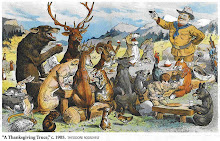
There are only two known diary descriptions of the 1621 event in Plymouth, Massachusetts that we have come to know and love as THANKSGIVING............“And God be praised we had a good increase… Our harvest being gotten in, our governor sent four men on fowling, that so we might after a special manner rejoice together after we had gathered the fruit of our labors. They four in one day killed as much fowl as, with a little help beside, served the company almost a week. At which time, amongst other recreations, we exercised our arms, many of the Indians coming amongst us, and among the rest their greatest king Massasoit, with some ninety men, whom for three days we entertained and feasted, and they went out and killed five deer, which they brought to the plantation and bestowed on our governor, and upon the captain and others. And although it be not always so plentiful as it was at this time with us, yet by the goodness of God, we are so far from want that we often wish you partakers of our plenty.”--Edward Winslow, Mourt’s Relation: D.B. Heath, ed. Applewood Books. Cambridge, 1986. p 82.........“They began now to gather in the small harvest they had, and to fit up their houses and dwellings against winter, being all well recovered in health and strength and had all things in good plenty. For as some were thus employed in affairs abroad, others were exercised in fishing, about cod and bass and other fish of which they took good store, of which every family had their portion. All the summer there was no want; and now began to come in store of fowl, as winter approached, of which is place did abound when they came first (but afterward decreased by degrees). And besides waterfowl there was great store of wild turkeys, of which they took many, besides venison, etc. Besides, they had about a peck a meal a week to a person, or now since harvest, Indian corn to that proportion. Which made many afterwards write so largely of their plenty here to their friends in England, which were not feigned but true reports"--William Bradford, Of Plymouth Plantation: S.E. Morison, ed. Knopf. N.Y., 1952. p 90...................390 years ago, the bounty of our great land was staggering in its plant, animal and mineral abundance ...........Let us hope on this Thanksgiving Day that we can find the resolve to rewild and revitalize our land, the critical foundation that makes us the strongest Country in the World.............Happy Thanksgiving to all of you!

Thanksgiving History


Very little is known about the 1621 event in Plymouth that is the model for our Thanksgiving. The only references to the event are reprinted below:


“And God be praised we had a good increase… Our harvest being gotten in, our governor sent four men on fowling, that so we might after a special manner rejoice together after we had gathered the fruit of our labors. They four in one day killed as much fowl as, with a little help beside, served the company almost a week. At which time, amongst other recreations, we exercised our arms, many of the Indians coming amongst us, and among the rest their greatest king Massasoit, with some ninety men, whom for three days we entertained and feasted, and they went out and killed five deer, which they brought to the plantation and bestowed on our governor, and upon the captain and others. And although it be not always so plentiful as it was at this time with us, yet by the goodness of God, we are so far from want that we often wish you partakers of our plenty.”

Edward Winslow, Mourt’s Relation: D.B. Heath, ed. Applewood Books. Cambridge, 1986. p 82


“They began now to gather in the small harvest they had, and to fit up their houses and dwellings against winter, being all well recovered in health and strength and had all things in good plenty. For as some were thus employed in affairs abroad, others were exercised in fishing, about cod and bass and other fish of which they took good store, of which every family had their portion. All the summer there was no want; and now began to come in store of fowl, as winter approached, of which is place did abound when they came first (but afterward decreased by degrees). And besides waterfowl there was great store of wild turkeys, of which they took many, besides venison, etc. Besides, they had about a peck a meal a week to a person, or now since harvest, Indian corn to that proportion. Which made many afterwards write so largely of their plenty here to their friends in England, which were not feigned but true reports.

William Bradford, Of Plymouth Plantation: S.E. Morison, ed. Knopf. N.Y., 1952. p 90

Thanksgiving: The Biography of an American Holiday


by James Baker

The origins and ever-changing story of America's favorite holiday. In this, the first in-depth study of the most American of holidays, James Baker sweeps away lingering myths and misconceptions to show how this celebration day was born and grew to be an essential part of our national spirit.

------------------------------------------------------------------------------------------------------------------------------------------------

Thanksgiving is a particularly American holiday. The word evokes images of football, family reunions, roasted turkey with stuffing, pumpkin pie and, of course, the Pilgrims and Wampanoag, the acknowledged founders of the feast. But was it always so?


Giving thanks for the Creator’s gifts had always been a part of Wampanoag daily life. From ancient times, Native People of North America have held ceremonies to give thanks for successful harvests, for the hope of a good growing season in the early spring, and for other good fortune such as the birth of a child. Giving thanks was, and still is, the primary reason for ceremonies or celebrations.


As with Native traditions in America, celebrations - complete with merrymaking and feasting - in England and throughout Europe after a successful crop are as ancient as the harvest-time itself. In 1621, when their labors were rewarded with a bountiful harvest after a year of sickness and scarcity, the Pilgrims gave thanks to God and celebrated His bounty in the Harvest Home tradition with feasting and sport (recreation). Jan van de Velde, August from The Twelve Months (series of engravings), 1616. Collection of Plimoth Plantation.


The arrival of the Pilgrims and Puritans brought new Thanksgiving traditions to the American scene. Today’s national Thanksgiving celebration is a blend of two traditions: the New England custom of rejoicing after a successful harvest, based on ancient English harvest festivals; and the Puritan Thanksgiving, a solemn religious observance combining prayer and feasting.


Florida, Texas, Maine and Virginia each declare itself the site of the First Thanksgiving and historical documents support the various claims. Spanish explorers and other English Colonists celebrated religious services of thanksgiving years before Mayflower arrived. However, few people knew about these events until the 20th century. They were isolated celebrations, forgotten long before the establishment of the American holiday, and they played no role in the evolution of Thanksgiving. But as James W. Baker states in his book, Thanksgiving: The Biography of an American Holiday, "despite disagreements over the details" the 3-day event in Plymouth in the fall of 1621 was "the historical birth of the American Thanksgiving holiday."


So how did the Pilgrims and Wampanoag come to be identified with the First Thanksgiving?

________________________________________

HARVEST HOME OR THANKSGIVING?

In a letter from “E.W.” (Edward Winslow) to a friend in England, he says: “And God be praised, we had a good increase…. Our harvest being gotten in, our governor sent four men on fowling that so we might after a special manner rejoice together….” Winslow continues, “These things I thought good to let you understand… that you might on our behalf give God thanks who hath dealt so favourably with us.”


In 1622, without his approval, Winslow’s letter was printed in a pamphlet that historians commonly call Mourt’s Relation. This published description of the First Thanksgiving was lost during the Colonial period. It was rediscovered in Philadelphia around 1820. Antiquarian Alexander Young included the entire text in his Chronicles of the Pilgrim Fathers (1841). Reverend Young saw a similarity between his contemporary American Thanksgiving and the 1621 Harvest Feast. In the footnotes that accompanied Winslow’s letter, Young writes, “This was the first Thanksgiving, the harvest festival of New England. On this occasion they no doubt feasted on the wild turkey as well as venison.”

________________________________________

PURITAN HOLIDAY

The American Thanksgiving also has its origin in the faith practices of Puritan New England, where strict Calvinist doctrine sanctioned only the Sabbath, fast days and thanksgivings as religious holidays or “holy days.” To the Puritans, a true “thanksgiving” was a day of prayer and pious humiliation, thanking God for His special Providence. Auspicious events, such as the sudden ending of war, drought or pestilence, might inspire a thanksgiving proclamation. It was like having an extra Sabbath during the week. Fasts and thanksgivings never fell on a Sunday. In the early 1600s, they were not annual events. Simultaneously instituted in Plymouth, Connecticut and Massachusetts, Thanksgiving became a regular event by the middle of the 17th century and it was proclaimed each autumn by the individual Colonies.

W.S.L. Jewett, "A Thanksgiving Dinner Among Their Descendants," Harper's Weekly, 30 November 1867. Collection of Plimoth Plantation.


The holiday changed as the dogmatic Puritans of the 17th century evolved into the 18th century’s more cosmopolitan Yankees. By the 1700s, the emotional significance of the New England family united around a dinner table overshadowed the civil and religious importance of Thanksgiving. Carried by Yankee emigrants moving westward and the popular press, New England’s holiday traditions would spread to the rest of the nation.

________________________________________

NATIONAL FEAST

The Continental Congress proclaimed the first national Thanksgiving in 1777. A somber event, it specifically recommended “that servile labor and such recreations (although at other times innocent) may be unbecoming the purpose of this appointment [and should] be omitted on so solemn an occasion.”


Presidents Washington, Adams and Monroe proclaimed national Thanksgivings, but the custom fell out of use by 1815, after which the celebration of the holiday was limited to individual state observances. By the 1850s, almost every state and territory celebrated Thanksgiving.

Sarah Josepha Hale (1788-1879). Many people felt that this family holiday should be a national celebration, especially Sarah Josepha Hale, the influential editor of the popular women’s magazine Godey’s Lady’s Book. In 1827, she began a campaign to reinstate the holiday after the model of the first Presidents. She publicly petitioned several Presidents to make it an annual event. Sarah Josepha Hale’s efforts finally succeeded in 1863, when she was able to convince President Lincoln that a national Thanksgiving might serve to unite a war-torn country. The President declared two national Thanksgivings that year, one for August 6 celebrating the victory at Gettysburg and a second for the last Thursday in November.


Neither Lincoln nor his successors, however, made the holiday a fixed annual event. A President still had to proclaim Thanksgiving each year, and the last Thursday in November became the customary date. In a controversial move, Franklin Delano Roosevelt lengthened the Christmas shopping season by declaring Thanksgiving for the next-to-the-last Thursday in November. Two years later, in 1941, Congress responded by permanently establishing the holiday as the fourth Thursday in the month.


________________________________________


THE PILGRIM AND WAMPANOAG ROLE

The Pilgrims and the Wampanoag were not particularly identified with Thanksgiving until about 1900, though interest in the Pilgrims as historic figures began shortly before the American Revolution.

Tableau of John and Priscilla Alden, 1910. Collection of Plimoth Plantation.


With the publication of Longfellow’s best-selling poem The Courtship of Miles Standish (1848) and the recovery of Governor Bradford’s lost manuscript Of Plimoth Plantation (1855), public interest in the Pilgrims and Wampanoag grew just as Thanksgiving became nationally important. Until the third quarter of the 19th century, music, literature and popular art concentrated on the Pilgrims’ landing at Plymouth Rock and their first encounters with Native People on Cape Cod.

This postcard shows quintessential Pilgrims in buckled hats and black clothes. The reverse side features a handwritten Thanksgiving greeting - in Polish. "Thanksgiving Greetings" Postcard, 1915. Collection of Plimoth Plantation.After 1890, representations of the Pilgrims and the Wampanoag began to reflect a shift of interest to the 1621 harvest celebration. By the beginning of the 20th century, the Pilgrims and the Thanksgiving holiday were used to teach children about American freedom and how to be good citizens. Each November, in classrooms across the country, students participated in Thanksgiving pageants, sang songs about Thanksgiving, and built log cabins to represent the homes of the Pilgrims. Immigrant children also learned that all Americans ate turkey for Thanksgiving dinner. The last lesson was especially effective with the recollections of most immigrant children in the 20th century including stories of rushing home after school in November to beg their parents to buy and roast a turkey for a holiday dinner.

________________________________________

TURKEY AND ALL THE TRIMMINGS

The classic Thanksgiving menu of turkey, cranberries, pumpkin pie, and root vegetables is based on New England fall harvests. In the 19th century, as the holiday spread across the country, local cooks modified the menu both by choice (“this is what we like to eat”) and by necessity (“this is what we have to eat”). Today, many Americans delight in giving regional produce, recipes and seasonings a place on the Thanksgiving table. In New Mexico, chiles and other southwestern flavors are used in stuffing, while on the Chesapeake Bay, the local favorite, crab, often shows up as a holiday appetizer or as an ingredient in dressing. In Minnesota, the turkey might be stuffed with wild rice, and in Washington State, locally grown hazelnuts are featured in stuffing and desserts. In Indiana, persimmon puddings are a favorite Thanksgiving dessert, and in Key West, key lime pie joins pumpkin pie on the holiday table. Some specialties have even become ubiquitous regional additions to local Thanksgiving menus; in Baltimore, for instance, it is common to find sauerkraut alongside the Thanksgiving turkey.


Most of these regional variations have remained largely a local phenomenon, a means of connecting with local harvests and specialty foods. However this is not true of influential southern Thanksgiving trends that had a tremendous impact on the 20th-century Thanksgiving menu.

"Hearty Thanksgiving Greeting" Postcard, c. 1910. Collection of Plimoth Plantation.Corn, sweet potatoes, and pork form the backbone of traditional southern home cooking, and these staple foods provided the main ingredients in southern Thanksgiving additions like ham, sweet potato casseroles, pies and puddings, and corn bread dressing. Other popular southern contributions include ambrosia (a layered fruit salad traditionally made with citrus fruits and coconut; some more recent recipes use mini-marshmallows and canned fruits), biscuits, a host of vegetable casseroles, and even macaroni and cheese. Unlike the traditional New England menu, with its mince, apple and pumpkin pie dessert course, southerners added a range and selection of desserts unknown in northern dining rooms, including regional cakes, pies, puddings, and numerous cobblers. Many of these Thanksgiving menu additions spread across the country with relocating southerners. Southern cookbooks (of which there are hundreds) and magazines also helped popularize many of these dishes in places far beyond their southern roots. Some, like sweet potato casserole, pecan pie, and corn bread dressing, have become as expected on the Thanksgiving table as turkey and cranberry sauce.

________________________________________

Thanksgiving Feast at Plimoth Plantation

________________________________________

THANKSGIVING

Family at Thanksgiving - Themed Dining at Plimoth Plantation

If there is one day each year when food and family take center stage, it is Thanksgiving. It is a holiday about “going home” with all the emotional content those two words imply. The Sunday following Thanksgiving is always the busiest travel day of the year in the United States. Each day of the long Thanksgiving weekend, more than 10 million people take to the skies. Another 40 million Americans drive 100 miles or more to have Thanksgiving dinner. And the nation’s railways teem with travelers going home for the holiday.


Despite modern-age turmoil—and perhaps, even more so, because of it—gathering together in grateful appreciation for a Thanksgiving celebration with friends and family is a deeply meaningful and comforting annual ritual to most Americans. The need to connect with loved ones and to express our gratitude is at the heart of all this feasting, prayerful thanks, recreation, and nostalgia for a simpler time. And somewhere in the bustling activity of every November's Thanksgiving is the abiding National memory of a moment in Plymouth, nearly 400 years ago, when two distinct cultures, on the brink of profound and irrevocable change, shared an autumn feast.

Tuesday, November 22, 2011

The Bozeman(Montana) Chronicle newspaper is conducting a poll on whether Montana Parks and Wildlife should extend the Wolf hunt past December............Cast your vote below............Thus far, a solid 72% are opposed to the extension


Should the Montana Department of Fish, Wildlife and Parks extend the wolf hunting season for an extra month as has been proposed?

CLICK ON LINK BELOW TO CAST YOUR VOTE

Here is your chance to make a difference. Tell your friends. So far, 72%  opposed to extending the hunt.

This week's question (informal poll) is: Should the Montana Department of Fish, Wildlife and Parks extend the wolf hunting season for an extra month as has been proposed?  Yes or no?  Visit www.dailychronicle.com to cast your vote.    

Are generalist predators critical to maintaining optimum biodiversity?............. McGill University biologists have discovered that a "branching network" maintained by generalist species, like foxes or coyotes, that are able to move around and prey on different species in different locations, have an important role in promoting complex food webs and thereby in maintaining biodiversity............ The researchers concluded that these generalist species have the advantage of being able to find prey no matter where they are as they move from one place to another, and this sustains the network....This biodiversity theory also lays a foundation for understanding the effects human activities – like deforestation – which are likely to not only adversely impact single species, but to crater entire food webs. The researchers show how food webs are eroded by species extinction when disturbed by habitat destruction

A new model for understanding biodiversity

GENERALIST PREDATORS A CRITICAL FACTOR
Animals like foxes and raccoons are highly adaptable. They move around and eat everything from insects to eggs. They and other "generalist feeders" like them may also be crucial to sustaining biological diversity, according to a new study published in the Proceedings of the National Academy of Sciences (PNAS).

McGill biology researchers have developed a unified, spatially based understanding of biodiversity that takes into account the complex food webs of predators and prey. "Biodiversity exists within a landscape. Predators and prey are continuously on the move as their habitats change – it's a complex dynamic system," says lead author Pradeep Pillai, a doctoral candidate at McGill.

Previous theories of biodiversity have either concentrated on the complex network of feeding interactions that connects all species into food webs or have focused on the way that species are connected in space. "A unified theory of ecological diversity requires understanding how species interact both in space and time, and this is what is different about our work," explains co-author Michel Loreau, who holds the Canada Research Chair in Theoretical Community and Ecosystem Ecology.

What they discovered was that a "branching network" maintained by generalist species, like foxes or coyotes, that are able to move around and prey on different species in different locations, have an important role in promoting complex food webs and thereby in maintaining biodiversity. The researchers concluded that these generalist species have the advantage of being able to find prey no matter where they are as they move from one place to another, and this sustains the network.

This theory also lays a foundation for understanding the effects human activities – like deforestation – are likely to have not simply on a single species but on whole food webs. The researchers show how food webs are eroded by species extinction when disturbed by habitat destruction. "The theory is useful because it helps us understand how biodiversity is maintained, but also the impacts humans have when they disrupt ecological networks by destroying and fragmenting habitat," concludes co-author Andrew Gonzalez, Canada Research Chair in Biodiversity Science and Director of the Quebec Centre for Biodiversity Science.

Texas Black Bear population surge (or) existing Bears coming into human habitats due to the recent drought (or) Mexican Bears wandering into Texas because fires ravaged their habitat??????

Bear sightings becoming more common

Animals may be looking for food

—Black bears once freely roamed the Texas landscape before their status as a predator to the state's ranching animals spurred their removal.

An increase in reported sightings suggests the bears might be making a comeback.

From 2010 to 2011 the Texas Parks & Wildlife Department has seen a spike in the number of reported black bear sightings, but Jonah Evans, wildlife diversity biologist for the TPWD's Trans-Pecos District in Alpine, said it's unclear what that means.

"It could mean that bears are hungrier because of the drought and fires, and they are getting into food sources that typically are dangerous (to them) because they're associated with people," Evans said.
"In order to meet their dietary requirements, they have to cover a lot more ground."

Furthermore, Evans said: "We just don't know what spurs people to give us reports. It could be there was a really cool report on the Discovery Channel, (and) before that, nobody cared to call in. We don't know if (more sightings) means there are more bears in the state. If I had to guess, I'd say it seems like there are."

Ruben Cantu, a wildlife biologist and regional director for Texas Parks and Wildlife's San Angelo office, said that while most Texans are aware of wildfires that blazed through the state last summer, fires in Mexico didn't garner as much attention. "Mexico had one of the largest fires in their recorded history," he said. "That was some of the best bear habitat that went up in smoke. A lot of these bears may be bears from that area."

Drought also is a likely culprit, Cantu said. "The drought allowed for those mountains (in Mexico) to get really dry, and it just takes a spark" to ignite, he said. "The drought itself also has bears moving more because they're looking for food, and the drought just compounded the fact that there's not a lot of food." "A nuisance bear or a bear that's causing a problem for people is almost always the result of a food source created by people," Evans said.

On Thursday, the Irion County Sheriff's Office posted on its Facebook page a black-and-white photo of a dark-colored bear standing on its hind legs beneath a deer feeder. According to the website, the photo was captured Oct. 13 by a game camera on Ketchum Mountain, west of Mertzon.Game Warden Lt. Doug Seamands on Thursday said the photograph is authentic. "They think it's the same one they've seen in Barnhart," he said.

Added Cantu: "The week before last we moved a bear from Del Rio out to West Texas because it got into the city limits. There was another (recent) bear sighting in the Western Hill Country."
Cantu said bear sightings should be reported to TPWD so the department can better track their movement and gauge whether the bear could become a nuisance. Bears are protected in Texas, he said, so it is illegal to shoot or trap them.

According to the Texas Parks & Wildlife website, black bears are generally not a threat to humans unless they are provoked."They're going to be as scared of you as you are of them," Cantu said.Evans said there are few reports of black bears attacking people. "In the U.S. I think it's somewhere between zero and three to four a year," he said. "Compared to car accidents, (the incidence) is incredibly small."

According to a May article from the Texas Wildlife Borderland News, more than 200 black bears lived in the Davis Mountains in the late 1930s."A lot of people started settling into that country, and a lot of people were ranchers who raised sheep and goats," Cantu said. "Having bear on your property is not conducive to having sheep and goats."

Black bears have trickled back into Texas since the 1990s, the Texas Wildlife Borderland News states, but — given that female black bears don't travel as far as males do — it's unlikely their population will be as large as it once was.

Monday, November 21, 2011

After virtual extermination, Bobcats have made a comeback in Iowa.......1500 to 2000 "Bobs" are thought tho inhabit the once prairie and now cornfield habitat of the State.......Our Consevation reserve program which pays farmers to keep some of their acreage in natural cover has assisted in the recovery of this necessary mesocarnivore, labeled as endangered in Iowaas recently as 1977.......The State furtrapping season which is underway, allows for a quota of 350 Bobcats to be taken, roughly 20% of the statewide population.............Seems a bit aggressive for a creature that was nearly off the map as recently as 2003........We restore animals and then shoot them to hell because the State Game Commissions are set up to be financed by hunters fees.............This must change(as discussed over and over again on this blog) if we are ever to have a true rewilding accomplished on our Continent

Bobcat population edges up in southeast Iowa, DNR says


Two bobcats play in the backyard of Steve and Judi Christianson several weeks ago. The Christiansons live west of Muscatine on Hickory Hills Road. The Iowa Department of Natural Resources says bobcats are making a comeback in the area.
Bobcat sightings can be reported to the Iowa Department of Natural Resources by calling Ron Andres at (641) 357-3517 or at the DNR Web site at www.iowadnr.gov. Sighting reports, including those captured by hunters' motion sensor cameras, help the DNR monitor the bobcat population by region.
MUSCATINE, Iowa — The bobcat population in southeastern Iowa is growing slightly every year, according to the Iowa Department of Natural Resources, or DNR.

Ron Andrews, a furbearer research biologist with the DNR, said bobcats have maintained a notable increase in population across the southern portion of the state since 1977, when they were listed as an endangered species.

But by 2001, the trend was reversing and the Natural Resource Commission downlisted the bobcat from endangered to threatened.

By 2003, DNR staff tallied sightings, road kills and incidental captures of bobcats statewide, finding the animals to be common in southern Iowa.

Legal seasons have been established for harvesting bobcats in Iowa's two southernmost tiers of counties. There is no bobcat trapping season in Muscatine County.

Poaching a bobcat is a simple misdemeanor, said Tom Campbell, a conservation officer for the Iowa DNR in Muscatine County. He has never charged — or heard of — someone with poaching bobcats in the county.

According to bowhunter surveys taken over the past four years, Andrews said, no bobcats were reported in the first two years of the surveys in a 10-county area that includes Muscatine County.
That doesn't necessarily mean, however, that there were no bobcats in the region at that time, he said.

In 2008, the third year of the surveys, there were 100 sightings per 1,000 hunting hours recorded. After 10 years, Andrews said, the survey will be more reliable in terms of telling the story of how the bobcat population is spreading from northern Missouri and southern Iowa.

The DNR estimates that there are 1,500-2,000 bobcats statewide.

Andrews said the habitat in Iowa, including the increase of grasslands and brush-filled reserves created by conservation programs, will allow continued growth.

"There is an increase ever so small into northeast Iowa. There is no reason to think that in 10 years there won't be sizeable numbers unless there is some disease, such as distemper, which is common in felines, that wipes out the population."

There was a time when Iowans, especially farmers, would kill bobcats before the animals could kill their chickens, hogs or young calves. Today, the threat to farm animals is significantly less because of hog and chicken confinements, Andrews said.

The modern-day biologist recognizes there is a role for predators and hopes to see the number of bobcats increase, he added. And if you have heard the rumor that the DNR released bobcats into the wild to control the deer population, you are not alone. But don't believe the buzz, Andrews said.
"That is completely unfounded," he said, adding that bobcats usually hunt for smaller animals as their meals.

"It's not very often that a bobcat would take down a full-grown deer, but not impossible," he added.
Small domestic animals such as dogs or cats may be a different story, he said, and that is one thing the Christiansons said concerns their neighbors.

Other government agencies suggest you not panic if you see a bobcat since they rarely attack people. When they do, they usually have rabies.

Bobcats may be attracted to yards with abundant wildlife, small pets, shade or water. Small pets need to be protected from bobcats and other predators in an enclosed area.Experts suggest that people should not spread seed that attracts other wildlife and that they not feed bobcats.

If you see a bobcat, enjoy the view, said Campbell, who has never seen one alive in the wild but added that he recently picked one up that had been killed by a vehicle on U.S. 61 north of Muscatine near Sweetland Road.
-------------------------------------------------------------------------------------------------------------------
Iowa furtrapping season well underway

Iowa furharvesters reported 114 bobcats harvested as of Nov. 15, 10 days into the season.

Once the quotas are reached, trappers may keep any otter or bobcat captured within the 48-hour grace period. Otters and bobcats accidentally captured after the grace period and bobcats captured in an area of the state closed to bobcat harvesting must be turned over to the DNR without penalty.

The bobcat season is open in the southern three tiers of counties, plus Guthrie, Harrison, Monona and Woodbury counties. The open zone quota is 350 bobcats plus any that are trapped by midnight of the following day after the quota is reached. The season limit is one bobcat per licensed furharvester, regardless if it was hunted or trapped.


Many of us are aware that Alan Rabinowitz and his fine PANTHERA wild cat conservation group is working diligently on getting South and Central American Governments to create a connective Jaguar "pathway" created that would stretch from Mexico to Patagonia...........What is missing from this plan is critical habitat in the USA, a historical home for the Jaguar up until the late 19th and early 20th Century.........."Jags" continue to be verified and spotted in the Arizona/New Mexico region over the past decade and now another confirmation in Southeastern Arizona has been recorded...........How do we get Mr. Rabinowitz and other Jaguar advocates to put pressure on the Obama admistration to implement the critical habitat plan that was created in 2010 for our "kill in one leap"(First Nations definition of Jaguar) magnificent Cat?

Arizona hunter spots rare U.S.-Mexico borderlands jaguar

Jaguars' habitat ranges from Argentina to the rugged borderlands of Arizona and New Mexico. There have only been a handful of sightings by hunters in Arizona, and no jaguars are believed to breed in the United States.

The report was received on Saturday morning from an experienced hunter using dogs to track mountain lions in Cochise County, in southeast Arizona, the department said.The large cat was driven up a mesquite tree, where the hunter was able to take photographs and video. The footage was subsequently viewed by the department, which classified the sighting as "verifiable or highly probable."

"It's very exciting ... we know that jaguars use southern Arizona as part of their northern habitat ... Although confirmed sightings are fairly rare," Lynda Lambert, a spokeswoman with the department, told Reuters.Lambert said the hunter declined to be named, and did not release the photographs or video footage for publication.

After photographing the cat, the hunter left the area with his dogs and watched from a distance. The jaguar remained treed for approximately 15 minutes and then headed south. aguars are the only cats in North America that roar. They prey on a variety of mammals, fish, birds and reptiles.

There were thought to have vanished from United States until two confirmed sightings in 1996. Only a handful have been spotted since then, and very little is known about their habits. Based on the images, biologists believe the jaguar is an adult male that appeared in good health and weighed approximately 200 pounds.

The department said it hoped to compare the photographs and video shot by the hunter to images of other jaguars taken in Arizona in the past. They will try to use comparisons between a jaguar's unique spots, known as rosettes, to determine if the animal has been previously identified.
In recent years, concern over the well-being of the U.S. jaguar population has intensified as a program to build some 700 miles of security fence along the nearly 2,000-mile border with Mexico has gathered pace.

Some conservationists feared that the fencing would prevent the powerful, solitary hunters from roaming up from Mexico.

In 2010, the U.S. Fish and Wildlife Service announced it would designate critical habitat for endangered jaguars in the United States and develop a jaguar recovery plan.

An urgent request by the conservation group, FLORIDA FOREVER, to get the USFW to protect the 150,000 acres in Florida known as the "PANTHER GLADES" (which is North of Lake Okeechobee) protected as critical habitat for the 100 Cougars still in existance in South Florida

Florida Panthers


Tell the U.S. Fish and Wildlife Service to finish the job started by Florida Forever over 10 years ago. Protect lands needed by the Florida panther by acquiring all of "Panther Glades" now! Submit comments by email here:
EvergladesHeadwatersProposal@fws.gov

Dear Friends,

Until Friday, November 25th, 2011, the U.S. Fish and Wildlife Service (USFWS) is accepting comments on a plan to expand the National Wildlife Refuge System in south Florida. The proposed "Headwaters of the Everglades National Wildlife Refuge" would protect 150,000 acres of still to be identified ranch lands north of Lake Okeechobee at a price tag of 700 million dollars.

 The patchwork quilt of properties created would include 50,000 acres purchased outright while a conservation easement would be placed on 100,000 additional acres to prevent development. Cattle ranching would continue on 2/3 of the new refuge. Although an occasional male panther finds his way to this area, females are not as adventurous. With no breeding opportunities, the males seldom stick around. The entire proposal can be found here:
http://m1e.net/c?112198231-lMeNDd0GgIexw%407008627...

While South Florida Wildlands Association (SFWA) certainly supports the idea of protecting habitat which could someday be turned into more of the suburban sprawl for which our region has become famous, we believe there is a better and more strategic way to spend at least some of massive amounts of money the American people are being asked to invest. Last May, readers of the occasional emails sent out on this list were shocked to learn that Florida Power and Light (FPL) was considering the purchase of approximately 3000 acres of primary Florida panther habitat in the Big Cypress basin on a piece of land known as "McDaniel's Ranch". The property would be home to the "Hendry Next Generation Clean Energy Center" – the largest fossil fuel plant in the country. Article below describes the project:
http://m1e.net/c?112198231-yMiRe6u/l6hCs%407008628...

On hearing this news, many immediately responded with an email to Lew Hay, CEO of Florida Power and Light, pleading with the company to consider the panther in its site selection and to seek land elsewhere. The letter below contains the company's response:
http://m1e.net/c?112198231-q1OvAzd8PaJIQ%407008629...

Unfortunately, our efforts were unsuccessful. In spite of mountains of evidence showing that this land is of the highest important for the critically endangered Florida panther and numerous other plant and animal species which share its habitat (e.g. wood storks, crested caracara, black bears, wild turkey, eastern indigo snakes, fox squirrels), FPL ultimately decided to spend 40 million dollars to purchase this property – while giving the previous owner, Eddie Garcia, a 25 million dollar profit on the 15 million dollars he invested in 2005.

 Vacant land prices in a state with some of the highest foreclosure rates in the country have hardly moved upwards since 2005. We have to assume that the enormous price FPL was willing to pay for this property reflected the rezoning Mr. Garcia successfully accomplished through the Hendry County Commission - converting (so far only on paper) a completely rural piece of south Florida into one of the largest industrial projects in the
country.
See photo of FPL's "West County Energy Center", a virtual twin of the proposed Hendry County plant, to get an idea of what the Clean Energy Center will look like:
http://m1e.net/c?112198231-AdZLjoSkZfheQ%407008630...

See also a map of collared male panthers in the vicinity of the proposed power plant from a recent Florida panther annual report produced by the state Fish and Wildlife Commission:
http://m1e.net/c?112198231-NgJCk6M4DWaDI%407008631...

Green areas on the map represent the network of already acquired public lands which would surround this monster sized project – the Big Cypress National Preserve to the south; Holeyland and Rotenberger Wildlife Management Areas and Storm Water Treatment Areas 3, 4, 5 and 6 to the east; the Dinner Island Wildlife Management Area and the Okaloacoochee State Forest to the north and west. In addition to direct loss of habitat, a plant of this size would also dramatically increase traffic and open up the entire area to sprawl, road building, and habitat fragmentation.

While SFWA is willing to expend its limited resources aggressively fighting this project as it winds its way through the vast and complex state and federal permitting process (e.g. South Florida Water Management District, Army Corps of Engineers, Florida Department of Environmental Protection, U.S. Fish and Wildlife Service), there is another solution which would benefit all parties concerned - including the panther.

 In 2001, the Florida Forever program was established by the state legislature in order to protect dwindling wildlife habitat statewide. As stated in the Florida Forever Act of 1999:
"The continued alteration and development of Florida's natural areas to accommodate the state's rapidly growing population have contributed to the degradation of water resources, the fragmentation and destruction of wildlife habitats, the loss of outdoor recreation space, and the diminishment of wetlands, forests, and public beaches."

The purpose of the National Wildlife Refuge System is to:
"administer a national network of lands and waters for the conservation, management, and where appropriate, restoration of the fish, wildlife, and plant resources and their habitats within the United States for the benefit of present and future generations of Americans."
The marriage between state, federal, and private interests which would be accomplished by incorporating Panther Glades (including the newly acquired FPL property) into the new Headwaters of the Everglades National Wildlife Refuge could not be better. Panther Glades has already been extensively studied for its wildlife and habitat importance. It is also a key part of the northern watershed of Big Cypress National Preserve which provides fresh, clean water to much of Everglades National Park and other public lands further south.

 As of May of this year, Panther Glades was ranked highest in importance of all Florida Forever "Critical Natural Lands Projects" in south Florida. In the state's current fiscal conditions, however, Florida Forever has received zero dollars in funding from the Florida legislature. See complete report on the Panther Glades property here:
http://m1e.net/c?112198231-YuR7V3eF2rcwU%407008632...

Your support for this simple request will help move this issue forward. It could even be the catalyst which drives FPL and the USFWS to hammer out a deal. With only about 100 panthers left in south Florida on habitat which continues to shrink all the time, this is an opportunity we do not want to miss. Please send an email to the U.S. Fish and Wildlife Service before the November 25th deadline and ask them to take whatever steps are necessary to include the complete "Panther Glades" property in their new refuge.
EvergladesHeadwatersProposal@fws.gov

In addition to sending in comments to the service (most important), donations are also very helpful to our ongoing efforts to protect south Florida's wildlife. Of late, we have taken on some particularly tough challenges. Please consider even a small donation this holiday season. South Florida Wildlands Association is a 501c3 organization registered with the Florida Division of Corporations since March of 2010. More information on how to donate below:
http://m1e.net/c?112198231-5SX14FtJOyvFA%407008633...

Best regards and a very happy Thanksgiving to you and your families,
Matt Schwartz
Executive Director
South Florida Wildlands Association
P.O. Box 30211
Ft. Lauderdale, FL 33303
954-634-7173

Sunday, November 20, 2011

Our friend Stanley Gehrt last year published an authoritative book entitled URBAN CARNIVORES, including an incisive section on urban Red Foxes...........University of Bristol(UK) biologists have added to Stan's research in determining that In urban fox families, male cubs with dominant mothers disperse to avoid inbreeding while their sisters remain to enjoy the benefits of living with their dominant mother figure. The opposite pattern is observed for cubs born to subordinate mothers. Comparison of the dispersal strategies of cubs fathered by dominant males with those fathered by males outside of the family demonstrates that fathers appear to play no role in this decision..... .Sneaky matings outside the family(male foxes mating with females outside their home territories as well as those in their territory) mean that dispersal is not a reliable mechanism for preventing inbreeding between fathers and daughters....Consequently, control of cub dispersal is much more important for mothers than fathers

Mother Knows Best for Urban Fox Families

 In urban fox families, mothers determine which cubs get to stay and which must leave while fathers have little say in the matter, new research by biologists at the University of Bristol has found.

In a world of increasing urban sprawl, red foxes have successfully established themselves in our very backyard. Surprisingly sociable, these foxes live in defined family groups with a dominant male-female pair and a varying number of subordinate adults. In spring each family produces a litter of cubs. Some of these cubs remain in the family group for the rest of their lives while others leave to search for another family to join. Scientists have long wondered what, or who, drives these individuals to leave the safety of their family.
The urban foxes in Bristol have been studied continuously since 1977 giving a rare window into their normally secretive lives. While the rest of the city sleeps, a dedicated team of researchers from Bristol University's School of Biological Sciences spends numerous nights following radio-collared foxes, observing family life, and discovering cubs in the strangest of places.

Establishing family trees for the foxes used to be difficult, as during the mating season male foxes often sneak off to mate with unknown females. However, by combining field observation with DNA paternity testing in the lab, the researchers have now succeeded in creating extensive fox family histories. Using this information, they found that the cub's genetic relationships with female family members determine its dispersal strategy.

The findings suggest male cubs with dominant mothers disperse to avoid inbreeding while their sisters remain to enjoy the benefits of living with their dominant mother figure. The opposite pattern is observed for cubs born to subordinate mothers. Comparison of the dispersal strategies of cubs fathered by dominant males with those fathered by males outside of the family demonstrates that fathers appear to play no role in this decision.

Helen Whiteside, lead author of the study published in the online journal PLoS ONE, said: "There is a limited cost to the dominant male fox in allowing unrelated males to stay in the family group. Moreover, sneaky matings outside the family mean that dispersal is not a reliable mechanism for preventing inbreeding between fathers and daughters. Consequently, control of cub dispersal is much more important for mothers than fathers.

"These findings have important implication for the evolution of dispersal and group living in social mammals, and provide a unique opportunity to advance our understanding of the key biological process of dispersal."

Long-term funding for this study was provided by the Dulverton Trust and molecular work carried out at the NERC Biomolecular Genetics Facility.
|

Louisiana black bear's have roughly doubled their population since 2006 from 600 to roughly 1000 Bruins......This subspecies of Black Bear is on the Endangered Species list and the BLACK BEAR CONSERVATION COALITION has worked hard with private landowners to create viable habitat and corridors for the Bears to spread out and multiply

Coalition helps black bear numbers creep up


The Louisiana black bear, which is on the U.S. Endangered Species List and classified as threatened in Louisiana, Mississippi and Texas, is making a comeback of sorts, albeit a slow one.
Thanks to the untiring work of the Black Bear Conservation Coalition, private landowners, wildlife professionals and timber companies, the bear's numbers have been creeping upward -- a victory for conservation.

In 2006, Louisiana's black bear population was estimated at only 400 to 500. Today, rough estimates put the bear's population at between 600 to 1,000 bears -- a significant increase.
Three different projects are ongoing in the state to try to give an accurate count.

"It is hard to accurately count the number of bears because they are so shy," BBCC Executive Director Paul Davidson said. "They shun human contact; stay mainly to themselves in the woodlands, and rarely attack livestock. That being said, I still believe we have more bears today than we did 100 years ago."

Davidson attributes the rebound to an aggressive campaign of planting of hardwood trees on more than 350,000 acres of Mississippi River lowlands in Louisiana, Mississippi and Arkansas, and the partnership the BBCC, land companies and private landowners have been able to forge during the last 21 years.

"The bear has become an asset to the average landowner," Davidson said.
While the population survives primarily along the Tensas (Tensas National Forest and Madison Parish) and Atchafalaya River Basins, the bear's growing numbers have led to increased sightings in east central Louisiana, especially among deer hunters.

"As the population grows, the bear is expanding its area," Davidson said. "They can easily walk 20 to 25 miles to get something to eat. And with more and more viable habitat -- Dewey Wills Wildlife Management Area comes to mind -- coming into play, the bear is starting to show up in locales they are not usually seen."

Davidson, though, is quick to point out that maintaining a "viable habitat" is not only beneficial to the bear, but to other species as well."Many people may not realize this, but a bear's habitat is a valuable asset to many other species -- 200 to be exact," Davidson said. "All benefit, when there is adequate habitat that includes plenty of good hardwood trees, food and water."

Thanks to a sizable grant from the Walton Family Foundation, there is an effort to restore habitat in Pointe Coupee Parish. The restoration project is planting different types of hardwoods, which, when mature, will provide not only prime habitat, but food for the bear and other species of wildlife.
While Davidson sees progress, there is a need for much more work to be done. This can only be accomplished through dedication, education and cooperation -- and money.

To learn more about Louisiana's Black Bear got to www.bbcc.org

High population densities of most creatures (yes, even homo sapiens) leads to the spread of disease and ultimately limiting of those populations in deadly ways....Natural predators (both large and small) can and will help to maintain the best, healthiest, balanced population densities – i.e. only if most homo sapiens can live and agree with nature's way of balancing wildlife populations.........It's a known fact that artificially high deer populations will impact many other wildlife populations in their habitat..

EPIZOOTIC HEMORRHAGIC DISEASE (EHD) CONFIRMED AS CAUSE OF DEATH IN ROCKLAND COUNTY DEER

           The New York State Department of Environmental Conservation (DEC) has confirmed that approximately 100 white-tailed deer found dead in the Town of Clarkstown, Rockland County, over the last two weeks were killed by Epizootic Hemorrhagic Disease (EHD).  EHD is a viral disease of white-tailed deer that is transmitted by the biting midge in the family Culicoides.  The EHD virus does not infect humans and humans are not at risk by being bitten by the infected midge also known as a no-see-um or punkie.

           DEC wildlife biologists collected a sampling of deer carcasses in Rockland County and submitted them to the Fish and Wildlife Health Unit for necropsy.  Tissue samples were then sent to the Animal Health Diagnostic Center at Cornell University and the National Veterinary Services Laboratory where the diagnosis of EHD was identified.

           The EHD virus was last confirmed in New York in 2007 in Albany and Niagara Counties.  EHD outbreaks are most common in the late summer and early fall when the midges are abundant.  The symptoms of EHD include fever, small hemorrhages or bruises in the mouth and nose, swelling of the head, neck, tongue and lips.  A deer infected with EHD may appear lame or dehydrated.  Frequently, infected deer will seek out water sources and many succumb near a water source.  An infected deer may die within 1-3 days after being bitten by the midge or the disease may progress more slowly over weeks or months.  There is no treatment and no means of prevention for EHD.  The dead deer do not serve as a source of infection for other animals.

           EHD outbreaks do not have a significant impact on deer populations.  Generally, EHD outbreaks occur in a specific geographic area and about half of the EHD infected deer may die in an outbreak.  In the North, the first hard frost kills the midges that transmit the disease and the EHD outbreak ends.

           Hunters should not handle or eat any deer that appears sick or acts strangely.  DEC will continue to monitor the situation.  Sightings of sick or dying deer should be reported to the nearest DEC Regional Office or to an Environmental Conservation Officer. For more information on EHD and helpful related links, visit the DEC website directly at http://www.dec.ny.gov/animals/39767.html.

Might we actually move forward positively on State Wildlife Management and Regulations if Nevada decides to do away with their Wildlife Commission????..........As so many of us have opined about over the past year, State Commissioners are politically appointed by Govenors who almost alway pay back campaign favors to hunting and livestock groups through these appointments.........No way carnivores get managed as benevolently as deer and elk until States have Game Commisions that are staffed by all stakeholders in wildlfie management, not just hunters, ranchers and mineral interests...Thumbs up to Nevada State Senator Sheila Leslie who wants to look at the Wildlife Commission because it has been mired in controversy and is dominated by pro-hunting members.....Govenor Gibbons was accused of packing the commission with pro hunters...... Commissioners last year established the state's first bear hunting season, enraging animal support groups and others

Panel targets dropping 35 state boards, commissions


CARSON CITY -- A new legislative subcommittee took aim Thursday at the possible elimination of 35 state boards and commissions, including the state Wildlife and Ethics commissions.
During the first meeting of Legislature's Sunset Subcommittee, members identified the boards and commissions they want to call in and ask to provide justification for their continued existence.
Some such as the Commission on Sports have not met in decades and clearly will be abolished. But others, including the Wildlife and Ethics commissions, were placed on the subcommittee's bull's-eye largely because they are controversial or failed to respond to legislative requests for information.

"We aren't saying these boards are good or bad," said Sen. Sheila Leslie, D-Reno, chairwoman of the nine-member subcommittee. "Every board and commission eventually will be looked at."
The Sunset Subcommittee was created through a bill sponsored by Sen. Ben Kieckhefer, R-Reno. Approved unanimously and signed by Gov. Brian Sandoval, the law allows the subcommittee to determine whether boards or commissions "should be terminated, modified, consolidated with another agency or continued."

Kieckhefer said during hearings that his goal was to ensure "taxpayers were getting the biggest bang for their buck" by reviewing boards to make sure they are operating efficiently and effectively.
He also said the committee's creation was recommended by the Spending and Government Efficiency Commission, which reviewed state government when Jim Gibbons was governor and identified ways to save money.The subcommittee's recommendations are due June 30 and on the same day every other year.Any recommendations made next year must be approved by the Legislature in 2013 before a board can be eliminated.Starting in February, Sunset Subcommittee members will look at a few boards each month. Members of the boards will be asked to attend and answer questions.

Leslie wants to look at the Wildlife Commission because it has been mired in controversy and is dominated by pro-hunting members.Gibbons was accused of packing the commission with pro hunters. Commissioners last year established the state's first bear hunting season, enraging animal support groups and others.

Assemblywoman Irene Bustamante Adams, D-Las Vegas, recommended the subcommittee look at eliminating or modifying the Wildlife Commission. Bustamante Adams said she had "no particular reason" for the Wildlife Commission's inclusion other than the fact it did not respond to calls from legislative staff members inquiring about when it most recently met. Contacted in Reno, Ken Mayer, state Wildlife Department director and secretary to the Wildlife Commission, said he never received any phone calls from the Legislature. He said the Wildlife Commission last met on Sept. 23-24.
All calls for the Wildlife Commission go to the Department of Wildlife. Mayer said a call might not have been forwarded to him.


    MAKE YOUR VOICE HEARD IN MONTANA AND GET FISH, WILDLIFE & PARKS TO DROP PLANS FOR EXTENDING THE WOLF HUNT BEYOND DEC. 31............AS OUR FRIEND TONI STARK ELOQUENTLY STATES: ......"Bears are not hunted down during hibernation and there is no hunting when they have small cubs"........"Only male mountain lions are hunted from 12/31-4/14 and Female mountain lions with kittens can not be taken."........."These exceptions should be allowed for wolves, especially females with pups"

    From: Toni Stark <iamironwoman@gmail.com
    Date: Sat, Nov 19, 2011 at 5:39 PM
    Subject: Please Do Not Extend the Wolf Hunting Season!
    To: fwpgen@mt.gov

    Dear Montana Fish, Wildlife & Parks Dept.,

    At a hearing held in your office on November 10, 2011, hunters requested that the Wolf Hunting Season be extended beyond December 31st.  You indicated that this would be open to public comment until December 5th.


    I am against the extension of Wolf Hunting Season because:
      Wolves should be given the same protection that other predators are given
    .
                 -- Bears are not hunted down during hibernation and there is no hunting when they have small cubs.
                 --. Only male mountain lions are hunted from 12/31-4/14 and "Female mountain lions with kittens can not be taken."

                  -- These exceptions should be allowed for wolves, especially females with pups.

                  -- Wolves like other predators in Montana should have the freedom after December 31st to have their young and regenerate as a species

    So far, 83 wolves have been killed in Montana out of the proposed 220.  The reason why hunters are   killing less wolves is that there are less than 550 wolves in the state. Federal Wildlife Services kills approximately 140 wolves each year in Montana.

    Ranchers admit that they frequently kill any wolf that enters their property.  Anti-Wolf Groups claim that since February 2011, they have poached at least 2 wolves per week.

    Wolves are not as much of a problem as perceived in the press.  Montana Dept. of Livestock recently stated that less than 1% of the 2.9 million livestock in Montana has been killed by wolves.  The Rocky Mountain Elk Foundation 2011 Report shows an increase in the number of elk in Montana from 101,000 animals in 2010 to 150,000 min 2011.

    If the wolf hunt is allowed to continue after December 31st, it is very possible that the wolves will become extinct again and the billions of dollars spent on Wolf Reintroduction will have been to no avail.

      Sincerely,
      Truth About Wolves

      Toni A. Stark
      Angela Stevens
      Nicole Skorka
      Joseph DiStefano
      Billy Angus
    -----------------------------------------------------------------------------------------
    If we can put a halt to the killing in Montana, maybe it will also stop in Idaho and Wyoming.
    Montana Fish, Wildlife & Parks is taking public comment until December 5th and they can be reached at:
    fwpgen@mt.gov

    They will be making their decision on December 6th.

    Toni
    Toni

    ATTENTION ALL IDAHO RESIDENTS THAT WANT A SOUND, SCIENTIFIC PLAN FOR WOLF MANAGEMENT IMPLEMENTED IMMEDIATELY,,,,,,NOT THE "KILL BABY KILL" PARADIGM THAT IS CURRENTLY IN EFFECT...........TOMORROW, NOV. 21 7PM COLE MARR COFFEE HOUSE ; 8TH AND MARKET IN BOISE...........HEAR AND SPEAK WITH IDFG WOLF MANGER JON RACHAEL AND LET HIM KNOW THAT SANITY MUST RETURN TO IDAHO WHEN IT COMES TO MANAGING WOLVES

    BOISE WOLF HUGGERS -

     rare opportunity to talk to IDFG wolf mgr Jon Rachael, Monday, Nov. 21, at 7 pm, at the Cole Marr Coffee House in the 8th St Market Place, Boise.

     Suzanne Stone, DOW will also be present. Event hosted by Mike Medberry, Artist & Writer in Residence. Mike worked for the Idaho Conservation League back in the 90's when wolves were reintroduced.

    PLEASE SPREAD THE WORD. My understanding is that swords must be checked at the door.

    Saturday, November 19, 2011

    The anti-wolf/coyote biologist, Dr. Val Geist is quoted by Blog writer Tom Remington in his attempt to justify and rationalize why bountys are just, necessary and productive in dampening coyote populations----Nova Scotia, Canada continues to buy into the rationale that killing as many coyotes as possible protects people.....Flys in the face of all proven science......You can take out offending animals selectively and make a difference,,,,,,,,,,,,You are never going to kill all the coyotes and those who slip the bulllet and snare come back and "breed like rats", ultimately enlargening the songdog population with inexperienced juveniles who are more likely to get into tangles with us............WAKE UP WHITE PEOPLE--CHANGE YOUR WAYS

    Coyote Bounty Returns to Nova Scotia

    Tom Remington

    As part of a predator control program, in which the Nova Scotia government implemented to "control aggressive coyotes, once again this year a $20 bounty will be offered for coyote pelts. The government intends to run the 4-step program long enough to collect data to determine its effectiveness. The four step program consists of:

    -hiring a biologist to focus on human-wildlife conflict, training more trappers, providing a pelt incentive and increasing education about dealing with the animals.

    What is being described as "extremely rare" and not "normal", blame is laid on drought and human encroachment as the problem for increased reports of coyote/human interaction. While drought, which can cause a reduction in food supply, and human encroachment play a role, I'm not sure that describing the action of these coyotes as not being "normal" is all that accurate and may, in fact, lead people to be less concerned with educating themselves about what is normal.

    People, including officials, need to better educate themselves on behavior traits and all the aspects of what influences in a coyote's environment causes behavior to stray outside of what we want to call "normal".

    Dr. Valerius Geist, some time ago, provided us with the steps wild canines will take that lead up an attack on a human. This behavior is actually quite normal. It's the progression of events that influence the behavior of the animal that we should all be aware of. According to Geist, drought and human encroachment in and of itself will not cause coyotes to attack.

    Once we all better understand and become familiar with behavior and the influencing factors, the sooner we can recognize why coyotes and other wild canines do what they do. From this we can be better prepared, which will result in increased public safety.

    A 6th Cougar(since 2007) has been verified by the Kansas Dept of Wildlife.......Our big cats are determined to spread their seed and multiply.............Up to us to give them a fighting chance to do so............Requires habitat preservation and political will........Can we muster the humanity and forsight to make it a reality?

    Sixth confirmed sighting of mountain lion in Kansas

    (ATCHISON COUNTY, Kan.)—

    The Kansas Department of Wildlife, Parks and Tourism said Wednesday that a mountain lion was spotted on a trail in Atchison County.A deer hunter checked his trail camera and found what he believed to be a slightly blurry image of a mountain lion. After searching the area and finding large tracks, he contacted the local Kansas Department of Wildlife, Parks and Tourism (KDWPT) natural resource officer (NRO).

      The NRO and a biologist investigated the site and found additional tracks, confirming the presence of a mountain lion. By measuring vegetation at the scene, they were able to estimate the size of the animal at 25 inches tall and 4.5 feet long. This is the sixth mountain lion verified in Kansas by KDWPT since 2007, and the third photographed by a deer hunter's trail camera.

    The hunter did not wish to have the specific location disclosed but did notify neighboring residents of the mountain lion's presence. KDWPT staff believe this animal probably dispersed from a western state and is not likely to stay in one area for more than a few days.

    According to ongoing research by the Colorado Division of Wildlife, dispersing mountain lions, which are primarily young males, mostly feed on medium-sized animals such as raccoons, raptors, coyotes, and turkeys. They feed on deer less frequently, which take days to consume and likely hinder their movement across the landscape in search of the opposite sex and an area in which to establish a permanent home range.

    It is believed these dispersing mountain lions continue to travel until they are killed or they find a mate. In June, DNA tests indicated that a young male mountain lion killed in Connecticut originated in the Black Hills of South Dakota, more than 1,800 straight-line miles away.