Visitor Counter

hitwebcounter web counter
Visitors Since Blog Created in March 2010

Click Below to:

Add Blog to Favorites

Coyotes-Wolves-Cougars.blogspot.com

Grizzly bears, black bears, wolves, coyotes, cougars/ mountain lions,bobcats, wolverines, lynx, foxes, fishers and martens are the suite of carnivores that originally inhabited North America after the Pleistocene extinctions. This site invites research, commentary, point/counterpoint on that suite of native animals (predator and prey) that inhabited The Americas circa 1500-at the initial point of European exploration and subsequent colonization. Landscape ecology, journal accounts of explorers and frontiersmen, genetic evaluations of museum animals, peer reviewed 20th and 21st century research on various aspects of our "Wild America" as well as subjective commentary from expert and layman alike. All of the above being revealed and discussed with the underlying goal of one day seeing our Continent rewilded.....Where big enough swaths of open space exist with connective corridors to other large forest, meadow, mountain, valley, prairie, desert and chaparral wildlands.....Thereby enabling all of our historic fauna, including man, to live in a sustainable and healthy environment. - Blogger Rick

Subscribe via email to get updates

Enter your email address:

Receive New Posting Alerts

(A Maximum of One Alert Per Day)

Tuesday, November 26, 2013

Does Arkansas have a breeding population of Pumas?..............David Goad, who represents the Arkansas Game and Fish Commission, says they know mountain lions are in Arkansas............."We've had another confirmed sighting or two around the last couple of months, so we believe they're here"........."(However),there's just no evidence of it(female Pumas with kittens)"............... "We don't get pictures of cubs".......... "We do have people say they've seen cubs"................."It's just like anything else, we're biologists"........" I'm a biologist and good scientist is going to try to figure out i'f the breeding is for sure taking place"........ "Until we get evidence of cubs and reproduction, our stance is going to be the same that they are here, but there is not a breeding population"

Game and Fish says Mountain Lions are in Arkansas but aren't bre - KATV - Breaking News, Weather and Razorback Sports


Game and Fish says Mountain Lions are in Arkansas but aren't breeding


(KATV) Many have claimed to have mountain lion encounters over the years and much to their dismay were told it was probably another cat or something else. But now the Arkansas Game and Fish Commission says mountain lions are in Arkansas. But the biggest controversy with is no longer if mountain lions are here, but if they are reproducing.

David Goad, who represents the Arkansas Game and Fish Commission, says they know mountain lions are in Arkansas"We've had another confirmed sighting or two around the last couple of months, so we believe they're here," Goad said.

The issue with the Arkansas Game and Fish is not whether mountain lions are in Arkansas, but if they are actually breeding."There's just no evidence of it. We don't get pictures of cubs. We do have people say they've seen cubs," Goad said.

The Arkansas Game and Fish Commission contracted with experts out of Texas several years ago, who brought dogs to search for evidence of breeding."They essentially wrote a report and it said there's no evidence of a breeding population. So, but that doesn't mean there's not mountain lions here and in fact we know there are," Goad said.

Tanya Smith, the president of the Turpentine Creek Wildlife Sanctuary, which houses many mountain lions says in her opinion there's no way these cats aren't breeding.
"Well if there are wild mountain lions, it does make sense to me they would be connecting because when the female goes into heat, it's very loud and vocal and they're going to find each other if there's a female anywhere around," Smith said.

George Butler of Eureka Springs says he and his wife have seen a female mountain lion and a cub.
"We sat here and watched it and watched the young one come and raised up out of the grass and go so far and come back down. And it was following its mamma because we had just seen the mamma go out of the grass," Butler said. 

But the Arkansas Game and Fish Commission insists that they need photographic or other proof.
"It's just like anything else, we're biologists, I'm a biologist and good scientist is going to try to figure out if the breeding is for sure taking place," Goad said. "Until we get evidence of cubs and reproduction, our stance is going to be the same that they are here, but there is not a breeding population."

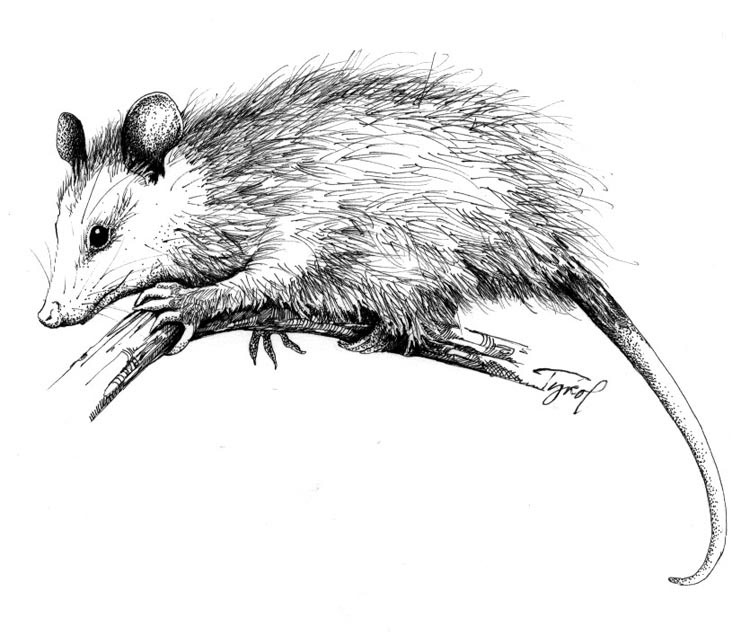
When I hear narrow minded and uninformed journalists and State Wildlife Commissioners say that Coyotes are not native to their state, it really gets my goat................If an indigenous animal in the Americas expands it's range because of climate change or because we have eliminated it's enemies, this does not make the species non-native, it makes them opportunistic and to be admired for their ability to adapt and expand their range............Our Virginia Opossum is one of those to be admired as it's original range was Central and South America..........Yet as the Winters have warmed over the decades, they have taken up residence throughout the mid-atlantic and New England states.......The Virginia opossum is the only one of 70 Opossum species capable of storing fat under its skin and in its tail............ The extra bit of fat – paltry compared to the amount of fat a raccoon puts on in the fall – enabled this species to move from Central into North America centuries ago............. In the early 1600s, European settlers in Virginia encountered an abundance of these strange creatures, described by Captain John Smith as having “an Head like a Swine, and a taile like a Rat.”.................. Even more marvelous, closer observation showed the opossum to be a marsupial, a mammal whose young are born quite small (A newborn opossum is about the size of a lima bean) and continue to develop in the mother’s abdominal pouch..

Opossums Find Cold Comfort in New England’s Winters | Northern Woodlands Magazine


Opossums Find Cold Comfort in New England’s Winters

Opossums Find Cold Comfort in New England’s Winters image
Illustration by Adelaide Tyrol
Natives of Central and South America, opossums are not particularly well equipped for life in northern New England, and yet they have been found here in increasing numbers since about 1900. Unlike other fur-bearing mammals in the region, opossums have relatively thin coats, and their ears, tails, and feet are virtually hairless.
Besides lacking the proper outerwear, opossums do not hibernate. Except for denning up for short periods during the very coldest weather, they must be out and about all winter searching for food, which makes them extremely vulnerable to hypothermia and frostbite. In fact, wildlife biologists use signs of frostbite to judge an opossum’s age; a frostbitten tail and ears show that the animal has lived through at least one winter. This far north – central New Hampshire and Vermont and southern Maine mark the northernmost reaches of their eastern range – opossums rarely live more than two years, though they live much longer in warmer climates.
How, then, have they persisted in migrating northward? 
Of the approximately 70 species of opossums, the one that became known as the Virginia opossum is the only one capable of storing fat under its skin and in its tail. The extra bit of fat – paltry compared to the amount of fat a raccoon puts on in the fall – enabled this species to move from Central into North America centuries ago. In the early 1600s, European settlers in Virginia encountered an abundance of these strange creatures, described by Captain John Smith as having “an Head like a Swine, and a taile like a Rat.” Even more marvelous, closer observation showed the opossum to be a marsupial, a mammal whose young are born quite small (A newborn opossum is about the size of a lima bean) and continue to develop in the mother’s abdominal pouch.
Beautifully suited to the climate of Virginia, North America’s only marsupial nevertheless continued to expand its range, until 300 years later it arrived in New England. Opossums have large families – between five and fifteen in a litter, with an average of eight – which helps explain its ability to colonize new areas.
Still, such an expansion would have been most unlikely except for the opossum’s ability to live near humans. Frequently called “an opportunist,” the omnivorous opossum can eat just about anything – from fruits, berries, insects, and small mammals to dog food left outside or garbage in dumpsters – and will happily make its bed under the back porch or in a corner of the woodshed. While its preferred habitat is in forested areas close to water, this animal’s close proximity to human habitation has been noted throughout the northern United States.
Unfortunately, we are most likely to see an opossum after it has been killed on the road. Nocturnal creatures, opossums rouse shortly after the sun sets and go out to look for food – often on roadways, where they feed on carrion and risk becoming roadkill themselves. According to studies summarized in Richard DeGraaf and Mariko Yamasaki’s New England Wildlife, human activities such as hunting, trapping, and roadkills account for the majority of opossum mortality. In one study, 35 percent of the animals equipped with radio transmitters or ear tags were killed by cars, while another 13 percent were killed in traps.
Fully grown, an opossum is approximately two and a half feet long, including the foot-long tail, and weighs from five to seven pounds. Encountering a predator or other threat, opossums may hiss and show their teeth but are more likely to run away and hide in a tree or burrow or to play dead. The tracker and naturalist Paul Rezendes describes an opossum he saw being attacked on the road by two dogs: “The opossum literally fell over, as if dropping dead of a heart attack. Saliva drooled from its mouth, and a very unpleasant smelling liquid began oozing from its anal glands. The dogs . . . barked at it, then nipped at it a few times, but the opossum didn’t move a hair.” After Rezendes chased the dogs away, the opossum got up and returned to the woods.
When out foraging or in its den – which can be in a hollow tree or brush pile as well as a human-made shelter – an opossum will be alone. Once the young leave their mothers, at about 120 days old, they are solitary animals and thus forgo even the comfort of snuggling up to another possum during the long, cold winter.
Catherine Tudish is a freelance writer living in Strafford, Vermont.

Rachel Tilseth of WOLVES OF DOUGLAS COUNTY WISCONSIN is literally "going into the woods" to cause all of us to "LOOK UP AND TELL WISCONSIN NO TO HUNTING WOLVES WITH HOUNDS...........Right after we all stuff ourselves with Turkey and Football, a percentage of Wisconsin hunters starting December 2 will be chasing down Wolves with packs of dogs................FAIR CHASE MY ASS!!!!!!!!!!!!!!!!!-------Let's help Rachel stop this madness before it starts!


From: Rachel Tilseth [mailto:wolvesdouglasco@gmail.com]
Sent: Tuesday, November 26, 2013 08:09 PM
To: Meril, Rick
Subject: PRESS RELEASE- WI TO COMMENCE BRUTAL WOLF HOUNDING-ONLY STATE IN NATION
 
PRESS RELEASE                                                 
FOR IMMEDIATE RELEASE  
Contact: Rachel Tilseth
715.440.5157 (cell)
wolvesdouglasco@gmail.com (email)                    

WISCONSIN TO COMMENCE BRUTAL WOLF HOUNDING
ONLY STATE IN NATION TO ALLOW INHUMANE HUNT
Menomonie, Wisc. (November 26, 2013) Wolves of Douglas County Wisconsin(WODCW) wants to remind the citizens of WI, that starting December 2, 2013, the State of Wisconsin will allow the commencement of the cruel and inhumane practice of "wolf hounding".

Wisconsin is the only state in the nation that allows the stalking of packs of GPS tagged dogs to run down wolves and kill them.  In a poll taken (here), by the Human Society of Untied States, in June of 2013, 85% of people in WI did not want hounding to take place.

"We want Wisconsinites to know what will happen when packs of dogs are unleashed on wolves", said Rachel Tilseth, founder of WODCW.  "It is not a fair fight. The "hounders" are allowed to place homemade collars on their dogs, which are fitted with nails and shards of steel, which will lacerate the mouths of the wolves, once wolves try to fight back. There is no way for the wolf to defend themselves, before the hounds' owners catch up to the pack tearing the wolf apart". 

dog chasing a coyote


WODCW is working with Senator Fred Risser to remove the dogs from the wolf hunt. However, in a move to obstruct the democratic process, Senator Neil Kedzie, has stalled in committee, Senator Fred Risser's Senate Bill #93, that calls for the removal of dogs from the wolf hunt, despite volumes of emails and calls to the Senator Kedzie's office.  

Members of the press are encouraged to join WODCW, in the woods, to expose this form of cruelty, in hopes to educate Wisconsinites on this archaic method of killing.  "There has never been a more important time for the people of WI to show they are not going to give in to a small group of people that want to torture animals for fun under the guise of "sport".


Dog confronting a Wolf cartoon 


Wisconsinites' are urged to support Senator Fred Risser's SB#93 that calls for the removal of dogs from the wolf hunt.  Tilseth stated, "Is this what WI citizens want to be known for? We ask you all to call and email you opposition to wolf hounding and end this bloodletting, before it begins in December".
###
About Wolves of Douglas County Wisconsin
Wolves of Douglas County Wisconsin was founded by Rachel Tilseth,  after spending 20 years as a WI DNR winter carnivore/wolf tracker volunteer, under the supervising of then wolf Biologist Adrian Wydeven. Tilseth is a long time WI resident, educator, and artist.  www.facebook.com/WolvesOfDouglasCountyWisconsin


www.facebook.com/WolvesOfDouglasCountyWisconsin

"On December 3, 2013 wolf hounding season opens in Wisconsin. It's time to end this barbaric practice  of hounding wildlife in Wisconsin. " Rachel   

Monday, November 25, 2013

When you keep removing the cogs in the wheel, evenutally the wheel stops rolling-----Paving over open space, killing off unwanted weeds", planting non native plants and lawns are all instruments of destruction that remove the insect food sources(critical cog in the wheel) that the Monarch Butterfly(and many other species) need to survive and prosper..................The ecological deserts that we are creating around the world are crushing blows to all the other species that we share the planet with

butterflys


News Analysis

The Year the

 Monarch Didn't Appear

By JIM ROBBINS
The precipitous loss of native vegetation
across the United States has led to a
 dramatic decline of insect populations.
Or, copy and paste this URL into your browser: http://nyti.ms/1dnJy62


NEWS ANALYSIS

The Year the Monarch Didn’t Appear


ON the first of November, when Mexicans celebrate a holiday called the Day of the Dead, some also celebrate the millions of monarch butterflies that, without fail, fly to the mountainous fir forests of central Mexico on that day. They are believed to be souls of the dead, returned.
This year, for or the first time in memory, the monarch butterflies didn’t come, at least not on the Day of the Dead. They began to straggle in a week later than usual, in record-low numbers. Last year’s low of 60 million now seems great compared with the fewer than three million that have shown up so far this year. Some experts fear that the spectacular migration could be near collapse.
“It does not look good,” said Lincoln P. Brower, a monarch expert at Sweet Briar College.
It is only the latest bad news about the dramatic decline of insect populations.
Another insect in serious trouble is the wild bee, which has thousands of species. Nicotine-based pesticides called neonicotinoids are implicated in their decline, but even if they were no longer used, experts say, bees, monarchs and many other species of insect would still be in serious trouble.
That’s because of another major factor that has not been widely recognized: the precipitous loss of native vegetation across the United States.
“There’s no question that the loss of habitat is huge,” said Douglas Tallamy, a professor of entomology at the University of Delaware, who has long warned of the perils of disappearing insects. “We notice the monarch and bees because they are iconic insects,” he said. “But what do you think is happening to everything else?”
A big part of it is the way the United States farms. As the price of corn has soared in recent years, driven by federal subsidies for biofuels, farmers have expanded their fields. That has meant plowing every scrap of earth that can grow a corn plant, including millions of acres of land once reserved in a federal program for conservation purposes.
Another major cause is farming with Roundup, a herbicide that kills virtually all plants except crops that are genetically modified to survive it.
As a result, millions of acres of native plants, especially milkweed, an important source of nectar for many species, and vital for monarch butterfly larvae, have been wiped out. Onestudy showed that Iowa has lost almost 60 percent of its milkweed, and another found 90 percent was gone. “The agricultural landscape has been sterilized,” said Dr. Brower.
The loss of bugs is no small matter. Insects help stitch together the web of life with essential services, breaking plants down into organic matter, for example, and dispersing seeds. They are a prime source of food for birds. Critically, some 80 percent of our food crops are pollinated by insects, primarily the 4,000 or so species of the flying dust mops called bees. “All of them are in trouble,” said Marla Spivak, a professor of apiculture at the University of Minnesota.
Farm fields are not the only problem. Around the world people have replaced diverse natural habitat with the biological deserts that are roads, parking lots and bluegrass lawns. Meanwhile, the plants people choose for their yards are appealing for showy colors or shapes, not for their ecological role. Studies show that native oak trees in the mid-Atlantic states host as many as 537 species of caterpillars, which are important food for birds and other insects. Willows come in second with 456 species. Ginkgo, on the other hand, which is not native, supports three species, and zelkova, an exotic plant used to replace elm trees that died from disease, supports none. So the shelves are nearly bare for bugs and birds.
Native trees are not only grocery stores, but insect pharmacies as well. Trees and other plants have beneficial chemicals essential to the health of bugs. Some monarchs, when afflicted with parasites, seek out more toxic types of milkweed because they kill the parasites. Bees use medicinal resins from aspen and willow trees that are antifungal, antimicrobial and antiviral, to line their nests and to fight infection and diseases. “Bees scrape off the resins from the leaves, which is kind of awesome, stick them on their back legs and take them home,” said Dr. Spivak.
Besides pesticides and lack of habitat, the other big problem bees face is disease. But these problems are not separate. “Say you have a bee with viruses,” and they are run-down, Dr. Spivak said. “And they are in a food desert and have to fly a long distance, and when you find food it has complicated neurotoxins and the immune system just goes ‘uh-uh.’ Or they become disoriented and can’t find their way home. It’s too many stressors all at once.”
There are numerous organizations and individuals dedicated to rebuilding native plant communities one sterile lawn and farm field at a time. Dr. Tallamy, a longtime evangelizer for native plants, and the author of one of the movement’s manuals, “Bringing Nature Home,” says it’s a cause everyone with a garden or yard can serve. And he says support for it needs to develop quickly to slow down the worsening crisis in biodiversity.
When the Florida Department of Transportation last year mowed down roadside wildflowers where monarch butterflies fed on their epic migratory journey, “there was a huge outcry,” said Eleanor Dietrich, a wildflower activist in Florida. So much so, transportation officials created a new policy that left critical insect habitat un-mowed.
That means reversing the hegemony of chemically green lawns. “If you’ve got just lawn grass, you’ve got nothing,” said Mace Vaughan of the Xerces Society, a leading organization in insect conservation. “But as soon as you create a front yard wildflower meadow you go from an occasional honeybee to a lawn that might be full of 20 or 30 species of bees and butterflies and monarchs.”
First and foremost, said Dr. Tallamy, a home for bugs is a matter of food security. “If the bees were to truly disappear, we would lose 80 percent of the plants,” he said. “That is not an option. That’s a huge problem for mankind.”
Jim Robbins is a frequent contributor to The New York Times and the author of “The Man Who Planted Trees.
”

Sunday, November 24, 2013

The concept of forest commons is neither new nor especially radical -- though some citizens would challenge it today................ This concept is rooted in ancient tradition and finds precedent in virtually every culture on Earth................However, in the modern era, as the ideologies of individualism and capitalism have come to dominate political thought, the idea that society bears a common responsibility for the well-being of its forests has fallen into disuse and even disfavor...................I agree wholeheartedly with the following statement that came out of the FOREST COMMONS CONFERENCE at Eastern Kentucky University in 1997----"The natural reality is that the Earth and its inhabitants form an organic system in which we human beings are part of the total community".............."Private property is an expedient that facilitates civil society by affording to individuals a degree of protection and security in those things they need for sustenance and comfort through the assertion and enforcement of certain rights"..........."However, the concept of a commons -- a shared interest, respect, and responsibility for the wholeness and well-being of the Earth -- is a much greater and primordial truth"--------READ THE ENTIRE FOREST COMMONS CONFERENCE BY CLICKING ON THE LINK BELOW


click on this link below to read the entire paper entitled-THE FOREST COMMONS
  http://www.uky.edu/OtherOrgs/AppalFor/commons.html

THE FOREST COMMONS

PREFACE 

In the Spring of 1995, Appalachia - Science in the Public Interest sponsored a conference at Eastern Kentucky University entitled "The Forest Commons." At the conference several distinguished experts addressed issues of forest conservation within the context of the concept of forest commons. The presentations were very informative and drew upon a variety of academic and professional disciplines, ranging from history and law to science and forestry. While this paper is neither a verbatim record nor a strict summary of the proceedings, it draws heavily upon ideas presented in the conference in attempting to draft a vision for a greater forest commons. For those interested in more in-depth analysis of specific issues addressed at the conference, several presentations are included in the appendix to this paper. In addition, video tapes of conference presentations may be purchased from ASPI Publications, 50 Lair Street, Mount Vernon, KY 40456. For further information call (606) 256-0077. 


INTRODUCTION 

Threat. Until recently, the portion of the earth covered in forest remained fairly constant. According to scientists, forest eco-systems decreased in size only slightly in the period from the beginning of human civilization until the turn of the nineteenth century (roughly 10,000 years), dropping from about 34 percent to 32 percent of the earth's land area. However, in the last two hundred years -- and particularly since 1950 -- deforestation has proceeded at an alarming rate. Today trees cover less than 26 percent of the earth's land, and intact forest eco-systems, less than 12 percent.(1)
The continuing loss and fragmentation of forests carry serious implications for climate, air quality, and biodiversity and could ultimately jeopardize the earth's ability to sustain life. 

Response. In light of the grave threats posed by deforestation, concerned citizens around the world have fought to curtail timber cutting and stop the clearing of forests. Needless to say, they have met with only limited success. With disturbing consistency, concerns for forest sustainability are pushed aside in favor of short-term economic gains derived from forest damage or destruction. However, the problem is more complex than just economics versus ecology. Some of the greatest difficulties in halting forest destruction are political and ideological, not simply economic. In attempting to restore healthy and sustainable forests it is important that we address not only the greed that drives the destruction of forests, but also the political systems and underlying philosophies that have protected and encouraged destructive practices. With this imperative in mind we seek in this paper to explore and develop the concept of the forest commons within the context of present day forestry policies and practices. 

Concept. The concept of forest commons is neither new nor especially radical -- though some citizens would challenge it today. This concept is rooted in ancient tradition and finds precedent in virtually every culture on Earth. However, in the modern era, as the ideologies of individualism and capitalism have come to dominate political thought, the idea that society bears a common responsibility for the well-being of its forests has fallen into disuse and even disfavor. Culturally imposed restraints that once afforded forests protection against destructive exploitation have been stripped away in favor of the notion that freedom to dispose of private property without limitation is the exclusive and absolute right of the individual or corporate owner. This philosophical shift coupled with tremendous technological advances in logging, processing, and transportation has worked to facilitate the devastation of America's rich forest heritage. Only in the management of government-owned forestland does the forest commons concept survive in a substantial way -- and even there, it is under heavy assault. If we are to halt and reverse the precipitous decline of sustainable forestlands, we need to vigorously revive and broaden the concept of forest commons. 


Convictions. For those of us who strive to retain a sense of social responsibility, the concept of "commons" is key to our understanding of civilization and culture. We are convinced that the concept of "forest commons" is crucial to sound future policy-making especially in regard to eastern American forests, which are predominantly in private hands. Furthermore, we are convinced that certain forest management practices are environmentally superior to others, that logging patterns could be changed through regulation, and that a viable sustainable program must be implemented quite rapidly, if our forests are to have a future. 

Invitation. This paper seeks to help revive the concept of forest commons and to inspire deeper commitment to the protection of our forests. It is not meant to be an exhaustive or a conclusive exploration of the idea of commons. Rather, it aims to open up the topic of commons for discussion within the context of its historical meaning and in view of its potential to impact the future. By placing this document on our internet site we are extending an invitation to a broad audience to participate in this discussion. We would be grateful for any constructive comments, criticisms, or suggestions you may care to offer to help strengthen weaknesses or fill in gaps in our presentation. 

Organization. We have organized our discussion of the forest commons into six sections. The first section examines the historical origin and application of commons, focusing primarily on the Western tradition, but touching on other traditions as well. The second looks at how the idea of a commons could legitimately be extended to threatened segments of the environment--particularly forests--in the United States. The third section examines how adopting a forest commons vision would impact forest policy and management. In section four we discuss specific forest utilization practices in relation to forest health, and in the fifth section we explore how a forest commons philosophy could advance sustainable forestry goals through both voluntary restraints and mandatory government regulations. Use the following or not, depending on how you want to treat Paul's speech. The sixth section presents a vision of ideal and sustainable forestry from the perspective of a professional forester. 


Section I - Commons: A Conceptual Background 

Summary --However, in the modern era, as the ideologies of individualism and capitalism have come to dominate political thought, the idea that society bears a common responsibility for the well-being of its forests has fallen into disuse and even disfavor. --------------------- 

The Word. In old English law the commons were areas of land that were held in common by the general population, "the commoners," as opposed to specific tracts that were held by the nobility. The grounds may have been pasture lands, woodlands, or open space used by the general population. The word commons is derived from Latin "communis" and means the quality of sharing by all or many. To communicate is to impart, share or literally to make common. A community is a place shared by many for residence or for some joint mission or purpose. Indeed communism is also derived from the same basic word "communis," and involves the ideology that all resources and means of production are held in common. However, the concepts of commons and private property are not mutually exclusive. Most cultures even communistic ones agree that some property may be held individually or in families with rights to the use, or usufruct, of goods and land for the benefit of the individual or family.

 WILDLANDS VISION OF LARGE SWATHS OF OPEN SPACE CONNECTED
VIA OPEN SPACE CORRIDORS THAT FACILITATE GENE TRANSFER OF
ANIMALS BACK AND FORTH ACROSS THEIR HISTORICAL RANGE


The Controversy. Arguing from an ideological standpoint, many demonize the idea of expanding the commons, as "un-American," "communist," "utopian," or "tyrannical." They perceive the exclusive and absolute right to private property as the mother of all human rights -- the right from which all others flow -- and a key component of the American ideals of liberty and justice. Others, arguing from an economic perspective, assert that property held in common is destined to be inefficiently managed and subject to greater plunder than private property. This assessment, commonly referred to as the tragedy of the commons paradigm, leads many to advocate even greater privatization of land and resources. While these objections to extending and more vigorously regulating the commons deserve careful and thoughtful consideration, we believe that abandoning the commons on their account would be a tragic mistake. The commons model has been successful in the past and continues to be successful today. Given the imminent threats facing the environment and the potential of a commons model to address these threats positively, it is more prudent to explore ways in which government excesses and wasteful practices can be preempted within the model, than to simply discard it.

Much of the controversy surrounding the idea of a greater commons stems from confusion and disagreement over what "commons" really means. For some, the term "commons" is understood to be synonymous with "common property" which has been variously used to refer to property that is owned by the government, property that is owned by no one, and property owned and defended by a community of resource users.(2) 

As used here "commons" embraces common property in all these forms; but it is a much larger and deeper term. Unlike "common property," the concept of a commons is not a human construct. It is less a statement about the legal rights associated with land ownership than an affirmation of a condition that exists prior and superior to ownership. In affirming the concept of a commons we acknowledge that the notion of property, whether public or private, is an artificial human creation superimposed on a natural reality. The natural reality is that the Earth and its inhabitants form an organic system in which we human beings are part of the total community. Private property is an expedient that facilitates civil society by affording to individuals a degree of protection and security in those things they need for sustenance and comfort through the assertion and enforcement of certain "rights." However, the concept of a commons -- a shared interest, respect, and responsibility for the wholeness and well-being of the Earth -- is a much greater and primordial truth. 

Saturday, November 23, 2013

When I was a kid in the late 60's and 70's, the environment was not the Partisan issue that it is today..................Clean Water, Air, Wilderness, Endangered Species Acts were very much bi-partisan in their move to the Congressional floor in D.C. with Presidents Johnson and Nixon both in favor and supporting................Unfortunately, under President Reagan(who loved his California Ranch) allowed his Interior Secretary James Watt to demonize all things wild and position them as the enemy of economic progress and wealth.................We still live with this 1980's "environmental hate" today with the Republican Party almost always voting No on land protection, wilderness designation and species recovery..............Today I smiled as I read that in one of the most conservative enclaves in the USA, Phoenix, people of all political ideologies are banding together to save open space,,,,,,,,,,,and thus encourage wildlife recovery...............Residents-approved a 0.35% sales tax for land preservation, funded in part by Scottsdale's booming tourist trade.............More than one-fifth of funds from the tax come from spending by nonresidents............. Last year, the city had more than eight million visitors, while its population has grown to about 220,000 from just 3,500 in the mid-1950s...................."You could talk to the most hard-core Republican in my community," Cave Creek(like Scottsdale, another Phoenix satellite community) Mayor Vincent Francia says, "and (land) preservation is the most important thing—it's the one thing we all agree on"..................Blog Readers, let us "bottle" this "genesis development" and inject a "dose of phoenix greening" into every locale in the Americas!!!!


The Wall Street Journal
* Please note, the sender's email address has not been verified
wild west.

WSJ.com - Scottsdale, Ariz.,


development.

Subscriber-only content will be available to non-subscribers for up to seven days after it is emailed.
This article can also be accessed if you copy and paste the entire address below
into your web browser.


In Scottsdale,

 a Quest

 to Keep the

 West Wild

Sprawling City Use 

Taxes, State Funds

 to Acquire and 

Preserve

 Open Lands 


This growth, here and elsewhere in
 the West, is coming at a
 cost, according to conservationists:
 harmed wildlife habitats,
 higher regional temperatures, air and
 water pollution, more
 traffic and the introduction of invasive
 species.
Now, increasingly, the city is working
 to protect its open spaces
 from development. Voters agreed to
impose a local sales tax,
and the state provided matching grants,
 to go toward scooping
 up land for preservation. In the past five
 years, Scottsdale has
 more than doubled the area of the
McDowell Sonoran Preserve
 to 30,000 acres, creating the largest
 municipality-owned urban
 park in the U.S. The city bought 2,365
additional acres of state
trust land just this past week at an auction.
Like Scottsdale, many cities and towns
across the West that grew
 up after World War II have struggled to
 maintain their quintessentially
 Western features while encouraging
growth and economic development.
 Hanging on to the West's characteristic
 "wide open spaces," officials
 say, is a constant battle.
Arizona is one of the fastest-growing U.S
. states, registering a nearly
 25% rise in population from 2000 to 2010
 and more than that in each
 of the preceding two decades, according
 to the U.S. Census. For the
 past five decades, Nevada has been the
 fastest-growing state, while
Texas, New Mexico, Colorado, Utah and
 Idaho also have seen
 substantial increases.
Such rapid expansion "triggers a contest
 for the soul of a place,"
 as historian Hal Rothman wrote of the
 American West in "Devil's
 Bargains" in 1998. "The inherent problem
 of communities that
succeed in attracting so many people is
 that their very presence
destroys the cultural and environmental
 amenities that made the
 place special."
Scottsdale Mayor W.J. "Jim" Lane, who
 moved to Arizona from
 New Jersey in 1973, attributes his city's
 successful conservation
 efforts to "an alignment of the stars":
With the downturn in the
real-estate market, the prices for state
 trust lands dropped, and
there was less competition for the properties
. Since December
 2009, the state's "Growing Smarter" program
 has provided
 $86 million that has allowed the city not to
 have to borrow
 as much money to buy land.
The voter-approved 0.35% sales tax for land
 preservation is
 being funded in part by Scottsdale's booming
tourist trade:
 Mr. Lane says more than one-fifth of funds
 from the tax come
 from spending by nonresidents. Last year,
 the city had more
than eight million visitors, while its population
 has grown to
 about 220,000 from just 3,500 in the mid-1950s.
Cave Creek, a nearby town of 5,000, has
made similar land
 acquisitions in recent years, as have Phoenix
 and Pima County
, where Tucson is located. As in Scottsdale,
 the residents of
Cave Creek, many of them right-leaning
 independents, voted
to tax themselves in order to be able to
purchase land for conservation.
"You could talk to the most hard-core
 Republican in my community,"
 Cave Creek Mayor Vincent Francia says,
"and preservation is the
 most important thing—it's the one thing
 we all agree on."
Last month, in a promotional effort poking
 fun at its upscale neighbor,
 Cave Creek disputed Scottsdale's claim
 as "The West's Most
 Western Town." Mr. Francia challenged
Scottsdale's Mr. Lane
 to a mock gunfight at an annual Old West
festival.
Mr. Lane didn't show. But his city made
clear that it took the
 challenge seriously, threatening legal action
 if its motto was
 appropriated. Cave Creek settled instead
on "Where the
 Wild West Lives."
The spat was lighthearted, but it reflected
 serious issues
facing Western states, says University of
Arizona anthropology
 professor Thomas E. Sheridan. Increasingly,
he says, the West
 has become "this land of the megalopolis,"
 and the natural
environment has been "overwhelmed" with
 urban development.
Efforts to keep the landscape intact and allow
native wildlife
 to thrive "may be too little, too late," Dr.
 Sheridan says, bu
t it's a "much more compelling and important
 story than two
communities fighting over" a slogan.
"Open spaces, ranching culture, native
 culture—places where
 these large landscapes are kept
 unfragmented," Dr. Sheridan says.
 "That, to me, is the West that's worth
fighting for."

Whether any of us like it or not,,,,,,,,,whether it should be the way it is or not,,,,,,,,,,,,,the fact is that money talks and everything else walks when it comes to deciding on wildlife protection and management.............Until we find another way to fund state game commissions, hunter fees will rule the decisions of those agencies as it relates to carnivore management(with carnivores getting the short end of the stick).................Interesting that $2 Billion in economic activity is generated by the 561 National Wildlife Refuges around America,,,,,,,,,,,,,,,,and I am guessing Billions more generated from our National Parks.................So, perhaps the Ranchers out West, and the farmers across the rest of the USA have to be further incentiviized(above and beyond the current fees paid to them to keep part of their land from the plow) to not only allow carnivores to live on their land, but to actually encourage their presence..................The Nature Conservancy is using this approach in parts of the West, allowing Ranchers to graze their livestock on Conservancy owned lands(in a biodiverse rotation) for a nominal fee in exchange for those Ranchers to encourage wildlife to utilize their properties..........I think that we have to embrace our capitalistic economic system and use it to our advantage rather than continue to take the "purist" do-the-right thing" route on conservation...............How bout that Blog readers?,,,,,,,,,,,,,,,Can we leave our Professorial idealism behind and step up to the plate and accomplish our goals within the confines of how most Americans think---with their wallets?...............Perhaps you feel a cop out,,,,,,,,,,,,,,,I think pragmatic problem solving if in fact our goal is to win on the environment, rather than constantly taking it on the chin and going home losers

Report: Wildlife Refuges Create $2B for Economy


By MATTHEW DALY Associated Press;abcnews.com


Bird watching, hunting or just picnicking. Whatever the reason, visits to the nation's 561 wildlife refuges are big business.
A new report says visitors to federal wildlife refuges generate more than $2 billion a year in economic activity, helping to employ more than 35,000 people and produce about $343 million in local, state and federal taxes.
Recreational activities such as birding, hiking and picnicking account for nearly 75 percent of total expenditures at wildlife refuges across the country, the report says, while fishing and hunting account for about 28 percent of expenditures.
The report by the Fish and Wildlife Service says wildlife refuges drew 46.5 million visits in 2011, with three of every four visitors coming from outside the local area. Visitors generated $2.4 billion of economic activity, making refuges a major contributor to ecotourism.
By comparison, the 401 national park units drew about 279 million visits in 2011, generating an estimated $30.1 billion in economic activity, the Interior Department said.
"Although national wildlife refuges are used less intensively than the other federal lands, they are a major contributor to the mix of outdoor recreational opportunities in the United States," the report said.
Interior Secretary Sally Jewell released the report Tuesday during a visit to a wildlife refuge in Minnesota.
Jewell said in a statement that the U.S. wildlife refuge system is not only "the world's greatest network of lands dedicated to wildlife conservation, but it is also a powerful economic engine for local communities across the country." Refuge visitors come from around the world and support hundreds of local restaurants, hotels and other businesses, she said.
In addition to conserving and protecting public lands for future generations, the report shows that "every dollar we invest in our refuge system generates huge economic dividends for our country," Jewell said.
Jewell visited the Minnesota Valley National Wildlife Refuge in Bloomington, Minn., on Tuesday, part of a weeklong push to highlight the role of public lands in boosting ecotourism and conservation.
Jewell will be in San Francisco Thursday to kick-off an initiative to encourage young people to engage with public lands. On Friday she will visit a scenic area along the Mendocino coastline in Northern California to stress the importance of outdoor recreation and wildlife habitat.
The trip comes after Jewell issued a call for increased conservation spending at a speech last week. In her first major address since taking office this spring, Jewell urged Congress to push for full funding for parks and other public lands in the federal budget.
If Congress does not act to protect mountains, rivers and forests from development, President Barack Obama will use his executive authority to do so, Jewell said. Obama designated five new national monuments earlier this year and will not hesitate to protect historic or ecologically significant sites, she said.
During the government shutdown last month, national parks and other public lands became a focus of political tension as lawmakers bickered over who was to blame for closing the Grand Canyon and other national landmarks.
Jewell said one of the few positive effects of the shutdown, which she called "absurd" and "wasteful," is a renewed appreciation for the nation's network of public lands, from national parks to wildlife refuges to vast areas maintained by the U.S. Bureau of Land Management. The Interior Department manages more than 500 million acres in national parks and other public lands — 20 percent of the nation's total land mass.
The report released Tuesday says refuge visitors pay for recreation through entrance fees, lodging nearby and purchases from local businesses.
Daily visitor expenditures were listed in four categories — food, lodging, transportation and other expenses — for six activities: freshwater fishing, saltwater fishing, migratory bird hunting, small-game hunting, big-game hunting and recreational activities such as birding and picnicking.
————

With about 10 to 12 Pumas in the Santa Monica Mountains ringing Los Angeles, young male "cats" have literally no place to stake out their own exclusive territory in their natal birthplace............And with the "erector set" ring of Freeways criss-crossing the city(405/101/10 freeways), the ability to for these young males to "get out of Dodge" is virtually impossible(no wildlife under or overpasses to cross the freeways)...........No other major U.S. city has the volume of wildlife that L.A. does. There are Rattlesnakes on our hiking trails, red-tailed hawks above our freeways, skunks and raccoons and possums in our yards.............. Bobcats lurk in the brush................ In Malibu and the Palisades, mule deer graze on designer lawns............ Coyotes are ubiquitous......... Great horned owls welcome in our evening hours............ Black bears make so many trash can raids in heavily populated areas like Monrovia that U.S. Fish and Wildlife agents refer to them as “pigs in fur coats..................What a great asset SoCal has in its biodiversity...............Can we keep it that way?............Will we find the will and the $$ to build some needed wildlife crossings so that this great menagerie of wild creatures can spread their genes and stay healthy?

Ghost Cat
Source: lamag.com
The city’s most mythic predators are as elusive as they are fierce. With the inevitable turf battles over their shrinking kingdom, the question

Ghost Cat

The city’s most mythic predators are as elusive as they are fierce. With the inevitable turf battles over their shrinking kingdom, the question is whether mountain lions can survive one another

Photograph by Andrew Zuckerman
It’s impossible to say when he got there. Surveillance cameras were set up, but he evaded them all, and late-night drivers didn’t make any reports. His precise route is also unknown. Residents didn’t phone authorities, though surely he’d been skulking around—orthrough—their properties. Here’s what is known about the mountain lion: He was born in the Santa Monica Mountains, somewhere west of the 405 and east of Camarillo, in between the 101 and Pacific Coast Highway. One of a half dozen or so cougars living in the range, he’d left the comfort of his mother and struck out on his own, only to discover the paw tracks, the whiffs of urine, the piles of scat strategically deposited by other males, each as definitive as a sign that read Not Welcome. 
Male mountain lions are devout polygamists. They’re also predisposed to kill any lion that stands between them and the nearest female. At 250 square miles, the Santa Monicas provide barely enough space for two males to peacefully coexist, and the four that were already there had the battle wounds to prove it. If the cougar wanted to survive, let alone find a mate, he had only two choices: vanquish the competition, or find new turf. But fleeing wouldn’t be that simple.
Mountain lions don’t beeline between destinations. During the day, they hunker down and rest. At night, with their round ears sticking up like tiny satellite dishes, the males embark on recon missions—checking perimeters, looking for traces of other lions, committing the landscape to memory. They push boundaries bit by bit, returning to safety before sunrise. Occasionally, though, a scouting expedition runs long, and a big cat finds himself exposed at daybreak, spotted in a backyard or a shopping district too far from the foothills.
The aforementioned lion’s first challenge was crossing the 405, from west to east, probably on one of two bridges at Mulholland Drive or a few miles down Sepulveda, where the road squiggles under the freeway just north of the Getty. From there he would have found ample cover in the chaparral and scrub oaks of Bel-Air and the canyons that drop off either side of Mulholland. It must have felt like feline purgatory, a trip through his own habitat made nightmarish by faux-Tuscan architecture and screeching Ducatis and the bass thump of Kanye whoomping from leased Infinitis.
No other major U.S. city has the volume of wildlife that L.A. does. There are flocks of wild parrots in our trees, rattlers on our hiking trails, red-tailed hawks above our freeways, skunks and raccoons and possums in our yards. Bobcats lurk in the brush. In Malibu and the Palisades, mule deer graze on designer lawns. Coyotes are ubiquitous, competing with great horned owls to snag sunbathing house cats and yapping min-pins. Black bears make so many trash can raids in heavily populated areas like Monrovia that U.S. Fish and Wildlife agents refer to them as “pigs in fur coats.
”Once he reached the 101, somewhere between the east end of Mulholland and the Hollywood Bowl, he made another dash. It’s unlikely the lion traversed the freeway’s nine lanes; even in the middle of the night he would have been noticed or run down. More likely he used the overpass connecting Cahuenga Boulevard and Lakeridge Place, where a group of Griffith Park biologists had rigged a motion-sensor camera to assess how wildlife travels from one patch of habitat to the next. If the cat followed this route, he must have crossed the bridge right after a passing car triggered the shutter, sending the camera into its minute-long reset mode. On the other side of the overpass was a small, steep slope of 20 feet or so and, behind it, direct access to Griffith Park. Undeveloped, rich with prey, and absent of competition, the area had everything he could need. With one exception: potential mates.
Maybe if the bears weren’t such indiscreet scavengers, they’d be regarded with the same awe that we reserve for big cats, which are all the more remarkable for merely existing in this jumbled metropolis. Weighing as much as 200 pounds, mountain lions are powerful enough to take down a man. They can hit speeds of 40 miles per hour and leap ten vertical feet from a near standstill. Not even a bear has the quickness or stealth or ferocity to rival a mountain lion, which roams vast tracts of L.A. wilderness without being seen. Whether you call it a mountain lion, puma, or cougar, the Puma concolor—also known as panther and catamount, depending on which part of the country you’re from or what books you’ve read—has the distinction of being the apex predator in the region, feeding on anything it chooses, which, for the most part, are deer.
Since Jeff Sikich began studying the big cats of L.A. in 2002, he and his colleagues have captured 31 cougars—many of them on multiple occasions—in the Santa Monica and Santa Susana mountains, the Simi Hills, and the southern Los Padres National Forest, which begins above Ojai. A Chicago transplant living in Topanga, he spends 70 percent of his time tracking and trapping wildlife. In February 2012, after the puma triggered one of 18 wildlife cameras in or near Griffith Park, biologists called the National Park Service’s Thousand Oaks office, where Sikich types up reports in a small cubicle. “They were pretty surprised by the image,” he said as we hiked into the park from a neighborhood near Lake Hollywood, the city’s arteries congealing with morning traffic down below. Even local scientists, it seemed, didn’t expect a lion in the city’s major municipal park. “They knew about our study and called us to handle it.”
Sikich, a wildlife biologist, is one of a handful of NPS staffers who track the lives of mountain lions, as well as  bobcats, reptiles, and amphibians, in the region. A slim, egoless 38-year-old with a shock of shaggy gray hair, he has a gappy smile and a face so boyish, it looks like he could never grow a beard. His tone is uniformly matter-of-fact, whether he’s providing the gory details of how the lion feeds on its prey or explaining the purpose of the study. Because relocating cougars could place them in direct competition with other males, he and his colleagues don’t move the animals. Their job is to capture, collar, observe, and assess in order to make recommendations that will ultimately contribute to the animals’ survival in the region.
“Most of this area is closed to the public, and there aren’t any real trails, so it’s a great spot for a capture,” he told me, his hard Midwestern a’s poking through a patient drawl. Clad in green cargo pants, a matching zip-up fleece, and a pair of work gloves to protect him from sharp brush and poison oak, he hiked briskly while describing the first time he captured the Griffith Park puma, back in March 2012. We stopped at a large boulder beside the rusted remains of an abandoned car, the nearest home no more than 500 yards away. Sikich motioned toward a faint game trail, where the canyon bottom narrowed like a leg on a pair of skinny jeans. “These pinch points serve as funnels,” he said. “As a trapper, that’s what I’m looking for.”


This feature originally appeared in the November 2013 issue of Los Angeles magazine