Visitor Counter

hitwebcounter web counter
Visitors Since Blog Created in March 2010

Click Below to:

Add Blog to Favorites

Coyotes-Wolves-Cougars.blogspot.com

Grizzly bears, black bears, wolves, coyotes, cougars/ mountain lions,bobcats, wolverines, lynx, foxes, fishers and martens are the suite of carnivores that originally inhabited North America after the Pleistocene extinctions. This site invites research, commentary, point/counterpoint on that suite of native animals (predator and prey) that inhabited The Americas circa 1500-at the initial point of European exploration and subsequent colonization. Landscape ecology, journal accounts of explorers and frontiersmen, genetic evaluations of museum animals, peer reviewed 20th and 21st century research on various aspects of our "Wild America" as well as subjective commentary from expert and layman alike. All of the above being revealed and discussed with the underlying goal of one day seeing our Continent rewilded.....Where big enough swaths of open space exist with connective corridors to other large forest, meadow, mountain, valley, prairie, desert and chaparral wildlands.....Thereby enabling all of our historic fauna, including man, to live in a sustainable and healthy environment. - Blogger Rick

Subscribe via email to get updates

Enter your email address:

Receive New Posting Alerts

(A Maximum of One Alert Per Day)

Tuesday, February 24, 2015

Just $10,000 in contributions will enable Julia Huffman to get her MEDICINE OF THE WOLF documentary film wrapped and ready for Film Festival unveiling---See information below if interested in donating to a worthy endeavor


From: Brooks Fahy <brooks@predatordefense.org>
Date: February 23, 2015 at 6:40:41 PM EST
To: undisclosed-recipients:;
Subject: Fwd: Medicine of the Wolf
Reply-To: brooks@predatordefense.org

Hi all,
Below is a note from my friend and fellow film maker, Julia Huffman. We've contributed to this film over the last two years and thought you might all be interested to see that it is nearing completion. I know Julia has had to dig deep to be able to complete this project, any help to her would certainly be appreciated.

Please see note and link to the trailer below.
Best,
Brooks

Brooks Fahy
Executive Director
brooks@predatordefense.org
(541) 937-4261 Office
(541) 520-6003 Cell

PREDATOR DEFENSE
Helping people & wildlife coexist since 1990
www.predatordefense.org
-----------------------------------------------------------------------------------------------------

-------- Forwarded Message --------
Subject: Medicine of the Wolf
Date: Mon, 23 Feb 2015 09:33:04 -0800
From: julia huffman <julia@medicineofthewolf.com
To: julia@medicineofthewolf.com, Brooks Fahybrooks@predatordefense.org


Dear Brooks

Hope all is well, were almost there, so much happening with politics lately, I want to get the film out ASAP!!  Thanks for all you do. ———Here is a letter I am sending out to try to raise the last funds, were almost there. I know you are busy doing your own fundraising, if you feel moved to share, please do! Can't wait to show you. I will let you know the festival premier early March! :)) Its a big one.

I wanted to let you know that the "baby" is about to be born! We are in Post Production with Medicine of the Wolf and in the final stages of tweaking, mixing sound and color.
Its been two plus years in the making since I first traveled to snowy Minnesota and filmed at Jim Brandenburg's home in Wolf Country.

The film has been a true labor of love for wolves and my deep desire is that this story will lift and inspire people to take another look at the most loved and misunderstood animal on the planet.


As you may know politicians are deciding once again the fate of the wolf in the White House as two wolf hunting bills are now on the table. This is a time when the film needs to get out!

So I am asking for your help:  This is a grass roots film and we need to raise 10K  to pay for finishing costs and marketing as we hope to take the film out on the road and share it across the country.

If you feel moved to help, here is what you can do:

Make a Donation: www.medicineofthewolf.com
Share this email with Friends and ask for their support.
Share via Face book our trailer and webpage link that has the donate button
Share our Trailer and Webpage Link on Twitter


Link to HSU ACE GRANT: http://goo.gl/fqHjRa

Lastly, we just got exciting news that we were accepted in a large film festival and will make the announcement on March 12th!!! (they asked us to wait).

I thank you for helping me bring my film and its message to the world!

My very best,

For Wolves,

Julia

Julia Huffman
Director 
Medicine of the Wolf


There has been a Missouri Bobcat resurgence over the past 30 years emanating from source populations in eastern Kansas and southern Nebraska...........What started as an Ozarks reproducing population is expanding into other northern and western counties in the state..........


http://www.dailystatesman.com/story/2168492.html

Sightings prove bobcats have presence in southeast Missouri

Saturday, February 21, 2015


(Photo)
Photo courtesy of PETER REA/USFWS - Peter Rea, Refuge
 Ranger at Mingo Wildlife Refuge near Puxico, photographed
 this bobcat around 8 a.m. on Feb. 3 in the refuge along Bluff 
Road in the fields close to Flatbanks Road.
PUXICO, Mo. -- More and more often, the public is hearing of bobcat sightings in southeast Missouri. A recent facebook posting of a bobcat seen within the confines of Mingo Wildlife Refuge confirmed their presence once again in the area and raised some questions for Peter Rea, Refuge Ranger at Mingo.


According to Rea, a daytime sighting of a bobcat is rare. They are nocturnal animals, preferring heavy forest cover with considerable underbrush, making Mingo an ideal setting for the animal.

"There is a healthy population of bobcats on the refuge," Rea says. "The refuge provides ideal habitat with the rocky bluffs, open field and forested areas. We have trail cameras out on the refuge and frequently get pictures of bobcats. They're extremely stealthy, and for that reason are not often seen by visitors."

According to the Missouri Department of Conservation, bobcats used to live primarily in the Ozarks and the Bootheel, but over the past few decades have expanded westward and northward. They are considered one of the most common wild cats in North America, with an estimated 1,000,000 from southern Canada to northern Mexico.

A mature bobcat can be from 18 all the way to 50 inches in length and weigh from eight to nearly 50 pounds. They are of yellowish to reddish-brown in color, streaked and spotted with black. They have long hind legs, a short, broad face and a short "bobbed" tail that is generally from three to eight inches in length.

"The one pictured has a number of black streaks, so it appears darker," Rea explains. "Bobcats molt twice each year, and the summer coat is often more of a reddish color while the winter coat is more gray in color," he adds.

It is estimated that a bobcat will travel between three and seven miles nightly. They begin to mate in December and that can extend all the way into June, with the peak mating season in March. They have a 50-70 day gestation period, and two or three kittens are considered a normal litter.

Rea says the bobcat is not an aggressive animal. "They tend to be shy animals that avoid human interaction," he notes.

Rea says he has not heard of any livestock attacks around the refuge that are suspected to be by a bobcat.

"Their food source is plentiful here," he affirms. "Their main food source includes rabbits, mice, rats, squirrels and other small mammals, as well as opossums, wild turkeys, deer and other meats."

There is an established hunting season for bobcat in Missouri. Primary next season in begins on Nov. 15, 2015 and runs through Jan. 31, 2016. There are no restrictions as to how many bobcats may be taken during the designated period.
---------------------------------------------------------------------------------------

William R. Clark, Ph.D. & Todd Gosselink, Ph.D.

IOWA STATE UNIVERSITY

Iowa Department of Natural Resources


 Recently-established populations
 in Iowa and 
northern Missouri, places where
 30 years ago
 bobcats were virtually absent, 
were closely linked
 with bobcats to the southwest 
(eastern Kansas and 
southern Nebraska), but they 
showed little geneti
c input from populations to the 
north and east. Thus,
 large scale habitat fragmentation 
is influencing how 
bobcats are rebounding in the
 Midwest. The results
 at the regional scale emphsize 
the importance of
 understanding how wildlife
 management actions
 in surrounding states may 
impact Iowa's expanding
 bobcat populations, and vice versa.


The study emphasizes that large 
scale landscape changes, 
whether
 caused by glaciers or human
 activities, have ecological 
and
 evolutionary effects that have 
influenced populations of
 bobcats
 in the past and will continue to do
 so for a long time
 into the future.


Monday, February 23, 2015

Sitting in a NY Hotel tonight as the temperature outside drops to the single digits.............I thought this article about sharing your home with the "critters" would hit home with all of you tonight who are tending to a fireplace or thermostat to keep warm

http://shar.es/1WsaZm

When Nature Comes Knocking
Illustration by Adelaide Tyrol
We two-leggeds build inviting habitats and fill them with ample food supplies. We heat these spaces in winter, cool them in summer, and keep them dry year-round. And when our wild neighbors have the audacity to move in, we frequently kill them on sight.
My wife and I recently restored an old brick farmhouse that was built in 1790, back when Vermont was still an independent republic. We removed walls and ceilings to expose and repair the original structure, then vacuumed every nook and cranny to remove debris left behind by two centuries of sundry inhabitants.
The cavities were crammed with butternut shells and tiny ears of corn that had been stripped clean – the work of red squirrels and mice. After we pried back a battered kickboard near the kitchen, a river of ancient wheat seeds cascaded out onto the floor. These must have been pilfered from human food stores and cached by mice during an era when Vermont farmers still grew their own wheat. I saved some of those seeds to see if I can resurrect what could be a lost heirloom variety.
Most of the wall and attic spaces were stuffed with clumps of useless insulation, replete with evidence of mice: countless droppings, pee-infused nest material, rodent skeletons and desiccated mouse-mummies. These were the remnants of nesting deer mice or white-footed mice – the most common denizens of homes in the hinterlands.
The house also boasted an extensive collection of spider webs, which festooned the rafters in the basement. Most of the webbing I encountered was spun by the common house spider, Parasteatoda tepidariorum – a round-bodied arachnid, about one tenth to one third of an inch in size, often with banded legs. This species is one of the “cobweb” spiders, known for their messy-looking snares. It seeks warmth and shelter in the quiet corners of our homes, and earned the species name, tepidariorum—which is Latin for “warming house”—because of its propensity for living in greenhouses.
In time, I worked my way up to the top of the house. Balanced on a rooftop while painting a dormer, I inadvertently invaded the flyway of a colony of paper wasps going in and out of a soffit vent. They buzzed loudly to warn me off; sometimes a wasp landed on my face or neck and crawled around ominously. Since I had no free hand, I allowed the wasps to creep around on my skin while trying to quell my nerves and exude an air of calm, all while continuing to paint.
I now do my writing in an office alcove beneath that same roof. As with many south-facing locations in old houses, this is the most active animal abode. I maintain a live mousetrap in the nearby crawl space. Some time ago, I heard skittering in the wall, followed by the sound of the trap tripping. When I checked, the trap was closed and the seeds gone, but there was no mouse inside. Over the next few weeks I tried every conceivable contrivance to catch whatever tiny creature could pull off such a trick.
Finally, I stayed up one night, tweaking the trap and re-baiting it repeatedly. Sometime after midnight, the trap clicked shut and started to rattle. I looked inside to find a masked shrew — one of the smallest mammals in the world — wiggling its tiny, tubular nose at me.
My encounter with that diminutive shrew was an epiphany; it put an end to any remaining hopes I harbored of critter-proofing a house that was more than two centuries old. After three years of trying to block every conceivable crack and hole that could serve as an entryway for mice, ladybugs, spiders and the like, I realized that “our” house is as much an extension of the natural habitats that surround it, as it is a domesticated refuge from the wild.
Michael J. Caduto is an author, ecologist, and storyteller who lives in Reading, Vermont.

Sunday, February 22, 2015

Glad that Berry College biologist Chris Mowry is "standing large and in charge" down in Atlanta pushing the coexistence theme as it relates to coyotes and humans.............We have previously reported on the South Carolina Coyote Study that "pointed fingers" at Coyotes for knocking down Fawn numbers.........This Study runs counter to most other Studies coming out of Pennsylvania, New York and other states that state that Coyotes do kill fawns but do not not cause debilitating impacts to the deer populations of those states..............And with Eastern Coyotes up north a good 10 or more pounds heavier than those in the southeast(and therefore Coyotes up north should be that much more successful deer hunters than down south), seems that the South Carolina Study is open to skepticism................Mowry's Atlanta Coyote Study has been going on since 2006 and he plans another 5 years of research on the population in and around this Metropolis........Concurrently, Wildlife Ecology Professor Mike Chamberlain out of Emory University is running a Research Study in and around Augusta and Auburn Georgia..................Back to Chris Mowry who states an unequivocal fact that we must educate our families, friends and neighbors about: “Removing/killing coyotes simply opens up territory for others to move in and occupy"............ “When left alone, coyotes will control their own numbers based on available resources (primarily food)"............. "Controlling and limiting those resources is the best management strategy"

http://www.northwestgeorgianews.com/rome/news/local/major-studies-underway-in-georgia-alabama-involving-coyote-research/article_c7d7298a-ba61-11e4-8be8-bb0ed494b28a.html#.VOpxvxJ5lZw.email

deer populations via fawn predation..........

2 major studies underway in Georgia, Alabama involving coyote research

Print
Font Size:
Default font size
Larger font size


 Berry College Associate Professor Chris Mowryand his 

students on the sprawling campus started tracking coyotes

 back in 2006. 

Now, Mowry and his research team are reaching into the Atlanta suburbs with the Atlanta Coyote Project to see how the beasts and humans live side by side in urban areas.


“What’s conflict to some people is enjoyable to others; conflict is a relative term,” Mowry said.
The teacher, who lives in Cobb County, has been speaking about the human vs. coyote situation to community groups for years, so he decided to take his research into the suburbs around Atlanta.
The instructor said the most common response for many is to call a trapper, which Mowry said does not actually address the situation.
“Removing/killing coyotes simply opens up territory for others to move in and occupy,” Mowry said. “When left alone, coyotes will control their own numbers based on available resources (primarily food). Controlling and limiting those resources is the best management strategy.”


Mowry created a Face­book page, Atlanta Coyote Project, and launched an online survey to help educate the public about the animals.
“We’ve had almost 2,000 people respond to our survey.” Mowry said. He is keenly interested in how coyotes are surviving in urban environments.
“What are they eating? What are their territory sizes like and what are their movement patterns like?” Mowry said.
In his first major study on the Berry campus and Rome area, Mowry collared nine animals and followed them for five or six years, as long as the batteries in the collars would last.
“We caught one male twice, once in 2006 and once in 2007 and I’m sure he was wondering what he did do to deserve this,” Mowry said.
One of the first animals caught in 2006 was a female. Mowry said they tracked her for a couple of years, and then lost contact. In December of 2013, he got a call about the shooting of a coyote off Smith Road. It was that same female he had caught near the Berry Equestrian center seven years earlier.


That indicted the range of the animal had been relatively small since the area where it was collared was less than two miles from where it had been shot, he added.
Mowry said another reason for his Atlanta Coyote Project is to develop data that is specific to the Southeast.
“What we know about coyotes across their historic range (west of the Mississippi) does not necessarily apply to our region,” Mowry said.
Mowry said he is interested in trying to analyze other differences between the southeastern animals and their western counterparts. The study will try to look at impacts related to climate patterns, food availability and reproduction.
Mowry is working with colleagues from Emory University, the University of Tennessee at Chattanooga and several Berry undergrads. “We expect this study to be ongoing, at least 5-plus years,” Mowry said.
A similar study is being headed by Mike Chamberlain, a professor of wildlife ecology and management at the University of Georgia. Its findings, including DNA samples from each animal, will be added to a growing coyote database at Princeton University.


Chamberlain’s survey focuses on animals taken by professional trappers in several counties near Augusta; on tracts across the Savannah River in South Carolina; and from the coastal plains south of Auburn, Alabama. At present, Chamberlain said, we don’t know much about Canis latrans.
“I get constant, constant, constant questions about coyotes from farmers and landowners,” said Chamberlain.
He readily admits he cannot answer all the queries, though part of his doctoral dissertation dealt with the creatures. One reason: Previous studies on coyote travel have focused on smaller tracts; this survey, which began in January, encompasses hundreds of square miles.
“If we’re going to understand this animal’s behavior, we’ll have to start studying it, on a larger scale,” he said.
The animals’ collars will beam their locations every four hours to a satellite, which will bounce that data back to an online server. Chamberlain can keep track of study subjects from a computer on the university campus. A Georgia coyote outfitted two weeks ago is now in South Carolina, Chamberlain noted.
The study has ecological ramifications. Biologists warn that coyotes in some areas are having a devastating effect on fawns — and that has implications for future generations of the whitetail deer. They also dig up and devour sea-turtle eggs, further imperiling species already endangered.


The survey, Chamberlain said, ought to show how coyotes use the landscape in their travels.
Coyotes came to the South from their native western ranges about 50 or 60 years ago, crossing the Mississippi in a relentless push for food. In Georgia and other states, they found a smorgasbord: open trash cans, pet food left outside, pets. Coyotes live in every state in North America; no one knows how many.
As they moved, some coyotes mated with wolves and dogs, said Bridgett vonHoldt, an associate professor of ecology and evolutionary biology at Princeton. She recently took over managing the New Jersey University’s coyote database, which has DNA samples from more than 1,000 animals.
The study is overdue, said Bradley Bergstrom, a biology professor at Valdosta State University. Bergstrom is a member of the science advisory board for Project Coyote, a nonprofit organization stressing a peaceful coexistence between humans and coyotes.
“I think there’s a growing thirst for knowledge about these animals,” Chamberlain said. “The bottom line is, we’re trying to figure out how they’re getting here.

Saturday, February 21, 2015

Oregon State biologists William Ripple, Jonathan Batchelor and colleagues(through our friend George Wuerthner) share their peer reviewed article with us today entitled-- Restoration of Riparian Areas Following the Removal of Cattle in the Northwestern Great Basin--As so many of us know, restrict cattle from intensive grazing and "results indicate that the removal of cattle can result in dramatic(POSITIVE) changes in riparian vegetation, even in semi-arid landscapes and without replanting or other active restoration efforts"............Thus, natural, eons old "bottom up" trophic flora and weather factors begin to reassert themselves with the land and water being beneficiaries..........As Ripple and fellow biologist John Laundre also brought to our attention,,,,,,, In combination with bottom up trophic events, restoring top trophic carnivores to these same landscapes creates a LANDSCAPE OF FEAR which keeps "wild cattle(Elk, Deer, Moose, Caribou, Pronghorn) ever vigilant and on the move,,,,,,,,,,,thus combining with "bottom up" factors to optimize the biodiversity of life across ecosystems


---------- Forwarded message ----------
From: Ripple, William J.;bill.ripple@oregonstate.edu
Date: Sat, Feb 21, 2015 at 8:06 AM
Subject: Ecosystem restoration after removing cattle
To: George Wuerthner ;gwuerthner@gmail.com;


George, See link below to our article on Hart Mountain before versus after the removal of cattle. Feel free to forward this information to those that might be interested.  As you can see below, the photo pairs are free and available to the  public. These before and after removal of cattle photos make a great addition to a powerpoint slide show on the effects of animal agriculture (If you use any image, just cite the source). Bill


Link to our journal article:
http://www.cof.orst.edu/leopold/papers/Batchelor2015_EM.pdf


See link below to our website with all photo pairs (available for downloading) and slide show of change:
http://www.cof.orst.edu/hart/index.html


See link below for the press release story about the project:
http://www.eurekalert.org/pub_releases/2015-02/s-cdt021915.php


William J. Ripple
Distinguished Professor of Ecology
Department of Forest Ecosystems and Society Oregon State University, Corvallis, OR 97331
Email: bill.ripple@oregonstate.edu
Phone: 541 737 3056

Abstract: We assessed the effects of the elimination of livestock in riparian systems at Hart Mountain National Antelope Refuge in southeastern Oregon, 23 years after the removal of cattle grazing, using 64 photos taken before grazing was removed compared with later retake photos. Two methods were used for this assessment: (1) a qualitative visual method comparing seven cover types and processes and (2) a new quantitative method of inserting digital line transects into photos.

Results indicated that channel widths and eroding banks decreased in 64 and 73 % of sites, respectively. We found a 90 % decrease in the amount of bare soil (P\0.001) and a 63 % decrease in exposed channel (P\0.001) as well as a significant increase in the cover of grasses/sedges/forbs (15 % increase, P = 0.037), rushes (389 % increase, P = 0.014), and willow (388 % increase, P\0.001).

 We also assessed the accuracy of the new method of inserting digital line transects into photo pairs. An overall accuracy of 91 % (kappa 83 %) suggests that digital line transects can be a useful tool for quantifying vegetation cover from photos. Our results indicate that the removal of cattle can result in dramatic changes in riparian vegetation, even in semi-arid landscapes and without replanting or other active restoration efforts.
----------------------------------------------------------------------------------------------------------------


Cattle damage to riverbanks can be undone

Researchers compare repeat photographs to assess rehabilitation of Oregon wildlife refuge


Simply removing cattle may be all that is required to restore many degraded riverside areas in the American West, although this can vary and is dependent on local conditions. These are the findings of Jonathan Batchelor and William Ripple of Oregon State University in the US, lead authors of a study published in Springer's journal Environmental Management. Their team analyzed photographs to gauge how the removal of grazing cattle more than two decades ago from Hart Mountain National Antelope Refuge in eastern Oregon has helped to rehabilitate the natural environment.

Livestock ranching is ubiquitous across much of the western US. Depending on the density of livestock and grazing duration, it can have numerous impacts on the environment - from changes in the soil characteristics to the plants and animals to be found in an area. Riparian, or riverside, vegetation is particularly susceptible to the effects of grazing. This is because cattle tend to congregate around rivers for easy access to water, lush forage and favorable terrain. Their presence can cause woody plants to decrease, riverbanks to erode, streams to become shallower and wider, and a change to take place in the quality and temperature of the water.
It is not only important to note the effects of grazing on the environment, but also to know what happens when cattle are no longer present in a particular ecosystem. To this end, Batchelor, Ripple and their colleagues turned to Hart Mountain National Antelope Refuge, from which all cattle were removed in 1991 after decades of grazing. This was done as part of management plans to restore the environment.


Their team compared 64 pairs of repeat photographs taken in 2013 and 2014 with those taken before cattle were removed in 1991 on Hart Mountain. They found promising results showing that passive restoration works as a way to rehabilitate a landscape after decades of cattle grazing. There was an increase in woody riparian vegetation, and most notably a fourfold increase in willow and rushes. Patches of bare soil decreased to a tenth of what they were while livestock were still kept in the area. Exposed stream channels decreased dramatically in 63 percent of the cases, as did channel widths (64 percent) and the number of eroding banks (73 percent).
The resurgence of riparian vegetation was not ascribed to climate changes, given that the years prior to 1991 were generally less drought-stressed than the years following the removal of the cattle.
"The study at Hart Mountain National Antelope Refuge shows just how much a system can change within only two decades of cattle removal," said Ripple.
Batchelor added, "The removal of cattle can result in dramatic changes in riparian vegetation, even in semi-arid landscapes and without active restoration treatments."
###
Reference: Batchelor, J.L., Ripple, W.J., et al (2015). Restoration of Riparian Areas Following the Removal of Cattle in the Northwestern Great Basin, Environmental Management. DOI 10.1007/s00267-014-0436-2
For more photos showing the restoration of Hart Mountain's riparian systems, see:http://www.cof.orst.edu/hart/index.html


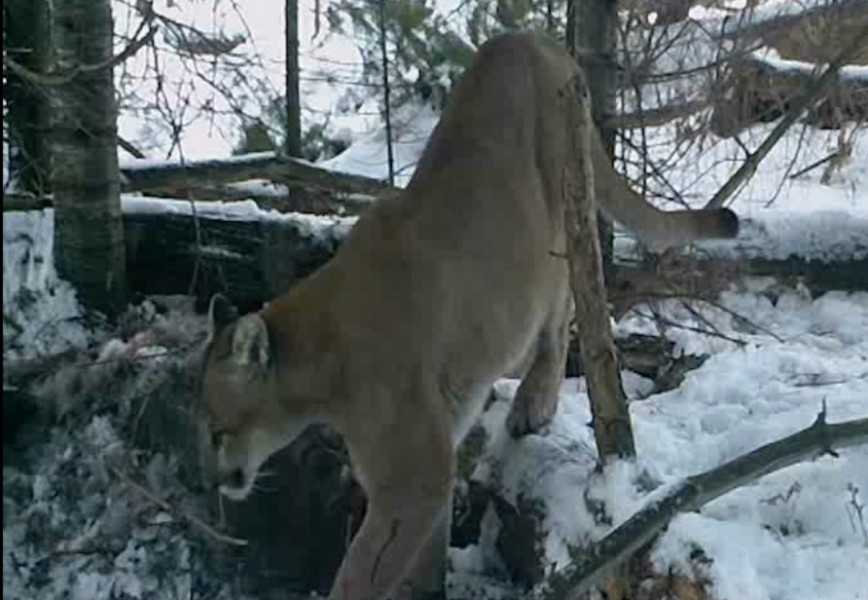
28 verified Puma sightings in Michigan since 2008 but until the Dept. of Natural Resources has a verified picture of a mother Puma with kittens, the Official word out of Michigan is that all of these"Ghost Cats" are "prospectors" from the Dakotas.................I recommend all of you who are interested in whether the Puma is reproducing in Michigan to pick up a copy of the excellent 2005 book entitled BEAST OF NEVER, CAT OF GOD.......An excellent read that stimulates, "dazzles the carrot" and leaves you wanting into the North Woods for an "up close and in person" look for yourself to determine the status of our trophic Puma and whether we have a reproducing population in the East outside of Florida............Geez, we seem to be close,,,,,,,,,Where are those kittens????????????????/

https://www.google.com/url?rct=j&sa=t&url=http://www.outdoorhub.com/news/2015/02/20/mountain-lion-spotted-michigan-hunters-trail-cam/&ct=ga&cd=CAEYAioTMjIxNzQyOTk5NTMzMjU2ODMzODIaNDY5MjBhOTZlZmMxMTU4ODpjb206ZW46VVM&usg=AFQjCNHVtaD-pMLGSygApxctTJgWGAhyHg


Mountain Lion Spotted on Michigan Hunter’s Trail Cam


This mountain lion was found in Michigan's Upper Peninsula late last year.


This mountain lion was found in Michigan's Upper Peninsula late last year.
Mountain lion sightings in Michigan’s Upper Peninsula are rare events (there’s no significant cougar population in the state), but one has been spotted prowling in Mackinac County recently. On Thursday, the Michigan Department of Natural Resources (DNR) confirmed that the large cat recorded by a hunter’s trail camera in December was indeed a mountain lion.
“This marks the 28th time that cougar evidence has been verified in the Upper Peninsula since 2008,” the DNR stated on its Facebook page.
Two hunters from Remus placed the camera near a deer kill site and it recorded footage of a male mountain lion visiting the area repeatedly to take advantage of an easy meal. This is especially significant because the species was thought to have been locally extinct since 1906. The DNR has recorded a slow uptick in sightings over the past seven years. According to wildlife officials, mountain lions were originally native to Michigan but were extirpated near the turn of the twentieth century. Despite this, it seems that a small number of the animals may have moved into the state. Biologists first discovered the presence of cougars in Michigan after one was reportedly struck by a car in 2004. Although the animal was not found, tests of fur samples collected from the car bumper positively identified the animal as a cougar.
Some of the animals may have escaped from private owners, as it is still legal to own a mountain lion brought into the state prior to 2000, when Michigan passed a law to ban the possession of large exotic cats. However, as the years pass, it has become increasingly unlikely that animals found in the wild were once captive. Officials now believe that some of the cats may have made long journeys from states with breeding populations.
“Based on documented evidence, cougars observed in Michigan could be escaped or released pets. Or, they could be transient or dispersing cougars from the nearest known breeding populations in North and South Dakota,” stated the DNR on its website. “These populations are over 900 miles from Michigan.”
Wherever they came from, mountain lions in the Upper Peninsula may face competition from the approximately 630 wolves living in the region. Officials advise residents to report any cougar sightings directly to the DNR.
You can see a 60-second clip of the trail camera footage below.


Michigan DNR releases video of male cougar in Mackinac County (UP)
Detroit News, 2/20/15
Video footage was taken of the cougar at a deer kill site.


FIRST PICTURE BELOW IS VERIFIED DECEMBER 
2014 MICHIGAN PUMA SIGHTING BY DEPT. OF NATURAL
RESOURCES.........PICTURES THAT FOLLOW ARE SOME
OF THE OTHER 28 VERIFIED SIGHTINGS SINCE 2008


From Publishers Weekly

Cougars have long been thought extinct in Michigan, but a coterie of environmentalists and wildlife enthusiasts, led by Michigan Wildlife Conservancy biologist Patrick Rusz, believe otherwise. In this engaging study of a wild animal and its human acolytes, journalist Butz traipses around with Rusz in search of droppings, paw prints, mauled deer carcasses and the testimony of people who have sighted the elusive beasts. He maintains a critical distance from the obsessive and sometimes off-putting Rusz and from his antagonists at the Michigan Department of Natural Resources, who remain dismissive of mounting evidence of the cat's presence. Butz, who was eventually granted his own magical glimpse of a prowling cougar, writes evocatively of the animal's habits and charisma. He makes it the focus of a larger panorama of backwoods northern Michigan, a hunter's paradise, with a quirky population of outdoorsmen and conservationists for whom the cougar offers both the promise and the pitfalls of an element of nature that can't be readily bent to human purposes. The result is a beguiling mixture of scientific lore, meditative natural history and vivid reportage. Photos.
Copyright © Reed Business Information, a division of Reed Elsevier Inc. All rights reserved.

From Booklist

Puma concolor goes by many names: cougar, catamount, mountain lion, and the author's preferred puma. Once found from the Atlantic to the Pacific, it has now been extirpated from the U.S. east of the Mississippi--or has it? An increasing number of people are claiming to have seen one. Nature writer Butz met Patrick Rusz, embarked on proving there were wild pumas in Michigan; he enlisted Butz as a reporter and sometime helper. What follows is a mix of politics (the Michigan Department of Natural Resources and Rusz do not see eye to eye), history (both feline and human), and reporting, interspersed with the author's meditations on the meaning of wilderness and the place for large, toothy predators in the modern age. Nancy Bent
Copyright © American Library Association. All rights reserved

Review

"BEAST OF NEVER, CAT OF GOD is a wonderfully engaging book on the cougar controversy and the pathetically warring factions of believers and cynics who demand a level of proof rarely available to criminal prosecutors."
--Jim Harrison, author of True North

"This is a journey into wilderness and the imagination as serendipitous as The Orchid Thief. Butz's lyricism is matched by his relentless honesty, giving a taut portrait of vivid sinew and rich heart, a beast whose shadows cut across our lives in ways we don't always understand. Butz's soul searching and naturalist's vivid grasp, tooth and nail, breathe the beast to life."
--Doug Stanton, author of In Harm's Way

"The eastern mountain lion haunts our domesticated dreams, infusing our too-tame world with hope and excitement. In BEAST OF NEVER, CAT OF GOD, Bob Butz follows this ghost cat through the woods of Michigan and the thickets of science, politics and the human heart, wrestling with his own skepticism and a belief that the great predator is still out there. Just like the enigmatic animal at its core, BEAST OF NEVER, CAT OF GOD holds and does not let go."
--Scott Weidensaul, author of The Ghost with Trebling Wings: Science, Wishful Thinking and the Search for Lost Species
“[a] fascinating report…”--Grand Rapids Press


"Every now and then a really good writer lifts the veil of mystery on a complex subject. Bob Butz succees at just exactly that in his wonderful book...an honest and absorbing account of his intellectual, emotional and physical journy into the questions."--Grand Rapids Press

From the Back Cover

For the last one hundred years, the puma-also known as catamount, panther, cougar, and mountain lion-has been extinct east of the Mississippi River. Or has it? In the early 1970s, an endangered handful of these 150-pound wildcats was discovered living deep in the palmetto jungle of the Florida Everglades. But elsewhere, and despite a long litany of sightings, tracks, and more recently photographs and video footage, most wildlife biologists and game department officials from New England to the Great Lakes flatly dismiss any notion that the "eastern puma" survives anywhere else in this increasingly fragmented and suburbanized country.
When the most compelling body of evidence yet surfaces to suggest that the government's experts might be wrong, Bob Butz sets out to discover the truth behind what is perhaps the most mythic and misunderstood predator in North America. The result is a weird and wacky glimpse at the people and politics surrounding the so-called "eastern puma." Why do state and federal biologists so often dismiss evidence that pumas are here? Is that denial leaving people at risk? Who are the characters out there looking for pumas-and at what cost to the cat and, ultimately, themselves? The answers reveal a mystery greater and far more complex than anyone ever imagined. It will also leave readers examining their own beliefs.
A journey into the woods, a road trip, a meditation, and an expose, Beast of Never, Cat of God chronicles the search for cougar, while exploring the implications, the myths, and the reality of the creature. It's one man's hunt for truth and wilderness in a place-the East-where true wilderness is thought not to exist.

Thursday, February 19, 2015

The Canadian Province of Ontario begins it's northwest arc of land straddling New York and our Grea Lakes States.......Like it's southern USA neighbors, it is seeing it's Moose population begin to shrink due to winter tic infestations caused by warming temperatures and human alteration of the landscape which allows the Moose to be more vulnerable to predation............Good to see an Ontario biologist(Vince Crichton) not blaming Wolves for the declines but rather pointing to a need to eliminate the hunting season for Moose Calves, which has now been curtailed to just two weeks............As Crichton states: "You've got to get rid of that calf season totally, only for a period of time, until you get that population up"...............

https://www.google.com/url?rct=j&sa=t&url=http://www.cbc.ca/news/canada/thunder-bay/ontario-moose-herd-requires-drastic-measures-expert-says-1.2963287&ct=ga&cd=CAEYASoTMjU1NDk5NzkyMjQzNDk3MDU0NTIaM2JiNTcwMGRiYTRlZTUyZDpjb206ZW46VVM&usg=AFQjCNGJ4Kh96I1mcsrp3Q-_BWBtqABT5Q


Ontario moose herd requires drastic measures, expert says

Vince Crichton supports the Ministry of Natural Resources and Foresty plan but more needs to be done

CBC News Posted: Feb 19, 2015 12:35 PM ET Last Updated: Feb 19, 2015 1:32 PM ET


If Ontario wants to increase the moose population in the province it needs to eliminate the hunt for calves, says a noted Canadian moose researcher and biologist.
The Ministry of Natural Resources and Forestry is proposing a reduction to the calf-hunting season to a two week period this year.
But Vince Crichton said there needs to be a more significant intervention in order to rehabilitate the moose herd.


Vince Crichton, a moose researcher and biologist, said Ontario needs to eliminate the calf hunt in order to increase the moose population in the province
"You've got to get rid of that calf season totally, only for a period of time, until you get that population up," he said.
In the early 1980s Ontario implemented a selective harvest system for moose which brought in allowable harvests and tag quotas.
The system was supposed to double the number of moose in the province from 80,000 in 1983 to 160,000 by 2000, Crichton said. "That has not worked," he said.


The recent proposal by the MNRF to reduce calf hunting is a step in the right direction, but Crichton said he's not convinced it is enough.
Hunters have a greater ability to impact the moose population in the last forty years because of changes in technology and improved road access, Crichton said.
Not so the moose, "since Bullwinkle walked across the Bering Land Bridge 10,000 years ago he hasn't changed," he said.
  1. Map of ontario canada


To hear more on this story the CBC's Outdoor columnist Gord Ellis spoke with Superior Morning guest host Cathy Alex. Click on the link below to listen to that conversation.
http://www.cbc.ca/news/moose-management-in-ontario-1.2963059
-------------------------------------------------------------------------------------------------------------------

Declining moose populations in some areas of Ontario puzzles biologists

The decline of moose populations in certain parts of Ontario reflects a growing concern across some other parts of North America.


Moose populations are thinning out in certain parts of Ontario, mirroring a disturbing pattern across other parts of North America.
Why the numbers are dropping in certain areas — while they are climbing in others — isn’t known.

IBrant Allison, senior northwest regional biologist with Ontario’s Ministry of Natural Resources, says that moose “are important to the biodiversity of the province.” Allison said he is seeing declines in Canadian jurisdictions near Minnesota, including Manitoba and the northwestern and northeastern parts of Ontario.
 
“We are definitely concerned,” he said, adding that biologists in Ontario have been in touch with their counterparts in Minnesota and Manitoba to see what the current research reveals.


“We are watching. They’re still trying to figure it out,” he said.
In the southeast part of Manitoba, some of the moose hunts have been closed for roughly past year.

Although several factors may be at play, climate change has been identified as a possible explanation. In the Cariboo Mountains of British Columbia, a recent study found that an epidemic of pine bark beetles led to a loss of trees and left the moose more exposed to human and animal predators.

Overall, however, the moose population in Ontario is regarded as healthy, with a population estimated at about 105,000, accounting for about 10 per cent of the North American population.

The areas of concern are the northwestern part of Ontario such as the Kenora-Dryden region, as well as an area running along the north shore of Lake Huron, from Sault Ste. Marie and Wawa to the Quebec border.

The Ministry of Nature Resources has identified issues such as habitat, climate, parasites, predation and harvesting by hunters.
On the positive side, moose numbers appear to have increased in the southern portion of the province, particularly in and adjacent to Algonquin Provincial Park.

The ministry monitors moose populations by aerial inventory surveys and post card survey information collected each year from moose hunters.

In the 1980s, Ontario saw the moose population dip to around 80,000. After strict controls were put in place on moose hunting, the numbers climbed back