Visitor Counter

hitwebcounter web counter
Visitors Since Blog Created in March 2010

Click Below to:

Add Blog to Favorites

Coyotes-Wolves-Cougars.blogspot.com

Grizzly bears, black bears, wolves, coyotes, cougars/ mountain lions,bobcats, wolverines, lynx, foxes, fishers and martens are the suite of carnivores that originally inhabited North America after the Pleistocene extinctions. This site invites research, commentary, point/counterpoint on that suite of native animals (predator and prey) that inhabited The Americas circa 1500-at the initial point of European exploration and subsequent colonization. Landscape ecology, journal accounts of explorers and frontiersmen, genetic evaluations of museum animals, peer reviewed 20th and 21st century research on various aspects of our "Wild America" as well as subjective commentary from expert and layman alike. All of the above being revealed and discussed with the underlying goal of one day seeing our Continent rewilded.....Where big enough swaths of open space exist with connective corridors to other large forest, meadow, mountain, valley, prairie, desert and chaparral wildlands.....Thereby enabling all of our historic fauna, including man, to live in a sustainable and healthy environment. - Blogger Rick

Subscribe via email to get updates

Enter your email address:

Receive New Posting Alerts

(A Maximum of One Alert Per Day)

Saturday, October 24, 2015

Little knowledge exists about where songbirds roost at night...........Is it in their daytime home range or someplace different?.............In 2013-14 in the coastal plain of Virginia, Researchers from the College of William and Mary studiied Wood Thrush behaviour during breeding season to get a better handle on this topic...................Their observations reveal tlat females stay in their daytime range and in their nest on top of their eggs in the evenings........... However, Male Thrushes move to more heavily wooded habitat at night to avoid predators................Once Nestlings fledge or are killed by predators, male birds move back to daytime territories during the evenings and roost side by side with their mates ............This change in behaviour occurs because the males do not want another male stealing their mates and impregnating them---# birds sleeping behaviour

http://feedproxy.google.com/~r/sciencedaily/plants_animals/ecology/~3/FIFAbx4_3bc/151021185056.htm?utm_source=feedburner&utm_medium=email


Secret nocturnal lives of wood

 thrushes


Wood Thrush


https://www.google.com/url?sa=t&rct=j&q=&esrc=s&source=web&cd=5&cad=rja&uact=8&ved=0CDkQFjAEahUKEwiR2vT2odvIAhVHGh4KHY4gBLk&url=http%3A%2F%2Fsaintpaulaudubon.org%2Feducation%2Fbird-spotlight%2Fbirds-asleep&usg=AFQjCNGKf71KFtE5HU_KOAakPeeY3GgFvg

Birds Asleep

Night is a dangerous time for birds and many are only half asleep. A bird’s life after dark is hidden from human view, and birds work hard to keep it that way. It’s rare to encounter a sleeping bird, since most are careful to cover their tracks on the way to and from their well-hidden sleeping spots.
Many birds become nervous, even fearful, as dusk approaches, because nighttime is a dangerous time for them. Their daytime vigilance is necessarily lowered as they slumber, leaving them extremely vulnerable to predators. Owls and other creatures that work the night shift are always on the lookout for a quick meal, and a sleeping bird is an easy target.
Birds are careful to select sleeping quarters that offer protection from predators (and weather). Not surprisingly, many birds roost at night in habitat similar to their nesting sites. Outdoor-nesting songbird, such as cardinals, catbirds and robins, lock their feet onto tree branches or twigs in dense shrubbery and doze away the night. Cavity-nesting birds like woodpeckers, chickadees and nuthatches, snooze in tree holes. Some birds that nest on the ground sleep there as well, including meadowlarks, white-throated sparrows, towhees and juncos.
Chimney swifts swirl down into tall chimneys or hollow trees, while many ducks float on water during the night, slowly paddling in place. Crows and other blackbirds gather in large groups, roosting together at the tops of trees. The northern bobwhite has one of the most fascinating sleeping styles in the bird kingdom. These small quail gather in a circle on the ground, heads out and tails in, ready to launch themselves into flight if a fox approaches.

Half Sleep

How deeply do birds sleep? Studies show that many species can sleep with one eye open and half their brain awake. Like marine mammals, they seem able to control this “half sleep” that allows them to remain at least partially alert for danger. They can switch between brain hemispheres to give one half a rest, then turn both off to enter full sleep if they feel safe.
During migration, most songbirds travel at night, which creates a major sleep deficit. They compensate by taking numerous small “power naps” during the day, most only a minute or two in duration. A few birds in the swallow family may even sleep while coasting in the air.
Some birds “talk” in their sleep, and some silently rehearse their species’s song repertoire while sleeping (brain tracking revealed this activity). Often, young birds will sleep bunched up on a branch with their siblings for the first few weeks after fledging, re-creating the shoulder-to-shoulder contact they experienced in the nest.
There’s still a great deal to learn about the sleeping life of birds. We do know that the amount they sleep varies with the seasons (longer sleeps on winter’s long nights) and that migration and nesting seasons push them to the brink of exhaustion.
A bird’s primary goal, as it heads into a tangle of shrubs, a tree hole, or leaf pile to spend the night, is waking up to greet the morning. Birds increase their odds by carefully selecting their sleeping quarters—and coming and going without attracting attention.

Sleep Aids

We can help birds get a good night’s sleep by providing a variety of places to roost in our backyards. Cavity nesters will use roost boxes attached to trees or posts. Find one at a wild bird store or check the Internet for building plans.
Plant evergreens, a great source of shelter in all seasons. Arborvitae shrubs and trees are a good alternative for yards that lack space for a full-sized conifer.
Build a brush pile from tree branches and twigs for shelter, the denser the better. In northern regions, snow accumulates on the pile, creating a “bird igloo.”
Leave nest boxes out at all seasons, since some birds will use them as nighttime roosts after the breeding season.
Val Cunningham, St. Paul MN. Val leads bird hikes for the St. Paul Audubon Society; writes about nature for local, regional and national newspapers and magazines

Thursday, October 22, 2015

The National Park Service is conducting the first urban Coyote Study in Los Angeles,,,,,,,,,,,,Three Coyotes have been fitted with GPS collars and the latest one under investigation utilizes a two mile stretch of land around the Los Angeles River..........Another being studied lives in the Silver Lake section of the city and the third was last heard from(GPS died) just west of downtown L.A.in Westlake, crossing the busy 101 freeway into Echo Park, ......Although the Park Service had previously studied more suburban and exurban living Los Angeles Coyotes over a 8 year period spanning 1996-2004, this is the first ever inner city evaluation of the life cycle habits of the adaptable canid........Biologists are amazed at how with virtually no green belt in the downtown area of the city, Coyotes manage to carve out a living for themselves......Kudos to the Park Service for conducting this study which will help us learn to coexist with our ever present SoCal Coyote population

https://www.google.com/url?rct=j&sa=t&url=http://www.imperialvalleynews.com/index.php/news/california-news/5902-scientists-begin-tracking-la-river-coyote.html&ct=ga&cd=CAIyGjQyMjFiY2NiNTFmYjE5OTM6Y29tOmVuOlVT&usg=AFQjCNFbVGwOAGFPFFld6mR5gg0puCo0hA


Santa Monica, California - As part of their recent efforts to better understand how coyotes survive in extremely urbanized areas, National Park Service researchers recently began tracking a coyote in Northeast Los Angeles near the LA River.
The young female, approximately seven to nine months old, is now known as C-146 because she is the 146th coyote tracked as part of the National Park Service study, though only the third in urban core of Los Angeles. She was captured early on the morning of September 23, outfitted with a GPS collar, and then released in the same location.
"We're very interested to learn how this animal is using the Los Angeles River," said Justin Brown, biologist with Santa Monica Mountains National Recreation Area. "So far all of her recorded GPS locations have been confined to a two mile or so stretch on both sides of the river.


"
Coyote C144 prior to losing the signal emanating from
 his GPS collar

C-146's GPS collar is programmed to record an average of eight GPS locations over a 24-hour period.
Brown believes C-146 is from a pack of at least five individuals, three juveniles and two adults, that was captured on camera together in early September. As a juvenile, she will provide insight into how long the juveniles in this area stay with their parents and what routes young animals may take to disperse and find their own territories.
Although National Park Service researchers studied coyotes from 1996 to 2004 in parts of Los Angeles and Ventura counties, they only began studying urban Los Angeles coyotes in May.
As for the other two animals in the pilot project, researchers continue to track the Silver Lake coyote known as C-145, but the battery in C-144's collar recently failed. C-144, who spent most of her time just west of downtown Los Angeles, is believed to have one of the most urban home ranges of any coyote ever studied and had recently made some interesting movements to the west. 
Read about what researchers learned about C-144 before her collar failed on Gridlocked, the urban wildlife blog of Santa Monica Mountains National Recreation Area.
Coyotes are medium-sized canids that inhabit most of North America. Coyotes in Southern California are often the subject of negative media attention, but serious coyote conflicts with humans are rare. In order to reduce the likelihood of a negative interaction with a coyote, residents should be careful not to feed wildlife, either intentionally or unintentionally. 
Learn more about co-existing with coyotes atnps.gov/samo/learn/management/coyotes.htm.
Santa Monica Mountains National Recreation Area (SMMNRA) is the largest urban national park in the country, encompassing more than 150,000 acres of mountains and coastline in Ventura and Los Angeles counties. A unit of the National Park Service, it comprises a seamless network of local, state and federal parks interwoven with private lands and communities. As one of only five Mediterranean ecosystems in the world, SMMNRA preserves the rich biological diversity of more than 450 animal species and 26 distinct plant communities. For more information, visit nps.gov/samo. 
-------------------------------------------------------------------------------------------------------------------------------------------

Technology giveth and it taketh away. For nearly five months, the GPS collar worn by the coyote known as C-144 provided rich and accurate location data that shed light onone of the most urban coyotes ever studied. 
And then the battery died. Right when it was getting really interesting.
After spending most of her time in the Westlake neighborhood just west of downtown Los Angeles, with occasional forays across the 101 Freeway into Echo Park, C-144 suddenly left her home range and headed west. Her jaunt included traveling through Koreatown, East Hollywood, Larchmont, Windsor Square, and Hancock Park. She returned after just a few days, but the battery in her collar died shortly thereafter

, C-144’s recorded GPS locations from May to late September 2015.
C-144 spent most of her time in the Westlake neighborhood just west of
downtown LA. | Image: National Park Service.


“It’s highly unusual for an alpha female to leave her home range like this,” said Justin Brown, a biologist with Santa Monica Mountains National Recreation Area. “We’d really like to understand why she left her territory, but unfortunately without a working collar we probably will never know.”
Although Brown is unsure why C-144 would move to the west, it’s possible it could have been related to the loss of a mate, a change in the availability of a food source, or an attempt to help pups establish their own territory once they disperse.
Because coyotes are difficult to re-capture and there are limited locations available to capture her  in her home range, Brown is doubtful that he’ll be able to replace her collar. He hopes to capture one of her pack mates in the near future in order to better understand pack dynamics, such as whether the pack will stay together and what happens to young animals that need to find their own home range in heavily urbanized areas.

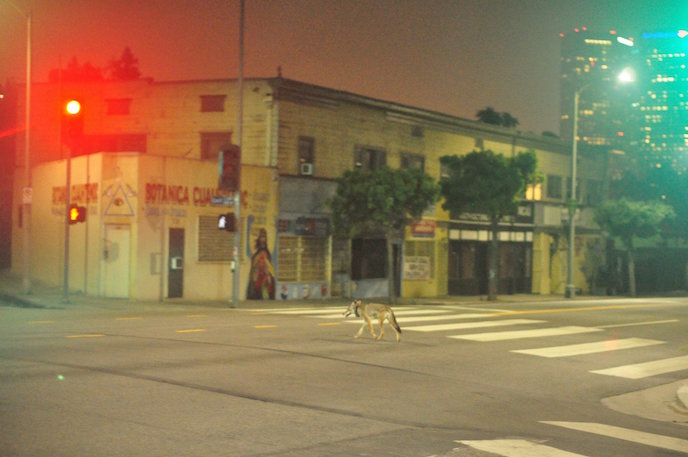
C-144 crosses a Los Angeles street in the early hours of the morning
. | Photo: National Park Service
C-144 crosses a Los Angeles street in the early hours of the morning. Photo: National Park Service
Still, C-144 (and her GPS collar) gave us a glimpse of something incredible: a top predator surviving and caring for her pups in a densely populated area with very little natural habitat -- not occasionally visiting from a more natural area, but actually persisting entirely within the confines of an extremely urbanized habitat. 
We’re grateful for the GPS technology that gave us a peek into her fascinating life and extremely disappointed about the battery that died far too soon.
C-144 crosses a Los Angeles street in the early hours of the morning. | Photo: National Park Service

Wednesday, October 21, 2015

Science actually prevails over special interest politics in Washington State as Govenor Jay Inslee rejects increasing the Puma hunting Quota in the state.............He stares down his Wildlife Commission with facts rather than succumbing to their fiction about the need to kill more Pumas because Wolves also exist in Washington, thus allegedly putting farmers livestock in more jeopardy.............The Governor is squarely on board with the long documented evidence secured by Dr. Rob Wielgus' Washington State University Large Carnivore Lab which consistenly proves that increased cougar removal/killing actually exacerbates risk to the public by creating an unnatural number of juvenile cougars in the population"............... "Juveniles have been shown to be the age class most frequently involved in conflicts with people"---# Cougar hunting/quotas, # Puma hunting increases conflicts with humans and wildlife

https://www.google.com/url?rct=j&sa=t&url=http://www.publicnewsservice.org/2015-10-21/animal-welfare/governor-rejects-increased-cougar-hunting-quotas/a48622-1&ct=ga&cd=CAIyGjFiNzBkMzkxMWFhNmJhZmQ6Y29tOmVuOlVT&usg=AFQjCNHTDevR3LZC1OLo-DIlbpR5cytF2w

Governor Rejects Increased Cougar Hunting Quotas

Gov. Jay Inslee has reversed a decision by the Washington Fish and Wildlife Commission to increase cougar hunting quotas in areas inhabited by wolves. Credit: Wikimedia Commons.

Gov. Jay Inslee has reversed a decision by the Washington Fish and Wildlife Commission to increase cougar hunting quotas in areas inhabited by wolves. Credit: Wikimedia Commons.
October 21, 2015
OLYMPIA, Wash. - Cougar hunting quotas are not going up. Gov. Jay Inslee has overturned a state wildlife panel's decision to increase the percentage of cougars that can in hunted in areas also inhabited by wolves.

Dan Paul, Washington state director for The Humane Society of the United States, said they asked Inslee to intervene because the quotas were increased without first hearing from the public.

"It's really nice to see the appreciation of the public process, which was clearly in violation here," Paul said, "as well as really using science to manage our wildlife and not fear mongering."

The governor's decision on Monday reverses the Washington Fish and Wildlife Commission's decision to increase the quotas 17 percent to 21 percent. Paul said the lower quota of 12 percent to 16 percent satisfies hunters without doing permanent damage to the cougar population.

Killing more cougars goes against the state's own research about balancing the cougar population to minimize conflict with people and livestock, Paul said.

"We did about 13 years of study at Washington State University to come up with these numbers," he said. "It was recommended by the department's own biologists to keep the numbers at 12 to 16 percent, which would be the most effective in keeping the population stable and also avoiding conflict."

Paul said killing more of the larger, "trophy" cats will disrupt the cougar population.

"That allows younger males to move in, but then they'll have conflict over the area," he said. "And so that'll boot out the weaker of the two cougars and they'll typically then run into conflicts either going into cities and towns or they'll have to switch to a prey base like livestock."

The Washington Fish and Wildlife Commission decided this spring to increase the quotas to provide relief to communities bothered by wolves and other predators.
- See more at: http://www.publicnewsservice.org/2015-10-21/animal-welfare/governor-rejects-increased-cougar-hunting-quotas/a48622-1#sthash.G1In4WKU.dpuf

------------------------------------------------------------------------------------------------------------

http://www.predatordefense.org/docs/cougars_biologist_weighs_in_November_2010.pdf


Top Cougar Biologist Weighs in on Oregon’s Cougar Management Plan Posted by Predator Defense, www.predatordefense.org, November 2010 In his report on the Oregon Cougar Management Plan, Dr. Robert Wielgus, Director of the Large Carnivore Conservation Lab at Washington State University, asserted that the Plan, adopted by the Oregon Fish and Wildlife Commission in April 2006, lacks any scientific credibility. He contends that the authors must go back to the drawing board and begin again. “The authors should consult with reputable wildlife scientists and statisticians to obtain a reliable experimental design, analysis, and report. We recommend they consult with Scientists at Oregon State University, University of Oregon, or another research university to design a scientifically credible study.

” Further, he contends that no valid scientific conclusions supporting the beneficial effects of administrative removal of cougars can be drawn from this study. There was no scientific evidence presented that administrative removals achieved any of the stated goals (reduced complaints, livestock depredations, and increased number of elk calves).

Dr. Wielgus’ comments support those made by well-known cougar biologists during the comment period when the Cougar Plan was first introduced in 2005. The Fish and Wildlife Commission chose to ignore scientific concerns and criticisms of the Plan’s population model and methodology, and unanimously approved it. Sadly, the Plan has succeeded in its single focus: to increase cougar killing as much as possible. It is ironic that the purported purpose of the Plan is to increase public safety for two reasons. First, the current target areas, all in remote eastern Oregon, are intended exclusively to kill more cougars in an effort to assist deer and elk hunters by removing competition from cougars and to assist livestock growers using public and private land.

 Secondly, research studies in Washington have shown that increased cougar removal/killing actually exacerbates risk to the public by creating an unnatural number of juvenile cougars in the population. Juveniles have been shown to be the age class most frequently involved in conflicts with people. Although there has never been a documented attack on a person by a cougar in the state of Oregon, the ODFW may be pushing its luck by continuing to manage cougars in a manner that science has found increases cougar-human conflicts. This management strategy puts public safety at risk in favor of deer and elk hunting and livestock production.

Listen to the commentary by Dr. Wielgus by clicking on the link below:

Effects of Sport Hunting on Cougar Population, Community, and Landscape Ecology

Tuesday, October 20, 2015

While all kinds of discussions are taking place at various Conservation Societies and in some State Houses on how to keep the Boreal Forest that blankets Alaska, Canada, Washington, Idaho, Montana and Minnesota(northern sections) from becoming a "swiss cheese, pock marked" inferior version of it's historical self, Dennis Murray, a professor of ecology at Trent University in Peterborough, Ontario, thinks the dying moose of Minnesota and New Hampshire and elsewhere are one symptom of something far bigger – a giant forest ecosystem that is rapidly shrinking, dying, and otherwise changing.............. "The boreal forest is breaking apart," he says........... "The question is what will replace it?"..................Murray has been researching the boreal forest for 25 years, and he and his colleagues have seen many changes firsthand................. "In British Columbia, 80 percent of the province's mature lodgepole, another boreal species, have recently died from the mountain pine beetle, whose range and season both expanded greatly because of a warmer world".............. "White and black spruce, the main trees species in the boreal, are also dying in vast numbers"............. “The southwest Yukon looks dramatically different than it did 25 years ago when I did my master’s [degree]".......... “Everywhere you go there is deadfall"..................Murray’s modeling shows that a large gap is opening in the boreal in Ontario and Quebec, a gap some 500 by 350 kilometers.................. "It will essentially split the contiguous forest into two separate forests — one to the east, the other to the west — as the black spruce and white spruce disappear"................... "That gap could then become grassland or Carolinian, the forest ecosystem that dominates south of the boreal in Ontario, characterized by oak, maple, black walnut and other deciduous species"................. "As the spruce goes, so goes its inhabitants".............. "We're predicting there’s going to be no lynx, moose, or hare in central Ontario in the years to come, “so we’re going to have disjunct populations on either side"................ "It could cause a break between populations of species and a loss of genetic diversity"........... Murray has coined a term for the patchy quality of the effects of warming on the boreal – "climate fragmentation"............. “Because it’s a gradual transition, it won’t be real boreal and it won’t be real deciduous". “Ecosystems will likely be less stable and more open to invasives"


click on this link below to

12 OCT 2015: REPORT

The Rapid and 

Startling Decline
Of World’s Vast

 Boreal Forests

Scientists are becoming

 increasingly

 concerned about the

 fate of the huge

 boreal forest that

 spans from 

Scandinavia to

 northern Canada. 

Unprecedented 

warming in the

 region is 

jeopardizing the

 future

 of a critical 

ecosystem that

 makes

 up nearly a third 

of the earth’s forest

 cover.

by jim robbins

Hare and Ritchie, 1972
The boreal forest extends around the earth at the top of the Northern Hemisphere.


NOAA
White spruce, shown above near the Denali Highway in Alaska, have been dying off in the boreal forest.


Monday, October 19, 2015

While the Wall Street Journal article on "MAINE'S LOBSTER BOOM" does mention climate change and a dearth of predators as contributing factors to the "SURGE", the casual reader comes away feeling that all is well in the waters of Maine and that the abundance and varieties of fish are back to their 16th century abundance..........Lets examine the early history of this fishery and put the Lobster "surge" into proper perspective......... Note that the first Europeans to discover these rich fishing grounds were the Basques, a fiercely independent people from northern Spain................ They had salt, which they used to preserve the fish, and by the year 1000 they had established an international trade in salted cod........... The Basques kept the location of their fishing grounds a secret for over 500 years, but in 1497 Giovanni Caboto, a Genovese known by the Anglicized version of his name, John Cabot, undertook a voyage for Henry VII of England............. Searching for a northern spice route, Cabot instead found 1000 Basque fishing vessels, rocky shores ideal for salting and drying fish, and waters teeming with fish............. A legend swiftly grew that the fish were so abundant that they could be scooped out of the water in baskets.............. Cabot named the place New Found Land and claimed it in the name of England............. Southern Europeans from Spain and Portugal called the country which John Cabot had discovered "Baccalaos", the native name for the cod .............. Sebastian Cabot, son of John Cabot, alleged that these fish were so plentiful that they sometimes stopped the progress of his ships...........The abundance of fish in the New World soon became common knowledge to the people of Europe............... To these fishermen, visions of baskets drawn from the seas slopping over with fish, or of their boats bumping and ploughing with difficulty through "great multitudes of big fishes" must have been as glittering as those of gold, silks, or broad lands were to their betters.............And now 500 years later after exploitation of this resource(similar to that of Bison and our land mammals), the result is that Cod and Shrimp no longer exist in New England in commercially viable numbers, the Lobsters have no enemies and they are basking in artificially warmed waters................Will even this Lobster nirvana come crashing down soon due to our manipulation of the planet and climate change?..............

http://www.wsj.com/articles/maine-lobster-boom-continues-feeding-expanding-market-1445074203

Maine’s Lobster Boom Continues, Feeding Expanding Market

Marine experts cite careful fishery management, warmer sea temperatures and decline in predator fish


Shrimp Down, Lobster Up: Is There a Connection?

A Tale of Two Species
by Bill Chameides | January 9th, 2014 
posted by Erica Rowell (Editor)

Something fishy’s goin’ on with the the shrimp off the coast of Maine.

Maine Shrimpers Cut off
You may have heard, the 2014 shrimp season in the Gulf of Maine, the most southern region where northern shrimp reside, has been called off. On December 3, state regulators in theAtlantic States Marine Fisheries Commission’s Northern Shrimp Section, who set annual catch limits for shrimpers, took a step they hadn’t taken since 1978: they declared a moratorium.
Citing a “collapsed” shrimp stock [pdf], the group’s technical committee noted that the numbers were so low that there was  “little prospect of recovery in the near future” [pdf]. Indeed, as the figure below shows [pdf], the Gulf of Maine’s shrimp stock has declined precipitously since 2007 and is at its lowest level in at least 30 years.
shrimp mortality
Estimates of the northern shrimp stock as a function of year. The dotted biomass threshold line denotes the level below which the fishery is considered to be overfished [pdf] and the dotted biomass limit line indicates numbers at which “the capacity of self-renewal of the stock” is endangered. (Source:Atlantic States Marine Fisheries Commission)
What Could Be Behind the Dwindling Shrimp?
These days when a fishery collapses — for instance, Bluefin tuna,orange roughy, and Canadian cod — it is usually because ofoverfishing. An inspection of the annual northern shrimp haul [pdf] since the 1960s suggests that indeed overfishing may be at least one of the culprits behind Maine’s shrimp collapse.
Between 2007 and 2011, according to state data, Maine’s share of the northern shrimp haul increased 20 percent while the fishery biomass declined precipitously. Higher catch rates could have depleted the population. But the rates of shrimp landings in 2010 and 2011 were nowhere near the highs of the late 1990s, and while the fishery in the 1990s was depleted, the biomass was about 10 times higher than now and the fishery was not closed. Seems that something else in addition to overfishing is at play here.
Some suggestions for that “something else” can be found in the report of the Atlantic States Marine Fisheries Commission [pdf],
“increasing water temperatures and a decline in phytoplankton abundance (a food source for shrimp) are factors which likely have and will continue to contribute to the poor recruitment in the stock. The increased abundance of northern shrimp predators (spiny dogfish, redfish and silver hake) may play a role in declining biomass. Northern shrimp stocks in other areas of the world (Greenland, Flemish Cap, Grand Banks) have also seen decreasing trends in abundance and recruitment, providing additional evidence that environmental conditions are impacting northern shrimp across their range.”
Note the reference to increasing water temperatures. As scientists have been gathering for some time now (see also here), global warming could very well be one of the culprits in Maine’s shrimping woes.
But there’s another part to this story, a somewhat different kettle of fish, but still relevant.

A Lobster Tale 
If Maine shrimp is a delicious coastal treat and a small but important food fish, Maine lobster is world-famous and a point of state pride and identity, even — and an economic force for the state.
My family often summers in the Vacation State on Mount Desert Island. It’s a wonderful locale to be sure but the last two years have had an added attraction: cheap, abundant lobster.
State statistics capture the situation: in recent years Maine’s lobster haul has skyrocketed, resulting in plentiful, inexpensive crustaceans. 2012 was a record-breaker for highest lobster landings and value recorded, beating out previous records in 2011 and 2010 (see graphic [pdf]). Good news for lobster-loving tourists like moi, but not so great for fishers whose livelihoods depend on the higher prices that smaller catches nab.
It’s a Bit of a Puzzle and Maybe an Ironic Solution
While populations of Maine shrimp are dwindling, Maine lobsters are thriving. (Canada’s lobsters are also doing quite well.) So why the glut of Maine lobsters? Theories vary. One holds that it’s due to a decline in the populations of cod, sharks and other predators. Another that warming ocean temperature temperatures speed up the metabolic processes in lobsters allowing them to grow faster. If the latter is correct, it’d be an ironic twist of fisher fate — global warming decimating Maine’s shrimp fishery while enhancing its lobster fishery.
But before all you lobsters out there start cheering on global warming, there’s one more twist to this story to consider.
For Lobster Populations, It’s Location, Location, Location
It turns out that the northeastern United States has three so-called lobster stock areas [pdf]:
  • The Gulf of Maine, the northernmost area, runs from the state’s northern border to the north side of Cape Cod,
  • The Georges Bank area lies east of Cape Cod, and
  • The Southern New England area runs along the coast south of Cape Cod to just north of North Carolina.
While lobster stocks from the Gulf of Maine and Georges Bank areas have been thriving in recent years, Southern New England lobster populations have been dwindling. So much so that the Long Island Sound was closed to lobster fishers last fall.
The Southern New England decline appears to be driven byenvironmental and biological changes [pdf] typified by the spread of a bacterial shell disease, rising ocean temperatures (which may be a root cause for the spread of the shell disease), and a loss in recruitment as spawning has shifted to deeper (and colder) waters. (A similar situation occurred in 1999 with similarly identified culprits but without a shutdown.)
So Are Warm Waters Good for Lobsters?
It’s a pretty strange situation, don’t you think? Warming temperatures are leading to a thriving lobster population in the Gulf of Maine while decimating lobsters further south. How so? Bob Steneck a marine biologist at the University of Maineexplains things like this:
“Anything above 20º C[elsius] is extremely stressful for lobsters. While warmer waters off the coast of Maine in recent years have probably aided the boom in lobster numbers, putting us right in the temperature sweet spot for this species, we’re getting closer and closer to that point where the temperature is just too stressful for them, their immune system is compromised and it’s all over.”
And this is leading many Maine lobster fishers (and lobster lovers like me) to worry. With continued warming, could the disease that’s been helping reduce lobster populations to the south begin to do the same in more northerly waters? The Pine Tree State is a beautiful state, sporting some of the country’s most spectacular wilderness, but without its lobster and shrimp, Maine just wouldn’t be the same. Could it be that going without lobster on a Maine vacation is but one example of the climate adaptations that may be in store?


Sunday, October 18, 2015

Glad to be back online with all of you...........Trouble with my internet service had me "down" since last Wednesday............I start back up with some disturbing statistics from the NATIONAL PARK SERVICE here in Los Angeles(responsible for the Santa Monica Park) revealing that since they began studying the impacts of Rodenticides on Carnivores in 1966, huge percentages of Pumas, Coyotes, Bobcats and Foxes have died from ingesting the poisons that were first eaten by rodents, rabbits, squirrels and small mammals............As of April 2012, 11 of 12 Pumas have tested positive for the poison and two animals have died from it................93 of 105 Bobcats have tested positive with over 70 of these animals perishing from it ..................And 20 of 24 Coyotes tested had the poison in their system and 12 died from it.................Folks, use rat traps to get rid of the mice and rats in your house and barn................STOP USING POISON.............On top of degradation of habitat and climate change, these rodenticides are going to be the knock out punch for our "Impact, Trophic carnivores.................How to exist amongst us and fulfill their ecological services if we conciously poison their food?

[PDF]Lethal Dose: Rat Poison & Local Wildlife

www.nps.gov/samo/learn/news/.../RodenticideInfographic_Apr2014.pdf


Another Victim of Rat Poison?

September 17, 2015 Posted by: Kate Kuykendall,
 Public Affairs Officer

A local resident discovered this gray fox and reported it to our biologists. | Photo: National Park Service
A local resident discovered this gray fox and reported
 it to our biologists. | Photo: National Park Service

When the National Park Service released an image that
 showed the famous Griffith Park mountain lion known
 as P-22 suffering from mange and disclosed that he
 had been exposed to rat poison, biologists hoped the
 unfortunate news would raise awareness about the 
harmful impacts of common household poisons on
 our local wildlife population. 

This week’s report of a dead gray fox brought home
 how far we have to go in educating the community 
about the unintended impacts of using these products 
around homes, parks, and businesses.
A local resident called on Monday to report the dead
 animal, found on private land near Peter Strauss 
Ranch in Agoura. Although the findings are still
 preliminary, the necropsy indicated that the gray 
fox likely died as a result of exposure to anticoagulant
 rodenticide (this is the more formal term for the rat
 poisons that use blood thinners to kill the animal).
 The gray fox had internal bleeding and did not
 have any signs of other trauma (such as injury 
from a vehicle, other animal, etc.). Testing the
 liver for poison residues will help confirm the 
cause of death.
National Park Service researchers havebob
 documented widespread exposure to anticoagulant 
rodenticides since they began studying carnivores
 in and around the Santa Monica Mountains in 1996.
 The graphic below summarizes this research and 
Infographic: Rat Poison and Local Wildlife
Despite the fact that we’ve only studied a limited 
number of gray foxes, this is not the first time we’ve
 documented the poisoning of a local gray fox. Back
 in 2008, biologist Joanne Moriarty conducted a
 necropsy on GF-29 (the “GF” stands for gray fox), 
an animal she had first caught near Westlake Village. 
In that case, the animal had such significant internal
 bleeding that blood was actually coming out of its
 ears and mouth (anticoagulants block the vitamin 
K cycle, which is critical for allowing the body’s 
blood to clot).
GF-29’s ear shows signs of external bleeding and bruising. Anticoagulant rodenticides interfere with blood clotting. | Photo: National Park Service
GF-29’s ear shows signs of external bleeding and
 bruising. Anticoagulant rodenticides interfere with
 blood clotting. | Photo: National Park Service

Although these photos and details can be disturbing (and 
these are the sanitized photos that do not show blood
 throughout the abdominal cavity and elsewhere), it’s 
critical that the public understands the unintended
 consequences of using these poisons.
So please share this blog post with others and learn
Although we think P-22 has recovered, it’s likely that
 he continues to be exposed to poisons left out by
 local residents and other property owners. 
Let’s see what we can do to change that.
-------------------------------------------------------------------


-2013/poisons-used-kill-rodents-have-safer


Poisons Used 

to Kill Rodents

 Have Safer 

Alternatives

A second generation of 
ultra-potent rodenticides 
creates a first-class crisis
 for people, pets, and wildlife