Visitor Counter

hitwebcounter web counter
Visitors Since Blog Created in March 2010

Click Below to:

Add Blog to Favorites

Coyotes-Wolves-Cougars.blogspot.com

Grizzly bears, black bears, wolves, coyotes, cougars/ mountain lions,bobcats, wolverines, lynx, foxes, fishers and martens are the suite of carnivores that originally inhabited North America after the Pleistocene extinctions. This site invites research, commentary, point/counterpoint on that suite of native animals (predator and prey) that inhabited The Americas circa 1500-at the initial point of European exploration and subsequent colonization. Landscape ecology, journal accounts of explorers and frontiersmen, genetic evaluations of museum animals, peer reviewed 20th and 21st century research on various aspects of our "Wild America" as well as subjective commentary from expert and layman alike. All of the above being revealed and discussed with the underlying goal of one day seeing our Continent rewilded.....Where big enough swaths of open space exist with connective corridors to other large forest, meadow, mountain, valley, prairie, desert and chaparral wildlands.....Thereby enabling all of our historic fauna, including man, to live in a sustainable and healthy environment. - Blogger Rick

Subscribe via email to get updates

Enter your email address:

Receive New Posting Alerts

(A Maximum of One Alert Per Day)

Monday, November 23, 2015

"There are a lot of reasons why the song dogs(Coyotes) sing".............. "Seasonal and diet patterns. Lunar phase. Social status"................ "The music plays a role in territorial maintenance and family-unit spacing, signals the sex and motivation of the caller"............ "In one study, scientists documented 11 distinctive vocalization patterns, each with its own behavioral context".......... "In another, they noted that barks were used to convey alarm or agonistic intentions, while howls were used to convey more general information over long distances"........... "That the songs often contain barks and howls gives some sense of how rich and detailed this language is"............. "This is who I am, this is where I am, this is what I’m doing, this is how I’m feeling"

http://northernwoodlands.org/editors_blog/article/song-dogs#.VlP9hCzNuKU.email

Song Dogs
Three a.m. and the room was dark save for weak moonlight through the north window. The little wolves had moved into the corn stubble and their cries had jarred me awake again. Technically they’re coyotes, but we call them song dogs. The song dogs had moved into the corn stubble to mouse and their cries ricochet around the room.
The blue Russian cat, at the foot of the bed, he had the wild eyes then. The moon was just bright enough to see his body curled against my feet. When I stirred, his shape melted and reformed with a light thump on the floor. He slunk to the door, belly low to the ground, eyes like black moons. I rose and cracked the door; watched him snake into the night. Some think that you shouldn’t let your cat out when the song dogs are crying, but my tom hears something in those howls that seems important to indulge.
There are a lot of reasons why the song dogs sing. Seasonal and diet patterns. Lunar phase. Social status. The music plays a role in territorial maintenance and family-unit spacing, signals the sex and motivation of the caller. In one study, scientists documented 11 distinctive vocalization patterns, each with its own behavioral context. In another, they noted that barks were used to convey alarm or agonistic intentions, while howls were used to convey more general information over long distances. That the songs often contain barks and howls gives some sense of how rich and detailed this language is. This is who I am, this is where I am, this is what I’m doing, this is how I’m feeling.
Some people say they sound like aliens when they cry. They hold the notes in the back of their throat, and when the sound wrenches free it falls out of their muzzles in haphazard patterns. To make a sound like a wolf, you howl through a pursed mouth, your tongue flat, your lips like an O. To make a sound like a coyote you open your mouth as wide as it’ll go, curl your tongue back on itself, then push the sound through your tongue while contorting your jaw and lips. Sometimes it sounds like a real wolf and sometimes it sounds like a woman screaming and sometimes it sounds like wind through the eaves of an old farmhouse.
Most of us have a simian reaction when they hear the coyotes sing. Our neck hair stands up as our bodies try to look bigger, which is funny because we lost our fur millions of years ago and ironic because coyotes do the same thing. But then that human consciousness bit kicks in and we recognize the sound as a source of strange beauty. Then what? Rest our chins on our pillows and stare off through the window, scanning the meadows, eyes like black moons. Maybe we elbow our partner and find they’re already wide awake, face full of wonder on good nights, or restless, if life is in a Virginia Wolff way.
I can never see the little wolves through the window because they like to run along the meadow’s edge with the shadows of the trees. Plus my eyes aren’t good enough in the low light. But I can track them by their sound and imagine them working the hedgerow, pawing the mice from beneath the round bales, skirting up and down the sides of the snow-covered manure pile. Eventually, I stop looking and lie back down and just let the sound dominate the room. Open the window a crack, maybe, to smell the cold air, to feel the outside on my skin. 
When the song dogs wake you, you have 3 a.m. thoughts, which are never easy. Sometimes you think about work. Or her. Or him. Or money troubles. Sometimes we notice the webbing that keeps us in bed while our tom cats, unencumbered, heed the call of the wild and run headlong into the night. 
But on the good nights you’re still half asleep. And the sound just rolls over you. And you’re soon off again, hunting the hedgerows out in Butternut Gutter, or singing soulful songs on a veranda with the disappeared. And your lady, she’s peaceful too, off running with these little wolves through her own dreamscape, closed eyes aflutter with every howl, lips parted slightly to reveal the hint of a canine tooth.
“Wa-ya-ha.” The coy-wolf. Hear them now as the down blanket and the faint stars and the night air amalgamate with your dreams.

Sunday, November 22, 2015

Rupert(Rupe) Cutler is one of our Blog readers with solid carnivore and land protection credentials..........He has taught environmental planning at Michigan State University, supervised the U.S. Forest Service as assistant secretary of agriculture, headed Defenders of Wildlife, and currently serves on the board of the Blue Ridge(Virginia) Land Conservancy..........Rupe's fine Op Ed piece focusing on the possibility of Pumas returning to the Appalachians appeared in Sundays ROANOKE(VIRGINIA) TIMES.......Most Puma researchers and carnivore spcialists(including Rupe) feel it will take decades( perhaps a 100 years?) for puma recolonization of the east...... As Females do not readily leave their natal birth regions and with the most easternmost Puma breeding colonies in the Dakotas and Nebraska under intense human hunting pressure, I think we will have to transplant females into the Appalachians if in fact we want a breeding population to once again call the east home during our lifetime


From: Rupert Cutler ;
Date: November 22, 2015 at 1:58:37 PM PST
To: ;rick.meril@gmail.com
Subject: Re: Coyotes,Wolves,Cougars..forever!

Rick, you're welcome to post my piece on cougars.

I enjoyed putting the panel of speakers together at Ferrum College.

Lots of folks hereabouts swear they've seen cougars, as you might imagine.

I agree it will be a long time before we see them here breeding.  Meanwhile, we can protect wilderness!

Rupe

Cutler: Are there mountain lions in Virginia?

Print
Font Size:
Default font size
Larger font size
Posted: Sunday, November 22, 2015 2:00 am

By Rupert Cutler
A lot of people think they’ve seen a wild mountain lion in Virginia.

The scientists tasked with keeping track of our native fauna with trail cameras say, “No, you haven’t.”
As moderator of a “panther symposium” in October at Ferrum College, where athletic teams are known as Panthers, I asked biologists on the panel who have years of data from cameras stationed along game trails in western Virginia from the Potomac River to the Smokies to give it to us straight regarding the presence or absence here of the critter variously called mountain lion, cougar, puma or panther.


Virginia Tech Wildlife Professor Marcella Kelly works among pumas in Central and South America. Since 2002, she and Tech students have maintained a motion-sensitive camera grid around Mountain Lake and throughout the nearby region. They’ve recorded bears, bobcats and coyotes, but no cougars. Her conclusion: “If you have a verifiable population, you will get photographs. We don’t have cougars here.”
Bill McShea, Senior Wildlife Ecologist for the Smithsonian Institution’s Conservation Biology Institute at Front Royal, has has come to the same conclusion. “You’re more likely to see an armadillo here than a cougar.” He’s counted three armadillos, but no cougars, with trail cameras in western Virginia over many years of looking.
McShea acknowledged the situation may change. “The males are coming,” he noted. (There have been verified observations of cougars recently in Connecticut, Ohio, Kentucky and Tennessee.) “But it takes two to tango,” meaning there won’t be little cougars here until females in the West decide to make the same cross-country trip a few adventurous young males have made recently.
A long-held view of the cougar is that of menace to the economic interests of man. As I was reading John James Audubon’s “Delineations of American Scenery and Character” in preparation for making a talk on Audubon at the Taubman Museum of Art, I ran across Audubon’s essay, “The Cougar.” Looking for new bird species to draw in Mississippi, Audubon encountered a settler who complained of a cougar’s “ravages” on his free-ranging pigs and calves. Audubon “offered to assist him in destroying the enemy” and joined a group of local hunters in tracking the cougar with dogs, shooting it out of a tree, and giving the carcass to the dogs to eat.


Contrast Audubon’s 1820s view of cougars with Aldo Leopold’s 1940s view of the importance of all species. Wildlife biologists regard Leopold’s book “Sand County Almanac” as a sort of Bible and frequently quote his line, “To keep every cog and wheel is the first precaution of intelligent tinkering.” He meant every species, including the cougar, has value and serves a purpose in the web of life.
I asked the Ferrum panelists for their personal views as to what position Virginia should take on the classification of the cougar if and when it does return. Should it be treated legally as a protected endangered species, as a game animal with open and closed seasons and bag limits, or as a nuisance animal with no protection? They said the public’s attitude will determine public policy, and that it will be influenced by whatever public education program about cougars is put in place before a new generation of cougars is born here.
Chris Bolgiano of Fulks Run, a freelance nature writer who co-edited the book “The Eastern Cougar,” observed that there is no public support for the reintroduction of cougars in the East now, and that rural citizens here will need time to get used to the idea of the presence of this solitary, wilderness-seeking creature and understand the slim chance of any negative interaction with cougars should they return.
Bolgiano predicted that the conventional anti-predator bias will fade and recommended, as a first step toward a sustainable cougar population here, that its habitat be protected through designation by Congress of as much National Forest wilderness as possible, noting that Southern Appalachian forests are uniquely diverse and deserve protection with or without cougars. She thinks that the return of a native predator, the cougar, would be “very good news.”
Panelist Jim Parkhurst, an associate professor of fish and wildlife conservation at Virginia Tech and director of Tech’s Center for Human-Wildlife Conflict Resolution, summarized the message of the Ferrum symposium with these observations:


“As a society, we need to have a serious discussion of what we do if [cougars] show up. We have done a less than stellar job of interacting with coyotes [and need to do better with cougars]. Perhaps the cougar can reassume its former ecological role as a keystone predator to help restore balance to herbivore [deer] populations [but] there will never be many of them because they require large territories. Somebody is going to have to start making decisions.”
Should cougars return, farmers with livestock near forests may need guard animals, fencing and protected birthing sites. Hunters may regard cougars as competitors for “their deer” but like the prospect of an additional “trophy” opportunity. Hikers and joggers may need to be aware and know how best to respond. Children in cougar country will need parental supervision. An educational program is needed.
There is value in thinking ahead, now, while we have fair warning that cougars are likely to show up here any day. My view is that they should be welcomed back into our forest ecosystem as an interesting and long-lost but valuable member of the team of predators that helps keep prey species in balance with their food supply.
As Parkhurst concluded, “We need to have a plan in place, proactive, ahead of time.”
Interested public, the ball is in your court now.


Cutler taught environmental planning courses at Michigan State University, supervised the U.S. Forest Service as assistant secretary of agriculture, headed Defenders of Wildlife, and served on Roanoke City Council. He now serves on the board of the Blue Ridge Land Conservancy.


Saturday, November 21, 2015

The Fungus OPHIDOMYCES OPHIODICOLA is as lethat as they come causing 100% mortality in snakes that get infected east of the Mississippi.............Impacting all species of snake, researchers state that this fungus has always existed in the soil...........What exactly has caused it to become a death sentence for snakes is not currently known..............The damage the disease does is brutal and recognizable, with severe skin lesions, swelling, and contortion after an infection reaches the bones of its victims............... This disease has already spread to at least 15 states and is believed to attack the snakes as they come out of hibernation, a time when their immune systems are at their weakest..............Like White Nose fungus in Bats and the fungus infecting frogs and salamanders, is the snake fungus now a killer due to our land changing and climate changing activities?

http://app.getresponse.com/click.html?x=a62b&lc=LvKLO&mc=IC&s=9yWxmR&u=Yy3s&y=P&


Researchers Confirm Snake Fungal Disease Culprit

By Dana Kobilinsky


Image Credit: Sharpj99, licensed by cc 2.0
Researchers have identified the fungus that’s causing snake fungal disease, an emerging disease in the eastern and midwestern United States that causes lesions on a number of snake species.
While past research has confirmed the fungus Ophidiomyces ophiodiicola in the snakes’ lesions, researchers hadn’t tested whether the fungus is the agent causing the disease. “Just because something is correlated with disease, doesn’t necessarily make it the causative agent,” said Jeffrey Lorch, a microbiologist at the United States Geological Survey National Wildlife Health Center and lead author of the study published in mBio, an open-access journal of the American Society for Microbiology.
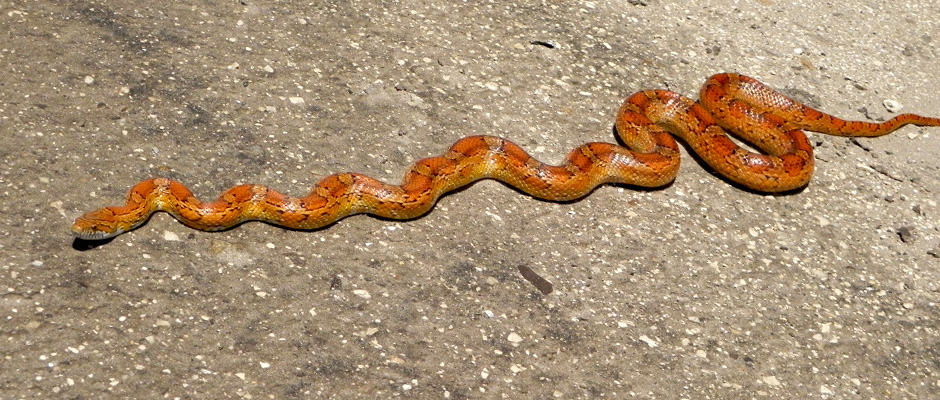
Lorch, a member of The Wildlife Society, was able to prove this. With his research team, Lorch took healthy corn snakes (Pantherophis guttatus) bred in captivity and exposed them to the fungus to see if they developed the same clinical and microscopic signs of the disease. After touching fine grain sandpaper to the snakes’ skin to create abrasions, researchers inoculated the fungus onto the snakes’ skin. “We also put it on the animals that didn’t have their skin abraded,” Lorch said. The team also had a control group that wasn’t exposed to the fungus at all.
The snakes with abraded skin were more likely to come down with the infection, Lorch said. In the wild, Lorch said that it probably isn’t uncommon for snakes to develop the small cuts they simulated in the experiment by simply from crawling on the ground. The team found that none of the snakes from the control group contracted the disease, while all of the ones in the experimental group did.
The team was also surprised by some of their observations in the laboratory. They saw snakes that were infected were exposed in certain areas of their cages although there was no basking light or heat gradient. In the wild, snakes have been observed doing similar abnormal behaviors such as basking in winter when they should be hibernating. “It’s interesting that we saw this in the lab, too,” Lorch said. With this knowledge, some biologists have proposed opening forest canopy where some rattlesnake dens are becoming shaded, so the snakes’ get more sun exposure to fight off the infection.
They also found that the snakes exposed to the fungus molted almost twice as frequently as the control group, which was abnormal. They were likely doing this in an attempt to shed the fungus from their skin, Lorch said.
“There was strong evidence before that showed the fungus probably was the cause,” Lorch said. “But we didn’t have complete confirmation. Now that we know, we can focus our attention specifically on that fungus and its interactions with snakes that result in disease progression.”
-------------------------------------------
https://www.google.com/url?sa=t&rct=j&q=&esrc=s&source=web&cd=5&cad=rja&uact=8&ved=0ahUKEwiunbjrp6PJAhUIWx4KHYRqBQcQFgg2MAQ&url=http%3A%2F%2Fwww.natureworldnews.com%2Farticles%2F15719%2F20150719%2Fdeadly-fungus-killing-snakes-leaves-none-alive.htm&usg=AFQjCNEPE1YUBhMtRCTz9yXsm6n7NJMxHQ


Deadly Fungus is Killing US Snakes, Leaves None Alive

Jul 19, 2015 04:06 AM EDT
rattlesnake
(Photo : Pixabay)
It's very rare for a disease to boast a 100 percent mortality rate. Rabies, for instance, is considered thedeadliest disease in the world and even it has seen a handful of exceptionally lucky survivors. However, in the case of a new fungal disease sweeping through North American snakes, experts are reporting only death and more death.
"Reports of fungus on snakes started trickling in a few years ago, and there has been some concern that this represents a new emerging threat," David Stern, a herpetologist at Auburn Universityrecently explained in the University of Washington'sConservation Magazine.
And there is certainly a lot of reason for concern. Fungal diseases have recently been ravaging amphibian populations across half the globe, and while that wouldn't include snakes, it does set a precedent for taking fungal epidemics seriously. (Scroll to read on...)

Scientists actually first started investigating the "snake fungal disease" (SFD), as it's now called, in the early 2000s. Within that time, Florida wildlife officials reported disturbing mass deaths of pygmy rattlesnakes - first a clutch of 42, and later 59 more carcasses.
ADVERTISING
The damage the disease does is brutal and recognizable, with severe skin lesions, swelling, and contortion after an infection reaches the bones of its victims. This allowed experts to quickly catch on to the fact that SFD has already spread to at least 15 states, and affects everything from poisonous rattlers to garter snakes, rat snakes, and even  rare ribbon varieties.
When researchers turned their attention to a small population of timber rattlesnakes in New Hampshire displaying these symptoms, they witnessed the disease kill more than 50 percent. The remaining survivors, while having been exposed to the disease, had never become infected themselves. That is to say, every snake that contracted the disease quickly died.
According to a study recently published in the journal Fungal Ecology, the fungus behind SFD survives by eating keratin - the stuff that makes up both human fingernails and snake scales. Normally happily residing in soil, the opportunistic fungus likely attacks snakes just exiting hibernation - a time when their immune system isn't fully revved up, and they have a nice full set of scales for munching on.
"Mortality," the researchers wrote, "appears to be 100 percent."
The concern now is not that the disease is here, but that it's prevalence is being underestimated. As any gardener or outdoorsman will know, snakes are by-nature tough to find in the wilderness. And if they can't be surveyed, how will scientists ever know an epidemic is on hand until it's too late? For now, it seems like we'll just have to wait and see.