Visitor Counter

hitwebcounter web counter
Visitors Since Blog Created in March 2010

Click Below to:

Add Blog to Favorites

Coyotes-Wolves-Cougars.blogspot.com

Grizzly bears, black bears, wolves, coyotes, cougars/ mountain lions,bobcats, wolverines, lynx, foxes, fishers and martens are the suite of carnivores that originally inhabited North America after the Pleistocene extinctions. This site invites research, commentary, point/counterpoint on that suite of native animals (predator and prey) that inhabited The Americas circa 1500-at the initial point of European exploration and subsequent colonization. Landscape ecology, journal accounts of explorers and frontiersmen, genetic evaluations of museum animals, peer reviewed 20th and 21st century research on various aspects of our "Wild America" as well as subjective commentary from expert and layman alike. All of the above being revealed and discussed with the underlying goal of one day seeing our Continent rewilded.....Where big enough swaths of open space exist with connective corridors to other large forest, meadow, mountain, valley, prairie, desert and chaparral wildlands.....Thereby enabling all of our historic fauna, including man, to live in a sustainable and healthy environment. - Blogger Rick

Subscribe via email to get updates

Enter your email address:

Receive New Posting Alerts

(A Maximum of One Alert Per Day)

Tuesday, March 28, 2017

Our continuing publication of biologist (LANDSCAPE OF FEAR co-author) John Laundre continues today with his unmasking just how much fake news is coming out of the Outdoor Magazine Industry...............Simultaneously headlining articles about TICK-BORNE DISEASES PROLIFERATING as well as LANDOWNERS GRANTING PERMISSION TO HUNTERS TO KILL MORE CARNIVORES ON THEIR LAND in the latest issue of GRAND VIEW OUTDOORS MAGAZINE has John debunking the hypocrisy revealed ................You cannot have it both ways meaning that "as deer populations go up(ticks depend on deer in part of their life cycle), so do tick populations and so do incidences of tick-borne diseases"...............As an example, "Pennsylvania currently has 1.5 million deer, around 32 deer per square mile!".............. "And surprise surprise, Pennsylvania is one of the states with the highest incidence of these tick-borne diseases!"........... "What should be done? That number of deer should be reduced by at least half!"............." A density of 15 deer per square mile is still high but better than 32!"................ And there would still be plenty of deer for hunters to stalk!"............. "There would still be over 750,000 deer in the state(and most probably, a significant reduction in tick borne diseases like Lyme)."

Interesting parallel headlines

by: John Laundre

Well the ragazine Grand View Outdoors (GVO) has done it again! In complete innocence and I might add, ignorance, these two headlines appeared together on their website: "New tick-borne diseases are sweeping the U.S". and "4 tips for securing predator hunting permission". Unfortunately, they didn't even see the irony, the hypocrisy of this placement! I really do sometimes wonder about their name "Grand View Outdoors" when they obviously have a pretty narrow view of the outdoors and how nature works. Such things make me realize that they and hunters just don't get it! So let's draw the lines, connect the dots for them! 

There are currently an estimated 30 million deer in the U.S.Many states have over a million deer with densities as high as 100 deer per square mile!  Now a hunter would say…GREAT! Better chance of me killing one!  But the rest of us and the science clearly see that THERE ARE JUST TOO MANY DEER OUT THERE. AND, line to first dot…most of those tick-borne diseases are transmitted by the…deer tick! Yes, a tick that depends on deer in their life cycle. 

Next line, next dot. As deer populations go up, so do tick populations and so do incidences of tick-borne diseases. It is simple epidemiology of disease transmission. We have known for a long time now that as a population increases, so does the transmission of diseases. This is what has happened to the deer population and…to us! There are just too many deer!
 Graphic showing the life cycle of blacklegged ticks frfom eggs to larva to nymph to adult and back to eggs.


Next line, next dot…the solution? Duh, this is a no-brainer, or it should be. Significantly reduce the deer population! And I mean significant! For example, Pennsylvania currently has 1.5 million deer, around 32 deer per square mile! And surprise surprise, Pennsylvania is one of the states with the highest incidence of these tick-borne diseases! What should be done? That number of deer should be reduced by at least half! A density of 15 deer per square mile is still high but better than 32! And there would still be plenty of deer for hunters to stalk! There would still be over 750,000 deer in the state! 

Next dot…how do we do it?  We know it has to be done, we know it should be done, at least most of us! But how? It is obvious that the hunters have the answer…they can do it! They are always saying let them manage the wildlife with the gun. They know best. They know how nature works, blah blah blah.In fact, some states are advocating that hunting be the ONLY way to manage wildlife, but that is another topic for another day. 

The simple question, however: Can hunters do it? Can game agencies significantly reduce deer numbers through hunting, for public safety? It turns out this line does NOT connect to that dot! The reason is that there is a minor detail the agencies and the hunters fail to mention. They don't want lower deer numbers. They want more! Through their "satisfaction surveys" agencies know what deer hunters want and what they want are more deer! In fact, the whole deer hunting industry is built around maintaining too many deer on the landscape. So even if the hunters could do it, they can't because they don't want to do it. They would continue to sacrifice public safety for "harvest opportunities", for "hunter satisfaction".
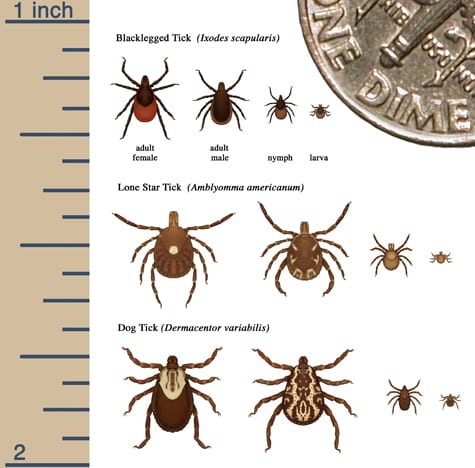
 Graphic showing relative sizes of several ticks at different life stages.
This can be seen in all the "management objectives" MO's, for deer of the game agencies. In most cases, they are set at current levels of deer or even higher! And if they dip below those levels, the hunters begin to howl! Up until the last couple of years, states were wringing their hands, pointing their fingers, writing dire headlines, "Deer Declines" oh my, oh deer! Hunters started complaining, even more than usual.  In efforts to stem the tide of declining deer numbers and increasing complaints, agencies reduced hunting, increased killing predators, to get those deer numbers back up again. But even at their lowest numbers, there were still over 30 million deer! By all accounts, THERE WERE STILL TOO MANY DEER! But the hunters wanted more! And now, because of better weather, the numbers are back up again, much to the pleasure of the agencies and the hunters! So no, that line does not connect, hunters nor the agencies they control will ever agree to significant reductions in deer numbers. They will continue to sacrifice public health for their "hunter satisfaction".

Ticks obliterating Deer's face


And now the final line, the final dot…the predators. The one connection hunters just don't seem to make. Why would someone who professes to know how nature works, who understands that there are too many deer, who accepts thathunters can never reduce deer numbers sufficiently, turn around and want to kill predators who eat deer? This is the irony of the two articles. It is obvious that the main driving force behind hunters wanting to gain access to private lands is to kill more predators. It is also apparent through other articles in GVO that one cannot kill enough predators. As the readers of Grand View Outdoors, hunters, obviously don't make the connection, let me briefly explain.  IF as hunters proclaim, predators are so good at killing deer, then we need more predators, not less! This is the hypocrisy of the two articles. Remember for the health of us all, to stop the sweep of tick-borne diseases, we need to reduce the number of deer…a lot! And predators can provide that service! But hunters not only refuse to make that connection, but continue to encouraging the excessive killing of predators.Why? To protect the deer of course, to protect their "hunting opportunities". To hell with public health!

Ticks overwhelming Fawn's eyes and ears


The best thing to happen for human health safety in the East for example is for wolves and cougars to return! Unlike hunters, they work 24/7, 365! Their life depends on catching deer!  And the nice thing, as the science indicates, it is all self-regulating, there is no need for human management! For a variety of reasons with not enough space here to explain, predators CANNOT, WILL NOT kill all their prey. What happens is they reach a balance, a balance that has been honed evolutionarily through time. A balance that allows for deer and their predators to coexist at ecologically sustainable levels, levels that promote human health safety, not hinder it.  

Wolves are needed in our woodlands to reduce deer herds and tick-borne diseases


So, that is the irony, the hypocrisy of the side by side articles in Grand View Outdoor. Raising the alarm of a growing health epidemic while actively promoting the thwarting of the only true solution to that epidemic, convinces me that hunters know nothing about how nature works nor do they care about how much society has to pay for their "hunting opportunities". That is also a topic for another time.

Pumas are needed in our woodlands to reduce deer herds and tick-borne diseases


Game agencies, catering to the desires of hunters of "more game for the bag", have made it unhealthy, unsafe for the rest of us to go into the woods! And they will continue to do this with their MO's that promote hunter satisfaction at the expense of public human health. Until these agencies "connect the dots", more than the lip service they give it in their propaganda, and seriously address significant reductions of deer numbers, we will continue to see not only tick-borne diseases sweeping across the U.S. but also increasing incidences of deer diseases like Chronic Wasting disease. Only when we see game agencies and hunter organizations actually advocate for the protection, the reintroduction of predators to these systems will I see hope that they have finally begun to connect the dots. Finally begin to understand how nature works.
--------------------------------------------------------------------------------


The Landscape of Fear: Ecological Implications of Being Afraid


The Open Ecology Journal, 2010, 3: 1-7

John W. Laundre, Lucina Hernandez, William J. Ripple

Department of Biological Sciences, SUNY Oswego, Oswego, NY 13126, USA.

Electronic publication date 3/2/2010

Abstract:
“Predation risk” and “fear” are concepts well established in animal behavior literature. We expand these concepts to develop the model of the “landscape of fear”. The landscape of fear represents relative levels of predation risk as peaks and valleys that reflect the level of fear of predation a prey experiences in different parts of its area of use. We provide observations in support of this model regarding changes in predation risk with respect to habitat types, and terrain characteristics. We postulate that animals have the ability to learn and can respond to differing levels of predation risk. We propose that the landscape of fear can be quantified with the use of well documented existing methods such as givingup densities, vigilance observations, and foraging surveys of plants. We conclude that the landscape of fear is a useful visual model and has the potential to become a unifying ecological concept.

--------------------------------------------------------------

https://www.google.com/url?sa=t&rct=j&q=&esrc=s&source=web&cd=14&cad=rja&uact=8&ved=0ahUKEwifuq3w9_nSAhUljVQKHQTxBzkQFghWMA0&url=http%3A%2F%2Fwww.cdc.gov%2Fticks%2Flife_cycle_and_hosts.html&usg=AFQjCNHKvuZLLYVb0mxWYia2Usjq7NslWQ&sig2=Ld86PmyyVLtTdrYgcmbk1w&bvm=bv.151325232,d.cGw

Life cycle of Hard Ticks that Spread Disease

Most ticks go through four life stages: egg, six-legged larva, eight-legged nymph, and adult. After hatching from the eggs, ticks must eat blood at every stage to survive. Ticks that require this many hosts can take up to 3 years to complete their full life cycle
 Graphic showing relative sizes of several ticks at different life stages.


 Graphic showing the life cycle of blacklegged ticks frfom eggs to larva to nymph to adult and back to eggs.


Monday, March 27, 2017

“The last word in ignorance is the man who says of an animal or plant, "What good is it?",,,,,,,,,,,,,,, "If the land mechanism as a whole is good, then every part is good, whether we understand it or not",,,,,,,,,,,,. "If the biota, in the course of aeons, has built something we like but do not understand, then who but a fool would discard seemingly useless parts?",,,,,,,,,,,,"To keep every cog and wheel is the first precaution of intelligent tinkering.” ― Aldo Leopold, from the Journals of of famed 20th century ecologist, Aldo Leopold...............And Leopold could not have been more right as we now learn that two bird species, the Pygmy Nuthatch and the Black Capped Chickadee are true "holistic healers of Western Ponderosa Pine forests........."These year round residents scour the bark, branches and needles of ponderosa pines for insects, boosting the growth rate of the trees by one-third"..........."Not only do the birds gobble insects, they also somehow prompt the tree to change the chemistry of the terpenes the trees produce to battle insects, fungus and mistletoe"....... "So the little birds effectively boost the trees’ immune systems"............... "Furthermore, the chickadees and nuthatches also disrupt the remarkable relationship between some species of ants and aphids".......... "The ants “herd’ the aphids, protecting them from predators like ladybugs and lacewings and even taking the tiny, leaf-sucking aphids back down into their ant hills for safe-keeping at night"..................."In return, the aphids produce a sweet drop of “honeydew” to feed the ants".................. "However, the chickadees and nuthatches prey on the ants and aphids, triggering big declines in the aphid populations — thereby enhancing the growth of the trees".........And even when the trees die, they are "safe houses" for the chickadees and Nuthatches against the killing cold of Winter............The Forest Service has come to learn that "cleaning up the forest" via removing dead snags and slash on the ground is counterproductive to optimizing the population of the very birds who bring life-giving and economic vitality to the Forest


The tiny friends of a forest giant

    by: Peter Aleshire 

The massive Ponderosa Pines dominate the forests of Northern Arizona, but recent research suggests they depend critically on the smallest of birds.


Spring dawns — heaven for birders. Some 200 species will flock through the Arizona high country on their way north, following the river corridors like the East Verde, the Verde and the Salt. They’ll drop from the bright blue sky in their brilliant plumage — yellow tanagers, scarlet cardinals, painted redstarts, sassy orioles. They winter in the tropics where life is easy — and venture north only when the cottonwoods and sycamores leaf out.
But despite the flash of color from our fair-weather friends, I vow to not forget the humble birds of winter — the hardworking chickadees and nuthatches.
After all, these plucky survivors deserve the credit for knowing and loving this forest — like the overlooked descendants of the ranching families who made a hard living in a stingy land.
Turns out, these overwintering, bug-eating, ponderosa pine loving itty, bitty brown birds contribute mightily to the health of the forest, according to researchers from the University of Colorado Boulder, writing in the scientific journal Ecology.
Pygmy nuthatches spend all year hunting insects on the bark of ponderosa pines. In the process, the tiny birds boost the growth of the pines significantly, recent research shows


The researchers discovered that the efforts of these tiny birds to scour the bark, branches and needles of ponderosa pines for insects boost the growth rate of the trees by one-third.
Not only do the birds gobble insects, they also somehow prompt the tree to change the chemistry of the terpenes the trees produce to battle insects, fungus and mistletoe. So the little birds effectively boost the trees’ immune systems. Furthermore, the chickadees and nuthatches also disrupt the remarkable relationship between some species of ants and aphids. The ants “herd’ the aphids, protecting them from predators like ladybugs and lacewings and even taking the tiny, leaf-sucking aphids back down into their ant hills for safe-keeping at night. In return, the aphids produce a sweet drop of “honeydew” to feed the ants. However, the chickadees and nuthatches prey on the ants and aphids, triggering big declines in the aphid populations — thereby enhancing the growth of the trees.
Black-capped Chickadees enhance the growth of ponderosa pines by harvesting insects, but depending on things like the hollows in dead snags to get through the winter


For three years, the researchers swathed trees in mesh to exclude the birds from ponderosa pine limbs of 42 trees in an experimental Forest Service plot in northwest Colorado. They also could exclude ants — so they could separate the impact of the birds from the impact of the ants, which also prey on other insects.
They found the trees without their bird protectors had 18 percent less foliage and 34 percent less wood growth over the course of the three years. The dogged researchers collected some 300,000 insects representing 300 species, a measure of the complexity of the world created by the ponderosa
Now, here’s another interesting little footnote to the study, which underscores the complexity of playing God in managing a complex system like a ponderosa pine forest.
Those overwintering birds barely make it through most winters and die in droves in cold years. They survive the cold by dramatically slowing their metabolism at night and huddling together in hallows and beneath layers of bark — found mostly on dead snags. Sometimes 100 birds will pile into such refuges in squeaky bundles of feathers, brothers, sisters, uncles, cousins — once and twice removed. In addition, they stash seeds in the easy times in hidden places for those bleak days of winter — again often taking advantage of the nooks and crannies of the snags.

Dead standing trees(snags) are
critically important homes and
safe havens for birds and animals


However, for decades the Forest Service paid loggers extra to cut down dead snags, thinking they would attract lightning strikes and start fires. Only after decades of pursuing this wrong-headed strategy did researchers discover that these dead snags and fallen trees offer those most important and productive wildlife habitat in the forest.


White Headed Woodpecker making a home
for itself in Ponderosa Pine snag


So, I can’t promise I won’t get distracted by the showy cardinals, with their flaming head pieces and their piercing call.
But I’ll still listen for droll, rubber-ducky calls of the pygmy nuthatches, knowing you can’t judge a bird by its feathers and owe the most in the end to the friends of the hard times.

Friday, March 24, 2017

A friend of this Blog, Dave Skryja turned me onto the recent John Benson led U. of Nebraska Study reinforcing the fact that Eastern Coyotes, while capable of preying on deer, are not a viable substitute to Eastern Wolves as it relates to being a true trophic predator of Deer, Moose, Elk and Caribou......................In Benson's own words------------"Wolves rely on large prey to survive whereas the smaller size of coyotes appears to give them dietary flexibility to survive on a wider variety of food and prey sizes, making them less predictable predators of large prey"............The eastern wolf weighs between 50 and 65 pounds; the eastern coyote typically hits 40 to 50".......... "Though the extra weight gives eastern wolves a greater chance of killing a moose, it also demands the greater caloric intake that moose and other meaty prey can provide".........."Because wolves need to feed on large prey, their populations tend to rise and fall together"............."In contrast, the buffet-style menu of the eastern coyote means that its numbers can remain steady or even rise without large prey if alternative food is abundant"..............."If coyotes start hammering white-tailed deer, and deer start to decline, then (coyotes) can just eat rabbits or squirrels or garbage"............."Our work suggests that there's an ecological role that wolves play that won't be played by other animals"............. "That's probably a role that's worth conserving on landscapes"


23-Mar-2017

Big-game jitters: Coyotes no match for wolves' hunting prowess

Eastern coyote lacks the chops to replace wolves in the ecosystem

Lincoln, Nebraska -- It may have replaced the dwindling eastern wolf atop many food chains, but the eastern coyote lacks the chops to become the big-game hunter of an ecosystem, new research led by a University of Nebraska-Lincoln ecologist shows.

Eastern wolves once roamed forests along the Atlantic coast, preying on moose, white-tailed deer and other hooved mammals collectively known as ungulates. As the wolf population plummeted via the rifle and the trap, however, the eastern coyote inherited the status of apex predator in those habitats.


Eastern Wolf killing White Tail Deer


But a study from John Benson and colleagues provides evidence that the eastern coyote hunts moose and other large prey far less frequently than does the eastern wolf -- instead preferring to attack smaller game or scavenge human leftovers.

The findings help resolve long-standing questions about whether eastern coyotes have filled the ecological niche left vacant when the eastern wolf became threatened, Benson said.


"Wolves rely on large prey to survive," said Benson, assistant professor of vertebrate ecology who conducted the research as a doctoral student at Trent University. "But the smaller size of coyotes appears to give them dietary flexibility to survive on a wider variety of food and prey sizes, making them less predictable predators of large prey.

"Having a top predator that preys consistently on large animals like deer and moose may be an important part of maintaining stable predator-prey dynamics and healthy, naturally functioning ecosystems."

Eastern Coyote with Canadian Goose kill


After GPS-tracking 10 packs of eastern wolves and analyzing their kill sites in Ontario, the team estimated that the wolves consumed 54 percent of their ungulate meat from moose and 46 percent from white-tailed deer. By contrast, eight packs of eastern coyote ancestry that occupied separate but neighboring territories got just 11 percent of their ungulate meat from moose and 89 percent from deer.


Eastern Wolf with White Tail Deer kill


The eastern wolf weighs between 50 and 65 pounds; the eastern coyote typically hits 40 to 50. Though the extra weight gives eastern wolves a greater chance of killing a moose - or at least surviving the encounter - it also demands the greater caloric intake that moose and other meaty prey can provide.

Because wolves need to feed on large prey, their populations tend to rise and fall together, Benson said. Wolves may kill many moose during a winter, for instance, depleting their numbers. With fewer moose available, the wolf population declines, boosting the moose population, which in turn boosts the wolf population, and so on.

Eastern Coyote killing mouse


Yet the buffet-style menu of the eastern coyote means that its numbers can remain steady or even rise without large prey if alternative food is abundant. This opportunistic diet, Benson said, might also be driving erratic population swings among those lower on the food chain.

"It's important to understand the role that wolves play in ecosystems and to not assume that smaller predators ... perform the same ecological functions," Benson said. "If coyotes start hammering white-tailed deer, and deer start to decline, then (coyotes) can just eat rabbits or squirrels or garbage but continue to prey on deer, too. So we think that could be a destabilizing element.

Eastern Wolf with Moose Kill


"There are some areas where you've got way too many white-tailed deer in the east, and then you've got other areas where hunters are concerned because the deer are declining. That speaks to the fact that coyotes are an unpredictable predator."

The study is timely: Canada recently designated the eastern wolf as threatened, with the vast majority of eastern wolves living protected in Ontario's Algonquin Provincial Park.

Human-caused mortality has limited efforts to expand the population beyond Algonquin Park, Benson said, which is made worse by the fact that wolves there are likely naïve to the dangers posed by humans. Another issue: Eastern wolves readily breed with eastern coyotes in the wild, making it difficult to maintain a pure lineage.

 Eastern Wolves hunting Beaver


"Is there a way to get them to expand numerically and geographically outside of the park? We're not sure at this point," said Benson, who provides advice to a team now developing a recovery plan. "One thing that can be managed is human-caused mortality, so if we can provide additional protection, that should put them on equal demographic footing.

"It's an incredibly challenging situation that is complicated by the interactions of these wolves with coyotes and humans. If the park stays the same, there's no immediate reason that they would go extinct. However, we wouldn't want to go forward with that as our only plan because it offers little chance for expansion."


Eastern Wolf


Though large-scale reintroduction across eastern North America will probably not occur soon, Benson said the study emphasizes the value of preserving delicate predator-prey balances that ecosystems have calibrated over millennia.

"Our work suggests that there's an ecological role that wolves play that won't be played by other animals," he said. "That's probably a role that's worth conserving on landscapes, even outside protected areas. If we're interested in restoring landscapes to a more natural, functioning ecosystem, this would be an important part of that."

######################

Benson authored the study with former doctoral adviser Brent Patterson, a research scientist at the Ontario Ministry of Natural Resources and Forestry; Karen Loveless of Montana Fish, Wildlife and Parks; and Linda Rutledge of Trent. The team's paper was featured in the journal Ecological Applications.  


Thursday, March 23, 2017

https://www.google.com/url?rct=j&sa=t&url=http://tucson.com/news/local/time-to-look-at-reintroducing-jaguars-here-enviro-groups-say/article_e194f847-d7d9-5b75-97a3-9e03a9e6b398.html&ct=ga&cd=CAEYACoTMzM3ODA1NTMyMjAzNTM2NDY4MjIaMjBiYjVlNzQwZDFkODQ2Mzpjb206ZW46VVM&usg=AFQjCNG51PtMP7Qqz1568E6tl7zMH8Tm6w


Environmental groups say more research is needed on reintroducing jaguars to Southwest


Rintroducing the jaguar into the United States is an idea whose time has come, says a Tucson-based environmental group.
A national conservation group says it’s at least an idea worthy of more analysis than the federal government has given it.


The U.S. Fish and Wildlife Service, which manages endangered species, doesn’t agree. It says the best use of its resources is to focus on what it sees as the jaguar’s core areas in Mexico, not on “secondary” jaguar habitat in the southwestern U.S.
The debate over bringing jaguars from Mexico to the Southwest comes as part of a larger discussion of the federal government’s draft jaguar recovery plan. That plan, released in December, advocates putting the most energy toward jaguar recovery in Mexico, where most borderlands jaguars live.
The Center for Biological Diversity and the Defenders of Wildlife said in their written comments on the plan, and in a separate report by Defenders, that more attention needs to be paid to bringing back jaguars in the Southwest, including possible reproduction.
Reintroduction of predators has always been a hot-button issue here. It took more than a decade for environmentalists and federal biologists to get a Mexican wolf reintroduction program started because of controversy over the wolf’s impacts on livestock. It remains controversial today although wolf populations are slowly recovering.
Jaguars are in better shape in the U.S. today than wolves were before reintroduction started. Only seven Mexican wolves remained in 1980 when the last five were pulled out of the wild to be put in captive breeding facilities. About 4,000 jaguars are known to live in Mexico today, but only seven, all males, have been confirmed to be living in Arizona and New Mexico since 1996.
Defenders doesn’t advocate reintroduction now, but “we are calling on (Fish and Wildlife) to do a scientific, objective analysis and we’d like to see their work reviewed by an independent, scientific body,” said Rob Peters, Defenders’ Southwestern representative. The 508-page jaguar recovery plan didn’t discuss reintroduction, he noted.
The seven known Southwestern male jaguars are believed to have come from northern Mexico. But “I think it’s very unlikely” that natural jaguar migration from Mexico alone will bring this country a breeding population soon, Peters said.
Younger female jaguars “set up their home ranges next to mom,” and don’t disperse at anywhere near the rate of young males, Peters said. In a paper, the late Peter Warshall, a longtime Tucson scientist, calculated that it would take 44 to 200 years for females to migrate north to the U.S., Peters noted. Warshall was science coordinator for the Northern Jaguar Project, which runs a major jaguar preserve in northern Sonora.

Pause
Current Time0:00
/
Duration Time0:00
Loaded: 0%
Progress: 0%
0:00
Fullscreen
Bringing jaguars into Arizona could help the northern Sonora population, which faces threats from poaching, said Michael Robinson, a conservation advocate for the center. Assuming the animals can travel back and forth between the two countries, having a U.S. breeding population could improve the Mexican population’s genetic diversity, he said.
The jaguar’s increased presence here at the top of the food chain could also benefit the overall ecosystem, Robinson said.
“They evolved in the United States with all other animals and plants, over many thousands of years and the ecosystem adapted to their presence over that time,” he said.
When the recovery team conducted rigorous jaguar population and habitat studies, it concluded resources are best spent in core areas in Mexico, “and not to the translocation of jaguars in secondary areas and certainly not in areas outside of where they can most meaningfully contribute to recovery of the species,” service spokesman Jeff Humphrey said Tuesday.
The recovery team, including U.S. and Mexican biologists, focused their strategy on sustaining habitat, eliminate poaching and improve social acceptance of the jaguar in Mexico, Humphrey said.
“Their rationale is that our limited dollars are best spent on making those populations as robust as possible rather than manufacturing new populations in a range that may no longer be appropriate,” Humphrey said.
With the Mexican jaguar population in some jeopardy, “it seems like we ought to take care of what’s already here first,” agreed Bill McDonald, executive director of the Malpais Borderlands Group, which seeks to promote open space conservation and “working landscapes” for ranchers and others along the border.
The group has no position on reintroduction, “but I think you should stabilize the population that gets the occasional male up here,” he said. “It’s ridiculous to hopscotch jaguars hundreds of miles north to try to make that work. It’s putting the cart way before the horse.”
But Sergio Avila, a longtime jaguar biologist, said while more specific analysis of jaguar behavior is needed for reintroduction to be seriously considered, it’s one of many “tools in the toolbox” worth considering.
“Because we have open space where they can set up territories, protected areas and environmental laws here, because we have healthy populations of wild prey here, and because we have connections to the south and we have habitat,” reintroduction could be worth it ecologically, said Avila, an Arizona Sonora Desert Museum research scientist.