Visitor Counter

hitwebcounter web counter
Visitors Since Blog Created in March 2010

Click Below to:

Add Blog to Favorites

Coyotes-Wolves-Cougars.blogspot.com

Grizzly bears, black bears, wolves, coyotes, cougars/ mountain lions,bobcats, wolverines, lynx, foxes, fishers and martens are the suite of carnivores that originally inhabited North America after the Pleistocene extinctions. This site invites research, commentary, point/counterpoint on that suite of native animals (predator and prey) that inhabited The Americas circa 1500-at the initial point of European exploration and subsequent colonization. Landscape ecology, journal accounts of explorers and frontiersmen, genetic evaluations of museum animals, peer reviewed 20th and 21st century research on various aspects of our "Wild America" as well as subjective commentary from expert and layman alike. All of the above being revealed and discussed with the underlying goal of one day seeing our Continent rewilded.....Where big enough swaths of open space exist with connective corridors to other large forest, meadow, mountain, valley, prairie, desert and chaparral wildlands.....Thereby enabling all of our historic fauna, including man, to live in a sustainable and healthy environment. - Blogger Rick

Subscribe via email to get updates

Enter your email address:

Receive New Posting Alerts

(A Maximum of One Alert Per Day)

Friday, May 26, 2017

"Teeth can tell a lot about a species’ line of work — particularly what they eat and how they catch their dinner".................. "Teeth are action-oriented; incisors nip and gnaw, canines stab and hold, premolars cut, sheer, slice, and grind, molars mash and crush".............. "Teeth forms hint at a species’ evolutionary story and crown wear can tell much about the age of an animal"..........." For example, deer and other herbivores that dine on abrasive foods — tree buds, inner bark, seeds, roots and shoots, leaves, woody stems, grasses — show rates of premolar and molar wear that are predictable and measurable".................... "Animals particularly long in tooth may have molars worn down to the bone".................... "Rodents, on the other hand, have “rootless” incisors or molars, and the crowns continue to grow, keeping up with wear"...................... "Aging a beaver using incisor wear wouldn’t work for that reason"


49
Mammal Teeth
Illustration by Adelaide Tyrol
When my daughter was four, she once asked, “Do mice get cavities?” We were coming back from the dentist, so teeth were on her mind and so were mice, since her pet mouse had recently escaped. Later in the day, she asked if ducks had teeth; such is the ranging nature of her intellect.
Why all the toothy questions? Because our teeth are interesting. Ask a dentist. And so are the teeth of our wild neighbors. Teeth can tell a lot about a species’ line of work — particularly what they eat and how they catch their dinner. Teeth are action-oriented; incisors nip and gnaw, canines stab and hold, premolars cut, sheer, slice, and grind, molars mash and crush. Teeth forms hint at a species’ evolutionary story, and crown wear can tell much about the age of an animal. For example, deer and other herbivores that dine on abrasive foods — tree buds, inner bark, seeds, roots and shoots, leaves, woody stems, grasses — show rates of premolar and molar wear that are predictable and measurable. Animals particularly long in tooth may have molars worn down to the bone. Rodents, on the other hand, have “rootless” incisors or molars, and the crowns continue to grow, keeping up with wear. Aging a beaver using incisor wear wouldn’t work for that reason.
Back in college, as a wildlife ecology student, I had to learn how to identify mammal skulls, and teeth cusp patterns were often important clues. Students were encouraged to make our own skull collections. That was the fun part. But what I remember most were hours in the lab at night, learning dental formulas and laboring over rows of small rodent skulls that all looked the same. I passed that class but only by the skin of my teeth.
I had occasion to think about mammal teeth again recently when the snow finally melted off the lawn. That’s a great time to inventory the winter activities of some of the small mammals that make up our backyard biodiversity. Little piles of dirt on top of the dead grass are the leavings of tunneling eastern and star-nosed moles. On rare occasions, I’ve found an expired mole on the surface and been able to examine its teeth. Moles are some of our smallest, most primitive mammals. They live secretive lives. With the adaptation of very large, webbed forefeet, they can tunnel 100 feet a day. Their method of movement is a bit like doing the breaststroke underground.
Did you ever wonder how moles work all that soil up to the surface? Here’s how Alfred J. Godin, author and illustrator of Wild Mammals of New England, describes the process: “When a pile of dirt has accumulated, the mole turns around in a half-somersault and pushes the dirt [to the surface] with one of its forepaws, with the head and shoulders turned to one side.”
Moles eat mostly soft foods. Earthworms make up the majority of their diet. But they also eat a range of insects – adults, larvae, and pupae. Their teeth have to perform a diverse set of functions: first capturing that toothsome worm with backward arching incisors that push it farther back into the mouth cavity; then dicing, slicing, and mashing. The premolars of moles are sharply differentiated from the molars, with ridges shaped like a tiny w.
The other evidence we find at snowmelt is the surface roads of meadow voles. Voles are enthusiastic path-makers that rarely make it into the fortress of the house, unlike white-footed mice, house mice, and deer mice. Instead, they create labyrinthine patterns of shallow runways. Here and there, round balls of dried grass mark their nests, which may be underground as well. Meadow voles, one of the most abundant mammals in New England, are mostly herbivorous, dining on seeds, bark, tubers, grasses, sedges, and grains — i.e., food that does not run away — so most of the work of the teeth is in the crushing action of the molars. These are continuously growing, while their incisors are deeply rooted. The crowns of the molars are intricate, with four triangular-shaped cusps and a posterior loop.
But getting back to the most central questions here: Do mice get cavities and do ducks have teeth? I believe I told my daughter that mice probably don’t get cavities, that dental hygiene is probably the least of their concerns, and that ducks don’t have teeth, though back when birds were deciding whether to be dinosaurs or their own class of animals, they did have teeth — rows of sharp, conical, reptilian teeth. In modern birds, duck’s teeth would be about as rare as hen’s teeth. I think, for a very brief period of time, those answers satisfied her.
Tim Traver, a past executive director of the Vermont Institute of Natural Science, lives with his family in Taftsville, Vermont. His recent book Lost in the Driftless, Trout Fishing on the Cultural Divide is available here.

Thursday, May 25, 2017

"American forests are under attack by invasive, tree-killing insects and disease-causing organisms that originated in other countries"............. "According to the U.S. Department of Agriculture’s Animal and Plant Health Inspection Service (APHIS), more than 400 non-native insects and 24 non-native pathogens are now permanently established in North American woodlands"........... "Some of these species have become invasive, spreading rapidly and causing significant economic and ecological impacts to the nation's forest and wildlife"............. "In the past dozen years, 28 new tree-killing pests have been detected in the country". ............. "Some of the species at risk are the foundation of ecologically unique species assemblies, such as the “high-five” pine species in the mountains of the West; hemlock groves in the Appalachians, tanbark as the only hardwood/hard mast species in the predominantly coniferous forests of northern California and Whitebark Pine, whose seeds in the Inter-mountain West are a critical food source for the remaining 750-1000 Grizzly Bears remaining alive in the lower 48 States"..............."Imported nursery stock—trees, shrubs, garden plants, roots and cuttings brought in from other countries for sale to the U.S. consumer—is one of two chief pathways that bring invasive insects and diseases into American forests"............. "Once the pests are established, their eradication is, at a minimum, costly and politically difficult"............... "Often it is simply impossible".................."The loss of nuts and berries formerly produced by vanishing or severely reduced tree species has had a poorly documented but surely substantial impact on forest wildlife species"............."At the beginning of the 1900s, the American chestnut was one of the most important wildlife plants of the Eastern United States (Martin and others 1951)"............... "With this tree practically exterminated by the exotic chestnut blight, mast-dependent forest wildlife such as white-tailed deer and black bears had to settle for inconsistent acorn and hickory nut crops as their primary food (Clark and Pelton 1999)".......... "The blight almost certainly reduced the carrying capacity of southern highland habitats for mast-dependent wildlife"............ "The blight is thought to have caused at least five indigenous insect species to become extinct or extremely rare"


All over America, a range of human-caused maladies, fatal ozone depletion, ultraviolet rays, acid rain, and the disastrous aftermath of clear-cuttinghas brought tree death and forest decline in its wake. Veteran environmentalist Charles Little explores the phenomenon and concerned response (or lack thereof) . What emerges is a sobering account of the implications for the future of our planet.


Fading Forests III 
American Forests: 
 What Choice Will We Make? 
2014
Faith Thompson Campbell, Ph.D.
The Nature Conservancy
4245 N Fairfax Dr #100
Arlington, VA 22203
http://www.nature.org/ & www.dontmovefirewood.org

and
Scott E. Schlarbaum, Ph.D.
Department of Forestry, Wildlife & Fisheries
Institute of Agriculture
Knoxville, TN 37996-4563
http://treeimprovement.utk.edu/FadingForets.htm


Trees and forests are essential to the American way of life. They provide shade and shelter, jobs and
products, and clean air and water. From tree-lined neighborhood streets to national parks, Americans
count on trees to provide benefits today and for generations to come. Today many of North America’s
trees and forests are being destroyed by non-native insects and diseases. These invaders are removing
entire species of trees from our forests and neighborhoods threatening air, water, economies, and the
quality of life in our communities.

 In the past dozen years, 28 new tree-killing pests have been detected in the country.


pathogen causing oozing through bark--SUDDEN OAK DEATH in California


Over 2-5 years, SUDDEN OAK DEATH kills Oaks


Once introduced, pests impose continuing, often rising, impacts over time. For example, white pine
blister rust, introduced 100 years ago, continues to spread to new geographic areas and new vulnerable
pines. These non-native insects and pathogens can essentially eradicate species from throughout their
ranges. The USDA Forest Service’ Forest Health Enterprise Team’s 2012 report projects mortality across
90% of the basal area of redbay within 15 years.

 Some of the species at risk are the foundation of ecologically unique species assemblies, such as the “high-five” pine species in the mountains of the West; hemlock groves in the Appalachians; and tanbark as the only hardwood/hard mast species in the predominantly coniferous forests of northern California.
--------------------------------------------------

 https://www.google.com/url?sa=t&rct=j&q=&esrc=s&source=web&cd=5&cad=rja&uact=8&ved=0ahUKEwjD6r6Ok-HTAhVRymMKHXfSDfsQFgg2MAQ&url=https%3A%2F%2Fcontinentalforestdialogue.files.wordpress.com%2F2015%2F03%2Founce_of_prevention_final.pdf&usg=AFQjCNEp_ZoueEJBgR7cKCof4m_cZHvphg

How to Stop Invasive Insects and Diseases 
from Devastating U.S. Forests
-------------------------------------

Sassafras tree dying from Laurel Wilt Disease


----------------------------------------------------

http://harvardforest.fas.harvard.edu/publications/pdfs/Foster_Arnoldia_2014.pdf

Hemlock: A Forest Giant on the Edge
David R. Foster, Editor

 Eastern hemlock (Tsuga canadensis) is an iconic tree species in northeastern
forests and the Appalachian Mountains. It has faced peril in the past but is now faced with
perhaps its most deadly threat—the invasive and devastating insect pest, hemlock woolly
adelgid. In this new book, Harvard Forest director David Foster and several colleagues and
scientific collaborators explore the history and ecology of and challenges to the majestic
eastern hemlock.


Dead and dying Hemlock via the sucking insect--The Wooly Adelgid


------------------------------------------------------
AMERICAN CHESTNUT BLIGHT

Chestnut decline, attributed to blight, is caused by an Asian bark fungus (Cryphonectria parasitica), which was unknowingly imported from Asia on infected Chinese Chestnut trees. While the Chinese variety adapted and developed a sturdy resistance to the blight, the American chestnut was no match for it.
Chestnut Blight in Adams County Ohio
The disease was first documented in 1904 on trees in the Bronx Zoo. The airborne blight was spread by downward winds. It spread 50 miles a year, and, within a few decades, had killed nearly three billion chestnut trees. It particularly devastated trees in the Appalachian region, where up to 25% of the trees were American Chestnuts. The spread of the blight resulted in billions in crop and lumber losses, as well as a decline in wildlife populations that fed off the nuts.
A Healthy Chestnut tree


Wednesday, May 24, 2017

Tim Hiller, a wildlife biologist and founder of the Wildlife Ecology Institute, began studying the Sierra Nevada red fox in 2012. He said he plans to capture and radio-­collar eight more foxes within a year to continue the study. “We don’t know their population status,” Hiller said. “Nobody has a clue.”

https://www.google.com/url?rct=j&sa=t&url=http://registerguard.com/rg/news/local/35604488-75/rare-foxes-spotted-in-oregon-may-help-california-population.html.csp&ct=ga&cd=CAEYACoUMTQwMTYyNTU3NzY3NzczNDAxMTUyGjE4MTdiNjk3ZGJjNWE0ZTk6Y29tOmVuOlVT&usg=AFQjCNGcTO2GkUtQP2hDwWnm48Qd-qnVIw


Rare foxes spotted in Oregon may help California population


BEND — Biologists are hoping a rare subspecies of foxes spotted in Oregon can help boost their number in California. 
Biologists captured and radio-collared two of the Sierra Nevada red foxes found in Oregon, The Bulletin reported. There are believed to be fewer than 50 of the foxes in Northern California.


----------------------------

Sierra Nevada red fox (Vulpes vulpes necator)

Update September 2010...new siting of Sierra Nevada red fox living in Sonora Pass area! See story, below...

Threats

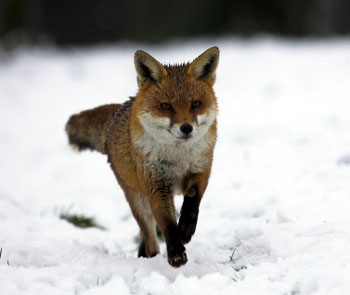
Red FoxThe Sierra Nevada red fox is distinguished from members of the introduced lowland population of red foxes by its slightly smaller size and darker colored fur.  Red fox fur was sought after by trappers during the early part of last century because it was softer than California’s grey fox. Sierra Nevada populations have been reduced by grazing in meadows, which reduces prey populations, and by trapping, logging, and recreational disturbances. Human activities of any significant degree in areas of core habitat will certainly put pressure on this highly endangered species. Given the low numbers of the Sierra Nevada red fox and the increase of non-native red fox population, particularly in the Central Valley of California, competition from this non-native species is increasingly a concern for the Sierra Nevada subspecies.

Habitat

The range of the Sierra Nevada red fox is limited to the conifer forests and rugged alpine landscape of the Sierra Nevada and Cascade ranges between 4,000 feet and 12,000 feet. Preferred habitat for the Sierra Nevada red fox appears to be red fir and lodgepole pine forests in the subalpine zone and alpine fell-fields of the Sierra Nevada. Open areas are used for hunting, forested habitats for cover and reproduction. Edges are utilized extensively for tracking and stalking prey. The red fox hunts in forest openings, meadows, and barren rocky areas associated with its high elevation habitats. Found mostly above 6,000 feet in the summer months, Sierra Nevada populations were historically found in a variety of habitats, including alpine dwarf-shrub, wet meadow, subalpine conifer, lodgepole pine, red fir, aspen, montane chaparral, montane riparian, mixed conifer, and ponderosa pine. Jeffrey pine, eastside pine, and montane hardwood-conifer also are used. This species is known to inhabit vegetation types similar to those used by the marten and wolverine. The range of the Red fox is from the northern California Cascades eastward to the northern Sierra Nevada and then south along the Sierran crest to Tulare County.

Conservation

The current range and distribution of Sierra Nevada red fox is unknown.  Because of this and the scientific certainty of its hazardously low numbers, greater research is needed to ascertain the full extent of the red foxes range. Recent research conducted in the vicinity of Lassen Peak, has begun the process of understanding exactly how rare the native Sierra Nevada red fox is. This research conducted in the late 1990’s estimated that only 10-15 individuals were likely present in the Lassen Peak area--a number certainly low enough to cause concern over the possibility of localized extinction and highly endangered status throughout its historic range. Other historical evidence related to the Sierra Nevada red fox has led scientists to believe that it likely never occurred in large numbers.  From 1940 to 1959, 135 pelts were taken by trappers and that number shrunk down to 2 pelts a year by the 1970’s.  It is possible that red fox numbers were declining before these statistics were collected but in either case the Sierra Nevada red fox has certainly been in serious trouble for a very long time. The State of California banned red fox trapping in 1974.

Status

Until this summer (2010), the only known current population has been in the vicinity of Lassen Peak in Lassen Volcanic National Park, and also within Lassen National Forest. Periodic sightings have been reported by inexperienced observers throughout the rest of the Sierra Nevada but have not been documented by experts. In August, Forest Service biologists retrieved photographs from a bait station trail camera near Sonora Pass. DNA retrieved from saliva found on the tooth punctures in the bait bag was then analyzed by canid researchers Ben Sacks and Mark Statham at the UC Davis Veterinary Genetics Laboratory. Sacks and his colleagues confirmed that the DNA was from the rare Sierra Nevada red fox. 
The Sierra Nevada red fox is genetically very distinct from red fox populations in coastal lowlands, the San Joaquin Valley and Southern California. These red foxes are derived from introduced foxes from the eastern United States (and Alaska). The Sacramento Valley subspecies is a genetically distinct native species, however. 
The Sierra Nevada red fox is so uncommon that the California Fish and Game Commission declared it threatened in 1980 and it is considered critically endangered by the California Department of Fish and Game. The U.S. Forest Service, Pacific Southwest Research Station lists the Sierra Nevada red fox as a sensitive species.

Tuesday, May 23, 2017

Today another insightful article from the JOURNAL OF WILDLIFE MANAGEMENT on the dilemma of the remaining 50 Red Wolf(Eastern Wolf) population in the USA, located in the 5 county region of North Carolina(Beaufort, Dare, Hyde, Tyrrell and Washington counties)................Completely exterminated by us humans from its East of the Mississippi River historical domain running from Texas east to Florida, NY, Maine and all eastern states in between by the mid 1950's, the last wild Red Wolves found in Louisiana and Texas were removed from the wild and placed into a captive breeding program in the 1970's as they were facing extinction due to decimation of habitat, potential of disease epidemic and hybridization with Western Coyotes......................Re-introduced in the North Carolina barrier island counties in 1987, researchers felt that with protection from coyote hybridization and human hunters, the region could support 150 of the animals.............Indeed, as of 2001, 131 Red Wolves called their reintroduced Carolina habitat home..........................This was short lived as year round coyote hunting has whittled the Wolf population to about 50....................With the Obama Administration having first decided to end the reintroduction program and then the Federal Courts countering that order with instructions for a re-evaluation of the rewilding, we await to see what the Trump Fish and Wildlife folks decide to do for the Wolves....................As many of you know, Red Wolves are a distinct species, an American Wolf that split from an Ancient Coyote species millenia ago(as did our modern western coyotes).................For this reason, when we humans killed off all large wildlife east of the Mississippi by the dawn of the 20th century, the few remaining Red Wolves found it necessary and ecologically possible to hybridize with westward colonizing coyotes(not enough red wolves to keep it all in the family).....................I know that many researchers feel that at this point why not just let Eastern Coyotes and the 50 Eastern Wolves mix and match and let the resulting "homogenized" canid be the "new wild dawg" of the east..............I say that Eastern Coyotes do not fully execute ecological deer/beaver/Moose/Elk eating functions of the Red Wolf(coyotes still smaller on average than the wolves) and that we should "keep all the cogs and wheels" of genetic diversity that the Red Wolves bring to the planet

click on  PDF to read full article


Survival and population size estimates of the red wolf

Authors

  • First published: 

ABSTRACT


Evaluating anthropogenic mortality is important to develop conservation strategies for red wolf (Canis lupus) recovery. We used 26 years of population data in a generalized linear mixed model to examine trends in cause-specific mortality and a known-fate model in Program MARK to estimate survival rates for the reintroduced red wolf population in North Carolina, USA. 


We found the proportion of mortality attributable to anthropogenic causes, specifically mortality caused by gunshot during fall and winter hunting seasons (Oct–Dec), increased significantly since 2000 and became the leading cause of red wolf death. Mortality rates were greatest for red wolves <4 activities="" age="" and="" be="" by="" caused="" e.g.="" human="" hunters.="" hunting="" inexperience="" killing="" likely="" more="" of="" opportunistic="" p="" susceptible="" suspect="" to="" we="" with="" wolves="" years="" younger="">


The Red Wolf is smaller than the Gray Wolf(the former an American
canid and latter historically coming over from Europe after the last few ice ages


Since 1987, the red wolf population steadily grew and peaked at an estimated 151 individuals during 2005 but declined to 45–60 by 2016. To reduce the negative effects of anthropogenic mortality and ensure long-term persistence of red wolves, the United States Fish and Wildlife Service (USFWS) will need to re-implement previous long-standing and proven management practices (e.g., Red Wolf Adaptive Management Plan) on public and private lands and cease issuing take permits. 


 The larger Gray Wolf of the Western USA/Canada/Alaska


The USFWS will also need to establish an effective management response to mitigate gunshot mortality through stronger regulation of coyote (Canis latrans) hunting and provide adequate ecologically and biologically supported regulatory mechanisms to protect red wolves. Finally, the USFWS should enhance recovery by providing information and education about red wolves to hunters and the general public.

Monday, May 22, 2017

An excellent article on the ability and propensity for both male and female Gray Wolves to be able to disperse from their natal birth place is in the current issue of THE JOURNAL OF WILDLIFE MANAGEMENT....................From my perch, I take from the article that without persecution, Gray Wolves likely could reclaim all of Western North America as home turf in the course of a human lifetime..............Both male and female Wolves who reach sexual maturity at approximately 2 years/8 months of age have nearly the same propensity to wander far and wide in search of a mate and territory of their own.................Unlike with Pumas where male "cats wander great distances and females do not, there would be a good "dating scene for the young Gray Wolves as they wandered far and wide seeking to spread their genes...............Full article below for you to click on and read


Click on this link to read full article
http://onlinelibrary.wiley.com/doi/10.1002/jwmg.21238/pdf


http://onlinelibrary.wiley.com/doi/10.1002/jwmg.21238/abstract

Wolf dispersal in the Rocky Mountains, Western United States: 1993–2008

Authors

  • First published: 

ABSTRACT

Gray wolves (Canis lupus) were extirpated from the northern Rocky Mountains (NRM) of the United States by the 1930s. Dispersing wolves from Canada naturally recolonized Montana and first denned there in 1986. In 1995 and 1996, the United States Fish and Wildlife Service reintroduced 66 wolves into central Idaho and Yellowstone National Park. By 2008, there were ≥1,655 wolves in ≥217 packs, including 95 breeding pairs in the NRM.


 From 1993–2008, we captured and radio-collared 1,681 wolves and documented 297 radio-collared wolves dispersing as lone individuals. We monitored dispersing wolves to determine their pack characteristics (i.e., pack size and surrounding pack density) before and after dispersal, their reproductive success, and eventual fate. We calculated summary statistics for characteristics of wolf dispersal (i.e., straight-line distance, age, time of year, sex ratio, reproduction, and survival), and we tested these characteristics for differences between sexes and age groups.

 Approximately, 10% of the known wolf population dispersed annually. The sex ratio of All dispersals favored males (169 M, 128 F), but fewer dispersed males reproduced (28%, n = 47) than females (42%, n = 54). Fifty-nine percent of all dispersers of known age were adults (n = 156), 37% were yearlings (n = 99), and 4% were pups (n = 10). Mean age at dispersal for males (32.8 months) was not significantly different (P = 0.88) than for females (32.1 months). Yellowstone National Park had a significant positive effect on dispersal rate.


 Pack density in a wolf's natal population had a negative effect on dispersal rate when the entire NRM population was considered. The mean NRM pack size (6.9) from 1993 to 2008 was smaller than the mean size of packs (10.0) from which wolves dispersed during that time period (P < 0.001); however, pack size was not in our most supported model. Dispersals occurred throughout the year but generally increased in the fall and peaked in January. The mean duration of all dispersals was 5.5 months. Radio-collared wolves dispersed between Montana, Idaho, and Wyoming to other adjacent states, and between the United States and Canada throughout the study.

 Mean straight-line distance between starting and ending points for dispersing males (98.1 km) was not significantly different than females (87.7 km; P = 0.11). Ten wolves (3.4%) dispersed distances >300 km. On average, dispersal distance decreased later in the study (P = 0.006). Sex, survival rate in the natal population, start date, dispersal distance, and direction were not significant predictors of dispersal rate or successful dispersal.

 Wolves that formed new packs were >11 times more likely to reproduce than those that joined packs and surrounding pack density had a negative effect on successful dispersal. Dispersal behavior seems to be innate in sexually mature wolves and thereby assures that genetic diversity will remain high and help conserve the NRM wolf population. © 2017 The Wildlife Society.