skip to main | skip to sidebar
Wolves, Wolf Facts, Cougars, Cougar Facts, Coyotes, Coyote Facts - Wolves, Cougars, Coyotes Forever

Learn about Grizzly Bears, Black Bears, Polar Bears, gray wolves/eastern wolves/red wolves,timber wolves, cougars/mountain lions/panthers/painters/pumas, bobcats, lynx, red and gray foxes, wolverines, martens, fishers, coyotes/eastern coyotes/coywolves with pictures, videos, photos, facts, info and news.

Visitor Counter

hitwebcounter web counter
Visitors Since Blog Created in March 2010

Click Below to:

Add Blog to Favorites

Coyotes-Wolves-Cougars.blogspot.com

Grizzly bears, black bears, wolves, coyotes, cougars/ mountain lions,bobcats, wolverines, lynx, foxes, fishers and martens are the suite of carnivores that originally inhabited North America after the Pleistocene extinctions. This site invites research, commentary, point/counterpoint on that suite of native animals (predator and prey) that inhabited The Americas circa 1500-at the initial point of European exploration and subsequent colonization. Landscape ecology, journal accounts of explorers and frontiersmen, genetic evaluations of museum animals, peer reviewed 20th and 21st century research on various aspects of our "Wild America" as well as subjective commentary from expert and layman alike. All of the above being revealed and discussed with the underlying goal of one day seeing our Continent rewilded.....Where big enough swaths of open space exist with connective corridors to other large forest, meadow, mountain, valley, prairie, desert and chaparral wildlands.....Thereby enabling all of our historic fauna, including man, to live in a sustainable and healthy environment. - Blogger Rick

Subscribe via email to get updates

Enter your email address:

Receive New Posting Alerts

(A Maximum of One Alert Per Day)

Tuesday, June 19, 2018

With tick transmitted Lyme Disease, Babesiosis and Anaplasmosis all increasing in frequency around the Country, thought a good idea to run a series a of Posts throughout the rest of this week so as to optimize your enjoyment of the outdoors this Summer season..........."Important to know that when ticks feed on white-footed mice, they are much more likely to survive and become infected with the pathogens that cause Lyme disease, anaplasmosis, and babesiosis"............."Also know that when a variety of birds and mammals are present, ticks can feed on non-mouse hosts that are less efficient at transferring the three disease causing bacterium"........... "As a result, this reduces the number of infected ticks"................."Also, some animals are very efficient at killing ticks"............. "Opossums are fastidious groomers and can kill thousands of ticks each week during tick season"..............."Landscapes that support predators have reduced Lyme disease risk"..........."This is because predators such as foxes, coyotes, bobcats, and barred owls feed on white-footed mice"

https://caryinstitute.us1.list-manage.com/track/click?u=735fd733abe107220114c7fe0&id=02f861f2b8&e=e2c42f73ca

The Ecology of Lyme Disease


Related Issues
Lyme Disease
Lyme disease is the most commonly reported vector-borne illness in the United States. In the Northeast, the blacklegged ticks that spread Lyme disease are increasing their range, putting more people in harm's way.
For more than two decades, the Cary Institute's Dr. Richard Ostfeld has been investigating how wildlife, land use, acorns, and climate change set the stage for tick-borne disease transmission.
Among the lessons learned:

1. Tiny blacklegged ticks called nymphs pose the greatest threat to people


Nymphal ticks, which are as small as poppy seeds, can transmit infections acquired during their larval blood meals. Nymphs are abundant from May through July.


2. Climate change is increasing tick-borne disease risk


Blacklegged ticks are expanding their range northward and nymphal ticks are emerging earlier in the spring. 

3. A single tick bite can pack a double (or triple) pathogen punch


Blacklegged ticks can carry and transmit multiple disease-causing pathogens. In the Hudson Valley, one tick bite can infect people with Lyme disease, babesiosis, and anaplasmosis.

4. White-footed mice make bad neighbors


When ticks feed on white-footed mice, they are much more likely to survive and become infected with the pathogens that cause Lyme disease, anaplasmosis, and babesiosis.
Opossums can kill up to 5,000 ticks per week through their grooming habits and are a poor vector for the Lyme bacterium.


5. Biodiversity is good for our health

When a variety of birds and mammals are present, blacklegged ticks can feed on non-mouse hosts that are less efficient at transferring the Lyme disease bacterium. This reduces the number of infected ticks. Also, some animals are very efficient at killing ticks. Opossums are fastidious groomers and can kill thousands of ticks each week during tick season.

6. Predators are a weapon against Lyme disease


Again, another biodiversity benefit. Landscapes that support predators have reduced Lyme disease risk. This is because predators, such as foxes, coyotes, bobcats, and barred owls control the abundance of white-footed mice.


.


7. Intact forests harbor fewer infected ticks


Numerous studies have found that small forest fragments have a higher percentage of infected ticks compared to intact forests. This is because forest patches have lower animal diversity, fewer predators, and an abundance of white-footed mice.

8. Acorns can help forecast Lyme disease risk


Notice an abundant supply of acorns on the forest floor? This is a good indicator that white-footed mouse populations will be high the following summer. When mouse populations spike, the risk of Lyme disease increases the following spring.
With Bard scientist Felicia Keesing, Ostfeld is currently co-leading The Tick Project. The five-year study is testing environmental interventions with the potential to reduce tick-borne disease in neighborhoods. Twenty Dutchess County, NY communities are participating. If successful, it will revolutionize Lyme disease prevention.
In the meantime, enjoy the outdoors. But be tick aware. The Centers for Disease Control recommends avoiding brushy areas, judicious use of repellents, performing tick checks, showering after spending time in tick habitat, and putting exposed clothing in the dryer on high heat to kill potential tag-along ticks.
For science-based advice on prevention and tick removal, visit this Lyme Disease FAQdeveloped in partnership between Cary Institute scientist Dr. Richard Ostfeld and the Dutchess County Department of Behavioral & Community Health.
Resources
  • Fact sheet (pdf, 421 KB)
Posted by Coyotes, Wolves and Cougars forever at 11:23 AM 0 comments

Monday, June 18, 2018

"Savanna and woodland were once common in the Midwest, but land use changes have led to increasing scarcity of these early-successional forest/grassland-shrub communities "............."A new study presents some of the best evidence to date that restoration efforts in Missouri's Ozark Highlands make a difference for nesting songbirds that breed there"............"The reduction of Missouri pine savannah and woodland areas has caused birds that rely on these habitats to decline"............."Current efforts to bring these habitats back are under way and include prescribed fire and thinning tree stands"................."This two-pronged habitat improvement paradigm changed the cover available to both hunting predators and hiding prey, changing the dynamics in favor of the birds who call this habitat home--shrub-nesters like the Eastern Towhee, Prairie Warbler, and Yellow-breasted Chat as well as canopy-nesting species including the Eastern Wood-Pewee, Pine Warbler, and Summer Tanager"


http://feedproxy.google.com/~r/sciencedaily/plants_animals/ecology/~3/E2mq-12aRko/180613101955.htm?utm_source=feedburner&utm_medium=email


Original habitat is best, but restoration still makes a big difference

Date:
June 13, 2018
Source:
American Ornithological Society Publications Office

Melissa Roach of the University of Missouri and colleagues investigated the relationship between daily nest survival and habitat and restoration efforts. Her team studied six species comprising two groups: shrub-nesters and canopy-nesters. Eastern Towhee, Prairie Warbler, and Yellow-breasted Chat were representative of shrub-nesting species, while canopy-nesting species included Eastern Wood-Pewee, Pine Warbler, and Summer Tanager. After monitoring nests for two years, researchers found that predation was the number one cause of nest failure. Current restoration efforts (fire and tree thinning) directly influenced the ground layer of vegetation. This changed the cover available to both hunting predators and hiding prey, changing the predator-prey dynamics. Thus, restoration efforts and maintaining a varied landscape for wildlife is important for the success of these songbirds.


Lead author Melissa Roach comments, "We found strong results that should help guide land managers when it comes to important management decisions regarding the restoration and maintenance of rare or sensitive habitats. Not only were we able to show that these species are responding positively to pine woodland restoration, we provided baseline nest survival data for some understudied species. We also hope that this study increases the public's awareness and appreciation of just how important prescribed fire and tree thinning can be for wildlife."
"As the Coordinator of the Central Hardwoods Joint Venture, the regional partnership guiding bird conservation across the Ozarks and Interior Low Plateaus ecoregions, I find it gratifying to see research showing that the restoration of fire-dependent natural communities like shortleaf pine woodlands has such a positive effect on populations of bird species of conservation concern," adds Jane Fitzgerald, of the American Bird Conservancy and Central Hardwoods Joint Venture Coordinator. "While we have, in the past, focused much of our planning on increasing carrying capacity by increasing the amount of high-quality habitat available to a species, we are learning that it's just as important to evaluate how management impacts the vital rates that drive population growth. I hope we see more and more research that provides that kind of 'big picture'."

Story Source:
Materials provided by American Ornithological Society Publications Office. Note: Content may be edited for style and length.

Journal Reference:
  1. Melissa C. Roach, Frank R. Thompson, Todd Jones-Farrand. Songbird nest success is positively related to restoration of pine–oak savanna and woodland in the Ozark Highlands, Missouri, USA. The Condor, 2018; 120 (3): 543 DOI: 10.1650/CONDOR-17-189.1


------------------------------------------------------------------------

https://www.google.com/url?sa=i&rct=j&q=&esrc=s&source=images&cd=&ved=2ahUKEwjc0pDM_93bAhVDLX0KHUz8BJEQjxx6BAgBEAI&url=https%3A%2F%2Fwww.fs.fed.us%2Fresearch%2Fhighlights%2Fhighlights_display.php%3Fin_high_id%3D652&psig=AOvVaw2Fk1Swwv8BPZw2Sx-FafsG&ust=1529438233855803


Oak savanna and woodlands are being restored through the use of prescribed fire and tree thinning and provide habitat for many birds of conservation concern. Jennifer Reidy, University of Missouri

Principal Investigators(s) :
Thompson, Frank R.
Research Station : Northern Research Station (NRS)
Year : 2014


Photo by Jennifer Reidy, U. of Missouri


Savanna and woodland were once common in the Midwest, but land use changes have led to increasing scarcity of these ecological communities.

 Land management agencies are now interested in restoring savannas and woodlands with prescribed fire and mechanical tree thinning. Savanna and woodland may provide breeding habitat for some declining bird species associated with early-successional forests or grassland-shrub communities, but there is limited knowledge of bird response to savanna restoration. 


Forest Service scientists surveyed bird abundance in restored or actively managed savanna and woodland and adjacent non-managed forest across the Missouri Ozark region. They determined bird responses to management and changes in bird densities across gradients of tree and understory density and fire frequency. Eastern towhee, field sparrow, indigo bunting, prairie warbler, white-eyed vireo, and yellow-breasted chat had greater densities in managed savanna or woodland than in non-managed forest and sites with lower tree density and canopy cover, recent or frequent fire, and higher shrub density.

  
Five woodland generalist species were also all more abundant in managed savanna and woodland but five mature forest species were not. This knowledge of species specific patterns in bird density across savanna, woodland, and forest can be used to guide landscape-scale management to benefit bird species of conservation of concern.
Posted by Coyotes, Wolves and Cougars forever at 1:07 PM 0 comments

Wednesday, June 13, 2018

"Raccoons are famous break-in artists".......... "No chimney flue, garbage can, or campground cooler is safe from their prying hands".................."While they lack thumbs, they do have five long, tapered fingers to lift and then acutely manipulate objects".............."Thanks to this tactile intelligence, Raccoons are outstanding problem solvers that adapt easily to cities, suburbs, and our other man-altered habitats".........."When Raccoons wet and wash an object, they are not cleaning it"................."Rather, they are "seeing it"--"It’s thought that water contact increases a raccoon’s tactile ability".............."When a Raccoon wets and handles a crayfish, stone, worm, or clam, he’s gathering information".........."Nearly two thirds of the sensory data that he’s processing comes from cells that interpret various types of touch sensation".............."In other words, touch is as important a sense as hearing, smell, and sight".............."Scientists believe that being omnivorous(e.g. humans and coyotes) has driven Raccoon brain development"..........."As with humans and coyotes, every object that Raccoons come across has the potential to be food"...........So is it any wonder that we both find the Raccoon fascinating as well as annoying............"They have this enormous ability to sense with their forepaws and a brain that’s able to interpret and store vast amounts of touch sense information".............."They’re omnivorous, curious, smart, practically fearless, and they have great memories".............If they had thumbs, they would be us(lol)!

https://northernwoodlands.org/outside_story/article/raccoons-hands

Raccoons: It’s All In The Hands

by Tim Traver
March 31, 2014
8 Comments

45
Illustration by Adelaide Tyrol
Harry Houdini was a great break-out artist: handcuffed, straight-jacketed, chained and submerged in water, he’d always emerge.  Raccoons are famous break-in artists. No chimney flue, garbage can, or campground cooler is safe from their prying hands.
Like Harry Houdini, it’s partly clever hand work that makes the raccoon so good…and so bad. Raccoons have remarkably sensitive hands, with five long, tapered fingers and long nails. They lack thumbs, so can’t grasp objects with one hand the way we can, but they use both forepaws together to lift and then acutely manipulate objects. Thanks to this tactile intelligence, raccoons are problem solvers that adapt easily to cities, suburbs, and other manmade habitats.


There’s a myth that raccoons wash their food. (Our North American raccoon’s species name, lotor, means washer in Latin.) But what they’re doing when they wet and rub an object is “seeing” it; it’s thought that water contact increases a raccoon’s tactile ability. When a raccoon wets and handles a crayfish, stone, worm, or clam, he’s gathering information: nearly two thirds of the sensory data that he’s processing comes from cells that interpret various types of touch sensation. In other words, touch is as important a sense as hearing, smell, and sight.


Raccoons are omnivorous, which many researchers believe has pushed raccoon brain development. Every object they come across has the potential to be food: this drive to acquire a wide variety of foods, scientists believe, has driven human brain development as well. As every teacher knows, children learn by touch, whether it’s building blocks or bouncing balls, and in cognitive development the sense of touch is vital to developing abstract understanding.
How did raccoons develop those incredible hands? They evolved around river and lake banks in South America where they had to use their forepaws to find food hidden under water or buried in mud and silt. The fingers of a raccoon’s forepaws are well-padded. Each has some four to five times more mechanoreceptor cells (cells adapted to detect mechanical stimulus, such as changes in pressure) than are found in most mammals. Only humans and other primates have similar numbers.


So raccoons have this enormous ability to sense with their forepaws and a brain that’s able to interpret and store vast amounts of touch sense information. They’re omnivorous, curious, smart, practically fearless, and they have great memories. So, why, I wonder, haven’t they learned how to open a simple barrel latch? Let me explain.
For over thirty years I’ve watched raccoons make their evening rounds to the primitive campsites on Cumberland Island, a national park at Georgia’s coastal border with Florida. Cumberland offers a welcome escape from mud season, and I look forward to making the trip there each year. There are miles of uninhabited beach, a large live oak forest and robust populations of feral horses, migrant birds, wild boar and armadillos.
Raccoons have all kinds of natural foods at their disposal, from oysters and fish to mast crops and crabs. Why they prefer boxes of Saltines and hamburger buns to fresh oysters is beyond me. But they will spend hours trying to obtain camper food, often successfully.


Raccoon-proof containers at each campsite on the island consist of four foot square plywood boxes with sides screened using small-mesh hardware cloth. The boxes sit on posts five feet high. The front of each box is hinged and locked with a simple sliding barrel mechanism. I have witnessed raccoons hanging for hours from the wire mesh sides, poking their fingernails through the fine mesh (the defense against that is to line the inside of the box with cardboard). But I have never seen or heard of a raccoon opening a simple barrel latch. Why haven’t they figured it out?  
Rangers who have been dealing with raccoons for years have their theories. Some think it’s the lack of an opposable thumb. Others say that because it’s a two-step process, raccoons simply can’t manage it through trial and error. I think it’s only a matter of time before they slide open the barrels and we have to change the locks. 

Tim Traver is an author and freelance writer. Previously, he served as executive director of the Upper Valley Land Trust and co-directed the social service organization COVER Home Repair.
Posted by Coyotes, Wolves and Cougars forever at 6:28 PM 0 comments

Tuesday, June 12, 2018

Woodchucks(Groundhogs as they were referred to in Bill Murray's Groundhog Day film) are the diggers of our woodlands and meadows, ranging from Southern Alaska across Canada and into the Midwest and eastern USA".........Known to the Indians as "Monax-The Digger", they move yards of topsoil and subsoil in excavating their burrows"........"They have short, powerful forelegs equipped with stout claws, and low ears that can close to keep out dirt"..........."Their sturdy incisors are used to cut roots and pry out loose stones as they dig"........"These dens provide shelter for many other animals"............"A Wisconsin study found 20 different species associated with woodchuck burrows"........."Rabbits, opossums, raccoons, and skunks may use part of the burrow while the woodchuck is hibernating"............"Other animals inhabit vacant or abandoned dens: otters, chipmunks, voles, shrews, weasels, and snakes"............"Coyotes and foxes often enlarge old woodchuck dens for their own use"..........."Foxes have been known to use a den while the woodchuck is still living in the same tunnel system"


https://northernwoodlands.org/outside_story/article/appreciating-woodchucks

Appreciating Woodchucks

by Susan Shea
May 25, 201

One summer we had an ongoing battle with a woodchuck. Unbeknownst to us, it had dug a burrow in an ideal location — in the center of our dense raspberry patch, about 10 feet from our vegetable garden. The woodchuck then dug a hole under the garden fence and feasted on beans, peas, and other tender vegetables. We filled the hole and placed a large rock over it. The next day the rock had been moved and the hole re-dug. We tried more rocks, then sheets of metal roofing, but every day these barriers were removed. Finally we put a Havahart trap near our garden — and caught a young skunk (which was released, very carefully)!


In addition to eating vegetables, woodchucks dine on clovers, grasses, dandelions, goldenrods, asters, apples and berries. They occasionally eat insects such as grasshoppers. In the spring, before much green vegetation is available, they will also feed on the buds and bark of deciduous trees and shrubs.

 Woodchuck range map


As many gardeners can attest, woodchucks have a voracious appetite. They emerge from hibernation having lost 30 to 40 percent of their body weight, and they’re keen to make up the difference, consuming up to half a pound of vegetation a day. In late summer and fall, they’ll especially start piling on fat, building up energy reserves for winter.

A "digger", the Woodchuck is


Besides eating, this time of year, female woodchucks are raising young kits. Mating season takes place in March, and females often mate with more than one male, so kits in the same litter often have different fathers. Born blind and naked in April or May, the baby woodchucks grow quickly. By four weeks they are furred and their eyes open. At this time the youngsters (averaging four to five to a litter) begin to appear at the burrow entrance. Their mother brings them green vegetation to eat.
Juvenile woodchucks emerge from the den at five weeks. Most disperse to seek out their own territories in July, though some female kits may stay with their mothers until their second spring. Dispersal is a vulnerable time for woodchucks. During this period they may fall prey to  many predators, including coyotes, bears, foxes, bobcats, mink, weasels, hawks and owls.
In addition to feeding predators, and ridding us of those pesky extra vegetables, another benefit woodchucks provide is soil aeration. While digging their burrows, they move large amounts of subsoil. Groundhogs are designed for digging. They have short, powerful forelegs equipped with stout claws, and low ears that can close to keep out dirt. Their sturdy incisors are used to cut roots and pry out loose stones as they dig.

The multi-chambered Woodchuck burrow


Summer burrows are often located in a field or pasture, with the main entrance often below a stump or large rock. An escape hole is concealed in nearby vegetation. Connecting these holes is a network of tunnels two to six feet underground, depending on soil type, and up to 40 feet long. Burrows have a nest chamber lined with dead leaves and dried grass and several blind pockets which serve as latrines. In the winter, woodchucks typically retreat to a deeper burrow, often on a slope in the woods, however sometimes they simply remodel, digging out a hibernation chamber at a lower level of the summer burrow.
These dens provide shelter for many other animals. A Wisconsin study found 20 different species associated with woodchuck burrows. Rabbits, opossums, raccoons, and skunks may use part of the burrow while the woodchuck is hibernating. Other animals inhabit vacant or abandoned dens: otters, chipmunks, voles, shrews, weasels, and snakes. Coyotes and foxes often enlarge old woodchuck dens for their own use. Foxes have been known to use a den while the woodchuck is still living in the same tunnel system.
We have finally solved the problem of woodchucks raiding our vegetable garden by wiring a one-foot-wide strip of fencing laid flat on the ground around the perimeter of our four-foot-high garden fence. Grass grew up through the wire strip, concealing it. When a woodchuck starts to dig next to the garden, it hits the wire and stops. Neighbors have had success with a couple of low strands of electrified wire around their gardens, though regular weed-whacking is required to prevent the wire from shorting out.
This summer, when I work in my garden and hear the whistles of the woodchucks in the adjacent pasture, I’ll appreciate all the ecological benefits they provide. And be grateful that they aren’t actively appreciating my vegetables.


Susan Shea is a naturalist, conservationist, and freelance writer who lives in Brookfield, Vermont


Posted by Coyotes, Wolves and Cougars forever at 8:55 PM 0 comments

Monday, June 11, 2018

"A 2014 study in Science documented a steep drop in insect and invertebrate populations worldwide"...................."Rodolfo Dirzo, an ecologist at Stanford University, developed a global index for invertebrate abundance that shows a 45 percent decline over the last four decades".................... "Dirzo points out that out of 3,623 terrestrial invertebrate species on the International Union for Conservation of Nature [IUCN] Red List, 42 percent are classified as threatened with extinction".............."In Europe and the United States, researchers have documented declines in wild and managed bee populations of 30 to 40 percent and more due to so-called colony collapse disorder".............."Other insect species, such as the monarch butterfly, also have experienced sharp declines"................."Scientists cite many factors in the fall-off of the world’s insect populations, but chief among them are the ubiquitous use of pesticides, the spread of monoculture crops such as corn and soybeans, urbanization, and habitat destruction"...................."A significant drop in insect populations could have far-reaching consequences for the natural world and for humans, who depend on bees and other invertebrates to pollinate crops"......................"A study by Canadian biologists, published in 2010, suggests that North American bird species that depend on aerial insects for feeding themselves and their offspring have suffered much more pronounced declines in recent years than other perching birds that largely feed on seeds"..................."The analysis is based on data from the North American Breeding Bird Survey"............We are witnessing a clasic case of a human caused disruption in the food chain from the bottom up..............As we kill the insects, we end up killing am unlimited array of larger life forms-including ourselves..........Can we reel ourselves in from using the chemicals, planting thousands of acres with just one crop and ripping up the landscape at every turn????????

https://e360.yale.edu/features/insect_numbers_declining_why_it_matters

What’s Causing the Sharp Decline 

in Insects, and Why It Matters

BY CHRISTIAN SCHWÄGERL • JULY 6, 2016

Insect populations are declining dramatically
 in many parts of the world, recent studies show. 
Researchers say various factors, from monoculture 
farming to habitat loss, are to blame for the plight 
of insects, which are essential to agriculture and ecosystems.


Scientists have described 1 million species of insects so far, and estimate at least 4 million are still unrecorded.


Entomologists call it the windshield phenomenon. "If you talk to people, they have a gut feeling. They remember how insects used to smash on your windscreen," says Wolfgang Wägele, director of the Leibniz Institute for Animal Biodiversity in Bonn, Germany. Today, drivers spend less time scraping and scrubbing. "I'm a very data-driven person," says Scott Black, executive director of the Xerces Society for Invertebrate Conservation in Portland, Oregon. "But it is a visceral reaction when you realize you don't see that mess anymore."


Infrared picture
 of fireflys
 in a german
 forest

Posted by Coyotes, Wolves and Cougars forever at 12:45 PM 0 comments

Friday, June 8, 2018

Over the past two years, we have Posted a couple of videos of Pumas swimming in lakes across their current Western USA range.........."”Cougars are great swimmers"..........."They'll commonly swim between islands in search of prey".............."Their preferred prey is deer, which also swim well"................ "In addition to deer and other terrestrial animals, these opportunistic hunters will also tackle sea creatures such as otters, seals and sea lion pups"................"They're a highly adaptable predator".............. "It’s this adaptability that has resulted in mountain lions formerly claiming the largest range of any terrestrial mammal in the Western Hemisphere, with a distribution that in pre-colonial days, stretched from Canada to the southern tip of South America"................"So it’s hardly surprising, given their extensive stomping grounds, that these cats are sometimes faced with “aquatic obstacles” that force them into the drink"................ "In 2016, a pair of cougars were spotted bobbing across California’s Shasta Lake, and earlier in the summer another nautically inclined cat was seen paddling across a lake in Bellingham, Washington"


click on this link to watch the video of the Puma swimming in California's Lake McClure
https://www.earthtouchnews.com/natural-world/animal-behaviour/fisherman-films-a-mountain-lion-taking-a-dip-in-a-california-lake

Fisherman films a mountain lion taking a dip in a California lake

Earthtouch News; June 6, 2018


When outdoorsman James Horton launched his boat into California’s Lake McClure to compete in a fishing tournament on Saturday, he probably wouldn’t have guessed that he would bump into a swimming mountain lion. As Horton made his way across the water, he spotted a bobbing creature that he initially mistook for a deer, but as he edged closer, a distinctive feline-shaped head came into focus.
Horton, who has enjoyed a few fleeting glimpses of mountain lions on land before, described the sighting as a "once in a lifetime experience." "It was really cool to see an animal like that for that length of time," he added when describing the encounter to the San Luis Obispo Tribune.

LAKE McCLURE ON THE CALIFORNIA MAP


Although the behaviour is rarely witnessed, mountain lions have been known to take the occasional dip, often to get to areas with more abundant prey. According to Horton, this cat appeared to be doing just that as it was spotted heading away from an area with sparse tree cover on route to more fruitful hunting grounds.
”Cougars are great swimmers … they'll commonly swim between islands in search of prey. Their preferred prey is deer, which also swim well," Danielle Thompson from the Pacific Rim National Park Reserve explained to the Times Colonist newspaper in 2016. In addition to deer and other terrestrial animals, these opportunistic hunters will also tackle sea creatures such as otters, seals and sea lion pups. "They're a highly adaptable predator."
It’s this adaptability that has resulted in mountain lions claiming the largest range of any terrestrial mammal in the Western Hemisphere, with a distribution stretching from Canada to the southern tip of South America. So it’s hardly surprising, given their extensive stomping grounds, that these cats are sometimes faced with “aquatic obstacles” that force them into the drink.

LAKE McCLURE


In 2016, a pair of cougars were spotted bobbing across California’s Shasta Lake, and earlier in the summer another nautically inclined cat was seen paddling across a lake in Bellingham, Washington.
According to Horton, this particular mountain lion swam a distance somewhere between a quarter and half a mile at a pace that he described as “Olympic”. After reaching the shore, the cat bolted up a hill and out of sight. "I'm sure he's living the good life over there," Horton said

Posted by Coyotes, Wolves and Cougars forever at 12:41 PM 0 comments
Newer Posts Older Posts Home
View mobile version
Subscribe to: Posts (Atom)

About Me

Coyotes, Wolves and Cougars forever
View my complete profile

Recent Comments

Red Fox fighting Badger

Email Rick Meril

Subscribe To

Posts
Atom
Posts
All Comments
Atom
All Comments

Bobcat in Vermont woodlands

Mother and daughter Puma playing in North Dakota

Find us on Facebook

Find us on Facebook

Christmas morning 2008-Coyote hunting mice

Blog Archive

  • March (5)
  • February (11)
  • January (3)
  • December (7)
  • November (10)
  • October (8)
  • September (4)
  • August (11)
  • July (12)
  • June (9)
  • May (12)
  • April (18)
  • March (23)
  • February (20)
  • January (18)
  • December (19)
  • November (21)
  • October (24)
  • September (22)
  • August (26)
  • July (19)
  • June (17)
  • May (22)
  • April (24)
  • March (27)
  • February (26)
  • January (26)
  • December (29)
  • November (18)
  • October (24)
  • September (19)
  • August (25)
  • July (25)
  • June (23)
  • May (29)
  • April (31)
  • March (28)
  • February (25)
  • January (33)
  • December (32)
  • November (32)
  • October (34)
  • September (30)
  • August (39)
  • July (29)
  • June (34)
  • May (39)
  • April (31)
  • March (34)
  • February (35)
  • January (45)
  • December (42)
  • November (32)
  • October (25)
  • September (33)
  • August (46)
  • July (34)
  • June (48)
  • May (43)
  • April (47)
  • March (43)
  • February (37)
  • January (37)
  • December (45)
  • November (42)
  • October (34)
  • September (36)
  • August (44)
  • July (36)
  • June (45)
  • May (43)
  • April (51)
  • March (48)
  • February (47)
  • January (64)
  • December (63)
  • November (57)
  • October (43)
  • September (45)
  • August (52)
  • July (52)
  • June (48)
  • May (55)
  • April (54)
  • March (77)
  • February (68)
  • January (51)
  • December (61)
  • November (49)
  • October (42)
  • September (62)
  • August (68)
  • July (69)
  • June (42)
  • May (72)
  • April (83)
  • March (77)
  • February (80)
  • January (78)
  • December (90)
  • November (91)
  • October (93)
  • September (94)
  • August (92)
  • July (85)
  • June (90)
  • May (91)
  • April (91)
  • March (93)
  • February (85)
  • January (94)
  • December (90)
  • November (80)
  • October (87)
  • September (96)
  • August (90)
  • July (62)
  • June (54)
  • May (62)
  • April (55)
  • March (27)
  • February (14)

Hiker in Glacier National Park encounters a Puma......The Puma walks "wide" of the hiker

Search This Blog

Lynx capturing a snowshoe hare

Likely Wolf sighting in Colorado

black Bear in the Smokey Mtns berry hunting in the trees

Blog Translation

favorite links

  • Wyoming Untrapped
  • The Natural History of the Urban Coyote
  • western wildlife
  • Wild Dog Foundation
  • Coyotes live in Maine
  • Santa Cruz Puma Project
  • http://www.coyotewatchcanada.com
  • Mexican Wolves.org
  • Greater Yellowstone Science Learning Center
  • Western Wolves
  • Lockwood Animal Rescue Center
  • Wolf and Wildlife Studies
  • Worth a Dam
  • The Wolverine Foundation
  • mountain lion foundation
  • Boulder-Whiteclouds Council
  • Wild Read
  • Big Wildlife
  • Southern Utah Wilderness Alliance
  • Coyote Yipps
  • The Wolverine Blog
  • Craighead research.org
  • Wild Earth Guardians
  • Biodiversity Conservation Alliance
  • Center for Native Ecosystems
  • izilwane.org online Magazine
  • Oregon Wild
  • Ralph Maughan's Wildlife Reports
  • North American Bear Center
  • Wolf and Cat
  • Conservation Northwest
  • Howling for Justice
  • Wilderness Watch
  • Wolf Watcher
  • Endangered Species Coalition
  • My Place By The Pond
  • The Wolverine Foundation
  • Wolf Ecosystem Research
  • canadian Parks and Wilderness Society
  • Earthroots
  • Predator Defense
  • Sightline Institute
  • Downeast Lakes Land Trust
  • Adirondack Council
  • jaguar Conservation Network
  • Bordercats
  • Large Carnivore Conservation Lab-Washington State U.
  • Bat conservation International
  • The human footprint
  • Craighead Beringia South
  • Yellowstone to Yukon Conservation Initiative
  • Canadian Boreal Initiative
  • Northern Rockies Conservation Cooperative
  • Keeping Track
  • Wildlife Conservation Society
  • Native Fish Society
  • Jaguar Habitat Campaign
  • Northern Woodlands Magazine
  • Canadian Wolf Coalition
  • Forest Service Employees
  • Trust for Public Land
  • Rainforest Action Network
  • The Wilderness Society
  • Greater Yellowstone Coalition
  • Keystone Conservation
  • American Wildlands
  • The Nature Conservancy
  • Algonquins to Adirondacks
  • Two Countries, One Forest
  • Vermont Land Trust
  • Center For Biological Diversity
  • Open Space Institute
  • Wildlands and Woodlands
  • Rewilding Institute
  • Cougar Network
  • Cougar rewilding foundation
  • Eastern Coyote Research
  • Project Coyote
  • Restore:The North Woods
  • The Wildlife News
  • N.E. Eco Recovery Society
  • WERC
  • Wildlands Network
  • Outdoor Liasons
  • People and Wolves

Click Below to Follow Us On Twitter

Click Below to Follow Us On Twitter

Northern Ontario, Canad Wolfpack caught on trailcamera

Add Coyotes-Wolves-Cougars Link To Your Igoogle Homepage

Add to Google Reader or Homepage

A New Jersey Eastern Coyote unable to take a fawn

Blogger Rick

Blogger Rick
Strategizing at the WB

Let Rick and other readers know you're a fan of this blog...Become a Follower!

Making a Pitch at the WB

Making a Pitch at the WB

Two Massachusetts Eastern Coyotes at their den site

Eastern Wolf in Algonquin Provincial Park, Ontario, Canada

Gray Foxes(unlike Red Foxes) can climb trees--an advantage when pursued by Coyotes

Aldo Leopold--3 quotes from his SAN COUNTY ALMANAC

"We abuse land because we regard it as a commodity belonging to us. When we see land as a community to which we belong, we may begin to use it with love and respect."


Aldo Leopold

"A thing is right when it tends to preserve the integrity, stability and beauty of the biotic community. It is wrong when it tends otherwise."


Aldo Leopold

''To keep every cog and wheel is the first precaution of intelligent tinkering."


Wildlife Rendezvous

Wildlife Rendezvous
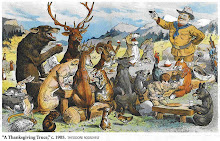
Like so many conscientious hunters and anglers come to realize, good habitat with our full suite of predators and prey make for healthy and productive living............Teddy Roosevelt depicted at a "WILDLIFE RENDEZVOUS"

Recent Posts


Blog Disclaimer

This is a personal weblog. The opinions expressed here represent my own and not those of my employer. In addition, my thoughts and opinions change from time to time…I consider this a necessary consequence of having an open mind. This blog is intended to provide a semi-permanent point in time snapshot and manifestation of my various thoughts and opinions, and as such any thoughts and opinions expressed within out-of-date posts may not be the same, nor even similar, to those I may hold today. All data and information provided on this site is for informational purposes only. Rick Meril and WWW.COYOTES-WOLVES-COUGARS.COM make no representations as to accuracy, completeness, suitability, or validity of any information on this site and will not be liable for any errors, omissions, or delays in this information or any losses, injuries, or damages arising from its display or use. All information is provided on an as-is basis.


Additional disclaimer information can be viewed by clicking here.