Visitor Counter

hitwebcounter web counter
Visitors Since Blog Created in March 2010

Click Below to:

Add Blog to Favorites

Coyotes-Wolves-Cougars.blogspot.com

Grizzly bears, black bears, wolves, coyotes, cougars/ mountain lions,bobcats, wolverines, lynx, foxes, fishers and martens are the suite of carnivores that originally inhabited North America after the Pleistocene extinctions. This site invites research, commentary, point/counterpoint on that suite of native animals (predator and prey) that inhabited The Americas circa 1500-at the initial point of European exploration and subsequent colonization. Landscape ecology, journal accounts of explorers and frontiersmen, genetic evaluations of museum animals, peer reviewed 20th and 21st century research on various aspects of our "Wild America" as well as subjective commentary from expert and layman alike. All of the above being revealed and discussed with the underlying goal of one day seeing our Continent rewilded.....Where big enough swaths of open space exist with connective corridors to other large forest, meadow, mountain, valley, prairie, desert and chaparral wildlands.....Thereby enabling all of our historic fauna, including man, to live in a sustainable and healthy environment. - Blogger Rick

Subscribe via email to get updates

Enter your email address:

Receive New Posting Alerts

(A Maximum of One Alert Per Day)

Wednesday, February 26, 2020

While there was a sizeable Indian population in eastern North America prior to European contact(circa AD1500), their impact on the land was minimal..............As Harvard Forest Director David Foster and Harvard Forest Paleoecologist W. Wyatt Oswald sum up in their recent article: “LAND MANAGERS SEEKING TO EMULATE PRE-CONTACT CONDITIONS SHOULD DE-EMPHASIZE HUMAN DISTURBANCE AND FOCUS ON DEVELOPING MATURE FORESTS".........."IN AREAS WHERE GRASSLANDS AND PASTURE ARE DESIRED (FOR EXAMPLE, TO RETAIN MODERN PATTERNS OF SPECIES DIVERSITY), COLONIAL-ERA TECHNOLOGIES FOR KEEPING LAND OPEN—SUCH AS PLOWING, GRAZING, MOWING FOR HAY, AND TREE-CUTTING—SHOULD BE USED INSTEAD OF BURNING, BECAUSE THOSE ARE THE AGRICULTURAL APPROACHES THAT CREATED THEM FOUR CENTURIES AGO" ..............Bottom line is that lake bottom sediment cores of some 12,000 years ago up to the present suggest that there were not widespread human impacts on New England landscapes before the arrival of Europeans".........."Further, It is known that while Indians at times set fires to the woods, prairie and chaparral environs they occupied, Hugh Raup a plant ecologist and Director of the Harvard Forest for 21 years, writing in 1937, "noted that Indian caused fires in the northeast were uncommon and the idea that they burned the entire New England area every year. or even every 10 to 20 years “is inconceivable" ............. As pointed out by esteemed Ecological Historian Emily Russell in her 1983 study of Indian caused fires in the northeastern United States: "There is no strong evidence that Indian purposely burned large areas of the forested northeastern United States frequently"..............."The presence of Indians did, however, undoubtedly increase the frequency of fires above the low numbers caused by lightning"................ "The increase from the 'natural' situation was greatest in local areas near Indian habitations"


New England’s Forest Primeval

1.20.2020
HAT DID THE NEW ENGLAND landscape look like before European colonizers arrived? The prevailing view among modern historians is that Native Americans engaged in widespread horticulture and used fire to keep grasslands and pasturelands open. Now a study by Harvard Forest director David Foster and colleagues, published today in Nature Sustainability, argues instead that Native Americans had very little impact on the regional landscape in that period, even when their populations were large. 

Eastern Woodland Old-Growth Forest


Written accounts of Native Americans cultivating the land in New England overstate the importance of agriculture in the pre-contact period, according to a new study. Here, an engraving by Theodor De Bry, after a drawing by Jacques Le Moyne, depicts Timucua Indians at Fort Caroline, a French settlement established in what is now Florida, hoeing and sowing seeds, including beans and maize. The image may be the only contemporaneous visual depiction by Europeans showing the importance of agriculture to Native Americans in the New World.
Courtesy of the Lewis Ansbacher Map Collection, permanently housed in the Morris Ansbacher Map Room, Jacksonville (Florida) Public Library.


The study reconstructs climate and vegetation in New England during the past 10,000 years, and draws as well on extensive archaeological evidence. It’s significant, Foster explained in an interview, because the relatively new belief that humans have always interfered in natural ecologies has been used to guide conservation practices in North America and elsewhere. The paper argues that this is a mistake, and that in the specific case of New England, “land managers seeking to emulate pre-contact conditions should deemphasize human disturbance and focus on developing mature forests.”
 In areas where grasslands and pasture are desired (for example, to retain modern patterns of species diversity), colonial-era technologies for keeping land open—such as plowing, grazing, mowing for hay, and tree-cutting—should be used instead of burning, because those are the agricultural approaches that created them four centuries ago. The larger implication is that the history of human involvement in ecologies elsewhere in North America and around the world may need to be re-evaluated. 


The study authors analyzed pollen and charcoal residues in sediment cores (above) from lake bottoms to learn about changes in vegetation and the severity of forest fires in New England since the end of the last glaciation.Photograph courtesy of the Harvard Forest


Paleoecologist W. Wyatt Oswald, first author on the paper and an associate of Harvard Forest, used cores extracted from lake-bottom sediments to reconstruct prevailing patterns of vegetation from about 11,700 years ago, when the last glaciation ended. By analyzing pollen trapped in the sediment, he discovered which plants dominated the landscape; charcoal residues indicated the extent of burning. “When you actually look at various lines of evidence,” Oswald explained in an interview, “there is nothing to suggest that there were widespread human impacts on New England landscapes before the arrival of Europeans.”
The research team collected sediment cores from 21 lakes across southern New England. Analysis revealed that pines dominated the landscape until 10,000 years ago. Then, as temperatures increased during the subsequent 2,000 years, oak forests began to appear, and elevated levels of pollen from ragweed and grasses indicate the presence of open land or an open forest structure maintained by fire, a change that was driven by the dry climate. Human populations at this point remained small. When moisture and temperature began increasing some 8,000 years ago, beech and hickory species joined the oaks, while signs of ragweed and grasses declined to almost nothing—indications that a closed-canopy hardwood forest had taken over the landscape, and that there was little fire, despite a burgeoning human population.

Archaeological evidence tells a similar story of minimal human impacts on the ecosystem, one that accords with Native American cultural beliefs about living in harmony with the land. A spike in the Native American population that occurred from 1,500 to 500 years ago “has often been attributed to the emergence of horticulture,” the authors note, “especially the planting of maize.” But the archaeological evidence cited in the paper reveals very little sign of farming. There is, on the other hand, abundant evidence for subsistence practices such as hunting, fishing, shell-fishing, and plant-gathering. Elizabeth Chilton, an archaeologist and former assistant professor at Harvard who is one of the co-authors of the paper, quickly established during her time in Cambridge that cultivated corn, squash, and beans were present in New England before contact, but weren’t widely used until Europeans arrived.


The study suggests that open land in New England should be maintained using the same colonial-era practices that created it, such as grazing and mowing, rather than burning.
Photograph courtesy of the Harvard Forest


“People were still very much living off of the land,” said Foster, “which is why they congregated on the coast and in river bottoms” where there are so many resources. “That’s a shock for most people, because it’s so ingrained in us that the native people were planting corn.” It may be part of the national mythology, but “In fact, there’s no archaeological support for widespread use of agriculture at all.”

The Historical Fallacy

THE IDEA THAT Native Americans engaged in widespread management of the landscape before European contact appears to have gained credence among scholars with a 1953 paper, “The Indian as an ecological factor in northeastern forests,” by anthropologist Gordon Day. Historian William Cronon’s Changes in the Land popularized the ideas that Native Americans were engaged in widespread horticulture, and used prescribed burns to keep grasslands and pasturelands open. Cronon relied on the accounts of early European explorers such as Thomas Morton, who described Native Americans setting such fires twice yearly, to conclude that:
Here was the reason that southern [New England] forests were so open and parklike; not because the trees naturally grew thus, but because the Indians preferred them so. As William Wood [in another early account] observed, the fire “consumes all the underwood and rubbish which otherwise would overgrow the country, making it unpassable, and spoil their much affected hunting.” The result was a forest of large, widely spaced trees, few shrubs, and much grass and herbage. 
Foster himself recalled embracing these ideas about native burning to manage the land during his undergraduate studies, and noted that “Bill Cronon is such a marvelously accomplished writer that this idea has been taken up and applied widely. Books such as 1491 and various others on the ‘ecological Indian’ have really made this into something, such that modern-day land managers and the forest service and state agencies and conservation organizations—all have embraced this entirely—without any compelling prehistorical data.” As the study’s authors write:
Humans are now inferred to have driven ecosystem dynamics for millennia across much of the globe, including many areas formerly interpreted as pristine or dominated by mature forests.  This new perspective has led to the conclusion that many valued characteristics of historical and modern landscapes, such as high levels of plant and animal diversity—including the occurrence of many rare and endangered species—may represent legacies of earlier cultural activities. In many forested or potentially forested landscapes, a wide array of openland habitats, including grasslands, shrublands, heathlands, and early successional forests have been attributed to purposeful landscape management by ancient people.

David R. Foster (left) and W. Wyatt Oswald prepare to take a core sample of sediment from a lake in southern New England.Photograph courtesy of the Harvard Forest


“This human-centered interpretation” has led to conservation management practices that include “the prescription of disturbances, especially fire,” as well as clear-cutting and other mechanical treatments to mimic the inferred activities of ancient peoples. In New England, where woodlands are often referred to as “the asbestos forest,” there are no fire-dependent species. “There are some species that will survive fire better than others,” Foster said, “but there are none that require fire in order to be maintained,” as there are in other parts of the country.
The present study, with its assembled empirical evidence from archaeologists, ecologists, and paleoclimatologists, is the culmination of a series of National Science Foundation grants on which Foster has been the principal investigator, combined with work done at the Harvard Forest as part of a long-term ecological research program. “We have been gradually building the number of sites,” said Foster, “and building a stronger and stronger case. Eventually, we were able to pull together the work that’s represented here.”
Their inescapable conclusion is that climate, not people, largely controlled fire severity in New England during the period since the end of the last glaciation. The paper’s conservation message is that “land managers seeking to emulate pre-contact conditions should deemphasize human disturbance and focus on developing mature forests: those seeking to maintain openlands should apply the agricultural approaches”—such as grazing, plowing, and mowing for hay—“that initiated them four centuries ago.” 

Saturday, February 22, 2020

We have know for some time that both Gray and Eastern Wolves will dine on berries and kill fish during certain times of the year to augment their hoofed browser(deer, elk, moose, bison, caribou) and beaver diet........Newly discovered is that the Wolves of Voyageurs National Park in Minnesota readily also feed their newborn pups of the year regurgitated blueberries.........Interesting to know that Wolves may be more adaptable than previously thought in enjoying meat, fish and fruit—Similar to their Coyote cousins!


httpshttps://www.mprnews.org/story/2020/02/12/new-research-from-northern-minn-shows-wolves-feed-berries-to-their-young://


New research from northern Minn. shows wolves feed berries to their young


New research into the surprising summer eating habits of northern Minnesota wolves known to be fond of beaver, fish and blueberries has now also documented wolves feeding those berries to their pups.
The finding, published this week in the journal Wildlife Society Bulletin, suggests that wild blueberries may be a more valuable food source for wolves in the boreal forests of far northern Minnesota than previously appreciated.
In the summer of 2017, Austin Homkes, a field biologist with the Voyageurs Wolf Project — a collaboration between Voyageurs National Park and the University of Minnesota — trekked to a beaver meadow just south of the park where researchers believed wolves had recently killed prey.
As he drew near, he saw five pups gathered around an adult wolf in the center of the meadow, about 100 meters away. He saw the pups lick at the adult’s mouth for about 30 seconds, and then watched as the wolf regurgitated food for the pups three times on to the ground.
A half hour after the wolves left, he approached and found several small piles of chewed and whole wild blueberries. While wolves are known to regurgitate deer and other meat to feed their young, this is the first documentation of a wolf feeding pups berries or fruit of any kind.

The finding is significant because “that means that wolves are getting some energetic value out of consuming blueberries like this,” explained Tom Gable, a Ph.D. student at the University of Minnesota who leads the Voyageurs Wolf Project.
Researchers have known for some time that wolves eat wild blueberries and other fruit to supplement their largely meat-based diet. In fact, Gable and his colleagues have found that blueberries can make up to 83 percent of the July diet of the eight wolf packs they study in and around Voyageurs National Park.
It could mean that wolves are simply taking advantage of the blueberries growing abundantly and close together.
“And so for an animal like a wolf, they’re expending very little energy eating those berries,” Gable said. “And so it's possible that just sitting in a berry patch, not really moving a whole lot, is a better strategy than running around your territory looking for a fawn or a beaver in the middle of the summer.”
The findings could suggest that wolves are using berries to meet their pups’ minimum food needs, Gable said. Or, he said, maybe berries could help pups survive the lulls when adults are unable to kill beaver or deer.
Gable said as researchers learn more about wolves’ summer predation behavior, including how much time they spend foraging berries, they hope to better understand the significance berries play in wolves’ diets, and whether those berries reduce the number of prey — mainly deer fawns and beavers — that wolves kill in July and August.
In conjunction with the newly-published research, the Voyageurs Wolf Project also released what they believe is a first-ever video showing wolves eating berries.
Using 25 cameras, researchers recorded wolves stripping blueberry bushes. Gable said the video provides irrefutable evidence that wolves do indeed consume berries. “There’s been some skepticism about whether or not wolves really do this,” he said.
For the past five years, researchers have placed GPS collars on wolves from in and around the park. They collect location data from the animals every 20 minutes. That allows them to see where wolves stop long enough to eat. The location information helps researchers place cameras.
The technology has led to the surprising discovery that wolves hunt fish in shallow streams. They also stalk beaver which can make up as much as 42 percent of a wolf’s diet around the park

Friday, February 21, 2020

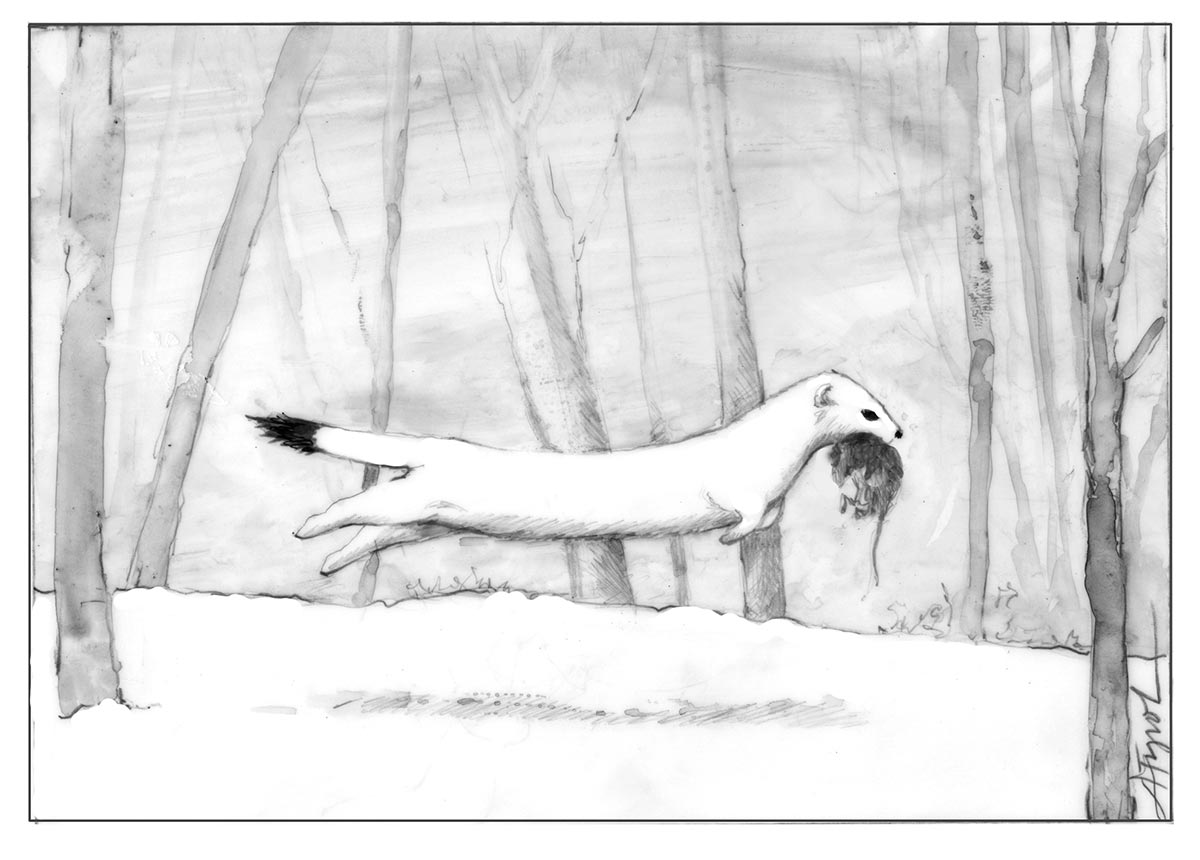
"Apart from the snowshoe hare, Short and Long-tailed weasels are the only animals whose coats turn white in preparation for winter".........."Both the Long-tailed and Short-tailed(short-tailed also known as Ermine) species ranges overlap with the larger Long-tailed Weasel able to out-compete the smaller Short-tailed"............"As a result, the Short-tailed life-paradigm has a range farther to the north where the the Long-tailed ranges farther to the south(see maps below)"..................."Both Weasel species are generalists, able to swim, climb trees and dig under snow in pursuit of voles, mice, rabbits, rats, lemmings, muskrats, pocket gophers, shrews, moles, squirrels,chipmunks, bats, bird eggs, snowshoe hare, snakes, frogs, and insects"..............."Deer, beaver, and woodchuck carrion is also on their menu with berries of any kind also sought out"............... "Long-haired Weasels will also prey on Short-tails should they cross paths"........."The main source of mortality for both weasel species are foxes, coyotes, owls, large snakes"

R


Winter Weasels – White on White


Illustration by Adelaide Tyrol
Winter Weasels – White on White Image


On a walk one winter afternoon, I spotted two white objects darting across a snow-covered field. White on white, they were difficult to identify at first. It was a short-tailed weasel chasing a snowshoe hare!
Apart from the snowshoe hare, short- and long-tailed weasels are the only animals in the Northeast whose coats turn white in preparation for winter. The smaller short-tailed weasel, also known as an ermine, is more common than the long-tailed weasel. It lives in a variety of habitats, is an adept hunter, and has a reputation for being curious and bold.

The Short-tailed Weasel in Winter White and Summer Brown(range map)


In summer, the short-tailed weasel is brown with a cream-colored chest and belly, and a black tail tip. In the fall, in northern latitudes, the ermine sheds its summer fur and grows a white winter coat. This amazing adaptation camouflages the weasel as it hunts, and hides it from predators such as hawks, owls, foxes and coyotes. The black tail tip, which remains in winter, diverts predators. A raptor attracted to a weasel’s movement will dive at the black tip, missing the weasel’s body.
In the spring, the ermine loses its white coat and turns brown again. Both molts are triggered by photoperiod, or length of daylight. Vermont naturalist Susan Morse once raised an orphaned weasel for release back into the wild. She enjoyed watching the ermine’s coat turn white, which began on lower parts of the body first and took seventeen days. However this adaptation may become a problem for weasels as the climate warms, and snow cover becomes inconsistent in our region. White weasels will be much easier to spot against a brown background and will be more vulnerable to predators.

The Long-tailed Weasel in Winter white and Summer brown(range map)


Researchers in Poland found that populations of the white subspecies of the least weasel (cousin to our short-tailed weasel) dropped with a decrease in number of days of snow cover. Experiments showed predators detected weasels with contrasting colors at a significantly higher rate than those that blended in with the landscape. If our northern weasels can adapt through natural selection, where snow is brief or erratic, they may develop patchy coats. Alternatively, populations may include both white and winter brown animals, as is already the case in mid-Atlantic weasel populations.
Short-tailed weasels feed primarily on voles and mice, and occasionally on larger prey such as chipmunks, squirrels, or even hares – which explains the snowy chase I observed. In summer they prey on nesting birds and their eggs, frogs, and insects; they also eat berries. Some ermines will kill chickens, though a weasel will often visit a chicken coop only to prey on the rats and mice attracted to the chicken feed.

Short-tailed(top picture) and Long-tailed weasel(bottom picture with 
mouse kill


Their long, thin shape enables weasels to travel through rodent tunnels and kill their prey in their underground burrows – or, sometimes, within a human dwelling. My sister once lived in an old farmhouse that became infested with mice. She and her roommates had a contest going to see who could devise the most ingenious mousetrap, and they kept a tally of how many mice were killed. Then an ermine moved in with them for a month. “We didn’t have much of a mouse problem after that,” she recalled. “The ermine would come up from the cellar under the door and slither along the kitchen countertops.”
Sometimes a weasel will live in a mouse den until all the occupants are consumed. Weasels often kill more than they can eat and cache dead prey for later use. “They strive to always have something in the pantry,” said Morse. “People routinely find stored mice in the crevices of their wood piles.”
While the weasel’s shape contributes to its hunting prowess, it also causes the animal to lose heat more quickly than a more rotund creature. To compensate, the ermine has a high metabolic rate and must eat one-third to one-half of its body weight a day, making it perpetually hungry. For this reason, ermines are active even in the coldest weather, especially at night. Weasels hunt primarily by scent, zig-zagging back and forth, investigating every hole and cranny.  
This winter, look for weasel tracks in the snow – small, paired tracks with five claws on each foot. Since weasels travel by bounding, their hind tracks fall directly on top of their front tracks. Also, keep an eye out for the weasel’s long, spiral-shaped, blackish-brown scat on rocks in the center of the trail, scent posts to communicate with other weasels.
A version of this article was originally published in the Long Trail News. Susan Shea is a naturalist, conservationist, and freelance writer who lives in Brookfield, Vermont.

Wednesday, February 19, 2020

"Similar to a human family where kids tend to thrive when Mom and Dad stay together and avoid divorce, a new University of Idaho Study reveals that for each year a wolf pair stays together, the odds of their pups surviving into adulthood increased 20%"..............."Unlike Coyotes, where male and females bond for life and remain monogamous, wolf pair bonds are super short" ............"They only last a couple years”.............."On average, wolf pairs stayed together for 2.2 years, although there was wide variance"..............."For instance, one wolf couple in the Idaho Study stayed together for at least nine years, basically an eternity for an animal that is considered ancient at 13"................"The average of 2.2 years found in Idaho aligned with rates measured in a recolonizing wolf population in Sweden".............."The longer wolf pairs remain monogamous, the more stability in the overall wolf pack"..........."Monogamy reduces the occurrence of 'sneaker males', those who come in and mate with females and take off, leaving pup rearing solely to the female and other cohorts".............."Another interesting observation and perhaps also similar to human couples is that when an older wolf mated with a younger wolf, the older appeared to teach the younger how to parent"................. "Pups born to those pairings were more likely to survive than pups born to two first-time parents"


https://www.spokesman.com/stories/2019/sep/15/study-suggests-monogamous-wolves-make-better-paren/


Study suggests monogamous wolves make better parents

In the rugged, sometimes violent world of the wolf, it pays to have mom and dad around.

A male and female wolf, along with their pups, are photographed near Salmon, Idaho in 2017. (Idaho Department of Fish and Game) 


The longer wolf couples are together, the more likely their offspring are to survive into adulthood, according to new research from the University of Idaho.
According to the study, which will be published in the journal Behavioral Ecology, for each year a wolf pair stays together, the odds of their pups surviving into adulthood increased 20%.

Put another way, “they get 20% better at what they do every year,” study author David Ausband said. The study used nine years of scat data collected by Ausband and others from wolves throughout Idaho.

Ausband started collecting the data as a graduate student at the University of Montana. He then worked for the Idaho Department of Fish and Game before taking a job at the University of Idaho last year. His research examines a relatively understudied area: the impact of monogamy in mammals.

“Remarkably, I could not find a study that measured pair bond duration and its effects on reproduction in a mammalian cooperative breeder,” Ausband writes in the study. In particular, he wanted to see how legal hunting impacted monogamy in wolves, how monogamy impacted pup rearing and how monogamous relationships changed the overall social structure of a pack.
He expected to find that hunting reduced monogamy, possibly fraying pack dynamics.

A male and female wolf play near Kelly Creek on the Idaho/Montana border in 2017. (Idaho Department of Fish and Game)


“I thought … harvest would reduce pair bonds. And that’s not what I found,” he said. “And it’s because pair bonds are super short. They only last a couple years.”
On average, wolf pairs stayed together for 2.2 years, although there was wide variance. For instance, one wolf couple documented by Ausband stayed together for at least nine years, basically an eternity for an animal that is considered ancient at 13. The average of 2.2 years found in Idaho aligned with rates “measured in a recolonizing wolf population in Sweden that experienced relatively high rates of human-caused mortality.”

“Wolf packs are dynamic,” he said. “There is more drama in a wolf pack than in a middle school dance. There is always stuff going.”

Overall, wolves were monogamous about 72% of the time, he found.
In addition to increasing pup survival, monogamy also stabilized pack dynamics. Monogamous pairs reduced the occurrence of “sneaker males” and decreased polygamy in the group.

Sneaker males are males who mate and then leave the hard work of rearing offspring to others.


Monogamous wolf pairs were, overall, better at maintaining control of their packs, although pack size played a big role. Possibly, smaller wolf packs (partially caused by hunting) are easier for an alpha male and female to maintain control over, he said.

“If a pair is together, and their group size is large, it’s harder to police sneaker males. If you have 20 wolves to keep track of, it’s really hard to keep sneaker males out,” he said. “It’s a lot like human families. Or a big classroom at an elementary school. If you have a lot of kids, it’s harder to police.”

The study builds on, and adds to, research done in Minnesota’s Voyageurs National Park suggesting that wolves learn, rather than relying solely on instinct.
There, scientists observed wolves lying in wait along known beaver paths, often picking their ambush site far from the water. In fact, according to National Geographic, some wolves appeared to specialize in killing beavers.


In Idaho, Ausband found that when an older wolf mated with a younger wolf, the older appeared to teach the younger how to parent. Pups born to those pairings were more likely to survive than pups born to two first-time parents.

Understanding how wolves live and breed is important information for scientists and managers.

“If we don’t understand the truth about how an animal breeds, we’re not going to be very good at managing and conserving them,” Ausband said.

Sunday, February 16, 2020

Scientists are working on Fusion and Beaming Solar Power from the Sun to existing Power Stations on Earth—Both sources would power us up without burning carbon and therefore truly be clean and renewable energy sources......Conversely, there are currently 57,000 Giant 500-foot Windmills defacing what once was truly green forest, farm and Desert environs......Yes, when the wind is blowing, they can power up 32 million American homes........With 350 million Americans living here currently, we would need to have 635,000 Windmills up and running without a glitch to power our homes and industry.........Is that what certain Politicians, Academics and Enviros are trying to sell us?,,,,,...More purposely fake news trying to brainwash and delude us about what this so-called “green energy would actually be doing—- Destroying our last remaining open spaces............And let us not forget the extensive digging up the ground to run pipelines to get the energy to us.......And the fact that a ton of oil and precious minerals are required to manufacture the “Mills”.......Is this truly green?.......As my Dad once told me, “you do not get rid of something because it is old”........”You do not start to use something simply because it is new”......”You start doing something new only if is good”——WINDMILLS AND LARGE SCALE SOLAR FARMS—-NOT GOOD!!!!!!


https://www.wsj.com/articles/whats-next-for-the-energy-grid-11581645094

Friday, February 14, 2020-Wall Street Journal
WHAT’S NEXT FOR THE ENERGY GRID 

Living solar power cells, household microgrids and more projects in the works for the decentralized grid of the future.


In the tokamak version of reactors, injectors fire particle beams to heat plasma. Magnets keep plasma contained and squeeze it to achieve fusion. Water is heated by the plasma and converted to steam that turns a generator.


In a solar satellite, mirrors reflect light onto a central reflector. The light is turned into power with solar cells.

Thursday, February 13, 2020

THE GOTHAM URBAN COYOTE PROJECT has been evaluating and studying the Eastern Coyotes that now call New York City and surrounding environs home........They have been following one of the first NYC Eastern Coyotes to make a permanent home in Queens, New York City--- view on video(below)................"As determined by scat analysis, he(male) is at least 10 years old now, old for a wild coyote"

One of the first NYC Eastern Coyotes coyote to make a permanent home in Queens is pictured on the video below:

He is at least 10 years old now, old for a wild coyote.

Queens Coyote video

THE GOTHAM URBAN COYOTE PROJECT in the NYC Metropolitan area has been able to get DNA from his scat, which identifies him as a male, related to the coyotes living in the Pelham Bay Park in the northeast Bronx.

As far as we know, no other coyotes have penetrated the urban jungle into Queens as far as he has and made a permanent home there.


He's lived quietly in a small wooded area for a long time now, alone. Nearly every spring we find a den that he has dug, but no females have shown up yet to join him.

Coyotes in NYC urban woodlands-video


Connectivity between patches of habitat are very important for wildlife populations in suburban and urban environments.
This guy managed to travel, we believe, along railroad tracks through NYC to find his current home.

It was a long shot for him to make it, and for a second coyote to survive the same journey (and happen to be the opposite sex) is even more unlikely.

This is why things like habitat corridors, wildlife crossings over or under highways, and undeveloped green spaces are so important for urban wildlife.

Eastern Coyotes under the George Washington Bridge in Washington Heights, Manhattan, NYC


Eastern Coyotes photographed in NYC and surrounding suburbs


Thursday, February 6, 2020

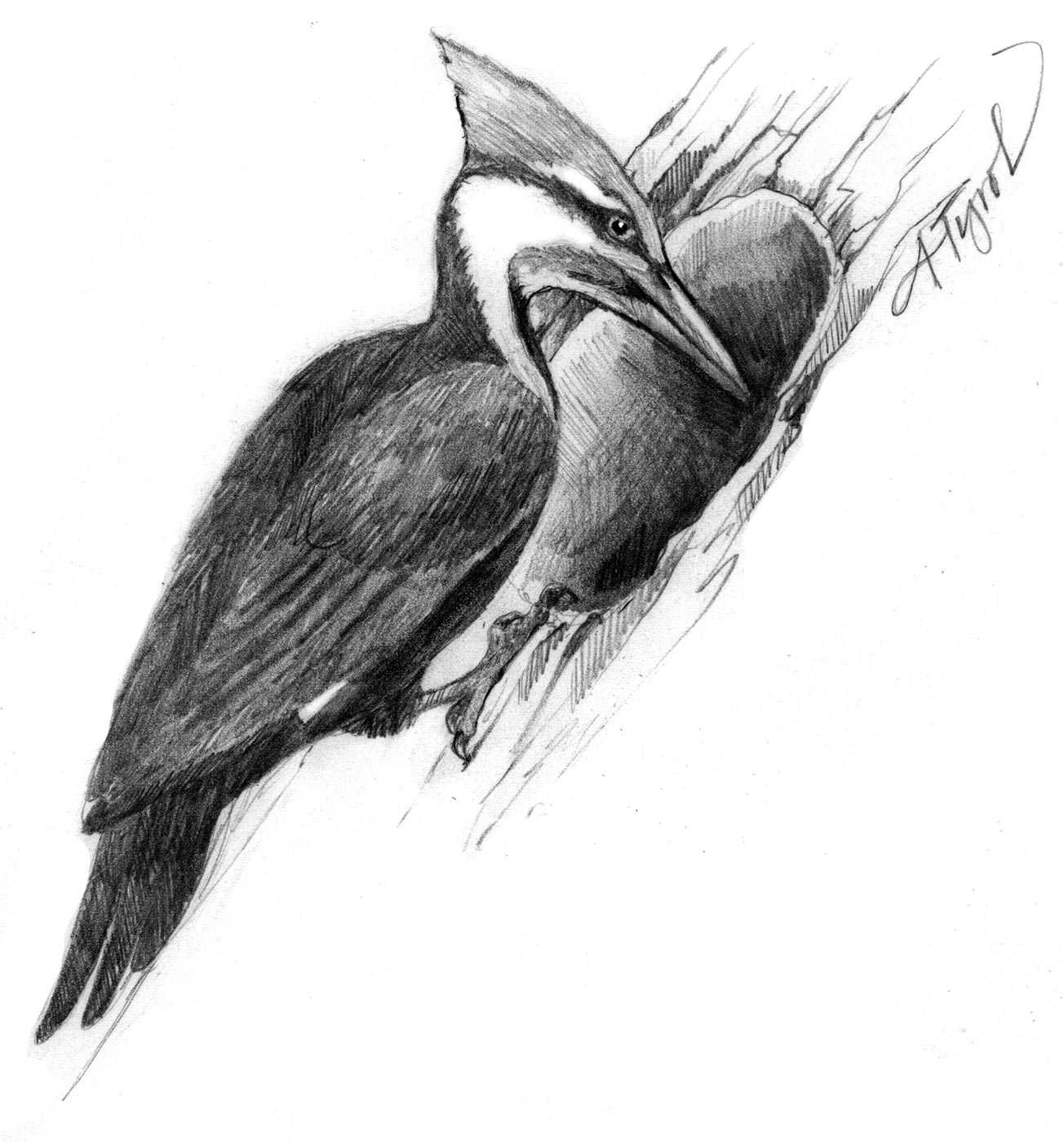
Ranging from the eastern half of the United States across southern portions of Canada and into the Pacific Northwest, the large, Crow-sized 18 inch long Pileated Woodpecker is a year-round resident, braving Winter cold and snow...............“They tend to use deciduous trees more than conifers"...........“Most of their foraging is on dead, dying, or downed trees, but they will utilize trees that aren’t compromised if there’s food there"..........."Omnivorous, they are a key predator of Carpenter Ants".........."Fall and Winter have these woodpeckers dining on nuts, fruits,larvae of beetles and other bugs that excavate into the bark of trees".............."Typically monogamous, both male and female remain within their home territory throughout the year, even when not breeding"

Pileated Woodpeckers: Winter Excavators


Pileated Woodpeckers: Winter Excavators

Pileated Woodpeckers: Winter Excavators ImageIllustration by Adelaide Tyrol


Whenever I spy a pileated woodpecker traversing the sky, I pause to watch its weird undulating flight. The jerky rise-and-drop movement of this large woodpecker is endearingly gawky – like a mini pterodactyl visiting from the Cretaceous period. This time of year, the bird’s bold crimson crest flashes in stark contrast to the mostly-muted colors of winter.


Pileated woodpeckers – Dryocopus pileatus – take their common and scientific names from the Latin word for “capped.” Both male and female sport the namesake red crest, as well as black streaks across the eyes. Measuring about 18 inches long, they have wingspans that can stretch past two feet.


These crow-sized woodpeckers live throughout the eastern half of the United States, across southern portions of Canada, and in the Pacific Northwest. They prefer mature forests with large trees, but also live in places from young forests containing snags and decaying wood to suburban areas with patches of forested land.
Wherever they call home, pileated woodpeckers stick around through the winter. On a walk through the woods, you may hear their distinctive high-pitched calls – some liken it to more of a jungle noise than something that belongs in a New England forest. More likely, though, you’ll hear the deep thudding of woodpecker beak on wood. Woodpeckers drum on trees as a means of communication, to excavate nesting and roosting sites, and – of course – to find food.
Their heavy, chisel-like bills are roughly the same length as their heads, which adds to the pterodactyl appearance, and are designed for pounding through the bark and outer layers of a tree to reach its core. Pileated woodpeckers dig out insects crawling around – or, this time of year, overwintering in larval stage. Excavations can be more than a foot long and leave piles of woodchips heaped around the tree’s trunk.


“They tend to use deciduous trees more than conifers,” said Pamela Hunt, avian conservation biologist at New Hampshire Audubon. “Most of their foraging is on dead, dying, or downed trees, but they’ll still used trees that aren’t compromised if there’s food there.”
Pileated woodpeckers’ meal of choice is carpenter ants (another common sign of their feeding: black poop at the base of trees comprised mostly of indigestible ant bits), but the birds are omnivorous, noshing on fruits and nuts when they’re in season and on an array of insects year-round. While we humans may think of insects as being primarily warm-weather creatures, these woodpeckers seek out the larvae of ants, beetles, and other bugs hidden within trees for the winter.
After excavating a hole, a pileated woodpecker will use its long, barbed tongue to reach and scrape out the buggy delicacy within. Hunt noted these woodpeckers, like all birds that weather the winter cold, spend much of their time during this season refueling on whatever food they can find. They’ll often make multiple large holes in a single snag during a feeding frenzy.
“If a tree is full of yummy larvae, the woodpecker can literally excavate the tree until there’s almost nothing left,” said Hunt.


While some of the bird species we see in winter have migrated short distances, pileated woodpeckers stick close to their nesting sites throughout the year. They are typically monogamous, and while Hunt said the woodpeckers are not necessarily “socially cohesive” during the winter, both male and female remain within their home territory.
During breeding and chick-raising season, pileated woodpeckers, like many other birds, defend their territories from interlopers. In winter, however, they often tolerate other pileated woodpeckers within their own range. The trespassers are generally young birds searching for their own territories to claim.
I will probably never be able to identify any specific chickadee from the myriad who frequent the bird feeder, or pick out one slate-colored junco from the flock hopping around the yard. But I can have some confidence that the big bird with the red-capped head and the undulating flight passing through the winter sky is the same one – or at least one of the same two – I sometimes spy in warmer months, flitting into the woods or perched on the side of a tree, pounding away.
Meghan McCarthy McPhaul is the assistant editor of Northern Woodlands magazine.