
Wolves fall prey to Canada's rapacious tar sands business
On the pretext of protecting caribou, wolves are threatened with a cull. But the real 'conservation' is of oil industry profits

- by:Paul Paquet
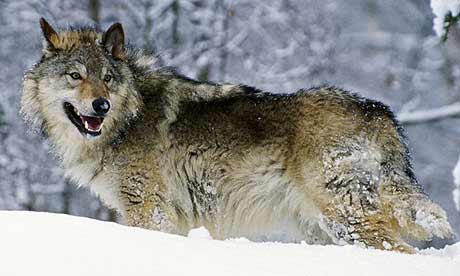
A gray wolf: in western Canada, wolves are now threatened with a cull to protect caribou in habitat where tar sands oil extraction is taking place.
Wolves are routinely, baselessly and contemptuously blamed for the demise of everything from marmots to mountain caribou in western Canada. Given that attitude, we at Raincoast Conservation Foundation are appalled, though not surprised, by Canada's proposed strategy to "recover" dwindling populations of boreal forest caribou in northern Alberta's tar sands territory. Essentially, the plan favours the destruction of wolves over any consequential protection, enhancement or expansion of caribou habitat.
Clearly, the caribou recovery strategy is not based on ecological principles or available science. Rather, it represents an ideology on the part of advocates for industrial exploitation of our environment, which subsumes all other principles to economic growth, always at the expense of ecological integrity. Owing to the breadth of the human niche, which continues to expand via technological progress, the human economy grows at the competitive exclusion of nonhuman species in the aggregate.
The real cost of Alberta's tar sands development, which includes the potential transport of oil by Northern Gateway and Keystone XL pipelines is being borne by wolves, caribou and other wild species.
Consistent with Canada's now well-deserved reputation as an environmental laggard, the caribou recovery strategy evolved over several years and many politicised iterations, carefully massaged by government pen pushers and elected officials who did their very best to ignore and obscure the advice of consulting biologists and ecologists.
So, the government should quit implying that the consultation approach provides a scientifically credible basis for decisions. Apparently, scientists can lead federal Environment Minister Peter Kent to information, but they cannot make him think.
Egged on by a rapacious oil industry, the federal government has chosen to scapegoat wolves for the decline of boreal caribou in a morally and scientifically bankrupt attempt to protect Canada's industrial sacred cow: the tar sands. Yet, the ultimate reason why the caribou are on the way out is because multiple human disturbances – most pressingly, the tar sands development – have altered their habitat into a landscape that can no longer provide the food, cover and security they need.
The relentless destruction of boreal forest wilderness via tar sands development has conspired to deprive caribou of their life requisites while exposing them to levels of predation they did not evolve with and are incapable of adapting to. Consequently, caribou are on a long-term slide to extinction; not because of what wolves and other predators are doing but because of what humans have already done.
Controlling wolves by killing them or by the use of non-lethal sterilisation techniques is biologically unsound as a long-term method for reducing wolf populations and protecting hoofed animals (ungulates) from predation. Lethal control has a well documented failed record of success as a means of depressing numbers of wolves over time.
Killing wolves indiscriminately at levels sufficient to suppress populations disrupts pack social structure and upsets the stability of established territories, allowing more wolves to breed while promoting the immigration of wolves from nearby populations.
At the broadest level, the caribou strategy favours human selfishness at the expense of other species. Implicit is the idea that commercial enterprise is being purchased by the subversion of the natural world, with one set of ethical principles being applied to humans and another to the rest of nature. The strategy panders to the ecologically destructive wants of society by sacrificing the most basic needs of caribou. In doing so, it blatantly contradicts the lesson Aldo Leopold taught us so well: the basis of sound conservation is not merely pragmatic it; is also ethical.
Simply, the caribou strategy is not commensurate with the threats to the species' survival. What is desperately needed is a caribou strategy designed to solve the problem faster than it is being created. Protecting limited habitat for caribou while killing thousands of wolves as the exploitation of the tar sands continues to expand will not accomplish this goal. Against scientific counsel otherwise, though, politicians have decided that industrial activities have primacy over the conservation needs of endangered caribou (and frankly, all things living).
Tar sands cheerleaders try hard to convince Canadians that we can become an "energy superpower" while maintaining our country's environment. They are, of course, wrong. Thousands of wolves will be just some of the causalities along the way. Minister Kent and his successors will find more opportunity to feign empathy as Canadians also bid farewell to populations of birds, amphibians and other mammals, including caribou, that will be lost as collateral damage from tar sands development. How much of our country's irreplaceable natural legacy will Canadians allow to be sacrificed at the altar of oil industry greed?
Clearly, the caribou recovery strategy is not based on ecological principles or available science. Rather, it represents an ideology on the part of advocates for industrial exploitation of our environment, which subsumes all other principles to economic growth, always at the expense of ecological integrity. Owing to the breadth of the human niche, which continues to expand via technological progress, the human economy grows at the competitive exclusion of nonhuman species in the aggregate.
The real cost of Alberta's tar sands development, which includes the potential transport of oil by Northern Gateway and Keystone XL pipelines is being borne by wolves, caribou and other wild species.
Consistent with Canada's now well-deserved reputation as an environmental laggard, the caribou recovery strategy evolved over several years and many politicised iterations, carefully massaged by government pen pushers and elected officials who did their very best to ignore and obscure the advice of consulting biologists and ecologists.
So, the government should quit implying that the consultation approach provides a scientifically credible basis for decisions. Apparently, scientists can lead federal Environment Minister Peter Kent to information, but they cannot make him think.
Egged on by a rapacious oil industry, the federal government has chosen to scapegoat wolves for the decline of boreal caribou in a morally and scientifically bankrupt attempt to protect Canada's industrial sacred cow: the tar sands. Yet, the ultimate reason why the caribou are on the way out is because multiple human disturbances – most pressingly, the tar sands development – have altered their habitat into a landscape that can no longer provide the food, cover and security they need.
The relentless destruction of boreal forest wilderness via tar sands development has conspired to deprive caribou of their life requisites while exposing them to levels of predation they did not evolve with and are incapable of adapting to. Consequently, caribou are on a long-term slide to extinction; not because of what wolves and other predators are doing but because of what humans have already done.
Controlling wolves by killing them or by the use of non-lethal sterilisation techniques is biologically unsound as a long-term method for reducing wolf populations and protecting hoofed animals (ungulates) from predation. Lethal control has a well documented failed record of success as a means of depressing numbers of wolves over time.
Killing wolves indiscriminately at levels sufficient to suppress populations disrupts pack social structure and upsets the stability of established territories, allowing more wolves to breed while promoting the immigration of wolves from nearby populations.
At the broadest level, the caribou strategy favours human selfishness at the expense of other species. Implicit is the idea that commercial enterprise is being purchased by the subversion of the natural world, with one set of ethical principles being applied to humans and another to the rest of nature. The strategy panders to the ecologically destructive wants of society by sacrificing the most basic needs of caribou. In doing so, it blatantly contradicts the lesson Aldo Leopold taught us so well: the basis of sound conservation is not merely pragmatic it; is also ethical.
Simply, the caribou strategy is not commensurate with the threats to the species' survival. What is desperately needed is a caribou strategy designed to solve the problem faster than it is being created. Protecting limited habitat for caribou while killing thousands of wolves as the exploitation of the tar sands continues to expand will not accomplish this goal. Against scientific counsel otherwise, though, politicians have decided that industrial activities have primacy over the conservation needs of endangered caribou (and frankly, all things living).
Tar sands cheerleaders try hard to convince Canadians that we can become an "energy superpower" while maintaining our country's environment. They are, of course, wrong. Thousands of wolves will be just some of the causalities along the way. Minister Kent and his successors will find more opportunity to feign empathy as Canadians also bid farewell to populations of birds, amphibians and other mammals, including caribou, that will be lost as collateral damage from tar sands development. How much of our country's irreplaceable natural legacy will Canadians allow to be sacrificed at the altar of oil industry greed?


 Posts
Posts







No comments:
Post a Comment