For Immediate Release
Wednesday, April 02, 2014
Contact for Reporters:
Jennifer Dimas
970.491.1543
Jennifer.Dimas@ColoState.EDU
|
|
|
FORT COLLINS -
Since their reintroduction in Yellowstone National Park, wolves have been heralded as the controversial savior of Yellowstone’s ecosystem. However, new research by ecologists at Colorado State University’s Warner College of Natural Resources proves that many diverse variables must be taken into account to fully understand how ecosystems respond to changes in food web structures.
The research is the first to show that reductions in elk numbers following the reintroduction of wolves are proportionate to increases in willow height along streams in Yellowstone. While that could lead to the simple conclusion that wolves improved the ecosystem, their central finding was that the relationship between elk populations and willow health was also dependent on geography, climate, and water supply for the willows.
“The effects of modifying a food web can’t be predicted by only studying one thing in isolation. No single force explains the patterns of plant establishment and growth in Yellowstone over the past three decades,” said CSU Professor Thompson Hobbs, co-author on the paper who is also a research scientist at CSU’s Natural Resource Ecology Laboratory. “It has been popular and convenient to tell the romantic tale that wolves have restored Yellowstone. But our findings prove that it is not that simple.”
The removal of wolves is commonly associated with an increase in populations of herbivores, such as elk, who then over-browse plants, such as willows. Conversely, willow growth and abundance is often credited as an indicator that wolf reintroduction has directly resulted in ecosystem improvements.
Focusing on this premise, the researchers studied 30 years of riparian willow growth and establishment using growth-ring data. They compared that information with a complex set of variables to predict willow growth over time before and after the return of wolves. They studied factors like annual precipitation, stream flow, growing season length, herbivore abundance, and landscape elevation and soil moisture.
Among their findings, the team reported that the negative correlation between elk abundance and willow establishment diminished during wet periods. They also found that impacts on plant growth due to changes in climate were less evident than the effects of changing elk abundance overall.
“Our results contribute to a growing body of evidence showing that changes in growth of woody deciduous plants following the reintroduction of wolves cannot be explained by the trophic cascade model alone,” said Marshall.
This research, funded by the National Science Foundation, was a large-scale study that extended across the entire northern range of Yellowstone. The study was a follow-up to more than a decade of research by CSU scientists in Yellowstone, including a 2013 paper that concluded beaver dams’ impact on water levels were equally responsible for vegetation health as herbivore browsing increases caused by the removal of wolves.
The new research reconfirms the CSU team’s previous conclusions that interactions among trophic forces, interannual climate variability and landscape topography must all be taken into account to fully understand how ecosystems will respond to changes.
---------------------------------------------------------------------------------------------------
Colorado State University, Fort Collins, CO -----------------------------------
http://nsf.gov/discoveries/disc_summ.jsp?cntn_id=126853&org=NSF
|
Yellowstone Ecosystem Needs Wolves and Willows, Elk and...Beavers?

Scientists plot crucial links among Yellowstone plant and animal species
February 7, 2013
This article is the fifth in a series on NSF's Long Term Research in Environmental Biology (LTREB) awards. Visit parts one, two,three, four, six, seven and eight.
Wolves and Yellowstone. In the public mind, and in nature, the two are inextricably linked.Now, it turns out, they aren't alone on the ecological dance floor.
Elk and willows play a critical role in wolves' success in the Yellowstone National Park ecosystem, willows serving as browse for elk--and elk as food for wolves.
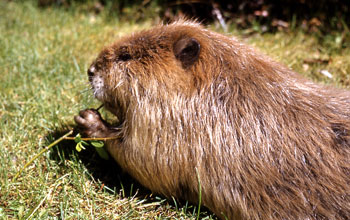
But there's another species involved, one that's instrumental to these well-choreographed steps: the beaver."Beavers are the missing piece in this ecosystem," says ecologist Tom Hobbs of Colorado State University (CSU) in Fort Collins.
No wolves, no beavers
The loss of wolves caused far-reaching changes in the Yellowstone ecosystem: more elk and fewer willows. With no willows to slow stream flow, creeks flowed faster and faster. Beavers prefer slow-moving waters, so they disappeared with the willows.
"Putting wolves back isn't enough to reverse the extensive changes caused by their long absence," says Hobbs, who, along with other scientists discovered in a decade-long research project
.
The ecologists published results of their study this week in the journal Proceedings of the Royal Society B. In addition to Hobbs, co-authors are Kristin Marshall, formerly of CSU and now of the National Oceanic and Atmospheric Administration, and David Cooper of CSU. Marshall is the paper's lead author.
"This research illustrates the value of long-term ecological experiments to understanding how species interactions cascade through food webs to determine ecosystem resilience," says Alan Tessier, program director in the National Science Foundation's (NSF) Division of Environmental Biology, which funded the research.
"The results have immediate practical applications in restoring and protecting ecosystems such as that of Yellowstone."
Wolves aren't enough
Scientists had thought that the return of the wolf, leading to a cutback on elk numbers and willow browsing, was central to restoring the Yellowstone ecosystem. "But Yellowstone also needs beavers," says Hobbs.
That's why bringing back wolves didn't work to quickly restore the ecosystem, the researchers believe.
Wolves hunted elk and brought down numbers of these ungulates. But removing elk browsing wasn't enough for the willows. They needed the sluggish streams created by beavers. But the beavers were gone.
Streams: the missing link
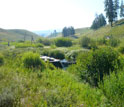
Once, beavers had been abundant anywhere streams flowed through Yellowstone. And that was almost everywhere.In the past, dams made by beavers were ubiquitous features of Yellowstone's stream network. A third of mainstream reaches show evidence of sediment deposition as a result of beaver dams, a process that's happened for millennia. That sediment offered willows a place to take root.
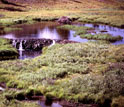
In the spring of 1921, scientist Edward Warren of the Roosevelt Wild Life Forest Experiment Station in Syracuse, N.Y., conducted a study of beavers in Yellowstone. Warren found beavers and their ponds scattered throughout the park.Near the Elk Creek Bench Colony, for example, Warren spotted "a group of beaver ponds which present interesting features," he stated in a report published in the 1920s.
"The water supply is a small brook originating from springs in a boggy tract of several acres. The brook flows through a flat depression in a ridge, and it is in the swampy, springy ground just below the woods that most of the ponds are located."
It's a rare if not non-existent sight in Yellowstone today, especially on the park's northern range where Hobbs' team conducted its research.
"Excessive browsing of willows (by elk after wolves were gone) was implicated in the disappearance of beavers from streams during the 20th century," Marshall, Hobbs and Cooper write in their paper. "The loss of beaver ponds from the stream network...compressed the area of bare, moist substrate needed for willow establishment."
Yellowstone ecosystem questions: answered by beavers?
Restoring an ecologically complete ecosystem in Yellowstone requires the return of willows--and with them, beavers.There's a clear threshold for ecosystem recovery. Willow stands must be more than 6 feet tall, the scientists found. That height is important, says Marshall. Then willows are beyond the reach of browsing elk, and can serve as seed sources for new young willows.
Once willows have returned, beavers will gnaw down a certain number of them to build dams. The dams will further slow stream flow, allowing yet more willows to grow.The results offer new insights on the role of wolf-driven trophic cascades in the Yellowstone ecosystem, says Hobbs.
Trophic cascades like that in Yellowstone occur when predators--or the lack thereof--in an ecosystem change the abundance or alter traits of their prey, in turn affecting the next lower trophic level.
"The reintroduction of wolves to Yellowstone has contributed to improvements in the park's ecology, but clearly that ecology is a complicated one," says Marshall. "The take-home message is that we have to be careful not to remove predators in the first place."
|  | |
|
| |
| | | |


No comments:
Post a Comment