
https://www.scribd.com/doc/262781450/rabies?secret_password=DmeWASlwHGqt5IZitoWg
Vet http://www.cdc.gov/rabies/location/usa/surveillance/wild_animals.html#.VThGTY09MGY.email
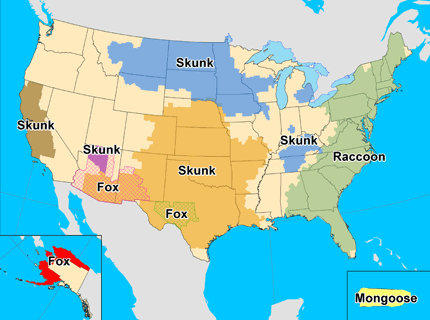
Map of terrestrial rabies reservoirs in the United
States during 2010. Raccoon rabies virus variant
is present in the eastern United States, Skunk rabies
in the Central United States and California, Fox
rabies in Texas, Arizona, and Alaska, and Mongoose
rabies in Puerto Rico.
Vet http://www.cdc.gov/rabies/location/usa/surveillance/wild_animals.html#.VThGTY09MGY.email
Wild Animals
Wild animals accounted for 92% of reported cases of rabies in 2010. Raccoons continued to be the most frequently reported rabid wildlife species (36.5% of all animal cases during 2010), followed by skunks (23.5%), bats (23.2%), foxes (7.0%), and other wild animals, including rodents and lagomorphs (1.8%). Reported cases decreased among all wild animals during 2010.
Outbreaks of rabies infections in terrestrial mammals like raccoons, skunks, foxes, and coyotes are found in broad geographic regions across the United States. Geographic boundaries of currently recognized reservoirs for rabies in terrestrial mammals are shown on the map below:
Map of terrestrial rabies reservoirs in the United
States during 2010. Raccoon rabies virus variant
is present in the eastern United States, Skunk rabies
in the Central United States and California, Fox
rabies in Texas, Arizona, and Alaska, and Mongoose
rabies in Puerto Rico.
No comments:
Post a Comment