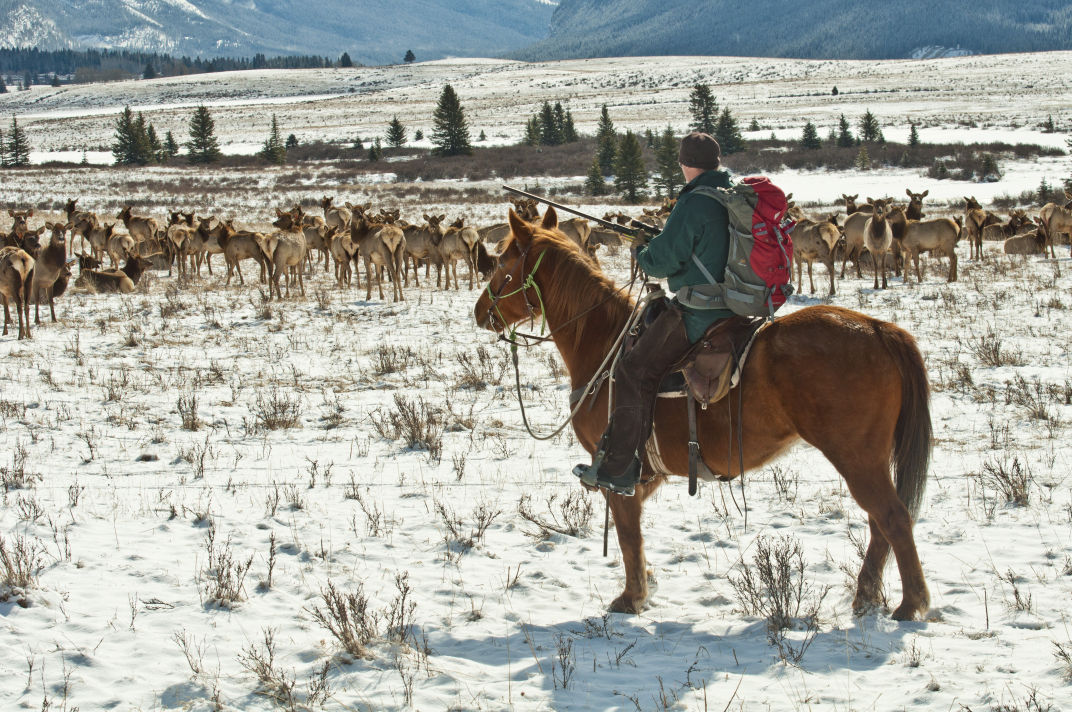
Yes, even herding animals like Elk are continually thinking, learning and adapting their behaviour to changes in their environment as now reinforced by the 15 year study of Elk in Banff National Park in Western Canada conducted by U. of Montana's Mark Hebblewhite and Evelyn Merrill(no relation) of the University of Alberta..............."They react to forest fires, clear-cuts and colonizing predators"................If you (radio) collar an elk and see what she does for two or three years, and assume that’s what she’ll do for the rest of her life – that’s not at all the case"............... "We’re seeing changes in migratory patterns in the Blackfoot, in Yellowstone and in the Bitterroot".............. "Those changes are made up of individual females changing their behavior over life"..............."We know elk make trade-offs on a day-to-day basis about the risk or threat of predation and the availability of forage"............... "If the forage outweighs the risk of predation, they make that decision"....................."“They’re social animals that learn from each other".......................... “Females learn from mothers how to behave, whether to migrate"......................... "We’ve also seen there’s a big gradient in elk personalities, from extremely bold, adventurous, thrill-seeking elk to extremely shy, risk-averse elk"................... "When presented with options like whether to migrate to a summer range in the mountains with good food but lots of grizzly bears, or staying next to a ranch with a generator that runs all night that the bears don’t like but the food isn’t as good, there’s lots of variation in how they respond".............. “If we have a hunting season that targets the bold elk that migrate, we can lose the ones who know the routes"............... "How they respond is determined by who lives and dies"

No comments:
Post a Comment