Visitor Counter

hitwebcounter web counter
Visitors Since Blog Created in March 2010

Click Below to:

Add Blog to Favorites

Coyotes-Wolves-Cougars.blogspot.com

Grizzly bears, black bears, wolves, coyotes, cougars/ mountain lions,bobcats, wolverines, lynx, foxes, fishers and martens are the suite of carnivores that originally inhabited North America after the Pleistocene extinctions. This site invites research, commentary, point/counterpoint on that suite of native animals (predator and prey) that inhabited The Americas circa 1500-at the initial point of European exploration and subsequent colonization. Landscape ecology, journal accounts of explorers and frontiersmen, genetic evaluations of museum animals, peer reviewed 20th and 21st century research on various aspects of our "Wild America" as well as subjective commentary from expert and layman alike. All of the above being revealed and discussed with the underlying goal of one day seeing our Continent rewilded.....Where big enough swaths of open space exist with connective corridors to other large forest, meadow, mountain, valley, prairie, desert and chaparral wildlands.....Thereby enabling all of our historic fauna, including man, to live in a sustainable and healthy environment. - Blogger Rick

Subscribe via email to get updates

Enter your email address:

Receive New Posting Alerts

(A Maximum of One Alert Per Day)

Monday, August 30, 2010

Does anyone else get angry when you hear folks say that while a State like Florida or New Jersey has several million people, a thousand or so black bears have to be killed off because "there are too many"................

Fla. black bears may have rebounded too much

FORT LAUDERDALE, Fla. -- It wasn't too long ago that Florida was desperate to save the black bear.
The species lost so much habitat and became so heavily hunted in the 1950s the animals were almost never seen.
Decades later, it looks like the state may've done too good a job.
The black bear population has exploded, forcing the animals out of the wilderness and increasingly into contact with humans.
The animals have been spotted prowling gated communities, in back yards, garbage cans and even at Universal Orlando. The problem is particularly acute in central Florida because black bears have rebounded so strongly in the Ocala National Forest.
The Florida Fish and Wildlife Commission is studying the issue.
The most controversial idea is whether to reopen a hunting season for the animals.
Information from: South Florida Sun Sentinel

Sunday, August 29, 2010

Historical records of abundant Buffalo in Greater Yellowstone Ecosystem--where there was Buffalo, there were Wolves aplenty!!!!

ONE OF THE GREAT PLEASURES OF PARTICIPATING IN THIS BLOG IS DOING THE RESEARCH AND DELVING BACK INTO THE HISTORICAL RECORD TO GET AS VIVID A PICTURE AS POSSIBLE AS TO WHAT THE BASELINE POUPLATIONS OF OUR NATIVE PREDATOR AND PREY SUITE WAS AS EUROPEANS ENTERED THE SCENE STARTING IN THE EARLY 16TH CENTURY.
PAUL SCHULLERY AND LEE WHITTLESEY OF THE NATIONAL PARK SERVICE GIVE US A "TIME MACHINE" BIRDS-EYE VIEW OF THE ADVENT OF THE HORSE INTO THE PLAINS INDIAN CULTURE AND WHAT THE PROBABLE NEGATIVE IMPACT OF THAT WAS IN COMBINATION WITH WHITE BUFFALO HUNTERS OVER A 360 YEAR PERIOD 1500 THROUGH THE ADVENT OF THE INTERCONTINENTAL RAILROAD CIRCA MID 1860'S.
IN A FUTURE POST, I WILL PROVIDE YOU WITH THE DETAILED JOURNAL OF OSBORN RUSSELL, MOUNTAIN MAN WHO CHRONICLED THE 9 YEAR PERIOD OF HIS LIFE(1834-43) WHEN HE HOOKED UP WITH NATHANIEL WYETH'S EXPEDITION TO THE ROCKY MOUNTAINS AND JIM BRIDGER'S BRIGADE OF OF OLD ROCKY MOUNTAIN FUR COMPANY MEN.......................HIS EYEWITNESS ACCOUNT OF THE BUFFALO, ELK, MOUNTAIN SHEEP AND WOLF POPULATIONS DOVETAIL VERY NICELY WITH SCHULLERY AND WHITTLESEY'S DESCRIPTIONS BELOW.........................A GOOD READ YOU WILL HAVE!
Greater Yellowstone Bison Distribution
and Abundance in the Early Historical Period

Paul Schullery
P.O. Box 168, Yellowstone National Park, WY 82190 (307-344-2220, paul_schullery@nps.gov)
Lee Whittlesey
P.O. Box 168, Yellowstone National Park, WY 82190 (307-344-2261, lee_whittlesey@nps.gov)
Abstract
Bison management in Yellowstone and Grand Teton national parks, as well as on other public and private lands in the Greater Yellowstone Ecosystem (GYE), has long been controversial. Both professional management and popular advocacy relating to bison are routinely based on presumptions about the historical distribution of the species in the region that have not yet been fully evaluated by ecological historians. In an exhaustive review of published and unpublished first-hand accounts of the GYE prior to the creation of Yellowstone National Park in 1872, we compiled all observations, accounts, and references to bison, including tracks, hide, meat, and other parts and evidence. Based on this substantial body of information, we describe the presence of bison in the first decades of Euro-American contact with Greater Yellowstone. We also provide and analyze anecdotal evidence of the decline of bison numbers and the contraction of bison distribution in the period before the famous industrial slaughter of the mid-1870s. Bison were spectacularly abundant in lower river valleys and prairie habitats, and were all but exterminated from those areas by the close of the study period. Contrary to still-popular belief, bison and other large herbivores were not "driven into higher country" by settlement, but inhabited those higher regions as environmental conditions permitted prior to the arrival of Euro-Americans. Key historiographical issues relating to this body of evidence and its use include: conflicting and incomplete previous interpretations of American Indian influences on bison population and distribution; the formidable weight of western and regional folklore regarding bison presence/absence; and previous misunderstandings of the meaning or relevance of early historical accounts to modern management dialogues. We discuss other avenues of investigation and evidence


Distribution of bison in the Greater Yellowstone Ecosystem

Prehistoric bison distribution in the GYE can perhaps best be summarized simply by saying that bison appear to have been living everywhere in Greater Yellowstone where habitats were suitable. The notion that bison are not native to the area now known as Yellowstone National Park, though still apparently a popular opinion, has no basis in historical record.It is worth pointing out that we are not dependent solely upon the historical record for our knowledge of bison distribution in the park area. Archeological work, most of it within the past 20 years, has identified bison remains at park sites near Gardiner, Montana; in the Hellroaring drainage; near Tower Junction; in Lamar Valley; and on the Yellowstone Lake shore. These finds indicate bison presence in the park area for 8,000 years (Johnson 1997). Likewise, a recent survey of Greater Yellowstone archeological research has identified bison remains in 29 archeological and three paleontological sites (Cannon 2001).
Abundance of bison in the Greater Yellowstone Ecosystem


The historical record of Greater Yellowstone provides some vivid and fascinating evidence relating to the abundance of bison. In the first few decades of the nineteenth century, various writers reported vast herds of bison on the prairies along the edges of the Greater Yellowstone Ecosystem, including the Yellowstone, Wind, and Snake River drainages. Smaller numbers of animals were reported here and there throughout the ecosystem, most often in the internal valleys.
In almost no case prior to 1880, however, does the written historical record provide the means of calculating any herd size for any locale. Nor does such a spotty and intermittent set of records allow us to assume that a sighting of a certain herd in a certain valley or meadow in a certain year meant that bison occupied that site similarly year after year.

This is a central point, and of special importance in the case of animals with complicated migratory habits. We can only make so much of this evidence because it consisted almost entirely of brief verbal snapshots of a certain day and condition. Virtually all early journalists in the Rocky Mountains were transient. Most traveled through the region in the warmer months of the year. Some of their accounts specifically remarked on the mobility of the bison herds, and the amazing swiftness with which a horizon-crowding herd of bison could apparently vanish. Such behavior on the part of enormous herds of grazers may seem intuitively sensible to us today, but it complicated life for early travelers even if they did understand it. Not all early travelers found bison in the same places, and some could not find them at all when they most desperately needed them for food.

However, the absence of bison from entire large drainages was apparently not always just a matter of the bison being somewhere else on the day a party came through. Sometimes the animals may have been either driven off or eliminated from a given range by native people. On July 14, 1806, some miles west of present Bozeman, Montana, Sacagawea told William Clark that bison had recently been abundant in the upper Gallatin Valley, but that Shoshone Indians had wiped them out (Thwaites 1905, 260–261).
According to this account, because of the superior military might of their neighbors, the Shoshones were unwilling to venture east into other bison ranges, and had hunted the local animals in the upper Gallatin Valley to extinction. As Clark's party moved across the Gallatin Valley and east into the Yellowstone drainage, he repeatedly said that they followed an "old buffalow road" (Thwaites 1905, 261). Proceeding eastward, on across the north side of Greater Yellowstone, they saw more bison after reaching the Yellowstone River, encountering them in large numbers from the site of present Big Timber, Montana, on downstream (Thwaites 1905, 266–269).


 In this instance, Greater Yellowstone provided potential evidence of ways in which native humans' political distribution on the landscape had the kinds of pronounced effects on western wildlife distribution and abundance hypothesized by Martin and Szuter (1999), who suggested that wildlife flourished in the "war zones" of less densely populated land contested by warring tribes, and were reduced in number in "game sinks" where large numbers of native humans were in regular residence.
Perhaps the largest herds that actually occupied what we now think of as Greater Yellowstone were in the south. In June 1833, trapper Warren Ferris was camped on the Green River not far from present Daniel, Wyoming. This one extended quotation from several such descriptions will help capture the mood of what Greater Yellowstone has lost:
Proceedings 137
Schullery and Whittlesey
"Few persons, even in these romantic regions, have ever witnessed so interesting a scene as was presented to our view from an eminence or high mound, on which we were fortunately situated, overlooking the plains to a great distance. Immense herds of bison were seen in every direction galloping over the prairie, like vast squadrons of cavalry performing their accustomed evolutions. Platoons in one part filing off, and in another returning to the main bodies; scattering bands moving in various courses, enveloped in clouds of dust, now lost, and now reappearing to view, in their rapid movements; detachments passing and repassing, from one point to another, at full speed; and now and then a solitary patriarch of the mountain herds, halting for a moment behind the dashing cohorts, to ascertain, if possible, the cause and extent of the danger and alarm; but soon again with instinctive impulse, hurrying to join his less fearless files; and all rushing on, till form and numbers disappear in the dust and distance, and nothing remains visible of the long black lines but dark clouds slowly sweeping over the distant plains. . . . (Ferris 1940, 168).
We also can rely on Ferris for a similar if more succinct account of abundant bison along the western edge of Greater Yellowstone. When his party reached Pierre's Hole, the large plains west of the Teton Range, in August 1832, Ferris wrote, "The plains were covered with buffalo, in all directions, far as we could discern them" (Ferris 1940, 128). It is these western herds that we must consider next.
Decline of bison in the Greater Yellowstone Ecosystem

Our study of the decline of bison in Greater Yellowstone in the several decades before 1880 confirms recent portrayals of similar declines throughout the West. Though traditional accounts of the extermination of bison have tended to emphasize the great commercial slaughters of the 1870s and early 1880s, more recent scholarship has shown that the process was much more drawn out than that (Flores 1991; Benedict 1999; Isenberg 2000; Krech 2000). It certainly was in Greater Yellowstone.

The arrival of horses in the late 1700s, the arrival of whites with firearms soon after, and the arrival of increasing trade incentives through the early 1800s conspired to create a growing white and Indian hunting industry (Janetski 1987; Hoxie 1989; Fowler 1996). It was this complex set of changing conditions that led humans to make serious inroads on bison numbers in Greater Yellowstone at least three decades before Yellowstone National Park was created in 1872.
The most striking example is from the west side of the ecosystem, where bison had been abundant (though how abundant is still a matter of disagreement) at the time of the first white arrivals around 1800. By about 1840, increasingly effective human hunters, both white and Indian, had essentially eliminated bison from the Snake River Plain (Haines 1964; Daubenmire 1985; Janetski 1987; Van Vuren 1987; Urness 1989; Whittlesey 1994; Shaw 1995). Climatic factors, especially the severe winter of 1836, may have further reduced herds (Lupo 1996).
It was in good part because of this loss of bison on the west side of Greater Yellowstone that use of a network of Indian trails across northern Yellowstone, now collectively known as the Bannock Indian Trail, greatly increased (Haines 1964; Janetski 2002). By the early 1840s, mounted Indians began making annual pilgrimages across the Gallatin and Absaroka ranges to better hunting grounds to the east and north of the present park.

It seems most likely to us that as bison were eliminated from the Snake River Plain, hunters would necessarily have sought out whatever bison were available in the interior of the Greater Yellowstone Ecosystem, starting along the western edge of Greater Yellowstone and working east. Thus, bison in Jackson Hole and other smaller habitats, such as the Firehole–Madison area or Hayden and Pelican valleys, would also have been hunted, presumably with similar effects as on the Snake River Plain. And thus, any bison lingering along the route of the Bannock Indian Trail in Gardner's Hole, the Mammoth–Gardner Basin, Blacktail Plateau, Pleasant Valley, or Lamar Valley, would have been subjected to heavier hunting pressure as well
.It is extremely important to recognize probable effects that industrial-scale bison hunting on the outer fringes of Greater Yellowstone had on interior populations. The increased mobility and improved technology of native hunters between 1800 and 1880 meant, among other things, that the first whites to make any attempt to estimate bison population size in the present park area were too late to get a clear picture of what the population must have been like before Euro-American influences reached the region. No one attempted to provide an actual count of bison in Yellowstone National Park until about 1880, after three or four decades of increased Indian hunting pressure were concluded by several years of industrial-scale commercial hide-hunting by whites.


Conclusion
Though the written historical record does establish the widespread distribution of bison throughout the GYE, that record was made too late to provide us with a full portrait of the relationships between native people and bison before those relationships were influenced by Euro-Americans. That written record was also made too late to portray anything necessarily resembling a so-called "pristine" state of ecological affairs in regional bison populations
.
What the historical record does tell us is that bison were here, they were all over the place, they were abundant, and, if we may add a new and sadder meaning to Warren Ferris's words, "nothing remains visible of the long black lines but dark clouds slowly sweeping over the distant plains."
References
Benedict, J. B. 1999. Effects of changing climate on game-animal and human use of the Colorado high country (U.S.A.) since 1,000 B.C. Arctic, Antarctic, and Alpine Research 31(1):1–15.
Cannon, K. P. 2001. What the past can provide: contribution of prehistoric bison studies to modern management. Great Plains Research 11(1):145–174.
Daubenmire, R. 1985. The western limits of the range of the American bison. Ecology 66(2):622–624.
Ferris, W. A. 1940. Life in the Rocky Mountains 1830–1835. Salt Lake City: Rocky Mountain Bookshop.
Flores, D. 1991. Bison ecology and bison diplomacy: the southern plains from 1800 to 1850. Journal of American History 78(2):465–485.
Fowler, L. 1996. The Great Plains from the arrival of the horse to 1885. Pages 1–55 in B. G. Trigger and W. E. Washburn, eds., The Cambridge history of the native peoples of North America, vol. 1, North America, part 2. New York: Cambridge University Press.
Franke, M. A. 2005. To save the wild bison: life on the edge in Yellowstone. Norman: University of Oklahoma Press.
Haines, A. L. 1964. The Bannock Indian Trail. Yellowstone National Park: The Yellowstone Library and Museum Association.
Hoxie, F. 1989. The Crow. New York: Chelsea House Publishers.
Isenberg, A. 2000. The destruction of the bison. New York: Cambridge University Press.
Janetski, J. 1987. The Indians of Yellowstone Park. Salt Lake City: Bonneville Books, University of Utah Press.
Johnson, A. 1997. How long have bison been in the park? The Buffalo Chip, January–February–March, 5.
Krech, S., III. 2000. The ecological Indian. New York:
W. W. Norton & Company.
Lewis, M., and W. Clark. 1905. In R. G. Thwaites, ed., Original journals of the Lewis and Clark expedition. New York: Dodd, Mead & Company.
Lupo, K. 1996. The historical occurrence and demise of bison in northeastern Utah. Utah Historical Quarterly 64(2):168–180.
Martin, P. S., and C. R. Szuter. 1999. War zones and game sinks in Lewis and Clark's West. Conservation Biology 13(1):36–45.
Schullery, P., and L. H. Whittlesey. 1992. The documentary record of wolves and related wildlife species in the Yellowstone National Park area prior to 1882. Pages 1.3–1.173 in John D. Varley and Wayne G. Brewster, eds., Wolves for Yellowstone? A report to the United States Congress, volume 4, research and analysis. Yellowstone National Park, Wyo.: National Park Service.
______. 1995. A summary of the documentary record of wolves and other wildlife species in the Yellowstone National Park area prior to 1882. Pages 63–76 in L. N. Carbyn, S. H. Fritts, and D. R. Seip, eds. Ecology and conservation of wolves in a changing world. Canadian Circumpolar Institute, occasional publication No. 35.
______. 1999a. Early wildlife history of the Greater Yellowstone Ecosystem: an interim research report presented to National Research Council, National Academy of Sciences, committee on "Ungulate Management in Yellowstone National Park" (July). Copies available from the National Academy of Sciences, Washington, D.C., or from the Yellowstone Research Library or Yellowstone Center for Resources, Yellowstone National Park, Wyo.
______. 1999b. Greater Yellowstone carnivores: a history of changing attitudes. Pages 10–49 in T. P. Clark, P. C. Griffin, S. Minta, and P. Kareiva, eds., Carnivores in ecosystems: the Yellowstone experience. New Haven: Yale University Press.
Shaw, J. H. 1995. How many bison originally populated western rangelands? Rangelands 17(5):148–150.
Greater Yellowstone Bison Distribution and Abundance in the Early Historical Period
140 Greater Yellowstone Public Lands Thwaites, R. G., ed. 1905. Original journals of the Lewis and Clark expedition, volume 5. New York: Dodd, Mead & Company.
Urness, P. J. 1989. Why did bison fail west of the Rockies? Utah Science 50(3):175–179.
Van Vuren, D. 1987. Bison west of the Rocky Mountains: an alternative explanation. Northwest Science 61(2):62–69.
Whittlesey, L. H. 1994. A pre-1905 history of large mammals in Pierre's Hole, Idaho; Jackson Hole, Wyoming; and the Bechler region of southwestern Yellowstone. In-house draft report, August 2, 1994. Yellowstone National

Foxes adapting to Coyotes new to their "neighborhoods"

Up until the last 40 years, East of the Mississippi Fox populations were the "top dog" in the Eastern woodlands and farm fields. With the Coyote now found in every State in the USA, red fox populations have declined significantly throughout their range. Just as Gray Wolves displace their smaller Coyote cousins when the two species are sympatric in the West, so do Coyotes displace foxes(reds more than grays as gray foxes can climb trees and escape much more often from pursuing coyotes--red foxes cannot climb trees) when the two species occupy the same habitat. Both Coyotes and Foxes utilize the same small mammal matrix for food so the larger Coyotes are quick to chase and kill foxes when the two species cross paths.
 
Foxes(like coyotes in the West) are learning to adapt to the presence of a larger Canid in their midst by taking up residence closer to humans where often coyotes get persecuted, trapped and killed. The smaller foxes can den under barns, sheds and cellars and find sanctuary in wooded suburbs.
 

Animal feelings,,,,,,,,,,,Animals thinking

Time Magazine recently did a cover story on whether animals feel, think, problem solve and use tools to accomplish tasks. Mammals weigh in strongly with all of these categories and Crows, Ravens and some birds have also been found to use tools to their advantage in obtaining food.  I go back to the "family values" theme that runs through so many of our Politicians and Clergy's call to arms.......................
 
If in fact human life is sacred, is not as Thomas Jefferson so ably put it in our Declaration of Independence.................that "ALL MEN(ALL ANIMALS) HAVE THE RIGHT TO LIFE, LIBERTY AND THE PURSUIT OF HAPPINESS"?????????????????????
 
All you have to do is look at your own cat and dog to know that all creatures seek and deserve to have those INALIENABLE RIGHTS...............Speaks to the heart of rewilding The Americas with all of the creatures we found present here upon our forefathers setting foot on this great Continent.


Saturday, August 28, 2010

I want Ranchers in the Rocky Mountain States to stay in business................i believe tax incentives should be provided the Ranchers in return for allowing wolves, cougars and bears access to their lands without harrassment in combination with husbandry practices that optimizes the health of the land

Public Lands Ranching:
Taxpayer Subsidized Habitat Destruction
by Mike Hudak, author of


In the eleven western states approximately 254 million acres of federal public lands managed by the U.S. Forest Service and the Bureau of Land Management are grazed by domestic livestock—an area more than eighty-one times that of Connecticut. Grazing also occurs on many wildlife refuges, and units of the National Park Service, among them Grand Teton National Park (WY) and Great Basin National Park (NV). These federal lands encompass a wide diversity of ecosystem types including creosote bush deserts, blackbrush deserts, slickrock mesas, sagebrush flats, pinyon-juniper woodlands, chaparral, ponderosa pine forests, and alpine meadows above timberline. Unlike Midwest prairies, these are areas which, during the past 10,000 years or so, have not been subject to intense grazing pressure from large herds of large ungulates. Hence the grasses in these regions have not evolved mechanisms (such as asexual means of reproduction) to protect themselves from such grazing.
Consequently, livestock grazing in the arid West is a major cause of species endangerment. Among 1,207 plant and animal species listed as endangered, threatened or proposed for listing, 11% are impacted by mining, 12% by logging and 22% by livestock grazing (Wilcove et al. 1998). Here are a few example impacts drawn from the survey paper by Tom Fleischner (1994):

•  In a sagebrush desert of Idaho, a grazed site had one-third of the plant species richness of an ungrazed site.

•  In a riparian area of Oregon, plant species richness increased from seventeen to forty-five species nine years after removal of livestock.

•  Among songbirds, raptors and small mammals there was a 350% increase in use and diversity after eight years rest from grazing in Rich County, Utah.

•  In southeastern Oregon, abundance of the Yellow Warbler increased by eight times when grazing intensity was reduced by 75%.

Livestock, of course, typically impact wildlife through alteration of habitat. Although such alterations take different forms in different ecosystems, there are few as surprising as this one summarized in the above-mentioned article by Fleischner: In central Washington, grazing was responsible for changing the physical structure of ponderosa pine forest from an open, park-like overstory with dense grass cover to a community characterized by dense pine reproduction and lack of grasses. Similar forest conversions have been documented elsewhere in the West, and indicate that even if poor logging practices such as high-grading and clearcutting are eliminated from our forests, livestock grazing alone will lead to a decline in forest health and an increase in catastrophic fires.

Can Better Livestock Management Correct These Problems?
Some proponents of the livestock industry (e.g., Knize 1999) have claimed that environmental degradation resulted from long-abandoned grazing practices that have now been replaced by "ecologically sensitive" methods that actually benefit native plants and wildlife. (See Savory (1988) for details.) Sadly, despite anecdotal reports of great environmental improvement with these methods, they have not stood up well to scientific scrutiny.
For example, Pieper and Heitschmidt (1988: 135) confront the fundamental claims of Allan Savory by examining a major component of his grazing management system. His claims being "… that dramatic improvements in range condition would occur following proper implementation of a short-duration grazing system … and … that both rate of improvement and individual animal performance would be enhanced as stocking rate increased." Since the time of Savory's claims "… a considerable number of scientific studies have been completed that specifically address the effects of short-duration grazing on above-ground forage dynamics, hydrologic integrity, and livestock performance. … In general, these studies do not support the claims that prompted the research."

Economic Benefits from Grazing Livestock on Federal Lands?
In the 11 western states, ranching on federal public lands provides less than 18,000 jobs (0.06% of total jobs) and 0.04% of the income (Power 1996: Table 8-2). Only about 22% of ranchers in these states even hold federal grazing permits (BLM and USDA 1994: 3-65). On a national basis, these ranchers represent only 2% of America's 1.1 million cattle operators, producing only 3.8% of the nation's beef cattle, according to the U.S. Department of Agriculture (Rogers and LaFleur 1999).

Why Should Non-Westerners Care What Occurs on Western Public Lands?
Aside from the extensive damage caused by livestock to western ecosystems—loss of clean water, increased soil erosion, decline of forest health, loss of native plants and decreases in wildlife populations—our federal taxes subsidize the very presence of livestock on these lands. A recent investigation by reporters from the San Jose Mercury News revealed that the U.S. Forest Service and BLM together spent $94 million more on their grazing programs in 1998 than they collected in fees from ranchers (Rogers and LaFleur 1999).
Other investigators claim the subsidies are even greater. Regarding just the western lands managed by the Bureau of Land Management, Nelson (1996: 4) placed the annual cost of the grazing program at $200 million, although ranchers paid only $20 million through their grazing permits. He also reported that the annual value of the forage coming from these lands was approximately $65.3 million—a good deal for the ranchers, but an economic disaster for taxpayers, who are paying almost three times more than the product is worth.
Hess and Wald (1995), considering both direct and indirect governmental subsidies to the western livestock industry, estimate their cost at $500 million annually.

An End to Public Lands Ranching?
Many people believe that it is time to begin looking at legislative solutions that will phase out livestock grazing on federal public lands. The environmental impacts and taxpayer subsidies are simply not justified by the meager economic benefits, nor by the value to the nation of the beef coming from these lands.

Where to Learn More
In the past few years several survey articles have been written about the environmental impacts of livestock grazing on western ecosystems. These summaries are excellent resources for anyone wanting to better understand these issues, but who do not wish to read hundreds of research papers. Here are three of my favorites:

•   A. Joy Belsky and Dana M. Blumenthal. 1997 (April). Effects of Livestock Grazing on Stand Dynamics and Soils in Upland Forests of the Interior West. Conservation Biology, 11(2): 315–27.

•   A. J. Belsky, A. Matzke and S. Uselman. 1999 (first quarter). Survey of Livestock Influences on Stream and Riparian Ecosystems in the Western United States. Journal of Soil and Water Conservation, 54(1): 419–31.

•  Thomas L. Fleischner. 1994 (September). Ecological Costs of Livestock Grazing in Western North America. Conservation Biology, 8(3): 629–44.

Readers with access to the Internet can find a wealth of information about public lands ranching on the RangeBiome website. In addition to essays and archived news articles, the website provides links to dozens of livestock-related websites throughout the U.S.

References
Bureau of Land Management and USDA Forest Service. 1994. Rangeland Reform '94: Draft Environmental Impact Statement.

Fleischner, Thomas L. 1994 (September). Ecological Costs of Livestock Grazing in Western North America. Conservation Biology, 8(3): 629–44.

Hess Jr., Karl and Johanna H. Wald. 1995 (2 October). Grazing Reform: Here's the Answer. High Country News, 27(18).

Knize, Perri. 1999 (July). Winning the War for the West. The Atlantic Monthly, 284(1): 54–58, 60–62.

Nelson, Robert H. 1996. How to Reform Grazing Policy: Creating Forage Rights on Federal Rangelands. Competitive Enterprise Institute.

Pieper, R. D. and R. K. Heitschmidt. 1988 (March/April). Is Short-Duration Grazing the Answer? Journal of Soil and Water Conservation, 43(2): 133–37.

Power, Thomas Michael. 1996. Lost Landscapes and Failed Economies: The Search for a Value of Place. Washington, DC: Island Press.

Rogers, Paul and Jennifer LaFleur. 1999 (6 November). Cash Cows. San Jose Mercury News.

Savory, A. 1988. Holistic Resource Management. Washington: Island Press.

Wilcove, David S., David Rothstein, Jason Dubow, Ali Phillips, and Elizabeth Losos. 1998 (August). Quantifying Threats to Imperiled Species in the United States. BioScience, 48(8): 607–15.

www.wolfwatcher.com..........our new friend Dave Hornoff has a very informative and visually beautiful Wolf site that all of you should spend time on.............


-----Original Message-----
From: Dave Hornoff [mailto:wolf101@ymail.com]
Sent: Friday, August 27, 2010 11:55 AM
To: Meril, Rick
Subject: Re: welcome to.................. coyotes-wolves-cougars.blogspot.com


Hi Rick,

You have a very informative site and I would be happy to link yours here.  I am upgrading my website and the links and new site should be up in a couple days.  Join us on my FB wolf watcher for lots of interaction with others around the world.We have fun there and lots on info shared.  Coyotes are most interesting and I am gladto see them on your site.  Check out some great coyote shots I took in Yellowstone of coyotes under wolfwatcher  authored.  You are welcome to use any of my photos if you like. 
www.wolfwatcher.com

Thanks for the invite Rick.   Dave


Dave Hornoff

www.wolfwatcher.com

www.yellowstonereports.com


ABOUT WOLFWATCHER 
 
Hi.  My name is Dave Hornoff and I am a Wolf Watcher.  I created this site for two reasons:  To watch and protect wolves in the wild amid all the controversial obstacles that they encounter, such as the aerial killings in Alaska and the depredation issues in the Northern Rockies and Yellowstone, and to serve as another engine in the protection of wolves and other wildlife through education and action.  The second reason is to provide another site where Wolf Watchers can share their passion for wolves in the wild, as well as share their experiences and photos.

I have spent ten years traveling across North America and have visited many wolf parks, and have been extremely active in raising my voice in supporting several organizations in their fight to protect our wolves , especially Defenders of Wildlife.  While I have been very vocal in my support, and wolves are an extremely important part of my life, it was not until this past June of 2009, when I saw my first wolf in the wild, that I decided to make this a lifetime commitment (full time).   I was very fortunate to join the Wild Side, Dr. Nathan Varley and his wife Linda Thurston, both very accomplished and extremely knowledgeable Biologists who work in Yellowstone National Park with a deep passion and commitment to wolves and other Park wildlife.  I will talk about them often.  Through them I had the honor of meeting Doug Smith.  Doug has headed the Yellowstone Wolf Project since 1994, with  the first wolf being introduced into Yellowstone in the September of 1995.  Obviously I will talk about and quote Doug often. His passion and experience is unparalleled. In this site I will provide video, photos, and interesting facts from others about their experiences with wolves in the wild and also wildlife blogs and photos of my own. 


There will be links to some great sites, including WolfTracker.com (The Wild Side site), Defenders of Wildlife, and WildlifeAlongTheRockies which is Dan and Cindy Hartman, two of the most accomplished wildlife photographers who live on the Yellowstone border.  Also Jim HalfPenny(A Naturalist's World), and International Wolf Center in Minnesota, among several others.

I saw my first wolf in the wild this past June....  High Side of the Agate Creek Pack.  I was fortunate enough to be with Nathan and Linda and alongside me was Rick McIntyre. Rick is a vital member of the Yellowstone Wolf Project (YWP) and has not missed a single day of watching wolves for over five years!  Rick pretty much narrated what I was watching with a history of the Agates, their makeup, etc.  I will never forget that.  I saw several other wolves of various packs that trip including the Druids, Cottonwoods, and Blacktails.


Most of all, I met some of the nicest people I could imagine.  People that shared this passion for wolf watching, not just for fun, but to record data and share it to further help the YWP efforts in studying and protecting them.  

I am returning with th
e Wild Side in February to study wolves in Yellowstone and am fortunate enough to be staying at the Buffalo Ranch where it is but a hop and  a skip to Lamar Valley. I hope to see many of the Wolf Watchers that I met in June and I know I will.  To many this is a lifetime commitment.  I welcome all of you wolf watchers to share your stories, experiences, passion, and more here on this site.   I am but another avenue to even more people who we can reach out to and educate to help make a difference in this  fight to protect and preserve our precious wildlife.

I look forward to hearing from you and will provide a blog and chat  site,  and will gladly post your stories and photos here for others to enjoy and learn from.  I too may soon join the full time wolf watchers in Yellowstone to fulfill my dream, and to help make a difference, as you do every day.  I also openly  accept any thoughts and ideas to make this a site to return to often. It is created with the help of my friend and avid wolf watcher Tara Rioux, who is extremely devoted to making this Your site as well.

Your friend in Wildlife,
Your fellow Wolf Watcher,
Dave


(Great recommended reading:  Decade of the Wolf by Doug Smith and Gary Ferguson, The Wolf, by David Mech, Yellowstone WOLVES..in the Wild, by Jim Halfpenny).


We know that coyotes and bobcats are sympatric predators and that coyotes can displace bobcats...........but is that the real reason for declines of bobcats in Southern California? --The real answer lies with people using rat poison to kill mice,

Where Have All The Bobcats Gone?
New research points to rat poison as a culprit in the animals' decline
2010-08-26
By RENNIE CHAMBERLAIN

Special to the Palisadian-Post


For the past dozen years, the National Park Service has been tracking mountain lions, coyotes and bobcats in the Santa Monica Mountains to study how these animals are adapting to the urban environment, gathering data on genetics, diet, movement patterns, number of kittens, size of home ranges, and mortality rates.

  Laurel Klein, a wildlife biologist and UCLA graduate student, is at the forefront helping the Park Service with its study of bobcats.

  In 1997 the bobcat survival rate was about 84 percent.' In 2002, there was a sharp decline, and by 2003 the survival rate had dropped to 28 percent.

  Klein wants to know why the bobcat population is declining and why the cats are behaving so erratically, wandering onto freeways and into backyards in broad daylight.

  Klein and the Park Service believe the culprit is a special kind of mange, an ectoparasitic disease called notoedric mange. Oddly, notoedric mange does not usually attack wild cats. And mange alone does not kill normal animals.

  Heading out to Thousand Oaks where the NPS has trapped a bobcat, my friend Terry Matkins and I listen as Klein discusses the recent decline in bobcat numbers. On our way we pass a dead coyote on the road, and Laurel hopes it will be there when we return. Not only can she use the coyote fur in her traps, but she will also check the coyote's liver for anticoagulants.'

  Anticoagulants, a main component in rat poison, have become a big problem in the area, especially for carnivores. The substance is everywhere, around homes, public parks, public buildings, golf courses, landfills, farms and gardens.'

  Since 1996 the Park Service has gathered blood and tissue samples from more than 190 cats that have died.

  Before 2000, there were no bobcat deaths due to mange, and the population was holding steady.' Then in 2001, one bobcat was found dead from mange. In 2002 it was eight, and in 2003 it was 10.' The Park Service began doing necropsies on the dead cats and found that in 90 percent of the cats with mange, there were also high levels of anticoagulants in the liver. This was also true for coyotes and mountain lions.

  But why this sudden increase in anticoagulants?'

  The answer is simple. By 2002, a new generation of rat poisons was on the market.' Before that, Warfarin was the main ingredient in rat poisons, but eventually the rats developed a genetic resistance to it. Companies then began creating compounds known as second-generation anticoagulants that were longer lasting and more potent.'

  These new anticoagulants have become a problem for wildlife because the poisons are stronger. Unfortunately, they are advertised as safe to use outside the home and people use them and they do the job.

  Although there are few studies to document how non-target wildlife is affected by the anticoagulants, it is known that the poison moves up the food chain: the bobcat eats the poisoned rat, or the mountain lion eats the dead coyote that has eaten the poisoned rats. '

  One might think that as the poison travels from one animal to the next it would become diluted, but the opposite is true.' The potency of the poison increases because the poison doesn't act immediately. The first dose is lethal, but because it takes several days to act, the rat has plenty of time to ingest more poison. It's the same with the coyotes and bobcats.' The more rats they eat, the weaker they become, thus the more rats they continue to eat because the poisoned rats are easy prey for a weakened carnivore.'

  On the whole, bobcats appear to be quite tolerant of anticoagulants. Necropsies performed on dead bobcats show that the cats have been exposed multiple times to multiple anticoagulants before they end up dying from a secondary cause, usually mange.

  These multiple exposures mean the cats are getting one brand of poison from around a home and a different brand of poison from a golf course. And because the animals are now living in an urban environment where their home range has become extremely restricted, they continue to hunt in a very small area, typically a golf course or along edges of wilderness between housing developments, where they continue to ingest the poisons.'

But what do all these new anticoagulants have to do with bobcats dying of notoedric mange?

  Of the 19 bobcats that died of mange between 2001 and 2003, all of them were exposed to anticoagulants and 17 of them were exposed to levels as low as .05 parts per million. This small amount is all it takes to compromise a bobcat's immune system, making it weak and susceptible to mange, as well as affecting its behavior.

  One cat that was strong and had lived in the area for a long time, three or four years, became exposed to anticoagulants and began changing his activity patterns. Ultimately, he became so disoriented he wandered onto the 101 Freeway and was killed.' By that time he was emaciated and had a severe case of notoedric mange. '

  Although there's still much to learn, scientists have pinpointed many contributing factors to the bobcat population decline: loss of habitat; the fragmentation of home ranges; increasing urban developments; and shrinking genetic pools. As for the mountain lions and coyotes, the anticoagulants have been a direct source of mortality instead of a secondary source such as mange.

  As Klein drops us back at Topanga Park and heads off to take her samples to UCLA for processing, I find myself wondering what is it going to take to make people realize that their desire for the cheap, easy fix can have devastating results? The irony, of course, is that in our insistence on using convenient poisons we are killing the very predators that help keep the rodent population in check, as well as endangering our own health and the health of our pets.'

  Bobcats are solitary animals and their dying happens in secret. Few of us even know it is happening.' But if we need a clearer picture of what our desire for the cheap, easy fix is doing to our wildlife and our environment, we need look no further than the oil spill in the Gulf of Mexico.

Friday, August 27, 2010

Like us humans, Wolves cannot "take the extra base" as frequently as they age................younger members of the pack compensate for their older brothers and sisters slowdown.....................

Washed-up wolves

Surprising discoveries about aging wolves and their effects on elk
By Deane Morrison
Contrary to their fearsome, folk tale-rooted image, wolves just aren't all that good as predators. To bring down big prey, they have nothing but speed and teeth--no claws that can rip flesh, no massive paws to kayo their quarry.

Now, a University of Minnesota-led study of wolves in Yellowstone National Park shows how even that modest ability soon ebbs away. Daniel MacNulty and his colleagues found that the wolves were in their hunting prime at the ages of 2 and 3, but then their skills deteriorated steadily. They lived, on average, till age 6.
Writing in the September 23, 2009 issue of Ecology Letters, MacNulty, a postdoctoral researcher in the University's Department of Ecology, Evolution and Behavior, and his colleagues reported that the higher the proportion of wolves older than 3 in the park, the lower the rate at which they kill elk, their main source of food.

The findings run counter to a belief, held by many ecologists, that wild predators maintain their physical skills as long as they live.

But the study "shows that aging impairs the ability of the wolves to catch elk," says MacNulty, "The data connect aging with an important ecological process, namely predation."

MacNulty has followed the Yellowstone wolves since their reintroduction to the park in 1995. He says the lowered hunting ability of older wolves may afford some protection to the elk, which would fare worse if all the wolves were spring chickens.

"For example, when 22 percent of the wolves in Yellowstone were 3 or older, the kill rate was 0.4 elk per pack per day," says MacNulty. "If the older wolves were 52 percent of the population, the kill rate dropped to 0.22 elk per pack per day."

In general, for every 10 percent rise in the proportion of wolves older than 3, the Yellowstone wolf population saw a decline in the kill rate of 10 to 15 percent, he says.

"... [W]hen 22 percent of the wolves in Yellowstone were 3 or older, the kill rate was 0.4 elk per pack per day. If the older wolves were 52 percent of the population, the kill rate dropped to 0.22 elk per pack per day."

MacNulty has also documented the decline of individual aging wolves' hunting skills. For example:

"Wolf number 21 in the Druid Peak pack lived to about 9," he says. "Video of 21 over his lifetime showed him slowing down when chasing elk as he neared the end of life." 

As the geezer wolves lose their edge, the study suggests that young adults in the pack shoulder more of the workload and share their kills. This may provide aging members of the pack with a lupine version of social security.
Why wolf hunting may backfire

The number of elk in Yellowstone has declined in recent years, and many believe wolves are the main cause, MacNulty says. But he notes that drought, which has reduced the supply of plants elk eat, and predation of elk calves by grizzly bears have also probably contributed.

Montana legalized wolf hunting after the animal was taken off the endangered species list in 2008. But hunting of wolves won't necessarily help the elk, and not just because only a few wolves have been taken so far, MacNulty says.

"It's been shown in other hunted populations of wolves that hunting skews the population toward younger age classes," he explains. And, as his research shows, that could spell more deaths, not fewer, for the elk.

The reason hunting pushes a population's age structure downward is because being hunted is like playing Russian roulette. If, starting early in life, every member of a society had to play Russian roulette regularly, not too many would live to a ripe old age, he says.
Currently, MacNulty is working with a colleague at Michigan Technological University to "nail down," or quantify, the effect on elk of wolf management that involves hunting. 

"We're modeling wolf-elk dynamics and looking at how changes in wolf age structure affect elk numbers," he says..

New Jersey Fish and Wildlife recommending how to co-exist with Bears in Suburban settings--all food sources must be removed from the yard

Want to avoid bears?

Health officer has advice

By MIKE CONDON, Editor
Published: Aug 27th, 7:09 AM
ROXBURY TWP. – Pardon the pun, but here's some advice that "bears" repeating.

Roxbury Township Health Officer Frank Grisi said his department has received few or no calls this year from alarmed residents who have spotted native New Jersey black bear in their immediate vicinities or neighborhoods.

But, Grisi said Thursday, that's because most call the police.

"We tell them, if they do call, to call either the police or the State Division of Fish and Wildlife," Grisi said. "We don't even  send someone out from our office if we have a bear sighting," he said.


Police officers, however, will respond, and Roxbury has officers specifically trained to handle nuisance bears.

And, in suburban areas like Roxbury Township, where man and nature try, sometimes unsuccessfully, to live in perfect harmony, there are sometimes sightings and concerns.

"The most important thing we tell them, here at the health department, is to eliminate the food source," he said.

"You have to completely eliminate the attraction of food. They have grown so accustomed to a free meal via the garbage can that they are very savvy," Grisi said.

"The latest advice now is that you shouldn't even leave a cooler on the front seat in the passenger compartment of your vehicle, because they equate those coolers with food, and they will break into the vehicle," he said.

"In Sussex and Morris counties, they have learned to associate residential areas with a free meal," Grisi said.

"Lock up your garbage cans securely. Keep them in the garage until the morning trash is collected, and keep the cans in the back of the garage or the shed," he said.

There have been instances, for example, where bears have broken through garage doors to access the food sources.

"Don't feed stray cats. And bring all of your pet food inside the house. Bring your birdfeeders in at night. In fact, we tell residents that they don't even need to be feeding the birds anytime past April," he said.

"They have plenty of insects and food sources they can eat. The birdfeeders are just attracting other wildlife," he said.

Grisi encouraged residents to visit the New Jersey Fish And Wildlife Web site, which has extensive tips for residents to avoid attracting bears.

"Everyone needs to work together to discourage them from coming to the neighborhood. Another recommendation now is that residents purchase trash cans with the bear proof, tight fitting lids," he said.

"They make trash can lids now that actually screw on. Bears will go to the easiest source of food, so you have to be consistent. You have to maintain your trash in the most unattractive way possible," he said.

Grisi said black bear are omnivores, meaning they will eat, for the most part, anything. "They will eat small animals, or they will eat vegetables," he said.

"They have been seen more and more on golf courses and at public recreational facilities," he said.

With "back to school" around the corner, Grisi advised that students carry their lunches, so they can be quickly discarded if a hungry bear confronts a student.

Attacks on humans, he said, are extremely rare. "There was one case this year, way up in the woods, where a hiker came upon a bear suddenly," he said.

For hikers and walkers, he advised making lots of noise, whistling, and otherwise making one's presence known. That, he said, will avoid any surprise encounters.

The bear overpopulation in New Jersey, he said, has become such an issue that the state has approved a bear hunt for December. He said between 400 and 600 bears may be taken by hunters this year.

State Tips

The NJ Division of Fish and Wildlife has a comprehensive list of options, tips and recommendations for successfully living in conjunction with the state's native black bear.

"New Jersey residents, especially those in areas frequented by black bears, should take steps to avoid attracting bears with food or garbage. This is the best way to prevent black bears from becoming a nuisance near your home," the site recommends.

"Some residents may observe black bears using yards as part of their natural travel corridors. The mere presence of a black bear is not considered a problem. Generally, bears tend to be wary of people. It is important not to leave out any food or garbage that may encourage bears to linger in residential areas," the agency recommends.

"One person feeding bears can create a problem bear that may affect the entire neighborhood."

"Black bears learn very quickly and bears that are fed intentionally or unintentionally by carelessly leaving out food or garbage will associate people with food. Bears will eat almost anything including human food, garbage, pet food, birdseed and small livestock. Once they find an easily accessible food source, like garbage in a housing development, they will lose their wariness of people and may return to the available food source. These bears can become a nuisance or aggressive and may have to be trapped and aversively conditioned or destroyed."

The division recommends that residents should use certified bear-resistant garbage containers and keep the container outdoors if you live in an area frequent by black bears. If certified containers are not being used, the division suggests that all garbage should be stored in containers with tight fitting lids that should be placed in a secure location where bears are unlikely to see or smell them.

It is recommended, for example, that trash cans be left in the basement until the morning of collection.

Residents should also wash containers with a disinfectant solution at least once a week to eliminate odors, which may attract bears. Hot water, mixed with bleach and/or ammonia, is ideal.

Even recycling containers should be kept in a secure building, and only put out on collection day. Empty recyclables, like beverage cans, bottles and food containers can attract bears.

In addition, when possible, pets should be fed inside, and pet food scraps should be cleared up. If a pet stays outdoors, such as in a rabbit hutch or a dog pen, it should be taken in at night.

Other tips include the recommendation that residents entirely avoid feeding birds.

"Birds will survive without the supplemental seed that attracts bears," the division's Web site states.

"If you choose to feed birds, do so during day light hours only, between Dec. 1 and April 1, when bears are least active," the site advises.

Residents should also suspend feeders from a free-hanging wire, making sure it is at least 10 feet off the ground and at least 10 feet away from the trunk of a tree. Feeders should not be suspended from the house or from decks.

"Keep in mind," the site advises, "that black bears are excellent climbers."

For additional information, visit the New Jersey Fish and Wildlife Web site, located at: www.njfishandwildlife.com.


Another look into the Red Wolf(C.rufus) captive breeding program and initial placement in the Wild in North Carolina

Red wolf makes comeback in North Carolina

Institutions across the state have joined to keep the North Carolina red wolf population alive.

By Laura Wilkinson, Features Editor
Published: Wednesday, August 25, 2010
It was the first carnivore ever to be reintroduced to the wild after being declared extinct. It's also an animal that has symbolic meaning to the University. The red wolf, through efforts by government funded programs and institutions such as N.C. State, is making a comeback in North Carolina and around the country.
Michael Morse, wildlife biologist for the Red Wolf Program at the Alligator River National Wildlife Refuge, said red wolves were reintroduced to North Carolina in 1987, after their numbers were at record lows in North America.
"There were only 14 red wolves left in the world and only 12 of those bred. That's how close we came to losing the species forever," Morse said. "At the time, this was the first carnivore ever to be reintroduced after it had been declared extinct in the wild."
All the wolves in the world originated from the grey wolf in Asia thousands of years ago, Morse said, with the exception of the red wolf.
"Every wolf you've ever heard of -- the Arctic wolf, the Mexican wolf, timber wolf, the Iranian wolf – they're all some species of grey wolf. They all came from Asia. The only other surviving wolf in the world developed in North America, and that's the red wolf," Morse said. "At one time, they would have ranged from Maine, all the way down through the Ohio River and Mississippi River valleys, all the way out to the central portion of Texas."
In the 1970s, when it was determined that the red wolf was going extinct, the last place red wolves existed was on the border of Louisiana and Texas, near the Gulf Coast,
according to Morse.
"About a million and a half acres, down in the bayous, was the last place the wolf existed. And the only reason it was there was because you couldn't get to it. It's very remote down there," Morse said.
The last red wolves were killed in North Carolina before the Declaration of Independence was signed, Morse said.
"We've got court records from surrounding areas written on parchment with a quill pen dating back to 1772-1773," Morse said. "There were bounties being offered on wolves and cougars. Around the same time, both species disappeared around the landscape in eastern North Carolina."
Sherry Samuels, Animal Department Director for the North Carolina Museum of Life and Science, said the government sponsored removal of the creatures.
"People tend to remove things they have concerns about rather than look first and see what the implications are," Samuels said.
Today, Samuels said "in the wild population, wolves are actually being killed from gunshots -- people are actually shooting them – and they are being hit by cars. In the captive population, the genetic bases are very limited and we have space issues. We can't just breed wolves if we don't have anywhere to put them."
Another reason red wolves nearly became extinct, Morse said, is because as a keystone species, they do not handle pressure well.
"As a top predator, they never developed a response to pressure – there's no reason a top predator would need some sort of biological response to pressure,"
Morse said. "They have no enemies other than humans, and unlike coyotes, you can get rid of wolves. We've gotten rid of wolves all over the world and all over the U.S."
In order to reestablish a population of red wolves, several programs have started in North Carolina. The National Wildlife Refuge Red Wolf Program first began at Alligator River Refuge in 1987. Morse said four pairs of wolves were reintroduced, and in 1992 four more pairs were reintroduced at another refuge.
"All those animals that were released, by default, were captive. They were extinct in the wild. Every animal we released was a captive animal, taken care of by humans, every day of their lives," Morse said.
Some of the wolves were not released because their genetic lines were more valuable, and the program did not want to take a chance of losing them forever, according to Morse.
There are two aspects to the recovery program – captive and wild. The captive aspect includes nearly 40 zoos and breeding facilities all over the United States, such as the North Carolina Zoo, that house and breed red wolves.
"The whole idea is that the genome, the bank, over time is crossed with the best chance of preserving the most genetic diversity for hundreds of years," Morse said. "In the wild, all the lines were not equally successful. The genetic makeup of the captive animals is more diverse than the genetic makeup of the wild population."
The North Carolina Museum of Life and Science currently has two wolves from the Alligator River National Wildlife Reserve. Samuels said the museum became
a part of the Red Wolf Species Survival Program in 1992.
"The Red Wolf SSP is a group of captive institutions, lead nature centers, museums around the country that come together and work as a unit to have a recovery program caring for the wolves in captivity trying to breed them and maintain them and do whatever we can to assist with the wild population," Samuels said. "Each summer, there is a master plan review meeting where we look at all the wolves in captive population and decide, in terms of breeding and companionship, what wolves make a good genetic pair and who do we want to try and breed."
The two current wolves in the museum have been together for two breeding seasons but have not bred, Samuels said, so they are going to be split up to try and hopefully have them meet with a different wolf next year.
The increase of the red wolf population is important to Samuels because the wolves represent a bigger issue.
"If we take large predators away from our ecosystem, the rest of the ecosystem tends to fall apart," Samuels said. For example, "without red wolves the deer populations have gotten out of control."
The real problem with studying the red wolves, according to Morse, is they were gone before anybody knew what they were.
"The people that first saw them, when they first came to North America, knew what coyotes were and knew what grey wolves were and knew that these were different animals, but started killing them anyway," Morse said. "The Endangered Species Act requires the Fisheries and Wildlife Service to try and reestablish populations
Because of the landscape change nowadays and human use, the plan is not for there to be red wolves all over the southeast again. Best case scenario there will be two or three subpopulations, a hundred animals each, that are self-sustaining."(PERHAPS WE CAN EXPAND UPON THIS PESSIMISTIC FORECAST AND GET THE "RED'S" UP AND DOWN THROUGHOUT THE WILD APPALACHIAN SPINE--BLOGGER RICK OPINING!!!!!!!!)
N.C. State has a strong connection to red wolves, even beyond its mascot. Michael Stoskopf, professor in the department of clinical sciences and chairman of the Red Wolf Recovery Implementation Team, said the University used to house red wolves in a pen at the Veterinary School.
"We were maintaining red wolves at the time primarily because we have graduate students that were working out some issues with detecting some viruses that were in their stools," Stoskopf said. "So the wolves' occupation while they were here at State was to eat and poop. Fairly simple work."
Since the Red Wolf Recovery Project is centered in North Carolina, when it came time to get some expertise from academic sorts, Stoskopf said the program managers and biologists contacted the Veterinary School and the University became involved.
"We try to help them answer scientific questions that can help them better manage the red wolves," Stoskopf said. For example, "we developed and found some special anesthetic techniques for mobilizing."
Stoskopf said the Red Wolf Program has had a great deal of success in the last 10 years, but the wolves still have a few problems to face, and new problems can always crop up.
"We at N.C. State, across all the disciplines, are here to help," Stoskopf said. "If there were studies that need to be done here, we would have no problem having wolves again."

Thursday, August 26, 2010

Fwd: Yesteday I posted a wonderfully written and insightful George Wuerthner penned ode to the injustice of Ranchers getting Government assistance to destroy wildlife......................I posted a commentary in New West regarding George's essay and another New West reader endorsed my recommendations on keeping Ranchers in business and simultaneously enabling them to protect wildlife on their properties


By rick meril, 8-26-10
George, as always, insightful, logical and requesting all of us to open up our minds and regard wild creatures as part of creation and not "obstacles" thrown in our path so that we might prove ourselves worthy.

Always find it interesting that the folks who constantly exhort "family values" and the right to life are many times the first ones to go out and "kill the varmint".....hypocrisy runs amuck as it relates to us human animals and our holier than thou proclamations.

I will come out and say that in our modern 300 million plus human USA, having Ranches exist is a good thing versus them going away and Ranchettes and Western Suburbia popping up all over our wild ground. I believe that our tax structure should be made over so that Ranchers are given tax breaks to "keep their livestock" penned and watched over and incentives provided for keeping the West (and East) wild with our native fauna. Incentives to actually rewild our Ranches.........get the Cowboys and Ranch owners thinking profit in them "critters".

I do not want the Ranchers out...........I want a new way of thinking about their objectives of profit making and I want them to acquire a new way of thinking about watching over their piece of Wild America and fervently protecting and restocking thier Ranches with the full suite of wild creatures that existed in America cira 1500.

Right on George for all of your creative and insightful writings!!
By Nancy, 8-26-10(commenting on Rick Meril's suggestions

++ I believe that our tax structure should be made over so that Ranchers are given tax breaks to "keep their livestock" penned and watched over and incentives provided for keeping the West (and East) wild with our native fauna++

Rick! Love that thought process, we'd save millions in predator control and at the same time encourage those that want to really continue to ranch "like daddy or granddaddy did" and, offer incentives, other than destroying anything that gets in the way of their lifestyle.

Plum Creek lands south of Glacier Park (SWAN VALLEY) now a saved critical corridor for cats, bears and wolves

Special Report

Land Legacy: The Swan Valley, Making Room for People and Bears

First in a three-part series exploring the future of newly public lands included in the Montana Legacy Project.

By Jason D.B. Kauffman, 8-25-10
In the history of complex land transfers in Montana, the Legacy Project stands alone. From the Swan Valley south of Glacier to Lolo Creek next to the Idaho stateline, much of western Montana was impacted in one way or another by this historic deal involving the Plum Creek timber company, the Trust for Public Land, the Nature Conservancy and state and federal land management agencies. Nearly all of the 310,000 acres of former Plum Creek lands will have shifted into public ownership once the last of the Legacy Project's three phases concludes, which is expected later this year. We asked a few Montanans with close ties to the lands covered by the historic agreement what it will mean for the state's future.
Condon-area resident Tom Parker knows his backyard better than most. And that's saying something, given that his backyard covers tens of thousands of rural acres in the scenic Swan Valley.
Asked about the best wintering habitat in the Swan, the longtime hunting guide can point to the mouths of specific drainages where unique microclimates create shallow snowpacks that draw in deer and elk. Where are the valley's prime spring grizzly bear foraging areas?
You can bet he knows. 
Sandwiched between two great wilderness areas just a few hours northeast of Missoula, the Swan is a place unto itself. From jagged mountaintops in the grizzly rich Bob Marshall and Mission Mountains wilderness areas to the east and west, forested mountain slopes and brush-choked avalanche chutes drop steeply to the broad, north-south, glacier-carved valley.

By the Numbers

Covering four counties and nearly 500 square miles, the Montana Legacy Project changed the face of forestland ownership across the western half of the state forever. Its 310,000 acres are found in six distinct areas. They include the Swan and Seeley valleys, the Potomac and Garnet Mountains area, much of Fish Creek and Lolo Creek, the Mill Creek area and mountainous areas to the north and south of Bonner. 
Except in a few instances, these Plum Creek timberlands existed in a "checkerboard" fashion alongside public lands managed by the state of Montana and the Lolo and Flathead national forests. Originally purchased by the Trust for Public Land and the Nature Conservancy for $490 million, the lands have mostly been transferred to the U.S. Forest Service, Montana Fish, Wildlife & Parks and the Montana Department of Natural Resources and Conservation. In so doing, the agencies can now manage the lands in large, contiguous blocks. 
Legacy Project supporters say that without the agreement, the lands could have been developed for residential uses in a piecemeal fashion, with just one result being the loss of critical connections between core wildlife ranges. Other benefits of the agreement include guaranteed recreational access for Montanans and out-of-state visitors both now and in the future.
With its diverse mix of forest, wetlands and lush meadow habitats, the Swan contains what is arguably some of Montana's richest wildlife habitat and most cherished recreational lands.
Early on, those spearheading the Montana Legacy Project keyed in on the Swan Valley. In large part, it came down to the area's significance for grizzly bears. For the opportunistic and wide-ranging omnivores, the Swan provides a much-needed connection between important islands of core habitat as well as a reliable place to forage in lean years.
Conservationists say the importance of ecologically diverse places like the Swan will only grow as the effects of climate change become more apparent, placing an even sharper focus on the need to protect them from development.
A big game hunting guide here since the mid-1970s, Parker has intently watched the habits of the Swan's grizzlies change over the years. From the loss of extensive whitebark pine stands in the high country to years of poor berry crops, the bears have become increasingly reliant on the rich foraging in the lower Swan. 
Parker says the changing behavior of local bears has made these lower elevation, Legacy Project lands all the more critical.
Parker points across one of the Swan's many wet, grassy meadows to another former parcel of Plum Creek land that's been transferred to the Flathead National Forest. Photo by Jason D.B. Kauffman.
Thinking back to his earliest guiding forays into places like the Big Salmon Creek drainage in the Bob, Parker recalls ancient whitebark stands that populated the area's high divides. Bears used to gorge on the high-fat seeds locked within golf ball-sized pine cones. The late 1970s were particularly significant whitebark foraging years, Parker says.
"There's a couple of basins in particular on the Big-Little Salmon divide that had incredible whitebark pine stands," he said. "To this day, the grizzly bear and black bear associations in those stands on those years remain one of the most amazing things I've ever witnessed. That's all changed. The pine beetle infestation over the past decade is the thing that's really whacked them."
With the loss of such an important, pre-hibernation food source, grizzlies now must look elsewhere to find the calories they need to pack on the fat reserves ahead of long Montana winters. This means journeying down into the Swan Valley.
SADDLING UP IN THE SWAN
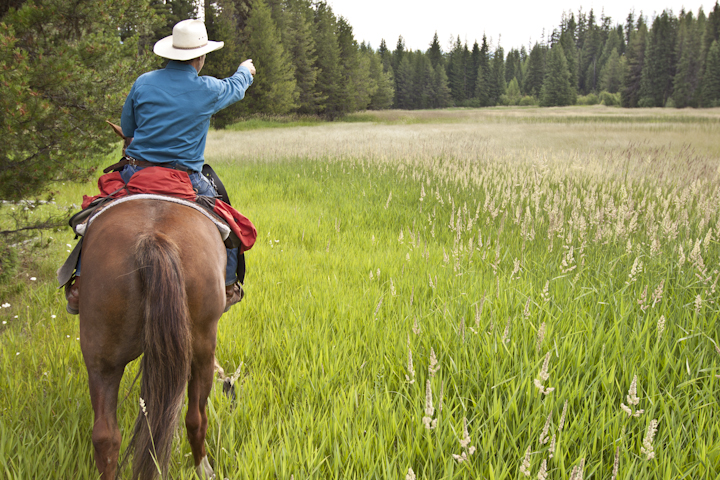
During a recent six-hour horseback ride across a half-dozen square-mile sections of former Plum Creek timberland that dot the Swan, Parker pointed to numerous signs of grizzly activity. They included ripped up logs, yellowjacket nests and "bear trees," where debarked trunks, oozing sap and telltale scoring told of repeated visits.
Our tour began northwest of Condon at the headquarters of Northwest Connections, a conservation organization started by Parker and his wife, Melanie Parker aimed at educating others about the critical habitats and habitat connections in the Swan Valley. We wound through what was, until just recently, mixed private and Flathead National Forest lands at the base of the Mission Mountains.
Today, the land is all one contiguous block owned by the Flathead thanks to the Legacy Project and the efforts of people like Parker. In all, the forest picked up 70 square miles, or 45,000 acres, of former Plum Creek timberlands scattered across the Swan Valley between the Bob Marshall and Mission Mountains wildernesses.
Just down Montana Highway 83, to the south in the Seeley Valley, the Lolo National Forest picked up 7,592 acres of similarly vital lands. Together, the Lolo acquired 67,000 acres of former Plum Creek property in spots surrounding Missoula.
From the start, some Montanans questioned the wisdom of spending taxpayer money to bring these Plum Creek lands into public ownership. Pointing to the heavy logging and associated roadbuilding there in the past few decades, they wondered if the lands still offered anything of value for wildlife.
Parker doesn't need any convincing. For him, the many churned-up grizzly foraging areas and clawed-up bear trees he spots anytime he heads out by horseback in the Swan are all he needs to conclude these lands still support wildlife. Beyond grizzly bears, the list of critters occupying the Swan Valley includes moose, elk, mule deer and whitetail deer, lynx, mountain lions and wolves.
Parker:
Parker: "I think Plum Creek really saw this place as...probably the most marketable land they had in the state of Montana." Photo by Jason D.B. Kauffman.
No matter where we traveled during our ride, whether it was a square-mile section of former Plum Creek timberland or a square-mile section of the Flathead, grizzly sign was never far off.
Seemingly unperturbed by such a high concentration of grizzlies were the numerous whitetail deer sighted at regular intervals along the way. Combined with obvious signs of elk and other species, the Swan's importance for wildlife became ever more clear.
Key to this richness are the wetlands. Long-extinct glaciers left a legacy of pothole wetlands scattered across the Swan. From Highway 83—the narrow two-lane stretch of blacktop that runs the length of the valley—most of the wetlands are invisible behind a cloak of trees. But what these wet areas support are many of the highly nutritious plant communities favored by grizzlies. 
This diversity of wildlife species and the mixed swaths, generally intact, of wetland, forest and meadow habitats have led some ecologists to call the Swan one of the northern Rockies' most important landscapes.
Among them is Gary Tabor, a Bozeman-based senior conservation adviser for Freedom to Roam, a conservation organization focused on preserving wildlife corridors and landscape connectivity across North America.
Much of Tabor's work has focused on protecting biological corridors used by wildlife in private and protected land through the Yellowstone to Yukon Conservation Initiative. According to him, work in the mid- to late-'90s identified two key linkage zones in northern Montana and southern Canada's Crown of the Continent Ecosystem. The first is the North Fork of the Flathead, the focus of recent cross-border conservation talks. The other was the Swan.
"The Swan is the ecological equivalent to the Flathead," Tabor said.
Just consider how the Swan will look in 10, 20, 50 and 100 years from now once restoration activities on the former Plum Creek lands really begin to take hold.
Within those portions of the Legacy Project now controlled by the Forest Service—112,000 acres at last count—the agency's "management area" focus will translate into a greater emphasis on restoration and the protection of sensitive species like grizzly bears and bull trout. On the ground, it will likely lead to actions that reduce the overall road density and modify harmful culverts in the former Plum Creek lands.
Future wildlife mitigation efforts focusing on the Swan and Highway 83—which takes a major toll on the valley's wildlife—are needed to ensure grizzlies and other species remain in the Swan, Tabor said. A holistic approach will be needed to best recover these lands, he said. "I think the (logging) roads will be part of that conversation."
Because of its favorable climate and rich soil types, the Swan is a resilient landscape. All one has to do is look at the rapid regrowth of deciduous and conifer tree species along many of the logging roads that wind through the former Plum Creek lands. Several times during the tour with Parker, impenetrable tangles of underbrush and fast-growing trees prevented the horses from continuing forward.
Backtracking, we'd regroup and find another path through the dense regrowth.
A VALLEY IMPAIRED, BUT NOT DEFEATED
Parker believes the Swan valley came perilously close to a tipping point where the density of residential development would have made the long-term survival of the valley's grizzlies all but impossible. More and more bears were running into trouble and being killed by wildlife managers.
"There was ample evidence that we had reached the human development threshold," Parker said. "The implications of the trainwreck were already evident."
Thankfully, educational efforts by the Swan Ecosystem Center and Northwest Connections have successfully reduced many of the sources of negative interactions—like untended garbage—among bears and local residents. A whole new wave of homebuilding on Plum Creek lands could have forever altered that delicate balance, with the great bears ultimately losing out.
"I think Plum Creek really saw this place as a place that was really, in terms of their land base, probably the most marketable land they had in the state of Montana," Parker said.
For years, the Swan's grizzlies have managed to survive in a roaded landscape dedicated to forest-product extraction, said Rod Boothby, a 10-year resident of the Condon area who came along for the horseback ride. Though certainly degraded, the habitat is still there. But the changes that would have come with more new homes—barking dogs, spilled trash and leftover grain—are another matter, Boothby said.
Grizzlies that grow accustomed to raiding homes generally aren't allowed to continue wandering freely for long.
"What the bears can't take is more and more homeowners permanently altering their home," Boothby said. "The foundation is here. Whatever we do with the trees, we can fix. But, boy, you can't fix a bear that got trained with a .30-06 because he was in the wrong place at the wrong time."
The swift, clear waters of the Swan River roll northward. In the distance, summits in the remote Swan Range. Photo by Jason D.B. Kauffman.
It remains to be seen whether the Legacy Project happened soon enough to preserve sufficient habitat to ensure a future for grizzlies in the Swan. Parker, Boothby and many other fans of the place like to think so.
Before the Legacy Project, groups like the Trust for Public Land were painstakingly piecing together a patchwork of protected lands in the Swan one parcel at a time. It was important work, but left many just-as-valuable lands without protection.
Still left in doubt were the vital connections for grizzlies moving back and forth across the lower Swan Valley between their core ranges in the Mission Mountains and the Bob Marshall Wilderness. For the bears to persist there, those connections must be maintained. "They're going to have to be able to swap some DNA," said Chris Bryant, the Nature Conservancy's Western Montana Director of Outreach in Missoula.
In 2008, the Legacy Project changed the storyline entirely. Up on the Swan and elsewhere across four counties in western Montana, the future of nearly a third of a million acres of vital lands immediately became clearer.
"It was like a footrace that turned into a horse race," said Boothby. "It should have happened 10 years ago. Praise the Lord it happened now."

Wisconsin Cougars............yes they are back, no they aren't???????

Cat fights: Cougar sightings spark debate on whether they belong here


MARY ELLEN GABRIEL | Special to The Capital Times 

 Cougars are coming back, and their presence is stirring up a hornet's nest of opinions as to whether or not they belong in Wisconsin.

 The cougar lies in a white metal drawer, skull and femur bones stored neatly in separate boxes.

"This is a very important specimen," says Paula Holahan, curator of rare mammals at the UW Zoology Museum. "It's the only known, existing Wisconsin cougar."

Stretched lengthwise, the expertly removed skin retains the memory of life — as if the warm heart and entrails, the thick muscles and golden eyes had simply vaporized, leaving behind an envelope of dense fur, a shrunken face, and large, limp paws.     

Wisconsin's native cougar — felis concolor schorgerii — is officially extinct. Wiped out as of the early 1900s, the cougar couldn't coexist with farmers who despised its tendency to pounce on livestock when other prey became scarce. The cougar in this drawer was killed more than 150 years ago by a farmer looking for a lost colt.

But it was no ghost cat that a bus driver observed crossing a road in Price County in January. And many Juneau County residents believe a cougar is responsible for a series of attacks on livestock this spring and summer.

Cougars are coming back, and their presence is stirring up a hornet's nest of opinions as to whether or not they belong in Wisconsin. Like the wolf, the cougar is seen by some as a threat to livestock, deer and people. Others are delighted to think that Wisconsin's wild landscape might once again sustain the admittedly beautiful cat.

The state Department of Natural Resources, meanwhile, is attempting to deal with an animal for which there is, as of yet, no management plan. Until wildlife biologists can prove there's a breeding population here, the cougar is in limbo, with DNR biologists deciding its fate on a case-by-case basis. The agency is struggling, as well, with a shortage of wildlife specialists trained to recognize cougar signs, and an unclear protocol about how to handle reports of sightings and livestock attacks. 

One thing's certain: If the predator stalking Juneau County this summer turns out to be a cougar, it will be euthanized and turned over to the UW Zoology Museum, where it will likely end up — along with its 150-year-old cousin — in a drawer in the rare species storage room.

"If we don't take action and control problem animals right from the start, acceptance of cougars will be very low," says Adrian Wydeven, a mammalian ecologist and wolf biologist who has been monitoring cougar sightings and running track surveys on the big cats since 1991.

Wisconsin has plenty of ideal cougar habitat, including rocky bluffs and forested rivers. But the cats like to roam, and the DNR wants to stay on top of their whereabouts. A handful of unconfirmed sightings in Dane County over the last 10 years aren't enough to concern wildlife specialists yet. But once a cougar shows up in an urban area, problems inevitably occur. Out West — in states with healthy cougar populations, including California, Montana and Washington — cougars have been spotted in backyards, on rooftops, and in city parks. And while attacks are rare, they are on the rise out West: Out of 10 fatal cougar attacks in the last 100 years, the last five have occurred within the last decade. 

Just how many cougars are in Wisconsin? In the last two years, the DNR has documented the presence of at least four cougars in the state. The animals are thought to be transient members of a western population, probably from South Dakota, just passing through. Cougars are present in Iowa, Minnesota and Michigan, though it probably will take another couple of years to prove the existence of a breeding population in those states, as well as here, Wydeven says.

Meanwhile, the DNR is watching to determine how well the transients do.

"Are they a nuisance? Are they staying in areas suitable for cougars, or are they going to areas where they are causing problems?" Wydeven ticks off a few criteria for determining how warm a welcome the creature will get from the DNR.

"We may decide that we don't have the space for a breeding population of cougars, so we aren't going to do anything to encourage or discourage it," Wydeven says. "That's all speculation — we just have to wait and see."

•    •    •    •

Sherry Jones does not have to wait and see. Since April, Jones has had four sheep killed, and two horses slashed from mane to throat, on her farm in southwestern Juneau County. A U.S. Department of Agriculture wildlife specialist, under contract with the DNR, confirmed all of them as cougar attacks at the time.   

The first time her horse, Chief, was attacked, Jones was mystified by the wounds. It was as if  "a large hand had raked down his neck," she says. Jones and her daughter went down to the pond to look for animal tracks.

"We found these perfect prints in the mud, and when the USDA wildlife specialist came out, he took plaster casts of them. He said they were the tracks of a very large cougar."

They also found a dead sheep, with wounds consistent with a cougar attack. Over the next few weeks, Jones lost four sheep, and a neighboring farmer lost a heifer, all to confirmed cougar attacks. And then on June 14, Jones' horse, Chief, was slashed again, this time more seriously. Jones searched for her horse early that morning.

"I kind of broke down," she recalls. "I was following his blood track through the brush, and I knew he was hurt bad. I begged them to bring the lion dogs out."

Dogs and trackers finally arrived mid-morning. They combed the bluffs, cliffs and wetlands, but the predator was long gone.

Trail cameras, sharpshooters and trackers failed to turn up anything further on Jones' farm. Then, on Aug. 3, Jones' horses were attacked for a third time. Chief broke a leg in the struggle and had to be put down. Jones says lion dogs were brought out that night, too, but again failed to find anything. She believed these attacks would also be confirmed as cougar. Instead, on Aug. 17, the DNR's central office issued a news release backpedaling on its previous confirmations of all Juneau County cougar attacks.

In the release, the agency doesn't rule out the possibility of a cougar in the area, but refers to the situation as a "mystery." 

"We sent pictures of the evidence — tracks, wounds — to experts out West," explains Wydeven. "They said it did not look like a cougar to them. But they can't say it's not, either."

What about the Juneau County turkey hunter who saw a cougar mauling a heifer in June? Turns out a farmer may have told the hunter's story, and DNR officials were too quick to call it credible. When Wydeven finally reached the hunter to interview him six weeks after the attack, "he surprised us. His description wasn't consistent with an adult cougar."

Wydeven admits the agency made mistakes in confirming the Juneau County attacks as cougar.

"We didn't do a thorough enough job of getting pictures and plaster casts. We made assumptions, based on information reported to us," he says. "Our goal is to get our wildlife specialists better trained."

Jones says she is confused and concerned. The injuries to her animals, the tracks found on her farm and inspected by three DNR specialists, the research she's done and the feedback she received from the DNR at the time all have her convinced that the attacks were cougar-caused.

"I don't understand the reversal," she says.

Such are the challenges the DNR faces as it develops a protocol for dealing with the notoriously elusive cougar as it returns to its old native habitat.

An old saying has it that you won't see a cougar unless it wants you to. Secretive and shy by nature, cougars are also curious. There have been reports of them following another animal, even a human, with no urge to attack. But this is rare; cougars prefer to stay hidden, says Wydeven. And there has never been a recorded cougar attack on a human in Wisconsin. That doesn't stop people from worrying about their children or pets. Online discussions following articles about cougars in Wisconsin almost always mention these concerns. Partly this is due, Wydeven believes, to reports of cougar encounters, some deadly, in western states, where shrinking habitat and urban sprawl are bringing cougars and people into closer contact.

"Stand your ground, wave your arms, shout and yell," Wydeven recommends, to folks fearful of coming face-to-face with the big cat. "It's relatively easy to scare them off."

The only exceptions, he says, would be a cougar who is starving, has kittens, or has become dangerously habituated to humans.

In the Black Hills of South Dakota, home to a healthy population of around 250 cougars, the latter problem is taken seriously and handled proactively. 

"We have a zero tolerance policy for cougars that try to settle themselves into a community. If we see that, we euthanize them," says Chuck Schlueter of South Dakota Game, Fish & Parks. Ditto for cougars that prey on livestock, though Schlueter says this has been much less of a problem than feared. Farmers are allowed to shoot cougars on the prowl, and there's also a cougar hunting season — controversial at first, and now considered a vital management tool. The state's cougar management plan has been in place since 2005 and so far, seems to be working.

"What our public surveys indicate is that there is a large acceptance of cougars and a desire to have them as part of our wild landscape," he says.

Eric Koens raises registered polled Hereford beef cattle on 400 acres in rural Rusk County, about 70 miles northwest of Eau Claire. Koens has never seen a cougar, but most of his neighbors have had problems with wolves.

"Any farmer who has had predator problems in the past — and that's most of us — would not be excited about having another predator on the landscape," he declares.

Koens, a leading member of the Wisconsin Cattlemen's Association who served on the group's board and is now on its legislative committee, also served on the Wolf Advisory Committee as the sole farmer's voice. He believes that farmers' concerns ought to be taken more seriously.

"The DNR couldn't predict the wolf population would grow so fast, and now look at the damage that is being done," he says.

The wolf population has climbed to 700, double the DNR's original goal of 350 animals when wolves began naturally repopulating the state in the 1970s. Depredation tends to fluctuate but has hovered around 30 to 40 cattle (and 15 to 20 hunting dogs) killed by wolves each year since 2004. Last year, the state paid out a little more than $90,000 in wolf damage compensation.

Koens believes letting cougars survive — and thrive — in Wisconsin should be a matter for the public to decide. 

"As far as I'm concerned, we do not need cougars in Wisconsin," he says. "Our cattle are free-range animals. There's no way we could protect them from a predator like the cougar."

Lessons from the wolf's recovery will be applied to the cougar, Wydeven says, but unlike with the timber wolf, the DNR has no plans to launch a formal recovery program for the animal; cougars, unlike wolves, are not federally endangered. And while the agency "welcomes the return of a native predator," DNR biologists admit there are even more unknowns with this predator than there were with the wolf.

Cougars, like wolves, eat white-tailed deer and feel at home in forested areas, but that's where the similarities end. The solitary cat's behavior is more difficult to predict than that of the more social wolf. A cougar can roam vast distances — the male cougar that wandered down through the Janesville area in 2008, on its way to a deadly fate in Chicago, traveled 800 miles from the Black Hills. It is expert at hiding, and has been known to attack people. Such attacks are uncommon, though not as rare as with wolves.

And out West, at least, wolves don't like to share territory with cougars.

Does that mean cougars will find farm country more to their liking? Even though Juneau County is dotted with towns and stitched by roads, there are enough rocky, wooded bluffs and narrow valleys where a cougar could have hidden for weeks. In fact, folks in this hilly region, known as the Driftless Area, say cougars have been roaming there for decades. Wydeven admits this might be so.

"If there were cougars we hadn't found yet, the Coulee Region would be the most likely place they'd be," he says. "We don't do tracking surveys there."

Wydeven says it's difficult to get the permission of private landowners in the area to allow any tracking studies; this work is done mostly up north, where there is more public land available.

If cougars have been living in the Driftless Area all this time, they've been remarkably well-behaved. Until this summer, there have been no confirmed cougar depredations in more than a century.

Wydeven points to South Dakota, where depredation isn't much of a problem, because the cougar's favorite food — deer — is widely available. Here in Wisconsin, there are plenty of white-tailed deer, and what biologists hope is that cougars will stick to their wild diet.

•    •    •    •

But many hunters aren't too excited about sharing deer with cougars.

"A transient cougar won't have much of an effect, but if one set up shop and started working a 30-mile area, it would have a significant impact on local deer herds," says Jeff Davis, a hunter from Sturgeon Bay who also edits Whitetails Unlimited's membership magazine. He says just the presence of a cougar would cause deer to hide and move, making hunting more difficult. Hunters, he says, are already discouraged by what they see as a dwindling herd and less rewarding days afield.

"We're hearing lots of guys say they didn't see anything last year," he says. "Hunter retention is a big deal right now. And anything that would reduce the number of hunters in the field would concern us."  

Wydeven concurs that deer might be spooked if a cougar were in the area but says overall, he's not sure if cougars would have much of an impact on deer numbers statewide. Wisconsin's deer herd is considered healthy, at around 1.2 million animals. An adult cougar kills, on average, one deer a week.

Once a breeding population is established here — and Wydeven says it's not a question anymore of if, but when, that will happen — the DNR will have to consider the concerns of influential groups like Whitetails Unlimited, the Conservation Congress, the Wisconsin Cattlemen's Association and others. Wydeven says the agency would need to go through, at the very least, "a general public involvement process, to determine people's opinions and hopes for cougars returning to the state." Moving the cougar from "protected wild species," its current designation, to "state-endangered" would offer the animal more protection but might tick off farmers and hunters. Some might support a cougar harvest, just as there is in South Dakota. Meanwhile, the cougar, unaware that its fate is tied to human concerns, will do what comes naturally: seek the rocky bluffs and forest edges where it can remain hidden, yet still find food.

There are plenty of folks quietly celebrating the cougar's comeback. Steve Glick, who lives in Lyndon near the Sauk and Juneau county line and has served on the Conservation Congress since 1976, says he is moved by the thought of the animal returning after so many years.

"Everything has a place in the ecosystem. I truly think that if people use common sense, there is room for everything."

Glick, a hunter, says other hunters share his view. But he doesn't want cougars preying on his neighbors' livestock, and admits that the animal roaming Juneau County this summer needs to be euthanized.

"This cougar has worn out its welcome," he says. "I would love to see it tranquilized and taken somewhere else, but that's just not economically feasible."

Near Lyndon, the Elroy-Sparta State Trail, a popular 32-mile rails-to-trails route, runs smack through the hills and valleys of Juneau County. You might think bikers would be a bit concerned, but that doesn't seem to be the case, according to Judy Lydon, manager of bike rental at Kendall Depot Trail Headquarters.  

"We haven't had any sightings by the trail. Nobody's even mentioned it," says Lydon.

Cindy Gagan, manager of the Horse Camp at Wildcat Mountain State Park, says no one has raised any concerns to her about cougars, either, though the camp is only 30 miles from the locus of the attacks in Juneau County. She herself has ridden horses in South Dakota and Wyoming, where cougars are more common.

"Out there, you are right among them. They may be here. This is perfect habitat for them. We just keep an eye out. I really have no misgivings about them, though."

As long as human encounters remain benign (or non-existent), hikers and campers may turn out to be the cougar's most passionate advocates.

Eric Sherman, an avid hiker who works for the Ice Age Trail Alliance, guesses most of the group's members would view the return of the cougar as "a celebratory thing." He admits that he would be thrilled to glimpse a cougar while hiking, just as he would be to see a wolf. The element of danger, he points out, is part of the meaning of wilderness.

"Anyone who ventures out into a wilderness setting in Wisconsin has some understanding of the risks. If a cougar was ever sighted, that would be a good time to think about promoting cougar awareness, preparedness and safety to our members."

In 2007, Wisconsin's 42 state trails, totaling more than 1,700 miles, were designated the Aldo Leopold Legacy Trail System, in honor of the conservation icon who founded the University of Wisconsin's wildlife management department. Part of Leopold's legacy was his view that predators were a necessary part of the landscape.

In his essay, "Wilderness" — written in 1947, the year before he died — Leopold lamented the "wolfless" national parks, the elimination of "lions" and the retreat of grizzlies toward Canada. He could not have foreseen the re-establishment of those large predators out West, let alone the return of the wolf and cougar to his home state of Wisconsin. While recognizing the thorny management issues, it is hard to imagine that Leopold would not also have found reason to celebrate.

Back at the UW Zoology Museum, Paula Holahan closes the white metal drawer containing the 150-year-old cougar. She wants visitors to understand the importance of having specimens like this one preserved right here, where people can come and study them. Around the storage room, the plastic-shrouded skeletons of extinct birds and long-dead mammals peer down, silent witnesses to hard lessons.