Visitor Counter

hitwebcounter web counter
Visitors Since Blog Created in March 2010

Click Below to:

Add Blog to Favorites

Coyotes-Wolves-Cougars.blogspot.com

Grizzly bears, black bears, wolves, coyotes, cougars/ mountain lions,bobcats, wolverines, lynx, foxes, fishers and martens are the suite of carnivores that originally inhabited North America after the Pleistocene extinctions. This site invites research, commentary, point/counterpoint on that suite of native animals (predator and prey) that inhabited The Americas circa 1500-at the initial point of European exploration and subsequent colonization. Landscape ecology, journal accounts of explorers and frontiersmen, genetic evaluations of museum animals, peer reviewed 20th and 21st century research on various aspects of our "Wild America" as well as subjective commentary from expert and layman alike. All of the above being revealed and discussed with the underlying goal of one day seeing our Continent rewilded.....Where big enough swaths of open space exist with connective corridors to other large forest, meadow, mountain, valley, prairie, desert and chaparral wildlands.....Thereby enabling all of our historic fauna, including man, to live in a sustainable and healthy environment. - Blogger Rick

Subscribe via email to get updates

Enter your email address:

Receive New Posting Alerts

(A Maximum of One Alert Per Day)

Wednesday, September 25, 2013

""We need a dramatic change in how wildlife are managed in this country"......... "The separation of 'game' management and wildlife management is the first critical step"------Our friend, biologist John Laundre who is one of the most eminent cougar-bologists in the country continues to write convincingly on why it is wrong to establish hunting seasons on Carnivores in the same way we do for hoofred browsers like Deer, Elk and Moose..............As many of you know, he is vice president of the Cougar Rewilding Foundation and author of the book "Phantoms of the Prairie: The Return of Cougars to the Midwest."............................John goes on to say---"Let the game agencies with their millions of hunter dollars manage the deer and the ducks, but let new wildlife agencies manage the rest of the wildlife the way they should be managed, based on sound ecological science, not hunter demands"...............John has commented often on the absurdity of the Nebraska Fish & Wildlife Agency allowing people to hunt the 22 Pumas that are attempting to re-wild the Corn Husker State.


Nebraska mountain lions targets of unrealistic fears

High Country news via Albuquerque Journal

It was just a few years ago that Nebraskans were awe-struck by the mountain lion's return to the state after a century's absence.Now we're getting ready to hunt them down.


There are only an estimated 22 cougars currently roaming the state's 77,000 square miles. Yet that's enough to justify a hunting season, at least according to the Nebraska Game and Parks Commission.,The decision wasn't a surprise. The nine commissioners were appointed by a like-minded governor who leans over backward to please the state's agriculture interests, which demand that any potential threat to their livestock and corn – however minuscule or exaggerated – must be eliminated.
"We got along fine without them for 100 years," said one anti-cougar Nebraska farmer. "We don't want them."


"God forbid they don't eat a child," wrote another over-excited rural Nebraskan. "Remember, people, these are killers, not pets, and you are on their food list." So far, humans have not provided much food for mountain lions. Statistics vary, but there have been between 12 and 20 fatal cougar attacks in the United States in the past 125 years – about one every six to 10 years.

There is no documented case of a cougar ever stalking or threatening a human in Nebraska. There is no record of a cougar even killing a cow or any other livestock in the state. Nebraskans might be wiser to look over their shoulders for other, more deadly (if less dramatic-looking) creatures.

Those bees and wasps buzzing outside a barn or porch? They kill 40 to 50 Americans each year. That brown recluse or black widow nestled in one of your home's ceiling corners? You are 40 to 50 times more likely to die from a spider bite than a cougar attack. And your neighbor's German shepherd? It is 400 times more likely to come after you than a cougar is.

In fact, according to CDC statistics, a person living in the United States is 75 times more likely to die from choking on a toothpick than being attacked by a mountain lion. Given the dietary preponderance of meat and corn in Nebraska, there are plenty of toothpicks in our kitchens. Just remember to pick with care, OK?

Aside from the irrational fear of cougars, a larger question looms here: Who "owns" the wildlife in Nebraska? Is it just the hunters, outfitters, ranchers and farmers? Or is it all Nebraskans?
If cougars – and all of our wildlife and natural resources, including our badly mismanaged groundwater – are determined to be a part of the commons, shouldn't all Nebraskans have a say in how we manage them?

That is the argument of New York biologist John Laundre, one of the most eminent cougar-ologists in the country. He is vice president of the Cougar Rewilding Foundation and author of the book "Phantoms of the Prairie: The Return of Cougars to the Midwest."

"We need a dramatic change in how wildlife are managed in this country, and the separation of 'game' management and wildlife management is the first critical step," he wrote in a commentary, "Who Owns the Wildlife?"

"Let the game agencies with their millions of hunter dollars manage the deer and the ducks, but let new wildlife agencies manage the rest of the wildlife the way they should be managed, based on sound ecological science, not hunter demands."


Before implementing its mountain lion management plan, the South Dakota Department of Game, Fish and Parks invited public comment in 2010. The agency received 112 comments. Ninety-six people expressed displeasure with the agency's plan to increase the cougar "harvest," and more than two-thirds of those 96 said they were against the hunting of lions altogether. There were seven comments that were neutral or undecided. Only about 9 percent of those responding favored increased hunting of cougars. Of course, that did not deter the department from deciding to hunt cougars anyway.

The reality is that a growing majority of Nebraskans – and South Dakotans – want honest-to-goodness wildlife management and environmental stewardship. Both have been sorely lacking.
As one South Dakotan commenter wrote: "It is beyond comprehension why the most rural states are the first to fear and kill a very shy and harmless species."

Even without an official hunting season, Nebraskans are now allowed to shoot a cougar – if they are lucky enough to see one. All they have to do is say they felt threatened, aim, fire and all is fine and dandy. Who will ever know the truth?

But that doesn't make it any easier to understand why Nebraska feels compelled to allow the hunting of a mere 22 mountain lions whose threat to humans is effectively zilch. That got me wondering: If the Nebraska Game and Parks Commission received a couple of reports about invading two-legged, hairy, carnivorous-looking "creatures," might it consider starting a hunting season on Bigfoot, too? Why wait to confirm that a creature exists when you can just start shooting at its shadow?

Pete Letheby is a contributor to Writers on the Range a service of High Country News. He is an editor and freelance writer in Grand Island, Neb.

Tuesday, September 24, 2013

The Michigan environmental Advocacy Group, KEEP WOLVES PROTECTED, is getting the word out to stop the killing of up to 43 Wolves in Michigan's Upper Peninsula starting November 15................. Michigan law already allows farmers, ranchers and pet owners to kill wolves threatening their animals................ In fact, the Dept. of Natural Resources sanctioned the killing of 89 wolves in Michigan over the past decade based on this paradigm.................There are only some 600 Wolves in this recovering population and therefore many biologiists feel that it is way to premature for any sport hunting season to take place..........Every piece of peer reviewed science(See Trent University paper on this subject by Linda Rutledge) regarding Wolf Pack culture reveals that there is no good reason to ever sport-hunt Wolves............Human hunting of Wolves results in social disruption of their Packs which precipitates a breakdown in the top down biological diversity stabilizing impacts that Wolves bestow on the full array of plants and animals in a given natural system...............The people of Michigan sought to have a referendum on the Wolf hunt which Legislators circumvented by doing an "end-around" and passing Senate Bill 288 (Public Act 21 of 2013) just weeks after the qualifying signatures were submitted............This allowed the Michigan Natural Resources Commission, in addition to the legislature, to add Wolves to the list of game species that could be hunted..................KEEP WOLVES PROTECTED has launched a 2nd petition referendum to restore peoples rights to vote on whether Wolves should be hunted and needs 225,000 signatures to get on a November 2014 ballot........................Support this effort and the people of Michigan might just overturn future Wolf hunting seasons going forward

                                                 KEEP MICHIGAN WOLVES PROTECTED
FOR IMMEDIATE RELEASE                                                                             CONTACT: Jim Karshner, 517-896-2004
Tuesday, Sept. 24, 2013                                                                                     media@keepwolvesprotected.com

Michigan's Upcoming Wolf Hunting Season Based on Fear, not Facts
The sale of 1,200 wolf hunting licenses beginning this weekend

LANSING, MICH. – After wolves were trapped, shot and poisoned to near extinction 50 years ago, Michigan's upcoming sport hunting season on this fragile, still-recovering species is unnecessary, irresponsible and based on flawed data. The Michigan Department of Natural Resources begins selling 1,200 licenses on Saturday, Sept. 28 to kill 43 wolves in three designated areas of the Upper Peninsula starting Nov. 15.

"There is no scientific justification for a wolf hunt—people can already shoot wolves that are threatening livestock or property, and people don't hunt wolves for food," said Jill Fritz, director of Keep Michigan Wolves Protected. "This wolf hunt is not based on science, but on politics. When more than 250,000 Michigan voters signed a petition to place the wolf hunting law on the November 2014 ballot, the politicians in Lansing did an end run around the people and decided to allow a wolf hunt anyway before we could even vote on the issue. That's just not right and it's an abuse of power."


The quota of 43 wolves this hunting season could expand to hundreds more  in future seasons, and could also include the use of inhumane, painful steel-jawed leghold traps.

Even though the state's wolf population has declined from 687 to 658 in just two  years, the legislature pushed through a wolf hunting season based on a perceived increase of wolf-livestock conflicts. However, recent information uncovered by a Freedom of Information Act request tells a different story.
FOIA documents reveal alarming details of a DNR investigation into a Matchwood farm, in Ontonagon County, owned by John Koski. An examination of DNR statistics of confirmed livestock losses due to wolves in one of the designated areas (includes Ontonagon, Baraga and parts of Houghton counties) reveal that the vast majority occurred on the Koski farm. Within that zone during the period of 2010 to 2013:
  • 73 percent (57 of 78) of wolf conflicts with livestock occurred on the Koski farm;
  • 80 percent (96 of 120) of individual livestock confirmed killed by wolves were on the Koski farm;
  • 82 percent ($32,936 of $40,098.51) of all compensation for livestock lost to wolves has gone to the Koski farm; and
  • 64.4 percent (96 of 149) of the cattle killed by wolves in the entire U.P. in the past 3 years have been on the Koski farm.
The investigation noted that Koski failed to use nearly $4,000 of non-lethal wolf deterrence methods, including fencing and donkeys, which the DNR provided to him free of charge. In fact, a DNR investigator and accompanying veterinarian found that Koski allowed two of the donkeys to die and a third was removed because of extremely poor health due to lack of care. The DNR also found that Koski failed to provide proper care and water for his own cattle and left carcasses on his property to attract predators.
Michigan law already allows farmers, ranchers and pet owners to kill wolves threatening their animals. In fact, the DNR has sanctioned the killing of 89 wolves in Michigan over the past decade, including dozens as a result of Koski's complaints.

Hunters won't be targeting problem wolves, but randomly killing animals in forests and wilderness areas.

Lansing politicians wrongly gave the seven, unelected members of the Natural Resources Commission authority to open hunting seasons for wolves and dozens of other protected species. This measure will restore the right of Michigan voters to have a voice on wildlife policy through the referendum process, and stop this abuse of power.

Keep Michigan Wolves Protected, a coalition of Upper and Lower Peninsula residents, animal welfare organizations, including The Humane Society of the United States, conservation groups, Native American tribes, wildlife scientists and veterinarians, recently launched a second petition referendum to restore people's rights to vote on important wildlife issues. The group hopes to collect at least 225,000 signatures to qualify for the November 2014 ballot.

Timeline:
  • December 2012 – A bill was rushed through the House and Senate that designates wolves a game species and authorizes the Natural Resources Commission to establish an open season on wolves. Gov. Snyder signs the bill into law and it becomes known as Public Act 520 of 2012.
  • January 2013 - Keep Michigan Wolves Protected forms. A coalition of conservation groups, animal welfare organizations, Native American tribes, wildlife scientists, veterinarians, hunters, farmers and more than 7,000 citizens in the Upper and Lower Peninsulas launches a petition drive to protect the state's fragile wolf population.
  • March 2013 – After 67 days, Keep Michigan Wolves Protected submits more than 255,000 signatures in an effort to overturn the law that allows for the cruel and pointless hunting and trapping of wolves.
  • May 2013 – Legislators circumvent the will of the voters and pass Senate Bill 288 (Public Act 21 of 2013) just weeks after the qualifying signatures were submitted, allowing the Michigan Natural Resources Commission, in addition to the legislature, to add animals to the list of game species that can be hunted. If the NRC makes such a designation, Michigan voters would be unable to reverse their decision because it is an act of a regulatory body and not the legislature.
  • May 2013 – The Board of State Canvassers certifies Keep Michigan Wolves Protected petition signatures to place the wolf hunt referendum on 2014 ballot.
  • August 2013 – Keep Michigan Wolves Protected launches a second referendum campaign to repeal Public Act 12 of 2013 and restore voters' rights on important wildlife issues.

Michigan residents interested in volunteering, donating or learning more about the issue can visit KeepWolvesProtected.com.
###

Monday, September 23, 2013

Texas has not seen Black Bears in the state for a good 50 years!!!! However, in recent times, Bruins have been finding success in neighboring Arkansas, Oklahoma and (to some extent) Louisiana and their prodigy are now recolonizing the Lone Star State..............If Black Bears can make it in New Jersey, one has to hope that the colossal land acreage state of Texas can also successfully harbor a population successfully

Black bears come home to East Texas


Louisiana Black Bears, which haven't been seen in these parts since
 the 1950s, are returning to the region, hungry for fresh sources of
 food and looking for mates.
The bears are moving naturally back to the Lone Star State across 
rivers from Oklahoma, Arkansas and Louisiana, said Donna Work,
 with the Texas A&M Forest Service.
"If they are coming over, they need a place to stay," she said. The bears
 are threatened and illegal to kill.
Work said bear populations in neighboring states have grown substantially
 in recent years, forcing rogue male bears to move to Texas in search of their
 own territories. The last black bear spotted in East Texas was killed in
 Polk County in the 1950s, Work said.
Nathan Garner, a volunteer for the East Texas Black Bear TaskForce,
 an official subcommittee of the Black Bear Conservation Coalition, 
said its important to raise awareness about the bears' return.
"I think they can be an asset to people and society," he said. "They're
 of value and a part of our natural heritage."
Garner said it is a good sign that the bears, which were forced out by
 hunters and urban sprawl, are returning to an area where they once
 thrived.
"It's a story of a large mammal that requires a lot of real estate that's
 coming back to East Texas and trying to repopulate the area," he said.
Work said her group wants to teach people here how to live in harmony
 with the bears - showing how it has worked in other states - in an attempt
 to make that transition as easy as possible.
"When you understand something you're fearful of, maybe you can be
 prepared" she said.
Bears make dens in large, hollow trees, brush piles, thickets, rock crevices
 and caves. They are opportunistic feeders, eating almost anything that is
 available. Hunters and property owners can help keep bears away by 
keeping hunting camps and yards clean to prevent odors that will attract 
bears or by switching bait types from corn to soybeans to reduce a bear's
 interest.
Without the enticement of food, bears want to stay away from people
 and will try to stay far from roads, Work said
.

COYOTEWATCH CANADA does the same type great advocacy for Coyotes up North as PROJECT COYOTE does for Songdogs in the USA-----They both take the fear and half-truths out of how to co-exist with Coyotes and lay out a tried and true paradigm that allows both species to have their proper time and space on our planet............Food and access to it are the main reasons that Coyotes take chances coming into human neighborhoods...............And yes, small dogs and cats are on the menu if Coyotes feel that they have a better than even chance of getting their meal without being harmed............Carry a baseball bat and bang it on the sidewalk when walking your pets and encountering a Coyote................Opening and closing an umbrella is another excellent deterrent............

Coyotes just looking for food, so remove 

food sources, expert saids

guelphmercury.com

GUELPH — If you have a problem with coyotes, 
what you really have is a problem with a 
food source, says Lesley Sampson, director
 and co-founder of Coyote Watch Canada.
Get rid of the food source and the coyotes 
will move on, she told about 30 people 
who attended a public meeting at City 
Hall Friday night on the subject.


There's been an increase in coyote sightings
 in Guelph in recent years, and the city is 
developing a strategy to deal with it.
Educating the public is step one, and that
 was the purpose of Friday's meeting.
Sampson spoke about the habits and
 demeanour of coyotes, who live in packs,
 mate for life and are very protective of 
their pups. Generally they don't want to 
interact with humans, but if they find a
 food source, they will venture into
 urban neighbourhoods.
About 80 per cent of their diet is small 
animals. Usually that means mice, but 
it could mean your family cat or small
 dog if conditions are right. More than 
likely, however, it's your compost or
 food put out in bird feeders, or birds
 that come to bird feeders that's 
catching their eye.
Sampson talked about a partnership
 between Coyote Watch Canada and 
the city of Niagara Falls that has has 
positive results. Niagara Falls passed
 a no-feeding-wildlife bylaw and that
 has done a lot to keep coyotes away.
"They are masters at finding food,"
 Sampson said. "And they are masters 
at finding our food. You put yourself
 and your neighbours at risk when you 
feed wildlife. They'll keep coming back
 for more."
Sampson said if you encounter a coyote
 on a trail or in your yard, don't run away.
 Instead, make yourself big, wave your
 arms and shout at it to go away. You 
can also bang a stick on the ground, 
throw things at it or spray it with water.
"An umbrella is a good hazing tool," 
Sampson said. "They don't like the noise
 and they don't like the surprise of an
 umbrella opening."
Sampson said there has to be a central 
place where people can report sightings. 
Those should be mapped and available
 to the public, so they know areas to avoid.
 Mapping can also help pinpoint a food source.
Kim Hammill lives in south-Guelph and has
 run into coyotes more than once while 
walking her Jack Russell terriers near Clair
 Road and Beaver Meadow Drive. She came
 to the meeting to learn more about the 
animals and the right way to deal with them.
"I saw a coyote in February," she said after
 the meeting. "It circled me and my dogs. I
 called police and they told me to carry a 
bat and bang it on the sidewalk next time. 
So I always do and it works."
Doug Godfrey, manager of bylaw compliance,
 security and licensing department, said the 
city is reviewing all its bylaws and animal 
control is up next. It's possible council would 
adopt a no-feeding-wildlife bylaw for Guelph,
 but that's a ways away, he said.
"I hope people will learn from these information
 sessions that there is something they can do 
about coyotes as individuals," he said. "As a 
city, we're developing a coordinated plan.
There will be another coyote information
 session next Friday, from 7 to 9 p.m. at city
 hall. More information about coyotes can be
 found at www.coyotewatchcanada.com and 
www.niagarafalls.ca/coyote.

Sunday, September 22, 2013

A quick overview of the Canadian Lynx: The breeding season of the Canada Lynx lasts for only one month in the spring, from the end of March to beginning of May.............. Female Lynxes will give birth to a litter of one to eight kittens after a gestation period of 64 days....... The size of the litter is correlated with the abundance of prey................L. c. subsolanus is also known as the Newfoundland Lynx and is the largest of the three subspecies................ They have been.known to hunt and kill caribou calves when their preferred prey, the snowshoe hare, is not available

The Canada Lynx (Lynx canadensis) is a medium-sized felid that can be found in North America, and I mean northern North America. Its range is over most of Canada, Alaska, and some of the very northern parts of the Lower 48.
Caturday - Lynx canadensis EditionSEXPAND
Canada Lynx is similar in appearance to the Eurasian Lynx.
 In the winter, its fur is silver-brown and silver-black. In the
 summer, it can become a more reddish-brown. It rocks some
 truly awesome facial hair in the form of a great ruff and long
 black tufts on its ears.

Caturday - Lynx canadensis EditionSEXPAND
There are three recognized subspecies of Canada Lynx:
  • Lynx canadensis canadensis
  • Lynx canadensis mollipilosus
  • Lynx canadensis subsolanus
L. c. subsolanus is also known as the Newfoundland Lynx,
 and is the largest of the three subspecies. They have been
 known to hunt and kill caribou calves when their preferred
 prey, the snowshoe hare, is not available.

Caturday - Lynx canadensis EditionSEXPAND
In general, Canada Lynxes can weigh up to 24 pounds (11 Kg)
 and measure 41 inches (105 cm) from nose to the base of the
 tail. Males are larger than females, and they do not have the
 variability in size the way their typically smaller cousins, the
Bobcats, do. The largest Bobcat will outweigh the average
Lynx. As mentioned above, the preferred prey of the Canada
 Lynx is the snowshoe hare. In order to be competitive
enough to hunt the hares in winter, the Canada Lynx
has an amazing adaptation:

Caturday - Lynx canadensis EditionSEXPAND
Its paws. The Canada Lynx has a large gap between the
 first and second toe, and their big toe is set at a wide
angle in order to give them a better grip on the snow.

Caturday - Lynx canadensis EditionSEXPAND
The breeding season of the Canada Lynx lasts for only one
 month in the spring, from the end of March to beginning of
 May. Female Lynxes will give birth to a litter of one to eight
 kittens after a gestation period of 64 days. The size of the
 litter is correlated with the abundance of prey. Lean years
 will bring small litters, and years of plenty will bring plenty
of kittens.

Caturday - Lynx canadensis Edition
Canada Lynx are typically solitary animals, but on occasion they have been observed to travel together. They are nocturnal, but could be active at any time during the day as well.
These cats are trapped (!) for their fur and have suffered population declines because of it, and also loss of habitat. However, the IUCN considers them to be a species of Least Concern. The U.S. Fish and Wildlife Service issued a Final Rule in March 2000, designating the Canada Lynx a Threatened Species in the Lower 48.


source:observationdeck.09-.com

Saturday, September 21, 2013

Interesting that the San Francisco newspaper website(sfgate.com) Outdoor writer Tom Stienstra includes Puma, Black Bear and Coyote predation of Deer in California as one of the key reason for the deer herd population declining to 445,000 in 2013 versus 2 million "bambi's" in the 1960's.................As the Calfornia Dept. of Fish & Wildlife accurately explains,,,,,,,,,,,,,,,,,"During the period around 1850-1920, California wildlands were subject to high disturbance from logging, mining, fire, and grazing"........ "These disturbances led to increased acreages of early successional vegetation (new, young plants) that deer thrive on. Deer populations increased to where overuse of range by deer became evident starting in the early 1930s"............ "Since that time, with increased fire suppression and declining disturbance from mining, etc., the vegetation has matured and is not capable of supporting the previous high numbers of deer"..........."These changes began to show in the 1930s, with deer populations not reaching their peak until the 1960s"................. "Dr. Tracy Storer, a noted ecologist from the University of California, had predicted such a change in a 1932 paper published in Ecology" .............."The changes have not been instantaneous, rather, have taken several decades to become evident"................................"California Dept. of Wildlife biologists biologists believe that long-term declines in habitat condition, starting in the 1930s and continuing today, are most responsible for the decline(and not due to Bears,Pumas and Coyotes which have grown up with deer for millenia--also Grizzlies and Wolves were part of the historical carnivore mix in the state and deer did just fine with them on the land as well)...... "Lack of habitat disturbance, especially from fire, has decreased habitat value for deer and other wildlife in much of the state's forested areas"............... "Deer and numerous other wildlife thrive on early successional (seral) vegetation that grows back in the first few years after fire"............ Without periodic fire, the habitat becomes old, or “decadent,” and is unable to support wildlife populations of the past"............. "Indirect consequences, such as increasing competition with livestock and overuse of ranges by deer themselves, are typical" as we humans continue to alter lthe landscape via our building and agricultural activities................Historical population patterns from 1800 suggest that if we people got off the land, about another 100,000 deer(from 450 to 550,000) would take up residence in the state


CALIFORNIA DEPT. OF FISH AND WILDLIFE


Long Term Trends in California's Deer Population

The graph below is a general representation of deer populations in California since 1800 and highlights a few of the significant events that have affected deer. During the period around 1850-1920, California wildlands were subject to high disturbance from logging, mining, fire, and grazing. These disturbances led to increased acreages of early successional vegetation (new, young plants) that deer thrive on. Deer populations increased to where overuse of range by deer became evident starting in the early 1930s. Since that time, with increased fire suppression and declining disturbance from mining, etc., the vegetation has matured and is not capable of supporting the previous high numbers of deer.
These changes began to show in the 1930s, with deer populations not reaching their peak until the 1960s. Dr. Tracy Storer, a noted ecologist from the University of California, had predicted such a change in a 1932 paper published in Ecology. The changes have not been instantaneous, rather, have taken several decades to become evident. This adds to the difficulty in making short-term predictions about wildlife populations.
Department biologists believe that long-term declines in habitat condition, starting in the 1930s and continuing today, are most responsible for the decline. Lack of habitat disturbance, especially from fire, has decreased habitat value for deer and other wildlife in much of the state's forested areas. Deer and numerous other wildlife thrive on early successional (seral) vegetation that grows back in the first few years after fire. Without periodic fire, the habitat becomes old, or “decadent,” and is unable to support wildlife populations of the past. Indirect consequences, such as increasing competition with livestock and overuse of ranges by deer themselves, are typical. Deer hunters can also attest that fewer deer in the woods is also result.
“Abundant” refers to deer populations of 700,000-1,000,000; “Common” refers to deer populations between 400,000-700,000; and “Scarce” refers to populations lower than 400,000 animals.


Deer trends in California


----------------------------------------------------------------------------------------


California deer face more challenges than ever

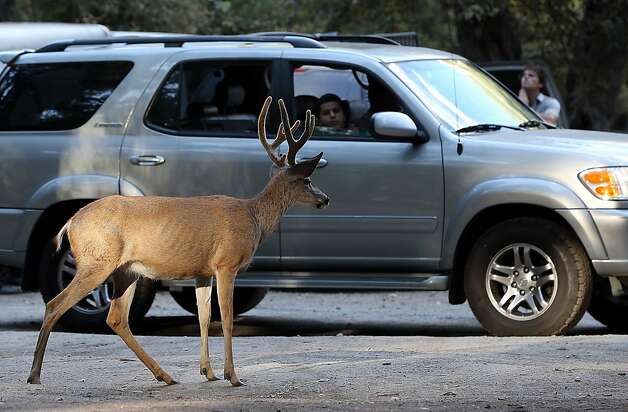
  • A deer strolls through a parking lot in Yosemite National Park. The Rim Fire means reduced food supply and habitat. Photo: Justin Sullivan, Getty Images
    A deer strolls through a parking lot in Yosemite National Park.
  •  The Rim Fire means reduced food supply and habitat.
  • Photo: Justin Sullivan, Getty Images
 
The strange saga of California's deer herds is in the spotlight again this weekend as fall hunting season nears.
Deer numbers statewide are down 80 percent, a new invasive louse is causing deer baldness on the San Francisco Peninsula and in parts of the Sierra foothills, and predation of fawns by mountain lions and bears is taking out a higher percentage of the herds than ever.
Yet the high numbers of small black-tailed deer near civilization can make it seem that there are more deer than ever, and in turn, create the illusion that there is no need for concern or steps to conserve the deer.
This story returns to the forefront as the Tuolumne Herd, already under siege from lice, will try to survive into next year with much of their wintering habitat and ground feed incinerated north of Groveland by the 257,000-acre Rim Fire.
Meanwhile, the mountain hunting seasons open this weekend and next across most of theSierra Nevada and Northern California, where prospects are slim for most.
Here are the latest notes from afield:
Deer numbers: The Department of Fish and Wildlife estimates there are now 445,000 deer in California, down from 2 million in the 1960s and 850,000 in the 1990s.
Your local deer: Many deer now spend their entire lives in a 5-mile radius, often in local parks, golf courses and the backyards of foothills homes.
Car vs. deer: Your odds of hitting a deer with your car in California are roughly 1 in 1,046, according to State Farm Insurance.
Hunter vs. deer: In the central Sierra Nevada, the odds of a hunter getting a deer this season are estimated at 4 to 15 percent; in the state's northern mountains, the odds are 15 to 24 percent. Most people don't realize how poor the success rate is even among avid, skilled woodsmen who know how to track and stalk game trails.
No migration: The once-great deer herds of the Sierra Nevada, which migrated from the Sierra crest to wintering grounds in the foothills each fall, are gone. Heavy traffic on highways, new subdivisions and shopping centers have blocked their routes and diminished their winter habitat.
Predation: One study captured 96 healthy fawns and tracked them for seven years; of those killed by predators, 49 percent were killed by mountain lions, 27 percent by coyotes and 22 percent by bears. In other studies, bear predation of fawns has been much higher. Another study equipped 25 adult does with radio collars; in three years, 11 were killed by mountain lions, one by coyotes.
Habitat loss: For 30 years, California's population growth has converted about 75,000 acres of wildlife habitat per year to housing, a loss of 2.25 million acres of places where wildlife can no longer live.
Diminished habitat quality: In many national forests, diverse ecosystems were cut down and replanted with conifer monocultures. With few hardwoods and less material to browse in second-growth forests, food for wildlife has been reduced. With that, overall nutrition for deer can be poor, which can bring reduced survival rates and antler growth.
Deer baldness: In 2009, biologists found a deer in the Sierra Nevada foothills in Tuolumne County that died from an infestation of non-native lice that caused baldness and internal parasites. A similarly infected deer was found on the San Francisco Peninsula. Since then, roughly 600 deer carcasses have been found showing the affliction. At this point, there is no cure.
Rim Fire: The same area with the highest incidence of non-native deer lice, the Tuolumne foothills, is the same area where the Rim Fire turned deer winter habitat into a moonscape. With no food, the deer are likely to crowd into areas outside the burn area, thereby increasing the ability to pass the non-native lice to other deer.
Drought: Two straight years of subaverage rain and snow across the state have led to poor soil moisture levels in many areas, and in turn, poor growth of vegetation and browse that deer, especially fawns, need for food to survive.
Low buck-doe ratios: In the Sierra foothills, low fawn survival from drought and predation means fewer bucks reach adulthood. For instance, the buck-to-doe ratio in Zone D-8 (mostly located in Sequoia National Forest) is roughly only 20 bucks per 100 deer.
Illegal pot grows: Scientists have not quantified the damage that the high number of illegal pot grows in national forests have on deer. But game wardens have verified illegal traps, poisons and poaching - and common sense would say, based on the scope of the operations, there has to be a collective impact.
Passion for the sport: Some avid hunters hike, spot and stalk for days. For them, camping, fair chase and woodsman skills are paramount in the low-odds attempt to get a buck. Surveys show that these hunters have more passion for their activity than those in any other outdoor sport.
Erosion of hunter skills: At the other extreme, some hunters go "deer trolling" by driving on Forest Service roads in pickup trucks, with sofas in the back and rifles on their laps. It's no wonder some people reject the idea that hunting is an ethical, fair-chase pursuit.
Deer openers: This weekend, the mountain deer season opens for rifle hunting in the central Sierra Nevada for most D zones, and in the northern part of the state for most B and C zones. A few other zones open next weekend. The X zones, located mostly on the eastern side of the Sierra and Cascade ranges, open the first Saturday of October.
Deer revenue: Money for deer management and wildlife restoration funds come primarily from the sales of deer tags. Last year, 182,000 tags were sold, which continued a long-term decline, but sales still helped generate $300,000 for the Department of Fish and Wildlife.
Tom Stienstra is The San Francisco Chronicle's outdoors writer.

The animal that graces the State Seal of California is the Grizzly,,,,,,,,,,,,,,,,,As discussed on this Blog often, California had the highest density of Grizzly Bears in the lower 48 at the time of European colonization(16th century)................The mild and temperate climate throughout the non-desert regions of the state harbored a wide array of fruit, insect and animal foodstuffs that enabled Grizzlies to "multiply and prosper" .............. Less than 75 years after gold was discovered in the Sierra Nevada foothills(1850), every grizzly bear in the state had been hunted down or trapped and killed..............A sad commentary it is regarding us as supposedly the most intelligent species(man), that we now can only celebrate "Griz" in California via stuffed animals at museums..................There is viable habitat throughout California where the Griz could once again roam...............Will we ever have the will the share the Golden State with the animal that many indigenous Indian tribes saw as sacred?

Grizzly bear returns to California

SANTA MARIA NATURAL HISTORY MUSEUM UNVEILS NEW EXHIBIT

The last known California grizzly bear was killed in 1922 in
 Tulare County near Yosemite National Park.
But visitors to the Santa Maria Natural History Museum can
 get a glimpse of the fearsome figure that adorns the state 
flag in a new exhibit on loan from Napa Valley.
"This bear is from Canada and it was donated to the museum,"
 said Clarence Rusconi, a docent in the Santa Maria museum. 
"They're a lot bigger than the black bears that are in the hills
 around here up toward Cuyama."

The bear shares a room with a California tule elk that has
 lived at the museum for many years.
The museum is hosting a Fall Equinox mixer Thursday from
 5 to 7:30 p.m. to show off the new exhibit.
The grizzly bear has been as tightly linked with California as a
 mother bear and her cub for as long as humans have lived in
 the Golden State.

Native tribes worshiped the grizzly for its strength, beauty and
 majesty when the massive bears thrived in California's valleys 
and foothills. When the trickle of Spanish explorers turned into
 a flood of Mexican and white settlers pouring into California, it 
marked the beginning of the bears' last stand.

Although white settlers used the bear as a symbol in their battle
 for independence from Mexico in the Bear Flag Revolt of 1846, 
they killed the bears by the hundreds. Less than 75 years after
 gold was discovered in the Sierra Nevada foothills, every grizzly
 bear in the state had been hunted down or trapped and killed.

One of the trappers, James Cappen "Grizzly" Adams, became an
 early California legend. Although he was known for trapping and
 hunting hundreds of the ferocious bears, he also raised young
 cubs as pets and was known for walking the streets of San
 Francisco with his longtime pet, Ben Franklin, according to reports.
The grizzly at the Santa Maria museum is smaller and darker
 than the typical California grizzly — ursus arctos californicus.
 One of the largest grizzlies on record, a 2,200-pounder, was
 killed near Valley Center in 1886.

The Santa Maria exhibit comes to the museum from the Mondavi 
family of the Napa Valley. It depicts a bear over the partially
 buried body of another grizzly.
"The museum is very grateful to the Marc Mondavi Family
 and David Hoxsey for making the new exhibit possible," 
said exhibit committee member Virginia Souza.
Another attraction new to the museum is the Bird Hall, 
a roomful of birds indigenous to the area.