Wolves and Oil(THE LINK BETWEEN THESE EXPLORED BY ONE OF THIS BLOGS BEST FRIENDS AND CONTRIBUTORS...........GEORGE WUERTHNER........ECOLOGIST, FORMER HUNTING GUIDE..................HIS OUTLOOK ON THE BENEFITS THAT PREDATORS LIKE WOLVES, COUGARS, BEARS, COYOTES, ETC BRING TO THE LANDSCAPE IS SHARED BY THIS BLOG................WE HAVE PUBLISHED MANY OF GEORGE'S OTHER REPORTS AND TREATISES ON LIVING WITH PREDATORS..............TIMELY AND INSIGHTFUL THIS ONE IS.........ALL ENJOY!
By George Wuerthner, 7-13-10
Recently we heard how courts in Louisiana reversed the Obama administration’s moratorium on deep water oil drilling. Some suggest that the judge’s decision was not completely unbiased due to his personal investments in oil company stock. And investigation of the federal judges in this region shows that the majority of them have investments in oil companies.
This calls into question whether any judge in the region can render a fair judgment regarding whether public values that may be destroyed by risky oil development will be given fair consideration when judges deciding these cases have a financial incentive to promote oil development.
Just as the financial interests of the judges in the Gulf Coast region may distort and bias their ability to make fair judicial decisions regarding issues surrounding the oil industry, the Montana Department of Fish, Wildlife and Parks agency has a similar financial conflict of interest when it comes to management of predators. A conflict that the department does not publicly disclose.
However, all state wildlife agencies depend on license fees to fund their bureaucracy. If there is a decline in huntable game, or even the perception of less game that reduces the sale of licenses, this will have a direct negative financial effect on the agency.
In addition, since predators sometime attack livestock, there is also a strong incentive to kill predators to appease the ranching community—a community that controls a lot of the huntable terrain in Montana, and a group that the MDFWP does not want to antagonize, least they make less land available to hunters.
Though MDFWP is one of the most progressive agencies in the West, it still can’t buck a system that rewards killing predators. So it’s not surprising that MDFWP Commission approved expansion of Montana’s wolf killing quota from 75 to 186 animals. The department has a strong financial incentive to reduce the wolf population in Montana because wolves are perceived as a threat to hunting and the ranching industry.
But is it ethical to allow an agency and/or a business whose direct financial well-being is at stake to make public policy? In California voters were persuaded that Fish and Game agencies could not scientifically manage cougars, and that hunting created more problems than it eliminated. Voters took authority for hunting away from the agency by banning cougar hunting.
Since the ban on hunting in 1991, cougar populations have grown significantly. But surprising to some, California now has far fewer cougar incidents than other western states that have fewer cougars, fewer people, but permit cougar hunting. The only control that California exerts on cougar populations is the strategic removal of individual cougar that are deemed a safety threat to humans.
The reason for these unexpected results has to do with the social ecology of large predators. Killing of large predators like cougars (wolves) can skew populations towards younger animals. Younger animals wander more widely where they are more likely to encounter humans, and they are less experienced hunters. As a consequence they are far more likely to attack livestock, and in the case of cougars, even attack people rarely.
Hunting wolves has many of the same consequences. Wolf populations with a high percentage of younger adults that are less experienced hunters are more likely to attack livestock. Hunting of wolves can also contribute to smaller packs that have fewer adults to help raise pups—such packs are also more likely to attack easy prey like livestock.
Smaller packs often kill as many elk and deer as larger packs because they are unable to consume an entire elk in one feeding, leaving the carcass behind for scavengers to consume, thus forcing them to locate and kill another elk or deer.
Managing predators to reduce their impacts upon ungulates like elk and deer also guarantees that predators do not have the full ecological benefits that result from top-down predation. Everything from reducing herbivory effects on vegetation to changing the age structure of elk and other prey to increases in carrion for scavengers are among the many benefits associated with predators that state wildlife agencies ignore.
Though I can understand how difficult it would be for the commission to do anything else other than authorize more predator killing given the hostility that many hunters have to predators, like the judges deciding the fate of the Gulf of Mexico’s natural communities that may be destroyed by oil spills, it behooves us to question whether anyone with a direct financial interest in the outcome of a decision should be permitted to determine public policy.
Indeed, the best management of predators is exactly what California has done with cougars—eliminate all hunting of predators, except for those which pose a direct threat to human life and/or livestock. With regards to livestock we should require changes in animal husbandry practices to reduce conflicts such as immediate removal of carrion, use of guard animals, among other practices. Then and only then the only animals that should be killed are those that are habituated livestock killers.
George Wuerthner is an ecologist, and former Montana hunting guide.
skip to main |
skip to sidebar





Strategizing at the WB

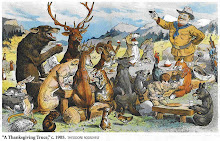
Like so many conscientious hunters and anglers come to realize, good habitat with our full suite of predators and prey make for healthy and productive living............Teddy Roosevelt depicted at a "WILDLIFE RENDEZVOUS"
Learn about Grizzly Bears, Black Bears, Polar Bears, gray wolves/eastern wolves/red wolves,timber wolves, cougars/mountain lions/panthers/painters/pumas, bobcats, lynx, red and gray foxes, wolverines, martens, fishers, coyotes/eastern coyotes/coywolves with pictures, videos, photos, facts, info and news.
Click Below to:
Add Blog to Favorites
Coyotes-Wolves-Cougars.blogspot.com
Grizzly bears, black bears, wolves, coyotes, cougars/ mountain lions,bobcats, wolverines, lynx, foxes, fishers and martens are the suite of carnivores that originally inhabited North America after the Pleistocene extinctions.
This site invites research, commentary, point/counterpoint on that suite of native animals (predator and prey) that inhabited The Americas circa 1500-at the initial point of European exploration and subsequent colonization.
Landscape ecology, journal accounts of explorers and frontiersmen, genetic evaluations of museum animals, peer reviewed 20th and 21st century research on various aspects of our "Wild America" as well as subjective commentary from expert and layman alike. All of the above being revealed and discussed with the underlying goal of one day seeing our Continent rewilded.....Where big enough swaths of open space exist with connective corridors to other large forest, meadow, mountain, valley, prairie, desert and chaparral wildlands.....Thereby enabling all of our historic fauna, including man, to live in a sustainable and healthy environment. - Blogger Rick


Recent Comments
Red Fox fighting Badger
Email Rick Meril

 Posts
Posts


Bobcat in Vermont woodlands
Mother and daughter Puma playing in North Dakota
Find us on Facebook
Christmas morning 2008-Coyote hunting mice
Blog Archive
- March (5)
- February (11)
- January (3)
- December (7)
- November (10)
- October (8)
- September (4)
- August (11)
- July (12)
- June (9)
- May (12)
- April (18)
- March (23)
- February (20)
- January (18)
- December (19)
- November (21)
- October (24)
- September (22)
- August (26)
- July (19)
- June (17)
- May (22)
- April (24)
- March (27)
- February (26)
- January (26)
- December (29)
- November (18)
- October (24)
- September (19)
- August (25)
- July (25)
- June (23)
- May (29)
- April (31)
- March (28)
- February (25)
- January (33)
- December (32)
- November (32)
- October (34)
- September (30)
- August (39)
- July (29)
- June (34)
- May (39)
- April (31)
- March (34)
- February (35)
- January (45)
- December (42)
- November (32)
- October (25)
- September (33)
- August (46)
- July (34)
- June (48)
- May (43)
- April (47)
- March (43)
- February (37)
- January (37)
- December (45)
- November (42)
- October (34)
- September (36)
- August (44)
- July (36)
- June (45)
- May (43)
- April (51)
- March (48)
- February (47)
- January (64)
- December (63)
- November (57)
- October (43)
- September (45)
- August (52)
- July (52)
- June (48)
- May (55)
- April (54)
- March (77)
- February (68)
- January (51)
- December (61)
- November (49)
- October (42)
- September (62)
- August (68)
- July (69)
- June (42)
- May (72)
- April (83)
- March (77)
- February (80)
- January (78)
- December (90)
- November (91)
- October (93)
- September (94)
- August (92)
- July (85)
- June (90)
- May (91)
- April (91)
- March (93)
- February (85)
- January (94)
- December (90)
- November (80)
- October (87)
- September (96)
- August (90)
- July (62)
- June (54)
- May (62)
- April (55)
- March (27)
- February (14)
Hiker in Glacier National Park encounters a Puma......The Puma walks "wide" of the hiker
Search This Blog
Lynx capturing a snowshoe hare
Likely Wolf sighting in Colorado
black Bear in the Smokey Mtns berry hunting in the trees
Blog Translation
favorite links
- Wyoming Untrapped
- The Natural History of the Urban Coyote
- western wildlife
- Wild Dog Foundation
- Coyotes live in Maine
- Santa Cruz Puma Project
- http://www.coyotewatchcanada.com
- Mexican Wolves.org
- Greater Yellowstone Science Learning Center
- Western Wolves
- Lockwood Animal Rescue Center
- Wolf and Wildlife Studies
- Worth a Dam
- The Wolverine Foundation
- mountain lion foundation
- Boulder-Whiteclouds Council
- Wild Read
- Big Wildlife
- Southern Utah Wilderness Alliance
- Coyote Yipps
- The Wolverine Blog
- Craighead research.org
- Wild Earth Guardians
- Biodiversity Conservation Alliance
- Center for Native Ecosystems
- izilwane.org online Magazine
- Oregon Wild
- Ralph Maughan's Wildlife Reports
- North American Bear Center
- Wolf and Cat
- Conservation Northwest
- Howling for Justice
- Wilderness Watch
- Wolf Watcher
- Endangered Species Coalition
- My Place By The Pond
- The Wolverine Foundation
- Wolf Ecosystem Research
- canadian Parks and Wilderness Society
- Earthroots
- Predator Defense
- Sightline Institute
- Downeast Lakes Land Trust
- Adirondack Council
- jaguar Conservation Network
- Bordercats
- Large Carnivore Conservation Lab-Washington State U.
- Bat conservation International
- The human footprint
- Craighead Beringia South
- Yellowstone to Yukon Conservation Initiative
- Canadian Boreal Initiative
- Northern Rockies Conservation Cooperative
- Keeping Track
- Wildlife Conservation Society
- Native Fish Society
- Jaguar Habitat Campaign
- Northern Woodlands Magazine
- Canadian Wolf Coalition
- Forest Service Employees
- Trust for Public Land
- Rainforest Action Network
- The Wilderness Society
- Greater Yellowstone Coalition
- Keystone Conservation
- American Wildlands
- The Nature Conservancy
- Algonquins to Adirondacks
- Two Countries, One Forest
- Vermont Land Trust
- Center For Biological Diversity
- Open Space Institute
- Wildlands and Woodlands
- Rewilding Institute
- Cougar Network
- Cougar rewilding foundation
- Eastern Coyote Research
- Project Coyote
- Restore:The North Woods
- The Wildlife News
- N.E. Eco Recovery Society
- WERC
- Wildlands Network
- Outdoor Liasons
- People and Wolves
Click Below to Follow Us On Twitter
Northern Ontario, Canad Wolfpack caught on trailcamera
Add Coyotes-Wolves-Cougars Link To Your Igoogle Homepage

A New Jersey Eastern Coyote unable to take a fawn
Blogger Rick
Strategizing at the WB
Let Rick and other readers know you're a fan of this blog...Become a Follower!
Making a Pitch at the WB
Two Massachusetts Eastern Coyotes at their den site
Eastern Wolf in Algonquin Provincial Park, Ontario, Canada
Gray Foxes(unlike Red Foxes) can climb trees--an advantage when pursued by Coyotes
Aldo Leopold--3 quotes from his SAN COUNTY ALMANAC
"We abuse land because we regard it as a commodity belonging to us. When we see land as a community to which we belong, we may begin to use it with love and respect."
Aldo Leopold
"A thing is right when it tends to preserve the integrity, stability and beauty of the biotic community. It is wrong when it tends otherwise."
Aldo Leopold
''To keep every cog and wheel is the first precaution of intelligent tinkering."
Wildlife Rendezvous
Like so many conscientious hunters and anglers come to realize, good habitat with our full suite of predators and prey make for healthy and productive living............Teddy Roosevelt depicted at a "WILDLIFE RENDEZVOUS"
Recent Posts
Blog Disclaimer
This is a personal weblog. The opinions expressed here represent my own and not those of my employer. In addition, my thoughts and opinions change from time to time…I consider this a necessary consequence of having an open mind. This blog is intended to provide a semi-permanent point in time snapshot and manifestation of my various thoughts and opinions, and as such any thoughts and opinions expressed within out-of-date posts may not be the same, nor even similar, to those I may hold today. All data and information provided on this site is for informational purposes only. Rick Meril and WWW.COYOTES-WOLVES-COUGARS.COM make no representations as to accuracy, completeness, suitability, or validity of any information on this site and will not be liable for any errors, omissions, or delays in this information or any losses, injuries, or damages arising from its display or use. All information is provided on an as-is basis.
Additional disclaimer information can be viewed by clicking here.
Additional disclaimer information can be viewed by clicking here.
1 comment:
I am in agreement with George. Traditional state game agencies were created to "put more game in the bag" and they originally did this at the expense of the rest of ecosystem components, especially predators. Because of funding sources, as George mentioned, they had little interest in ecosystem health, just more huntable wildlife, yet they were put in charge of all wildlife resources. Needless to say, when conflicts arose, they sided with more game species. This is indeed a conflict of interest that should not exist in these agencies because other wildlife (non-huntable and predators) will never be fairly represented. Even switching to Departments of Natural Resources does not help because the branch of these departments is what used to be the game agencies, so no real change. The only real solution is to remove the "management" of predators and non-game species from these agencies and branches to separate branches/agencies that are removed from the bias of hunting. It is only then that the other 99% of the wildlife in our ecosystems can get a fair voice and wildlife will be managed on an ecosystem level.
Post a Comment