Released May 12, 2011, by the National Agricultural Statistics Service (NASS), Agricultural Statistics Board, United States Department of Agriculture (USDA).
This report is released every five years as a cooperative effort between the National Agricultural Statistics Service and Animal and Plant Health Inspection Service – Wildlife Services and Veterinary Services. The information presented in this report is based on producer reports from the January 2011 Cattle survey and includes detailed percentage breakouts of cattle and calf losses by predators and non-predator causes as well as non-lethal control measures.
Cattle and calf losses from predators
totaled nearly 220 thousand head during 2010. This represented 5.5 percent of the total deaths from all causes and resulted in a loss of $98.5 million to farmers and ranchers. Coyotes and dogs caused the majority of cattle and calf predator losses accounting for 53.1 percent and 9.9 percent respectively.
Cattle and calf losses from something other than predators
totaled 3.77 million head or 94.5 percent of the total losses during 2010. Respiratory problems represented the leading cause of non-predator deaths, accounting for 28.0 percent, followed by digestive problems at 13.4 percent.
Cattle and calf losses from non-predator causes
---------------------------------------------------------------------------------------------------------------
WINONA, Minn. – Minnesota officials estimate more than 105,000 turkeys and up to 1,500 cattle were lost due to the recent heat wave.
The Winona Daily News reports both dairy and beef cattle can be worth up to $2,000 each. Also farmers who avoided losing animals still had decreased production created by the high temperatures.
Minnesota Turkey Growers Association Executive Director Steve Olson says the 105,000 turkeys lost equals an economic hit of somewhere between $1.1 and $1.6 million.
There is relief for owners who lost cattle, through the U.S. Department of Agriculture's livestock indemnity program.
Minnesota State Cattlemen's Association Executive Director Joe Martin recommended farmers immediately document their losses and contact their local Farm Service Agency office.
The heat wave started July 16 and left the area Thursday evening.
-----------------------------------------------------------------------------------------------------------------
Feds find money for Minnesota wolf-control program
U.S. Sen. Amy Klobuchar, D-Minn., told the News Tribune today that Agriculture Secretary Tom Vilsack pledged to use money from the agency's operating budget to re-start the wolf trapping and killing program.
By: John Myers
The federally funded wolf-trapping effort in Minnesota that ran out of money and shut down Friday could be running again within days after the U.S. Secretary of Agriculture pledged new money for the program.Wolf
There are an estimated 3,200 wolves in Minnesota and about 700 each in Wisconsin and Michigan's Upper Peninsula, many more than federal officials expected when the animal first received federal protection in 1974. (2009 file / News Tribune)
U.S. Sen. Amy Klobuchar, D-Minn., told the News Tribune today that Agriculture Secretary Tom Vilsack pledged to use money from the agency's operating budget to restart the wolf trapping and killing program.
"Sec. Vilsack has assured me that he has found the money to extend the program out to the end of the year," Klobuchar said. "We need this program to keep Minnesota livestock and residents safe. ... The gap in that coverage was unacceptable."
Klobuchar said her focus is to push forward an effort by the U.S. Fish and Wildlife Service to "de-list" wolves off the endangered species list by the end of 2011 and hand management back to state and tribal natural resource agencies. Then the state can begin more aggressive wolf-management efforts that also allow the public to shoot trouble-causing wolves.
U.S. Rep. Chip Cravaack, R-North Branch, agreed.
"I commend the USDA for temporarily continuing essential resources for operations to protect private property and ensure public safety from problem wolves while we work to delist the wolf from protected status in Minnesota," Cravaack said in a statement, also urging Congress to legislate wolf delisting in Minnesota rather than waiting for the Endangered Species Act protocol to unfold.
Because expert federal trappers are able to pinpoint their efforts near where farmers and pet owners are having problems, Klobuchar said she's also hoping to keep federal funds available for the trapping program even after the state assumes management of wolves. State officials and some farmers have asked for the federal government to split the cost of focused trapping.
"I'm trying to keep this program alive" in an upcoming Agriculture Department funding bill, said Klobuchar, a member of the Senate Agriculture Committee.
The USDA trapping program has been killing wolves in Minnesota since 1978. Last year, the program investigated 272 complaints and killed 192 wolves. In 2009, it killed 199 wolves. This year it was up to 189 until the federal budget year ended Friday and the current Congressional "earmark" for the program ran out of money.
Supporters say the wolf-trapping program acted as not only pinpoint response, but also as a safety valve to relieve social and political pressure among people who don't like wolves and might otherwise take matters into their own hands, killing wolves indiscriminately with poison or guns.
Killing wolves is allowed, even though wolves are a federally protected species, because Minnesota wolves were classified as threatened, a step removed from endangered. In Wisconsin and Michigan, trapped wolves are relocated away from farms.
Peak demand typically occurs starting in April, when calves and lambs are born, and continues through summer. But trappers get calls every month.
There are an estimated 3,200 wolves in Minnesota and about 700 each in Wisconsin and Michigan's Upper Peninsula, many more than federal officials expected when the animal first received federal protection in 1974.
skip to main |
skip to sidebar





Strategizing at the WB

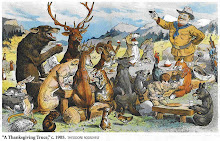
Like so many conscientious hunters and anglers come to realize, good habitat with our full suite of predators and prey make for healthy and productive living............Teddy Roosevelt depicted at a "WILDLIFE RENDEZVOUS"
Learn about Grizzly Bears, Black Bears, Polar Bears, gray wolves/eastern wolves/red wolves,timber wolves, cougars/mountain lions/panthers/painters/pumas, bobcats, lynx, red and gray foxes, wolverines, martens, fishers, coyotes/eastern coyotes/coywolves with pictures, videos, photos, facts, info and news.
Click Below to:
Add Blog to Favorites
Coyotes-Wolves-Cougars.blogspot.com
Grizzly bears, black bears, wolves, coyotes, cougars/ mountain lions,bobcats, wolverines, lynx, foxes, fishers and martens are the suite of carnivores that originally inhabited North America after the Pleistocene extinctions.
This site invites research, commentary, point/counterpoint on that suite of native animals (predator and prey) that inhabited The Americas circa 1500-at the initial point of European exploration and subsequent colonization.
Landscape ecology, journal accounts of explorers and frontiersmen, genetic evaluations of museum animals, peer reviewed 20th and 21st century research on various aspects of our "Wild America" as well as subjective commentary from expert and layman alike. All of the above being revealed and discussed with the underlying goal of one day seeing our Continent rewilded.....Where big enough swaths of open space exist with connective corridors to other large forest, meadow, mountain, valley, prairie, desert and chaparral wildlands.....Thereby enabling all of our historic fauna, including man, to live in a sustainable and healthy environment. - Blogger Rick


Recent Comments
Red Fox fighting Badger
Email Rick Meril

 Posts
Posts


Bobcat in Vermont woodlands
Mother and daughter Puma playing in North Dakota
Find us on Facebook
Christmas morning 2008-Coyote hunting mice
Blog Archive
- March (5)
- February (11)
- January (3)
- December (7)
- November (10)
- October (8)
- September (4)
- August (11)
- July (12)
- June (9)
- May (12)
- April (18)
- March (23)
- February (20)
- January (18)
- December (19)
- November (21)
- October (24)
- September (22)
- August (26)
- July (19)
- June (17)
- May (22)
- April (24)
- March (27)
- February (26)
- January (26)
- December (29)
- November (18)
- October (24)
- September (19)
- August (25)
- July (25)
- June (23)
- May (29)
- April (31)
- March (28)
- February (25)
- January (33)
- December (32)
- November (32)
- October (34)
- September (30)
- August (39)
- July (29)
- June (34)
- May (39)
- April (31)
- March (34)
- February (35)
- January (45)
- December (42)
- November (32)
- October (25)
- September (33)
- August (46)
- July (34)
- June (48)
- May (43)
- April (47)
- March (43)
- February (37)
- January (37)
- December (45)
- November (42)
- October (34)
- September (36)
- August (44)
- July (36)
- June (45)
- May (43)
- April (51)
- March (48)
- February (47)
- January (64)
- December (63)
- November (57)
- October (43)
- September (45)
- August (52)
- July (52)
- June (48)
- May (55)
- April (54)
- March (77)
- February (68)
- January (51)
- December (61)
- November (49)
- October (42)
- September (62)
- August (68)
- July (69)
- June (42)
- May (72)
- April (83)
- March (77)
- February (80)
- January (78)
- December (90)
- November (91)
- October (93)
- September (94)
- August (92)
- July (85)
- June (90)
- May (91)
- April (91)
- March (93)
- February (85)
- January (94)
- December (90)
- November (80)
- October (87)
- September (96)
- August (90)
- July (62)
- June (54)
- May (62)
- April (55)
- March (27)
- February (14)
Hiker in Glacier National Park encounters a Puma......The Puma walks "wide" of the hiker
Search This Blog
Lynx capturing a snowshoe hare
Likely Wolf sighting in Colorado
black Bear in the Smokey Mtns berry hunting in the trees
Blog Translation
favorite links
- Wyoming Untrapped
- The Natural History of the Urban Coyote
- western wildlife
- Wild Dog Foundation
- Coyotes live in Maine
- Santa Cruz Puma Project
- http://www.coyotewatchcanada.com
- Mexican Wolves.org
- Greater Yellowstone Science Learning Center
- Western Wolves
- Lockwood Animal Rescue Center
- Wolf and Wildlife Studies
- Worth a Dam
- The Wolverine Foundation
- mountain lion foundation
- Boulder-Whiteclouds Council
- Wild Read
- Big Wildlife
- Southern Utah Wilderness Alliance
- Coyote Yipps
- The Wolverine Blog
- Craighead research.org
- Wild Earth Guardians
- Biodiversity Conservation Alliance
- Center for Native Ecosystems
- izilwane.org online Magazine
- Oregon Wild
- Ralph Maughan's Wildlife Reports
- North American Bear Center
- Wolf and Cat
- Conservation Northwest
- Howling for Justice
- Wilderness Watch
- Wolf Watcher
- Endangered Species Coalition
- My Place By The Pond
- The Wolverine Foundation
- Wolf Ecosystem Research
- canadian Parks and Wilderness Society
- Earthroots
- Predator Defense
- Sightline Institute
- Downeast Lakes Land Trust
- Adirondack Council
- jaguar Conservation Network
- Bordercats
- Large Carnivore Conservation Lab-Washington State U.
- Bat conservation International
- The human footprint
- Craighead Beringia South
- Yellowstone to Yukon Conservation Initiative
- Canadian Boreal Initiative
- Northern Rockies Conservation Cooperative
- Keeping Track
- Wildlife Conservation Society
- Native Fish Society
- Jaguar Habitat Campaign
- Northern Woodlands Magazine
- Canadian Wolf Coalition
- Forest Service Employees
- Trust for Public Land
- Rainforest Action Network
- The Wilderness Society
- Greater Yellowstone Coalition
- Keystone Conservation
- American Wildlands
- The Nature Conservancy
- Algonquins to Adirondacks
- Two Countries, One Forest
- Vermont Land Trust
- Center For Biological Diversity
- Open Space Institute
- Wildlands and Woodlands
- Rewilding Institute
- Cougar Network
- Cougar rewilding foundation
- Eastern Coyote Research
- Project Coyote
- Restore:The North Woods
- The Wildlife News
- N.E. Eco Recovery Society
- WERC
- Wildlands Network
- Outdoor Liasons
- People and Wolves
Click Below to Follow Us On Twitter
Northern Ontario, Canad Wolfpack caught on trailcamera
Add Coyotes-Wolves-Cougars Link To Your Igoogle Homepage

A New Jersey Eastern Coyote unable to take a fawn
Blogger Rick
Strategizing at the WB
Let Rick and other readers know you're a fan of this blog...Become a Follower!
Making a Pitch at the WB
Two Massachusetts Eastern Coyotes at their den site
Eastern Wolf in Algonquin Provincial Park, Ontario, Canada
Gray Foxes(unlike Red Foxes) can climb trees--an advantage when pursued by Coyotes
Aldo Leopold--3 quotes from his SAN COUNTY ALMANAC
"We abuse land because we regard it as a commodity belonging to us. When we see land as a community to which we belong, we may begin to use it with love and respect."
Aldo Leopold
"A thing is right when it tends to preserve the integrity, stability and beauty of the biotic community. It is wrong when it tends otherwise."
Aldo Leopold
''To keep every cog and wheel is the first precaution of intelligent tinkering."
Wildlife Rendezvous
Like so many conscientious hunters and anglers come to realize, good habitat with our full suite of predators and prey make for healthy and productive living............Teddy Roosevelt depicted at a "WILDLIFE RENDEZVOUS"
Recent Posts
Blog Disclaimer
This is a personal weblog. The opinions expressed here represent my own and not those of my employer. In addition, my thoughts and opinions change from time to time…I consider this a necessary consequence of having an open mind. This blog is intended to provide a semi-permanent point in time snapshot and manifestation of my various thoughts and opinions, and as such any thoughts and opinions expressed within out-of-date posts may not be the same, nor even similar, to those I may hold today. All data and information provided on this site is for informational purposes only. Rick Meril and WWW.COYOTES-WOLVES-COUGARS.COM make no representations as to accuracy, completeness, suitability, or validity of any information on this site and will not be liable for any errors, omissions, or delays in this information or any losses, injuries, or damages arising from its display or use. All information is provided on an as-is basis.
Additional disclaimer information can be viewed by clicking here.
Additional disclaimer information can be viewed by clicking here.
No comments:
Post a Comment