Visitor Counter

hitwebcounter web counter
Visitors Since Blog Created in March 2010

Click Below to:

Add Blog to Favorites

Coyotes-Wolves-Cougars.blogspot.com

Grizzly bears, black bears, wolves, coyotes, cougars/ mountain lions,bobcats, wolverines, lynx, foxes, fishers and martens are the suite of carnivores that originally inhabited North America after the Pleistocene extinctions. This site invites research, commentary, point/counterpoint on that suite of native animals (predator and prey) that inhabited The Americas circa 1500-at the initial point of European exploration and subsequent colonization. Landscape ecology, journal accounts of explorers and frontiersmen, genetic evaluations of museum animals, peer reviewed 20th and 21st century research on various aspects of our "Wild America" as well as subjective commentary from expert and layman alike. All of the above being revealed and discussed with the underlying goal of one day seeing our Continent rewilded.....Where big enough swaths of open space exist with connective corridors to other large forest, meadow, mountain, valley, prairie, desert and chaparral wildlands.....Thereby enabling all of our historic fauna, including man, to live in a sustainable and healthy environment. - Blogger Rick

Subscribe via email to get updates

Enter your email address:

Receive New Posting Alerts

(A Maximum of One Alert Per Day)

Sunday, July 11, 2010

Oregon has the ability to show common sense and restraint in dealing with their recently arriving wolf packs

Wolves in Oregon: Don't be so quick on the trigger

Published: Saturday, July 10, 2010, 10:36 AM     Updated: Saturday, July 10, 2010, 3:35 PM
Throughout Western history, it has always been easier to shoot wolves than to live with them. Now, just as the first small packs of gray wolves are getting a toehold in Oregon, it is vital that this state not go back to the old way, the easy way, every time there is a conflict with wolves.

graywolf.JPG

There's just such a conflict now. The Oregon Department of Fish and Wildlife responded to several documented cases of wolf depredation on Wallowa County livestock by ordering the killing of two suspected wolves in early June. Conservation groups filed a federal suit in Portland challenging the kill permits, and a judge blocked the shooting of the wolves at least until July 3.

We understand that Oregon cattle and sheep ranchers operate on terribly thin margins and face a long list of threats to their stock, including harsh weather, disease, coyotes, mountain lions and domestic dogs. It's too much to expect them to welcome another predator. Furthermore, it isn't fair that a small number of ranchers must shoulder virtually all of the costs, all of the burden, of returning wolves to Oregon's wild country.

We are not against killing wolves that develop a taste for cattle, sheep and other livestock. Two such wolves, identified by their radio collars, were tracked down and killed not long ago, reducing Oregon's wolf population from 16 to 14. Those killings were justified.

Moreover, we strongly believe that Oregon ought to have a tax-supported compensation fund so that all the Oregonians -- more than 70 percent by one poll -- who support the recovery of wolves in this state do their own small part to pay for the costs of bringing them back.

But in the current case, Oregon seems too quick on the trigger and too willing to sidestep the sensible rules in its own recovery plan for gray wolves. Those rules generally require wildlife officials to document several wolf incidents on one or more adjacent ranches and clearly identify the targeted animals before issuing kill permits. That wasn't done in this case; about all that's known of the suspected wolves is that both are gray in color and neither one is wearing a radio collar. There are, of course, a lot of wolves that meet that description.

While Idaho, Montana and Wyoming have spent years grappling with wolf issues, this is still relatively new territory for Oregon. Our state had the advantage of watching wolves re-establish themselves and saw how they have affected elk and deer herds and domestic livestock. Ranchers have learned in most cases to live with wolves and take common-sense precautions, such as burying animals that die of disease and other causes to avoid inadvertently baiting wolves onto their lands. Problem wolves have been killed by wildlife authorities. Ranchers elsewhere generally have been compensated for losses.

After the first gray wolves swam the Snake River into Oregon beginning in 1999, a panel of ranchers, wildlife experts, hunters, Native Americans and others wrote a plan for how Oregon would respond to the arrival of wolves. It's not a perfect plan -- as we noted, it lacks a compensation fund for ranchers -- but it's a reasonably good one. And wherever and whenever one of Oregon's precious few wolves creates a problem, Oregon wildlife officials should adhere to that plan, rather than take the old way, the easy way, out. 


Coyotes dampening Deer herds in the East?????????????????????

We will be further reviewing what impact coyotes have on deer populations in the next couple of days.............In Pennsylvania and Kentucky, no recorded impact.................Vermont and New York State continue to have very large deer herds.............NJ deer are out of control large................most of Massachusetts have more than the 4 to 8 deer per sq km that most biologists feel is optimum for the continued reproduction of all the plants that grow in the woods.............Folks in Maine always seem to be blaming coyotes for what they perceive as deer herd reductions from abnormally large counts..............We know that coyotes take fawns in the Spring and adult deer in Winter(deer vulnerable if heavy snows occur)and other times of the year...........We know that bears are the most opportunistic predators of fawns..................more on this shortly to come......................


Written by Steve Vantreese   
Saturday, July 10 2010

071010_odrs_coyote Southeast population decline due in part to coyote increases

Biologists note that deer populations are beginning to decline in some areas of the Southeast, and they point some of the blame — or credit — at coyotes.

Wildlife managers in South Carolina say the deer population there dropped by more than a third over a decade from 1997 into 2006 despite implementing more restrictive hunting regulations. Not coincidentally, the increase in coyote populations directly reflects the downturn in deer numbers, biologists say.

Managers in Kentucky have their eyes on what's happening elsewhere in the Southeast, but so far they don't see anything in the ascension of coyotes in our food chain to put any undue stress on the prey link that whitetails pose.

if we want wildlife for real and not just on tv........tolerance and behavior change needed

Comment Subscribe
Volunteers attended an orientation before the panther outreach event in Golden Gate Estates
Lisa Ostberg/Friends of Florida Panther Refuge
Nearly 50 volunteers and support staff showed up Saturday morning at Max Hasse Park in Golden Gate Estates to participate in an outreach event organized by the Friends of the Florida Panther Refuge, Defenders of Wildlife and others.
During an overview provided by Mark Lotz, a panther biologist with the Florida Fish & Wildlife Conservation Commission (FWC), participants learned that a mother panther and her three kittens had been hunting livestock and other animals in the north western portion of Golden Gate Estates.  Lotz said the family may have moved out of the area by now, since there hasn't been a panther predation incident reported since June 10, but the mother may still claim this area as part of her home range.  Her young, particularly any females in her brood, could set up their own territories in the nearby vicinity once they mature.
To help residents learn how to live responsibly with Florida panthers, bears, and other wildlife in southwest Florida, teams set out to distribute information residence by residence. Packets included step-by-step instructions on how to build panther-proof enclosures for pets and livestock, as well as informational brochures and a magnet with panther resources.
Panthers are an Endangered species.  Their range once included all eight of the southeastern states but has been reduced to only peninsular Florida over the last century due to habitat loss and other threats. 
Lisa Ostberg with the Friends of Florida Panther Refuge urges residents to keep their pets and livestock safe by building sound enclosures that discourage panthers, something some residents seem hesitant to do.  As the event was underway, event organizer Shannon Miller with Defenders of Wildlife received a report of an overnight attack on a goat in the same vicinity as the June predation events, and indicated that FWC officers and biologists were responding to the report. 
Other agencies involved in the event included U.S. Fish & Wildlife Service, the Conservancy of Southwest Florida, the National Park Service, the Naples Zoo, and Collier County Sheriff's Office.
Click here to find out more!
More About: nature · conservation

Friday, July 9, 2010

Asian Longhorn beetle, an exotic scourge of maple trees now found in Boston.........a real threat to the Northeastern habitat, the maple syrup industry.........sugar maples are the keystone tree of the northern hardwood forest

For immediate release                                               Contact:          Wendy Fox

July 6, 2010                                                                                        617-626-1453


FEDERAL, STATE, AND LOCAL OFFICIALS

ANNOUNCE DISCOVERY OF ASIAN LONGHORNED BEETLES

ON GROUNDS OF BOSTON'S FAULKNER HOSPITAL

Six infested trees in Jamaica Plain removed this morning represent first confirmed Massachusetts presence of ALB outside Worcester County


BOSTON - Following the discovery of Asian longhorned beetles (ALB) in six trees in Jamaica Plain this past weekend, Energy and Environmental Affairs (EEA) Secretary Ian Bowles, Boston Mayor Thomas M. Menino, Department of Conservation and Recreation (DCR) Commissioner Richard K. Sullivan Jr. and other federal, state, and local officials today announced plans to further investigate the source and extent of the infestation, and scheduled meetings to inform local residents and businesses about the effort.


"We understand that news of the ALB presence in Boston will be a concern to the community, and we are working as quickly as possible to determine the extent of the issue," said EEA Secretary Bowles. "So far, only six infected trees have been found here, and they were destroyed this morning. We have a highly trained and skilled team with experience in the eradication efforts in Worcester, and the situation is in good hands."


Over the weekend, federal officials from the US Department of Agriculture's Animal and Plant Health Inspection Service (APHIS) confirmed the presence of the invasive beetles in six trees on the grounds of Faulkner Hospital in Boston's Jamaica Plain neighborhood. Early this morning, they removed those trees and ground them into chips to kill any adult beetles or larvae. The six infested trees in Jamaica Plain represent the first confirmed ALB presence in Massachusetts outside Worcester County, where the invasive species was discovered in August 2008.


The ALB is believed to have come to the United States in wooden packing crates originating from China several years ago. The beetles bore into the heartwood of a host tree, eventually killing the tree. The beetles have no known predators in this country.


Since their discovery in Worcester in 2008, $50 million in federal and state money has been spent to eradicate the beetle, and 25,000 infested trees in the Worcester area have been cut down in an effort to halt the spread.


NORTHERN WOODLANDS GUESSING GAME........WHAT IN THE WOODS IS THAT? ENTER YOUR ANSWER BELOW

NORTHERN WOODLANDS MAGAZINE(MY FAVORITE AND IT COMES QUARTERLY) FOCUSES ON THE NORTHERN WOODLANDS.....................PEOPLE, WILDLIFE, SUSTAINABILITY, LIVING IN HARMONY WITH NATURE.................
HERE IS THEIR GUESSING GAME QUESTION.............I SAID IT TO BE A GIANT BEEHIVE...........YOUR GUESS....SEE BELOW AND ENTER YOUR GUESS

What in the Woods is That?

Our weekly guessing game!

Whatever draws us into the forest—be it birdwatching or logging, hiking or hunting—all of us are unified by the sense of wonder we feel in the outdoors. The forests, fields, and streams of our region are full of mystery, and if you stop and look closely, you'll see all sorts of oddities.
Below find a picture of one such woodlands curio. Guess what it is and you'll be eligible to win a copy of The Outside Story, a paperback collection of our Outside Story newspaper columns. A prize winner will be drawn at random from all the correct entries. The correct answer, and the winner's name, will appear once next week's column is posted.

This Week's Entry

Our proofreader discovered this strange object in a spruce tree near her home. What in the woods is it?

Enter this week's contest.

Entries will be accepted until Wednesday, July 28th at 8:00am
Please enter the word you see in the image below. (This is to prevent spam.)
*We'll never share your email address with anyone else!
Visit the What in the Woods is That? archive…

we know the exotic bees are on the decline due to parasites and disease................."trouble in paradise" for our native pollinators as well?

Traveling Bumblebees Bring Trouble Home


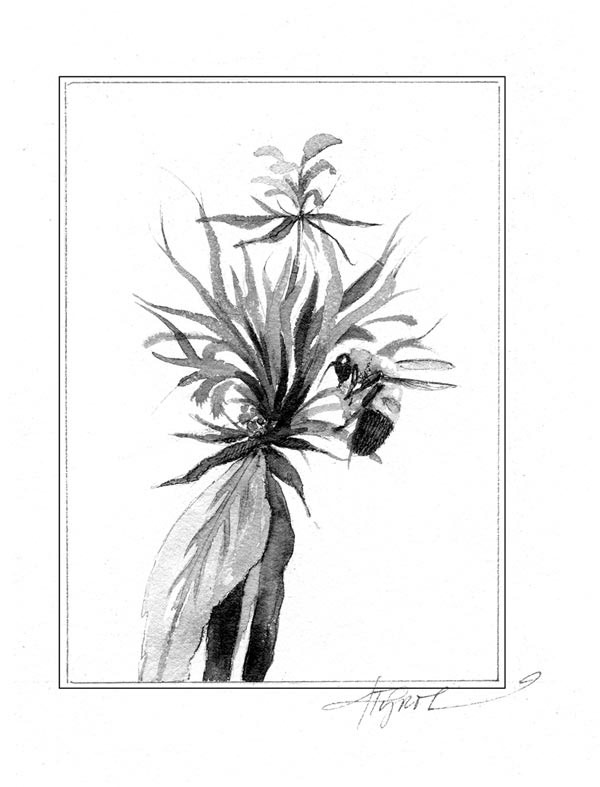
Illustration by Adelaide Tyrol
There has been a lot of bad buzz about bee populations lately, mostly about the decline of European honeybees that are used across North America to help pollinate everything from California almonds to Maine blueberries. Scientists coined the phenomenon colony collapse disorder (CCD), and have since identified a variety of culprits, including pathogens, toxins, and stressful apicultural practices.
But while CCD focused scientists and the public on the threat to honeybees, a non-native species originally imported from Europe in the 17th century, some native bees appear to be in serious trouble, too. These natives are often highly specialized and efficient foragers that are important pollinators for tomatoes, cucumber, squash, berries, and fruit orchards. Across the United States, these native pollinators annually contribute an estimated $3 billion worth of crop pollination.
In the late 1990's, bee biologists started to notice a decline in the abundance and distribution of several bumblebee species, and in the Northeast, there appeared to be a sudden, range-wide decline in numbers. Leif Richardson, a biologist with the Vermont Fish and Wildlife Department, was concerned.
Because there was no data on bumblebee populations in the region, Richardson visited the insect collections at the University of Vermont and other institutions to examine past records of bumblebee abundance. Richardson found that students had commonly collected one species, the rusty-patched bumblebee, in the 1960s and 1970s but that, despite searching for them, no rusty-patched specimen has been found in Vermont in recent years. What was among the most common bumblebee species of fields, farms, and gardens is just about completely gone.
Because the rusty-patched bumblebee disappeared, so did the Ashton cuckoo bumblebee. Cuckoo bumblebees are antisocial bees that parasitize other bumblebee colonies. They infiltrate a rival queen's colony, enslave the workers, and use them to feed the cuckoo's young. The Ashton cuckoo specializes in parasitizing the nests of rusty-patched bumblebees. As the host disappears, so goes the parasite.
Bumblebees are excellent pollinators of greenhouse-grown tomatoes and other plants, and this may be where some of the trouble began. In order to increase crop production, especially in greenhouse-grown tomatoes that don't benefit from wind for natural pollination, farmers release common Eastern bumblebees into their greenhouses. As it happens in these days of global trade, many of these native American bees are actually hatched and raised in Europe before being exported back home. While in Europe, some of the queens were infected by intestinal parasites common to native European bumblebees, and those parasites came to North America on the homeward journey.
Some of the imported and infected bumblebees escaped from the greenhouses where they were working and came into contact with wild bumblebees populations, transmitting the parasites to them. In 2006, Sheila Colla, a doctoral student at York University in Toronto, and colleagues captured native bumblebees at varying distance from commercial greenhouses where bumblebees were being used. They found that native bees captured close to these greenhouses were much more likely to be infected with introduced parasites than those captured far away.
The common Eastern bumblebee is a host that isn't affected by these parasites. It can, however, carry them and pass them onto other bumblebees. Short-tongued bumblebees, such as rusty-patched and yellow-banded bumblebees, appear to be especially sensitive to these introduced parasites, and this may explain the decline in wild populations.
Introduced parasites are not the only problem facing our native bumblebees. Habitat loss and land fragmentation, planting of monocultures, and urbanization are taking their toll on pollinator populations of all kinds. Some widely used pesticides, particularly the neonicotinoids, may be as big a threat to bumblebees as they are to honeybees in colony collapse disorder.
The Xerces Society, one of the leading insect conservation groups in North America, has placed the rusty-patched bumblebee, the yellow-banded bumblebee, and two western species, the western bumblebee and Franklin's bumblebee, on its red list of most-threatened insects. Franklin's, confined to just southern Oregon and northern California, has not been found since 2004 and might be extinct. The rusty-patched bumblebee might not be far behind.
Though there is some hope. In Vermont last year, Richardson found a rise in yellow-banded bumblebee populations, and this year, the bees appear to buzzing around again. No one knows why they might be recovering, but at least the trend is good.
Kent McFarland is a biologist with the Vermont Center for Ecostudies

Thursday, July 8, 2010

CAN THE THREATENED LOUISIANA BLACK BEAR POPULATION AVOID THE HARMFUL EFFECTS OF THE OIL SPILL?

Black bears may escape Gulf oil contamination, experts hope

Daily reports and aerial footage of the direct impact of the oil spill on marine ecosystems draws anger, outrage, sadness and much hopelessness among those of us removed, but tuned into the news updates coming out of the Gulf Coast region.

Certainly, much more heightened emotion is elicited among those directly affected by the fallout of this ecological catastrophe. But floating carcasses of bottlenose dolphins, growing numbers of oiled brown pelicans, northern gannets and sea turtles, and concerns over the health of shellfish and pelagic fisheries impress upon us how broad in scope and real this ecological tragedy is. And it is all the result of a single off-shore oil leak.

Among environmentalists (naturalists and some scientists included), frustration will likely grow as the collateral damage has extended beyond theory and shown real or perceived potential to endanger more than marine and estuarine ecosystems. The oil spill's trajectory may now clearly reach riparian zones of inland forests and other biomes.

What may make this more insidious is that the impact on non-aquatic or non-surface water habitat and species is not so easily comprehensible or obvious or certain.

"The Gulf Coast disaster may draw attention to some surprising umbrella species that live within the region."

The wildlife that inhabit regions in the trajectory of the oil leak may not be particularly affected by the contamination in the short-term, but if anything, the Gulf Coast disaster may draw attention to some surprising umbrella species that live within the region.

Although they are not so closely tied to estuarine habitat or even to some riparian zones, these uber-iconic megafauna associated with bald cypress swamps, like the Florida panther (Puma concolor coryi), one of 30 subspecies of the cougar or mountain lion, and one of the most endangered mammals on Earth, serve as keystone species representing diverse faunal groups. [Read the blog post Florida Panther Fights for Survival Again--This Time in Washington D.C.]

These include marine and brackish water ichthyofauna (fish) and herpetofauna (reptiles/amphibians), avifauna (birds) and a host of mammalian species. Some include species that have already been impacted by the oil leak from oiled ciconiiformes (e.g., herons), and pelecaniformes (e.g., pelicans) to species more indirectly impacted like piscivorous and scavenging raccoons to living dinosaurs. The impact to American crocodiles which were downlisted from Endangered to Threatened in 2007 and American alligators is largely unknown.    


CLICK ON PICTURE CAPTIONS TO SEE BLACK BEARS IN LOUISIANA

black-bear-from-the-air-photo-1.jpg

black-bear-from-the-air-photo-2.jpg

Aerial photos of a bear in a food plot, June 6, 2010.

Photos by Jeb Linscombe, Biologist Louisiana Department of Wildlife and Fisheries

Two subspecies of the American black bear, the Florida black bear (Ursus americanus floridanus) and the Louisiana black bear (Ursus americanus luteolus), have received less attention. But they also serve as umbrella species in the Gulf Coast region for a diversity of fauna living in somewhat disparate zoogeographic regions where these occasional and common peri-domestic, and highly adaptable opportunistic omnivores find themselves, as suitable and available habitat continues to shrink.

The Louisiana black bear was federally listed as a threatened species under the Endangered Species Act in 1992, and is one of the most imperiled of the 16 subspecies of American black bear. Two subspecies also range throughout northern Mexico.

Any black bear subspecies living within the historic range of the Louisiana subspecies is also provided with the same federal protection as the threatened Louisiana black bear. This subspecies currently ranges throughout eastern Texas, the southern part of Mississippi and the state of Louisiana (they are currently confined to three small populations in Louisiana). The historic range of the subspecies includes southern parts of Arkansas.

In March of 2009 the U.S. Fish & Wildlife Service (USFWS) designated critical habitat for the Louisiana black bear in the state of Louisiana, where the bear is also celebrated as the state mammal. The designated area covers 1,195,821 acres spanning 15 parishes.

Prior to this, large-scale efforts to create forest corridors in the state of Louisiana were launched as part of a national and federal bear-recovery plan.

Several breeding populations of the Louisiana black bear have been identified north of coastal zones in habitat that includes cypress-tupelo swamps also known as southern deepwater swamps.

Areas where breeding populations exist as well areas of preferred habitat type like bottomwood hardwood forests are still important to the conservation and management of the Louisiana black bear.

Management efforts require that the habitat is restored and protected from threats to degradation and fragmentation and other human disturbance.

The stability of the bear population must be carefully monitored and as for any species, consideration of augmentation through reintroduction programs must be carefully planned.

These bears also utilize riparian habitat, which refers to the interface between the water's edge and the specific surface water run-off in the form of rivers, streams, and creeks.

The bears less commonly utilize brackish and freshwater marsh habitat. When they do use marsh habitat they can be found traveling across elevated spoil banks which may serve as travel corridors.

Marsh wetlands are subjected to continuous flooding, and are predominated by grasses, sedges and other herbaceous vegetation, including some of the flora that the bears may consume.

Inland, the black bears primarily use the swamp and particularly the cypress and tupelo trees as denning sites. They den inside hollow trees, which also provide "escape cover" for these shy and reclusive animals.


CLICK ON PICTURE CAPTIONS TO SEE BEAR PICTURES

bear crossing photo.jpg

A bear crossing a spoil bank. "These banks crisscross the coastal habitat and are important travel corridors for the bears," says Maria Davidson, Large Carnivore Program Manager, Louisiana Dept. of Wildlife & Fisheries.

Photo by Thomas C. Michot, USGS-National Wetlands Research Center, Lafayette, Louisiana, 1996

As a part of a habitat and species restoration initiative, the Black Bear Conservation Coalition is managing stands of these trees to preserve critical denning habitat for Louisiana black bears. It is the cover and not so much the abundance of food resources that draw the bears to specific sites within the cypress swamps which are home to upwards of 400 vertebrate species.

As opportunistic foragers the bears have quite catholic tastes and will just as readily feed on yellow jacket nests and reptile eggs along with other available and easy to access food stuffs. They are not particularly piscivorous, that is predisposed to feed on fish in this habitat, or as likely to seek out challenging prey such as aquatic rodents that make the deep water swamp an underwater refuge.

It's much easier to feed on accessible herbs, berries, nuts, grasses, palmetto hearts, ants, and grubs. But occasionally, the bears will feed on small mammals and carrion. And similar to raccoons or skunks or scavenging birds, exposure to just one carcass contaminated with oil can be potentially lethal to a bear.

"Long-term effects on individual bears or other wildlife may include suppression of the immune system and impair reproductive capacity potentially impacting population levels."

Long-term effects on individual bears or other wildlife may include suppression of the immune system and impair reproductive capacity potentially impacting population levels. For more information on the impact of oil exposure on wildlife, please read this USFWS report.

Paul Davidson, executive director of the Black Bear Conservation Coalition, points out that it would be quite rare for black bears to become victims of this Gulf Coast tragedy unless an unusually strong tidal surge from a powerful storm were to push oil-contaminated water beyond marsh habitat, precipitating a major fish kill.

My colleague, Dr. Joe Clark, chief of the U.S. Geological Survey's Southern Appalachian Research Branch at the University of Tennessee, agrees that the three Louisiana black bear populations are quite well insulated from contaminated waters living in inland in forested habitats.

He adds that two are somewhat sequestered north of Highway 90 (the coastal population is south of 90), a major East-West expressway that transects the southeastern United States. Furthermore, Dr. Clark added that his research of black bear habitat disturbance by Hurricane Katrina indicated that the impact on bears was minimal.

Jordan-Schaul.jpg
Jordan Schaul is a conservation biologist and a collection curator with the Alaska Wildlife Conservation Center. He received his PhD in veterinary science from The Ohio State University and a Master's Degree in zoology. Jordan pursued a clinical degree in veterinary medicine prior to returning to his interests in husbandry science and conservation and ecological health. He serves as a council member (ex officio) of the International Association for Bear Research and Management (IBA) and as an advisor to the Bear Taxon Advisory Group of the Association of Zoos and Aquariums. Jordan also serves as the Correspondent Editor and Captive Bear News Correspondent for International Bear News (IBA/IUCN SSC Bear Specialist Group). Most recently, he joined the Advisory Council of the National Wildlife Humane Society.


Will we ever become tolerant of the Creators work as it relates to other living beings?????????????

Montana sets wolf-hunt quota, awaits fed ruling

HELENA, Mont. – Montana wildlife regulators have set this year's wolf-hunt quota at 186, more than doubling last year's quota, with the aim of reducing the state's wolf population for the first time since they were reintroduced to the Northern Rockies in 1995.

The quota was set Thursday, even as the state awaits a federal judge's ruling that may determine whether there will be a wolf hunting season at all.

U.S. District Judge Donald Molloy has yet to rule after hearing arguments last month in a lawsuit brought by environmental groups seeking to restore Endangered Species Act protections for wolves in Montana and Idaho.

Opponents of the wolf hunt argued the commission should end the hunt before the courts act.

Ranchers and hunters say the wolf population has grown too high, which has led to more attacks on livestock and game.


    Southern California's Mountain Lions Become International Diplomats

    http://www.treehugger.com/files/2010/07/southern-californias-mountain-lions-become-international-diplomats.php

    LIONS AND OTHER WILDLIFE NEED TO BE ABLE TO CROSS BETWEEN THE USA AND MEXICO TO FOSTER HEALTHY GENE POOLS FOR THE POPULATION.............OUR BORDER WALLS ARE A PROBLEM FOR ANIMALS.................PERHAPS BETTER TO HAVE THE NATIONAL GUARD ON THE BORDER AS A DETERRANT FOR ILLEGALS RATHER THAN CONCRETE WALLS

    Our friend Christina Eisenberg and Wildlands Network in partnership researching on whether Wolves are colonizing Colorado

    Wolf-related research continues at Colorado ranch
    Long-term study includes camera monitoring, tracking, DNA testing

    While some scat samples found on The High Lonesome Ranch in northwestern Colorado have not tested positive for wolf DNA, research efforts continue on the original ecological assessment of the ranch that first lead to discovery of wolf sign on the property.

    According to the DNA report just released by the Robert Wayne Lab at UCLA, "The fact that we were unable to amplify…DNA product in many of the samples… indicates that the DNA in these samples was significantly degraded.  Our experience with even fresh canid scat samples is that 10-40% of samples may not yield amplifiable DNA from the individual of origin," said the report. Some of the samples were found to be of coyote origin.

    The majority of the scat samples contained DNA that was not fully amplifiable because of the degraded specimen condition. The scats were collected at different times and were of different ages. The condition of the scat could have been affected by environmental conditions, as well storage and shipping.

    The ranch's chairman and CEO, Paul R. Vahldiek, Jr., who initiated the original ecological assessment of this property, says research will continue to investigate a die-off of aspen groves on his land. As in other parts of Colorado, aspen on The High Lonesome Ranch show evidence of Sudden Aspen Decline, which is related to a variety of factors including climate change, disease, and excessive browsing by elk.

    Regular measurements of aspen regeneration, changes in movement of elk herds and their behavior, and remote camera installations will also aid the study, which researchers say can expand the understanding of "trophic cascades" -- the domino effect that top predators have on plant and animal communities. A lack of keystone predators, like wolves, has been linked to over-browsing of aspen saplings by elk herds in the western U.S.

    "These DNA tests are a valuable snapshot in time, but they represent only a small part of our ongoing research," said Vahldiek, who indicated that he was not surprised that some of the specimens tested positive for coyote. The ranch owner noted that he planned on continuing a full scientific assessment of his lands, headed by Cristina Eisenberg, a conservation biologist at Oregon State University specializing in predator prey interactions. "We will continue to use the best possible science to be good stewards of this land, and that will involve looking more deeply at scientific issues related to the land and its flora and fauna," said Vahldiek.

    The DNA results do not necessarily mean that wolves are not present, due to continuing, reliable wolf sign collected by expert trackers on the ranch, including tracks and howling. Future research will include further DNA testing of scat samples and measurement of baseline aspen health for comparison with future conditions that might occur as a result of changes in carnivore populations.

    Another member of the ranch's science team, Michael Soulé, a founder and board member of the Wildlands Network – a conservation group working to restore a network of wildlife corridors between Canada, the U.S., and Mexico – remains optimistic that wolves will naturally return to their former range in the southern Rockies. "The restoration and protection of safe landscape connections across the West, in places like the High Lonesome Ranch, will play a major role in allowing wolves to return in the future," says Soulé, "thus rehabilitating native ecosystems."

    According to Wildlands Network Executive Director, Margo McKnight, the focus on the possible natural return of wolves to Colorado presents an excellent opportunity to think about wolf recovery in a different way. "We're confident that the lessons learned from other recovery efforts will help to create a Colorado plan that allows wolves and ranching to co-exist to the benefit of both," she notes. "Now is the time to consider a new approach to restoring ecological relationships in Colorado," she says, "even before wolves officially take up residence."


    Wildlands Network P.O. Box 5284, Titusville, FL 32783 | info@wildlandsnetwork.org

    Monday, July 5, 2010

    Black Bears, Wolves and Coyotes all swim.........one of the ways they colonize new habitat

    http://www.youtube.com/watch?v=XklKhiXxiW4

    click above link to see black bear swimming in a pond

    Wild America asking us human animals to let them repopulate their historical habitats including New York City and surrounding suburbs

    No lions and tigers, but plenty of bears for New York City as population of coyotes, deer and raccoons boom

    BY Barry Paddock
    DAILY NEWS STAFF WRITER

    Sunday, July 4th 2010, 4:00 AM

    NYC Parks and RecreationWild coyote Hal ran amok in Central Park in 2006 before getting caught. Related NewsSewage-pumping boat is saving the bayClose encounters: NY Aquarium keepers embrace ocean awareness

    The urban jungle's getting wilder every day.Booming populations of coyotes, deer, bears and raccoons are causing chaos in close suburbs and encroaching more and more on the five boroughs.

    A coyote led cops on a three-day chase through Tribeca in March. Three black bears were spotted just a few miles from the George Washington Bridge in May. And Thursday, two deer tore around the parking lot of a Target in the Bronx.

    Experts say numerous factors are leading to the city's growing wild kingdom, from more greenways and bike paths to overdevelopment in the burbs.

    "You see them in city limits more than you have in the past," said Dr. Pat Thomas, head animal curator at the Wildlife Conservation Society's Bronx Zoo. "Animals can become desensitized to our presence and more emboldened."

    After only three coyote sightings in Manhattan over the last decade, the cunning canines have been popping up all over Manhattan. One roamed Harlem in January, three were spotted at Columbia University in February and another was seen crossing a frozen lake in Central Park.

    "We're going to see them continue to infiltrate New York City," said Kevin Clarke, a wildlife biologist with New York's Department of Environmental Conservation.

    In Rye, just 12 miles from the Bronx, police are hunting for coyotes that attacked a 3-year-old girl Tuesday and a 6-year-old girl four days earlier.

    And on Friday, a cop in Yonkers fired at a coyote but the animal escaped."This is new to a lot of the experts," said Rye Mayor Doug French. "There's no explanation at this point."

    Parents aren't letting their children outside, said Kelly Hodulik, whose daughter, Emily, 6, suffered minor injuries after being bitten on her shoulder and thigh by a pair of coyotes. "Everybody's being really cautious," Hodulik, 42, said. "It's really scary."

    Coyotes also are striking out into the city, following power line corridors, parkways and greenways - perfect paths for critters.

    "One thing I've learned in the past 10 years," said Dr. Stanley Gehrt, a coyote expert at Ohio State University, "is to never bet against coyotes."

    Biologists believe deer in New Jersey have been swimming across the Hudson River to Staten Island since 2000, replenishing the dwindling native population.

    Frank Masseria, 53, videotaped the migration of two deer swimming from Perth Amboy, N.J., to Tottenville in May."You always wonder how they got here," Masseria said. "I understand they are good swimmers, but to actually see it, I was pretty shocked."

    The city is increasingly going to the birds. New York has the highest density of peregrine falcons in the world, said Glenn Phillips, executive director of New York City Audubon. And while Pale Male and Lola used to be about the only red-tailed hawks, now there are more than 30 in the city, he said.

    While bears have yet to be spotted in Manhattan, they have gotten close. West Milford, N.J., postponed fireworks after a bear charged a hiker, injuring his dog.

    A bear could make the swim across the Hudson River, biologists say, but would likely be discouraged by the urban landscape on either side of the river.

    "You're seeing them in places you didn't see them before," said Larry Ragonese of the New Jersey Department of Environmental Protection. "They're moving toward New York."

    Saturday, July 3, 2010

    Westchester County, New York residents urged to scare off coyotes and not make them feel welcome in neighborhoods--outside of shooting them, this is the right way to go!

    Yonkers cop shoots at coyote; state urges aggressive response to the animals

    By Greg Clary • gclary@lohud.com • July 3, 2010

     NEW PALTZ — State wildlife officials want communities with increasing coyote sightings to be more aggressive in scaring the animals off.

    But Yonkers police were hours ahead of those Friday afternoon warnings: An officer there took two shots at a coyote about 1:20 a.m. near Chase and Park avenues.

    "Whether it was struck by a bullet or not I certainly don't know," Yonkers police Lt. Philip Collins said. "We have no more information as to the whereabouts of the coyote at this point or whether it's dead or alive."

    An off-duty police officer saw the coyote near his home and called police. He described it as light brown or golden in color, with matted fur, a long snout and a bushy, curved tale.

    Yonkers police Sgt. Bryant Pappas fired two shots at the coyote upon arriving at the scene and said he believed one of the bullets hit the animal because he heard a "yelp sound."

    Pappas didn't fire additional shots because he was near several residences, police said, and it would have been too dangerous.

    Rye police reported no new incidents or coyote sightings Friday afternoon.

    Lt. Robert Falk said the department would have extra patrols over the weekend in response to the two coyote attacks on little girls within four days.

    Rye Mayor Doug French said residents should continue to keep up their guards as they start the holiday weekend.

    "There are a lot of community events planned this weekend, and we just advise people to follow our precautions and if confronted to know how to act and to keep your children nearby," he said.

    Officials from the state Department of Environmental Conservation met with Rye and Westchester County police officers, as well as county parks officials and others, at the agency's regional headquarters in New Paltz.

    In a two-hour meeting, wildlife experts and conservation officers urged community representatives to have residents respond more aggressively to the animals, to make the animals uncomfortable in the presence of humans.

    "The air horns are a good idea," DEC spokeswoman Wendy Rosenbach said. "They scare the animals."


    Included in the strategies are getting residents to make noise with pots and pans, or other metal objects, throw rocks or sticks and possibly even use pepper spray.

    Rosenbach said DEC officials reiterated the police's authorization to use deadly force or to set traps.

    "We think the city of Rye and others have been doing the right thing so far," Rosenbach said. "We basically want the coyotes to not want to be around human beings."

    Staff writers Will David and Hannan Adely contributed to this report.

    Oregon Wolf Packs get a reprieve from Wildlife Services killing plan

    Wolves Earn Reprieve as Hunt Is Halted


    Wildlife Advocates Celebrate Short-term Victory for Endangered Wolves


    PORTLAND, Ore.— In response to a lawsuit by four conservation groups challenging the legality of a state-sponsored hunt of two of Oregon’s 14 endangered wolves, Wildlife Services voluntarily agreed today not to kill any wolves in Oregon for at least four weeks. The conservation groups asserted that the federal wildlife-control agency did not follow appropriate steps in carrying out the thus-far unsuccessful hunt. The groups claimed that had the agency done so, they would have found the continued hunt was inappropriate and unnecessary. Wolves are responsible for six livestock deaths this year but none in nearly a month.

    Ultimately, it was the state of Oregon that authorized the ongoing hunt. The groups are in the process of filing a claim against the state for breaking its own rules and the Wolf Conservation and Management Plan.

    “Oregon’s struggling wolf population has been given a reprieve,” said Noah Greenwald, endangered species program director for the Center for Biological Diversity. “With a mere 14 wolves in the state, killing two has a big impact. We’re glad this won’t be happening — at least for now.”

    “Most Oregonians value native wildlife and were saddened to see the state violate the trust we put into the wolf conservation plan,” said Rob Klavins, Roadless Wildlands Advocate for Oregon Wild. “With only 14 wolves and one breeding pair in the state, killing wolves should be the option of last resort. We expected better and are disappointed it took a court action to do the right thing.”

    The state’s wolf plan was developed in 2005 and is currently under a mandated five-year review. Conservationists have asked for some changes and clarifications to ensure wolf recovery and reduce conflict. They raised concerns earlier this week when the Oregon Department of Fish and Wildlife relaxed rules defining chronic depredation, thus making it easier to kill wolves. The rule change came despite an ongoing public review process. The plan does allow for killing depredating wolves, and last year, two Oregon wolves were killed in response to depredations on private lands. Despite the harsh measures allowed by the plan, some interests have argued for gutting it and taking management decisions away from professional biologists.

    “Oregon is big enough for both wolves and people,” said Sean Stevens of Oregon Wild. “We honored the good-faith efforts made by all the stakeholders in developing the wolf plan. But when the agencies entrusted with its implementation began breaking their own rules, and the governor failed to act, we had no choice but to take them to court.”

    The reprieve only lasts until July 30 and could resume if further chronic depredations occur.

    “Living with wolves and wildlife is part of living near the big wild places in the West,” concluded Josh Laughlin, campaign director of Cascadia Wildlands. “Today’s news buys a bit of time for Oregon’s budding wolf population, yet it remains critical that the Oregon wolf plan is properly followed in the future to allow for a successful recovery and less unnecessary conflict.”
    The kill order stems from recent livestock depredations by wolves in Wallowa County. In May and early June, six cattle deaths were confirmed as wolf depredations. For comparison, in 2005 — the year the wolf plan was created — domestic dogs killed 700 sheep and cows in Oregon, according to the National Agricultural Statistics Service. No new livestock depredations have occurred since June 4.

    According to the groups, Oregon’s wildlife agency is violating the wolf management plan by issuing the kill permits when damage is not presently occurring, the wolves are not on the land where damage is occurring, and multiple carcass dump piles were left on ranch lands resulting in “unreasonable circumstances” attracting wolves to the area. Had Wildlife Services conducted the proper environmental analysis, the agency would have realized that wolves pose no current depredation threat and hunting them is inappropriate. The Oregon Department of Fish and Wildlife has also failed to document how efforts by ranchers to avoid depredations through nonlethal means were “deemed ineffective,” or to document unsuccessful attempts to solve the situation through nonlethal means — both requirements of the plan.

    Oregon is currently home to a confirmed population of 14 wolves in two packs, both in northeast Oregon. The Imnaha pack of 10 is led by wolf B-300. Another pack of four wolves located in the Wenaha wildlife unit was caught on film for the first time earlier this spring. The Oregon wolf plan is currently undergoing a mandated five-year review process. With a current population of fewer than 14 confirmed wolves, conservationists are working to fully fund the wolf plan and empower biologists to make decisions regarding the state-listed endangered species.

    Friday, July 2, 2010

    Wisconsin to research and analyze the impact of their predator suite of wolves, coyotes, bears and bobcats on deer mortality

    "(BLOGGER READERS SHOULD REMEMBER THAT WOLVES VERY MUCH CREATE A "LANDSCAPE OF FEAR" WHICH KEEPS DEER ON THE MOVE, NOT LOCKED IN TO DECIMATING THE VEGETATION OF A PARTICULAR ACREAGE...................AN EXCELLENT THING FOR REGENERATION OF OAKS AND OTHER HARDWOODS SUSCEPTIBLE TO DEER OVERBROWSING....................DEER ARE AROUND, JUST NOT SEDENTARY AND EASY PICKINGS FOR THE CASUAL HUNTER....................REQUIRES "HUNTING PROWESS" OF OLD TO GET YOUR DEER WHEN YOU ARE JOINED BY A SUITE OF OTHER PREDATORS(WOLVES, COYOTES, BOBCATS AND BEARS.....AND PERHAPS SOON AGAIN COUGARS)................I FEEL HUNTERS SHOULD BE ENERGIZED BY THE PREDATOR SUITE AND SEE IT AS A CHALLENGE TO IMPROVE THEIR HUNTING SKILLS...................AS MY FRIEND BILL BUTLER OF SINCLAIR BROADCASTING TOLD ME WHEN I JOINED WARNER BROTHERS TV 10 YEARS AGO, "RICK, YOU ARE PLAYING IN THE BIG LEAGUES...................YOUR SELLING AND MANAGEMENT SKILLS WILL BE TESTED LIKE NEVER BEFORE"........................SAME IS NOW TRUE FOR OUR FRIENDS WHO HUNT,,,,,THEIR SKILLS WILL BE TESTED NOW THAT SOME OF OUR MIDWEST AND EASTERN FORESTS AND MEADOWS ARE ALIVE WITH THE "HOWLS, YIPS AND ROARS" OF OUR NATIVE CARNIVORE COUSINS.--BLOGGER RICK EDITORIAL

    Predator impacts on deer are goal of research efforts to begin in 2010

    Weekly News Article Published: March 9, 2010 by the Central Office
    MADISON – Scientists with the Department of Natural Resources and the University of Wisconsin will launch an ambitious, multi-year field research effort to better understand the impacts predators such as wolves, bears, coyotes and bobcats have on white-tailed deer in Wisconsin.

    A review of existing literature on predation and a mathematical analysis using Wisconsin's extensive harvest and population data suggest a low level impact, but just how much, at what times, by what predators and under what conditions are all relatively unknown at this time, scientists said.
    "The literature review and data analysis are first steps that identified the need for specific field research on deer predation and how that research might be designed," said DNR research scientist, Christopher Jacques
    .
    A particular concern being raised by hunters is the fact of expanding wolf and bear populations in Wisconsin. Both are large predators that feed on deer either primarily as in the case of wolves or occasionally as in the case of bears.

    Some hunters argue an expanded wolf population, in particular, has resulted in fewer deer in the northern and central forests.
    Review of published research and preliminary data analysis suggests bears are having a small but measurable impact on fawn mortality and that wolves have a small impact on the mortality rate of adult does.

    One study in northern Wisconsin will use radio telemetry to track fawns and determine how many are killed by predators and by which predators. Almost nothing is known, for example, about the impact of coyote and bobcat predation on deer in Wisconsin. Similar research is underway in Michigan's Upper Peninsula, and the two states are sharing results.

    Another study, set to run for five years, will use a combination of field research methods, including radio telemetry, to study buck mortality. This research, on the DNR wish list for more than a decade, was recommended by independent auditors in 2006 to fine tune Wisconsin's procedures for estimating herd size.

    The review of published research on predation and the early analysis of Wisconsin data were done by researchers Jacques of the DNR Bureau of Science Services and Tim Van Deelen of the University of Wisconsin- Madison. They unearthed 90 studies from the U.S. and Canada, most conducted in recent years with a few dating back to the 1960s and 1970s. Their complete review is available on the Wisconsin wildlife survey page of the DNR Web site (look under deer).

    Many deer hunters tend to believe that every deer killed by a predator results in one less deer available for a human hunter to harvest. Research has found the truth to be more complicated. Predators do not, in fact, always reduce the population growth rates of prey.

    Biologists use the terms "compensatory" and "additive" to describe the impact of predation on any given wildlife population. If predation is "compensatory," it means the total number of prey to die in any given year does not change as a result of predation. It means the predators remove the number of animals that would have been lost anyway to other causes.
    If predation is "additive," then the predator is killing prey animals that otherwise would have survived the cycle of seasons. In these cases, the predator is slowing the growth of the prey population, or in some instances, causing that population to decline.

    Not surprisingly, the truth in any given predator-prey system often lies somewhere between with some predation being compensatory and some being additive. The trick is to determine degree. If predation has an "additive," or negative, effect on prey population growth, is the effect small or large?

    Jacques and Van Deelen applied statistical analysis to ten years of field and registration data (1998-2008) supplied by hunters from 57 deer management units, or DMUs, in the northern and central forests.
    This 10 year period coincides with a steady increase in wolf populations and a probable increase in bear populations in the northern and central forests.

    The Wisconsin researchers were looking for relationships, or correlations, within this large mass of data. For instance, do the data show a relationship between increasing wolf numbers in a given area and the growth rate of the deer herd? If such a relationship is revealed, researchers call this a "signal." The signal can be positive or negative, weak or strong.

    This statistical analysis does not show cause and effect, Van Deelen cautions. Nevertheless, the numerical "signals" it produces are valuable markers, pointing to areas where further research is needed to explain the numbers.

    The statistical model created by Jacques and Van Deelen suggests black bear presence is associated with a reduced population growth rate for deer of less than one percent. Under this model deer herds would still grow in the presence of a large bear population, just at a slightly reduced rate. The model also suggests that the presence of wolves is related to a slightly increased rate of doe mortality.

    "This early analysis appears to say that impacts on deer populations associated with bears and wolves are clearly minor relative to impacts associated with hunting by humans," said Van Deelen.

    These statistical relationships reflect what could be happening across large regions according to biologists. The numbers have nothing to say when it comes to an individual hunter and the 40 or 80 acres he or she hunts.

    "If you happen to be hunting in an area of wolf activity," Jacques said, "it could affect deer behavior or movement patterns and the number of deer you see.
    DNR wildlife officials are committed to continually improving the quality of the state's deer management program. Hunters play a critical role in this process, and as the agency moves forward with its ambitious research program, hunter involvement will be more important than ever.
    FOR MORE INFORMATION CONTACT: Keith Warnke, DNR big game ecologist, (608) 264-6023              (608) 264-6023       or Bob Manwell, DNR communications, (608) 264-9248              (608) 264-9248      
    View all articles in this issue or check our previous Weekly News Issues.


    Center for Biological Diversity successfully sues for Mexican Wolves to be Federally Protected as a separate species from Gray Wolves

    For Immediate Release, June 30, 2010

    Contact:  Michael Robinson, (575) 534-0360              (575) 534-0360      

    Mexican Gray Wolf One Step Closer to Separate Protection Under Endangered Species Act
    Recognition Will Mean Increased Protection, New Recovery Standards

    SILVER CITY, N.M.—  A Center for Biological Diversity settlement with the U.S. Fish and Wildlife Service, filed today with a federal court, requires the Service to respond by July 31, 2010 — one month from today — to a 32-page petition submitted by the Center last August asking for recognition of the Mexican gray wolf as an endangered species separate from gray wolves in the rest of the country. The federal agency had missed a 90-day deadline to issue an initial finding on the petition's scientific validity.

    "Today's settlement agreement is a victory for the Mexican gray wolf, which now has a shot to receive the recognition and protection it needs to survive," said Michael Robinson of the Center. "The Mexican gray wolf's distinctiveness from other gray wolves means their survival and recovery is of heightened significance."

    A separate listing for the Mexican wolf as a subspecies or distinct population would compel the Fish and Wildlife Service to develop a new Mexican wolf recovery plan, which the agency has been promising to do since the mid-1990s.

    The Center's petition cites multiple independent assessments that the Mexican wolf is a subspecies of the gray wolf and also describes the peril to Mexican wolves from government and private persecution and habitat loss. Mexican wolves are smaller than other gray wolves and inhabit very different ecosystems.

    In 1976, the Mexican gray wolf was originally listed as endangered separate from other gray wolves, but in 1978 the Fish and Wildlife Service consolidated the various wolf subspecies listings into a single listing for the conterminous United States. In 1982, the Service did issue a recovery plan for the Mexican wolf, which called for captive breeding and establishment through reintroduction of two viable populations in the wild, but it failed to contain criteria for recovery and delisting — an omission the Service has used to stall progress in securing the viability of the first reintroduced population, in the Gila and Apache national forests of New Mexico and Arizona, as well as stall any planning for establishing additional populations. Once the Mexican wolf is separately listed, the Fish and Wildlife Service will be required to update the recovery plan — something that is merely discretionary right now.

    "With today's settlement, we hope Mexican wolf recovery can get back on track," said Robinson. "With its own listing and recovery plan, the Mexican wolf should see needed reforms in management and eventual return to the other Southwest habitats where it once roamed."


    Thursday, July 1, 2010

    Two Oregon Wolves(total population in the State is a fledgling 14) targeted to be killed for cattle attack

    Conservation groups try to stop wolf kill order
    Conservation groups are trying to stop federal wildlife agents from carrying out a state kill order on a pair wolves in northeastern Oregon that are blamed for killing cattle. There are only 14 wolves in the State..............now is not the time to be culling these predators

    http://seattletimes.nwsource.com/html/localnews/2012258794_aporwolflawsuit.html

    ======================================================================

    Tropic Cascades and how the introduction of man into North America was a triggering mechanism for other animal extinctions(not the only factor but a "jump ball" opening salvo that spiraled on from there


    WE HAVE HEARD FROM BILL RIPPLE AT OREGON STATE BEFORE ON TROPIC CASCADES, TOP DOWN INFLUENCE OF CARNIVORES ON THE SYSTEM........THE LANDSCAPE OF FEAR AND WHAT HAPPENS WHEN A NEW PREDATOR IS INTRODUCED INTO A SYSTEM PREVIOUSLY IN EQUILIBRIUM..........................

    'Trophic cascades' of disruption may include loss of woolly mammoth, saber-toothed cat

    July 1, 2010 'Trophic cascades' of disruption may include loss of woolly mammoth, saber-toothed cat
    Enlarge

    Both woolly mammoths and saber toothed tigers may have fought each other and ultimately driven themselves to extinction thousands of years ago after humans arrived on the scene, upsetting a delicate balance that had previously existed. (Artwork by Mauricio Anton, courtesy of Oregon State University)
    A new analysis of the extinction of woolly mammoths and other large mammals more than 10,000 years ago suggests that they may have fallen victim to the same type of "trophic cascade" of ecosystem disruption that scientists say is being caused today by the global decline of predators such as wolves, cougars, and sharks.

    In each case the cascading events were originally begun by human disruption of ecosystems, a new study concludes, but around 15,000 years ago the problem was not the loss of a key predator, but the addition of one - human hunters with spears.
    In a study published today in the journal , researchers propose that this was caused by newly-arrived humans tipping the balance of power and competing with major predators such as saber-toothed cats. An equilibrium that had survived for thousands of years was disrupted, possibly explaining the loss of two-thirds of North America's large mammals during this period.

    "For decades, scientists have been debating the causes of this mass extinction, and the two theories with the most support are hunting pressures from the arrival of humans, and ," said William Ripple, a professor of and society at Oregon State University, and an expert on the ecosystem alterations that scientists are increasingly finding when predators are added or removed.
    "We believe humans indeed may have been a factor, but not as most current theory suggests, simply by hunting animals to extinction," Ripple said. "Rather, we think humans provided competition for other predators that still did the bulk of the killing. But we were the triggering mechanism that disrupted the ecosystem."

    In the late Pleistocene, researchers say, major predators dominated North America in an uneasy stability with a wide range of mammals: mammoths, mastodons, ground sloths, camels, horses, and several species of bison. The new study cites previous evidence from carnivore tooth wear and fracture, growth rates of prey, and other factors that suggest that there were no serious shortages of food caused by environmental change 10,000 to 15,000 years ago.

    Quite contrary to that, the large herbivores seemed to be growing quickly and just as quickly had their numbers reduced by a range of significant carnivorous predators, not the least of which was lions, dire wolves, and two species of saber-toothed cats. Food was plentiful for herbivores, the system was balanced, but it was dominated by predators.
    "When human hunters arrived on the scene, they provided new competition with these carnivores for the same prey," said Blaire Van Valkenburgh, an expert at UCLA on the paleobiology of carnivores, and a co-author with Ripple on this study.

    "The humans were also omnivores, and could live on plant foods if necessary," Van Valkenburgh said. "We think this may have triggered a sequential collapse not only in the large herbivores but ultimately their predators as well. Importantly, humans had some other defenses against predation, such as fire, weapons and living in groups, so they were able to survive."

    But the driving force in eliminating the large mammals, according to the new theory, was not humans - they just got the process started. After that, predators increasingly desperate for food may have driven their prey to extinction over long periods of time - and then eventually died out themselves.
    In recent studies in Yellowstone National Park and elsewhere, scientists from OSU and other institutions have explored these "trophic cascades," often caused by the loss or introduction of a single major predator in an ecosystem.

    With the elimination of wolves from Yellowstone, for instance, the numbers of elk exploded. This caused widespread overgrazing; damage to stream ecosystems; the slow demise of aspen forests; and ultimate effects on everything from trees to beaver, fish, birds, and other life forms. When wolves were re-introduced to Yellowstone, studies are showing that those processes have begun to reverse themselves.

    "We think the evidence shows that major ecosystem disruptions, resulting in these domino effects, can be caused either by subtracting or adding a major predator," Ripple said. "In the case of the and saber-toothed tiger, the problems may have begun by adding a predator, in this case humans."

    The new analysis draws on many other existing studies in making its case.
    For instance, other research describes this process with a model in modern times in Alaska. There, the allowance of relatively limited human hunting on moose caused wolves to switch some of their predation to sheep, ultimately resulting in a precipitous decline in populations not only of moose but also wolves and sheep
    .
    The loss of species in North America during the late Pleistocene was remarkable - about 80 percent of 51 large herbivore species went extinct, along with more than 60 percent of important large carnivores. Previous research has documented the growth rates of North American mammoths by studying their tusks, revealing no evidence of reduced growth caused by inadequate food - thus offering no support for climate-induced habitat decline.

    It seems that diverse and abundant carnivores kept herbivore numbers below levels where food becomes limiting. By contrast, the large population of predators such as dire wolves and saber tooth cats caused them to compete intensely for food, as evidenced by heavy tooth wear.
    "Heavily worn and fractured teeth are a result of bone consumption, something most carnivores avoid unless prey is difficult to acquire," says Van Valkenburgh.

    Trophic cascades initiated by humans are broadly demonstrated, the researchers report. In North America, it may have started with the arrival of the first humans, but continues today with the extirpation of wolves, cougars and other predators around the world. The hunting of whales in the last century may have led to predatory killer whales turning their attention to other prey such as seals and sea otters - and the declines in sea otter populations has led to an explosion of sea urchins and collapse of kelp forest ecosystems.

    "In the terrestrial realm, it is important that we have a better understanding of how Pleistocene ecosystems were structured as we proceed in maintaining and restoring today's ecosystems," the researchers wrote in their conclusion. "In the aquatic realm, the Earth's oceans are the last frontier for megafaunal species declines and extinctions."

    "The tragic cascade of species declines due to human harvesting of marine megafauna happening now may be a repeat of the cascade that occurred with the onset of human harvesting of terrestrial megafauna more than 10,000 years ago. This is a sobering thought, but it is not too late to alter our course this time around in the interest of sustaining Earth's ecosystems."
    Provided by Oregon State University (news : web)

    Minnesota residents report cougars--sightings on the increase


    Is there a cougar prowling around the Lake Elmo Minnesota?  View Full Story


    Wednesday, June 30, 2010

    Killing Coyotes Doesn't accomplish reducing their population!!!!!!!!!!!!!!!!!!!!!!!!!!!!!!!!

    Many of you know and admire Marc Bekoff’s illuminating work on animals having feelings and their ability to learn and feel—emotions, like us human animals!


    Marc discusses the folly of humans trying to reduce coyote populations by shooting, trapping and poisoning them………It does not work and as we have discussed on so many occasions, is counterproductive ……………actually resulting in larger coyote populations and unstable family units that can lead to increased conflicts with people……….click and read below.

    http://animals.change.org/blog/view/killing_coyotes_doesnt_work