A Description of the New Netherlands
by Adriaen van der Donck
by Adriaen van der Donck
Van der Donck purchased an estate on the Hudson near the upper extremity of Manhattan Island, about sixteen miles from this city, afterwards known as Yonkers. One of his grants of land at that place was made to him in 1648, under the name of JoNKEP. (pronounced Yonher) Van der Donck, and it appears that he was familiarly called the Yonher, a common appellation for a gentleman among the Dutch farmers. His land was spoken of, as we find in the Colonial Records, as the Yonker's land, and there can be little doubt that the name of the present town of Yonkers was in this way derived from him. t Van der Donek made several purchases from the Indians in that neighborhood, and altogether acquired an extensive tract of land, bounded on the south by the creek Paprimenin, to. which the Dutch name of Spyten-duyvel was afterwards given. On the north was the Zaeg Kil, or Saw-Mill creek,' at the mouth of which is the present village of Yonkers, or Phillipsburg, where our author erected mills and laid out a plantation. The land and river of Bronck, or Bronx, another Dutch planter, bounded the estate on the cast.
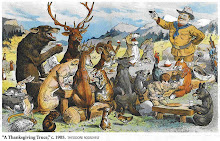
| The deer are incredibly numerous in the country. Although the Indians throughout the year and every year, (but mostly in thee fall,) kill many thousands, and the wolves, after the., fawns are cast, and while they are young, also destroy many, still the land abounds with them' everywhere, and their numbers appear to remain undiminished. We seldom pass through the fields without seeing deer more or less, and we frequently see them in flocks. Their meat digests easily, and is good food. Venison is so easily obtained that a good buck cashes for five guilders, and often for much less. There are also white bucks and does, and others of a black colour in the country. The Indians aver that the haunts of the white deer are much frequented by the common deer, and that those of the black species are not frequented by the common deer. These are the sayings of the Indians. The truth remains to be ascertained relating to the preference, between the animals. There is also another kind of animals in the country, which are represented to be large, and which are known to the people of Canada, who relate strange things concerning the same. I have heard from the mouth of a Jesuit, who had been taken' prisoner by the Mohawk Indians and released by our people, and come to me, that there were many wild , forest oxen in Canada and Nova Francia, which in Latin they name boves silvestres, (the moose, or elk,) which are as large as horses, having long hair on their necks like the mane of a horse, and cloven hoofs; but that, like the buffalo, the animals Were not fierce. I have also been frequently told by the Mohawk Indians, that far in the interior parts of the country, there were animals which were seldom seen, of the size and form of horses, with cloven hoofs, having one horn in the forehead, from a foot and a half to two feet in length, and that because of their fleetness and strength they were seldom caught or ensnared. I have never seen any certain token or sign of such animals, but that such creatures exist in the country, is supported by the concurrent declarations of the Indian hunters. There are Christians who say that they have seen the skins of this species of animal, but without the horns. Wolves are numerous in the country, but these are not so large and ravenous as the Netherlands wolves are. They will not readily attack any thing, except small animals, such as deer, but most commonly when young,) calves, sheep, goats, and hogs. But when a drove of hogs are together, they do not permit the wolves to do them any injury, as those animals defend and assist each other. The wolves in winter know how to beset and take deer. when the snow is upon the earth, eight or ten wolves, hunterlike,. prowl in the chase in company. Sometimes a single wolf will chase and follow a single deer, until the animal is wearied, and falls a prey ; but if the deer in the pursuit crosses a stream of water, then the wolf is done, because he dare not follow, and remains on the margin of the stream to see his chase escape. Wolves frequently drive deer into the rivers and streams. Many are taken in the water by persons who reside in the neighbourhood of . rivers and streams, by the means of boats, with which they pursue the animals. If the deer is so near the shore as to be likely to gain the land before the boat can be near enough to take the prize, the person or persons in the boat shout and holloa loudly, when the echo from the land and, woods frightens the animal off from the place to which it was swimming, and fearing to land it is easily taken by these stratagems. Some persons are of opinion, that a driven deer will not betake itself to fresh water for safety, but we if the New Netherlands know to the contrary, and that there is no difference. When deer are chased upon an island near the sea, or on land near the sea, they will enter the open ocean, and frequently swim so far from shore that they never find their way to the land again. Beavers are numerous in the New-Netlierlands. We will treat at large of these animals hereafter. There are also fine otters in the country, very fine fishes, and ,wild cats, which have skins nearly resembling the skin of the lioness ;-these animals also resemble them in form, but they have short tails, like the hares and conies. Foxes and racoons are plenty; Although the New-Netherlands lay in a fine climate, and although the country in winter seems rather cold, nevertheless lions(cougars) are found there, but not by the Christians, who have traversed the land wide and broad and have not seen one. It is only known to us by the skins of the females, which are sometimes brought in by the Indians for sale; who on inquiry say, that the lions are found far to the southwest, distant fifteen or twenty days' journey, in very high mountains, and that the males are too active and fierce to be taken. Many bears are found in the country, but none like the grey and pale-haired bears of Muscovy and Greenland. The bears are of a shining pitch black colour ; their skins are proper for muffs. Although there are many of these beasts, yet from the acute sharpness of their smelling, they are seldom seen by the Christians. Whenever they smell a person they rain off. When the Indians go a--hunting, they dress themselves as Esau did, in clothes which have the flavour of the woods, (except in their sleeping and hiding season, whereon we will treat hereafter,) that they may not be discovered by their smell. The bears are sometimes seen by the Christians, when they are approached from the leeward side, or when they swim across water courses. The bears are harmless unless they are attacked or wounded, and then they defend themselves fiercely as long as they can. A person who intends to shoot a bear, should be careful to have a tree near him to retreat to for safety; for if his shot does,not take good effect, and the bear is not killed instantly, which, on account of their toughness, seldom happens, then the hunter is in danger; for then the bear instantly makes a stopper of leaves or of any other substance, as instinct directs, wherewith the animal closes the wound, and directly proceeds towards the hunter if in sight, or to the place whence the smoke ascends and the gun was fired. In the meantime the hunter should be up the tree, which should be thick and full of limbs, otherwise the bear would also climb the tree easily. In this position the hunter has the advantage, and should be prepared to despatch his adversary ; otherwise he must remain in his sanctuary until the rage of the animal is abated, which has frequently lasted two hours, and he retires. Hunters have related these particulars, who have preserved themselves as related. The bears of this country are not ravenous, and do not subsist on flesh and carrion, as' the bears of Muscovy and Greenland do. They subsist on grass, herbs, nuts, acorns and chestnuts, which, we are told by the Indians, they will gather and eat on the trees. It is also affirmed by the Christians, that they have seen bears on trees gathering and eating the fruit. When they wish to come down, then they place their heads be tween their legs, and let themselves fall to the earth; and whether they fall high or low, they spring up and go their way. Bears are sometimes shot when on the trees. The Indians and the Christians are firmly of opinion that the bears sleep and Jay concealed twelve weeks in succession in a year. In the fall they always are fat. During the winter they eat nothing, but lie down on one side with a foot in the mouth, whereon they suck growling six weeks; they then turn on the other side and lay six weeks more, and continue to suck as before. For this purpose they usually retire to the mountains, and seek shelter under projecting rocks in a burrow, or in a thick brushy wood, wherein many large trees have fallen, where they also seek shelter froze the wind, snow and rain. The Indians say that the greatest number of bears are taken during their sleeping season, when they are most easily killed. The heaviest bears which are taken, (judging from their skins,) are about the size of a common heifer. The animals also are very fat, as before stated, the pork frequently being six or seven fingers in thickness. The Indians esteem the fore quarters and the plucks as excellent food. I have never tasted the meat, but several Christians who have eaten bear's flesh, say it is as good as any swine's flesh or pork can be. Buffaloes are also tolerably plenty. These animals mostly keep towards the southwest, where few people go. Their meat -is excellent, and more desirable than the flesh of the deer, although it is much coarser. Their skins when dressed are heavy enough for collars and harness. These animals are not very wild, and some persons are of opinion that they may be domesticated and tamed. It is also supposed that a female buffalo, put to a Holland bull, would produce a cross breed which would give excellent milking cattle - |


 Posts