Visitor Counter

hitwebcounter web counter
Visitors Since Blog Created in March 2010

Click Below to:

Add Blog to Favorites

Coyotes-Wolves-Cougars.blogspot.com

Grizzly bears, black bears, wolves, coyotes, cougars/ mountain lions,bobcats, wolverines, lynx, foxes, fishers and martens are the suite of carnivores that originally inhabited North America after the Pleistocene extinctions. This site invites research, commentary, point/counterpoint on that suite of native animals (predator and prey) that inhabited The Americas circa 1500-at the initial point of European exploration and subsequent colonization. Landscape ecology, journal accounts of explorers and frontiersmen, genetic evaluations of museum animals, peer reviewed 20th and 21st century research on various aspects of our "Wild America" as well as subjective commentary from expert and layman alike. All of the above being revealed and discussed with the underlying goal of one day seeing our Continent rewilded.....Where big enough swaths of open space exist with connective corridors to other large forest, meadow, mountain, valley, prairie, desert and chaparral wildlands.....Thereby enabling all of our historic fauna, including man, to live in a sustainable and healthy environment. - Blogger Rick

Subscribe via email to get updates

Enter your email address:

Receive New Posting Alerts

(A Maximum of One Alert Per Day)

Monday, January 7, 2013

Grizzly Bear deaths have ranged between 14 and 26 for the past dozen years in the Northern Continental Divide, with 18 recorded in 2012..............While Grizzly mortality has been lower on public lands due to road closures and strict camper food security, the loss of Grizzlies on private lands has increased from 18 to 26% since 2000............With more people building homes and ranchettes on the land, conflicts with humans are on the increase.............Bear management specialists have been spending more time coaching landowners about electric fencing and other measures to reduce conflicts............... Jamie Jonkel, the specialist who covers the southern end of the Northern Continental recovery area, refers to chickens as “the new garbage” for causing conflicts...............Is this one of the reasons that Chris Servheen, Grizzly Bear Coordinator for the USFW is pushing so hard for federal delisting of the Bruins?............Is the pressure mounting to institute a hunt on the Griz to reduce their #'s due the sloppy habits of the human being?.

Grizzly deaths remain at steady level
18 mortalities reported during 2012

With improved habitat security on federal lands and continued public education, the number of grizzly bear mortalities in the Northern Rockies was relatively low at 18 in 2012.With the exceptions of 30 grizzly deaths in 2011 and 34 in 2004, the number of human-caused bear deaths in and around the Northern Continental Divide recovery area has hovered between 14 and 26 for most of the last 12 years. The low was 11 in 2008.


“Our mortalities are remaining pretty steady,” said Chris Servheen, grizzly bear recovery coordinator for the U.S. Fish and Wildlife Service. “I think it’s the ongoing efforts of the bear managers, both the tribal and state guys, dealing with a lot of conflicts and working with a lot of new land owners.”

The work of state bear management specialists such as Tim Manley, who covers the Flathead area, has been significant because of the encroachment of homes into bear habitat and a growing bear population that continues to use those areas.


“We are seeing increasing numbers of bears, but our mortalities are remaining steady,” Servheen said.
Seven of the 2012 mortalities occurred in the Flathead Valley area. The highest cause of deaths for the year was illegal kills, which accounted for seven bears.

Over the last 12 years, however, management control has been the main cause of death, accounting for 32 percent of the 262 bear deaths, followed by illegal kills at 18 percent, automobile collisions at 11 percent and train collisions at 9 percent.

Servheen noted that no bears were killed by trains this year.“Trains and vehicles are kind of a constant source, so it’s nice to see we didn’t have any train collisions this year, but that doesn’t mean we won’t see some in the future,” he said.Servheen pointed out another significant trend — a decline in bear deaths on lands managed by the U.S. Forest Service.

From 1974 to 1999, 58 percent of bear deaths were on Forest Service lands that account for 61 percent of the recovery area. But since the year 2000, only 39 percent of mortalities have occurred on Forest Service lands.Servheen attributes that to improved habitat security related to forest road closures as well as food storage rules in Forest Service camping areas.

But an increase in the percentage of bear deaths on private lands also comes into play. Since 1970, 18 percent of grizzly deaths occurred on private lands. But since 2000, 26 percent have been on private land.
“We have more bears on private land now and we have more private landowners in bear habitat with more people settling in Western Montana,” Servheen said, noting how it is obvious there are homes in rural Flathead areas where there weren’t any 10 to 20 years ago. “Often people move in with habits that are not compatible in bear habitat,” he said. “Hobby farmers with chickens in bear habitat — that’s the stuff that causes problems.”


Bear management specialists have been spending more time coaching landowners about electric fencing and other measures to reduce conflicts. Jamie Jonkel, the specialist who covers the southern end of the recovery area, refers to chickens as “the new garbage” for causing conflicts. With the overall improvement in the Northern Rockies bear population, state, federal and tribal agencies continue to work toward removing grizzly bears from endangered species listing.

Servheen said a draft conservation strategy — a plan for managing bears after delisting — will be released for public review and comment in the next few months.“Before we propose delisting, we have to have this,” Servheen said. “It institutionalizes most of the protections that are currently in place.” “Delisting doesn’t mean going back to the way it used to be,” he said. “It doesn’t mean go back and build all the roads you want and there are no limits on mortalities.”

But delisting could clear the way for limited grizzly bear hunting. “There might be a hunt,” Servheen said. “Hunting will never threaten the grizzly bear population. It will always be done under a very conservative approach with very sustainable limits.”

Our friend Sadie Paar is tireless in her goal of protecting Wolves in Canada..................Sadie informing us that we should all check out a new Wolf Conservation website focused on Wolf protection in Western Canada..............go to www.justbeings.com


From: sadie parr [mailto:sadieparrwolfpact@gmail.com]
Sent: Monday, January 07, 2013 4:55 PM
To: sadester
Subject: New website for wolf conservation

Greetings fellow wolf supporters.  This email is to let you know that a new website has been launched for wolf conservation in Western Canada; www.JustBeings.com
 
It is still in its early stages and will continue to grow with your support.  Information will be added over time.  If there is a topic that you feel needs to be addressed immediately please use the contact form to let me know of your suggestions.

For the wolves and the wild within us all, Sadie Parr

--
"Is the world still wild enough for wolves?  A creature is not a wild creature unless it is being polished by unfenced landscapes, abundant prey, and the freedom to pursue it.  We have added roads and radio collars and exotic animals to the forces of evolution.  Have we so carved the world into geometric shapes of  possession, liability, privacy and commercial haste that it cannot abide wolves?"

-Peter Steinhart from his book The Company of Wolves.
-
Sadie Parr - Just Beings & the Western Wolf Pact
www.JustBeings.com
21-514 Anderson Rd
Golden, BC  V0A 1H

Sunday, January 6, 2013

Long Island,NY, specifically Nassau and Suffolk Counties are the last remaining landmass not to have a breeding population of Coyotes in the USA.............That is predicted to change at some point soon as the adaptive and highly intelligent "Songdogs" follow the myriad of commuter railroad tracks into and out of the 5 boroughs of NYC

Hudson Valley coyotes on track to become Metro-North's latest 'commuters'

Coyotes are captured by a wildlife camera used
Photo credit: Courtesy of Mark Weckel | Coyotes are captured by a wildlife camera used by the Mianus River Gorge Preserve. Biologists say Westchester coyotes are increasingly following train tracks to urban areas, including cities and towns.

The shy and highly intelligent coyote is a nature-loving Westchester resident that is expanding into New York City and Long Island -- by following train tracks, according to new research by Bedford-based conservation biologists.

"We're finding them in new places and it looks like railroads might be one of their modes of transportation to get to urban areas with parks," said Mark Weckel, director...

Costa Rica is in the forefront of working with the Jaguar adocacy group, PANTHERA, in creating both sanctuaries and protected corridors for "EL TIGRE", the largest cat in the Americas..........Panthera conservation work has initiatives to protect the jaguars in 13 countries, to provide strategies that link and allows protective services and safe corridors for jaguar populations throughout the species’ range, from northern Mexico, through Costa Rica, all the way south to Argentina. ..............The USFW Agency is also trying to optimize the return of the Jaguar to the USA through its recent designation of crittical habitat in Arizona and New Mexico..........It is also trying to with work with the Dept. of Homeland to ensure enough passageways exist in the border fence with Mexico to allow for the Cats to move back and forth into the USA

Protecting the Mystical Jaguar

costaricanews.com

  The Jaguar, revered for its hunting prowess and strength, feared for the same reasons, the secretive and elusive jaguar came to represent majestic beauty, power, stealth, cunning, and mystery interwoven in rituals and traditional stories.

This mystic creature has long been admired and even worshiped through South, Central and North America. One of the many stories is the Mayan myth; the Jaguar was a supernatural being, Jaguar Sun, who rose each day in the east and prowled west, aging along the course, until finally plunging into the darkness of the west. Then Jaguar Sun fights the Lords of Xibalba (the Underworld) all night. Through his strength and cunning, Jaguar Sun wins the right to rise each day in the East, making the Jaguar Sun ruler of both day and night.
Now, this mystical, elusive animal’s habitat is threatened in many areas in the Americas.

Jaguar conservation has been getting more attention in recent years as conservationists were seeing dropping population. This past year though, jaguar conservation has received a large boost in Latin America. An agreement signed between the government of Costa Rica and the world’s leading wild cat conservation organization Panthera as well as the U.S. Fish and Wildlife Service (FWS) proposed efforts to revive the legendary jaguar in its habitat and further to return the cats to the American Southwest.

In July of 2012, Costa Rica Minister of Environment, Energy and Telecommunications (MINAET), signed a Memorandum of Understanding (MOU) between the government and the Panthera organization.
The outline is establishing an official jaguar conservation strategy in Costa Rica and protects jaguar wildlife corridors. Both groups in the partnership “commit to carrying out rigorous scientific and conservation initiatives that will help in securing protected wild lands linking jaguar populations in Costa Rica”.

Protecting corridors is critical to ensure that jaguars have zones of secure passage in their territory ranges. Panthera conservation work has initiatives to protect the jaguars in 13 countries, to provide strategies that link and allows protective services and safe corridors for jaguar populations throughout the species’ range, from northern Mexico, through Costa Rica, all the way south to Argentina.

Many people note that Jaguars appear in the U.S. every few years now, but it’s very difficult to say whether there will ever be resident populations of jaguars again in the U.S. The U.S is the northern edge of the jaguar’s range, and is no longer suitable habitat for them.

The mystical jaguar is listed as Near Threatened on the IUCN Red List. The jaguar faces not only habitat, but also the threat of direct killing by poachers looking to cash in on its prized fur.
Restoring the jaguar population will take international efforts. But many experts are optimistic that future of Jaguar is secure thanks to efforts of organization like Panthera and efforts of pro-active governments like

Seemingly being propelled north by warming temperatures ...........Red Foxes are becoming more prevalent in Hudson Bay, Canada as Arctic Foxes become less and less seen on the landscape..............The Red Foxes seem to be more aggressive than the Arctic Foxes and are capable of driving them out of their historical habitat................However, will winter weather slow down their immigration into the Arctic?

Arctic foxes suffer

 while reds thrive

 in northern Canada

bbc.co.uk
Arctic fox

And, unusually, the number of red foxes has

 simultaneously surged in the area, on Hudson
 Bay.Arctic fox sightings in northern Canada are
 at an unprecedented low this winter, according
 to wildlife guides.
The surprising pattern has prompted observers to
 question whether the elusive Arctic foxes are being
 driven out of their dens by invading red relatives.
"It stopped dead, turned and ran," says Tera Ryan,
 wildlife guide at polar expedition company Churchill Wild,
 describing the time she witnessed an Arctic fox's reaction
 to a red fox travelling away in the distance.

"In the Arctic you conserve energy... This was running for fear. He did not want to be seen by that red fox."

Arctic fox
Famed for their bright white coats in winter, delicate
 Arctic foxes (Vulpes lagopus) are not much larger
 than a domestic cat. Yet with their thick, insulating
 fur and increased blood circulation they are adapted 
to thrive in some of the world's most extreme conditions.
Previous studies have indicated that larger and more
aggressive red foxes moving northward may outcompete
their Arctic cousins for food and even kill the smaller
 species when the two collide on the same territory.
Arctic fox populations naturally fluctuate from year to
 year depending on the availability of their main food
 source, lemmings.
But the wildlife guides at Seal River lodge on Hudson
 Bay have reported the lowest number of Arctic fox
 sightings for years, despite what they say is a good
 year for lemmings.
The team have reported an average of two Arctic foxes
spotted near their observation lodge in the same day,
 whereas "it would not be unusual to see a dozen or
 more per day in an average year," says Churchill
 Wild's Mike Reimer.
"Last year we had Arctic foxes everywhere you looked
 and no coloured foxes. And this year is completely
different.
"This year it's coloured foxes... we've got red, silvers
, crosses. And we've had the odd Arctic fox try to come
 in and the coloured [ones] are much more aggressiv
e so they drive them off."Dr Roth's annual
 observations of both Arctic and red fox
 dens around the Arctic town of Churchill
Red fox show that the success of the two species is highly
correlated.red foxes may struggle in cold weather 
But biologist Dr Jim Roth from the University of Manitoba in Winnipeg, Canada says that while it is "possible" a surge in red foxes this season could have a temporary impact on Arctic fox numbers, the dip is more likely to have been caused by another factor such as food resources, disease or parasites.
"However, in 2011 Arctic fox den success was among the lowest ever recorded, while red fox den was among the highest," he says.
Dr Roth concluded that a different prey species such as snowshoe hare may have been abundant in red foxes' forest habitat but was not available to Arctic foxes hunting on the tundra terrain.
Despite this evidence, some experts believe that red foxes gradually moving further north are a major threat to Arctic foxes.
A red fox seamlessly squeezes through a wire fence in Arctic Canada

.In Russia, reds have been observed taking over Arctic
 fox dens and scientists have occasionally found Arctic
 fox remains around some red fox dens.


"Being bigger, the red fox tends to exclude the Arctic
 fox from its habitat," explains Dr Dominique Berteaux
from the University of Quebec, Rimouski (UQAR) in
 Canada.
"They occupy the same ecological niche and are
in direct competition."
However, Dr Roth argues that in general, "changes
in food availability and disease" are "more likely to
 have greater impacts" on Arctic fox numbers.
The change in red fox distribution, with the species
 pushing further northwards, has been associated
with climate change in the Arctic.
Warmer conditions allow red foxes to travel further
 north as they are more likely to survive without
 the special adaptations of the Arctic species.
But Dr Berteaux, who has conducted a number
of studies into Canada's Arctic foxes, believes
we may actually be more directly accountable
for the species' movement.
"Red foxes follow humans," he tells BBC Nature.
"In the last 60 years many villages have established
 in the Arctic and red fox benefit from the dump
sites where they scavenge on human garbage."
Dr Bertaux simply summarises that the red foxes
"have more food available now than in the past"
but his fellow biologists continue to debate the issue.

Saturday, January 5, 2013

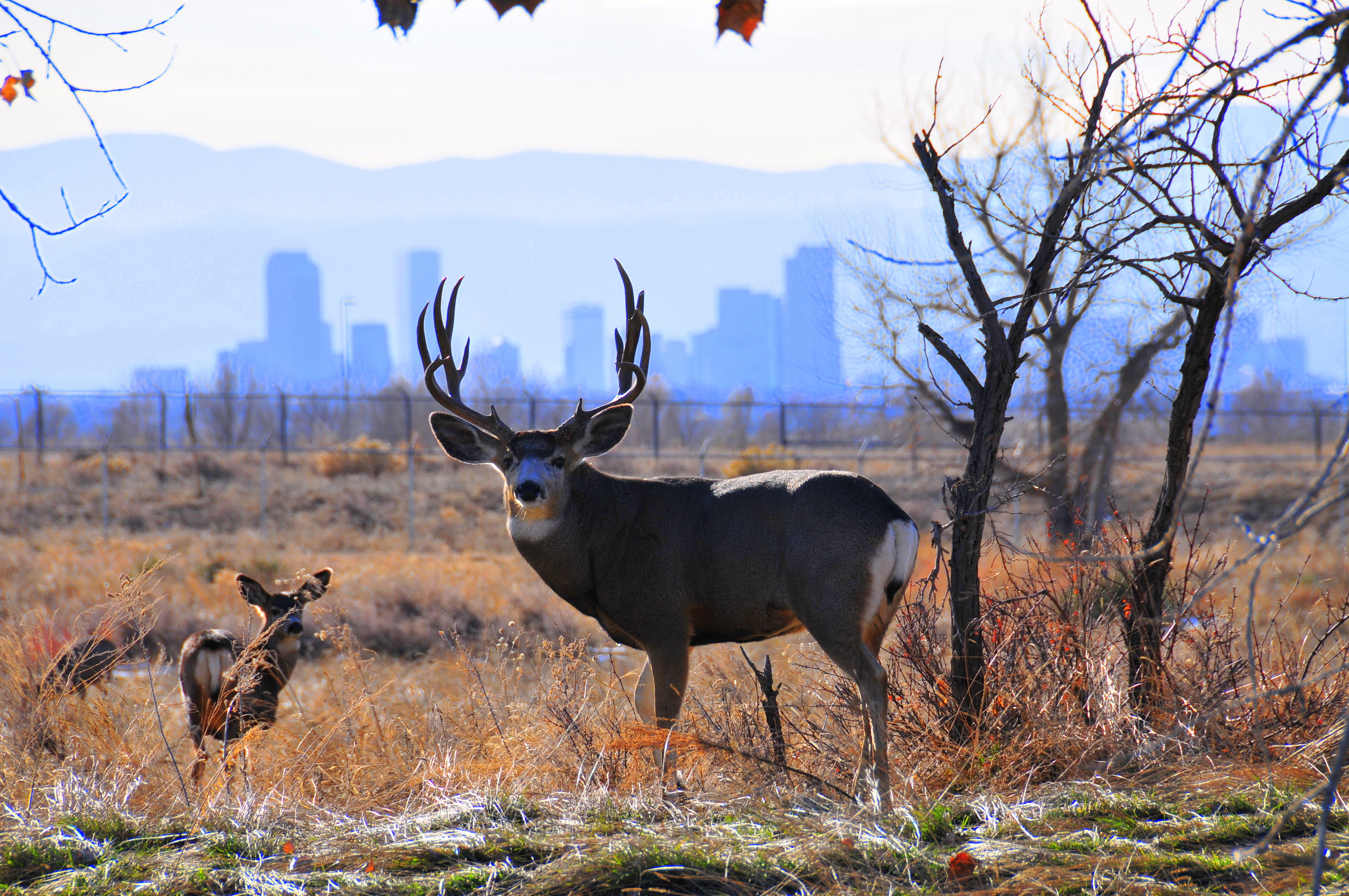
Mule Deer populations are roughly half of what they were 40 years ago in Colorado, Wyoming and Utah..............A Research Study partially financed by the Oil and Gas industry is underway to determine the causes of the decline...............Human sprawl is a key ingredient responsible for a diminishing food supply and blocking historical migratory routes of the deer............Oil and gas pipelines and roads are a major set of obstruction obstacles that the Mulies are having a hard time circumventing..............And as the deer continue to get stressed, they become more vulnerable to fawn predation by Coyotes...............And of course, in most of the Mulies range, the key predator of the Coyote, the Wolf is absent from the landscape..............Us humans just keep piling on the problems for these deer..............Instead of blaming the Coyotes, let us look long and hard in the mirror to recogninze that just as we have harmed the Mule deer with our "tinkering" of the landscape, so can we restore the Mulie population by choosing not to drill in their most sensitive migratory routes,,,,,,,,,,, simultaneously expanding the restoration of the Wolf across the Americas...........As Leopold always said: keep "all the cogs and wheels"

Disappearing Mule Deer A New Reality Throughout Western U.S.


Scientists throughout the West are trying to figure out the mystery of the disappearing mule deer. Since the 1970s, biologists in Colorado, Wyoming and Utah have seen deer populations drop by 50 percent. The potential causes vary. Oil and gas development and the growth in coyote populations top the list.
.
ROBERT SIEGEL, HOST:
From NPR News, this is ALL THINGS CONSIDERED. I'm Robert Siegel.

AUDIE CORNISH, HOST:
And I'm Audie Cornish. Scientists throughout the west are investigating a mysterious disappearance. Mule deer are vanishing. In Colorado, Wyoming and Utah, populations are half what they were in the 1970s. From Aspen Public Radio, Luke Runyon reports on some possible reasons.

LUKE RUNYON, BYLINE: When John Hilandras(ph) was just a boy growing up on his family's ranch in the northwest corner of Colorado, his father would take him deer hunting. Back then, it wasn't even a challenge.

Mule Deer hemmed in by the works of Humanity
File:Mule-deer.jpg
JOHN HILANDRAS: We had literally thousands of deer. There was just deer everywhere. It seemed like they were like rabbits.

RUNYON: That's not the case today. Mule deer throughout the West are becoming more and more scarce. Hilandras runs his own outfitting business out of his family ranch. His customers used to bring back 12-point bucks, no problem. Now, weeks will go by before he sees a prize-winning animal.

HILANDRAS: In good conscience, a good ethical outfitter offering a trophy deer hunt should be careful 'cause it's not like it was.

RUNYON: About a dozen researchers huddle on a flat ridge, a 20-minute drive from the Hilandras ranch. Today's task, tagging and studying female mule deer in the heavily-drilled Piceance Basin, an important area for both deer and humans.

Coyotes prey on Mule Deer fawns

HILANDRAS: Well, it's the largest migratory deer herd in the state and it's also one of the largest energy reserves in the state.

RUNYON: Colorado wildlife researcher Chuck Anderson is the leader of this study, paid for, in part, by drilling companies. He's trying to figure out the role oil and gas development plays in mule deer decline. Anderson says human sprawl has fractured the deer's migrating paths and diminished their food sources.

CHUCK ANDERSON: Obviously, the road construction, the path construction, the pipeline construction reduces, overall, the habitat for the animals.

RUNYON: That buzz you hear in the background is a small blue and yellow helicopter that's about ready to take off. It's the method of capture for gathering the mule deer out of this area in the Piceance Basin. This deer, which was captured nearby, is dropped off in a bright orange sling. She's blindfolded and sedated. The team rushes to the deer and places her on a stretcher...
Weighs her and takes her to a tent where she'll be measured and given an ultrasound. The whole process is stressful for the deer. The researchers do their best to calm her. Lisa Wolfe(ph) is a veterinarian with the state.

LISA WOLFE: Oh, I'm just rinsing her mouth out and just giving her a drink of water, just making her feel a little bit better.

If we rewilded the West with Gray Wolves, Coyotes would likely lessen their kill of Mule Deer Fawns

RUNYON: Wolfe says does hold the clues to this mysterious disappearance. If the researchers figure out what's harming the female deer and their fawns, they can work to slow the decline.

WOLFE: And deer are pretty adaptable. It's just making sure they have plenty of good habitat.

RUNYON: Other states have been taking measures to control another possible cause of the dwindling mule deer herds. Researchers in Utah are examining coyote populations, which prey on the deer. Both Wyoming and Utah recently increased the bounty for each dead coyote brought in. Back at John Hilandras' ranch, his seven and eight-year-old sons play in the snow.
Whether it's coyotes or the oil and gas development, he says it'll be difficult to raise the next generation of hunters.

HILANDRAS: It's sad. My kids are growing up. They don't understand. They haven't a clue of what it used to be.

RUNYON: And Hilandras says he doesn't expect the herds to look anything like they used to anytime soon. For NPR News, I'm Luke Runyon in Aspen, Colorado.
 

Another Puma confirmed wandering in Missouri right in front of Christmas............Snapped by a trail camera, The Missouri Dept. of Conservation confirmed the sighting near Van, Buren Mo............Despite the genocide killing of Pumas in South Dakota(the easternmost breeding location of Pumas in the USA outside of Florida), prospectors continue to roam far and wide looking for female cats that just are not available yet in the midwest and beyond

Trail camera snapped another mountain lion in

Carter County

 
James C. Holmes;ky3news.com

Trail camera snapped another mountain lion in Carter County
Photo: Missouri Dept. of Conservation
Click here to find out more!
VAN BUREN, Mo. -- The Missouri Department of Conservation confirmed a mountain lion sighting on private land near Van Buren. The photograph was taken by a conservation trail camera on Dec. 21.
 
An MDC news release says widely scattered mountain lion sightings have been confirmed in Missouri and likely will continue. Some sightings or photographs of mountain lions may be of the same animal, but MDC cannot confirm individual animals without DNA evidence.
In spite of the increased number of sightings, wildlife officials say there is no confirmed evidence of a breeding population in Missouri.

Reports of sightings can be sent by e-mail to mountain.lion@mdc.mo.gov, or by contacting local conservation agents or the Response Team at (573) 815-7901                                               

Jane Goodall and her associates have verified what most of us know intrinsically but are afraid to acknowledge publically in our overly polititcally correct society............That known but unspoken fact is that social species that live in groups(Chimpanzees, Lions, Wolves, Hyenas and Humans) tend to kill others of their own kind...............Variable group size means that lone individuals sometimes encounter small, vulnerable parties of neighbors............ Having group territory means that by killing neighbors, the group can expand its territory to find extra resources that promote better breeding............ In these circumstances, killing makes evolutionary sense...............As an example, 40% of Wolf mortality is due to attacks from Wolves from other Packs............Under everyday conditions, humans are a delightfully peaceful and friendly species............ But when tensions mount between groups of ordinary people or in the mind of an unstable individual, emotion can lead to deadly events........... There but for the grace of fortune, circumstance and effective social institutions go you and I.............. Instead of constructing a feel-good fantasy about the innate goodness of most people and all animals, we should strive to better understand ourselves, the good parts along with the bad

We, Too, Are Violent Animals

Those who doubt that human aggression is an evolved trait should spend more time with chimpanzees and wolves

wallstreetjournal.com

By JANE GOODALL, RICHARD WRANGHAM and DALE PETERSON

[image]Corbis
Chimpanzees are known to attack vulnerable strangers.

Where does human savagery come from? The animal behaviorist Marc Bekoff, writing in Psychology Today after last month's awful events in Newtown, Conn., echoed a common view: It can't possibly come from nature or evolution. Harsh aggression, he wrote, is "extremely rare" in nonhuman animals, while violence is merely an odd feature of our own species, produced by a few wicked people. If only we could "rewild our hearts," he concluded, we might harness our "inborn goodness and optimism" and thereby return to our "nice, kind, compassionate, empathic" original selves. If only if it were that simple. Calm and cooperative behavior indeed predominates in most species, but the idea that human aggression is qualitatively different from that of every other species is wrong.

The latest report from the research site that one of us (Jane Goodall) directs in Tanzania gives a quick sense of what a scientist who studies chimpanzees actually sees: "Ferdinand [the alpha male] is rather a brutal ruler, in that he tends to use his teeth rather a lot…a number of the males now have scars on their backs from being nicked or gashed by his canines…The politics in Mitumba [a second chimpanzee community] have also been bad. If we recall that: they all killed alpha-male Vincent when he reappeared injured; then Rudi as his successor probably killed up-and-coming young Ebony to stop him helping his older brother Edgar in challenging him…but to no avail, as Edgar eventually toppled him anyway."

 
A 2006 paper reviewed evidence from five separate chimpanzee populations in Africa, groups that have all been scientifically monitored for many years. The average "conservatively estimated risk of violent death" was 271 per 100,000 individuals per year. If that seems like a low rate, consider that a chimpanzee's social circle is limited to about 50 friends and close acquaintances. This means that chimpanzees can expect a member of their circle to be murdered once every seven years. Such a rate of violence would be intolerable in human society.

Hunter/Gatherer tribes like the Huron and Iroquois regularly fought and killed each other

The violence among chimpanzees is impressively humanlike in several ways. Consider primitive human warfare, which has been well documented around the world. Groups of hunter-gatherers who come into contact with militarily superior groups of farmers rapidly abandon war, but where power is more equal, the hostility between societies that speak different languages is almost endless. Under those conditions, hunter-gatherers are remarkably similar to chimpanzees: Killings are mostly carried out by males, the killers tend to act in small gangs attacking vulnerable individuals, and every adult male in the society readily participates. Moreover, with hunter-gatherers as with chimpanzees, the ordinary response to encountering strangers who are vulnerable is to attack them.

Most animals do not exhibit this striking constellation of behaviors, but chimpanzees and humans are not the only species that form coalitions for killing. Other animals that use this strategy to kill their own species include group-living carnivores such as lions, spotted hyenas and wolves. The resulting mortality rate can be high: Among wolves, up to 40% of adults die from attacks by other packs.
Killing among these carnivores shows that ape-sized brains and grasping hands do not account for this unusual violent behavior. Two other features appear to be critical: variable group size and group-held territory. Variable group size means that lone individuals sometimes encounter small, vulnerable parties of neighbors. Having group territory means that by killing neighbors, the group can expand its territory to find extra resources that promote better breeding. In these circumstances, killing makes evolutionary sense—in humans as in chimpanzees and some carnivores.

Wolves from one pack will atack Wolves from another Pack


What makes humans special is not our occasional propensity to kill strangers when we think we can do so safely. Our unique capacity is our skill at engineering peace. Within societies of hunter-gatherers (though only rarely between them), neighboring groups use peacemaking ceremonies to ensure that most of their interactions are friendly. In state-level societies, the state works to maintain a monopoly on violence. Though easily misused in the service of those who govern, the effect is benign when used to quell violence among the governed.

Under everyday conditions, humans are a delightfully peaceful and friendly species. But when tensions mount between groups of ordinary people or in the mind of an unstable individual, emotion can lead to deadly events. There but for the grace of fortune, circumstance and effective social institutions go you and I. Instead of constructing a feel-good fantasy about the innate goodness of most people and all animals, we should strive to better understand ourselves, the good parts along with the bad.

—Ms. Goodall has directed the scientific study of chimpanzee behavior at Gombe Stream National Park in Tanzania since 1960. Mr. Wrangham is the Ruth Moore Professor of Biological Anthropology at Harvard University. Mr. Peterson is the author of "Jane Goodall: The Woman Who Redefined Man."

While those who read this blog have perhaps read an article here or there about how human created noise might adveresely effect wildlife, the Wildife Conservation Society(WCS) has been thoroughly investigating the fact that the noise that we create with our machines can be extremely disruptive to animal behavior, even if we are providing the necessary land mass for creatures to occupy............The impacts of Naval sonar on whales and other marine life,,,,,,,,,,,,,,,,,,and now new information showing that human noise affects owls in an area 45% larger than the area affected for humans..............Exposure to noise may affect an owl's livelihood as the animal relies on its acute sense of hearing to detect even the slightest movement of its prey

If You Cut Down a Tree in the Forest, Can Wildlife Hear It?

 
Science Daily— A new tool developed by the Wildlife Conservation Society (WCS) and its partners is being used by scientists and land managers to model how noise travels through landscapes and affects species and ecosystems -- a major factor in land and wildlife management decisions such as where to locate new roads or recreational trails.

The tool, SPreAD-GIS, uses spatial data layers to predict how sound spreads from a source through the surrounding landscape and how it is affected by such factors as vegetation, terrain, weather conditions, and background sound levels. By determining how sound propagates, potential impacts to wildlife can be forecasted. Such impacts can include reducing habitat quality, altering the geographic distribution of species, disrupting animal communication, and causing stress.
In an example discussed in the paper, the sensitivities of humans and owls to motor vehicle sound levels were compared. The results of the SPreAD-GIS analysis showed that in the same location, motor vehicle noise would affect owls in an area 45 percent larger than the area affected for humans. Exposure to noise may affect an owl's livelihood as the animal relies on its acute sense of hearing to detect even the slightest movement of its prey.

WCS Scientist Sarah Reed said, "Exposure to human-caused noise can change the game for many species. Those species that are less tolerant of noise can be put at a disadvantage and ultimately, this may result in a loss in biodiversity. By predicting what the effects of sound will be on a bird or mammal species in advance, we can more adequately balance our land-use planning decisions with conservation considerations."

Reed and colleagues are currently using SPreAD-GIS and field measurements of motor vehicle noise to forecast the area affected for bird and mammal communities in the Sierra National Forest in California. In addition, the model has been downloaded by hundreds of users in more than 25 countries and used for diverse education, research, and management applications. This includes modeling potential noise propagation from roads, recreational activity, heavy equipment, residential development, and natural resource extraction.

Reed added, "Most existing tools are used to understand noise in human-dominated environments and don't incorporate factors affecting noise propagation in natural systems. This tool is free and relatively user-friendly for the average desktop GIS user, and comes at a time when ecologists are just beginning to understand the critical role that sound disturbances play in affecting wildlife."
Reed started the SPreAD-GIS project as a scientist with The Wilderness Society (TWS) and completed it as a Smith Conservation Research Fellow and WCS employee. The model is available for download from TWS's Landscape Collaborative (www.landscapecollaborative.org) website.

The tool is described in the November print edition of the journal Environmental Modeling & Software. Authors include Sarah E. Reed of the Wildlife Conservation Society and Colorado State University, Jennifer L. Boggs, formerly of The Wilderness Society, and Jacob P. Mann.

Friday, January 4, 2013

Interesting it always is to learn how all things are connected in some fashion.............The EHD virus that infects and kills deer seems to be spreading northward as mild winters and drought laced Summers become more and more the norm due to global warming.............The Chicago area has seen a 70% die off in their white-tail deer population this year due to EHD and the Coyotes in the region have feasted on their remains..............It will be interesting to see if a hard and snowy winter knocks down the Coyote population now that a key food source(deer) are at an all time low..................As the article below suggests, Coyotes are the ultimate omnivore and will eat just about anything.............Here is betting that the deer shortage does not advesely impact one of the most resourceful creatures on the planet--C.latrans(and in the east C.latrans x lycaon)

Harsh winter would be tough on area coyotes
5-26-10  At Poplar Creek Forest Preserve   Cook County forest preserve district biologists take careful datcaptured 3 pups
At Poplar Creek Forest Preserve , Cook County forest preserve district biologists take careful data on the captured 3 pups before releasing them back to their den. The 3 coyoite pups ... two were female and one was male. sun-times photo by al podgorski
EHD facts
EHD does not affect humans or impact the safety of consumed deer.
EHD is caused by the bite of an infected midge; once there has been a hard freeze, the insects die off for the winter, eliminating new cases of EHD.
It's the most significant disease of white-tailed deer in the United States
It's most prevalent in Southeastern United States.
Outbreaks often are associated with drought.
It can result in high deer mortality in some areas (usually 25 percent, but up to 50 percent in rare instances).
Source: Kentucky Department of Fish and Wildlife


A virus that killed hundreds of white-tailed deer in parts of northeastern Illinois means coyotes here are heading into winter fat and happy. But the die-off last fall that left numerous carcasses for coyotes to eat means there will be fewer deer around this winter for the hungry critters to scavenge.
And if the weather turns cold and snowy, that will put unusual pressure on the coyotes to find something — anything — to eat, biologists say. "If we get a real winter — a severe winter — they're going to be very hard-pressed," said Chris Anchor, a wildlife biologist for the Cook County Forest Preserve District. "There's going to be less food."

So scientists will be paying very close attention to how the animals respond. They're expected to adapt by eating everything from plants to rodents to garbage, but it isn't unthinkable that their numbers will drop.The forest preserve district has been involved for more than 12 years in the Cook County Urban Coyote Study, the nation's most comprehensive look at the increasingly common canines.
During that span, Anchor and other biologists have captured and tagged more than 660 coyotes in Cook County in an effort to track where they live and what conflicts they cause with people and pets.

But the situation the animals face now is unusual because of a near-perfect storm of environmental factors, including last year's mild winter and dry summer. The weather may have created ideal conditions to spread the epizootic hemorrhagic disease (EHD), virus, which is deadly to white-tailed deer, although it doesn't usually strike in the Chicago area.
This year, the virus may have killed as many as 70 percent of the deer living in northern Cook County, Anchor said.

Coyotes aren't affected by the virus but have feasted in recent months on the carcasses of deer stricken by it.The question heading into winter is how the coyotes will fare with one of their staple food sources dramatically reduced."Everything's been scavenged now," Anchor said. "They're going to have far fewer roadkill around here. They're going to be hit hard."
That's especially true if the Chicago area eventually gets heavy snow, Anchor said.
"If we get 10, 20 inches, they have a much harder time hunting the fields," he said.

Nobody expects coyotes to disappear from the area slammed by the EHD virus, simply because the canines eat so many different things."If one food supply dries up, they can move on to another," said Gina Farr, a spokeswoman for Project Coyote, a California-based advocacy group. "They're probably one of the most resilient animals out there."
The critters aren't picky about their meals — they'll eat anything from rodents to unwary pets, deer carcasses or household garbage.

coyotes can practically become vegetarians if necessary, subsisting on plant bark, roots, and even juniper berries."One of the reasons they are so successful is they are true omnivores," Farr said, citing a study that found about 100 different types of food in the droppings and stomachs of coyotes.\

Still, Anchor and other biologists will be watching to see if the number of coyotes drops in the area hardest hit by the EHD virus."Right now, they don't need to do anything because they're fat and happy," said Anchor. "But come February, it's going to be real interesting."

Most of us think nothing of calling our local Pest Control vendor when mice and rats start getting into our homes and yards...........What we fail to realize is that 90% of the time, the Exterminator is lacing your domecile with poison that causes internal bleeding-------Not only does the rodent start to wither,,,,,,,,,,,,,but the Pumas, Coyotes, bobcats and other animals that eat the rodents end up dead as well as the poison amps up inside their systems..................This has become a topic of great concern here in Southern Ca0lifornia where I live................Alternatives to rodent poisons include the RAT ZAPPER(electrical shock kills the creature) and glue traps that do not use poison..................Even if we provide the necessary open space for our wildlife to thrive, if we are simultaneously poisoning them, NOT A GOOD THING!

Rodenticides, lack of space threaten local wildlife
malibutimes.com 


Bobcats, coyotes and other rat predators have fallen victim to rat poison, while mountain lions face a shrinking amount of habitable space.


Nearly two months have passed since hikers spotted Puma- 25, a one-year-old female mountain lion, dead near Newbury Park.

Scientists found rat poison in the animal’s system, but were unable to confirm the precise cause of death because of how badly the animal had decomposed.

Still, the loss of Puma-25 shone a new light on the danger of rodenticides. Recent studies show bobcats and coyotes as the most affected by the toxin, according to National Park Service (NPS). The studies, conducted between 1996 and 2003, tracked bobcats and coyotes in the Santa Monica Mountains.

One study revealed rodenticide poisoning as the second-leading cause of coyote deaths. A bobcat study found very few deaths linked directly to rodenticides, though experts believe rodenticides have sparked an epidemic of notoedric mange, an infection caused by burrowing mites, and killed more than 30 bobcats.

Duane Tom, a veterinarian and director of Animal Care at the California Wildlife Center, warns that coyotes, bobcats, birds and any other type of animal that feeds on rodents can die from the poison if they eat rodents that have ingested the toxin. This happens when the rodenticide, specifically a widely used, long-lasting one called “second generation,” lingers in the predators’ bodies, causing them to bleed to death.

Reflecting on what he’s learned since he first discovered rat poison killing these animals, Tom asserted rodenticides would counterproductively increase the rat population. He explained that with rodenticides killing off predators that eat rodents, the rodent population could skyrocket.  “You actually probably end up doing the opposite of what you intend to do,” he said. “In the meantime, your rat population [starts] exploding because they no longer have predators.”

While mountain lions fall victim to rodenticides far less often than other predators, they still face other survival challenges. Film producer Michael Harris has undertaken a documentary project to expose the issue of local mountain lions struggling to access other habitats outside the Santa Monica Mountains. Mountain lions have a natural need to travel to open space, something Harris believes the Santa Monica Mountains needs more of.  “It’s just this island of habitat, essentially,” he said.
Mountain lions are forced to wander into populated areas, Harris said. Officers shot one dead last May on Wilshire Boulevard in Santa Monica, and the Sepulveda Pass claimed the life of one in 2011.  Aside from Santa Monica and the 405 freeway, their quest to find their own territory has also been thwarted by the 101 freeway. The NPS holds no records of mountain lions dying on the 101 in Southern California during an 11-year study of the animal, but it remains a pressing issue that has climbed the bureaucratic ladder to Washington, D.C.

The Caltrans, NPS and Santa Monica Mountains Conservancy spearheaded a longstanding fight to create a passageway in Liberty Canyon underneath the 101 that would allow the lions to travel from one side of the freeway to the other. The planning phase happened in 2003, and in 2004, the three agencies pursued a $10.9-million federal grant and $1.49 million in state and local dollars to fund the project.  But as time passed, federal money grew scarce amid the dwindling economy, and the local dollars went to Oakland, Calif., to bolster a park project. The decision outraged local officials, as they felt the passageway project carried more environmental importance. Harris feels the project would become a landmark improvement. “That would be a great legacy for this region, and a case study for what other areas [and] regions can do,” he said.

And since mountain lions feed off of deer, Harris predicted the project would preserve the local deer population and help avert a serious food chain crisis. “Without the apex predator, the whole ecosystem will collapse. You’ll see an explosion of deer,” he said, adding that they will eat up the grass and eventually starve. For now, the agencies have their sights on reapplying for funding when the economy improves. They also are crossing their fingers to receive part of a federal $50 billion stimulus for transportation, pending the outcome of Washington’s fiscal cliff battle, and that no state transportation money gets funneled into the general fund.

Wednesday, January 2, 2013

George Wuerthner reinforcing his(and my) belief that Carnivores should not be managed as game animals the way deer, elk, moose and caribou are.......In fact, there should not be a hunting season on Wolves, Coyotes, Pumas, Bears, and the other carnivores that grace the Americas.............In George's own words------"There is no legitimate reason to indiscriminately kill any predator".............. "The best available science is disregarded by state wildlife management agencies that manage predators because it would challenge the validity of many of their management prescriptions"...............".The best available science also suggests that many predators including bears, wolves, mountain lion and coyotes have intricate social interactions that are disrupted or damaged by indiscriminate killing from hunters and trappers"............"Hunting, and most trapping, does not specifically target any particular offending animals—such as a bear that might be killing livestock"............... "Rather, the majority of bears (or wolves, mountain lions or coyotes) killed are not causing any conflicts at all".............. "They are innocent by- standers who happen to be caught in the cross hairs of predator persecution"...........Read Wuerthner's full article below that focuses on the call by many in Wyoming to get the Grizzly Bear off the endangered species list so that the State of Wyoming can start blowing them away at will...............As mentioned many times on this blog, George "rides point" on the notion that killing carnivores breaks down their social institutions which leads to a younger and more inexperienced population>>>>>>which leads the immature and less experienced members of the remaining carnivore population to get into more conflicts with people...............George concludes rightly that: "The unnecessary and indiscriminate persecution of predators does not help grizzly or any other animal's recovery"

Wuerthner Environment:
 commenting on the plan to hunt
 Grizzly Bears in Wyoming as a
means of helping them recover


In their December 29th editorial in the Billings Gazette, Scott Talbott of the Wyoming Game and Fish and Harv Forsgren of the U.S. Forest Service wrote that hunting was another step towards grizzly bear recovery.
http://billingsgazette.com/news/opinion/guest/guest-opinion-hunting-another-step-toward-grizzly-bear-recovery/article_b7763b6e-2221-5c1b-91b9-dc05c3c35bb9.html

Specifically, the authors claim that regulated hunting will recover grizzly bears. Boy is that a leap. We haven't hunted grizzlies for several decades now, and the bears appear to be doing fine without being shot or trapped. There is no legitimate reason to indiscriminately kill any predator.

Those, like the authors, who advocate the hunting of grizzly bears continuously, proclaim that state management will not cause the extirpation of bears (or wolves, mountain lions, etc.) This is a straw man they construct so they can knock it down. Few opponents of predator hunting/trapping are worried that these animals will be completely eliminated from the West.

By trying to frame the issue this way, proponents of bear killing misrepresent the real concerns of those who question state wildlife management of predators. The concern of opponents of bear hunting, wolf hunting, mountain lion hunting has more to do with ethics and how we should be treating other living creatures—a concern to which the authors and others appear tone deaf.

They further claim that state agencies use the "best available science." Nothing could be further from the truth. The best available science is disregarded by the authors as well as all state wildlife management agencies that manage predators because it would challenge the validity of many of their management prescriptions.

With regards to grizzly bears, conservation science suggests we need many more bears in many more places to sustain their populations over the long term. There is plenty of unoccupied bear habitats in the Northern Rockies. Many parts of Montana, Idaho and Wyoming that could support grizzlies where they are currently absent, including Wyoming's Salt and Wyoming Ranges, the Bitterroot Mountains of Idaho, and the Centennial Mountains of Montana to name just a few.

hunters with killed Puma
The best available science also suggests that many predators including bears, wolves, mountain lion and coyotes have intricate social interactions that are disrupted or damaged by indiscriminate killing from hunters and trappers.

At best hunting and trapping are blunt tools to address what may be in some rare instances legitimate conflicts such as the surgical removal of a food-habituated bear--though I hasten to add that many conflicts are self-created by humans who exercise sloppy animal husbandry or camping practices.
Hunting, and most trapping, does not specifically target any particular offending animals—such as a bear that might be killing livestock. Rather the majority of bears (or wolves, mountain lions or coyotes) killed are not causing any conflicts at all. They are innocent by- standers who happen to be caught in the cross hairs of predator persecution.

For instance, dominant bears will occupy the best habitat and prevent other bears from occupying the territory. Yet in many cases, if a bear has lived long enough to become a dominant animal, it is not one that causes troubles for humans. Yet it is the biggest bears, in other words, the dominant bears that hunters seek to kill opening up habitat for occupation by another bear that may not be so friendly to human desires.

To suggest, as the authors do, that hunting will reduce human conflicts directly contradicts the best available science which they profess to use, but obviously ignore. This growing body of research suggests that hunting of predators actually increases human conflicts. For instance, there are many predators that live among livestock without ever killing cattle or sheep. Yet because they inhabit the territory, they keep other members of their species from occupying the area. If a hunter should kill this livestock-friendly bear, the habitat, if it's any good, will be filled quickly by another bear that may or may not be so livestock friendly.

Indeed, one study of black bears in the eastern US found that as states increased the killing of bears to "reduce conflicts", the number of bear-human conflicts increased.  Similar studies of mountain lion have documented exactly the same pattern. As mountain lions are killed, and even as the population is declining, the number of conflicts increases—the exact opposite of what state wildlife agencies predict will occur. Hunters tend to kill the dominant toms (male) mountain lion opening up space for immature young lions, who like human teenagers, are bolder, less cautious, and more inclined to attack livestock and even humans.

Thus the typical "management" approach advocated by state wildlife agencies exacerbates, rather than reduces human-wildlife conflicts. To suggest that regulated hunting is a "solution" to perceived problems with humans is like arguing that the best way to address crime in our cities is to shoot all young men since the majority of crime is done by youths. Obviously you might eliminate some of the criminal element by such a policy, but you would be unavoidably be killing many innocent people.

Why aren't Fish and Game agencies using that science in their management decisions? I will answer it. Because they are a regulatory agency that has been captured by the very group they are supposed to regulate—namely hunters and trappers. Follow the money. State wildlife agencies run on the sale of licenses. Anything that contributes to greater license sales is looked upon favorably.

hunters with killed wolf


To be fair, it should be acknowledged that these agencies are not immune from political pressure from the hunting and trapping community. Many western state Fish and Game agencies are already under duress from ill-informed hunters and trappers and legislatures ignorant of ecology and animal behavior.  Some of the more extreme predator killers even go so far as to suggest that that these agencies are coddling predators and god forbid bowing to the wishes of animal rights advocates. Thinking that any animals have "rights" is heretical to these folks who believe wildlife exists for their sole pleasure and exploitation.

So these state agencies practice a vicious cycle; whereby predators are indiscriminately killed, which disrupts their social organization, which leads to greater human conflict, and thus more demands for predator control.

Worse, the authors as well as many state wildlife agencies eulogize the North American Model of Wildlife Conservation. That model, among other things, specifically requires the highest ethical behavior from hunters. What is ethical about killing a bear for self -aggrandizement just because you are so insecure the only way you can so you can prove your manhood is by killing a bear? Most hunters are not going to eat the meat—isn't that wanton waste? Is killing a bear just to have a "trophy" rug on the wall a legitimate and ethical use of wildlife, especially when that destruction of a wild creature denies the rest of the public of its wildlife heritage?

Others argue that we "need" to permit hunting and trapping of predators to reduce the anger of some members of the hunting and trapping community. Is killing any animal justified just to address the emotional problems of some members of the public? These people need counseling, not a license to kill.

I am a former Montana hunting guide. I studied wildlife biology and currently work as an ecologist. I believe that hunting can lead to some valuable insights about wildlife and individuals. Some of my hunting experiences have been almost transcendental experiences—ironically more often when I did not kill an animal. If one is going to take the life of another creature, one must be absolutely certain that killing is justified.

The unnecessary and indiscriminate persecution of predators is what fuels public opposition against all hunting, not to mention it does not help grizzly or any other animal's recovery.

PROTECT AMERICA'S WOLVES! - TAKE ACTION PLEASE by signing the petitions below calling for President Obama to replace Interior Secretary Salazar with a person who has a more balanced perspective of how Wolves fit into the fabric of Americas wildlands


---------- Forwarded message ----------
From: Robert Goldman <noreply@list.signon.org>
Date: Tue, Jan 1, 2013 at 7:18 PM
Subject: PROTECT AMERICA'S WOLVES! - TAKE ACTION PLEASE
To: rick.meril@gmail.com


IT IS NOT ENOUGH TO LOVE AND RESPECT WOLVES AND ALL NATIVE WILDLIFE. THE POINT IS TO TAKE ACTION TO DEFEND AND PROTECT THEM. IF YOU TRULY WANT TO HELP PROTECT AMERICA'S WOLVES IN 2013 AND BEYOND, READ ON... AND TAKE ACTION!
Dear Rick,

Thanks for signing the Protect America's Wolves! petition at http://signon.org/sign/protect-americas-wolves?mailing_id=7942&source=s.icn.em.cr&r_by=5236087. If you have not already done so, please take a moment to read the Petition Background text which can be found just below the petition. It is very informative and knowledge is power.


The American people, through our federal government, undertook decades of effort to help restore wolves to this country. After 300 years of the persecution, torture and killing of approximately 2,000,000 native wolves across North America, the American people were finally ready for a far better way of living on this continent. 

Beginning in the 1970's, with passage of the Endangered Species Act under a Republican president with support from a Democrat-controlled Congress, members of both parties collaborated to help make this happen. A mere 66 wolves were re-introduced into Yellowstone and nearby wildlife habitat in the mid 1990's, where they always belonged in their native land. This small number of wolves eventually bred with other wolves that had been returning to the US, on their own, from the nearby Canadian Rockies.

And yet this wonderful restoration has set wolves up to be blown away, persecuted, tortured and killed all over again. Over 800 beautiful wolves, including wolf pups and entire wolf families (wolf packs) have been destroyed since the beginning of September of this year alone, in Idaho, Montana, Wyoming, Minnesota and Wisconsin. More wolves have been hunted down and killed in Washington State, Oregon and New Mexico where so few wolves live. Why?

A small, vocal, yet powerful minority of Americans, led by brutal and arrogant cattlemen, did not accept the more respectful, humane evolution of the majority of Americans towards wolves and other native wildlife. The naysayers blamed the federal government for imposting its will on them, which polls show was as completely false then as it is today. The restoration of wolves to their native homeland was one of those wonderful actions that the federal government undertook and got right on behalf of the American people. It was a great example of the government doing the right thing. But the naysayers kept up their drumbeat of intolerance, ignorance and neurotic hatred of the most amazing and beautiful living symbol of America's magnificent wilderness heritage, the wolf.

Cattlemen, then as now, have been the most intolerant and vicious opponents of the wolf and all native wildlife. Cattlemen continue to spread lies and misinformation about predation of cattle by wolves, which is statistically almost zero in every state. Cattlemen stand in the way of an American majority that has been ready for a long time to live in this country in a more respectful, kind and loving way. A better way that honors and repects wildlife, that allows all native wildlife to live free on their native land, which still has so much room for all of us. Wolves, bison, grizzly and black bears, prairie dogs, mountain lions,  coyotes, wild horses, wolverines, beavers, fox and all other native beings, all have their place under the sun, throughout the American West and throughout the entire country.

It's time to say NO to the cattlemen. NO to their intolerance, NO to their brutality, NO to their disrespect towards native wildlife, NO to their lies and hysteria, NO to their contempt for the humane American majority and most of all NO to their destruction of America's native wildlife and wild lands.
________________________________________

FOR THIS FIRST ACTION OF 2013:
SAY NO TO COLORADO RANCHER KEN SALAZAR, WHO HAS BEEN A DISASTER AS SECRETARY OF INTERIOR. As chief wildlife officer of the United States, the right wing Salazar is responsible for leading the persecution and death of many thousands of wolves, thousands of wild horses and so many other iconic, vital and beautiful members of America's wild heritage.

URGE PRESIDENT OBAMA TO FIRE KEN SALAZAR IMMEDIATELY AND REPLACE HIM WITH US REP. RAUL GRIJALVA. Congressman Grijalva of Arizona has the support of many hundreds of conservation and wildlife groups, Native American and Hispanic and Women's organizations and an impressive number of other groups devoted to animal welfare, recreation, ethics, business and labor.
Here's two ways to say NO to Ken Salazar and YES to Wolves, right now and during the coming week:
1. Call the White House comment line at: 1-202-456-1111
2. Submit your comment through the White House website at: http://www.whitehouse.gov/contact/submit-questions-and-comments
___________________________________________

Fellow wolf defender:
Take Action. Make the phone call and submit your comment. These things when done by enough people eventually cannot be ignored. We will prevail for wolves as more and more of us step forward and take action to defend and protect them. Share this email so many others can help, too.


We'll discover that as we spread respect and kindness and acceptance of wolves and all wildlife and all animals, there will be more peace and more respect among people.

Healthy and happy 2013 to you and your loved ones and for all of America's wolves and wildlife. 
Thank you, for America's ecologically vital and beautiful wolves,
Robert Goldman
Protect America's Wolves!


Tuesday, January 1, 2013

Harsh winters, global warming, disease and nest predation by Coyotes, Foxes and Bobcats can all take their toll on Pheasants---however, they are not the source reasons for Pheasant scarcity in Iowa and the rest of America...............In 2012, Iowa reportedly had its Pheasant population at 81% of the past 40 year average----10,000 Pheasants shot in the State in 2011 versus 1,000,000 taken from the sky in 2003!!!!!!!!!!!!!!!.............The skyrocketing price of farmland in Iowa has farmers bailing out of the Conservation Reserve Program(CRT) which historically paid the farmers enough in subsidy money not to put all of their land into crops,,,,,,,,,,,instead allowing the land to lie fallow and return to indigenous shrub and forest cover.....................IF THERE IS NO WILDLANDS,,,,,,,,,,,,,,,THERE CAN BE NO WILDLIFE-------Do we have the will, empathy and smarts to keep a 1/3 of our lands wild and free,,,,,,,,,,,,,and contiguous,,,,,,,,,,,,,a foundation % of land that will help keep our air clean, our water clear and natures gene pool intact?????????????

As Pheasants Disappear, Hunters in Iowa Follow


Daniel Acker for The New York Times
Damp weather and animal predators have led to a decline in the number of pheasants in Iowa.(HABITAT IS THE KEY VARIABLE IN THE DECLINE; NOT PREDATORS-BLOGGER RICK) 
By JOHN ELIGON;newyorktimes.com   

ELKHART, Iowa — Mike Wilson glared dejectedly through the mist on his silver-frame glasses at the soggy field of tall, dense brush, tilting the barrel of his 12-gauge shotgun toward the gray clouds.

Daniel Acker for The New York Times
Kent Rupiper with a male pheasant during a hunt last month, admits to hunting out of state. "It is a hard decision."  "All I want to do," he said, "is see a bird at this point."        More than two hours into this pheasant hunt, the colorful rooster that one of Mr. Wilson's hunting partners had shot that morning was now a distant memory. Only one other pheasant had graced the skies since, and it was too far off to even try a shot.
      
The pheasant, once king of Iowa's nearly half-a-billion-dollar hunting industry, is vanishing from the state. Surveys show that the population in 2012 was the second lowest on record, 81 percent below the average over the past four decades.   The loss, pheasant hunters say, is both economic and cultural. It stems from several years of excessively damp weather and animal predators. But the factor inciting the most emotion is the loss of wildlife habitat as landowners increasingly chop down their brushy fields to plant crops to take advantage of rising commodity prices and farmland values.
Over the last two decades, Iowa has lost more than 1.6 million acres of habitat suitable for pheasants and other small game, the equivalent of a nine-mile-wide strip of land stretching practically the width of the state. And these declines have been occurring nationwide.
      
The overall amount of land enrolled in the Agriculture Department's Conservation Reserve Program has dipped to 29.5 million acres from a peak of 36.7 million in 2007. Under the program, the government pays owners a certain rate to plant parts of their land with grass and other vegetation that create a wildlife habitat. Land in the program is most suitable for pheasants and other upland game, and owners often make it available for hunting. But as the price of corn and other crops has risen, so have land values, and the rates paid by the government under the program have been unable to keep up.
      
Each of the top seven pheasant hunting states have seen sizable reductions in the number of pheasants shot and the number of pheasant hunters over the last five years, according to data provided by Pheasants Forever, a group advocating for the expansion of wildlife habitat and land for public hunting. Last year, there were more than 1.4 million pheasant hunters nationally, a drop of about 800,000 in two decades.
      
"We're at a tipping point, and we have to decide how important it is to keep traditions for upland bird hunting alive and into the future," said David E. Nomsen, the vice president of government affairs for Pheasants Forever.
      
Federal wildlife officials say the money that sportsmen and -women pump into the local communities is vital. More than $33.7 billion was spent on hunting in 2011, including $2.5 billion on small game, which includes pheasants. "In these times of fiscal restraint, when budgets are being slashed, we need to do all we can to make sure hunting and fishing remain viable pastimes," Daniel M. Ashe, the director of the United States Fish and Wildlife Service, said in an e-mail.
In Iowa, the issue essentially has pitted the interests of the state's recreational industry against its biggest economic driver, farming.
      
Among farmers, "it's being passed down, from generation to generation, 'How much can you get out of this land?' " said Mr. Wilson, the pheasant hunter, a 49-year-old former naval officer who hunts about three times a week. " 'Yes, you've got to take care of it — blah, blah, blah — but how much can you make for your family out of this piece of land?' It's not about 'Is little Billy going to grow up to be a hunter?' anymore."
      
Bruce Rohwer, the president of the Iowa Corn Growers Association, said he believed that farmers were as concerned as ever about being good stewards of the land and allowing natural habitats to bloom where they would prevent soil erosion and water contamination. But farmers also have to contend with economic realities, he said.  "As much as some people have romantic ideas that farming is just something that happens," he said, "it is the way in which we make a living, so you have to consider all factors."

     In 2011, there were just fewer than 46,000 pheasant hunters in the state, about one-fifth the number 25 years ago. The state used to average 50,000 out-of-state pheasant hunters a year, but that number was down to 8,800 in 2010. Iowa hunters shot 108,905 pheasants in 2011, compared with more than a million in 2003.


Hunters in Iowa shot more than a million pheasants in 2003, but fewer than 109,000 in 2011. The sport's future is at "a tipping point," one advocate said.
                          
The economic benefit of pheasant hunting in Iowa fell to $135 million in 2006 — the most recent figure available — from $200 million in 1996, and it has most likely dropped even further since. This impact was in stark relief on a recent morning at a diner in Ankeny. Amid several empty tables, Jared F. Wiklund, a regional representative for Pheasants Forever, explained that the restaurant used to be packed during pheasant season. A waitress overheard the conversation and chimed in that she had only one table on opening weekend in October. The season in Iowa ends Jan. 10.
      
One of the problems in Iowa, hunting advocates said, is that less than 1.5 percent of the state's land is public (where people can hunt for free), ranking near the bottom in the country. While private landowners generally do not charge people to hunt pheasants in Iowa, there are fears that could change as more landowners lease out parcels for hunting deer and other game.
Land has become so sparse in Iowa that some natives have dared to venture out of state to hunt pheasants.
      
"It is a hard decision," said Kent Rupiper, 49, who owns 170 acres of hunting land in Iowa but has hunted out of state. "I'd rather support the local economy if I could."
But things have changed since his childhood, he said, when "we could go anywhere and shoot our limit of birds."
      
Agriculture Secretary Tom Vilsack, a former Iowa governor, traveled to the state in October to announce the allocation of 400,000 acres nationwide — including more than 92,000 in Iowa — to specifically create habitat for species like pheasants and quail. But landowners may not begin enrolling new property in the program until Congress reaches agreement on the stalled farm bill, and that uncertainty was the biggest impediment to conservation efforts, Mr. Vilsack said.
Himself a hunter, Mr. Vilsack said the sport had a crucial place in rural American life.
"Oftentimes what happens in a hunt, stories are told, people relax, you see your father or your grandfather or your son or your daughter in a different light," he said. "It's really about values."    

I commend Marc Cooke and Kim Bean of the advocacy group, WOLVES OF THE ROCKIES for their heartfelt and open minded outlook on wolf management negotiation and their willingness to as they put it----- "acknowledge the importance of hunting as a tool for managing wolves"......... "We also value science which creates data to make the best possible choices in the sustainability and viability of all wildlife"............Sound statements they are...........With that said, the idea that a fair compromise is achieved by having a wolf hunting buffer zone around Yellowstone where wolves cannot be hunted in exchange for a near year round "vermin hunt of wolves" everywhere else in Montana is not the type of negotiation and sought out result that I would seek in sit-down talks with State game commissioners and biologists..........I think that the views of biologists George Wuerthner and Linda Rutledge are more in line with my thinking in that wolves as social carnivores cannot be viewed with the same "mangement lens" that browsers such as elk, deer, moose and caribou are...................Tens of thousands of years of interaction in multi carnivore/prey eccosystems suggest that a long term ebb and flow balance that makes sense for the health and regeneration of the land takes place without a need for humans killing carnivores..............If anything, in our modern era of land disruption and change, more human hunting of deer and elk in combination with allowance of bears, pumas and Wolves to multiply without management seems prudent and smart considering the the rundown conditions that exist on our rangelands, meadows and forests...........not to mention the surge of disease vectors(brucelliosis, lymes, deer brain diesease, etc. etc) that elk, deer, etc brring to the landscape...........How do you blog readers see it??????????

Compromise important for wolf management

helenair.com
 
"Because we are their only voice" We, the people of the 'Wolves Of The Rockies' organization support the recent decision to close all wolf hunting and trapping in two small but important geographic areas north of Yellowstone National Park (YNP). Our support is not an attack on the Montana Wolf Manage-ment Plan and the hunting season that is part of that plan. Our support is directed at protecting both the costly scientific investment being made in wolf research, and at protecting the legitimate interests of wildlife viewers who come to the park from all over the world to see wolves among other wildlife of the park.

We are not advocating the end of wolf hunting. We have only asked for a slight modification to the state wolf management plan to accommodate other legitimate values in this specific locale. Remember, regardless of one's views on wildlife management policy, Montana's wildlife is owned by all the people not just hunters. That fact should not get lost amid the dust storm of rhetoric stirred up by the Commis-sion's action. By making the decision to close these areas, that do not contain any Montana resident wolves, the FWP Commission has given us at Wolves of the Rockies some hope. Hope that we can at last find ways to work together with hunters and other wildlife interests to meet human needs while serving both wildlife viewers and users alike.

Wolves on the "fly" pursuing Elk


So really… are we that different in the overall goal that we cannot come together and find the balance necessary to keep us from bouncing in and out of litigation? Must we forever take our failures to cooper-ate to federal court? The preservationist and conservationist have a very common thread – we all believe in the sustainability of this land, our land here in Montana.

We at Wolves of the Rockies understand and acknowledge the importance of hunting as a tool for managing wolves, and we stand beside the ethical hunter in doing so. We also value science which cre-ates data to make the best possible choices in the sustainability and viability of all wildlife.

Therefore, we stand firmly by those who conduct scientific research for the benefit of all.
As we move forward with the Montana Wolf Management Plan it is inevitable that we will encounter obstacles and disputes. Managing wolves is a new experience for Montana and often you will hear biolo-gists use the phrase "learn as we go" when discussing wolf management. Well, we have encountered a disputed obstacle in how to treat wolves moving in and out of YNP -specifically, the large-scale killing of collared wolves just outside the park boundaries.

These YNP wolves were collared at great effort and expense to provide important information to both the park and the surrounding states for ecological studies, conservation and management purposes. This invaluable data that the Yellowstone Wolf Project provides includes; tracking wolf movements, the study of the wolf-prey dynamic and the ecosystem effects wolves have, reproduction and mortality, obtaining counts, and allow both the park and the states to track the movement of wolves in areas with livestock operations. While these park wolves benefit science they also have a substantial economic effect on businesses surrounding the northern territory of YNP such as; outfitters, hotels, tour guides, restaurants and stores. These include, but are not limited to the towns of Bozeman, Livingston and Gardiner.

Puma successfully kills deer


We are very aware of concern among hunters about elk populations around the Park. Many factors are negatively impacting the total number of ungulates, some of which we cannot control. We have frag-mented lands and habitat, and drought conditions that suppress important nutritional flora for the sustainability and viability of our wildlife. This list is long and dreadful. Now let's look at the things we can control; we can set quotas, create wildlife management units, improve habitat and water quality, change accessibility to lands, acquire and preserve land for future generations.

Perhaps the most important thing we can, and must control, is our anger over the few personal differ-ences that divide we Montanans on wildlife goals. A bit of chilling out with some civil dialogue would be for the common good of all our wildlife, and for our future generations of Montanans. Whether you are walking your dog on the many trails, hunting, fishing, saddling up or viewing and photographing wild-life, we all need a slice of what Montana has to offer us.

Marc Cooke, President
Stevensville
Kim Bean, Vice President
Helena