Visitor Counter

hitwebcounter web counter
Visitors Since Blog Created in March 2010

Click Below to:

Add Blog to Favorites

Coyotes-Wolves-Cougars.blogspot.com

Grizzly bears, black bears, wolves, coyotes, cougars/ mountain lions,bobcats, wolverines, lynx, foxes, fishers and martens are the suite of carnivores that originally inhabited North America after the Pleistocene extinctions. This site invites research, commentary, point/counterpoint on that suite of native animals (predator and prey) that inhabited The Americas circa 1500-at the initial point of European exploration and subsequent colonization. Landscape ecology, journal accounts of explorers and frontiersmen, genetic evaluations of museum animals, peer reviewed 20th and 21st century research on various aspects of our "Wild America" as well as subjective commentary from expert and layman alike. All of the above being revealed and discussed with the underlying goal of one day seeing our Continent rewilded.....Where big enough swaths of open space exist with connective corridors to other large forest, meadow, mountain, valley, prairie, desert and chaparral wildlands.....Thereby enabling all of our historic fauna, including man, to live in a sustainable and healthy environment. - Blogger Rick

Subscribe via email to get updates

Enter your email address:

Receive New Posting Alerts

(A Maximum of One Alert Per Day)

Thursday, October 8, 2015

Let us be optimistic that the Sierra Nevada Fox, slightly smaller than the common lowland subspecies of red fox which is found in high elevation montane pine and spruce forests is indeed on the way back to sustainable levels as researchers are suggesting in the Oregon Cascades...................Snare samples and wildlife camera pictures collected between 2012 and 14 revealed that these foxes were occupying 11 of the 41 "bait stations" throughout this study area.............This evidence(do you feel it is enough?) gave the USFW Service folks enough comfort to keep the Sierra Nevada Foxes off of the Endangered Species List.............In addition to the Cascades population(not yet determined is the actual number of foxes in existence), a small population of the Foxes have also been documented in Yosemite National Park in California

http://www.ktvz.com/news/co-research-helps-fox-avoid-endangered-species-list/35713162#.VhXolrqC3C0.mailto


C.O. research helps fox avoid endangered species list

Wider range, but still added as 'Strategy Species' to state plan

POSTED: 5:23 PM PDT October 7, 2015 UPDATED: 5:25 PM PDT October 7, 2015 


Sierra Nevada red fox Tim Hiller
Tim Hiller
Sierra Nevada red fox did not make the federal Endangered Species Act list due
 in part to research conducted in Oregon showing a significant extension of the
 species' range.
SALEM. Ore. -
The U.S. Fish and Wildlife Service declined Wednesday to list the Sierra Nevada red fox under the Endangered Species Act due in part to research conducted in Central Oregon showing a significant extension of its range.


More samples from the study are being collected in the original study area and also throughout the Oregon Cascades, including the Mt. Hood National Forest and Crater Lake National Park.
Due to the finding, the fox has been added as a Strategy Species in the 2015 draft update of the Oregon Conservation Strategy. Strategy Species include those with small, declining or unknown population levels that could be at risk and may be in need of conservation.
The USFWS did find that a small population of the fox north of Yosemite National Park is warranted-but-precluded from ESA listing by higher current priorities.
The study started as part of a forest carnivore survey by the Oregon Department of Fish and Wildlife. Working with the U.S. Forest Service, researchers set up bait, hair snares and cameras in a study from 2012 to 2014.
Remote cameras captured images of the presumably rare fox which was originally thought to be the Cascades red fox that exists in Washington. Oregon also has the Rocky Mountain red fox in the northeastern part of the state and non-native lowland red foxes in much of the state.
More than 700 photographs of Sierra Nevada red fox were taken over the two-year project, and they were found at 11 of 41 bait stations throughout the Cascades study area.
“Our cameras detected red foxes at high elevations throughout the study area, which occasionally included areas with high human activity such as ski resorts,” said Jamie McFadden-Hiller who led the field work.
Tim Hiller, now with Mississippi State University, leads the overall project that he started when he was a researcher with ODFW. He said hair and scat samples from the 2012 to 2014 study were analyzed at the UC-Davis laboratory and the project is moving into the next phase to collect more data.
After the initial bait and camera project ended in June 2014, Hiller, McFadden-Hiller, and Ben Sacks met with and trained biologists and seasonal employees with the U.S. Forest Service, Crater Lake National Park and the Confederated Tribes of Warm Springs to collect scat and other samples.
Hiller partnered with Sacks, an Associate Adjunct Professor in the Mammalian Ecology and Conservation Unit at UC Davis because of his expertise with canid genetics, specifically red foxes.
Preliminary DNA analysis of hair samples suggests the foxes are the native Sierra Nevada subspecies of red fox. Researchers are confident additional testing will answer more questions about these montane (mountain) red foxes, such as assessing their population connectivity and whether hybridization with non-native lowland red foxes may be a conservation concern.
Hiller hopes the research will more clearly define factors influencing the population in Oregon.
 Sierra Nevada red fox are slightly smaller than the common lowland subspecies of red fox and have darker fur. Most of their habitat is thought to occur at high elevation pine and spruce forests within National Forests, often in wilderness areas or National Parks. This subspecies is highly specialized to montane ecosystems, areas that may be impacted by climate change and other factors.
 Funding from both the initial bait and camera project and current DNA analysis comes from the Pittman-Robertson Act and the U.S. Fish and Wildlife Service. Many other organizations also provided support for the field research, including the U.S. Forest Service.

Wednesday, October 7, 2015

"What do killer whales, polar bears(Wolves, Grizzlies, Coyotes) and humans have in common?"............ "They are adaptable predators with the ability to select new prey when their favourite food is in low supply".............. "But this change can disrupt entire ecosystems"................The plight of the fading Caribou population in North America is a first hand account of so-called "Prey-Switiching..........As we humans carve up the remaining boreal forests where the historic suite of Caribou, Wolves and Grizzly Bears reside, we create "linear paths" for those Wolves and Grizzlies to migrate deeper into once harder to reach interior forests where Caribou once found enough safe haven to maintain stable populations.............Along those same linear paths of habitat alteration and enhanced by a warming climate come Caribou's sympatric hoofed browsers, deer and Elk.............As the Caribou are somewhat slower and less adapt at eluding Wolves and Griz than Deer and Elk, suddenly the Wolves and Bears determine that a Caribou meal serves them up just as many valuable calories as Elk and Deer, with a significantly reduced energy output ratio of "pursuit to capture".......Crashing down in population size go the Caribou as a result!......A classic prey switching paradigm has accordingly taken place with the once stable Caribou-driven system thrown into disarray by the manipulations of man, simultaneously taken advantage of by the Wolves and the Bears............So should we be killing off Wolves and Griz to save Caribou or like U. of Saskatchewan researcher Gordon Stenhouse puts forth---"We're trying to look at ways to put habitat conditions back that are more favourable to Caribou"............"(As) there’s limited resources to do that, so we want to make sure we go in and put the recovery into the places that will have the greatest impact".................."If we’re going to go in and, say, plant more trees, or revegetate these areas, we know now where the best places to do that are"-------#predator and prey, # prey switching, # trophic cascades, # human alteration of the landscape crashes biodiversity

http://feedproxy.google.com/~r/sciencedaily/plants_animals/~3/5fzno4Wrrn0/151006085230.htm?utm_source=feedburner&utm_medium=email

The predator survives –

 but the ecosystem crashes


The killer whales' main prey used to be newborn whale
 calves. When whale populations fell dramatically due to
 intensive hunting, they began to hunt seal instead. Then
 when the seal population was quickly eradicated, the killer
 whales moved on to sea otters. This reduced the pressure
 on sea urchins, the preferred diet of the sea otters. As a
 result, the sea urchins grazed down the kelp beds that
 have served as nurseries for many different fish species
 and small marine animals
-------------------------------------------------------------------

http://www.thestarphoenix.com/technology/researcher
+plants+seeds+caribou+recovery/11419023/story.html

Researcher plants seeds of 

caribou recovery


Researcher plants seeds of caribou recovery

Gordon Stenhouse, adjunct professor at U of S, has been studying

 how human-made features affect wildlife.

Caribou and grizzly bear populations are low in Western
Canada, and a University of Saskatchewan researcher has
been trying to figure out an effective way to help them.

Gordon Stenhouse has spent three years studying how
 linear features — power lines, seismic lines and roads
 that criss-cross boreal forest — affect the predators and
 prey in Alberta. This week, he’s presenting his findings
 at the Sustainable Forestry Initiative Annual Conference
in California. The StarPhoenix called him up for a biology
 lesson. This interview has been condensed and edited.


First off, what’s the relationship between grizzly bears
and caribou?
You’ve got predators and prey. Caribou are the prey
 species, and grizzly bears and wolves are predators
 that eat caribou.

The challenge for caribou has been that usually
when you modify forest conditions you increase the
 number of other prey species like white-tailed deer
 and moose, and when you increase the number of
 prey species you get a concurrent increase in the
number of predators like wolves and bears.

Mother Griz and cubs


We’re trying to look at ways to put habitat conditions
back that are more favourable to caribou to encourage
their recovery.
How are man-made features making life hard for caribou?
Those linear features make it easier for predators to
move around the landscape.

Think of building trails when you’re in the bush —
it’s much easier for you to walk on a trail than through
 the bush. So by making all these linear features, or
 trails, through the bush, you’ve increased the hunting
 efficiency of predators, and that increase in efficiency
 has had a detrimental effect on caribou ... We found
that specifically more for wolves than grizzly bears.
Grizzly bears will use them, but grizzly bears will hunt
 (caribou) where they find them. Wolves are more a
 species that moves around the landscape looking for
 prey.

Caribou very vulnerable to road cuts encouraging predation


If these trails are bad news for caribou, wouldn’t they
 help predators?
These same access corridors provide access for
 people — and people are the predators for grizzly
 bears. So as you put more linear features and
access to high quality bear habitat, there’s usually
 more poaching events that occur and more bears
 die at the hands of humans.
What’s next?

Caribou in unfragmented forest better able to withstand
predation
Selkirk caribou bull. Photo: USFWS

Our work has been focused on trying to identify
 which lines can be recovered. It’s all about wise
 use of a conservation dollar — so when we’re
 trying to recover a species there’s limited
 resources to do that, so we want to make
 sure we go in and put the recovery into the
 places that will have the greatest impact ...

If we’re going to go in and, say, plant more
 trees, or revegetate these areas, we know
 now where the best places to do that are.
---------------------------------------------------

https://www.google.com/url?sa=t&rct=j&q=&esrc=s&source=web&cd=2&cad=rja&uact=8&ved=0CCgQFjABahUKEwi7ycLs6bHIAhXG2B4KHadgDCw&url=http%3A%2F%2Fwww.conservationnw.org%2Fwhat-we-do%2Fpredators-and-prey%2Fcarnivores-predators-and-their-prey&usg=AFQjCNHLPCLtRcgaaToIlyZzUaYJtGHwPw


Predators & prey: Where have all the mule deer gone?

doe-mule-deer-looking-out-david-moskowitz.jpgResearchers from Washington State University wanted to understand the reasons for long-term mule deer declines in the intermountain West. Hunters had long been blaming cougars. They were right...sort of. Cougars do kill mule deer. So do wolves, coyotes, bobcats, black bear, and grizzly bears.
But as with all natural systems, nothing’s that simple.
It turns out that the open, mixed forest habitat preferred by mule deer
 has been so dramatically altered in the West through irrigated
agriculture that it’s provided wonderful white-tailed deer habitat.
 White-tails, historically rare in Washington, now outnumber mule
 deer in eastern Washington.  
And as white-tailed deer numbers grow, mule deer decline. It
 appears as though landscape level habitat changes have created
 the white-tailed equivalent of tenements for cockroaches. It also
 appears that cougars have responded in kind.
But while there may be a slight uptick in cougar numbers as a
 result of increased ungulate numbers, cougar numbers have
 not exploded as some people seem to think.  
"It's particularly striking how little difference there is in resident
cougar densities across cougar range in western North America,"
 says Gary Koehler, carnivore biologist, Washington Department
 of Fish and Wildlife. According to Dr. Koehler and his colleagues,
"North American cougars exist in densities of about 1 to 2 adult
 animals per 100 sq. km everywhere they live—almost without fail.
 Female cougars are limited by prey availability, but males are
 limited by the availability of females in their territories, which
 they defend vigorously."

However, the WSU researchers have found that cougar predation
is having a greater impact on mule deer than on white-tails and
 occurs in the summer when white-tails move into higher
elevation mule deer habitat. Mule deer are the "secondary" prey,
 but as they're already in decline, predation is having a greater
effect on them.   
A similar dynamic has happened with mountain caribou in British
 Columbia’s inland rainforest. As the caribou's historically
 extensive old-growth forest habitat has been increasingly
 fragmented, it’s opened more niches for deer, elk, and moose.
 Cougars and wolves follow and opportunistically prey on caribou
 which cannot withstand the “new normal.” For centuries the
mountain caribou old forest and high elevation niche was at
 the heart of their predator avoidance strategy. Predators simply
 weren’t able to get to them enough to make a difference in
 caribou numbers.
Like steelworker jobs in Pittsburgh, jobs for mountain caribou
 have diminished. Now the wolves are literally at the door and
 it’s forced some tough choices for managers and
 conservationists alike until the habitat and historic prey
 species numbers are restored.
Woodland caribou are considered one of the most
 endangered large mammals in North America. Loss
 of old-growth habitat to logging and other development
 have removed old growth and reduced mountain caribou
 herds to just 1,900 animals.
Tree lichens are caribou food


In B.C., logging, road building, and motorized
 recreation are still caribou's chief threats. Caribou
rely in winter on arboreal lichens which develop only
 in old-growth forests. The continuing proliferation of
motorized recreation in winter such as snowmobiling
 stresses mountain caribou during a season when their
 health is weakest. This can force caribou are
 into poorer habitat, where predation rises.

Tuesday, October 6, 2015

Geri Vistein is a friend of this Blog and a very active and accomplished Wildlife Biologist in Maine advocating on behalf of our Eastern Coyotes...........Geri just published a new book entitled I AM COYOTE and I encourage all of you to pick up a copy via Amazon.Com


From: "Geri Vistein" <gvistein@coyotelivesinmaine.com
Date: October 5, 2015 at 9:23:48 AM PDT
To: <rick.meril@gmail.com
Subject: my new book I Am Coyote

Greetings Rick,
I wanted to share with you that my newly published book "I Am Coyote" is now available both on Amazon and in bookstores all over. 
In my work as a conservation biologist working with our communities I have experienced first hand the great need to educate our people about this amazing native canine.  So this book is for the people.
Geri 
____________________
Geri Vistein
Carnivore Conservation Biologist
www.CoyoteLivesinMaine.com
(207) 323-9959


Reviews  about I AM COYOTE

This is not a book about "a species of animal" and what "it" does. Geri Vistein takes us so deep into Coyote's skin and behind the eyes and nose that she reveals for us the intricacies and perceptions of creatures who lead lives among us. This is the right perspective for understanding who we are here with on Earth. Vistein has chosen one of the absolutely most wondrous fellow-creatures in America to make our introduction. 
— Carl Safina, author of Beyond Words; What Animals Think and Feel


For wild predators every day is a drama of life and death - Geri Vistein uses these daily theatrics to tell the tale of the colonization of eastern forests by coyotes.  The story invokes the spirit of Ernest Thompson Seaton's classic "Animals I Have Known" but is more firmly rooted in modern scientific findings not available to Seaton.
________________
Roland Kays, Ph.D.
Professor, NC State University, Dept Forestry & Environmental Resources
Lab Director, NC Museum of Natural Sciences

  
Vistein, a carnivore biologist, tells the story of one of the early migrants from the coyote's point of view and asks readers to consider coyotes as "intelligent, sentient beings" able to experience "fear, joy, affection, loss, grief, puzzlement, and acceptance but never anger." Vistein's writing is impassioned and poetic as she tells of the female Coyote who travels east—facing danger from traps, traffic, guns, and dogs—to finally find a refuge in Baxter State Park. When Coyote finds a trapped coyote, she helps him to free himself (he chews off his paw). They become mates and, as seasons and years pass, raise four litters of pups. Readers learn about the complex social structure of coyotes (previous years' siblings help out) and that life as a wild creature is often tragic—though Vistein balances the harshness of death with a wider, natural-order-of-things perspective. A sensitive, passionate story told from an intriguing point of view. 

-Kirkus Review

---------------------------------------------------------------------------------------------------------------
The Great COYOTE YIPPS blog 
had this to say about Geri's new book:


I Am Coyote, by Geri 

Vistein

by yipps
My bookPlease check out Geri Vistein's new book, "I Am Coyote", available through Amazon beginning on October 9th! Congratulations, Geri!
The brief review on Amazon states the following: "Coyote is three years old when she leaves her family to seek a home of her own and a mate to share it with. Journeying by night through a Canadian winter, she doesn't know that her search will become a 500-mile odyssey. Nor can she know while enduring extreme cold, hunger, and harrowing brushes with death that she and her descendants are destined to play a vital role in the forests of the eastern United States, replacing wolves (exterminated a century ago) as the keystone predator the landscape desperately needed."
"Combining rigorous science with imaginative storytelling, I Am Coyote reveals the complex outer and inner lives of coyotes. We are not the only sentient beings on this planet; we are not unique in experiencing love, fear, grief, joy, and acceptance. This magical story will change the way you think about the animals with whom we share the world."
One of the reviews states the following: "This is not a book about 'a species of animal' and what 'it' does. Geri Vistein takes us so deep into Coyote's skin and behind the eyes and nose that she reveals for us the intricacies and perceptions of creatures who lead lives among us. This is the right perspective for understanding who we are here with on Earth. Vistein has chosen one of the absolutely most wondrous fellow-creatures in America to make our introduction." --Carl Safina, author of Beyond Words: What Animals Think and Feel.

We all love seeing the bold and adventurous male Pumas prospecting territory east into Michigan, Wisconsin, Kentucky and now Tennessee.........Sept 19 sighting of what appears to be a Puma at the Tenn./Kentucky border(picture below) suggests that if we had the political will to "plant" a few female Pumas east of the Mississippi River (even with the reduced populations now existing in South Dakota and Nebraska(due to overhunting--see below), we just might get a breeding population of the Cats taking hold, and true rewilding of this much needed Deer predator across our eastern states--Will that 1 in a million female Puma somehow get the wanderlust and connect with one of the males that periodically forge east for a new life?

https://www.google.com/url?rct=j&sa=t&url=http://www.courier-journal.com/story/tech/science/watchdog-earth/2015/10/06/mountain-lion-seen-near-ky-tn-border/73440490/&ct=ga&cd=CAEYACoUMTA2Njc2MDQ3MDk3OTcxNTUxODEyGjQ2OTIwYTk2ZWZjMTE1ODg6Y29tOmVuOlVT&usg=AFQjCNH7n3E5WBC0zZmZ8XLqLfr7cccKNg

Mountain lion seen near Ky.-Tenn. border


A trail camera in far northwest Tennessee has captured an image of a mountain lion, providing further potential evidence of the big cat's reclamation of its former range in the eastern United States.


That the image was taken on Sept. 19 on private property in a county bordering on Kentucky will no doubt further the speculation on the origins of a mountain lion shot and killed by in Kentucky by wildlife officials last year.
The Kentucky Department of Fish and Wildlife Resources said they believe the Bourbon County mountain lion shot by their officer was not a wild animal, while biologists outside the state have said the evidence suggested it may have indeed walked into the state from its likely South Dakota origins.
Tennessee wildlife officials are 
still in the process of 
confirming the camera sighting,
 but 
Tennessee Wildlife
 Resources Agency spokesman 
Don King
 said Tuesday the
 photo appears to be legitimate.
 A
 mountain
 lion has not been 
confirmed by state authorities in
 Tennessee
 in perhaps
 100 years, he said.
Biologists are looking for physical evidence such as tracks or other trail cam images in an effort to get more information, he said.
Tennessee allows people to have captive mountain lions, but there were none that they knew about in that region, he said.
The Cougar Network, whose researchers study mountain lion range expansion, noted the sighting's potential significance:
The confirmation took place in Obion County, which is in western Tennessee, approximately 80 miles west of Nashville and only a few miles east of the Mississippi River on the border of Kentucky. To our knowledge, this is Tennessee's first cougar confirmation in recent history.
The recent cougar confirmations in Tennessee and Kentucky appear to represent a continuation of the increasing trend of male cougars dispersing from established western populations into the Midwest.  Confirmation of cougars in Midwestern states, where they had once been extirpated, is no longer rare and is becoming almost a routine experience. 
We are not surprised by the Tennessee and Kentucky cougars.  Based on what we have been seeing in Midwestern states over the past 15 years, we had considered confirmations in these states to be just a matter of time.  The state game agencies need to prepare themselves for more incidents like these going forward.  There is nothing to be alarmed about.  Cougars generally have a healthy fear of people.

 ------------------------------------------------------------------------------------------------------------

Sunday, October 4, 2015

The Theodore Payne Native Plant Foundation of Los Angeles articulates the the benefits of GOING NATIVE and creating an indigenous landscape on your property--------You do your part rewilding the fauna and flora in your region, optimizing the chance for life to flourish ---I just ripped up a section of my lawn adjacent to my driveway, planting the Chaparral array of native plants that call this region home---Butterflys and Hummingbirds greeted me as I walked off my 10am-2pm digging, planting and mulching project...........Guys, nothing better than being out there doing your thing and restoring a little piece of natures creation


Theodore Payne Foundation - Summer Hours

Discover the Beauty of Native Plants

beautify the landscape
native plants are rich in color, form, texture, and aroma – with careful design, your garden can have flowers year round
nurture pollinators and other wildlife
native plants provide food and shelter for birds, hummingbirds, butterflies, and other pollinators
save water
once established, California native gardens use, on average, 80% less water than conventional gardens
thrive in our local climate
native plants are adapted to our natural cycles, responding to cool, wet winters with lush growth and slowing down during the hot, dry summers
prefer our soils
native plants do well in our native soils and do not require soil amendments or fertilizers
cut pesticide use
native plants typically have fewer pest problems than non-natives because they have co-evolved with native insects
minimize your carbon footprint
most California native plants are grown in state and travel short distances to your nursery
reduce maintenance
a well-designed native garden, planted for the mature size of the plants, can require very little maintenance once established
can be installed at low cost
native gardens can easily be started with one-gallon size plants, saving on installation costs
cool the environment
even through native plants are water thrifty, they play an active role in the water cycle, adding cooling moisture to the atmosphere
harmonize with diverse garden styles
from cottage to formal to contemporary, there are native plants for every design
create a sense of place
the diversity of our flora means gardeners have many options for creating place-specific, local gardens that connect us with California's past and its future


All of us should continue to plant NATIVE MILKWEED plants(not varieties from Europe or Asia) in an attempt to optimize the Monacrch Butterfly population which is under siege from a "witches brew" of environmental degradation including the destruction of their Mexico wintering home forests and the near obliteration in the USA of it's preferred food, milkweed nectar.....................as Vermont naturalist Barbara Mackay states below: "To start your own milkweed patch this fall, collect milkweed pods just as they are splitting open, carry them in a tight fist or paper bag, and bury them under leaves or grass so they don’t blow away".............. "Next spring you can enjoy the beauty of the flowers and the bounty of life that depends on milkweed"............ "You’ll be helping out the monarchs, too"


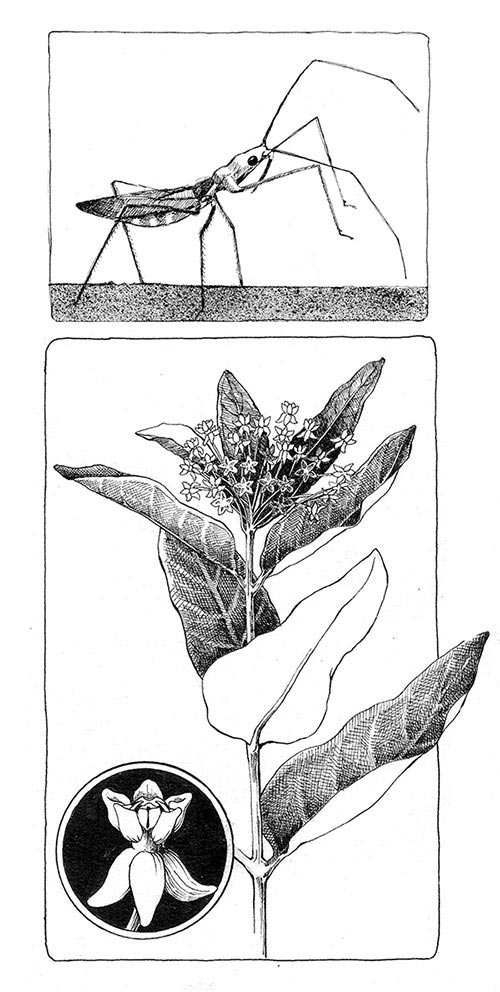
See What’s in the Milkweed Patch

See What’s in the Milkweed Patch
Illustration by Adelaide Tyrol
Eight or so years ago I collected milkweed seeds and painstakingly buried them one at a time under leaf debris at the back edge of my yard, hoping they would mature and attract more monarch butterflies to my home. The project has been wildly successful, but recently the monarch population has declined. So far this year I have seen only one.
Still, milkweed is a valuable perennial. Common Milkweed (Asclepias syriaca L.) is a sweet haven for a diversity of organisms. Visit a patch along the road or in a field and see for yourself the variety of wildlife that uses this unique wildflower.
As we near the end of summer, you are likely to notice the milkweed tussock moth caterpillar. Its appearance makes it a good candidate for a science fiction movie. It is orangey-brown, with black and white bristles and tufts sticking out in all directions. About one inch long, it often curls into a comma shape on a leaf, and will roll up in a ball if disturbed.
A dozen tussock eggs are laid together, hatch together, and move about as a group, called a colony. They communally devour a leaf, leaving behind droopy, skeletonized, green threads. Surprisingly, a milkweed plant can usually recover from the damage caused by a colony of tussock moth larvae. As they mature, they split up and feed individually.
The red milkweed beetle is a conspicuous milkweed resident. It looks a bit like an elongated ladybug. It has a slim red body with black spots on its back. It sports antennae that seem disproportionately long for its size. If you don’t see the beetle itself, you might see evidence of it having been there: it eats the tapered point of the leaves. It also eats the buds and flowers.
Another insect to discover is the milkweed bug. It has a dark body with an orange X across its back, and a line of orange across where you imagine its neck would be if it had one. Milkweed bugs can live their entire lives, from egg to nymph to adult, on their namesake plant. They are common enough that you might even see a mating pair. You have time: they stay attached (end-to-end) for up to thirty minutes.
The milkweed bug has sucking mouth parts and is considered a “true bug.” It uses its long straw-like proboscis to inject salivary enzymes into maturing seeds, then sucks out the digested juice. The female lays about thirty eggs a day between seed pods, depositing around 2,000 eggs over a lifetime.
One insect you might see is there to prey upon the other insects. Aptly named, this is the milkweed assassin bug. It can be distinguished from the milkweed bug by its long legs. The assassin bug ambushes its victims with the “sticky trap strategy.” From a hiding spot, it awaits a target with sticky forelegs held high. At just the right moment, it grabs the insect, covering it with a goo from which there is no escape. The assassin bug inserts its beak into its meal, injects digestive enzymes to liquefy the internal tissues, and then sucks up the nourishment.
The milkweed stem weevil is devastating to milkweeds. From early to mid-summer, the female burrows into the plant’s stalk, repeatedly moving up the stem poking holes for her eggs. When the eggs hatch, the newborn larvae eat the surrounding juicy pith. Between a severely weakened stem and the loss of fluids, weevil damage usually results in the death of the whole plant. In late summer, you can see which plants are weevil-damaged: look for black holes along the wilted stem.
How is it that insects aren’t killed when they ingest the poisonous sap, which contains latex alkaloids and cardiac glycosides?  In many cases by avoiding the secretion altogether. An initial bite cuts the vein below where the insect wants to eat, which stops the toxic sap from flowing. If you see a milkweed leaf with its end chewed up, you’ll often find that the large veins on the underside have been cut. Other insects can detoxify the poisons internally. One notable insect, the monarch caterpillar, devours the leaf, poisons and all, without any harm.
Many birds, butterflies, bees, wasps, flies, and ants also visit milkweed plants. They are seeking its nectar, which is sweeter and more plentiful than most other wildflowers. Take a close look at a flower. Notice the numerous cup-like parts, called hoods, in groups of five. Each hood holds nectar, worth a sweet taste on your little finger.
To start your own milkweed patch this fall, collect milkweed pods just as they are splitting open, carry them in a tight fist or paper bag, and bury them under leaves or grass so they don’t blow away. Next spring you can enjoy the beauty of the flowers and the bounty of life that depends on milkweed. You’ll be helping out the monarchs, too.

Barbara Mackay is a teacher and naturalist who lives in northern Vermont.