Visitor Counter

hitwebcounter web counter
Visitors Since Blog Created in March 2010

Click Below to:

Add Blog to Favorites

Coyotes-Wolves-Cougars.blogspot.com

Grizzly bears, black bears, wolves, coyotes, cougars/ mountain lions,bobcats, wolverines, lynx, foxes, fishers and martens are the suite of carnivores that originally inhabited North America after the Pleistocene extinctions. This site invites research, commentary, point/counterpoint on that suite of native animals (predator and prey) that inhabited The Americas circa 1500-at the initial point of European exploration and subsequent colonization. Landscape ecology, journal accounts of explorers and frontiersmen, genetic evaluations of museum animals, peer reviewed 20th and 21st century research on various aspects of our "Wild America" as well as subjective commentary from expert and layman alike. All of the above being revealed and discussed with the underlying goal of one day seeing our Continent rewilded.....Where big enough swaths of open space exist with connective corridors to other large forest, meadow, mountain, valley, prairie, desert and chaparral wildlands.....Thereby enabling all of our historic fauna, including man, to live in a sustainable and healthy environment. - Blogger Rick

Subscribe via email to get updates

Enter your email address:

Receive New Posting Alerts

(A Maximum of One Alert Per Day)

Sunday, January 10, 2016

Is it a "wives-tale" that Deer are color blind?..........Have the apparel clothing firms that advertise various camo patterns to deer hunters selling them a "house of cards?".................The bottom line is that "deer vision has been studied on a molecular level using DNA cloning, electroretinography, and scanning electron microscopy".................... "It’s also been studied in more old school ways using positive and negative stimuli tests on live, captive animals"............. "What researchers have found is that deer can see colors, though they don’t experience them in the same way we do"................ "They can pick out short (blue) and middle (green) wavelength colors, but they’re less sensitive to long wavelength colors such as red and orange"............ “They’re essentially red-green color blind,” said Brian Murphy, a wildlife biologist and the CEO of Quality Deer Management Association"..........But even if you have on the the "red/greens" while in the woods, know that "a deer’s sense of smell may be 1,000 times better than ours, their hearing is at least as good as ours, and as a prey species, their brains have been hardwired over millennia to pick up on the slightest movement in the woods and associate it with danger".........."They also have less binocular overlap because their eyes are on the sides of their heads, bringing the advantage of a wider field of view".................. "Without moving their heads, deer can see nearly 300 degrees of their surroundings, leaving only a 60-degree blind spot to the rear".............. "This gives them the ability to detect objects around them in a wide visual strip."...... "In short, what color your hunting clothes are is pretty insignificant in the grand scheme of things"


What Colors Can Deer See?
Illustration by Adelaide Tyrol
If you’re a hunter who’s ever ordered something from a sporting goods company, it’s probably safe to assume that you’ve been inundated with catalogues over the past four months. God help you if you save your seed catalogues, too.

If you take a moment to flip through your now complete seasonal collection, you might find yourself wondering why during archery season in October the companies were trying to sell you the latest and greatest camo patterns that would make you invisible to deer, but then, during rifle season in November, the same companies tried to sell you glowing blaze orange suits – but don’t worry, deer can’t see those colors anyway.

Over the years I’ve had hunters tell me that deer can too see color, and that the conventional deer-are-color-blind thing is a white lie dreamed up by well-meaning government officials who were tired of hunters shooting one and other. (For the record, there is overwhelming evidence that wearing bright colors during rifle season saves human lives, and blaze orange is mandatory in some states.) On the other hand, there’s a similar conspiracy theory that holds that maybe it’s just the camo clothing companies who are blurring the truth here, as it’s in their best interest to sell you two sets of hunting clothes, one for each season.

Fortunately whitetailed deer have been exhaustively studied over the past hundred years, and there’s a significant scientific record we can turn to to separate rumor from fact. Deer vision has been studied on a molecular level using DNA cloning, electroretinography, and scanning electron microscopy; it’s also been studied in more old school ways using positive and negative stimuli tests on live, captive animals.

What researchers have found is that deer can see colors, though they don’t experience them in the same way we do. They can pick out short (blue) and middle (green) wavelength colors, but they’re less sensitive to long wavelength colors such as red and orange. “They’re essentially red-green color blind,” said Brian Murphy, a wildlife biologist and the CEO of Quality Deer Management Association. Murphy participated in research done at the University of Georgia in the 1990s, where different wavelengths of light were emitted into the eyes of sedated deer and researchers measured the deer’s brainstem responses.

The difference in the way that humans and deer see goes beyond color. Deer have excellent night vision, thanks to eyes with a high concentration of rods, an oval pupal that acts like an aperture on a camera, and a layer of tissue that acts like a mirror and magnifies light. (This tissue, called the tapetum lucidum, is why their eyes glow when you shine a light on them in the dark.) But their eyes have only about half the number of cones that ours do, which affects their daytime and long wavelength color vision.

If you’re a hunter or nature photographer who’s trying to be inconspicuous in the woods, it seems that the worst color you can wear is blue. Deer eyes lack the ultraviolet light filter that human and other longer-lived animals have, which means they see blues and other short-wavelength colors about twenty times better than we do. “Blue jeans are much more vivid to a deer than blaze orange,” said Murphy. Color-conscious outdoorspeople should be aware, too, that clothing companies and laundry detergent manufacturers often add UV dyes and enhancers to their garments and cleaning products, so clothing can take on an ultraviolet glow regardless of color or pattern.

The takeaway seems to be that there’s nothing conspiratorial going on when a fish and wildlife department urges hunters to wear orange – in fact, hunters should feel free to wear orange during archery season, too. If you’re more inclined towards cool colors, avoid blue and anything that’s UV brightened. And if you’re a young hunter feeling overwhelmed by the advice being dispensed by clothing manufacturers and the self-appointed experts in the hunting magazines, also keep in mind the big picture here. A deer’s sense of smell may be 1,000 times better than ours, their hearing is at least as good as ours, and as a prey species, their brains have been hardwired over millennia to pick up on the slightest movement in the woods and associate it with danger. In short, what color your hunting clothes are is pretty insignificant in the grand scheme of things.
Dave Mance III is the editor of Northern Woodlands magazine.
-------------------------------------------------------------------------------------------------------

https://www.google.com/url?sa=t&rct=j&q=&esrc=s&source=web&cd=10&cad=rja&uact=8&ved=0ahUKEwiyu4TktKDKAhWF8CYKHa-WADcQFghnMAk&url=https%3A%2F%2Fwww.qdma.com%2Farticles%2Fcan-deer-see-blaze-orange&usg=AFQjCNGGG17nC_1knvwA4K0vWUf4eDAReQ


Can Deer See Blaze Orange?


Can Deer See Blaze Orange?
“
.

Saturday, January 9, 2016

"Landscape of Fear" co-author, Cougar and Wolf biologist-- John Laundre is with us to kick off the New Year discussing the justification for killing animals(in this case Pumas) as expressed by hunters.........Beyond the possibility of shooting the quarry dead, what you often hear hunters say is that there is a thrill, a "high" that comes with the chase whether that be being at one with nature, outwitting the prey animal or just hanging with pals in the woods............John asks the following questions as it relates to this manner of thinking and acting----- "If the thrill is in the chase, why do you need to kill the animal when it is over?"........................ "Do you not realize that you are participating in probably only a few instances of truly catch and release hunting?".................. "After the dogs have chased the cat up the tree, and you have had your thrill, YOU COULD JUST WALK AWAY!"................... "After you have lured the cougar to where you can see it, YOU COULD JUST WALK AWAY!"............. "If it is just the thrill of the chase, why not JUST WALK AWAY? ".... "I contend that the "thrill of the hunt or chase" is just a bunch of bull crap hunters throw at us to hide their real motivation for hunting cougars and other varmints"................ "It really is the "thrill of the kill" that they are after""

For the thrill of the hunt….

John Laundre

These words are oft repeated, like a mantra, by hunters trying to divert the non-hunters' attention from the actual endpoint of most hunts, a dead animal.  In many cases, such as for deer or even little bunny rabbits, at least most, not all, hunters will eventually eat what they killed. This, obviously, gives the hunter more justification, providing food for his, based on all available data, affluent family's mouths. But that is another issue.  What about those other animals hunters kill, coyotes, crows, prairie dogs, etc. etc, and…cougars. No one I know would eat crow, thus the origination of this phrase meaning having to ingest, figuratively, something distasteful.  How many coyote burgers or bowls of groundhog stew are made from the animals killed by "varmint" hunters?. Some say cougars are good to eat but let's be honest, just how many hunters that kill cougars actual eat them??? 


So, the only way these hunters can divert attention from that dead cougar on the ground is to resurrect the "Its not the killing of the animal, it's the thrill of the hunt, the chase" and maybe even throw in…"comradery with other hunters" Or worse yet, as spouted in a recent new article "it's the memories and the exercise" . Let's look at this statement in more detail.  The thrill of the hunt, hmm…  This often congers up images of the wily hunter craftily outwitting his prey after tremendous effort to gain intimate knowledge of its patterns and habits.  A true bonding with nature's ways in an effort to "out fox" a truly cunning prey. Putting your hunting prowess to the test! Matching wits mano a mano! 

Now it can be argued that given the shear advantage of a high powered rifle, or nowadays, a high powered bow, there really is no doubt as to the outcome of this contest.  Just as the bull always gets killed in the ring, no matter what, so too, the cougar just cannot stand up to a large caliber bullet!  But again, that is another issue.  What we are looking here is this thrill thing.  The chase. 
Well to begin with, hunters almost never "chase" cougars.  They either sit in ambush and try to lure one in with fake calls or they let, usually someone else's, dogs do the chasing.  In the first case, tricking an animal to come in range of your gun is a common way of hunting ducks and turkey.  I suppose there is a thrill in thinking you can outwit an animal with a brain a fraction of your size, I suppose….  


And as curious bystanders, hunters tag along behind the dogs, keeping up as best as their limited ability lets them.  Fortunately for the hunters, cougars tire easily of this silly game of chase and climb a tree to get out of the reach of the dogs, the true hunters in this case. Often the hunters don't even try to keep up with the "thrill of the chase" but just wait in the warmth of their trucks to hear the dogs bark "treed".  We often hear, and I suspect it happens a lot, that the real "hunter", the one that will kill the cat, is not even there!  Rather, once the dogs have chased a cat into a tree, the "hunter" is contacted at his home or office or local bar and he then joins in on the "chase" once he gets there. In any case, the end of the chase is a cat up a tree about 10-20 feet away from the "hunters" (I call them hikers with guns) gathered around the base of the tree.  The cat is then shot, like a fish in a barrel, at close range, often with a handgun.

Now in this case, I suspect a person with hounds can argue it is the satisfaction of watching his dogs do the chasing that is the "thrill" of the hunt.  Whether or not the person who does the actual killing partakes of this same satisfaction, I doubt it. Most cougar hunters just want to get to that last part, where they prove how manly they are by shooting a cat out of a tree.


So there you have it, the thrill of the hunt for cougars.  Either you ambush them as they come to your fake call or you shoot them out of a tree at close range after the dogs did the hard work. Does not sound too thrilling to me!  But just for the sake of an argument, let's say that there is a thrill out of thinking your smarter than a cougar or that following behind the dogs, assuming the hunter is doing it, is a thrill in itself.  I know from my experience chasing cougars with dogs for my research, the chasing part was just plain hard work! For me the thrill was seeing the cougar in the tree, a sight few get an opportunity to experience.

Ok let's say that regardless of where it happens in the chase, there is a thrill there. Enough to justify doing it. If that is the case, and a hunter is honestly justifying the hunt for that thrill, I have a few basic questions for him.  The first is: If the thrill is in the chase, why do you need to kill the animal when it is over? Do you not realize that you are participating in probably only a few instances of truly catch and release hunting? After the dogs have chased the cat up the tree, and you have had your thrill, YOU COULD JUST WALK AWAY! After you have lured the cougar to where you can see it, YOU COULD JUST WALK AWAY! If it is just the thrill of the chase, why not JUST WALK AWAY? 


On another level, if it is the thrill of the chase, why then would you want to cheat another hunter out of that thrill?  Are you that selfish that you would deny another hunter that thrill you experienced? A dead cat can only be chased once, by you!  A cat you leave in the tree or spook off after it was called in, can be chased again…can be called in again. If it is the thrill of the hunt, then allow others to experience that thrill.

Many argue that "oh by the way" besides the thrill of the hunt, they need to kill the animal at the end because of some warped sense of doing a societal good. It's not that they don't want to walk away but they have no choice but to kill it. High among this distorted sense of reality is killing a predator like a cougar to save an ungulate, like a deer, so a human can kill it later!  As I recently saw in another news article, "kill a cougar, save a bighorn sheep"! (so someone can pay $5,000 or more later to kill it!)._And this comes from a group who really believe they know better than non-hunters how nature works! Do we not now know that predators like cougars are the most important component of a healthy ecosystem? Would not someone who truly understood how nature worked want to protect cougars, not kill them?


Of course in this bag of disillusion is the idea of human safety, protecting us from a vicious predator that could, but rarely does, attack or kill us. Always we see…"think of the safety of our children" thrown in our faces for killing cougars.  If safety was a concern, then we should be killing deer year round and without limit.  Over 200 people a YEAR are killed by car accidents with deer from excess deer populations, maintained at such high levels so deer hunters can be more sure of killing a deer! A true hidden cost of modern hunting! Are not the life stories of these 200 lives lost a year, many children, just as precious as the 20 lives lost to cougars IN THE LAST 100 YEARS?  Were not their families, their friends, their mothers and fathers as devastated by their loss? Are their lives somehow less important, less valuable?

Along with the "thrill of the hunt" these and other false reasons for killing cougars are just lame justifications for the real reason hunters kill cougars. I contend that the "thrill of the hunt or chase" is just a bunch of bull crap hunters throw at us to hide their real motivation for hunting cougars and other "varmints".  It really is the "thrill of the kill" that they are after. The thrill of killing something just to kill it, remember they are not going to eat it! The thrill of snuffing out another organism's life just to bolster their own pathetic inadequacies. The thrill of true sadism of watching another animal die, just to die. It is this morbid deep-seated cruelty that is hidden by the smiling faces of hunters with their guns standing over the blood-stained carcass of a cougar. It is this deep-seated cruelty that calls the "professional" hunters to coyote killing contests to kill as many as one can.  It is this deep-seated cruelty that along justifies outlawing the hunting of cougars and all predators.


Friday, January 8, 2016

I am pleased to be able to share a third 2016 Cristina Eisenberg article with you this morning-----Today, our Ecologist and Author friend discusses her journey from Montana wilderness housewife to tracking carnivores and their prey in the 1970's and 90's using VHF and GPS collars to more recently collecting data via less invasive Camera traps and wildlife transect tracking methods.................Transect tracking covering areas as expansive as 1 km. long, by 2 meters wide has enabled Cristina, professional colleagues and volunteers in the Waterton Lakes National Park in Alberta, Canada to observe "THE LANDSCAPE OF FEAR PARADIGM in real time(see William Ripple/John Laundre et al. for more on this phenomena) .........In Cristina's own words------"Elk avoid areas that have highest predation risk, although those areas also have the most plentiful, high-quality food".................. "Elk in our study spend time where it's easier for them to detect and escape predators--such as the edges of an aspen stand--but which have less abundant food"................ "We also found that the more severe a fire, the higher the predation risk for elk"

http://www.huffingtonpost.com/cristina-eisenberg/quantifying-wildness-trac_b_8940966.html

Quantifying Wildness; Tracking Wolves and Elk in the Rockies

 
Ecologist, Author


Twenty years ago, I was a stay-at-home Montana mom
 living in a place where the large carnivore population
 (wolves, bears, cougars) outnumbered the human
 population. Parenting our daughters here required
 learning new life skills--such as wildlife tracking.
 Before I could send our kids out to play, I'd go tracking
 in our yard and woods to see who'd been around. If I
 found fresh grizzly bear or cougar tracks, I planned
 an indoor activity instead. This strategy worked well.

Beyond keeping my family safe, tracking had many
 personal benefits. It sharpened my senses, gave me
 a keen awareness of the wildlife community, and made
 me feel part of the natural world, rather than a
 detatched
 observer. And when I eventually returned to college to
 become a scientist, my tracking skills provided the
foundation for my wildlife research.
The past 40 years have brought great technological
 advances in how we survey animal movements. In the
 1970s, scientists pioneered the use of Very High
Frequency
 (VHF) collars that send out radio signals to indicate
 animal locations--called telemetry. In the mid-1990s,
this technology leapt forward with Global Positioning
 System (GPS) collars that collect animal location data
 via satellite signals with up to one-meter accuracy.
2016-01-08-1452287961-9872228-DSC_0867.jpg


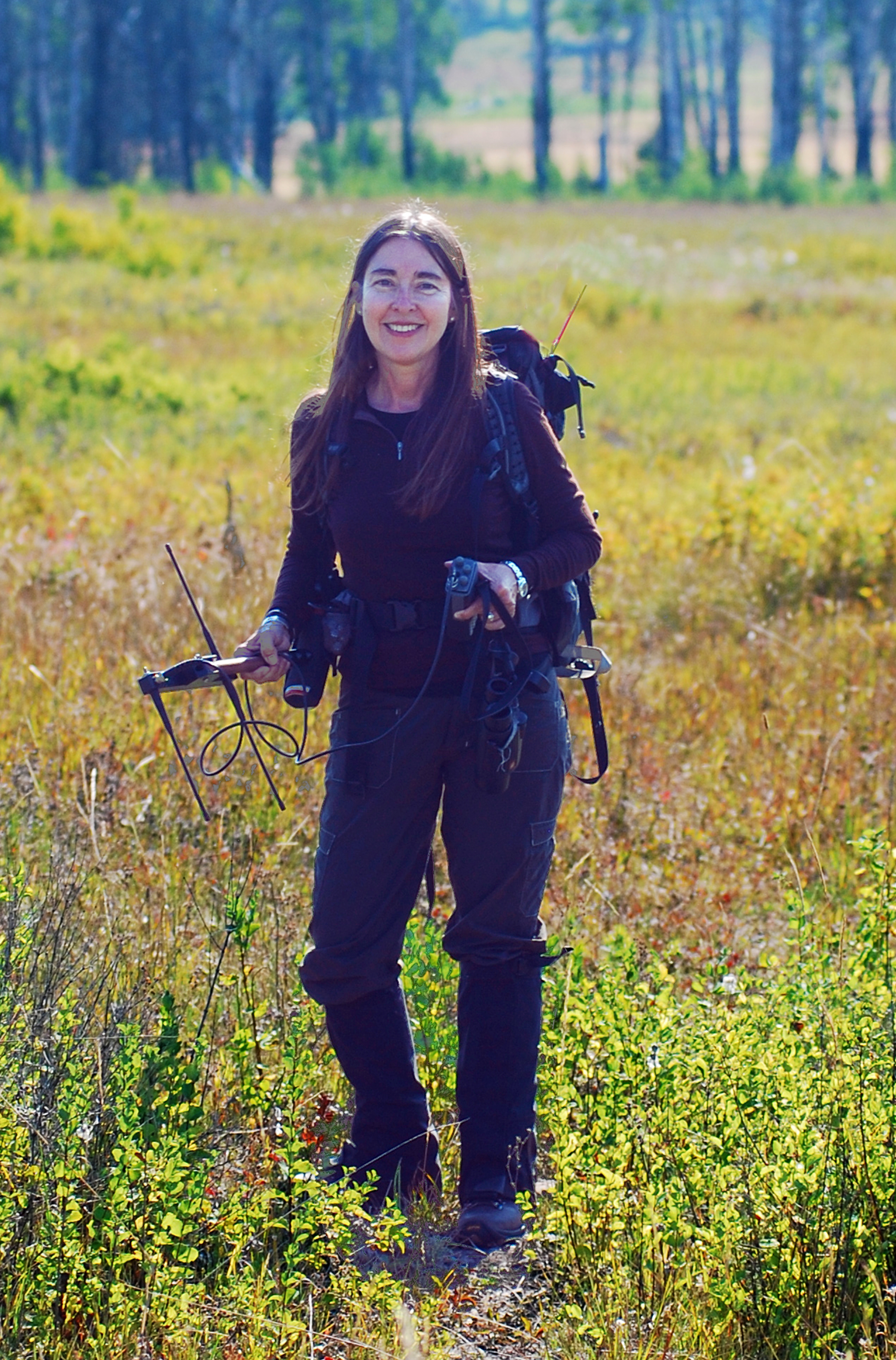
The Author Radio-
Tracking
 a Wolf
Photo by Brent Steiner


VHF- and GPS-collar data enable scientists to answer
 questions about how animals use a landscape.
 However,
 this technology is expensive and invasive. Collars
 can cost
several thousand dollars, and actually placing
 one on an
animal can cost thousands more for trapping,
helicopter
 time, and veterinary care. While animals recover
 from being
 trapped or net-gunned from a helicopter for
 collaring, and
 these procedures usually don't injure them
 the experience
can be traumatic. Cameras set to automatically
 record images
 when an animal walks by (called camera traps)
 are minimally
 invasive, but also expensive to purchase and maintain.
2016-01-08-1452287659-6290161-bellywolfhowling.jpg


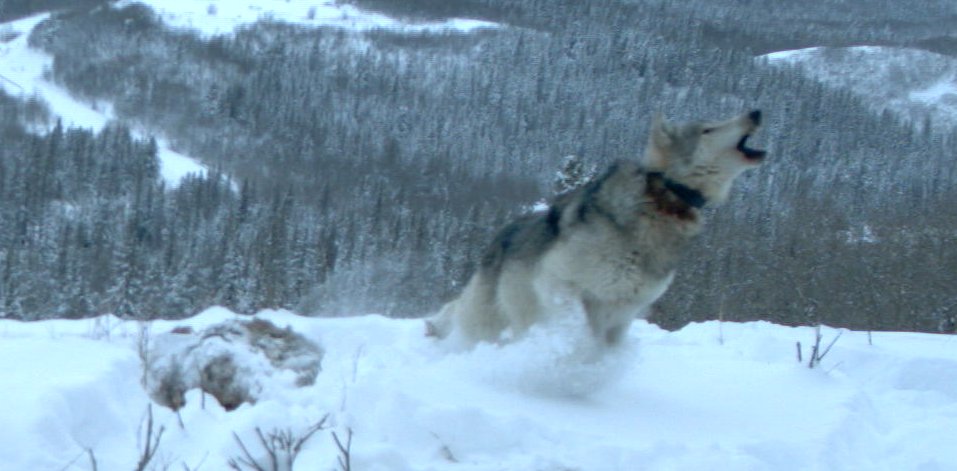
Camera Trap
 Image of a Collared
 Alpha
 Male Wolf,
 Courtesy Parks Canada

However, long before such technology existed,
 wildlife biologists
 tracked animals the way humans have for
millennia--by
following their trails, identifying their tracks
and droppings
 (called scat), and finding their dens, rendezvous
 sites, and
 carcasses. Today, thanks to scientist-trackers
 who have
 standardized such methods and championed
 noninvasive
 work, wildlife tracking has made a tremendous
 comeback
 as a top wildlife survey method.
2016-01-08-1452287359-8474936-DavidMoskowitz0821.jpg


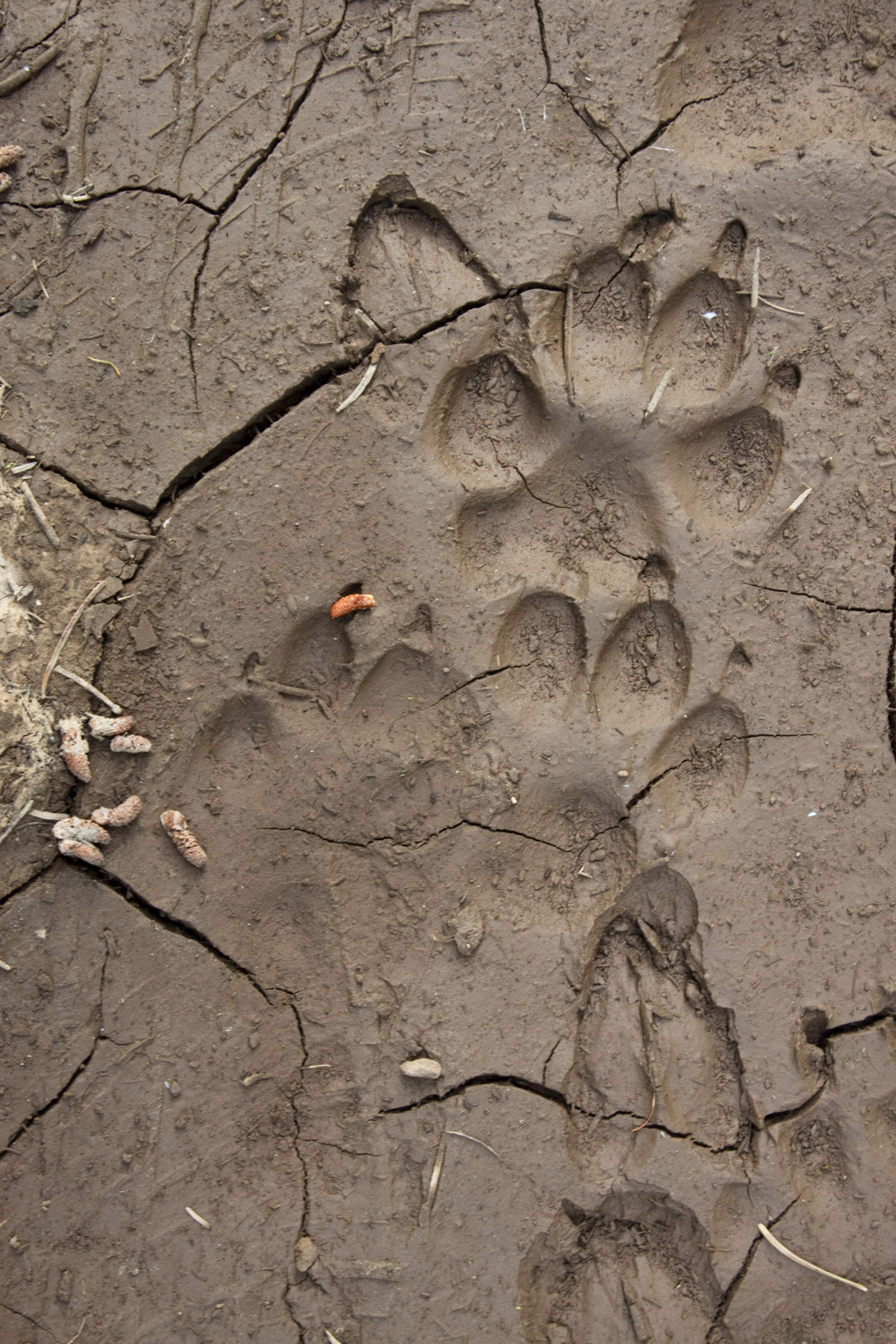
Wolf Tracks,
Photo by
 David
 Moskowitz


When I began to study wolves and their prey
as a scientist,
 I used VHF and GPS collars, but also turned
to traditional
 wildlife tracking. In 2007 as a PhD student,
 I worked with
 Parks Canada conservation biologists to
standardize my
tracking methods. I learned to collect
 wildlife data in
 transects that systematically cover a
whole landscape.
 By trial and error, I learned a large
sample size (e.g.,
 100 kilometers of transects) support
s even the most
 sophisticated statistical analysis. While
 this sounds
 like a huge effort, the transect work
 goes rapidly.
2016-01-08-1452286960-7754069-CroppedElk.jpg
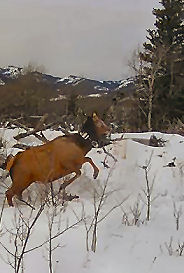
GPS-Collared Elk
Photo by Roger
 Creasey

Since 2008, my colleagues and I have been
 studying two
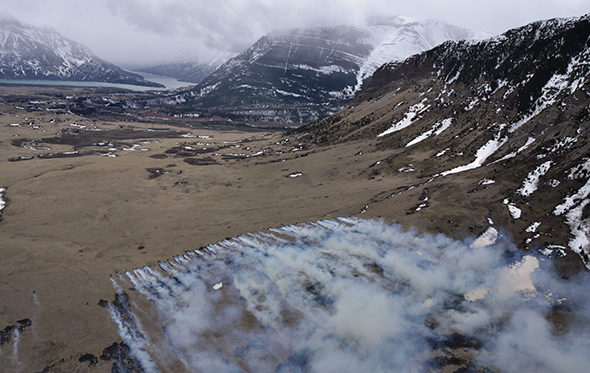
 fires in Waterton Lakes National Park, Alberta:
 the 2014
Red Rock Complex Prescribed Fire, which
 burned 2,300
 hectares; and the 2008 and 2015 Y-Camp
Prescribed Fires,
 which burned 1,200 hectares twice, in April
 2008 and
 April 2015. The sites contain a very high elk
density and
two wolf packs. Management objectives
 are to reduce
aspen land cover and restore the prairie
 within the burn
 units. In these sites we're studying how
 fire and wolves
influence elk behavior. We want to know
 whether
 restoring two out of three key ecological
 forces in this
system (fire, wolves) without restoring
the third (bison)
 is sufficient to return this fescue
 grassland to pre-
Euro-American settlement conditions.
2016-01-08-1452287099-2614149-fireeskerine2014590.ashx.jpg


Waterton Lakes
National Park
 Prescribed Fire,
Photo Parks Canada


While we've had 17 elk GPS-collared on this project,
 we've found
 given our study questions, that track transect data,
 which cost
 one hundredth of what GPS collar data cost,
 provide the most
 accurate way to determine where elk are
spending their time.
These data permit analyses of the potential
drivers of elk
behavior, such as food and wolf predation.
Accordingly, in the spring between snowmelt
 and greenup,
 we collect track transect data on elk, deer,
moose, wolf,
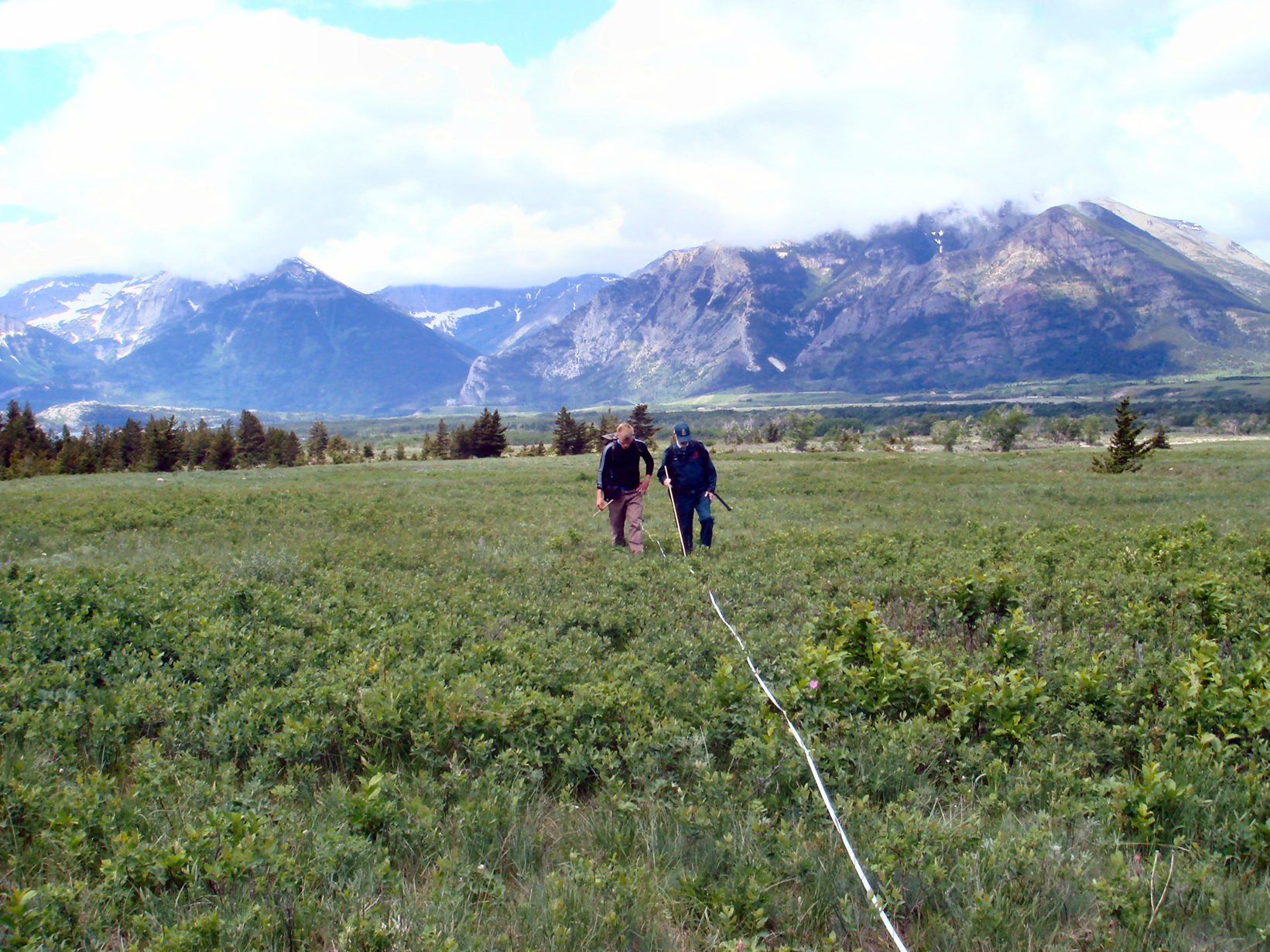
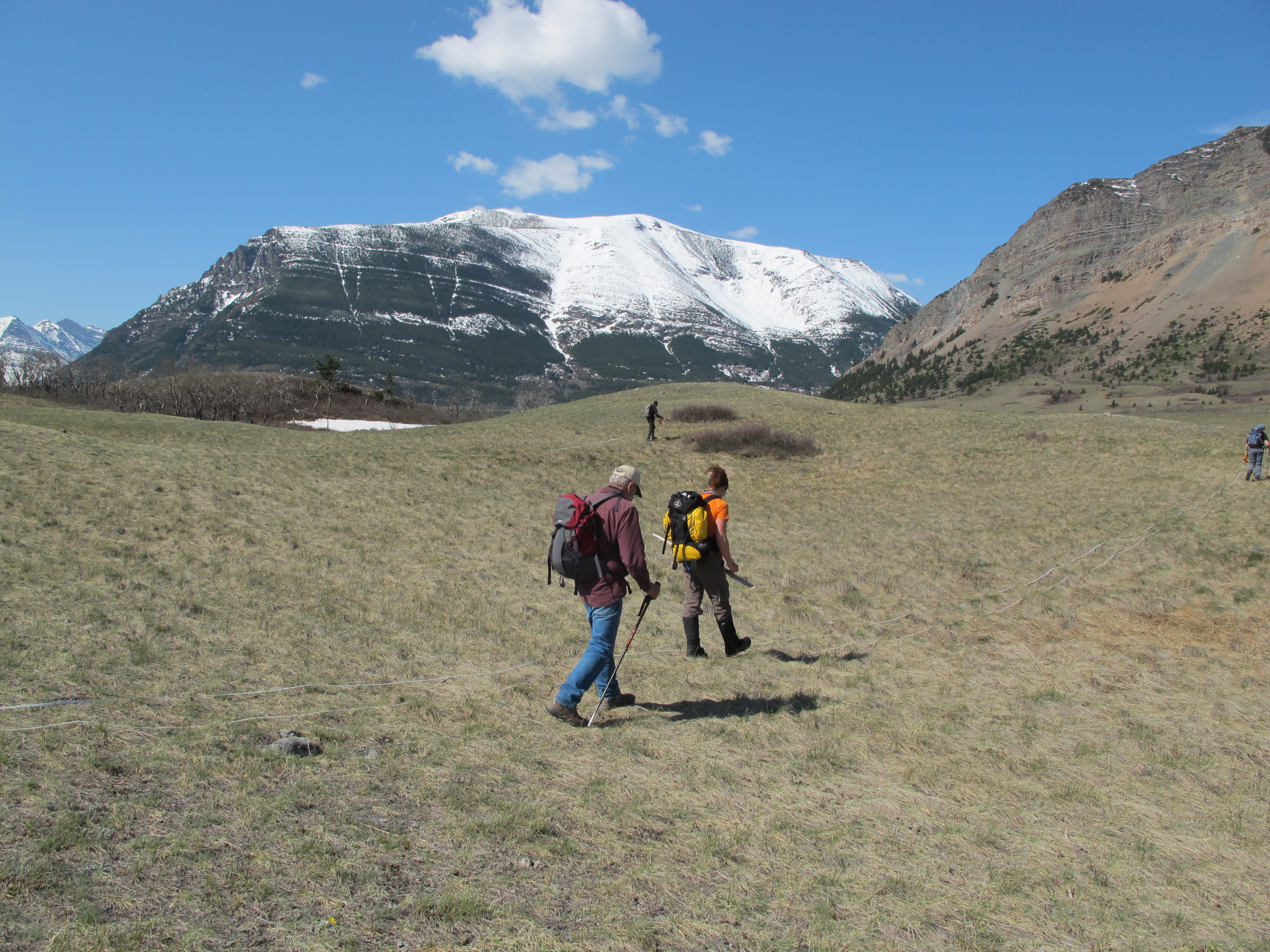
 bear, cougar, and coyote presence. The 1
 kilometer-long,
 2 meter-wide transects extend from the
 prairie deep into
aspen stands and are based on the plots
 in which we
collect grass and aspen data. Since 2007,
 volunteers
 have been joining me and our technicians
for this work,
which is both highly rigorous science and
the ultimate
 tracking adventure.
2016-01-08-1452287470-9008998-Track_Transect_Rob_3.png
Rob Watt and Mark Thorkelson Doing Track Transect 
Work, Photo by Cristina Eisenberg

Over time, our track transect data have
revealed astonishing
 things: a pair of wolves killing an elk on
 our transect line as
 we walked the transect; an alpha female
 wolf we didn't
know existed feeding on a fresh elk carcass
 in a high
predation-risk transect; a pair of grizzly
 bears mating;
a cougar stalking elk. These transects give
 us a window
 into wildness and are enabling us to quantify
 how wildness
creates healthy, resilient grassland and aspen
 communities.
2016-01-08-1452288329-5705292-034.JPG


Volunteers Doing
Track Transect
 Work,
 Photo by
Cristina Eisenberg

Earthwatch Institute, Parks Canada, and Oregon
State University
 support our work. Our data thus far are showing
that elk avoid
areas that have highest predation risk, although
 those areas also
 have the most plentiful, high-quality food. Elk
 in our study
 spend time where it's easier for them to detect
 and escape
 predators--such as the edges of an aspen stand-
-but which
 have less abundant food. We also found that the
 more severe
a fire, the higher the predation risk for elk.

I hope some of you will consider joining us in the
 field for this
work (Tracking Fire and Wolves through the
Canadian Rockies),
 which takes place in May of each year and
 provides an
excellent learning opportunity and immersion
 in one of the
 wildest, most intact North American
 landscapes. You can help
 us answer questions about how the size of
 an aspen stand
influences predation risk and elk browsing,
and what happens
 when an area is burned repeatedly.
Together we can
quantify wildness and increase our
understanding of
 the ecological role of wolves and fire.

Thursday, January 7, 2016

As in British Columbia, Ontario, Canada Ministry of Natural Resources Officials have the mistaken idea that killing Wolves is the answer to declining Moose populations and that killing Coyotes will actually reduce livestock deaths..............As we know, a warming environment bringing on parasites in combination with human alteration of habitat and an expansive moose hunting season are the root Moose limiting factors that need addressing,,,,,,,,,,And proper livestock husbandry that reduces open boneyards, increases the use of guard dogs are the first and most important step to coyote coexistence

The Ministry of Natural Resources proposes regulation changes to allow hunting of wolf and coyote under a small game license without requiring a separate game seal for animals harvested in Northern Ontario.
File photo


The Ministry of Natural Resources proposes regulation changes to allow
 hunting of wolf and coyote under a small game license without requiring 
a separate game seal for animals harvested in Northern Ontario. File phot


https://www.google.com/url?rct=j&sa=t&url=http://www.kenoradailyminerandnews.com/2016/01/04/proposed-changes-to-wolf-and-coyote-hunt-garner-mixed-public-response&ct=ga&cd=CAEYACoUMTU4OTA1Mjg1MzMzNDQ0ODg1OTQyGmMxODQwZGYxM2VhNGIxOGU6Y29tOmVuOlVT&usg=AFQjCNGj55GsqgQce1DUR_vOxsh-HZfyRw

Proposed changes

 to wolf 

and coyote hunt 

garner mixed 

public response

 Miner and News


The Ministry of Natural Resources and Foresty (MNRF) invites the public to comment on proposed hunting regulation changes for wolf and coyote.

The ministry intends to allow the hunting of grey wolves, also known as timber wolves, and coyotes under small game licenses without requiring a separate game seal for the animals in Northern Ontario. If it is approved, the regulation changes would take effect in 2017, retaining the two animal limit on wolves while removing limitations on the harvest of coyotes.

The ministry wants to implement the proposed changes as a wildlife management tool under the Moose Project to “reduce predation and spur population growth” of the declining numbers of moose in the province. It will also address concerns by ranchers regarding livestock losses due to coyotes.

“Recent population surveys have shown declines in moose populations in many parts of Northern Ontario. Populations of grey wolves and their hybrids in Northern Ontario have been relatively stable,” MNRF states on the ER.

The proposal has so far received a mixed public response. Outdoors groups support the move while animal rights lobbyists condemn the initiative.

The Ontario Federation of Anglers and Hunters endorses the management of wolves and coyotes in northern Ontario as a way to increase hunting opportunities and help reduce wildlife conflicts.
“Ontario wolf populations represent one of the best protected and intact populations in Canada,” stated the OFAH on it’s website. “Coyotes are common and abundant across most settled areas of the province, are very adaptable and more tolerant of human disturbances than wolves.”

Meanwhile Wolves Ontario urges supporters to speak out against the wildlife management initiative it regards as misguided.
“Not only does this proposal fail to address moose declines, it continues to endanger at-risk eastern wolves living in central Ontario and encourages the unregulated slaughter of coyotes,” stated the organization.

People have until Jan. 18 to respond to the MNRF posting on the Environmental Registry.
----------------------------------------------------------------

https://www.google.com/url?sa=t&rct=j&q=&esrc=s&source=web&cd=2&cad=rja&uact=8&ved=0ahUKEwiXtoW5wpnKAhVV9WMKHZO2D-QQFggjMAE&url=http%3A%2F%2Ffurbearerdefenders.com%2Fblog%2Faction-alert-ontario-wants-make-it-easier-kill-wolves-coyotes&usg=AFQjCNGhNn963DXVJAI990sOsgQtoZscLg


ACTION ALERT: ONTARIO WANTS

 TO MAKE IT EASIER TO KILL 

WOLVES, COYOTES


01/04/2016 - 11:58
Ontario politicians should have looked west and saved themselves the trouble of asking the public to weigh in on their moose preservation plan. The government quietly put forward a regulation proposal on the province’s Environmental Registrylast month that would make it easier to kill wolves and coyotes for all hunters.
Moose populations have been in flux in recent years in Ontario due to several factors, notably the deadly combination of climate change, development and resource exploitation, and a wide open hunting season. While the bureaucrats organizing hunting regulations in the province have reduced the “calf harvest” available (yes, that is killing of juvenile moose), their plan now is to increase the number of potential predators killed each year.
This is eerily similar to the plan in British Columbia to protect endangered caribou populations by killing wolves – it is ignoring the primary causes of a population decline so that the loud hunting lobby is impacted the least. It should be noted that moose in Ontario are not considered a species at risk – loose population counts have indicated a decline.
The proposal on the table includes primarily focuses on the requirement of a “game seal” for hunters in Northern Ontario who want to kill wolves and coyotes. The proposal indicates that this requirement would be changed to holding a small game license – meaning every hunter in Northern Ontario could kill two wolves per season and as many coyotes as they wish. The reporting requirements would also be reduced, with hunters only needing to confirm kills – not hunting activity itself.
These proposed changes are being put forward at the whim of Ontario’s hunting and trapping lobby – not to do what is best for wolves, coyotes, and moose. The true factors of the moose population decline (development, under researched and treated disease, and ongoing hunting activity) are not appropriately addressed in the proposal, and that’s what we need you to tell the government.

TAKE ACTION

While an online petition is circulating, the government of Ontario will not recognize it as a formal communication. The Environmental Registry, MPPs and Ministry leadership are key aspects of this kind of policy change and must be addressed. The commenting period for this proposal ends on January 18, 2016, so please get your comment in as soon as possible.
Registry
If you’re a resident of Ontario, you can access and comment directly on the Environmental Registry online.Click here to see the full proposal, click here to submit a comment, and click here to send it as an email instead.
Ontario MPPs
Your elected official does want to know what you have to say about these issues – and if they don’t,… well, tell them anyway. You can find your MPP by clicking here.
Ministry leadership
If you’re not a resident of Ontario, you can still take action – write to the leaders involved in this decision:Bill Mauro, Ministry of Natural Resources, and Kathleen Wynn, Premier of Ontario. Tell them that the way they treat their environment will be reflected in your business and personal decisions – such as a vacation or sourcing for manufacturing