Visitor Counter

hitwebcounter web counter
Visitors Since Blog Created in March 2010

Click Below to:

Add Blog to Favorites

Coyotes-Wolves-Cougars.blogspot.com

Grizzly bears, black bears, wolves, coyotes, cougars/ mountain lions,bobcats, wolverines, lynx, foxes, fishers and martens are the suite of carnivores that originally inhabited North America after the Pleistocene extinctions. This site invites research, commentary, point/counterpoint on that suite of native animals (predator and prey) that inhabited The Americas circa 1500-at the initial point of European exploration and subsequent colonization. Landscape ecology, journal accounts of explorers and frontiersmen, genetic evaluations of museum animals, peer reviewed 20th and 21st century research on various aspects of our "Wild America" as well as subjective commentary from expert and layman alike. All of the above being revealed and discussed with the underlying goal of one day seeing our Continent rewilded.....Where big enough swaths of open space exist with connective corridors to other large forest, meadow, mountain, valley, prairie, desert and chaparral wildlands.....Thereby enabling all of our historic fauna, including man, to live in a sustainable and healthy environment. - Blogger Rick

Subscribe via email to get updates

Enter your email address:

Receive New Posting Alerts

(A Maximum of One Alert Per Day)

Monday, March 7, 2016

As we see Grizzly Bears moving farther and farther north into the range of Polar Bears (as warmer weather patterns kick into Canada and Alaska), so seemingly is the Bobcat expanding it's range into traditional Lynx habitat in British Columbia, Canada...................Accordingly, the University of British Columbia Okanagan is investigating just how far north this new Bobcat territory extends into..................Historically, bobcats and lynx have been typically separated by snow depth"............. “Lynx have extremely long legs and large snowshoe-like paws, making them well adapted for travelling across deep snow"................ “In contrast, bobcats are heavier, have small feet and sink into the snow". ........... "However, climate change has led to earlier springs and lower snow levels in North America enabling "Bobs" to encroach on their "big webbed foot" cousins, the Lynx


Wanted: Photos of bobcats and lynx


https://www.google.com/url?rct=j&sa=t&url=http://www.kamloopsthisweek.com/wanted-photos-of-bobcats-and-lynx/&ct=ga&cd=CAEYACoTMzEwOTk5OTI4MTM1ODY5NzM5MDIaMWZiYWM0NmZiZmUyN2MzODpjb206ZW46VVM&usg=AFQjCNGMoylIv0sWqapWsZ_vA7YNQJIihg

Wanted: Photos of bobcats and lynx(bobcat in picture above)


A bobcat/lynx study is underway at the University of BC Okanagan in partnership with the provincial Ministry of Environment — and they need your help.
“We are seeking photos of bobcats and lynx captured by trail cameras or conventional cameras from all corners of the province and from all time periods to help determine the current provincial distribution of each species,” said T.J. Gooliaf, who is part of the study.


FigureĀ 1.

“We think that bobcats are moving northwards and into higher elevations.”
The photos do not have to be great photography. They simply need to show a bobcat or lynx — or even just a part of one. Photos can be blurry or dark and don’t even have to clearly show which cat species is present.
When sending photos, please include both the date and location of each photo. Location should be as specific as possible: most preferred is UTM or LAT/LONG co-ordinates. If that information is not available, please provide the name of the nearest road or landmark (including distance and direction from road or landmark) or nearest town (including distance and direction from town) or watershed or management unit.

Bobcat


Photos will be used for data only (which species was where and when) and will not influence management decisions regarding hunting/trapping bag limits or season dates. Photos will not be published or shared with anyone without permission and photographers will retain ownership of their photos.
The results of this study will be shared with all those who are interested.
“Historically, bobcats and lynx have been typically separated by snow depth,” Gooliaf said. “Lynx have extremely long legs and large snowshoe-like paws, making them well adapted for travelling across deep snow. They are found in the boreal forests across Canada and Alaska, as well as the mountain ranges extending south into Washington, Idaho, Montana, Wyoming and Colorado.
“In contrast, bobcats are heavier, have small feet and sink into the snow. They are found throughout the deserts and grasslands of the contiguous United States, as well as southern Canada. However, climate change has led to earlier springs and lower snow levels in western North America,” Gooliaf said.

Canada Lynx


“As a result, suitable bobcat habitat may now be present in new areas of B.C. I am using photos of bobcats and lynx submitted by the public to help map the current provincial distribution of both species to determine if their ranges have shifted in response to climate change. I hypothesize that bobcats have moved northwards and into higher elevations.”
Photos, along with the date and location of where each was taken, can be emailed to tj.gooliaff@ubc.ca.
-------------------------------------------------------------------------------------------------------------------------

https://www.google.com/url?sa=t&rct=j&q=&esrc=s&source=web&cd=7&cad=rja&uact=8&ved=0ahUKEwiqld6j6q_LAhULzGMKHVRBBPAQFghCMAY&url=http%3A%2F%2Fwww.trentu.ca%2Fnewsevents%2FnewsDetail.php%3FnewsId%3D4199&usg=AFQjCNF1NJJguKLDVYk_etnHv1P5PwaCDQ


High-Profile Publication Establishes Trent Grad Student as World-Class Ecological Researcher

Michael Peers' study on Canada lynx and bobcat makes cover of Proceedings of the Royal Society journal


Michael Peers is more than an M.Sc. candidate in Environmental and Life Sciences (ENLS) at Trent University. He is also an accomplished researcher and animal educator with a growing list of impressive credentials.

Now the international ecological community is taking notice of Mr. Peers’ ground-breaking research. His latest study entitled “Evidence for large-scale effects of competition: niche displacement in Canada lynx and bobcat,”is the lead article of the December 2013 issue of the widely respected journal, Proceedings of the Royal Society.

The study, which compared the Canada lynx and bobcat across North America, is the largest of its kind. Speaking of its impact, Mr. Peers’ supervisor Dr. Dennis Murray (www.dennismurray.ca), Canada Research Chair in Integrative Wildlife Conservation and professor of Biology at Trent University, says: “Michael’s work is the first to show that competition between two species can be detected at the scale of the entire geographic range of the species. This is unprecedented and gives us insight into how competition can cause a common response at a continental scale.”

Lynx hunting snowshoe hares


The Impacts of Climate Change
Mr. Peers worked on the study with Dr. Murray and Dr. Daniel Thornton, a former post-doctoral fellow in Prof. Murray’s lab and currently an adjunct assistant professor at Washington State University.  The research demonstrates how increased competition, owing to climate change and expansion of bobcat into lynx range, may cause lynx to be more susceptible to changing climates by forcing southern lynx into the habitats where they are least likely to encounter bobcat.

“If Canada lynx are displaced to areas of high snow cover, these areas will be most affected by warming temperatures and will disappear in the southern lynx range,” says Mr. Peers. Dr. Murray continues, “Thus, it is a double whammy involving the effects of climate change on increased competition with bobcats, and the effects of climate change on deterioration of habitats that lynx are forced into as a result of increased competition.”

Prior to the release of this study, Mr. Peers has published several other papers that relate to his research interests involving distribution modelling to determine the factors that influence the large-scale distribution of species.
--------------------------------------------------------------------------------------------------

https://www.google.com/url?sa=t&rct=j&q=&esrc=s&source=web&cd=1&cad=rja&uact=8&ved=0ahUKEwj78rX_66_LAhUEwGMKHYvwCNQQFggcMAA&url=http%3A%2F%2Frspb.royalsocietypublishing.org%2Fcontent%2F280%2F1773%2F20132495&usg=AFQjCNFXz2bed5aQ5FofWhShrF-TREtmHQ


Evidence for large-scale 

effects of competition:

 niche displacement in 

Canada lynx and bobcat

Michael J. L. PeersDaniel H. Thornton
Dennis L. Murray

Abstract

Determining the patterns, causes and consequences of
character displacement is central to our understanding
 of competition in ecological communities. However, the
 majority of competition research has occurred over
 small spatial extents or focused on fine-scale
 differences in morphology or behaviour.

 Lynx hunting hare


 The effects of competition on broad-scale distribution
 and niche characteristics of species remain poorly
 understood but critically important. Using range-wide
 species distribution models, we evaluated whether
 Canada lynx (Lynx canadensis) or bobcat
 (Lynx rufus) were displaced in regions of sympatry.

 Consistent with our prediction, we found that lynx
 niches were less similar to those of bobcat in areas
 of sympatry versus allopatry, with a stronger 
reliance on snow cover driving lynx niche
 divergence in the sympatric zone. By contrast,
 bobcat increased niche breadth in zones of
 sympatry, and bobcat niches were equally similar
 to those of lynx in zones of sympatry and allopatry.

 These findings suggest that competitively 
disadvantaged species avoid competition at
 large scales by restricting their niche to highly
 suitable conditions, while superior competitors
 expand the diversity of environments used. Our
 results indicate that competition can manifest
 within climatic niche space across species’
 ranges, highlighting the importance of biotic
 interactions occurring at large spatial scales
 on niche dynamics.

Sunday, March 6, 2016

While Lewis & Clark had explored and mapped much of the trans-Missouri territory at the beginning of the 19th century, it was not until just in front of the Civil War, May-July 1860, that Capt. William F. Raynolds of the U.S. Army was given the assignment by the Federal Government to "explore the region of country through which flow the principal trbutaries of the Yellowstone river and which they, and the Gallatin and Madison forks of the Missouri river, have their source".......While late season snow prevented Raynold's party from entering what today is Yellowstone Park, they did explore a good swath of Wyoming, Idaho and Montana..........Their travels took them into the Wind River and Gros Ventre Mountains and had them spend eight days in Jackson Hole, Wyoming.........Like Lewis & Clark, Raynolds kept a detailed diary of all he saw...............His report on the Bison herds he encountered strikes me so strongly of the anti-wolf sentiment that so many in our Country harbor to this day, seemingly unabated in it's lack of understanding of the millenia long dance of the Wolf and the Bison---"When we reached the Valley of the Upper Yellowstone, I estimate that 40 or 50 miles of the area are covered thickly with buffalo"............"The on-going wholesale destruction of buffalo is because female buffaloes are always singled out by the hunter"............"Hence, the males in a herd always exceed the females in the proportion of not less than 10 to 1"........"The reason females are singled out is that only the skin of females is valuable for robes"........"The skin of the male buffalo over three years old is too thick and heavy to be used for anything but lodge coverings and the flesh is coarse and unpalatable and never used as food"..........."The immense number of Wolves in the country are responsible fir killing buffalo calves"............"There might be some improvement(in population numbers) if trading buffalo robes were prohibited and a premium(bounty) placed on Wolves".............." I think it is more than prbable that another generation will witness the entire extinction of this noble animal(buffaloes)...................Indeed, Raynolds was right about the near extinction event of Bison......... He was right about over hunting,,,,,,,,,,,,,However, he was dead wrong about the dance of Wolf and Bison...............Same as today, wrong about the decline of Caribou being due to Wolves-----Habitat destruction(ranching), and over hunting,. the scourge of both of these hoofed browsers in the 19th century as well as today

http://www.amazon.com/Up-Winds-Over-Tetons-Expedition/dp/0826350976

UP THE WINDS AND OVER THE TETONS
Edited by Marlene and Daniel Merrill(no relation)

AS DESCRIBED ON AMAZON.COM:

In the late 1850s many of the most striking places in Wyoming, Idaho, and Montana had not yet been surveyed by any government expedition. This book brings to life the expedition that first explored these regions.

 As the last major government survey of the American West before the Civil War, the Raynolds Expedition began in 1859. This highly readable daily journal of Captain William F. Raynolds, previously unpublished, covers the most challenging period of that expedition, from May 7 to July 4, 1860. 

It describes what the Raynolds party did and saw while traveling from its winter quarters near today's Glenrock, Wyoming, up to the head of the Wind River, through Jackson Hole, and on to the Three Forks of the Missouri in southwestern Montana.

 The party included legendary mountain man Jim Bridger, geologist Ferdinand Hayden, and artists Anton Schƶnborn and James Hutton, among the first to depict the Teton Range.


Saturday, March 5, 2016

Some dozen or so Pumas still call Los Angeles home and the great video in the article below takes you on a tour of two of their lives..........Male Pumas normally needing a 200 square mile territory to thrive are somehow making due with only 6 square miles...........And beating the odds, on the rare occasion, actually getting across two of America's most busiest highways, the 405 and 101...........Take a look,,,,,,,,,,,,,and "enjoy the show"

https://www.google.com/url?rct=j&sa=t&url=http://la.curbed.com/2016/3/3/11158588/mountain-lions-los-angeles-video&ct=ga&cd=CAEYACoUMTIwODIzMTU5NTg5NTAzMjY1NDUyGjQ2OTIwYTk2ZWZjMTE1ODg6Y29tOmVuOlVT&usg=AFQjCNED7kfKOTR84qsHoEn1yw9OGVNHdw

CLICK ON LINK ABOVE TO WATCH THIS GREAT VIDEO...

THEN, SCROLL DOWN THE ARTICLE TO THE 2ND PICTURE WITH THE ARROW,,,CLICK ON THIS TO WATCH VIDEO

Video: Inside the Hard Lives of Los Angeles Mountain Lions

The trials and tribulations of the very private Griffith Park Mountain Lion and friends


It's a tough life for a mountain lion trying to make it in the big city. As a recent video from KCETshows, these impressive predators face immense obstacles to survival as they try to navigate a hostile urban environment populated with some very territorial family members.
The video tracks the exploits of P-22 and P-32 (the "P" stands for puma), two local mountain lions born in the Santa Monica Mountains. (P-22 is the famous Griffith Park Mountain Lion.) Because mountain lions are very protective of their space, both animals had to venture far from home in search of a new habitat, and along the way, they have braved dangerous freeway crossings, ingested rat poison, and, like so many Angelenos, been forced to pose with the Hollywood sign.
It's fascinating to get such an in-depth look at the lives of some of Los Angeles's most rarely seen creatures, but make sure to have a box of tissues handy when viewing. Let's just say there's a good reason Caltrans is trying to build an animal crossing over the 101 (apparently at great cost).
For more on the mountain lions of Southern California, check in with the National Parks Service or visit this strange site that diagrams the lions' very inbred family history.

Friday, March 4, 2016

Is the Western Rattlesnake one species or are there actually 6 subspecies of the Rattler across the American West? U. Of Arkansas and U. of Illinois researchers believe that 6 is the "magic number" and that as a result, increased protections to protect each of the sub species should be considered by the USFWS

https://www.google.com/url?rct=j&sa=t&url=http://news.uark.edu/articles/33810/biologists-identify-six-new-unique-species-of-the-western-rattlesnake&ct=ga&cd=CAEYASoTOTQxOTQ4MTc0MDY2MjY2MjExNzIaYWJiMmMxNTM2YWY2YWQ1Mzpjb206ZW46VVM&usg=AFQjCNEIVei1Skq3WxW_-P1TSu5GHG7qbQ

Biologists Identify Six New Unique Species of the Western Rattlesnake

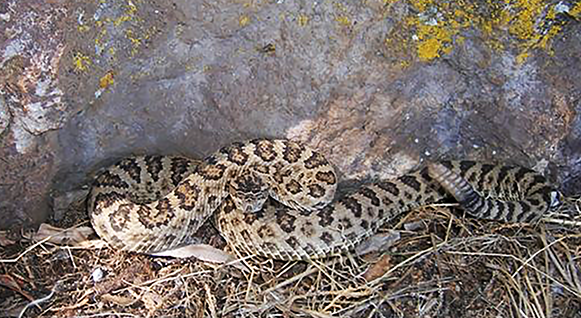
The great basin rattlesnake (Crotalus lutosus), one of six new unique species identified by University of Arkansas biologists and their colleagues
Courtesy of Blake L. Thomason
The great basin rattlesnake (Crotalus lutosus), one of six new unique species identified by University of Arkansas biologists and their colleagues
FAYETTEVILLE, Ark. – There There are more species of rattlesnake slithering around western North America than previously thought.
That’s the conclusion of a new study conducted by University of Arkansas biologists Michael Douglas and Marlis Douglas and their colleagues at the University of Illinois at Urbana-Champaign and Western Kentucky University.
The researchers published their findings in the journal PLOS One.
The research team, using head shapes and genetic analyses, recommend that six groups of subspecies of the western rattlesnake be elevated to full species status, with the following names:
  • Crotalus viridis, prairie rattlesnake
  • Crotalus oreganus, northern Pacific rattlesnake
  • Crotalus cerberus, Arizona black rattlesnake
  • Crotalus helleri, southern Pacific rattlesnake
  • Crotalus concolor, midget faded rattlesnake
  • Crotalus lutosus, great basin rattlesnake
The scientific and standard English names will be submitted to the International Committee on Zoological Nomenclature for ratification.
The study has important implications for ecological conservation efforts across the United States, said Michael Douglas, professor of biological sciences and Twenty-First Century Chair in Global Change Biology.
“These snakes have been long been recognized by herpetologists as being demonstrably different, and in fact were designated as western rattlesnake subspecies in the first half of the 20th century,” Douglas said. “None are currently considered rare, but species designation allows them to gain certain legal protection, particularly within individual states.”
Marlis Douglas, associate professor of biological sciences and Bruker Chair of Life Sciences, said the genetic data were also evaluated to identify these snakes as individual species. The Douglases collaborated with Mark Davis, research scientist at the Illinois Natural History Survey, part of the Prairie Research Institute at the University of Illinois, and Michael Collyer, associate professor of biology at Western Kentucky University.
As part of his doctoral research, Davis collected data from nearly 3,000 western rattlesnakes available in natural history museums across the western United States.
In addition to genetic traits, the team examined head shape, which can vary drastically between different species of snakes and potentially reflect what kind of prey the snake prefers.
About the University of Arkansas: The University of Arkansas provides an internationally competitive education for undergraduate and graduate students in more than 200 academic programs. The university contributes new knowledge, economic development, basic and applied research, and creative activity while also providing service to academic and professional disciplines. The Carnegie Foundation classifies the University of Arkansas among only 2 percent of universities in America that have the highest level of research activity. U.S. News & World Report ranks the University of Arkansas among its top American public research universities. Founded in 1871, the University of Arkansas comprises 10 colleges and schools and maintains a low student-to-faculty ratio that promotes personal attention and close mentoring.
CONTACTS
Michael Douglas, professor 
Department of Biological Sciences 
479-575-6343, med1@uark.edu
Marlis Douglas, associate professor 
Department of Biological Sciences 
479-575-4176, mrd1@uark.edu
Chris Branam, research communications writer/editor 
University Relations 
479-575-4737, cwbranam@uark.edu


A mild 2015 Winter due to El Nino seems to have helped the Monarch Butterflys with some 10 acres west of Mexico City "stuffed large" with the iconic species..........Note however, that 20 years ago, this region once housed some 44 acres of "The Flys".............Increased plantings of native milkweed in the USA is also thought to be a factor for the slight bump up these past two winters..............The Monarch's are not nearly out of the woods as increased logging in Mexico and land alteration in the USA continue to pose long term threats to their survivaL


Mexico documents big rebound in monarch butterflies

 
1 photo
FILE - In this Jan. 4, 2015 file photo, a kaleidoscope of
 Monarch butterflies cling to tree... Read more
MEXICO CITY (AP) — Monarch butterflies have made a big comeback in their wintering grounds in Mexico, after suffering serious declines, experts said Friday.
The area covered by the orange-and-black insects in the mountains west of Mexico City this season was more than three and a half times greater than last winter. The butterflies clump so densely in the pine and fir forests they are counted by the area they cover rather than by individual insects.
The number of monarchs making the 3,400-mile (5,500-kilometer) migration from the United States and Canada declined steadily in recent years before recovering in 2014. This winter was even better.
This December, the butterflies covered 10 acres (about 4 hectares), compared to 2.8 acres (1.13 hectares) in 2014 and a record low of 1.66 acres (0.67 hectares) in 2013.
While that's positive, the monarchs still face problems: The butterflies covered as much as 44 acres (18 hectares) 20 years ago.
"The news is good, but at the same time we shouldn't let our guard down," said Omar Vidal, director of the World Wildlife Fund in Mexico. "Now more than ever, Mexico, the United States, and Canada should increase their conservation efforts to protect and restore the habitat of this butterfly along its migratory route."
The United States is working to reintroduce milkweed, a plant key to the butterflies' migration, on about 1,160 square miles (3 million hectares) within five years, both by planting and by designating pesticide-free areas. Milkweed is the plant the butterflies feed and lay their eggs on, but it has been attacked by herbicide use and loss of open land in the United States.
Dan Ashe, the director of the U.S. Fish and Wildlife Service, said that in the first year of that effort, the United States had managed to restore about 250,000 acres (100,000 hectares) of milkweed, and raised about $20 million for the program.
"It is time for celebration because we see the beginning of success," Ashe said. "But our task now is to continue building on that success."
The Washington, D.C.-based Center for Biological Diversity, which is pushing for endangered species status for the monarchs, noted that even with the rebound, the butterflies are still only at 68 percent of their 22-year average. It said in a statement that "the population was expected to be up this winter due to favorable summer weather conditions in the monarch's U.S. breeding areas."
"The increase is certainly great news, but the bottom line is that monarchs must reach a much larger population size to be resilient to ever-increasing threats," said Tierra Curry, a senior scientist at the Center.
In Mexico, meanwhile, illegal logging has remained a problem. It more than tripled in the monarch butterflies' wintering grounds in 2014, reversing several years of steady improvements. Illegal logging had fallen to almost zero in 2012.
Authorities said the reserve's buffer area lost more than 22 acres (9 hectares) in 2015 due to illegal logging in one area, but said the tree cutting was detected and several arrests were made.
The forest canopy acts as a blanket against the cold for butterflies forming huge clumps on branches during their winter stay in Mexico.
Monarch expert Lincoln Brower wrote in a research paper that the 2015 forest loss was actually 25 acres (10 hectares) in the reserve area, and said the illegal logging "questions the effectiveness of current strategies to protect the already precarious overwintering habitat of the monarch butterfly."
The logging took place in a particularly sensitive area of the reserve, and if butterflies can't find shelter there, "they may be forced into forested areas with less microclimatic protection," exposing them to potential cold and rain that can prove fatal, Brower wrote.
Alejandro del Mazo, the head of Mexico's protected natural areas, credited the three countries for their cooperation and said they were on their way to achieving the goal of having 220 million butterflies in the reserve by 2020. Del Mazo estimated there were 140 million this year.
"This is a motivation for us to continue building bridges between our three countries, not walls," Del Mazo said.
The migration is an inherited trait: No butterfly lives to make the full round trip, and it is unclear how they find their way back to the same patches of pine forest in Mexico each year.
Some scientists suggest the butterflies may release chemicals marking the migratory path and fear that if their numbers fall too low the chemical traces will not be strong enough for others to follow.
The long-term trend is troubling. After their peak in 1996, when the monarchs covered more than 44 acres (17.8 hectares), each time the monarchs have rebounded, they have done so at lower levels. The species is found in many countries, but experts fear the migration could be disrupted if very few butterflies make the long trip.
Largely indigenous farm communities in the mountain reserve have received government development funds in return for preserving the 139,000-acre (56,259 hectare) reserve that UNESCO has declared a World Heritage site.
Writer and environmental activist Homero Aridjis, and the chief scientist for Parks Canada, Dr. Gilles Seutin, also suggested that favorable weather conditions may have helped the monarchs rebound this year.
"Although thanks to more favorable weather conditions along the monarch's migratory routes numbers in the reserve this season have increased, this does not mean we can ignore one of the main threats to the monarchs now: the extremely damaging illegal logging taking place within the reserve," Aridjis wrote.

The Kenai Peninsula (Alaska) Grizzly population is now much better known thanks to the WILDLIFE SOCIETY study of the bruins this past Summer..........Due to increased hunting, there are likely 500 Bears in this region compared to 600 back in 2010.............Kenai is separated from some 10 miles from mainland Alaska and as a result, The USFWS has labeled this population a distinct genetic Griz population..............The information from this latest "count" will hopefully be used to put forth a plan to protect the bears from further human encroachment and hunting

http://app.getresponse.com/click.html?x=a62b&lc=jfl9v&mc=IC&s=RrbrmB&u=Yy3s&y=W&

WS member behind first major grizzly estimate of Kenai

By Joshua Rapp Learn

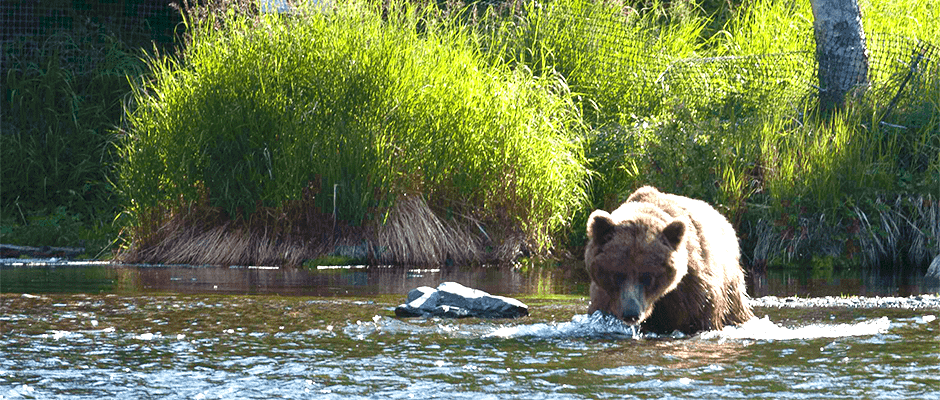
A brown bear fishing for sockeye salmon on the banks of the Kenai River. ©Berkley Bedell
Biologists have scrambled up mountains and searched the remote backcountry of Alaska’s Kenai Peninsula to provide the first comprehensive estimate of the region’s grizzly bear population.
“We’ve been trying to get a Kenai brown bear population estimate for many years now,” said John Morton, a supervisory biologist at the Kenai National Wildlife Refuge and lead author of a new study published in The Journal of Wildlife Management. “It’s a very important benchmark,” said Morton, who is also a member of The Wildlife Society.
John Morton pours blood and fish lure on a fake cache to attract bears while Liz Jozwiak works in the background. Both are biologists at the Kenai National Wildlife Refuge. ©USFWS
The logistics of the study were intense. The team flew crews in two helicopters for 31 consecutive days in June 2010 over 3 million acres of remote backcountry in the Kenai Peninsula.
“Kenai is a pretty rugged and remote area,” Morton said, adding that elevations sometimes went up 6,000 feet from sea level. Some of the traps they deployed in early June on top of snow had moved significantly after melting. “In one instance we looked up and saw it 15 feet up in the trees — that’s how much snow there was.”
They used mark and recapture data compiled from hair snare traps equipped with scented lures of rotten cow blood and barb wire. They repeatedly returned to the traps, taking DNA samples of the individual bears from hair left on the barb wire to see how many bears were in the area.
They extrapolated these numbers to areas they didn’t directly survey and estimated around 600 bears were on the peninsula as a whole in June, 2010.
The number is significant because the Kenai Peninsula is separated from the rest of the state by a 10-mile wide passage of land, meaning much of the wildlife in the area is virtually isolated from outside populations.
The genetic data revealed that the bears in the peninsula aren’t genetically unique enough to constitute a distinct population as defined by USFWS regulations. Morton said the numbers show a healthy population, but worries about the increased hunting levels approved by the state government since 2007, given that the population doesn’t see a lot of outside recruitment.
“Even with the additional births, we’re just hammering the population,” he said.
A camera trap capture of a Kenai brown bear leaving one of 145 barbed-wire hair-sampling stations. ©USFWS
Around 200 bears were known to be killed by humans through intentional harvesting, self-defense or through accidental takes from 2012 to 2014. Accounting for births, Morton said he estimated the population at around 500 individuals on the peninsula today. But the environment of the peninsula is also facing habitat pressure, with increasing development and human population in the area.
Morton said he hopes that the baseline estimates the team made will help inform sound management decisions in the state.
“That’s the impetus to go out there and get this population estimate, to make some science-based decisions,” he said.
Joshua Rapp Learn is a science writer at The Wildlife Society. Contact him at Joshua.learn@wildlife.org with tips or story suggestions on conservation, wildlife science, management or other story ideas.

Wednesday, March 2, 2016

The Panthera Teton Cougar Project.is the longest ongoing study of Pumas in North America..............It has revealed so many new behaviours of how these trophic carnivores conduct themselves in the wild,,,,,,,, Proving that the once thought-to-be-solitary females will congregate with other adult females as well as allowing the males who sired their current litter to share a meal with her kittens...............What a fascinating and revealing 6 minute video (below) for all of you to soak in and enjoy!!!

Check out "The Secret Life of Mountain Lions" by Secret Life of Mountain Lions on Vimeo.
The video is available for your viewing pleasure at:
https://vimeo.com/157288534


About Panthera’s Teton Cougar Project

Cougar peering down from a treeLocated in northwestern Wyoming on 2,300 km2 of the most ecologically-intact ecosystems in the lower United States, Panthera’s Teton Cougar Project is one of very few long-term cougar projects operated in North America. Today, the project spans the Grand Teton National Park, National Elk Refuge, and Teton Wilderness Area in the Bridger-Teton National Forest – exquisite landscapes that boast diverse wildlife populations, including cougars, grizzly bears, black bears, wolves, coyotes, mule deer, white-tailed deer, elk, moose, bighorn sheep, pronghorn, bison, and occasional wolverines, bobcats and Canada lynx.
Now in its fifteenth year, Panthera's Teton Cougar Project was co-founded by Dr. Howard Quigley, Executive Director of Panthera’s Puma and Jaguar Programs, and Dr. Maurice Hornocker, one of the original pioneers in cougar research. The project’s focus includes cougar population dynamics, such as the effects of recolonizing wolves and human hunting on cougar survivorship; cougar habitat selection; foraging ecology; and cougar interactions with other carnivores.
Panthera’s current team of scientists led by Dr. Mark Elbroch, Director of Science for Pumas, utilize cutting-edge GPS collars and high-tech remote cameras to track cougar movements, identify cougar dens, and observe the secret interactions between cougars. Our team has recorded rare and undocumented cougar behaviors, extended family lineages over time, and gathered a vast amount of data to reveal the hidden lives of cougars. Thus far, our research has included more than 120 individual cougars, documenting their territories, prey selection, population dynamics, and more.
All of these data are improving our understanding of the ecology of the species, and allowing Panthera’s scientists to better preserve the ‘American lion.’
We hope that you enjoy this channel’s videos and photos documenting the lives of these beautiful wild cats.
Read Panthera's Q&A on collaring cougars. 

Related Press

Read the December 2013 National Geographic Magazine ‘Ghost Cats’ article featuring Panthera’s Teton Cougar Project and cougar photos.
Learn about National Geographic Television’s ‘American Cougar’ documentary featuring Panthera’s Teton Cougar Project.
 See more at: http://cougarchannel.org/project#sthash.SiLpjLOJ.dpuf

Tuesday, March 1, 2016

Biologist Edward O. Wilson, professor emeritus at Harvard University and recipient of two Pulitzer Prizes has published his 32nd book, a personal exhortation to conserve biodiversity titled “Half Earth: Our Planet’s Fight for Life.”--His premise: Preserve half of the remaining land on the planet as open space................"Wilson recently calculated that the only way humanity could stave off a mass extinction crisis, as devastating as the one that killed the dinosaurs 65 million years ago, would be to set aside half the planet as permanently protected areas for the ten million other species".................... “Half Earth,” in other words,—half for us, half for them"...................... "A version of this idea has been in circulation among conservationists for some time".................... “It’s been in my mind for years"..................” "People haven’t been thinking big enough—even conservationists".................... "Half Earth is the goal, but it’s how we get there, and whether we can come up with a system of wild landscapes we can hang onto".................... "I see a chain of uninterrupted corridors forming, with twists and turns, some of them opening up to become wide enough to accommodate national biodiversity parks, a new kind of park that won’t let species vanish"


In ‘Half Earth,’ E.O. 

Wilson Calls for a 

Grand Retreat


The review below from Amazon.com

Half-Earth proposes an achievable plan to save our imperiled biosphere: devote half the surface of the Earth to nature.
In order to stave off the mass extinction of species, including our own, we must move swiftly to preserve the biodiversity of our planet, says Edward O. Wilson in his most impassioned book to date. Half-Earth argues that the situation facing us is too large to be solved piecemeal and proposes a solution commensurate with the magnitude of the problem: dedicate fully half the surface of the Earth to nature.
If we are to undertake such an ambitious endeavor, we first must understand just what the biosphere is, why it's essential to our survival, and the manifold threats now facing it. In doing so, Wilson describes how our species, in only a mere blink of geological time, became the architects and rulers of this epoch and outlines the consequences of this that will affect all of life, both ours and the natural world, far into the future.
Half-Earth provides an enormously moving and naturalistic portrait of just what is being lost when we clip "twigs and eventually whole braches of life's family tree." In elegiac prose, Wilson documents the many ongoing extinctions that are imminent, paying tribute to creatures great and small, not the least of them the two Sumatran rhinos whom he encounters in captivity. Uniquely, Half-Earth considers not only the large animals and star species of plants but also the millions of invertebrate animals and microorganisms that, despite being overlooked, form the foundations of Earth's ecosystems.
In stinging language, he avers that the biosphere does not belong to us and addresses many fallacious notions such as the idea that ongoing extinctions can be balanced out by the introduction of alien species into new ecosystems or that extinct species might be brought back through cloning. This includes a critique of the "anthropocenists," a fashionable collection of revisionist environmentalists who believe that the human species alone can be saved through engineering and technology.
Despite the Earth's parlous condition, Wilson is no doomsayer, resigned to fatalism. Defying prevailing conventional wisdom, he suggests that we still have time to put aside half the Earth and identifies actual spots where Earth's biodiversity can still be reclaimed. Suffused with a profound Darwinian understanding of our planet's fragility, Half-Earth reverberates with an urgency like few other books, but it offers an attainable goal that we can strive for on behalf of all life.