Learn about Grizzly Bears, Black Bears, Polar Bears, gray wolves/eastern wolves/red wolves,timber wolves,
cougars/mountain lions/panthers/painters/pumas, bobcats, lynx, red and gray foxes, wolverines, martens, fishers, coyotes/eastern
coyotes/coywolves with pictures, videos, photos, facts, info and news.
Visitor Counter
Visitors Since Blog Created in March 2010
Click Below to:
Add Blog to Favorites
Coyotes-Wolves-Cougars.blogspot.com
Grizzly bears, black bears, wolves, coyotes, cougars/ mountain lions,bobcats, wolverines, lynx, foxes, fishers and martens are the suite of carnivores that originally inhabited North America after the Pleistocene extinctions.
This site invites research, commentary, point/counterpoint on that suite of native animals (predator and prey) that inhabited The Americas circa 1500-at the initial point of European exploration and subsequent colonization.
Landscape ecology, journal accounts of explorers and frontiersmen, genetic evaluations of museum animals, peer reviewed 20th and 21st century research on various aspects of our "Wild America" as well as subjective commentary from expert and layman alike. All of the above being revealed and discussed with the underlying goal of one day seeing our Continent rewilded.....Where big enough swaths of open space exist with connective corridors to other large forest, meadow, mountain, valley, prairie, desert and chaparral wildlands.....Thereby enabling all of our historic fauna, including man, to live in a sustainable and healthy environment. - Blogger Rick
Calif. - The California Department of Fish and Wildlife (CDFW) has confirmed the presence of two gray wolves in western Lassen County.
New trail cameras across Lassen County helped to locate these two wolves after photographs, tracks and eyewitnesses said they saw two wolves during the summer of 2016. Numerous scat samples were collected by CDFW scientists and submitted to the University of Idaho's Laboratory for Ecological, Evolutionary and Conservation Genetics. Genetic analysis of the samples confirmed the presence of a male and a female gray wolf. There is no evidence - such as images, tracks, scat or reported observations - suggesting the wolves had pups this year.
Lassen County(red)
Analysis of scat indicates that the male wolf was born into the Rogue Pack in 2014, and most likely dispersed to Lassen County in late 2015 or 2016. The founder of the Rogue Pack is the well-known gray wolf OR7 (collared in Oregon by the Oregon Department of Fish and Wildlife) who dispersed from northeast Oregon and traveled around northern California in 2011 and 2012 before eventually finding a mate and establishing a territory in southern Oregon in 2013. The DNA of the female wolf does not match any known individual wolves from Oregon, or even a close relative of the Oregon wolves.
Beautiful Lassen County just begging for the trophic Wolf to start raising pups here
Gray wolves were eliminated from California more than 100 years ago, until the return of OR7 in 2011.
CDFW will continue to assess and monitor gray wolves in California. If the pair documented in Lassen County continues to stay in the region, monitoring may include capturing at least one of the two and fitting it with a satellite-based GPS transmitter.
"Due to concerns for the welfare of wolves, capturing them is generally not feasible in cold weather. Therefore, we would not attempt to capture and collar the wolves until late spring at the earliest," said Karen Kovacs, a CDFW Wildlife Program Manager.
Thirteen grizzly bears were observed together in the foothills of Montana’s Rocky Mountain Front in what bear experts said may have been a gathering of related grizzlies.
“I don’t know if anybody has really observed that many bears together before,” said Mike Madel, a grizzly bear management specialist with Montana Fish, Wildlife and Parks.
Madel witnessed the congregation of bears in the third week of October south and west of Dupuyer on the Dan Freeman ranch, and documented the scene with photographs taken from an airplane.
Madel notified Freeman, the ranch owner, about the presence of the large number of bears on his property and also provided him with bear spray.
Dupuyer is 90 miles northwest of Great Falls.
At the time, Madel was tracking radio-collared grizzly bears along the Front, and one of the grizzlies in the group had a radio collar fitted on its neck.
“It almost seemed like a gathering of females with young who were related or familiar with each other,” Madel said.
Some of the females had young. Some were alone.
The 13 bears were bedded down in the snow in a small patch of cover.
Wayne Kasworm, a grizzly bear biologist with the U.S. Fish and Wildlife Service, said he’s never seen that many bears in one location in Montana.
It’s possible the bears were related, he said.
These five grizzly bears were spotted 100 yards from eight other bears in the foothills of the Rocky Mountain Front south and west of Dupuyer.(Photo: Photo courtesy of Mike Madel)
“That’s at least one of the theories out there these bears have some relationship with one another in terms of mother-daughter and possibly even grandmother,” Kasworm said.
Young female bears typically adopt part of their mother’s home range when they separate, Kasworm said.
“And that’s different from males because often times when males separate from mom they go much further away from mom’s home range,” Kasworm said.
That may help explain why so many females were in one location, he said.
Food sometimes draws bears to one location, he added.
Dead bison or other animals that die in the winter in Yellowstone National Park, for example, have been known to attract several bears, he noted.
But there was no obvious source of food in the area where the 13 bears were seen on the Front, he said.
The only other place Kasworm has seen that number of bears in one location was in a photograph of bears taken around a beached whale in Alaska.
It could just be an anomaly, Kasworm said.
“Quite frankly, we don’t know for sure,” he said.
While the gathering of grizzlies is interesting, Kasworm said, “Beyond that, I don’t know of any outstanding biological significance to this.”
Female grizzly bears along the Rocky Mountain Front are beginning to enter mountain dens despite the mild weather this fall, and the bears are in good shape, Madel said.
“It was a good to excellent food year for bears, summer and fall,” Madel said.
Some bears remain at lower elevations, and FWP is responding to calls daily.
FWP is encouraging landowners not to place pet food on back porches, and to secure livestock feed and grain.
And rifle hunters in the field need to be aware that bears still are out, making proper storage of game meat essential, Madel said.
Grizzly bears along the Rocky Mountain Front are part of the growing 1,000-bear Northern Continental Divide Ecosystem population, the largest in the Lower 48. It also includes Glacier National Park, parts of the Flathead and Blackfeet Indian reservations, parts of five national forests and state and private lands.
Government’s Push for Solar Power on Federal Lands Stirs Concerns
Environmentalists, renewable-energy firms raise doubts over plan to streamline permitting process
SAGUACHE, Colo.—Over Key lime pie at The Oasis, one of this tiny town’s two restaurants, officials from the U.S. Bureau of Land Management and local leaders grappled recently with a big problem: the failure to attract solar energy companies to the San Luis Valley, whose elevation of over 7,000 feet should make for prime solar potential.
Joe Vieira, a planning and environmental coordinator at the U.S. Bureau of Land Management, stands in the San Luis Valley in Colorado. The valley, owned by the federal government, has been designated for solar energy by the government. PHOTO: AMY HARDER/THE WALL STREET JOURNAL
ENLARGE
Joe Vieira, a planning and environmental coordinator at the U.S. Bureau of Land Management, stands in the San Luis Valley in Colorado. The valley, owned by the federal government, has been designated for solar energy by the government. PHOTO: AMY HARDER/THE WALL STREET JOURNAL
For now, the only solar-power production in the valley, a scenic expanse a few hours south of Denver, is on private land—despite years of effort by local BLM officials to develop solar on federal lands here, including an auction in 2013 that attracted zero bids from renewable-energy companies.
“At the risk of ruffling the feathers around this table,” said Jason Anderson, Saguache County commissioner, “I’d pick a solar project on private lands over public lands. It’s going to be a lot quicker.”
Local BLM officials admit that federal permitting, including longer environmental reviews, is holding back solar energy, along with limited capacity on the electric lines that run from the sunny valley to the Denver area, which would be the biggest market for power produced here.
In Washington, BLM plans to issue within weeks a new rule that government officials hope will streamline the permitting and management process for renewable-energy companies’ operations on federal lands and create a competitive process for leases, much like current oil and gas leases. The goal is to sharply increase renewable energy generated on federal land.
Clean-power advocates say the millions of acres of federal lands, with their wide expanses and low population, are a natural home for wind and solar projects. After nearly eight years of regulations curtailing pollution from fossil fuels, the new rule will be the administration’s first major stab at regulating renewable-energy development on public lands.
Yet many traditional allies are dividing over the rule. Environmentalists welcome renewable energy, but worry about how wind and solar projects on federal lands affect wildlife and other natural resources. Renewable-energy companies anticipate new opportunities, but say the rule could lead to higher costs. The administration is seeking to strike a balance between the two, while pursuing its goal of fighting climate change by doubling down on renewable energy.
America uses relatively little renewable energy. Last year, 4.7% of the nation’s electricity came from wind, and just 0.6% from large solar farms, according to the U.S. Energy Information Administration. A small proportion of that is on federal land; there are currently just nine solar projects and four wind projects operating on federal territory.
ENLARBLM, which manages 250 million acres of federal lands mostly in Western states, has employed a patchwork of interim policies since 2009 to approve and manage these projects. Officials hope the new rule will speed and simplify the process. rule sets structure for us at this level,” said Joe Vieira, planning and environmental coordinator at the BLM’s San Luis Valley field office. Mr. Vieira has long worked to bring solar to federal lands in Colorado, but he recently switched to other issues given the lack of activity in the solar arenaRenewable-energy companies warn that their costs could soar—and worse, become unpredictable—under the new rule. The current system locks in monthly rents on federal lands, allowing solar and wind power generators to plan their costs for 20 years.
Under the new rule, they complain, rents on most federal land would fluctuate based on annual “updates” that could change sharply from one year to the next.
“If the costs they have to pay BLM are jumping up and down, it doesn’t work,” saidChristopher Mansour, vice president of regulatory affairs for the Solar Energy Industries Association. “Their profit margins would get squeezed.”
Beyond that, the government plans to continue charging companies an extra fee based on how much electricity the facility generates.
BLM officials and environmentalists say the new rule will allow companies to significantly cut the cost of getting government permits by operating in areas the government has “prescreened.” BLM has designated about 285,000 acres of federal land in the West, including almost 16,000 acres in the San Luis Valley, as having strong solar potential and low conflict with other resources, like wildlife.
The new rule will also set up a process to designate more land for solar and other renewable power development, according to a BLM official.
“I see BLM providing financial incentives for developing inside designated leasing areas,” said Alex Daue, assistant director of energy and climate at The Wilderness Society.
Supporters hope such incentives help change the equation for renewable energy. BLM’s Mr. Vieira, over burgers at Saguache’s other restaurant, the 4th Street Diner, predicted that despite the difficulties, solar will eventually come to federal lands in Colorado.
“I believe in this program,” Mr. Vieira said. “I just think it’s been delayed.”
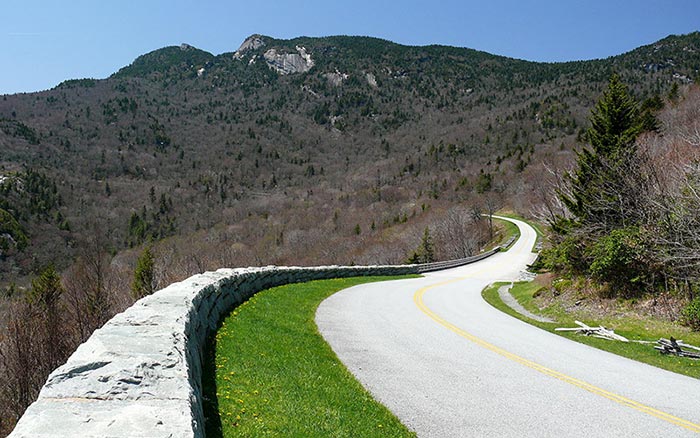
The Blue Ridge Parkway snakes around Grandfather Mountain near the Linn Cove Viaduct. Photo by Ken Thomas.
Here in Vermont there’s an interesting political race going on for governor, and it relates to our subject matter in that the contest might hinge, in some small but possibly significant way, on ridgetop wind turbines and the associated issues of renewable energy and land use and ecosystem health. In what is to some a quirky twist of political stereotypes, the Democrat in the race supports ridgetop wind installation and counts wind developers as donors, while the Republican has said he would ban ridgetop wind development and double down on solar and research into yet-to-be-perfected alternative energy technologies, like batteries capable of storing and distributing power on demand.
Most Vermonters probably do not count wind energy as their primary motivation for going to the polls, but because the race is so close, and because a small but very passionate minority are single-issue voters, some pundits who know more about politics than I do are suggesting that the anti-wind vote could be what puts the Republican over the top. A recent letter to the editor in my local paper put it this way: “I usually vote Liberal Progressive Democrat...[but] I'll be voting the Green Mountain P(R)otection Party for Governor this time around, thank you very much.”
The whole thing reminds me a little bit of the debates over the Green Mountain Parkway that took place in Vermont 80 years ago. The Parkway was an ambitious New Deal idea that would have put unemployed people to work building a “skyline drive” across the spine and flank of the Green Mountains from one end of the state to the other; there was also a conservation component in that the road would have had a 1,000 foot right-of-way around it – the “park” in the parkway.
If you’ve ever been to the Blue Ridge Parkway in Virginia, that’s what they wanted to do in Vermont. Proponents – many of them Roosevelt Democrats – said the project was going to create jobs, preserve the environment by putting more land under federal control, and keep young people in the state by giving them high-minded employment in log cabin rest stops, like the ones where Socrates used to work. (William Wilgus, one of the planners, wrote: “Along this lofty scenic route I envision year-round cultural, recreational, and spiritual centers, akin to those of ancient Greece, in which attractive occupations thereby offered young Vermonters would hold them to their native heath.”)
Opponents included conservations like Aldo Leopold (“I can assure you that any desire on my part to revisit the Green Mountains would be forever canceled and destroyed if your state goes ahead with this road.”) and the Green Mountain Club – the group that created and maintains the Long Trail. But there was also resistance from anti-New Deal Republicans who resented big federal government programs and small business owners who didn’t want to see their businesses bypassed as tourists motored across the mountains.
Over the years, historians from across the political spectrum have weighed in on what the vote to reject the Green Mountain Parkway meant. Some hold that Vermonters were simply acting with fiscal-prudence by rejecting “quick fix” federal schemes. Others, lately, have been pushing revisionist interpretations that suggest the anti-Parkway vote had a provincial, even anti-Semitic component, and was more about keeping outsiders out. I find Hannah Silverstein’s take – published in a 1995 edition of Vermont History magazine – to be the fairest and most commonsensical. She concludes that: “Those who appreciated the aesthetics of the built environment had little trouble supporting the proposal to build a parkway . . . Vermonters who fought and voted against the parkway could not reconcile their ideal of ‘unspoiled’ nature with a permanent, artificial structure .
If the battle were being fought today, the opponents’ arguments would be full of data about ecosystems and environmental impact, issues that concern more than the human world. Those arguments were not well formulated in the 1930s. Opinions about the parkway were mediated through individual beliefs about how nature and civilization should interact. For better or worse, Vermonters decided that a scenic parkway was not the best use of their mountain landscape.”
There are big differences, of course, between windmill development in 2016 and Parkway development in 1936. But I think Silverstein’s analysis remains relevant to at least some aspects of today’s wind debate
Northern Ontario, Canad Wolfpack caught on trailcamera
Add Coyotes-Wolves-Cougars Link To Your Igoogle Homepage
A New Jersey Eastern Coyote unable to take a fawn
Blogger Rick
Strategizing at the WB
Let Rick and other readers know you're a fan of this blog...Become a Follower!
Making a Pitch at the WB
Two Massachusetts Eastern Coyotes at their den site
Eastern Wolf in Algonquin Provincial Park, Ontario, Canada
Gray Foxes(unlike Red Foxes) can climb trees--an advantage when pursued by Coyotes
Aldo Leopold--3 quotes from his SAN COUNTY ALMANAC
"We abuse land because we regard it as a commodity belonging to us. When we see land as a community to which we belong, we may begin to use it with love and respect."
Aldo Leopold
"A thing is right when it tends to preserve the integrity, stability and beauty of the biotic community. It is wrong when it tends otherwise."
Aldo Leopold
''To keep every cog and wheel is the first precaution of intelligent tinkering."
Wildlife Rendezvous
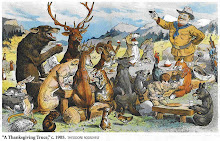
Like so many conscientious hunters and anglers come to realize, good habitat with our full suite of predators and prey make for healthy and productive living............Teddy Roosevelt depicted at a "WILDLIFE RENDEZVOUS"


 CDFW scientists and submitted to the University of Idaho's Laboratory for Ecological, Evolutionary and Conservation Genetics. Genetic analysis of the samples confirmed the presence of a male and a female gray wolf. There is no evidence - such as images, tracks, scat or reported observations - suggesting the wolves had pups this year.




 Posts
Posts