Visitor Counter

hitwebcounter web counter
Visitors Since Blog Created in March 2010

Click Below to:

Add Blog to Favorites

Coyotes-Wolves-Cougars.blogspot.com

Grizzly bears, black bears, wolves, coyotes, cougars/ mountain lions,bobcats, wolverines, lynx, foxes, fishers and martens are the suite of carnivores that originally inhabited North America after the Pleistocene extinctions. This site invites research, commentary, point/counterpoint on that suite of native animals (predator and prey) that inhabited The Americas circa 1500-at the initial point of European exploration and subsequent colonization. Landscape ecology, journal accounts of explorers and frontiersmen, genetic evaluations of museum animals, peer reviewed 20th and 21st century research on various aspects of our "Wild America" as well as subjective commentary from expert and layman alike. All of the above being revealed and discussed with the underlying goal of one day seeing our Continent rewilded.....Where big enough swaths of open space exist with connective corridors to other large forest, meadow, mountain, valley, prairie, desert and chaparral wildlands.....Thereby enabling all of our historic fauna, including man, to live in a sustainable and healthy environment. - Blogger Rick

Subscribe via email to get updates

Enter your email address:

Receive New Posting Alerts

(A Maximum of One Alert Per Day)

Wednesday, September 13, 2017

As you Blog readers might recall, Long Island, NY is the last bastion in the Americas where there(to our knowledge) is not a breeding colony of Coyotes........Our "Songdogs" are found in every state, except Hawaii, every Canadian province, and every Central American country except Panama............And we were on the verge of this changing last Summer when a breeding pair(likely emigrating out of the Bronx or Westchester County, NY) took up residence in Queens at the Laguardia Airport..............Of course, Airport Officials went right ahead and killed the breeding pair, their 8 pups and a non breeding adult as if they were vermin----NOT!.................Back in 2011, a lone Coyote was photographed(picture below) on the South Fork of Long Island and it is believed that this "lone wolf" is still making a living as a bachelor(bachelorette) out that way-----Seen this past Summer outside of Southhampton!............There will be more attempts made by the 4 breeding Coyote pairs in the Bronx to make it to the Long Island............The majority of the pups of the year leave their natal territories in the Fall seeking out mates and territories of their own to fill............Like New Jersey(3000 Coyotes during Sumer months, 1500 in Winter), suburban Long Island offers Coyotes a smorgasboard of eateries--rabbits, squirrels,raccoons, rodents of all kinds, Canadian Geese eggs, et al...........Stay tuned for the next Coyote "mad dash" to the Island


https://www.google.com/url?rct=j&sa=t&url=http://www.27east.com/news/article.cfm/East-End/532906/Long-Island-Coyote-Update&ct=ga&cd=CAEYACoUMTYzMzgwMzY4MjY2NTYxMjIwMjAyGjI5OGRhMGI0Mzc5N2FiZmI6Y29tOmVuOlVT&usg=AFQjCNGh0KtYjUaf6AeNrXK0iNA


Sep 11, 2017 Publication: The East Hampton Press & The Southampton Press
Mike Bottoni

Long Island Coyote Update


Last year marked the first time that a pair of coyotes successfully bred on Long Island, producing a litter of eight pups in a den near LaGuardia Airport in Queens.Although coyotes can live as long as 14 years in the wild, their average life expectancy is six to eight years. The Queens crew did not last nearly that long. Airport officials decided that the coyotes posed a threat to their employees, and ordered all eight pups, the breeding pair and a sub-adult “helper” coyote—11 animals in all—trapped and killed. According to Chris Nagy of the Gotham Coyote Project (gothamcoyote.com), 10 were disposed and one managed to elude capture.


The lone Coyote on the South Fork of Long Island(2011 photo)
Dell Cullum was able to shoot the elusive coyote on the farm that lines the corner of Scuttle Hole Road and Day Lily Lane in Bridgehampton. DELL CULLUM

This was longtime coyote advocate and founder of the Wild Dog Foundation Frank Vincenti’s worst nightmare. Frank has been working hard to educate the general public, and public officials, on how to co-exist safely with coyotes, and he spent many nights observing the Queens pups over the summer and fall of 2016. Vincenti noted that there were no incidents that justified destroying the animals.

Today, the coyote (Canis latrans) is widely distributed throughout North and Central America. It is found in every state, except Hawaii, every Canadian province, and every Central American country except Panama.

Long Island is the largest island in the United States outside of Hawaii and Alaska, and remains the only major island in the coyote’s current range that has not been completely colonized by breeding pairs.

Coyote family in the Bronx


Coyotes have resided in the Bronx since 1994, and today there are four breeding pairs documented by wildlife researchers in that borough of the Big Apple. Making their way from the Bronx, which is situated on the mainland adjacent to some significant greenbelts in Westchester County, and across the Harlem and East Rivers to Manhattan Island and Long Island is a bit more challenging. But neither is an insurmountable obstacle for this wily and adaptable creature.

Off the tip of the other end of Long Island lies Fishers Island, another home to coyotes including at least one breeding pair. This small island, although situated much closer to (within two miles of) the Connecticut and Rhode Island mainland, is a portion the Town of Southold and Suffolk County. Fishers Island’s closest point on Long Island is Orient, 11 miles away. That route includes an archipelago of small islands with a maximum open water span of 4.6 miles and strong currents at “The Race” and “Plum Gut.” Even utilizing the archipelago of islands as resting and feeding stops, it is a formidable swim for a coyote.

Out here on the South Fork, an apparently solo coyote was first sighted in 2011 by Scott McMahon north of Water Mill and photographed by Rick Wesnofske two years later in 2013. It has been photographed and videoed several times since between there and Wainscott, including a video shot this year just north of Southampton Village.

Is this a single individual, or has another coyote made a home on the East End? Dell Cullum, a professional photographer who is very knowledgeable and experienced in wildlife matters, and one of the few people who had photographed the South Fork coyote, surmises that the photos are of the same individual. Depending on how old the coyote was when it reached the South Fork, it is at least seven years old. Will it hang on until a mate arrives?

It is simply a matter of time before this wily and adaptable creature thrives here on Long Island, where a huge banquet of deer, geese, feral cats, raccoons and rodents awaits. This raises some interesting questions that a group of wildlife biologists from the American Museum of Natural History, Hofstra University, and Brookhaven National Laboratory hope to answer by establishing some ecological monitoring stations throughout the island.

The Coyote family killed by Laguardia Airport Officials
(Truly hypocritical that we demonize the killing of
African Lions, while allowing killing of our wildlife)
Image result for coyotes trapped and killed at laguardia airport

What types of habitats will the coyotes initially utilize on Long Island? What impacts will they have on our deer population, and what will be the cascade impact on the vegetation deer browse and the ticks that use deer as a host? Will our red fox population decline, will it cease its wild fluctuation cycles, and will we continue to witness the dramatic cases of mange among our red foxes? Will our feral cat colonies disappear? Will the coyote hinder ground nesting birds and shorebirds through predation, or will they help these species by reducing fox, feral cat and raccoon predators?

And how will Long Islanders deal with this new species? One of the biggest challenges the “trickster” faces here are the folks who feel that wildlife need handouts. Feeding coyotes can result in some serious problems. As with all our non-domesticated fauna, keep the “wild” in wildlife and please refrain from feeding them.
-------------------------------------------------

https://www.google.com/url?sa=t&rct=j&q=&esrc=s&source=web&cd=1&cad=rja&uact=8&ved=0ahUKEwivzYnJwaPWAhUT0IMKHfluABUQFggoMAA&url=http%3A%2F%2Fnymag.com%2Fdaily%2Fintelligencer%2F2015%2F05%2Fcoyotes-new-york-city.html&usg=AFQjCNGYCPIkp_iRJAa963E64OP-aT1ZRA

Why Coyotes Are Flourishing in New York City

Jen Kirby; May 2015

 Where Are They?
Motion-detecting coyote cams installed by Nagy and Weckel have established that they live in four parks: Van Cortlandt, Pelham Bay, Ferry Point (all in the Bronx), and Railroad Park (in Queens). Human observers have seen them in Central and Riverside parks as well as Battery Park City, La Guardia Airport, Co-op City, and even Stuy Town
 Human observers have seen them in Central and Riverside parks as well as Battery Park City, La Guardia Airport, Co-op City, and even Stuy Town. In 2010, one was spotted by the Holland Tunnel and captured after a wacky chase through Tribeca.


Tuesday, September 12, 2017

This one comes under the headline of RIPLEY'S BELIEVE IT OR NOT---A woman driving to Calgary(Canada) from her home in Airdrie going highway speeds, slams into a Coyote crossing the road,,,,,,,,,,,,,,,,The woman assumes the Coyote is dead and keeps driving...................100km(62 miles) later as she gets out of the car in Calgary, what does she see stuck inside the grill in front of the car?..................The Coyote, embedded inside the metal grill but awake and seemingly uninjured.................And sure enough, after the Wildlife biologists and Emergency Crews freed him, the Coyote was pronounced "fit as a fiddle",,,,,,,Returned to one of the open spaces in the Provincial Parks outside the City.................."In many Native American origen stories, the Coyote is known for his crafty intelligence, stealth and voracious appetitite, a "comic trickster whose sometimes risk taking behaviour gets him into trouble while ultimately his cleverness gets him back out"...................I would say this episode of surviving a direct car hit reinforces all of these characteristics that Indians saw in our SONG DOG-THE COYOTE

https://www.google.com/url?rct=j&sa=t&url=https://www.kamloopsbcnow.com/news/news/National_News/Miracle_coyote_hit_by_car_on_Alberta_highway_safely_travels_30_km_in_car_s_grill/&ct=ga&cd=CAEYASoUMTEyODY0MTQyODc5OTQ1NTkxMjMyGmY1MDlhNmI0NGUzZGM2ODk6Y29tOmVuOlVT&usg=AFQjCNG0mK9kUG7ZOFEHzmKUB8Y8S5Re1


Miracle coyote hit by car on Alberta highway, safely travels 30 km in car’s grill

Josh Duncan Sept 11, 2017

Coyotes may not be part of the feline family, but one of them certainly has nine lives.
Georgie Knox was travelling from Airdrie to Calgary for work recently when she hit that particular coyote with her car.

Airdrie is North of Calgary on the map below
Image result for airdrie and calgary on the map
“Last week, on my way to work in the early morning, a coyote darted in front of my car and I hit it,” Knox explained on a Facebook post about the incident. “I heard a crunch and believed I ran over and killed it.”
<who>Photo Credit: Georgie Knox on Facebook
When she arrived in Calgary, however, a
 construction worker 
pointed out to Knox that she had a hitchhiker.
“Upon stopping at a traffic light by my work, 
a construction woman
 notified me that there was in fact a coyote 
still embedded in my 
car,” said Knox. “When I got out to look,
 this poor little guy was
 looking up and blinking at me.”
The poor animal was stuck in the grill of Knox’s
 vehicle and
 despite the crazy nature of the incident, didn’t 
appear to be 
too badly injured.
<who>Photo Credit: Georgie Knox on Facebook
Photo Credit: Georgie Knox on Facebook

Knox called Alberta Fish and Wildlife
Enforcement, 
who sent an officer to check out and
deal with the
 coyote.
“Miraculously, he was freed and had
 minimal injuries
 despite having hitched a ride from
Airdrie to Calgary
 at highway speeds,” Knox’s
Facebook post said. 
“Their biologist checked him
over and gave him
 the good to go.”
The coyote was released in
 Kananaskis, which is
 just over 100 km away from
Airdrie and right on
 the edge of multiple provincial
 parks.
Knox called Alberta Fish and
 Wildlife Enforcement,
 who sent an officer to check
out and deal with 
the coyote.
“Miraculously, he was freed
 and had minimal 
injuries despite having hitched a
 ride from
 Airdrie to Calgary at highway
speeds,” Knox’s 
Facebook post said. “Their biologist
 checked
 him over and gave him the good
to go.”
The coyote was released in
 Kananaskis, which
 is just over 100 km away from
Airdrie and 
right on the edge of multiple
 provincial parks.

Monday, September 11, 2017

Are you a person who feels the impact of both the place that you reside in and the season of the year?..............As an October baby, I know that I am a "PLACE AND SEASON PERSON" for sure, reacting to the smells, sounds, landscape, people and wildlife around me with primal intensity as one season passes to the next................As NORTHERN WOODLANDS MAGAZINE Editor Dave Mance states so knowingly- "Some months, like some people, have a very strong sense of who and what they are".........Read his column below and see if you agree with his description of you based on birthday and "place"

http://r20.rs6.net/tn.jsp?f=001UfLwZhI9a35eVQnWGNTW3b2MSWnLQc9p6g1UBpg5Npgfql3rrKRQdPBW-nYbOIr2Xsq42yQLxZnXtRyfYl2ch4SrOguQulJFIvHQPKUUnfL3uItY1GZrPjdBPwaTaK1Z0yAcwF2RjM_uwvP8v6lhy5qDuYtOdtDhW8Zyovhh-Z-wFWYNDXpbi4ND4NdraTPDR9FBS2EL_r7Q-y_Fr15qYDiSPba2zbvNQwRc7WCtnIQ=&c=eywZJz6sHJCex-ELJ3lWvpgjom_7aQfUQrPK9qWKyeaK341-SfRbkw==&ch=3FZwC-h6Zf6BLJwgou5pgBYIls_olHQd_f5VD9TLhMAFDgZeybQ_MQ==


997
On September
Some months, like some people, have a very strong sense of who and what they are. May is spring. July and August are summer. October is fall. January, February are winter. If these months had a hair style it would be a crewcut. If they had a political philosophy it would be conservative. There’s a roadmap to life, and by jingles they’re going to follow it.
On the flip side are months like April and November, who feel constrained by labels and seek over and over again to redefine themselves. Might be 70 and sunny, or there might be a foot of snow. These months wouldn’t have one hair style or even one hair color.
Some months are demure middle children who can’t get out of their older sibling’s shadow. March is pre-April. June is pre-July. December is pre-January. Yes, they sometimes rebel but it’s usually muted and kind of cute. They don’t demand attention like their louder siblings.
Which leaves us with September. You might say 
that it’s a kind of pre-October, but where I live, anyway, its average daytime high (70 degrees) is much closer to August (78 degrees) than it is to October (59 degrees). It’s hard to call 70 degrees fall, and yet September is clearly not a summer month, that clarity based not so much on what you feel on your skin but by what you sense. There are more mice, and chipmunks, and squirrels than there used to be. Fewer birds. More traffic on the roads but fewer children in town during the day. Things are quieter.
The back, unmowed meadow is obscene: waves of goldenrods and ragweed and milkweed and vetches breaking into brambles and young sumac spears and squat dogwood sprawls, the edges full of vines that smother whatever they’re growing on; you don’t even want to walk into it – it looks like you’d never emerge again; plus the riotous smells, the pollen perfumes and pleasant herbal aromas cut with something dank and musty, in places hints of vinegar and other acidic tangs. And yet with this jungle as a backdrop you notice, in the mowed section of the lawn, that the texture of the grass is different. In the shady sections it’s not growing anymore. The shadows are longer. Mist pools in the valleys on the cool mornings now. If you’ve lived through an autumn in the Northeast before you’d recognize the purples in the Virginia creeper foliage, the first reds in the swamp maple foliage, and see them as a harbinger of what’s about to unfold. But even if you didn’t know this, you’d sense something was afoot.
I guess in human terms September is the intelligently quiet guy or gal in the corner. They don’t say a lot, but when they do speak you lean in because whatever they say will be worth hearing.

Sunday, September 10, 2017

For those living where a freezing Winter is a yearly phenomenon, have you ever wondered where the Frogs go to stay safe and warm?,,,,,,,,,,,,"Some frog species burrow into the mud at the bottom of the pond, insulating themselves against freezing air temperatures, but wood frogs have evolved a different strategy"............ "They accept a frozen fate by digging down into a couple of inches of leaf litter"............."Although the wood frog has been the most extensively studied, other amphibians also possess this ability to tolerate freezing: the gray tree frog, spring peeper, and chorus frog, along with one species of Siberian salamander, the immature spotted turtle, the eastern box turtle, the pond-slider turtle, and the garter snake, as well as numerous invertebrates"............."The Wood Frog and these other creatures survive by turning glycogen into glucose, which serves as antifreeze",,,,,,,,,,,,,,,,. "Blood glucose can increase up to 200-fold in response to freezing".......... "Besides manufacturing antifreeze, freeze-tolerant frogs are able to evacuate water from major organs, thus reducing the formation of ice in these critical areas"..........."Up to 65 percent of the frog’s body-water in the intercellular spaces can freeze without causing damage"....................... "The glucose, meanwhile, keeps the water remaining inside the cells from freezing".................. "One strange twist in the process is that as water turns to ice, heat is given off, and it is this heat that saves the frogs from cooling too rapidly"...................... "They can freeze, but they mustn’t freeze too fast!".................Might Medical Researchers one day replicate some of this "freezing survival anti-freeze" paradigm and apply it to preserving human limbs,,,,,,,,,,,,,or some type deep freeze sleep process for Astronauts?

http://northernwoodlands.org/outside_story/article/frogs-withstand-winter-by-freezing

Frogs Withstand Winter by Freezing


1
Frogs Withstand Winter by Freezing
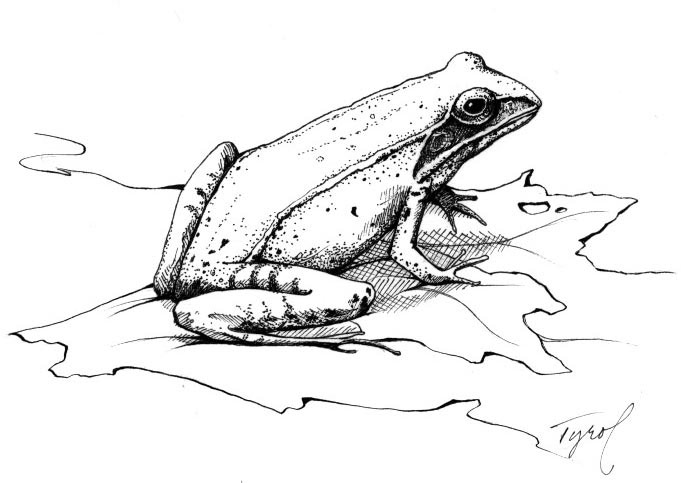
Illustration by Adelaide Tyrol
It was a busy summer in the pond at the foot of my hill. Hundreds of wood frogs mated there. I watched their eggs hatch, watched as tadpoles grew up, got legs, lost tails, and headed for the woods for which they are named. There, I assume, they spent the summer and fall fattening up on insects. But where are they now that there is no more food to be found and ice and snow have covered the ground?
Some frog species burrow into the mud at the bottom of the pond, insulating themselves against freezing air temperatures, but wood frogs have evolved a different strategy. They accept a frozen fate by digging down into a couple of inches of leaf litter.
Samuel Hearne, journeying in the Arctic in 1769-1772, described them: “Frogs of
various colours are numerous in those parts as far North as the latitude 61 degrees…. I have frequently seen them dug up with the moss, frozen as hard as ice; in which state the legs are as easily broken off as a pipe-stem… but by wrapping them in warm skins, and exposing them to a slow fire, they soon recover life.” He was likely referring to our wood frog, Rana sylvatica, found both in the Arctic and here in northern New England.
Although the wood frog has been the most extensively studied, other amphibians also possess this ability to tolerate freezing: the gray tree frog, spring peeper, and chorus frog, along with one species of Siberian salamander, the immature spotted turtle, the eastern box turtle, the pond-slider turtle, and the garter snake, as well as numerous invertebrates.
As you can imagine, freezing is tough on most creatures. Ice crystals damage cells, causing them to rupture and collapse. Toxins build up in cells and cause nervous system dysfunction. Increased heart rates and damage due to rapid cooling are also potential hazards that could lead to death.
This does not seem to intimidate the wood frog, which, unlike humans in the Northeast, does very little to prepare for the long cold winter. The single preparation this frog makes is to store glycogen in its liver. In the fall, these animals may harbor 2-10 times more of this substance than pond-hibernating species.
Once temperatures drop below freezing, and water just inside the skin of the frog starts to freeze, the wood frog rapidly transforms this glycogen into glucose, which serves as antifreeze. Blood glucose can increase up to 200-fold in response to freezing. Besides manufacturing antifreeze, freeze-tolerant frogs are able to evacuate water from major organs, thus reducing the formation of ice in these critical areas. (Some plants have a similar ability to protect sensitive tissue.) Up to 65 percent of the frog’s body-water in the intercellular spaces can freeze without causing damage. The glucose, meanwhile, keeps the water remaining inside the cells from freezing.
One strange twist in the process is that as water turns to ice, heat is given off, and it is this heat that saves the frogs from cooling too rapidly. They can freeze, but they mustn’t freeze too fast!
Frozen dissected frogs appear dead. There is no sign of breathing or blood flow. Organs appear bloodless. Heartbeats are absent or intermittent. If there is a mid-winter thaw (or, in the case of Samuel Hearne, warm skins and a blazing fire), glucose levels subside and the frog thaws. The organs with the highest glucose levels (liver, heart, kidney) thaw first, allowing metabolism to start back up. This process can fluctuate back and forth throughout the winter. Because thawing is slower than freezing, and because there is usually a nice thick blanket of insulating snow, the frogs are not likely to thaw many times during the winter.
The temperature to which frogs freeze and the length of time they remain frozen is crucial. One hundred percent will survive frozen to –1.5 degrees C for 14 days, but only 50 percent will survive at this same temperature for 28 days. None will survive temperatures as low as –30 degrees C. A cold winter with no snow, therefore, would be devastating to the local wood frog population.
It is not clear why some frogs have evolved this freezing strategy. Maybe there is some danger that lurks for them under the protection of an ice-covered pond, leading them to choose a different winter home. Or maybe they couldn’t stomach the idea of being trapped under a foot of ice all winter with a bunch of bull frogs. Either way, they have what it took to develop the mechanisms needed to withstand freezing.

Tii McLane is a forest ecologist from S. Strafford, Vermont.

Friday, September 8, 2017

"What manner of beast is the Eastern Coyote?".............. "It is the most adaptable, the most intelligent, the most resourceful wild animal in America".............. "Not only is the coyote a functioning part of the wild Northeast but also it has redefined the roles of many other animals"...................... "The coyote eats deer and wild turkey, yet both species thrive"................. "The coyote doesn’t eat red fox or bobcat, yet both predators suffer in its presence, having to make their living on the perimeters of Coyote territories, much the same way Wolves pinch the range of Coyotes in our Western States"........."Gray Foxes escape Coyotes by climbing trees,,,,,,,,,,As the Red Fox is not able to do the same, it runs when chased-----and Coyotes run faster than the "Reds"..........."It communes with ravens and train whistles and sirens, and its yipping falsetto gives meaning to a winter night"................... "The coyote is neither predictable nor sacred, and is blamed for everything but the weather"..................."Vermont supports between 3-4,000 coyotes in the summer"................ "After mortality and dispersal have taken a toll, the population shrinks to between 1,500 and 2,000 during the winter"

http://northernwoodlands.org/outside_story/article/the-coyote-is-here-to-stay


The Coyote is Here to Stay
Illustration by Adelaide Tyrol
One recent winter morning, when I awoke at dawn and glanced out our bedroom window, a nervous coyote slipped from the woods – crouching, tail tight between its hind legs like a naughty dog – and walked tentatively to my mammal feeding station in the side yard. The coyote stood for some time, eyes fixed on the woods, before he gathered the courage to chisel bits of meat from the rock-hard deer carcass. Grabbing my binoculars, I hurried downstairs for an eye-level look.

click to see a Eastern Coyote in
Swanton, Vermont woodlands last week
https://www.youtube.com/watch?v=WRfoz7PBfxI

Swanton, Vermont (in red)

Location in Franklin County and the state of Vermont.
What manner of beast is the coyote? It is the most adaptable, the most intelligent, the most resourceful wild animal in our area, if not all of America. Not only is the coyote a functioning part of the wild Northeast but also it has redefined the roles of many other animals. The coyote eats deer and wild turkey, yet both species thrive. The coyote doesn’t eat red fox or bobcat, yet both predators suffer in its presence. It communes with ravens and train whistles and sirens, and its yipping falsetto gives meaning to a winter night. As a recent immigrant to Vermont, the coyote is neither predictable nor sacred, and is blamed for everything but the weather.
Before Europeans carved up the eastern forests and the heartland prairies, the coyote was more or less confined to desert and scrubland. It lived in regions that either did not support a population of gray wolves, or it lived furtively in the landscape cracks between adjacent wolf packs. Once the East had been cleared and grasslands plowed, wolves were virtually exterminated. Then, coyotes began to make a bold and innovative move eastward.

Female Eastern Coyote in Vermont


On October 24, 1944, a fox hunter in Holderness, New Hampshire, shot a coyote, the first ever recorded in New England. Four years later, one went down in Vermont. By the 1960s, coyotes had become established in northern New England, and by the 1990s, a few individuals began appearing in seemingly unlikely corners of the Northeast: downtown Boston and Central Park in New York City. Today, Vermont supports between 
three and four thousand coyotes in the summer. After mortality and dispersal have taken a toll, the population shrinks to between 1,500 and 2,000 during the winter. 
Eastern coyotes are much more secretive than their western cousins. They prefer the woods to the meadows, the night to the day, and do not as often broadcast their exuberance.
Once the day began to lighten, my side-yard coyote hitched his tail between his legs and slunk back into the woods. In his absence, a pair of ravens, which had been visiting the carcass for the past several days, flew in to feed. According to Bernd Heinrich, University of Vermont biologist and author of Ravens in Winter, ravens circling high above a carcass often alert coyotes to the imminent possibility of food; if a carcass is unopened, feeding coyotes chew through the hide, which provides an access point for hungry ravens. In turn, ravens cache pieces of meat, which coyotes often track down and consume.


Another Vermont Eastern Coyote


Fifteen minutes after a pair of ravens appeared on the carcass, a gray fox drove them off. The fox seemed unconcerned that the scent of a coyote littered the area; it fed in daylight and even napped in the open. Although gray foxes appear to be holding their own, eastern coyotes have had a profound impact on red foxes, killing them or driving them out of their home ranges, forcing them to live in the narrow zones between adjacent coyote packs, much the same way wolves pinch the range of coyotes. The opposing fates of the two foxes appears to be a byproduct of species-specific behavior. When threatened, a gray fox climbs a tree or hides in a burrow. A red fox runs. And coyotes run faster.
Eastern coyotes have also displaced bobcats, though not by running them down. Coyotes, by virtue of their catholic feeding habits, are much more common than bobcats, which are strictly carnivores. Before 
settlement, wolves and catamounts stole prey from bobcats. In the absence of the big predators, Vermont’s bobcat population peaked by the 1930s and 1940s. Since the arrival of the carcass-stealing coyote, bobcat numbers have been in decline.
Make no mistake about it, the eastern coyote is a predator; it kills fawns in spring and early summer and adult deer in the winter, particularly in deep snow. Faced with several thousand hungry coyotes, however, Vermont’s deer herd has steadily grown since the early 1980s. In fact, I believe deer need an effective predator – wolves for instance – to help control their numbers. Until the wolves return or are returned to Vermont and New Hampshire, however, I’ll enjoy my chance encounters with the eastern coyotes - survivalist extraordinaire.

Ted Levin is a naturalist and freelance writer living in Thetford Center, VT.

Thursday, September 7, 2017

A 2nd Summer "prospecting" Puma, likely starting his trek into Iowa out of either the Dakotas, Nebraska or Wyoming is wandering though Buena Vista County..........While not a protected species in Iowa, Officials at this point are not looking to kill the Lion,,,,,,,,,,,,,,,,,,In June, the first female mountain lion found in Iowa in over 100 years was killed in neighboring Ida County, about 30 miles from Buena Vista................. Since 1995, there have been 22 Pumas in Iowa confirmed by the Department of Natural Resources.....,,,,,Let us hope that this hands-off policy continues


Sept. 6, 2017

Yes, there is a mountain 

lion roaming in Iowa

A mountain lion has been spotted in Linn Grove and is confirmed
 to be roaming in northwest Iowa.
Aaron Anderson of Linn Grove, Ia., caught a mountain lion on his trail camera
 footage on Aug. 31, 2017, in the Buena Vista County town.
Vince Evelsizer, a furbearer biologist with the Iowa Department of 
Natural Resources, told the Register on Wednesday that a mountain
 lion was reportedly seen in southwest Clay County a few weeks ago.
"We don't know if that's the same cat or a different one," he said.
 "This is all fairly random when they typically show up."
Aaron Anderson of Linn Grove caught a mountain lion on trail 
camera footage in the tiny Buena Vista County town, which is 
about 22 miles south of Clay County

Buena Vista County(red) in Northwest Iowa
Image result for buena vista county iowa
In June, the Iowa Department of Natural Resources killed a
about 40 miles from Buena Vista County. Evelsizer said the
 DNR isn't planning to seek it out unless there's "a perceived
 threat to human safety" like the last cat.


The female Puma that was shot and killed
in June in Ida County


"The cat is staying out of trouble," Evelsizer said. "Respect 
for the animals whenever and wherever possible is a first 
priority. We highly encourage folks to give them their space.
 And they often are so secretive they keep to themselves."
Since 1995, there have been 21 mountain lions in Iowa 
confirmed by the DNR. Evelsizer said DNA results from the
 mountain lion killed in June indicated that it originated from
 Wyoming.

Ida County where the female Lion was shot dead in June

Image result for ida county iowa
 Mountain lions in Iowa generally come from 
western South Dakota and Nebraska.
Mountain lions are not listed as a furbearer and have no
 protected status in Iowa