Visitor Counter

hitwebcounter web counter
Visitors Since Blog Created in March 2010

Click Below to:

Add Blog to Favorites

Coyotes-Wolves-Cougars.blogspot.com

Grizzly bears, black bears, wolves, coyotes, cougars/ mountain lions,bobcats, wolverines, lynx, foxes, fishers and martens are the suite of carnivores that originally inhabited North America after the Pleistocene extinctions. This site invites research, commentary, point/counterpoint on that suite of native animals (predator and prey) that inhabited The Americas circa 1500-at the initial point of European exploration and subsequent colonization. Landscape ecology, journal accounts of explorers and frontiersmen, genetic evaluations of museum animals, peer reviewed 20th and 21st century research on various aspects of our "Wild America" as well as subjective commentary from expert and layman alike. All of the above being revealed and discussed with the underlying goal of one day seeing our Continent rewilded.....Where big enough swaths of open space exist with connective corridors to other large forest, meadow, mountain, valley, prairie, desert and chaparral wildlands.....Thereby enabling all of our historic fauna, including man, to live in a sustainable and healthy environment. - Blogger Rick

Subscribe via email to get updates

Enter your email address:

Receive New Posting Alerts

(A Maximum of One Alert Per Day)

Saturday, March 10, 2018

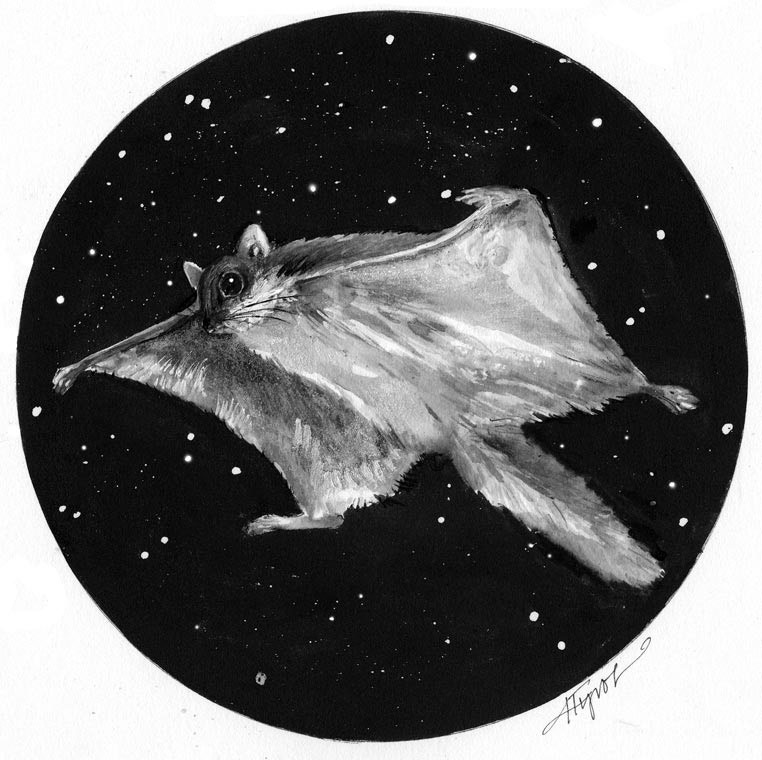
Our two Flying Squirrel species have an interesting eons-old life story............"The evolutionary divergence of the northern flying squirrel (Glaucomys sabrinus) from the southern flying squirrel (G. volans) is an excellent example of speciation resulting from environmental change"............"During the late Miocene about 5 million years ago, a forested landbridge connected Asia with America, explaining how the ancestor of both American species of flying squirrels colonized this continent"... .........."The smaller, Southern "Flyer" became an acorn eater and dominated lower elevation Oak-Hickory-Chestnut forests and the larger(3-5 oz.) Nothern "Flyer became a fungi eaters(truffles) and dominated higher elevation Spruce Forests"................"There is an interesting ecological interdependence between Northern Fying Squirrels, red spruce, and several species of fungi(truffles)"........... "Truffles grow intertwined with the red spruce roots, and they exchange nutrients"..............."The 'Northern Flyers' eat the truffles and spread their spores throughout the forest in their droppings"............. "A healthy spruce forest requires an abudance of truffles"............. "Many red spruce forests have been logged, and without the Northern Flying Squirrel’s help as a 'spore disperser', trees such as oak, maple, beech, and cherry are replacing the spruce"........"And in these secondary hardwood forests, the Southern Flying Squirrel has the mast it needs to outmultiply and replace the Northern Flying Squirrel"............."Additionally, The Southern Flying Squirrels carry an intestinal parasite, unknown in northern squirrels in places where there are no southern flying squirrels".......... "Where the two species overlap, the parasite may be harming the northerns directly, or the parasite may be altering the northern squirrel’s internal ecosystem, allowing other, previously harmless parasites to join forces with the newly introduced parasite, a double edged 'death blow' to to Northern Flying Squirrel".............The two Flying Squirrels story is another example of the magnificence of "Nature's Design", and how, when altered by human animals land clearing regimines, adversely impact the long standing rough equilibrium between two long enduring cousin species"


https://northernwoodlands.org/outside_story/article/flying-squirrels

Flying Squirrels: North vs. South


126
Flying Squirrels: North vs. South
Illustration by Adelaide Tyrol
The calls come in all winter, said Paul DeBow of DeBow Wildlife Service in Plymouth, New Hampshire. If there is no snow, the peak will be in January or February, when it’s the coldest. Some people think the animals they hear partying in the attic are chipmunks, he says. Chipmunks in the attic in the middle of winter. But they are not.
Chipmunks, DeBow explained, hibernate in winter and what homeowners are probably hearing are flying squirrels. Because flying squirrels are nocturnal, few people ever see them.
There are two species of flying squirrels in our area, the northern flying squirrel and the southern flying squirrel. John Litvaitis, professor of wildlife ecology at the University of New Hampshire, said that the southern flying squirrel is the smaller of the two, often weighing just two or three ounces. “The northern flying squirrel [at three to five ounces] may be half again or may be twice as big as the southern,” he said.


But even the northern flying squirrel is smaller than a red squirrel. The southern flying squirrel is about the size of, yes, a chipmunk (which is a ground squirrel). Both species of flying squirrels can be distinguished from other squirrels by their patagium, the membrane between their front and rear legs that allows them to glide (not fly).
For all their similarities, the northern and southern flying squirrels are in a conflict that sounds a lot like war. “There was one paper that was titled something like, ‘The South Advances, While the North Retreats,” said Carolyn G. Mahan, professor of biology and environmental studies at Pennsylvania State University, Altoona, and a squirrel researcher.
Northern flying squirrels are creatures of conifer (cone-bearing tree) forests. “We know that northern flying squirrels depend on fungi that are associated with conifer forests,” she said. But southern flying squirrels can live anywhere. When conifers are cleared from a mountainside and homes are built, southern flying squirrels are happy to move in, bringing several more threats to the northerns. It’s not that the two species don’t get along; it’s that they get along too well. Squirrels of both species will pile into the same tree cavity on a cold winter night. Hybrids between the northerns and southerns follow.

NORTHERN FLYING SQUIRREL


The southern flying squirrels carry an intestinal parasite, unknown in northern squirrels in places where there are no southern flying squirrels. Where the two species overlap, the parasite may be harming the northerns directly, or, as Mahan’s research shows, the parasite may be altering the northern squirrel’s internal ecosystem, allowing other, previously harmless parasites to join forces with the newly introduced parasite.
The northern flying squirrel is in serious decline in the higher elevation forests of Pennsylvania, Virginia, West Virginia, and North Carolina. It is a state-endangered species in Pennsylvania. The Carolina flying squirrel, a subspecies, is federally endangered.
As the many phone calls to DeBow Wildlife Services suggest, northern and southern flying squirrels seem to be doing just fine in New Hampshire and Vermont, although it would be hard to tell if the southerners were overtaking the northerners as they are in other places. That mystery is the only reason both northern and southern flying squirrels are “species of greatest conservation need” in Vermont’s 2005 Wildlife Action Plan.

SOUTHERN FLYING SQUIRREL


Litvaitis did studies of flying squirrel habitat in the 1990s in New Hampshire. Southern flying squirrels are dominant along the seacoast and the southern 20 percent of the state, he said – basically anywhere you find acorns and hickory nuts. “As you get inland and northern, it flips to northerns,” he said. He assumes the pattern is similar in Vermont.
One of the more recent studies on flying squirrels done by Litvaitis’ students focused on the animal’s energy use. That patagium, or gliding membrane, exposes a lot of a flying squirrel to the elements. “Once the temperature got below freezing, they buddy up,” he said, for warmth. “There are real benefits.”
That buddying up can mean up to 50 flying squirrels in your attic during the winter, explained DeBow. “You can’t trap them out,” he said. “It’s like bailing a leaky boat.” Instead, he uses exclusion, using either a one-way door or a cone that discourages them from re-entering.
These are the same tools DeBow uses for bats, but when it comes to control, he likes flying squirrels better for a few reasons. One is because, unlike the region’s disease-decimated bats, flying squirrels seem to be thriving, at least in the region’s attics. He thinks the popularity of improperly screened ridge vents may be one reason.
The other reason is that they are so boisterous and noisy. DeBow never has to guess when he’s gotten the last flying squirrel to leave the party.

Madeline Bodin is a writer living in Andover, Vermont.

-------------------------------------------------------------------------------------

https://markgelbart.wordpress.com/2014/06/14/the-squirrel-conifer-fungi-connection/


The Squirrel-Conifer-Fungi Connection


The evolutionary divergence of the northern flying squirrel (Glaucomys sabrinus) from the southern flying squirrel (G. volans) is an excellent example of speciation resulting from environmental change.  Genetic studies suggest both of these American species of flying squirrels diverged from Eurasian flying squirrels between 4-6 million years ago.

During the late Miocene about 5 million years ago, a forested landbridge connected Asia with America, explaining how the ancestor of both American species of flying squirrels colonized this continent.  Genetic evidence suggests the 2 American species of flying squirrels diverged from each other early during the Pleistocene between 1-2 million years ago when Ice Ages began to become more severe.

 Boreal spruce forests expanded during Ice Ages, growing as far south as middle Georgia and Alabama. Spruce forests offer less food for squirrels–seeds from spruce cones are only available for 2 months of the year.  However, underground fungi, also known as truffles, are available year round in spruce forests.  For most species of squirrels, fungi is a minor component of their diet, but truffles and other fungi make up 85% of the northern flying squirrel’s diet whereas southern flying squirrels eat more acorns, nuts, berries, and animal matter.

 The ancestors of the northern flying squirrel were those individuals from the parent population best able to subsist on a diet of mostly fungi.  These individuals were able to colonize spruce forests, while the rest of the parent population remained in oak forests.  Eventually, this habitat partition resulted in a divergence between the 2 American species.
Photo: Northern Flying Squirrel, Glaucomys sabrinus.
Northern flying squirrels eat mostly fungi which is a minor component in most squirrel’s diet.  The ability to subsist on a diet of mostly fungi enabled this species to colonize spruce forests.  Eventually, they evolved into a different species than southern flying squirrels because of this capability.
Elaphomyces or truffle–favorite food of the northern flying squirrel.

 Red Spruce (Picea rubens)
Red spruce (Picea rubens).  Red spruce, truffles, and northern flying squirrels are beneficial and interdependent to each other.

Fossils of both species of flying squirrels have been found at Ladds and Kingston Saltpeter Cave in Bartow County, Georgia.  This is evidence that patches of spruce forest grew near patches of oak forest in this region during some climatic stages of the Pleistocene.  Northern flying squirrels are confined to the former; southern flying squirrels require the latter.

There is an interesting ecological interdependence between northern flying squirrels, red spruce, and several species of fungi.  Truffles grow intertwined with the red spruce roots, and they exchange nutrients.  The squirrels eat the truffles and spread their spores throughout the forest in their droppings.  A healthy spruce forest requires an abudance of truffles.

  Many red spruce forests have been logged, and without the squirrel’s help, trees such as oak, maple, beech, and cherry are replacing them.  

Reference:
Arbogast, Brian
“A Brief History of the New World Flying Squirrel: Phylogeny, Biogeography, and Conservation Genetics”
Journal of Mammalogy 88 (4) 2008

Friday, March 9, 2018

"A just concluded Research Study of Melanism(black color-phase) in Gray Wolves suggests that a single adaptive(gene) introgression(mating event) from dogs to wolves most likely occurred in the Northwest Territories or Yukon(Canada) sometime between 1,598 to 7,248 years ago"............."An earlier 2009 Research Study suggests a similar one-time event 12-14,000 years ago"..............The same melanistic mutation for Coyotes took place as they migrated east through Ontario, where some mated with Eastern Wolves and the occasional domestic dog............As a result, from New England down through Florida, folks come into contact with black coated Eastern Coyotes.

https://www.google.com/url?rct=j&sa=t&url=https://academic.oup.com/mbe/advance-article/doi/10.1093/molbev/msy031/4913657&ct=ga&cd=CAEYAyoUMTM2MjQxNzY0MjEyMzY5Nzg0ODEyGmRhOTdjZjk0NzgwNDY5OWE6Y29tOmVuOlVT&usg=AFQjCNHvmBWDp8JqtHvIaQwi957Yr1uHSQ

ACCEPTED MANUSCRIPT

Natural selection and origin of a melanistic allele in North American gray wolves

Molecular Biology and Evolution, msy031, https://doi.org/10.1093/molbev/msy031
Published:

06 March 2018

 In gray wolves, the K locus, a Î²-defensin gene, causes black coat color via a dominantly inherited KB allele. The allele is derived from dog-wolf hybridization and is at high frequency in North American wolf populations.

 Gray Wolf-Black Color Phase


We designed a DNA capture array to probe the geographic origin, age, and number of introgression events of the KB allele in a panel of 331 wolves and 20 dogs. We found low diversity in KB, but not ancestral ky, wolf haplotypes consistent with a selective sweep of the black haplotype across North America.

 Further, North American wolf KB haplotypes are monophyletic, suggesting that a single adaptive introgression from dogs to wolves most likely occurred in the Northwest Territories or Yukon. We use a new analytical approach to date the origin of the KB allele in Yukon wolves to between 1598 to 7248 years ago, suggesting that introgression with early Native American dogs was the source.

Gray Wolf-Black Color Phase


 Using population genetic simulations, we show that the K locus is undergoing natural selection in four wolf populations. We find evidence for balancing selection, specifically in Yellowstone wolves, which could be a result of selection for enhanced immunity in response to distemper. With these data, we demonstrate how the spread of an adaptive variant may have occurred across a species geographic range.
------------------------------------------------------------------------------------------------------

Molecular and Evolutionary History of Melanism in North American Gray Wolves

March 6, 2009
*To whom correspondence should be addressed. ude.drofnats@hsrab

Abstract

Morphological diversity within closely related species is an essential aspect of evolution and adaptation. Mutations in the Melanocortin 1 receptor (Mc1r) gene contribute to pigmentary diversity in natural populations of fish, birds, and many mammals. 

Eastern Coyote-Black Color Phase


However, melanism in the gray wolf, Canis lupus, is caused by a different melanocortin pathway component, the K locus, that encodes a beta-defensin protein that acts as an alternative ligand for Mc1r. We show that the melanistic K locus mutation in North American wolves derives from past hybridization with domestic dogs, has risen to high frequency in forested habitats, and exhibits a molecular signature of positive selection.
The dog was domesticated between 15,000 and 40,000 years ago in East Asia from gray wolves (, ), and we estimate that KB is at least 46,886 years old (95% confidence limit: 12,779 to 121,182 years); therefore, we cannot distinguish whether KB arose before or after domestication. However, if KB arose in Old World wolves before domestication, our data indicate that it must have been lost from the gene pool and reacquired in North America, perhaps from Native American dogs that accompanied humans across the Bering Strait 12,000 to 14,000 years ago

Eastern Coyote-Black Color Phase


The same mutation also causes melanism in the coyote, Canis latrans, and in Italian gray wolves, and hence our results demonstrate how traits selected in domesticated species can influence the morphological diversity of their wild relatives.


Thursday, March 8, 2018

Every living creature that exists on a given Continent (prior to us human animals transporting "aliens"into the biotic mix) has a purpose for being and is interconnected into the fabric of the natural systems where they are found..............While so many of us fear Rattlesnakes, they are excellent rodent killers(reduce lyme disease ticks) and "seed farmers"......... "Cornell University Researchers have discovered that the seeds in the guts of the rodents that snakes eat sprout in the snake's colon and then are "planted" across each snakes territory via their feces droppings"........... "Since Rattlesnakes can’t digest seeds themselves, they protect the seeds from being digested by their rodent prey"............."And since they can travel five to 10 times farther than known seed dispersers such as kangaroo rats (Dipodomys) or pocket mice (Chaetodipus), Rattlesnakes are one of the elite seed dispersers in the animal kingdom, encouraging biodiversity to flower wherever they are found"-----As our eminent 20th Century biologist Aldo Leopold stated so succinctly: “The last word in ignorance is the man who says of an animal or plant: 'What good is it?

http://app.getresponse.com/click.html?x=a62b&lc=BIpNJ5&mc=IC&s=fWrHid&u=Yy3s&y=K&

Rattlesnakes may be overlooked seed dispersers

By Dana Kobilinsky; Feb 23, 2018


When researchers were looking at the digestive tracts of three desert-dwelling rattlesnake species to learn about their diets, they were surprised to find little black dots in the upper intestine of one snake under a microscope.
Those dots turned out to be seeds. Since seeds are not part of the snakes’ natural diet, researchers realized, they were likely from the rodents they were consuming.
A Sonoran sidewinder rattlesnake consumes a kangaroo rat. Researchers found snakes can disperse seeds that the rats were storing in their cheeks. ©Wouter Kok


Even more intriguing, some of the seeds were about to sprout in the snake’s colon — the last place the food travels before becoming waste. Could rattlers — which can travel five to 10 times farther than known seed dispersers such as kangaroo rats (Dipodomys) or pocket mice (Chaetodipus) — be dispersing seeds, too, only through their feces?
“We were super excited,” said Harry Greene, a Professor Emeritus of ecology and evolution biology at Cornell University and co-author of a recent study published in Proceedings of the Royal Society B.
“We had the natural history to prove this does happen in nature,” said Greene, noting a past experiment that showed that feeding captive African snakes fruit resulted in seeds in their feces.

Western Diamondback Rattlesnake


In their study, Greene and his colleagues examined 50 snake specimens including sidewinders (Crotalus cerastes), Mojave rattlesnakes (Crotalus scutulatus) and speckled rattlesnakes (Crotalus mitchellii) from the Museum of Vertebrate Zoology at University of California at Berkeley. They found rodent remains in 45 of them, and 970 seeds in the snakes’ digestive systems. In a number of the specimens, seeds were already germinating in the colons.
The rattlers not only dispersed the seeds, Greene said. Since they can’t digest the seeds themselves, they protected the seeds from being digested by their rodent prey.

Eastern Timber Rattlesnake


It’s just another example of the important role snakes play in their ecosystem, Greene said. Like pollinators, he said, they provide ecosystem services for people and for other species.
The research is also an example of paying attention to new discoveries when conducting research, Greene said. When his team opened up snake digestive tracts, they had no plan to study seed dispersal, he said, and no idea they were about to make such a new discovery.
“There are all these secrets still out there and unknown things about nature,” Greene said. “As much as modern science is driven by testing hypotheses, it’s also driven by discovery of unexpected phenomena.”
Dana Kobilinsky is a science writer at The Wildlife Society. Contact her at dkobilinsky@wildlife.org with any questions or comments about her article.

Wednesday, March 7, 2018

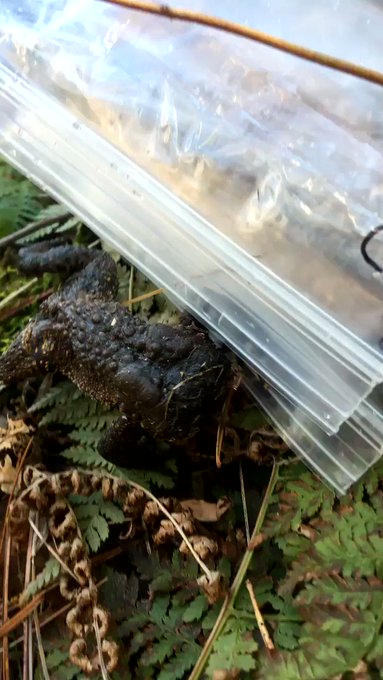
With so many of our reptiles and amphibians under attack from a multitude of pathogens(viruses, fungus, parasites), when herpetologist Jill Fleming came across an American Toad in Connecticut that was without a face, her first thought was that a predator bit off the Toad's face during hibernation or that some type genetic or environmental pathogen had caused the disfigurement............."This toad, however, had no visible wounds suggesting - as Fleming suspects - that an opportunistic predator may have gnawed at the animal’s face while it was in brumation – a hibernation-like state that cold-blooded animals enter into to survive icy weather".............. "In very cold conditions, American toads will burrow underground below the frost line, slow their heart rate, stop breathing and wait until temperatures climb above freezing again"........... "It’s possible that the toad left its face more exposed than the rest of its body and suffered the grim consequences"................. Although for a short while the Toad could survive and carry out basic motor functions like breathing and jumping, this type injury either will lead to death via starvation or being eaten by a predator


CLICK ON THIS LINK TO WATCH THE VIDEO OF THE FACELESS AMERICAN
TOAD

https://www.earthtouchnews.com/wtf/wtf/the-curious-case-of-the-faceless-toad

The curious case of the faceless toad

The curious case of the faceless toad
BY Ian Dickenson MARCH 07, 2018In April 2016, herpetologist Jill Fleming and her colleagues were collecting data on Eastern red-spotted newts in a Connecticut state forest when they stumbled across a truly bizarre find: a toad without a face.

The researchers were seated on a log processing the day’s samples when a seemingly disoriented toad repeatedly crashed into their feet. Puzzled by the amphibian’s unusual behaviour, the team took a closer look and was surprised to discover that the animal was entirely lacking a nose, eyes, jaws and a tongue. In place of a face, the fully grown American toad (Anaxyrus americanus) had only a smooth stump and a small mouth opening. The rest of its body, however, appeared perfectly healthy.
“My initial thought, which I still believe is a likely explanation, was that the extensive injury was inflicted by one of the toad’s many natural predators during hibernation (for example, garter snakes or American mink),” Fleming explained to National Geographic. “For whatever reason, the predator did not finish the job and the toad was able to become active again on that early spring day – amphibians are incredibly resilient.”
Fleming recently shared photos and a video of the toad on Twitter hoping the online science community could shed some light on what may have caused the unusual condition. Some herpetologists pointed to the flesh-eating larvae of a parasitic toad fly called Lucilia bufonivora. The flies have a nasty habit of eating the soft tissues of toads – a grisly process that begins when an adult fly lays its larvae in an amphibian’s eyes or nostrils. Once the eggs have hatched, it takes just two or three days for the larvae to cause extensive damage to the toad’s face, wildlife veterinarian Lydia Franklinos explained to Live Science. Facial tissue is gobbled up so rapidly that the rest of the toad’s body appears relatively healthy as the animal would not have yet begun to exhibit signs of malnutrition.


This toad, however, had no visible wounds suggesting - as Fleming suspects - that an opportunistic predator may have gnawed at the animal’s face while it was in brumation – a hibernation-like state that cold-blooded animals enter into to survive icy weather. In very cold conditions, American toads will burrow underground below the frost line, slow their heart rate, stop breathing and wait until temperatures climb above freezing again. It’s possible that the toad left its face more exposed than the rest of its body and suffered the grim consequences.
While some have suggested that the condition may be the result of a genetic defect, Fleming is doubtful. The toad lacked much of the anatomy necessary for feeding, so it seems highly unlikely that it would have reached adulthood while suffering its faceless affliction.
Injuries like this are rarely witnessed by herpetologists, although they are not unheard of. “Turtles can come out of hibernation with an injury as severe as a missing limb – their hardy shell protects their vital organs and many of them do just fine,” Fleming told National Geographic. “But I have never seen anything with a head injury this severe still capable of getting around like this toad was.”
It’s unlikely that the tale of the faceless toad had a happy ending. Although it’s possible for animals to survive and carry out basic motor functions like breathing and jumping even after suffering such a serious injury (a chicken beheaded in 1945 had enough of its brainstem left to survive for 18 months!), this toad’s disfigurement would have made it almost impossible for the animal to feed in the wild and it would be highly vulnerable to predators