Visitor Counter

hitwebcounter web counter
Visitors Since Blog Created in March 2010

Click Below to:

Add Blog to Favorites

Coyotes-Wolves-Cougars.blogspot.com

Grizzly bears, black bears, wolves, coyotes, cougars/ mountain lions,bobcats, wolverines, lynx, foxes, fishers and martens are the suite of carnivores that originally inhabited North America after the Pleistocene extinctions. This site invites research, commentary, point/counterpoint on that suite of native animals (predator and prey) that inhabited The Americas circa 1500-at the initial point of European exploration and subsequent colonization. Landscape ecology, journal accounts of explorers and frontiersmen, genetic evaluations of museum animals, peer reviewed 20th and 21st century research on various aspects of our "Wild America" as well as subjective commentary from expert and layman alike. All of the above being revealed and discussed with the underlying goal of one day seeing our Continent rewilded.....Where big enough swaths of open space exist with connective corridors to other large forest, meadow, mountain, valley, prairie, desert and chaparral wildlands.....Thereby enabling all of our historic fauna, including man, to live in a sustainable and healthy environment. - Blogger Rick

Subscribe via email to get updates

Enter your email address:

Receive New Posting Alerts

(A Maximum of One Alert Per Day)

Wednesday, April 4, 2018

We should all give "4 stars" and cheer Secretary of the Interior Ryan Zinke's recent decision to re-start the Grizzly Bear Recovery Plan for the Northern Cascades in Washington State..........While historically, Grizzly Bears were a top trophic canivore in the Northern Cascades Ecosystem, killing of the bears by trappers, miners, and bounty hunters during the 19th century removed most of the population by 1860"...................."Hudson Bay Company trapping records show that 3,788 grizzly bear hides were shipped from trading posts in the North Cascades area between 1827 and 1859"(over 118 annually over this 32 year span)".................."In his study of the early historical record in the area around North Cascades National Park, researcher Paul Sullivan quoted early reports from actual sightings".........."The most hides traded in any one year at Thompson’s River, British Columbia, Canada was 11 in 1851"........... "Apparently 4 hides turned up at Fort Nisqually near present Tacoma over a period of years"........…. "Sullivan found that much higher numbers of hides came in to the post at Fort Colville, in eastern Washington".................…. "The peak year in the Grizzly hide trade there was 1849 when 383 hides came through"…............. "Fort Nez Pierce, near present Walla Walla had its peak year in the Grizzly hide trade in 1846 when 32 hides came through"…........ "The decimation of the bears continued for more than a century with the last Grizzly killed in Fisher Creek (in what is now North Cascades National Park) in 1967"............ "Despite the bears being legally protected since 1969, there has not been a convincing verified photo of them appearing in the Washington State portion of the Cascades over the last 16 years" .................."However, just 15 miles north of the border between Washington and Canada(photo (below) , a North Cascades Grizzly Bear was captured in Manning Provincial Park, British Columbia".......... "This is just a mere 2 to 3 hour walk for the bear from Washington State"..............If Bears are re-introduced into Washington, there is an excellent chance for a genetic diversity to occur between the UA and Canadian populations, thus increasing the chances that USA re-introduced bears will hava an optimum chance for long term persistence" .......... ..The draft Environmental Impact Statement presents four options for pursuing grizzly bear recovery: a "no-action" alternative (maintaining the status quo), and three "action" alternatives for achieving the ultimate goal of restoring "a self-sustaining population of at least 200 bears" over the next 25 to 100 years".............. "The estimated speed of recovery will depend on the option selected


Grizzlies Back on Track in the

 North Cascades

Ryan Zinke revives grizzly

 bear recovery plan in Washington

 Hats off to Zinke and the horse he rode in on. 
The secretary apparently holds a special place in
 his heart for grizzly bears.

A rare grizzly photographed in the Canadian
 portion of the North
 Cascades Ecosystem---Photo by John Ashley-Price


"I grew up on the flanks of Glacier National Park, so I've dealt with the grizzly bear all my life," Zinke told a small group of agency personnel and conservationists gathered at North Cascades National Park headquarters in Sedro Wooley, Washington, on March 23. He went on to say that he has directed his staff to accelerate the recovery planning process for grizzlies in the North Cascades — which his agency reportedly halted last December. "I'm in support of the great bear. I'm also in support of doing it right," Zinke said, adding pointedly that we're not talking about the "reintroduction of a rabbit."
 The last documented kill of a North Cascades grizzly occurring in 1967. Although a few grizzlies have been sighted here since, there hasn't been an officially confirmed sighting in more than two decades.
The North Cascades Ecosystem remains one of the wildest places in the Lower 48, with 6.1 million acres of mostly public lands connected to additional wildlands in British Columbia. Grizzly bears are also very rare in the Canadian portion of the ecosystem, which is geographically isolated from healthy grizzly populations elsewhere.

Manning Provincial Park, British Columbia, 2010
Just 15 miles north of the border between Washington and Canada this photo (below) of a North Cascades Grizzly Bear was captured in Manning Provincial Park. This is just a mere 2 to 3 hour walk for the bear from Washington State, making it the closest confirmed sighting of a North Cascades Grizzly Bear in years.


"It's very obvious to us that grizzly bears in the North Cascades are going to disappear without some concrete actions to protect and restore the population. It's also obvious to us that there's only one way of doing that," says Joe Scott, international programs director for Conservation Northwest. Scott has spent a large part of his career advocating for the reintroduction of grizzlies to the North Cascades Ecosystem.
Grizzly bear recovery finally got legs in 2014, when the FWS and the National Park Service announced a joint three-year process to develop an Environmental Impact Statement (EIS) for the North Cascades grizzly. The draft EIS, published in January 2017, drew 126,000 public comments from around the state — most of them positive, according to agency staff. Indeed, surveys have shown that the majority of Washingtonians support grizzly recovery, although personal safety is a concern for some. As Zinke put it: "The great people of Washington have not hiked around grizzlies before, and so there's going to be a learning curve of what to do and what not to do."
Jack Oelfke, Chief of Natural and Cultural Resources at North Cascades National Park and park lead for grizzly bear recovery, highlights the importance of working with people in the region to make sure everyone is heard. "If the final decision involves moving bears in, we need to work with the ranching community and recreational groups and small communities on the edges of and within the ecosystem so that we ensure that we're addressing their potential concerns."

 THE NORTHERN CASCADES OF WASHINGTON STATE


Nonetheless, Oelfke is confident that grizzlies can coexist safely with humans — he's lived and worked among them himself in the past — and feels we have a moral obligation to make sure they don't disappear from the North Cascades. "This is a great opportunity for a major conservation success. We hope, we think, we've got the window now to proceed to get it done," he says.
The draft EIS presents four options for pursuing grizzly bear recovery: a "no-action" alternative (maintaining the status quo), and three "action" alternatives for achieving the ultimate goal of restoring "a self-sustaining population of at least 200 bears" over the next 25 to 100 years. The estimated speed of recovery will depend on the option selected.
No one is sure why Zinke hit the pause button on the EIS in December, but Oelfke says it's not unusual for a new administration to evaluate what any given agency is doing. "When they became aware of this EIS for a high-profile, charismatic species, their reaction was initially to say, 'wait a minute.' Of course, that 'wait a minute' kind of dragged on, but then we finally had the chance to do a briefing for them — which they eventually requested, to their credit. The briefing played a pivotal role…in their recognizing the value of this project."
Now that the EIS process is back on track, Oelfke and his colleagues will begin the arduous task of analyzing and responding to public comments in order to finalize the EIS. After the Final EIS is published, the FWS will release a Record of Decision, which Zinke expects to be completed by the end of the year.
Scott and other grizzly supporters are cautiously optimistic that, in the not-too-distant future, grizzlies will roam free again in the North Cascades. "The fact that Secretary Zinke emphatically endorsed the effort, the concept, and the process is a very hopeful sign to us that we'll finally accomplish this thing that we've been trying to do for 30 years now," he says.
Paula MacKay
Paula MacKay is a freelance writer/editor, field biologist,
 and communications consultant for conservation. For
 the past two decades, she has studied wild predators
with her husband, Dr. Robert Long. Paula served as
managing editor for Noninvasive Survey Methods for
 Carnivores, and earned an MFA in creative writing
 from Pacific Lutheran University in 2015. She has
 written for numerous nonprofits, books, journals,
and magazines — including Wild Hope, Washington
Trails, The Bark, E Magazine, Wild Earth, and Wildlife
 Conservation. MacKay currently manages Wildlands
 Network’s blog Trusting Wildness, and is writing a
conservation memoir about searching for wolverines
 and grizzly bears in the North Cascades.

Tuesday, April 3, 2018

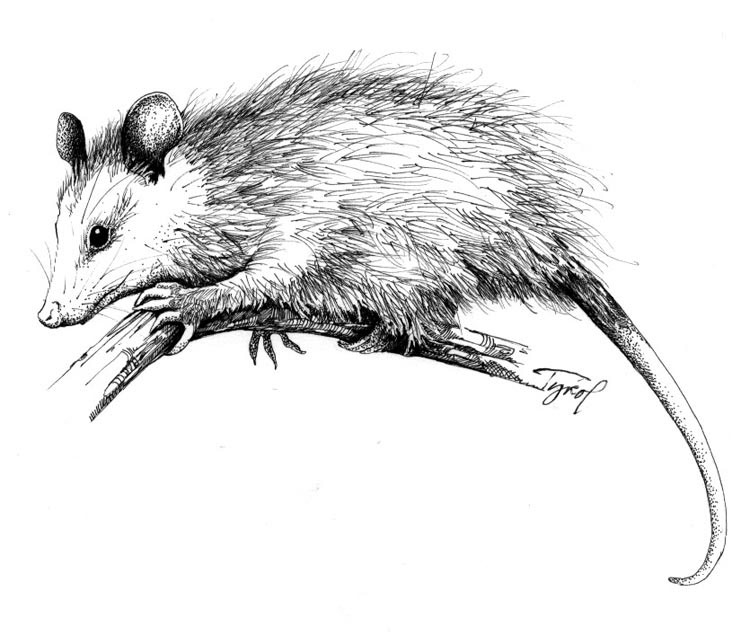
"One of the great range expansion success stories of American fauna is the the Virginia Opossum (Didelphis virginiana)"............."Originally, a Central American species, Opossums started migrating northward 500 years ago taking advantage of gradually warming temperatures and the rapidly expanding european colonial population pouring into what is now the USA"............"This ultimate opportunist-omnivore now ranges up to Maine and the Great Lakes States, with some reports that it has crossed the border into Canada"............. "Opossums thrive on any and all foodstuffs icluding fruits, insects rodents, worms, slugs, snails, frogs, birds, vegetables, nuts, pet food, bird seed, human garbage and roadkills"................Our farms, suburbs and cities literally provide a 24/7 all-you-can-eat gourmet smorgasboard for this slow moving(but not stupid) marsupial..........."The only "pouched mammal"(marsupial) in our hemisphere, the Opossum can store fat under its skin and tail, enabling it to brave the colder climes" ................"Opossums have high mortality rates at all ages and are preyed on by dogs, coyotes, foxes, raccoons, bobcats, eagles, hawks, and owls"................."They are also often hit by our cars---roadkill, as I am sure many of you have often noticed.........."Unlike raccoons and skunks, Opossums are resistant to rabies and rarely carry the disease". ............."As they are fastidious self groomers, Opossum can kill about 5,000 ticks a year as they travel through woods, lawns and brushy terrain"............"The Cary Institute of Ecosystem Studies in Millbrook, New York reposts that every Opossum in Lyme Disease regions likely kill some 5000 deer ticks annually, putting them up there with Foxes and Coyotes(who kill rodents that carry lyme disease) as key fighters of the debilitating lyme disease and other tick-borne pathogens

https://northernwoodlands.org/outside_story/article/opossums-find-cold-comfort-in-new-englands-winters

Opossums Find Cold Comfort in New England’s Winters


6
Opossums Find Cold Comfort in New England’s Winters
Illustration by Adelaide Tyrol
Natives of Central and South America, opossums are not particularly well equipped for life in northern New England, and yet they have been found here in increasing numbers since about 1900. Unlike other fur-bearing mammals in the region, opossums have relatively thin coats, and their ears, tails, and feet are virtually hairless.
Besides lacking the proper outerwear, opossums do not hibernate. Except for denning up for short periods during the very coldest weather, they must be out and about all winter searching for food, which makes them extremely vulnerable to hypothermia and frostbite. In fact, wildlife biologists use signs of frostbite to judge an opossum’s age; a frostbitten tail and ears show that the animal has lived through at least one winter. This far north – central New Hampshire and Vermont and southern Maine mark the northernmost reaches of their eastern range – opossums rarely live more than two years, though they live much longer in warmer climates.


Historically a Central American species,
The Opossum has over the past 500 years
migrated northward


How, then, have they persisted in migrating northward? 
Of the approximately 70 species of opossums, the one that became known as the Virginia opossum is the only one capable of storing fat under its skin and in its tail. The extra bit of fat – paltry compared to the amount of fat a raccoon puts on in the fall – enabled this species to move from Central into North America centuries ago. In the early 1600s, European settlers in Virginia encountered an abundance of these strange creatures, described by Captain John Smith as having “an Head like a Swine, and a taile like a Rat.” Even more marvelous, closer observation showed the opossum to be a marsupial, a mammal whose young are born quite small (A newborn opossum is about the size of a lima bean) and continue to develop in the mother’s abdominal pouch.

Opossums convincingly "play dead" to escape predation;
Once the predator leaves the scene, the Opossum rights
itself up and continues on its way


Beautifully suited to the climate of Virginia, North America’s only marsupial nevertheless continued to expand its range, until 300 years later it arrived in New England. Opossums have large families – between five and fifteen in a litter, with an average of eight – which helps explain its ability to colonize new areas.
Still, such an expansion would have been most unlikely except for the opossum’s ability to live near humans. Frequently called “an opportunist,” the omnivorous opossum can eat just about anything – from fruits, berries, insects, and small mammals to dog food left outside or garbage in dumpsters – and will happily make its bed under the back porch or in a corner of the woodshed. While its preferred habitat is in forested areas close to water, this animal’s close proximity to human habitation has been noted throughout the northern United States.


Unfortunately, we are most likely to see an opossum after it has been killed on the road. Nocturnal creatures, opossums rouse shortly after the sun sets and go out to look for food – often on roadways, where they feed on carrion and risk becoming roadkill themselves. According to studies summarized in Richard DeGraaf and Mariko Yamasaki’s New England Wildlife, human activities such as hunting, trapping, and roadkills account for the majority of opossum mortality. In one study, 35 percent of the animals equipped with radio transmitters or ear tags were killed by cars, while another 13 percent were killed in traps.


Fully grown, an opossum is approximately two and a half feet long, including the foot-long tail, and weighs from five to seven pounds. Encountering a predator or other threat, opossums may hiss and show their teeth but are more likely to run away and hide in a tree or burrow or to play dead. The tracker and naturalist Paul Rezendes describes an opossum he saw being attacked on the road by two dogs: “The opossum literally fell over, as if dropping dead of a heart attack. Saliva drooled from its mouth, and a very unpleasant smelling liquid began oozing from its anal glands. The dogs . . . barked at it, then nipped at it a few times, but the opossum didn’t move a hair.” After Rezendes chased the dogs away, the opossum got up and returned to the woods.

When out foraging or in its den – which can be in a hollow tree or brush pile as well as a human-made shelter – an opossum will be alone. Once the young leave their mothers, at about 120 days old, they are solitary animals and thus forgo even the comfort of snuggling up to another possum during the long, cold winter.
Catherine Tudish is a freelance writer living in Strafford, Vermont.

Monday, April 2, 2018

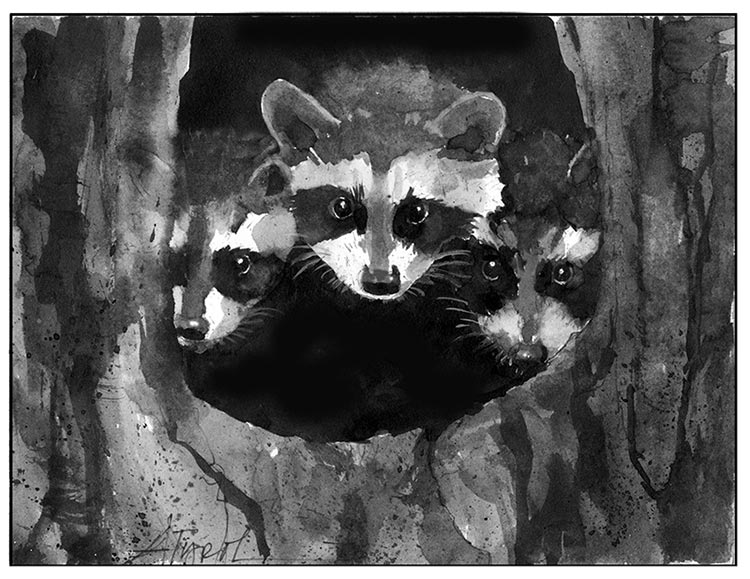
Raccoons are one of our most successful animal species,ranging from the Canadian prairies across the United States of America (except for parts of the Rocky Mountains and the deserts) through all Central America down to northern Panama"...............Both a lover of water and forest, “Raccoons don’t make a den, they just find a place to be during the winter, wherever they can find shelter"................. “Large enough tree hollows, about 20 to 30 feet off the ground, would probably be their first choice".............."While raccoons don’t hibernate, they do curl up for much of the winter, having fattened themselves up previously as much as possible".......... ."They will use abandoned woodchuck burrows and beaver lodges, and they’ll also take shelter in barns, attics, and chimneys(as many of us have experienced)"............."January through March is Raccoon breeding season".............. "They do not form lasting pair bonds – both males and females will mate with multiple partners in the same breeding cycle – the mating process may last several days"........ "Once the male finally wanders off, the female will likely return to sleeping until it’s time for the kits to be born".............."The gestation for raccoons is about 63 days, with kits typically being born in April."............ "Females have litters of between two and seven babies, with four being the most common"............'Often, the kits stay with their mother through their first Winter"........ "Average home range for the species is 90-150 acres with densities found to be one individual per 10-16 acres" .................."Intelligent, adaptable and curious, they are ever present in woodlands, suburbs and cities-omnivorous, dining on everything from berries, to Fruits, Frogs, Squirrels, Rabbits, Muskrats, Crayfish, rodents and human garbage"...............'Pumas, Bobcats, Coyotes, Wolves, Caimans, Crocodiles, large Snakes, Hawks and Eagles all prey on Raccoons"


http://r20.rs6.net/tn.jsp?f=0011yb5Sh0vIoKlRHwjhBbVDGN5dnmJZA24KtapTl6ADA_9bqkLUfqB4WRoLNFOu2iyGVhWL21yzrflCJx6wwfs93nD-vGK9CkCfa3NVp0ayLGIq86NiWX-e0DGfLev6G467yqB2p2UiRYdRq1EkpXOOyEQWw-L2yc6AMRgrN5lyZ3lRVJZHNRVnpiFq-fvnbegdng7XyKbiLgFOzaO1iuD0BQVtdyJuePn6lpA3sjx0zE=&c=8ugQK6KnvPq7UZTdMK3KU1ZMtKWkbA5lU76vgqHv4C9JDMqSfX-fWA==&ch=dSsrJ4hzFnR_Vg0M9GLqG3w1Hh1c2acPad6P09yyuWO0N6W9mhHBJw==


6
Spring Raccoons
Illustration by Adelaide Tyrol
Often, during my forays into the woods behind our house, I wonder who might be occupying the holes carved into tree trunks by time and nature. The barred owls I hear hoo-hoo-hoo-hooing, maybe, or the chittering red squirrels. And, chances are, there are raccoons in some of those hollows, high above the ground.
“Raccoons don’t make a den, they just find a place to be during the winter, wherever they can find shelter,” said Dave Erler, a senior naturalist at Squam Lakes Natural Science Center in Holderness, New Hampshire. “Large enough tree hollows, about 20 to 30 feet off the ground, would probably be their first choice.”
While raccoons don’t hibernate, they do curl up for much of the winter, having fattened themselves up as much as possible before snow covered the landscape. Erler has seen raccoons using abandoned woodchuck burrows and beaver lodges, and they’ll also take shelter in barns, attics, and chimneys.


The exception to this holing up comes during breeding season, which typically happens, depending a bit on a raccoon’s age and the weather, between January and March.
“Usually the first warm spell we have in February is when you start seeing the tracks,” Erler said. “As soon as it cools off, raccoons go back in and go to sleep again. Their paws are not furred out like a lot of other animals, so they’re not going to be hanging around outside when it’s 20 below.”
While raccoons do not form lasting pair bonds – both males and females will mate with multiple partners in the same breeding cycle – the mating process may last several days. Male raccoons seek out females and will make themselves right at home in a female’s denning area for as long as a couple of weeks. Once the male finally wanders off, the female will likely return to sleeping until it’s time for the kits to be born.

THE RANGE OF THE RACCOON


The gestation for raccoons is about 63 days, putting the birthday for the year’s young typically at some time in April. Raccoons have litters of between two and seven babies, with four being the most common.
The kits are helpless at birth, weighing only a few ounces and with eyes closed, ears pressed tightly to their heads, and only a fuzz of fur for protection. They are totally dependent on their mother for food and warmth. By about six weeks of age, they start to walk, run, and even climb, but they are still mostly confined to the den where they were born and still rely on their mother.


“They’re dependent on her to bring home the groceries,” said Erler. “She has to leave them unattended to look for food.”
Nocturnal by nature, the mother does most of her hunting by cover of darkness, although with hungry mouths to feed, she may occasionally hunt by day.
E.B. White, that writer of fantastic children’s novels and poignant essays, was also a great observer of nature. His essay, Coon Tree, penned in 1956, gives a lovely description of a mother raccoon occupying a tree hollow in his yard with her kits:


“There are two sides to a raccoon—the arboreal and the terrestrial. When a female coon is in the tree, caring for young, she is one thing. When she descends and steps off onto solid earth to prowl and hunt, she is quite another. In the tree she seems dainty and charming; the circles under her eyes make her look slightly dissipated and deserving of sympathy. The moment she hits the ground, all this changes; she seems predatory, sinister, and as close to evil as anything in Nature (which contains no evil) can be.”
Any parent of small children – of any species – can likely relate to White’s sympathetic description of a harried mother looking after rambunctious and constantly-hungry children.


By around two months of age, sibling raccoons will engage in play fighting, complete with vocalization. Perhaps coincidentally, it’s around this time that mother raccoons lead their kits out of the den to learn about the world – and the food options – around them.  
Raccoons are omnivorous, eating everything from berries and fruit to frogs and rodents, along with scraps from the compost pile, garbage from the inadequately secured trash can, and whatever else they can get their clever little paws into.


“One of the reasons raccoons have been so successful is that they’re so adaptable,” said Erler. “They’re very curious. They’re intelligent. And they’re so nimble with those front paws.”
The curious kits stay with mother raccoon through the summer and sometimes bunk up with her again during their first winter. Erler has seen half a dozen raccoons emerge, one after the other, from a woodchuck burrow. White wrote that a succession of mother raccoons and their babies occupied the same hollow for many years running. I’ve seen raccoon tracks in the melting spring snow and found their masked mugs on my game camera. Perhaps, somewhere nearby, I have my own coon tree.
Meghan McCarthy McPhaul is an author and freelance writer. She lives in Franconia, New Hampshire.
----------------------------------------------------------------------------------------------------------------

While observing the antics of a litter of red fox kits recently, I was witness to an encounter between the kits’ mother and a very large raccoon. The vixen started barking incessantly when she saw the raccoon, and slowly moved closer and closer to it until she was within 10 feet of it. After a short standoff, the raccoon lunged towards the fox, which ran a few feet away and then turned and chased the raccoon in the opposite direction. They took turns chasing each other until the fox eventually drove the raccoon away from her den and kits. While raccoons are omnivores, and a large part of their late spring diet is animals (mainly frogs, fish, crayfish and invertebrates, but also mammals, including squirrels, rabbits and young muskrats). I have never heard of raccoons preying on fox kits, but the mother fox’s behavior indicated that she was not comfortable with the raccoon being so close to her litter.

Sunday, April 1, 2018

With the Coyote(both Western and Eastern) 60-66 gestation period coming to an end now thru the end of April, and anywhere from 2 to 12 pups joining the adult mated pair and perhaps a couple of the previous season yearlings, thought it an opportune time for our annual "checkup" on the life cycle of North America's 2nd most successful mammal species(us humans are #! in this category), the Coyote.................And who better to bring us the easy-to-digest facts about our wild "songdogs" than Massachusetts biologist Jon Way, acknowledged as one of the leading authorities on Eastern Coyotes in North America.............Below, Jon states the facts and dispels the "fake news" and often hysteria-laden commentary that unkowing newspaper, tv, radio and on-line reporters tend to feed to the public on a regular basis................Enjoy the read............Jon is happy to field any questions you might have via his easterncoyotesresearch@yahoo.com email address


http://www.easterncoyoteresearch.com/easterncoyotelifecycle/


Eastern coyote/coywolf life cycle in southeastern Massachusetts and some commonly asked questions
(All photographs below taken by Jonathan Way)
Jonathan G. Way1
1Eastern Coyote Research; E-mail: easterncoyoteresearch@yahoo.com.
Suggested Citation: Note: click below to download this as a pdf.
Introduction
I often receive questions about eastern coyote/coywolf ecology and behavior. Most of this is somehow related to a yearly cycle with certain events happening during specific times of the year. Therefore, in this short paper I attempt to answer some of these questions about eastern coyotes and do it in a year-long time-frame starting with January and going until the following December. I also ask and answer questions throughout the paper to give the reader a better perspective of a given life-history characteristic.


Question:  Why do you use the term coywolf throughout this paper (and on your website)?
Recent genetic research on eastern coyotes indicates that they are actually a hybrid between western coyotes (Canis latrans) and eastern/red wolves (Canis lyacon) and should perhaps more appropriately be called coywolves (Canis latrans x lycaon) since they are larger and genetically distinct from western coyotes and eastern/red wolves.  Therefore, I will hereafter refer to them as either eastern coyote or coywolf throughout this paper.
Mid-January to early February – Mated pairs mate, in the height of winter, during a short window of time when the female is in estrus.
Question: What is a pack?
A pack is generally the mated pair and one or two of their offspring (at this time 10 months or 1 year and 10 mo. olds) that delay dispersal and help form a social unit or pack, similar to wolves in the wild. So a typical pack in Massachusetts is 3 to 4 adults (including the full-sized pups or yearlings), with 5 to 6 not being unheard of.
Question: When do offspring disperse from (or leave) their natal territory?
Typically in their first winter (when about 9-10 months old), except for the ones which delay dispersal to stay with their parents.
Mid-March to early April – Females give birth following a 60-66 gestation period. This reported time is documented by my field research which documents earlier births than which state wildlife agencies acknowledge (usually they say April-May). On Cape Cod, I have not documented any births after mid-April. May births occur in colder, more northern climates like Maine.
Question: How many pups does a female give birth to?
On average 5, but this can range from 2 to 12.
Question: What does a den look like?
A den is often inconspicuous. They are hidden in the woods and typically hard to find. Usually they are dug into roots or under trees – occasionally in and around human structures (such as decks, sheds). There is often no debris around an active den. Dens are basketball sized holes which can go 5 to 30 feet into the ground potentially forming large underground chambers. Dens usually have a mound of fresh dirt at the mouth of the entrance.
Question: Do adults bring back prey to dens?
I have heard reports of dens surrounded by cat collars, cat remains, or deer fawns. However, all dens I have examined (over 20) have been devoid of prey. I believe this is an old wives tale to perpetuate the myth that coyotes/coywolves wipe out their prey supply, or at the least are having an undesirable affect on our local wildlife (or pets). Adults regularly clean dens by doing things like eating pup feces and regurgitate most food to the pups during this time.


Late-April to May – Pups are weaning from their mother’s milk and the rest of the pack is now feeding them regurgitated meat. In the winter, mated pairs are inseparable but in the spring/summer they are barely together, often taking turns hunting or watching the pups. The helpers (or betas) in a pack also assist with pup rearing. Pups begin leaving the den and exploring surrounding areas – usually in the forest, even for animals that live in urbanized areas.
Question: I live in an urban area and don’t understand why coyotes live near me. Shouldn’t they be out in more rural areas?
Coyotes (when combining western and eastern) live throughout the country and in all sorts of habitats ranging from rural/wilderness to highly urban including most major cities. A common misconception by many is that they should not live near me because I live in a developed area. However, urban areas can actually be better habitats for coyotes and much of their prey like rabbits and deer. We provide lots of food, both natural and human caused, as well as plenty of cover. The paradox is that while coyotes thrive in human dominated areas they often take advantage of the natural cover that we provide them to be “ghosts of the suburbs or cities”. Additionally, because coyotes are territorial it should be thought of that a given area (state, city, etc) is potential coyote habitat and if coyotes don’t already live in a given area it is only a matter of time as the goal of most young dispersers is to find new habitat where other coyotes do not live. That will allow them to claim a territory and raise a family. These two factors (1) abundant food and cover; and 2) claiming vacant territory) are why coyotes have spread throughout North America.
June – July – Pups are now weaned and eating solid food. They move to rendezvous sites which are above ground den sites that typically have thick brushy areas where they can hide. Water is usually nearby and there are often open areas where the pups can hunt (beginning with grasshoppers/crickets and moving to mice). These open areas also provide a vantage point where the adults can scan for danger.
Question: What are some typical rendezvous sites?
Cranberry bogs, golf courses, swamps, old fields surrounded by woods. These areas all usually have open areas to hunt and nearby thick brush areas to hide in.
Question: It is the fall/winter and I found a coyote den, but why aren’t I seeing any coyotes?
Coyotes only use dens for the first 8-10 weeks of life. After that, even young pups generally sleep in the woods – even on nasty, rainy days. What you are seeing may or may not have been a coyote den, but there is little chance that it would be actively used by coyotes beyond April-June.
Question: Why do I hear all of that howling this time of year (mid to late summer)?
They are communicating with each other. Pups and adults are often separated, especially as the pups mature, so howling reunites them. Imagine a typical pack of 3 to 4 adults and 5 pups of the year. It can sound like an army is around you, but it is a normal progression for a pack. By the way, all of that howling also serves as a territorial guarding mechanism, effectively keeping non-pack members out of their territory.
Question: Why do coyotes sometimes follow my dog during this time of year whereas during most of the year they rarely bother me during my walks?
First of all, I will assume that you leash your dogs to prevent unneeded interactions from occurring in the first place, like your dog chasing after a pack and getting attacked as a result. The reason why you often see coyotes appearing to act bold or maybe even aggressive is because you are likely in a rendezvous site. Possibly you don’t know it but if you are in one of these areas, the adults (especially the parents) often follow dogs, sometimes even on a leash, as they see the dog as a potential threat to their pups whom are likely hiding nearby in the woods. The vast majority of people that I have talked with that have experienced this claim that the coyote will follow the person and the dog for a certain distance and then, strangely, simply turn around and walk off. It is sort of like an escort service to get the dog (with the associated person) to leave the general area. You can probably see why dogs that are leashed have much less of a chance of getting attacked than do unleashed, free-roaming dogs. It is worth noting that I have seen smaller western coyotes (in Yellowstone National Park) harassing wolves and even grizzly bears near their pups.


August – September – Pups are maturing into mini-adolescents and are learning how to hunt, starting with insects and moving to small rodents. Also, adults are continuing to bring back food and either regurgitate it to the pups or bring back whole prey items like rabbits. Packs may have multiple rendezvous sites in their territory and now often travel between them.
Question: You talked about dogs, but what about my pet cat. Are they safe from eastern coyotes?
As discussed above dogs are viewed mostly as competition. This is verified through the unfortunate fatal encounters where coyotes kill a dog. Generally it is not eaten and left where killed, similar to how wolves will kill coyotes or coyotes will kill foxes and not eat them. Canids generally don’t like other canids, except for their pack-mates. However, cats are a different story. They are certainly viewed as a fawn or woodchuck sized food source by coyotes and will kill them where available. It is important to keep in mind that cats are often outside doing the same thing that wild carnivores are doing, which is hunting and killing prey. The best thing for the environment and your cat(s) is to make it an indoor cat. It will live longer and will kill less (or no) small animals like song birds. If it must go outside, however, try and do so during the day time (when coyotes are least active) as this will reduce (but not eliminate) dangers to your cat. Do not let it out at dawn when it is light out but still early as coyotes are sometimes active then, especially in the summer time.
October – December – Pups are about two-thirds size in early fall (6 months of age) and then approach full-size by Christmas. Pups undergo a tremendous change during the fall. They are now mostly foraging independently or in small groups with some still at rendezvous sites and others traveling with their parents. Parents are spending less time at rendezvous sites and more time nomadically patrolling their territories. Some pups begin the process of dispersal during this time while others stick around to help form a pack. The coywolf life cycle continues into the next breeding season.
Question: How far do coyotes/coywolves travel?
Short answer, a lot! Adults typically move 10 miles a night throughout their territory. Juveniles move less when tied to rendezvous sites but when dispersing, they can travel similar daily distances as adults and can potentially go far from where they were born.
Question: How far can a coyote disperse?
Dispersal distances of over 400 miles have been documented, so that means that a youngster born on Cape Cod, MA (where I live) can show up anywhere else on Cape Cod, or better yet cross the canal (by either swimming or crossing the bridge) and move off-Cape. Youngsters born in the Northeast can easily travel to a different state assuming it survives that long and isn’t killed by a car or gun.


Question: What is a territory?
A territory is an area that is guarded by a pack of eastern coyotes/coywolves. On Cape Cod, they are typically 6-10 square miles. These are generally exclusive of a pack with occasional transients (dispersers) moving in and out of these areas. Other territories border a given territory like a honeycomb.
Question: How many coyotes/coywolves are there in Massachusetts?
Population estimates are difficult to accurately estimate but they are generally made during the lowest point in a species yearly cycle which for eastern coyotes would be in early March before the new pups are born. This would account for pup losses during the summer, hunting kill, and most vehicle accidents (since yearling and adult animals become more adept at crossing roads as they age). Using simple math of the number of coywolves per pack and territory size, it is safe to estimate that there is less than one per square mile.
 Therefore, I would estimate about 3,000 to 5,000 eastern coyotes in Massachusetts. I believe that Mass Wildlife’s official estimate of 10,000 is too high and would only be possible if they included pups of the year. To put it a different way, no study in the Northeast has documented over one “coyote” per square mile and because the eastern coyote or coywolf is a hybrid with wolves it would be problematic to use density estimates from other areas of the country and equate those to “coyote” density estimates in the Northeast. By the way, 5,000 would be a high density of eastern coyotes in an area the size of Massachusetts. Similarly, 300 on all of Cape Cod would be a very high (probably maximum) estimate excluding pups of the year. I would guess 200-250 on Cape Cod at the end of the winter, accounting for hunter kill.
Jon Way with Eastern Coyote


Conclusion
This paper attempts to answer some commonly asked questions about eastern coyote/coywolf natural history in Massachusetts. I follow a calendar year and attempt to describe major events in an eastern coyote’s annual life cycle and address commonly asked questions. Many of the answers here are supported by peer reviewed science, much of which I have personally published. But instead of muddying the paper by including citations I simply refer the reader to the Publications Page (click here) of my website for further information on many of the topics discussed herein.