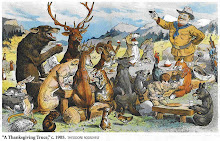
The Blue Ribbon Whitewash: The selling out of our wildlife
Is it just me or does anyone else see something wrong with this picture: Two private individuals appoint themselves to form a panel, calling it no less, a Blue Ribbon panel. They then fill it with their handpicked members to decide what direction the ENTIRE COUNTRY should take regarding the funding of the conservation of our wildlife resources! Just where do they derive their power to first of all establish this committee and second of all invite only those they want to be on this panel? Were they asked by some public organization to form this panel? Did they make an effort to make sure the panel represents the makeup of Americans regarding their views on wildlife? Did they seriously consider options that would truly result in ALL Americans being represented as "investors in fish and wildlife conservation"?

Spokesmen from the Blue Ribbon Panel speaking on March 2 at the release of recommendations. From Left, David Freudenthal, Dave Chanda, John Morris, Collin O’Mara, and Jeff Crane. © Joshua Learn

It seems the answer to these and many other questions is a resounding NO.
First let's consider the makeup of this supposed blue ribbon panel. The co-chairs and founders of this august body are a former governor of Wyoming, a state that has a long history of emphasizing hunting and energy (= fracking) development, and the founder of the Bass Pro Shops, a business specializing in sport fishing. They then proceeded to populate their panel with representatives of these special interests. Of the 28 members, 13 (46%) were from sport hunting or fishing groups, 7 (25%) were from industry, including the sport industry and 3 from the energy industry. Why the energy industry? Only 6 individuals (21%) came from conservation minded organizations. NONE from any citizen's group advocating for non-consumptive use of wildlife.
Is this representative of Americans relative to the current and future use of wildlife? According to the latest U.S. Fish and Wildlife Survey, only 4% of U.S. citizens hunt and 14% fish while 32% watch wildlife. According to this same report, the only group to more equally represent gender, age, ethnic, and economic proportions of the American population are wildlife watchers. According to this same report, wildlife watchers, spent more time observing wildlife. Finally, according to this same report, wildlife watchers spent almost 3 times more than hunters and 1.6 times more than anglers in pursuing their activity. Yet, they only made up 21% of this blue-ribbon panel! To be representative of those who actually use wildlife in different ways, should not the bulk of the members have come from wildlife watching, usually conservation minded, organizations? Should there not have been individuals from citizens advocacy groups such as Speak for Wolves or Project Coyote?

Especially since the main reason for the panel was to identify how to fund primarily non-game species, why didn't it fairly represent those interests. Not only do hunting and fishing interests have the most representation but combined with industry interests, they have a super majority (71%). This easily insures that any recommendations reflect their interests, their biases. Which, as I have written before, is to maintain a stranglehold on how wildlife are mismanaged in this country.

Especially since the main reason for the panel was to identify how to fund primarily non-game species, why didn't it fairly represent those interests. Not only do hunting and fishing interests have the most representation but combined with industry interests, they have a super majority (71%). This easily insures that any recommendations reflect their interests, their biases. Which, as I have written before, is to maintain a stranglehold on how wildlife are mismanaged in this country.
A Blue panel indeed. It is more a stacked deck, a whitewash, purposely biased to come up with specific preconceived recommendations that continue to exclude the 84% of us who do not hunt or fish, of which 40% watch wildlife. A stacked deck to make sure whatever was decided favored traditional hunting and fishing interests over conservation minded non-consumptive use of wildlife. A stacked deck insuring the continued exclusion of most of us from wildlife decisions.
And the final recommendations reflect this bias. They had the data that equal numbers surveyed (95%) favored setting aside either existing oil and gas drilling fees (= fracking) or reinvesting existing state and federal revenues (taxes) in state wildlife action plans. They had two equally politically acceptable choices.

In the first case, such funding would explicitly tie state wildlife funding to a very specific funding source, revenue from oil and gas extraction. This is no different than the dedicated funding of wildlife by hunters and anglers that currently exists in most states. It ties the funding to a very explicit special interest group. It is not, as they claim, a reinvesting of funds but a diversion of those funds from an industry that has nothing to do with wildlife, other than destroy its habitat. At least with hunters and anglers, they have a vested interest in a small percent of the wildlife resource. But here, this funding comes from a source totally devoid of any connection with wildlife, other than see it as an impediment to their operations.

In the first case, such funding would explicitly tie state wildlife funding to a very specific funding source, revenue from oil and gas extraction. This is no different than the dedicated funding of wildlife by hunters and anglers that currently exists in most states. It ties the funding to a very explicit special interest group. It is not, as they claim, a reinvesting of funds but a diversion of those funds from an industry that has nothing to do with wildlife, other than destroy its habitat. At least with hunters and anglers, they have a vested interest in a small percent of the wildlife resource. But here, this funding comes from a source totally devoid of any connection with wildlife, other than see it as an impediment to their operations.
This source would also tie this funding to another dying horse. As stated in their propaganda, wildlife FUNDING is in crisis. Contrary to their misconception however, it is not because Americans are becoming disconnected with nature. The truth is MORE Americans are reconnecting to nature. Wildlife watching has increased from 29 to 32% of us just in the last five years! We are spending more time watching, feeding, studying wildlife than ever before! It is just that fewer and fewer of us are hunting them and because hunters conveniently tied game agencies to license fees, revenues to these game agencies are declining.
Unfortunately, linking wildlife funding to oil and gas is just tying it to another declining industry. The current momentary blip in oil and gas production is due to the present fracking rage that cannot continue. Even the industry knows there are limited amounts of oil and gas that can be fracked. And they can't frack it fast enough, mainly to sell it as fast as they can overseas. Just how long will it be before that oil and gas also runs out and those revenues decline? Additionally, many predict fracking will soon be banned as we realize that injecting billions of gallons of toxic waste into the ground is not such a good idea. In all cases, it can be safe to say that revenues from oil and gas drilling will start to decline long before "future generations share in this wealth" and wildlife funding will again be in crisis. What do we do then?

The second choice, using existing (NOT NEW) tax revenues, would first of all place the funding of state wildlife in the hands of all the people in the state, not just a specific self-interest group. It would allow all of us to reinvest revenue gained from our actions back into the most popular use of wildlife…watching them! And there is a LOT to reinvest! Just considering wildlife watching fishing, and hunting, state and federal tax revenues generated exceed $39 billion. Earmarking or reinvesting only 3% of those revenues to state wildlife action plans would equal the amount this panel wants to extract from oil and gas…but no strings attached and in perpetuity! Some states have already started this by either earmarking a part of the general fund or a small part of sales tax revenues and surprise surprise, they have additional resources to use, for all wildlife! So, it can be done and is being done. It is also a sound investment with an estimated $9 return on $1 invested. Would not those industry types see the soundness of this already functioning system?
Unfortunately, linking wildlife funding to oil and gas is just tying it to another declining industry. The current momentary blip in oil and gas production is due to the present fracking rage that cannot continue. Even the industry knows there are limited amounts of oil and gas that can be fracked. And they can't frack it fast enough, mainly to sell it as fast as they can overseas. Just how long will it be before that oil and gas also runs out and those revenues decline? Additionally, many predict fracking will soon be banned as we realize that injecting billions of gallons of toxic waste into the ground is not such a good idea. In all cases, it can be safe to say that revenues from oil and gas drilling will start to decline long before "future generations share in this wealth" and wildlife funding will again be in crisis. What do we do then?

The second choice, using existing (NOT NEW) tax revenues, would first of all place the funding of state wildlife in the hands of all the people in the state, not just a specific self-interest group. It would allow all of us to reinvest revenue gained from our actions back into the most popular use of wildlife…watching them! And there is a LOT to reinvest! Just considering wildlife watching fishing, and hunting, state and federal tax revenues generated exceed $39 billion. Earmarking or reinvesting only 3% of those revenues to state wildlife action plans would equal the amount this panel wants to extract from oil and gas…but no strings attached and in perpetuity! Some states have already started this by either earmarking a part of the general fund or a small part of sales tax revenues and surprise surprise, they have additional resources to use, for all wildlife! So, it can be done and is being done. It is also a sound investment with an estimated $9 return on $1 invested. Would not those industry types see the soundness of this already functioning system?
Given these options, which did this dignified panel choose? Did they, as they so loftily state chose to: "…allow a greater number of citizens to be investors in fish and wildlife conservation"? Did they choose to make wildlife management all inclusive, as the North American Model for Wildlife Conservation dictates? Where all citizens pay? Where all citizens would then have a say? Did they choose to make the funding sustainable over time?
Given that over 57% of the panel represents either hunting, angling, or energy interests, it is not surprising that the answer is a resounding…No. Their decision reflected their desire to keep most citizens from the wildlife table. Their decision was designed not to allow more citizens to reinvest in wildlife but to switch from one biased dying industry, hunting and fishing, to another biased dying industry, oil and gas!

There are so many things wrong with this decision, I don't know where to start. First, again, am I the only one who sees major problems with putting the wildlife of this nation in the hands of the oil and gas industry? Remember, the current mentality is: those who pay get to say. I do not see that changing. We have seen with hunters and anglers a feeling of entitlement to have the bulk of the say over wildlife because they pay to directly support game agencies. Will not the oil and gas industry also feel the same entitlement? After all, they are paying the bills! Also remember that for hunting and fishing, revenues are tied to licenses sold, which have led to the single minded "more fish in the creel and more game in the bag" management goals to maintain those revenues. Will there not also be the same pressure to "manage wildlife" so as to not interfere with maintaining or increasing the cash cow from oil and gas extracting? When decisions are made regarding where to frack or not relative to its impact on a wildlife species, especially a non-hunted one, do we seriously think that they will be made in favor of that species? If so, we are more naïve than we think.

There are so many things wrong with this decision, I don't know where to start. First, again, am I the only one who sees major problems with putting the wildlife of this nation in the hands of the oil and gas industry? Remember, the current mentality is: those who pay get to say. I do not see that changing. We have seen with hunters and anglers a feeling of entitlement to have the bulk of the say over wildlife because they pay to directly support game agencies. Will not the oil and gas industry also feel the same entitlement? After all, they are paying the bills! Also remember that for hunting and fishing, revenues are tied to licenses sold, which have led to the single minded "more fish in the creel and more game in the bag" management goals to maintain those revenues. Will there not also be the same pressure to "manage wildlife" so as to not interfere with maintaining or increasing the cash cow from oil and gas extracting? When decisions are made regarding where to frack or not relative to its impact on a wildlife species, especially a non-hunted one, do we seriously think that they will be made in favor of that species? If so, we are more naïve than we think.
In fact, in a conspiracy world, the earmarking of oil and gas money for wildlife can be seen as a back-door attempt by this industry to gain more influence over game agencies. Remember, much of the current conflict over wildlife species comes from the impact oil and gas development, primarily fracking, has on wildlife populations. The funding of wildlife will switch from being influenced by hunters with the more game in the bag means more revenue to one where decisions in favor of more energy exploitation means more revenue. If people think the oil and gas industry will not wield its new-found clout to influence wildlife decisions that favor energy exploration, they are naïve at the least. Commissions will be stacked with energy favorable members, as they are now with hunting and fishing interests. Research and regulatory actions of game agencies will be biased for "more energy revenue in the bag". Again, as with hunting and fishing, the majority of wildlife will suffer as a consequence. And the general public will continue to be excluded from the decision-making table.
Why has this panel of "experts" done this? Tied wildlife funding to another special interest source that does NOT have the best interest of all wildlife or citizens in their minds? Why did they basically decide to "sell out" wildlife to the oil and gas industry? Again, it all boils down to control over how wildlife is managed. Hunters abhor the idea that the general public has a say in how all wildlife, including game species are managed. Though they themselves lack even the basic understanding of how nature works, they continually demean and try to marginalize the other 96% of us who do not hunt. They whine that public funding of wildlife agencies would inject politics into wildlife management. But politics, their politics, the politics of the minority, already constantly dominate wildlife management. And their politics is basically that no one other then themselves should have a say on what can or cannot be killed for sport.
This is why for example the state of Idaho takes pride in proclaiming that no public funds are used by their fish and game agency. Basically this "pride" excludes the 85-90% of the citizens who do not hunt or fish. Other states dictate that only people who hunt or fish can be on commissions. They (hunters and anglers) do NOT want the rest of us to participate and they know that IF we pay, we get to say!
This is why for example the state of Idaho takes pride in proclaiming that no public funds are used by their fish and game agency. Basically this "pride" excludes the 85-90% of the citizens who do not hunt or fish. Other states dictate that only people who hunt or fish can be on commissions. They (hunters and anglers) do NOT want the rest of us to participate and they know that IF we pay, we get to say!
Tying funding of wildlife to the oil and gas industry will continue this exclusion of the general public. Only under the most credulous sense would this, as proclaimed in the panel recommendation, "allow all Americans to become investors in fish and wildlife conservation". Just how do they come to this conclusion? This money is revenue paid to the government by the oil and gas industry! Not by us! It is not our money, except in the perverted sense that it represents gouged prices we pay to the oil and gas industry at the pump or to heat our homes! It is not our money and it will not insure every citizen's right to sit at the table where wildlife decisions are made. Only in the most convoluted sense would the use of this money somehow represent an "investment" by the American people. It is more an investment by the oil and gas industry to insure they get to sit at that table…not us!
And it is dirty money! It is money from climate changing fossil fuels, which we know is one of the growing threats to wildlife. It is money that is derived from fracking, the most disruptive and environmentally damaging way possible to extract those fossil fuels. It is money creating time bombs where large sections of this country will become permanently contaminated, including the wildlife. It is money derived from the very process that is increasingly shown to actually harm the wildlife it is now supposed to help! Help from what…fracking?? But you can be sure it is money that will NOT be allowed to be used to document such affects. Again, it appears to be a ploy by the oil and gas industry to buy the silence of the very agencies appointed to protect wildlife from such dangers…from the oil and gas industry.
The true investment by all in the conservation of our wildlife resources would be to earmark taxes already generated by the non-consumptive and consumptive use of wildlife and truly reinvest it into the unbiased support of wildlife resources. This too is favored by a majority of those surveyed. This too would not require taxpayers to pay more. However, unlike oil and gas revenues, it would truly allow all Americans to become investors in fish and wildlife conservation. Why? Because this is our money. The money we earned through our own labor, not by an industry contaminating the countryside. The money we spent enjoying the wildlife resources of this country and would gladly want some of it spent to conserve those resources. It is money, our taxes, that we should have a say in how it is spent. And if we designate it to be spent on wildlife conservation then we, all of us, have a right to be at the table in making those decisions that affect all wildlife. I suspect this is the reason the majority of the panel, the hunters, the anglers, dismissed this option. They don't want us at that table.
Make no mistake, apart from its flowery words, pretty pictures, and obtuse misleading statements, this blue-ribbon panel was a whitewash panel. A panel to try and maintain the status quo of wildlife conservation in this country. A panel designed to NOT allow the majority of us to invest in fish and wildlife conservation. A panel whose main recommendation will continue and even exacerbate the crisis of our wildlife resources in this country. A panel that has sold out our wildlife resources.
Either out of naiveté or engrained biases or, worse yet, intended design, the recommendation of this blue-ribbon panel, if followed will continue to doom the care of our wildlife resources to a small handful of citizens with personal agendas regarding how wildlife are mismanaged. The majority of us will still be left out in the cold as will the majority of the wildlife in this country. We can do better that that, we must do better than that. It is time we the people, all the people, take charge of and financial responsibility for our wildlife. The only way that can be done is if we all reinvest tax dollars WE pay, not the oil and gas industry, from the wildlife activities that we support. Only then can we truly "help ensure that current and future generations share in (our wildlife) wealth".
John Laundré
ABOUT JOHN LAUNDRE:
-----------------------------------------------------------------
PRESS RELEASE REGARDING THE BLUE RIBBON
CONSERVATION FUNDING PANEL
The Blue Ribbon Panelists
Blue Ribbon Panel National
Co-Chairs:
John L. Morris, Founder and CEO, Bass Pro Shops
Dave Freudenthal, former Wyoming Governor
ABOUT JOHN LAUNDRE:
John is the co-author of the landmark ecological paradigm known as THE LANDSCAPE OF FEAR
"In predator-prey relationships it's not the actual killing that has the most influence on prey behavior -- it's living in constant fear"
-----------------------------------------------------------------
"In predator-prey relationships it's not the actual killing that has the most influence on prey behavior -- it's living in constant fear"
PRESS RELEASE REGARDING THE BLUE RIBBON
CONSERVATION FUNDING PANEL
The Blue Ribbon Panel will reimagine a 21st century model of funding conservation that bridges the funding gap between game and nongame species.
Under the leadership of the co-chairs--Bass Pro Shops founder John L. Morris and former Wyoming governor Dave Freudenthal--the Blue Ribbon Panelists represent the outdoor recreation retail and manufacturing sector, the energy industry, conservation organizations and sportsmen’s groups.
The Panelists will work together over the course of a year to produce recommendations and Congressional policy options on the most sustainable and equitable model to fund conservation of the full array of fish and wildlife species.
Download Report #1 (Short Report): Recommendations from the Blue Ribbon Panel on Sustaining Fish & Wildlife Resources
Download Report #2 (Long Report): Recommendations from the Blue Ribbon Panel on Sustaining Fish & Wildlife Resources
The Blue Ribbon Panelists
[updated 2/19/16]
Dave Freudenthal--Blue Ribbon Panel co-chair, former Governor of Wyoming
Johnny Morris--Blue Ribbon Panel co-chair, Founder and CEO, Bass Pro Shops
Kevin Butt--General Manager and Chief Environmental Officer, Toyota Motor Engineering and Manufacturing North America, Inc. and Board Member, Wildlife Habitat Council
Richard Childress--CEO and Chairman, Richard Childress Racing Enterprises
Jeff Crane--President, Congressional Sportsman's Foundation
Bruce Culpepper--Executive Vice President, Human Resources & Regional Coordination, Shell Americas
John Doerr--President and CEO, Pure Fishing, Inc. and Board Member, Theodore Roosevelt Conservation Partnership and the Recreational Boating & Fishing Foundation
Jim Faulstich--Owner, Daybreak Ranch and Vice Chairman, Partners for Conservation
John Fitzpatrick--Director, Cornell Lab of Ornithology and Co-inventor, eBird
Greg Hill--President and CEO of Exploration and Production, Hess Corporation
Rebecca Humphries--Chief Conservation Officer, National Wild Turkey Federation
Dr. Stephen Kellert--Professor Emeritus of Social Ecology and Senior Research Scholar, Yale University School of Forestry and Environmental Studies and Board Member, Bio-Logical Capital; Founding Partner, Environmental Capital Partners
Jennifer Mull--Chief Executive Officer, Backwoods Equipment, Inc. and Board Chair of the Outdoor Industry Association
John W. Newman--CFO and Treasurer, LLOG Exploration Company, LLC and Board Chairman, Ducks Unlimited
Michael Nussman--President and CEO, American Sportfishing Association
Margaret O’Gorman--President, Wildlife Habitat Council (WHC) and Board Member, Stewardship Action Council
Glenn Olson--Donal O’Brien Chair in Bird Conservation and Public Policy, National Audubon Society (NAS) and Member, North American Wetlands Conservation Act (NAWCA) Council and the Neotropical Migratory Bird Conservation Act Advisory Council
Collin O’Mara--President and CEO, National Wildlife Federation
Connie S. Parker--CEO and Founder, CSPARKERGROUP and Board Member, Theodore Roosevelt Conservation Partnership and the Wildlife Foundation of Florida
Charlie Potter--CEO, Max McGraw Wildlife Foundation and Founder and Chairman, Great Outdoors, LLC
Steve Sanetti--CEO, National Shooting Sports Foundation
John Tomke--President, Ducks Unlimited de Mexico and Chair, Wildlife and Hunting Heritage Conservation Council
Jeff Trandahl--CEO, National Fish & Wildlife Foundation
Dr. James Walker--Vice Chairman of the Board, EDF Renewable Energy and Board Member, American Wind Energy Association
Dr. Steve Williams--President, Wildlife Management Institute (WMI) and Board President, National Conservation Leadership Institute; Board Member, National Fish and Wildlife Foundation
Bob Ziehmer--Director, Missouri Department of Conservation
Michael Bean-- Ex Officio Member, Principal Deputy Asst. Secretary for Fish, Wildlife and Parks, US Department Interior
Ronald Regan-- Ex Officio Member, Executive Director, Association of Fish & Wildlife Agencies
Johnny Morris--Blue Ribbon Panel co-chair, Founder and CEO, Bass Pro Shops
Kevin Butt--General Manager and Chief Environmental Officer, Toyota Motor Engineering and Manufacturing North America, Inc. and Board Member, Wildlife Habitat Council
Richard Childress--CEO and Chairman, Richard Childress Racing Enterprises
Jeff Crane--President, Congressional Sportsman's Foundation
Bruce Culpepper--Executive Vice President, Human Resources & Regional Coordination, Shell Americas
John Doerr--President and CEO, Pure Fishing, Inc. and Board Member, Theodore Roosevelt Conservation Partnership and the Recreational Boating & Fishing Foundation
Jim Faulstich--Owner, Daybreak Ranch and Vice Chairman, Partners for Conservation
John Fitzpatrick--Director, Cornell Lab of Ornithology and Co-inventor, eBird
Greg Hill--President and CEO of Exploration and Production, Hess Corporation
Rebecca Humphries--Chief Conservation Officer, National Wild Turkey Federation
Dr. Stephen Kellert--Professor Emeritus of Social Ecology and Senior Research Scholar, Yale University School of Forestry and Environmental Studies and Board Member, Bio-Logical Capital; Founding Partner, Environmental Capital Partners
Jennifer Mull--Chief Executive Officer, Backwoods Equipment, Inc. and Board Chair of the Outdoor Industry Association
John W. Newman--CFO and Treasurer, LLOG Exploration Company, LLC and Board Chairman, Ducks Unlimited
Michael Nussman--President and CEO, American Sportfishing Association
Margaret O’Gorman--President, Wildlife Habitat Council (WHC) and Board Member, Stewardship Action Council
Glenn Olson--Donal O’Brien Chair in Bird Conservation and Public Policy, National Audubon Society (NAS) and Member, North American Wetlands Conservation Act (NAWCA) Council and the Neotropical Migratory Bird Conservation Act Advisory Council
Collin O’Mara--President and CEO, National Wildlife Federation
Connie S. Parker--CEO and Founder, CSPARKERGROUP and Board Member, Theodore Roosevelt Conservation Partnership and the Wildlife Foundation of Florida
Charlie Potter--CEO, Max McGraw Wildlife Foundation and Founder and Chairman, Great Outdoors, LLC
Steve Sanetti--CEO, National Shooting Sports Foundation
John Tomke--President, Ducks Unlimited de Mexico and Chair, Wildlife and Hunting Heritage Conservation Council
Jeff Trandahl--CEO, National Fish & Wildlife Foundation
Dr. James Walker--Vice Chairman of the Board, EDF Renewable Energy and Board Member, American Wind Energy Association
Dr. Steve Williams--President, Wildlife Management Institute (WMI) and Board President, National Conservation Leadership Institute; Board Member, National Fish and Wildlife Foundation
Bob Ziehmer--Director, Missouri Department of Conservation
Michael Bean-- Ex Officio Member, Principal Deputy Asst. Secretary for Fish, Wildlife and Parks, US Department Interior
Ronald Regan-- Ex Officio Member, Executive Director, Association of Fish & Wildlife Agencies
Blue Ribbon Panel National
Co-Chairs:
John L. Morris, Founder and CEO, Bass Pro Shops
Dave Freudenthal, former Wyoming Governor


 Posts
Posts