

Arizona documentation of potential Ocelot population..............or just a Mexcan "straggler" wandering North................No matter, one is killed crossing a road.......................first sighting since 1964...........as in NJ with bears, "Wild America" wants to return to our terrain....will we let them?
click on this link to read full article:
http://www.azreporter.com/news/index.php?itemid=983
Wednesday, May 19, 2010


rick.meril@warnerbros.com has shared: Ocelot Killed Trying to Cross Hwy 100 Near Los Fresnos
| THE NEED FOR OPEN SPACE CORRIDORS AND PROTECTED HIGHWAY CROSSINGS AND CULVERTS FOR OUR WILD CREATURES IS AGAIN HIGHLIGHTED BY THE OCELOT KILLED RECENTLY IN SOUTH TEXAS CROSSING A ROADWAY.............WITH ONLY 50 OR SO OF THESE BEAUTIFUL CATS LEFT IN THE USA..............ALL LOCATED IN SOUTH TEXAS--perhaps now in Arizona as well--(LIKE THE JAGUAR, OCELOTS ARE BELIEVED TO HAVE ROAMED FROM THE BAJA TO FLORIDA IN COLONIAL TIMES), IT IS CRITICAL FOR CRITICAL HABITAT AND "SAFE HARBOR" ROAD CROSSINGS TO BE CREATED ASAP TO PRESERVE THE WILD DIVERSITY OF OUR SOUTHERN STATES. | |
click on this link to read full article: Ocelot Killed Trying to Cross Hwy 100 Near Los Fresnos Source: krgv.com | |
INDIANA HARBORING A PROSPECTING COUGAR?
Michigan and now Indiana.........captive Mountain Lion escaped into the wild or a "prospector moving East? As in Posting below this one, I call on my Cougar Expert Helen McGinnis for "opinion and testimony"____________________________________________________________
Mountain lion: Several more unconfirmed Greene County sightings reported
 |
| This photograph of a mountain lion was caught on an infrared motion-activated camera during the early morning hours of May 1 in a Highland Township wooded area not far from County Road 450E in Greene County. DNR officials say it's confirmed as a mountain lion, and they are investigating the sighting. (Photo Courtesy of the Indiana Department of Natural Resources) |
Indiana State Department of Natural Resources wildlife specialists and State Conservation Officers continue to receive unconfirmed reports of a mountain lion roaming in a rural area of Greene County -- about five to six miles northeast of Bloomfield in Highland Township.
"There have been at least three or four (reports) since Friday," said Mike Gregg, a conservation officer from the DNR Division of Law Enforcement, told the Greene County Daily World on Monday.
A confirmed image of a mountain lion was caught on an infrared motion-activated camera during the early morning hours of May 1 in a wooded area not far from County Road 450E, according to Scott Johnson, DNR's non-game mammal biologist and member of the DNR Division of Fish and Wildlife's team that assists in reviewing reports having credible evidence.
The photo and a news report was issued by DNR on Friday.
Johnson made the determination from photographs take in the area after a preliminary investigation found evidence consistent with mountain lion behavior, including an eviscerated deer carcass buried under a pile of leaves.
Johnson says he also got a report of another sighting over the weekend, but has not had a chance to look into it.
A couple of mushroom hunters walked up on the mountain lion devouring a deer carcass April 27 and later notified Greg Swanson, a conservation officer from the DNR Division of Law Enforcement, who then contact DNR officials.
"They (the mushroom hunters) heard this squalling sound and it was a deer. When they went up to see what was going on, this mountain lion was on it," Gregg stated. "Mountain lions, whenever they kill something like a deer, they actually cover it with leaves and stuff. They call it a cache."
Cameras were set on April 30, and multiple images of a mountain lion were captured at approximately 2:30 a.m. on May 1.
Conservation officers helped Johnson set the trail cameras and have been informing local residents of the mountain lion's presence.
"This is the first time we've been able to confirm it," Gregg said. "We've had reports where there was a couple of them together and they don't generally travel that way ... most of the time it's really hard to tell what the person saw, if it was late at night."
Gregg said there was a reported sighting on May 2 closer to Bloomfield, not far from State Road 157.
"This lady said it (the mountain lion) jumped right out in front of her in the road. It was in flight by the time she saw it. It could have been headed toward the river bottoms. It's hard to say where this thing is going to end up or where it actually stays most of the time," Gregg stressed.
Mountain lions are known by many names, including cougar, puma, catamount and panther.
Historically, mountain lions lived in most of the eastern United States, including Indiana.
Different published reports cite the last documented case of a wild mountain lion in Indiana as somewhere between 1850 and 1865.
Gregg said male mountain lions vary in size with a male weighing up to 150 pounds and females about 90 pounds. The males have a range of 150 miles while a female generally won't travel more than 60 miles.
"It's going to be anywhere in the county potentially or in other counties around us," Gregg said. "It may come from another county, so this may not be where it hangs out all of the time, it's hard to say."
The conservation officer says mountain lions generally don't stalk their prey and rarely harm livestock.
"They don't like to just walk up on an animal. They'll actually find heavy deer trails and just lay and wait for a deer to walk by and pounce on it," Gregg explained. "That's what it appears this one is doing."
Without additional evidence, Johnson and Gregg both said it's impossible to say if the mountain lion photographed in Greene County is wild or is a formerly captive cat. They also can't determine from the photo if the animal is male or female.
"We're still trying to work on its origin," Johnson said. "I know the law enforcement folks have got a few leads they are trying to work on."
Johnson said a female mountain lion escaped from the Exotic Feline Center near Center Point in Clay County, but there is no determination of whether there is a link with the local incident.
He also said there have been confirmed reports of mountain lions in Greene, Clay, Monroe and Vigo counties for a number of years.
The DNR occasionally receives reports of mountain lion sightings around the state, but typically the evidence has turned out to be something other than a mountain lion, has been inconclusive, or has proved to be part of an Internet hoax.
Since a new DNR policy's inception March 1, 19 mountain lion sightings have been reported.
However, the report in Greene County is the only one confirmed to be a mountain lion.
Prior to implementing the policy, a DNR biologist investigated and confirmed in late 2009 a mountain lion in Clay County based on evidence submitted by a hunter who had taken photographs from an elevated hunting stand. Another biologist investigated a report near Idaville in White County in December, but evidence was inconclusive.
Mountain lions are a protected species in Indiana, but state law allows a resident landowner or tenant to kill a mountain lion while it is causing damage to property owned or leased by the landowner/tenant. If the landowner/tenant wishes to have someone else take the mountain lion, that person is required to secure a permit from the DNR Division of Fish & Wildlife.
Examiner.com: Wisconsin cougar attack on cow first in more than 200 years [VIDEO]

My friends at Eastern Cougar Foundation have felt that East of the Mississippi , Cougar sightings have always come up short on authenticity.........I had previously posted the video that the Michigan Upper Peninsula Police had taken of what appeared to be a Cougar. However, further information came back suggesting that the video was not accurate and in fact it was a larger house cat.
Can I ask my friend Helen McGinnis(Eastern Cougar Foundation) to give us her take on this new report of Felix concolor possibly at home again in Michigan..........Helen, your comments please:
Wisconsin cougar attack on cow first in more than 200 years
A recent cougar attack on a Wisconsin dairy cow was the first in more than 200 years, DNR officials said. The southern Wisconsin attack occurred last Saturday on a Juneau County farm near Wonewoc. A turkey hunter heard the tussle and fired... To read the rest of this article, please click on the link below:
http://www.examiner.com/x-38158-Cultural-Oddities-Examiner~y2010m5d19-Wisconsin-cougar-attack-on-cow-first-in-more-than-200-years-VIDEO?cid=email-this-article
Tuesday, May 18, 2010
Black Bears thriving in New Jersey...extirpated by 1800....re-colonizing historical habitat
My home State(New Jersey) back in the 60's and 70's was not known for it's biological diversity despite carrying the nickname--"The Garden State"--. True that truck farms growing vegetables and fruits was what the State was known for for 150 years 1800-1943..........
The opening of the George Washington Bridge connecting Bergen County, New Jersey with Manhattan(Westchester County, NY as well as Queens NY and Long Island) in 1931 and then the swelling of the population with the World War 2 Vets returning home to start families created a surge of home building that by present day has Bergen County(and virtually the entire State of NJ) in a "built-out" condition hosting a population density that is amongst the "thickest" in the World:
Human Population per sq mile of arable land......Taiwan 6657, Japan 6657, New Jersey 5505 and China 3146.................NJ should be in Asia!!!!!
Due to this "swell of humanity", New Jersey residents have consistantly voted "YES" on Green Acres Bond issues with former Governor Christie Whitman(President Bush's first EPA Director) in her last year in office pushing through a referendum to preserve half of the remaining open space in the State.
The Northwestern "Highlands"(named after the same rugged hills and forests in Scotland) and the Pinelands, located in the Southern portion of the State, have become "sanctuaries" for "prospecting" New York and Pennsylvania black bears, Eastern coyotes(Coywolves), Fishers and Bobcats seeking new territories to "set up shop" and raise families of their own.
So, in just 40 years, the "Garden State has grown a new "crop" of native Carnivores..................teriffic, I say...................but of course with limited space for their offspring to move out into................bears have now been showing up virtually at the toll booths of the George Washington Bridge. Goes to show that if you have a remnant population of animals within a reasonable distance and corridors for them to navigate, then they will repopulate their former haunts.
How do we learn to live with them? Can we evolve so as to not leave the garbage cans out the night before...............can we keep our cats inside and our dogs on leashes................can we find a way to enjoy our "wild side" out our front door rather than just on the Discovery Channel and Ntl Geo?
No one ever discusses human overpopulation as a problem(see bear video adjacent to this article).........it is always that there are too many Wolves in the West(a couple thousand)................too many bears in NJ(several hundred)....................what about the 300 million plus of us inhabiting the land in a manner that will just not ever be sustainable. Three planet earths of natural resources needed for all 7 Billion humans on our Planet to enjoy the "American Dream"................Technology advances and agricultural revolutions will not save the day because there are not enough raw materials to make billions of computers, cars, homes, etc, etc without plundering every last inch(and two planets more) of our natural World...............A DILEMMA FOR SURE..........................meanwhile, I root for the bears, coyotes, fishers and bobcats to not only make NJ the Garden State......................I root for them to get people referring to Jersey as the Wild State!!!!!!!!!!!!
The opening of the George Washington Bridge connecting Bergen County, New Jersey with Manhattan(Westchester County, NY as well as Queens NY and Long Island) in 1931 and then the swelling of the population with the World War 2 Vets returning home to start families created a surge of home building that by present day has Bergen County(and virtually the entire State of NJ) in a "built-out" condition hosting a population density that is amongst the "thickest" in the World:
Human Population per sq mile of arable land......Taiwan 6657, Japan 6657, New Jersey 5505 and China 3146.................NJ should be in Asia!!!!!
Due to this "swell of humanity", New Jersey residents have consistantly voted "YES" on Green Acres Bond issues with former Governor Christie Whitman(President Bush's first EPA Director) in her last year in office pushing through a referendum to preserve half of the remaining open space in the State.
The Northwestern "Highlands"(named after the same rugged hills and forests in Scotland) and the Pinelands, located in the Southern portion of the State, have become "sanctuaries" for "prospecting" New York and Pennsylvania black bears, Eastern coyotes(Coywolves), Fishers and Bobcats seeking new territories to "set up shop" and raise families of their own.
So, in just 40 years, the "Garden State has grown a new "crop" of native Carnivores..................teriffic, I say...................but of course with limited space for their offspring to move out into................bears have now been showing up virtually at the toll booths of the George Washington Bridge. Goes to show that if you have a remnant population of animals within a reasonable distance and corridors for them to navigate, then they will repopulate their former haunts.
How do we learn to live with them? Can we evolve so as to not leave the garbage cans out the night before...............can we keep our cats inside and our dogs on leashes................can we find a way to enjoy our "wild side" out our front door rather than just on the Discovery Channel and Ntl Geo?
No one ever discusses human overpopulation as a problem(see bear video adjacent to this article).........it is always that there are too many Wolves in the West(a couple thousand)................too many bears in NJ(several hundred)....................what about the 300 million plus of us inhabiting the land in a manner that will just not ever be sustainable. Three planet earths of natural resources needed for all 7 Billion humans on our Planet to enjoy the "American Dream"................Technology advances and agricultural revolutions will not save the day because there are not enough raw materials to make billions of computers, cars, homes, etc, etc without plundering every last inch(and two planets more) of our natural World...............A DILEMMA FOR SURE..........................meanwhile, I root for the bears, coyotes, fishers and bobcats to not only make NJ the Garden State......................I root for them to get people referring to Jersey as the Wild State!!!!!!!!!!!!
Fw: Lymes disease and coyotes
----- Original Message -----
From: Meril, Rick
To: 'walter.jakubas@maine.gov' <walter.jakubas@maine.gov>
Cc: 'John.DePue@maine.gov' <John.DePue@maine.gov>; 'RANDP@mmc.org' <RANDP@mmc.org>
Sent: Tue May 18 11:42:06 2010
Subject: Re: Lymes disease and coyotes
Walter
Appreciate your follow-up.......on my coyotes-wolves-cougars.blogspot.com blog, I posted two Minnesota studies that mention coyotes and wolves testing positive for lyme..........some thought of joint siffness and fever same as domestic dogs experience from the disease hinted at........David Mech was part of one study(1999) and Voyageurs Park Minnesota 1989 review of wolf populaltion the other reference.......both can be found about 4 or 5 postings down from the top on my site.
Would love to read your sources and Dr Rand's.
Stay in touch.
Rick
----- Original Message -----
From: Jakubas, Walter <Walter.Jakubas@maine.gov>
To: Meril, Rick
Cc: DePue, John <John.DePue@maine.gov>; RANDP@mmc.org <RANDP@mmc.org>
Sent: Tue May 18 09:18:40 2010
Subject: RE: Lymes disease and coyotes
Hi Rick,
Unfortunately, I was not able to come up with a definitive answer on the
effects of Lyme disease on coyotes. I found literature that indicated
that they commonly test positive for the disease, but I could not find
information on the pathology of the disease in coyotes. Certainly, dogs
are affected by Lyme disease, but I believe the course of the disease in
a particular species is governed by the immune response of that species.
I found one reference that suggested that it is rare for wildlife
animals to be adversely affected by Lyme disease. I am copying Peter
Rand on this email, who is an expert on Lyme disease. He may have a
better idea of how this disease affects coyotes. Good question and I am
interested in the answer.
Dr. Walter J. Jakubas (Wally)
Mammal Group Leader
Maine Dept. of Inland Fisheries and Wildlife
650 State Street
Bangor, ME 04401
Phone: 207-941-4471
Fax: 207-941-4450
email: walter.jakubas@maine.gov
-----Original Message-----
From: Meril, Rick [mailto:Rick.Meril@warnerbros.com]
Sent: Thursday, May 13, 2010 4:59 PM
To: Jakubas, Walter
Subject: Re: Lymes disease and coyotes
Wally
Thanks so much for responding to me. I am iin touch with Bill Krohn
periodically on these type issues and have a blog on the
web......Coyotes, Wolves and Cougars Forever........if you come across
info on the lymes question or any other articles on our Eastern fauna
that u think I would find interesting, would love to reveive from you.
Should u wish to have something put on my blog, would be happy to do so
as well.
Many thanks
Rick
We know what it can do to humans left untreated(neurological, heart,
depression and even death)........how do coyotes endure this ailment so
thickly prevalent now around the USA with our out-of-control and
skyrocketing deer herds as vectors for the deer tick?
Do coyotes have the internal plumbing that shields them from the worst
symptons and subsequent ailings that we humans can sustain?.........does
it interfere with ability to breed and raise pups?....are pups killed
off as quickly by lymes as say parovirus?
Thanks for considering
Rick
From: Meril, Rick
To: 'walter.jakubas@maine.gov' <walter.jakubas@maine.gov>
Cc: 'John.DePue@maine.gov' <John.DePue@maine.gov>; 'RANDP@mmc.org' <RANDP@mmc.org>
Sent: Tue May 18 11:42:06 2010
Subject: Re: Lymes disease and coyotes
Walter
Appreciate your follow-up.......on my coyotes-wolves-cougars.blogspot.com blog, I posted two Minnesota studies that mention coyotes and wolves testing positive for lyme..........some thought of joint siffness and fever same as domestic dogs experience from the disease hinted at........David Mech was part of one study(1999) and Voyageurs Park Minnesota 1989 review of wolf populaltion the other reference.......both can be found about 4 or 5 postings down from the top on my site.
Would love to read your sources and Dr Rand's.
Stay in touch.
Rick
----- Original Message -----
From: Jakubas, Walter <Walter.Jakubas@maine.gov>
To: Meril, Rick
Cc: DePue, John <John.DePue@maine.gov>; RANDP@mmc.org <RANDP@mmc.org>
Sent: Tue May 18 09:18:40 2010
Subject: RE: Lymes disease and coyotes
Hi Rick,
Unfortunately, I was not able to come up with a definitive answer on the
effects of Lyme disease on coyotes. I found literature that indicated
that they commonly test positive for the disease, but I could not find
information on the pathology of the disease in coyotes. Certainly, dogs
are affected by Lyme disease, but I believe the course of the disease in
a particular species is governed by the immune response of that species.
I found one reference that suggested that it is rare for wildlife
animals to be adversely affected by Lyme disease. I am copying Peter
Rand on this email, who is an expert on Lyme disease. He may have a
better idea of how this disease affects coyotes. Good question and I am
interested in the answer.
Dr. Walter J. Jakubas (Wally)
Mammal Group Leader
Maine Dept. of Inland Fisheries and Wildlife
650 State Street
Bangor, ME 04401
Phone: 207-941-4471
Fax: 207-941-4450
email: walter.jakubas@maine.gov
-----Original Message-----
From: Meril, Rick [mailto:Rick.Meril@warnerbros.com]
Sent: Thursday, May 13, 2010 4:59 PM
To: Jakubas, Walter
Subject: Re: Lymes disease and coyotes
Wally
Thanks so much for responding to me. I am iin touch with Bill Krohn
periodically on these type issues and have a blog on the
web......Coyotes, Wolves and Cougars Forever........if you come across
info on the lymes question or any other articles on our Eastern fauna
that u think I would find interesting, would love to reveive from you.
Should u wish to have something put on my blog, would be happy to do so
as well.
Many thanks
Rick
We know what it can do to humans left untreated(neurological, heart,
depression and even death)........how do coyotes endure this ailment so
thickly prevalent now around the USA with our out-of-control and
skyrocketing deer herds as vectors for the deer tick?
Do coyotes have the internal plumbing that shields them from the worst
symptons and subsequent ailings that we humans can sustain?.........does
it interfere with ability to breed and raise pups?....are pups killed
off as quickly by lymes as say parovirus?
Thanks for considering
Rick
Coyote Lyme disease commentary from Eric Gese
Eric
Thanks for getting back to me. I posted a couple of articles from Minnesota lymes investigations regarding wolf susceptibility to this disease......as u state, nothing absolutely conclusive but joint problems and fever are likely symptoms......how it impacts lifespan, etc requires further investigation.
Go to my blogsite and the 2,d, 3rd and perhaps 4th Postings allow u to access those studies.
Click on
www.coyotes-wives-cougars.blogspot.com
---------------------
Rick,
Little if nothing is known of the effects of Lyme disease on coyotes. It really has not been examined in terms of population effects. Parvovirus is definitely a killer of coyote pups, but monitoring the impacts of Lyme disease just has not been done as a research focus. Something to think about for future research efforts particularly in the Midwest and East where Lyme's is prevalent.
Cheers,
Eric
Thanks for getting back to me. I posted a couple of articles from Minnesota lymes investigations regarding wolf susceptibility to this disease......as u state, nothing absolutely conclusive but joint problems and fever are likely symptoms......how it impacts lifespan, etc requires further investigation.
Go to my blogsite and the 2,d, 3rd and perhaps 4th Postings allow u to access those studies.
Click on
www.coyotes-wives-cougars.blogspot.com
---------------------
Rick,
Little if nothing is known of the effects of Lyme disease on coyotes. It really has not been examined in terms of population effects. Parvovirus is definitely a killer of coyote pups, but monitoring the impacts of Lyme disease just has not been done as a research focus. Something to think about for future research efforts particularly in the Midwest and East where Lyme's is prevalent.
Cheers,
Eric
Fw: WNS in Missouri and Oklahoma
From: Meril, Rick
To: 'HelenMcGinnis@frontiernet.net' <HelenMcGinnis@frontiernet.net>
Sent: Tue May 18 08:52:54 2010
Subject: Re: WNS in Missouri and Oklahoma
Helen......many thanks for this additional information, as distressing as it may be.
From: Helen McGinnis <HelenMcGinnis@frontiernet.net>
To: Meril, Rick
Sent: Tue May 18 06:59:06 2010
Subject: Fw: WNS in Missouri and Oklahoma
----- Original Message -----
From: Rogelio Rodriguez
Sent: Monday, May 17, 2010 10:22 PM
Subject: FW: WNS in Missouri and Oklahoma
Forwarded from worldbatline…
It was bad enough whenthis hit gray bats in MO, now it's confirmed in
western Oklahoma.
"I am very sorry to bear some bad news this Friday evening, but we just
found out about an hour ago, that a bat collected from a cave in western
Oklahoma has tested 100% positive for the fungus associated with white-nose
syndrome (WNS). White-nose syndrome has already caused the death of over 1
million bats in the eastern United States. Below is an email from one of
our biologists, Richard Stark, who gave a presentation on WNS at the
project leader meeting here in February.
Richard Hatcher is the Director of the Oklahoma Department of Wildlife
Conservation (ODWC) and we just spoke about closing the cave to public
access and possibly issuing a joint press release early next week. Mr.
Hatcher tells me that the cave is not generally open to the public.
This situation has a number of unusual circumstances associated with it.
First, this is the first detection of possible WNS in the cave myotis
species. It is the first detection of possible WNS in Region 2 or in
Oklahoma and this represents the most western detection of WNS in the
United States. This raises concerns for other bat species throughout the
states in Region 2. Richard Stark provides a link below that will show you
the range of cave myotis. We believe that this makes the 13th state where
WNS has been found in the United States."
We will prepare a briefing paper for you and submit it next week.
Again, sorry to bear bad news,
Dixie
Dixie L. Birch, Ph.D.
Field Supervisor/Project Leader
Oklahoma Ecological Services Field Office
9014 E. 21st Street
Tulsa, OK 74129
Phone: (918) 382-4504
Fax: (918) 581-7467
Email: dixie_birch@fws.gov
May 14, 2010
For Immediate Release
Dena Matteson, Ozark National Scenic Riverways, 573-323-8234 ext. 21
Ozark NSR Closes All Caves after White-Nose Syndrome is Discovered in Shannon County
Van Buren, MO - Officials at Ozark National Scenic Riverways have announced the closure of all caves in the park effective immediately. On May 2 bat researchers from Missouri State University found an infectious fungus in five gray bats netted just outside a cave in Shannon County, Missouri. The bats tested positive in a genetics test for the Geomyces destructans fungus, which causes White-Nose Syndrome (WNS). Scars on their wings were a clue that the bats probably were infected over the winter, when the fungus grows on the bats' faces and skin during hibernation. The cool, damp conditions in many caves provide an environment in which the fungus thrives.
WNS is a serious disease that has been responsible for the deaths of over one million bats since its discovery in New York in 2006. The first occurrence in Missouri, the twelfth state to document the disease, was discovered in Pike County in April. Six bat species were known to be vulnerable, but the recent find is the first known case in Shannon County, and the first case in the federally endangered gray bat.
The westward spread of WNS is believed to occur primarily through bat-to-bat contact, but might also be transmitted on the clothes and gear of humans who have visited an infected cave. Closing bat caves to human entry reduces human disturbance of bats, which exacerbates the mortality rate caused by WNS, and reduces the risk of possible human-borne transmission. WNS does not infect other animals or humans.
The four biologists who discovered the infected bats are graduate students supervised by Dr. Lynn Robbins at Missouri State University and are conducting a bat research project supported by a grant from the National Park Service. They had obtained netting permits from the Missouri Department of Conservation, National Park Service, and U.S. Fish and Wildlife Service for that purpose.
The cave, owned by the Missouri Department of Conservation, is on the Current River within the boundaries of Ozark National Scenic Riverways. The name and location are withheld to avoid disturbance of the cave, which contains many natural resources and several species of bats. A cave gate on the entrance prevents trespassers from entering.
Ozark Riverways protects over 300 caves within its boundaries. Access to several of these has previously been restricted in order to protect fragile resources and ecosystems. Due to WNS, the park is exercising caution in managing activities that impact caves and bats. Park Superintendent Reed Detring has determined that WNS is an imminent threat to the cave bats in the park and every effort should be made to prevent or slow its spread.
The park is asking visitors to observe all closures and to avoid other caves or passages of caves that may contain hibernating populations of bats.
Round Spring Caverns will remain open to public tours at this time, although the park will implement screening measures and precautions designed to reduce the risk of human transmission of WNS. Visitors should decontaminate all clothing, footwear, and gear upon exiting any cave in order to reduce the possibility of transmitting the disease. For more information regarding decontamination of clothing and cave gear please visit: http://www.fws.gov/northeast/white_nose.html.
According to Detring, this new policy will be reviewed regularly as new information about the spread of WNS becomes available. "The park's biologists have been working diligently to gather information about WNS since its discovery and to assess the cave resources at Ozark Riverways. We are using the best scientific data at hand to make decisions about our future management actions in this situation. We will continue to gather information and cooperate with other entities in order to protect these valuable resources."
The discovery of WNS in Missouri, a state with more than 6,300 caves, is troubling to the state's leading cave resource experts.
"Missouri is home to at least 12 species of bats," explained Missouri Department of Conservation Cave Biologist Bill Elliott. "They are our front-line defense against many insect pests including some moths, certain beetles and mosquitoes. Insect pests can cause extensive forest and agricultural damage. Missouri's 775,000 gray bats alone eat more than 223 billion bugs a year, or about 540 tons. They also play a vital role in cave ecosystems, providing nutrients for other cave life through their droppings, or guano, and are food for other animals such as snakes and owls."
The National Park Service will join other resource agencies in June to begin work on a comprehensive Statewide White-Nose Syndrome Action Plan to address management of this issue.
Ozark National Scenic Riverways preserves the free-flowing Current and Jacks Fork Rivers, the surrounding natural resources, and the unique cultural heritage of the Ozark people. For more information, visit the park website at www.nps.gov/ozar.
-NPS-
__,_._,___
Hotmail: Powerful Free email with security by Microsoft. Get it now.
Monday, May 17, 2010
Fw: Your blog and bats
From: Meril, Rick
To: 'nfascione@batcon.org' <nfascione@batcon.org>
Sent: Mon May 17 18:57:15 2010
Subject: Re: Your blog and bats
Nina.....teriffic of you to contact me like this....I would love to be an honorary member of BATS and would love to post updates that you and your site provide me.........I learned of WNS as this terrifying killer swept through NY and Vermont caves.
Are we to blame through a combination of chemicals, warming temperatures???? I know there are no answers yet but is there any hypotheses that u have heard about that have some "teeth" to their rationale.........your perspective?.........will the 10 percent of the various Bat species that survive pass immunity to WNS onto their offspring........in essence innoculating them and making them immune to this horror?
Many thanks again......I am posting our exchange tonight for others to comment on should they wish to.
Stay in touch and I root for you and colleagues to fin out why the affliction.....and what can be done to mitigate it's deadly impact on our "WINGED FRIENDS OF THE NIGHT".
Rick
Are we to blame through a combination of chemicals, warming temperatures???? I know there are no answers yet but is there any hypotheses that u have heard about that have some "teeth" to their rationale.........your perspective?.........will the 10 percent of the various Bat species that survive pass immunity to WNS onto their offspring........in essence innoculating them and making them immune to this horror?
Many thanks again......I am posting our exchange tonight for others to comment on should they wish to.
Stay in touch and I root for you and colleagues to fin out why the affliction.....and what can be done to mitigate it's deadly impact on our "WINGED FRIENDS OF THE NIGHT".
Rick
From: Nina Fascione <nfascione@batcon.org>
To: Meril, Rick
Sent: Mon May 17 18:14:19 2010
Subject: Your blog and bats
Hi Rick.
Thank you so much for posting information about bats on your blog and for letting me know about it. White-nose Syndrome (WNS) is a terrifying disease, with nearly 100% mortality rate in many caves. Unfortunately, we continue to hear more bad news about it – please see below press release that just went out today about gray bats and WNS.
I'd love to give you an honorary membership to BCI so you can learn more about us through our BATS magazine. If you are interested, please provide your address so we can send you that. Also, if you are interested in receiving electronic notices about bat conservation updates, please let me know and I will add your name to our email list.
Thanks again for helping to educate people about bats.
Regards,
Nina
| ||||||||||||


Contact: Mylea Bayless
Work: 512 327-9721 x34
Cell: 512 809-9072
FOR IMMEDIATE RELEASE
WNS Fungus Hits Endangered Gray Bats
A fungus tied to White-nose Syndrome (WNS), the most devastating disease ever faced by North American bats, is now confirmed in endangered gray bats in Missouri. Recovery efforts, especially protecting critical caves used by these bats, have been so successful that the gray bat was being considered for graduation off the list of endangered species. WNS threatens to reverse that success.
WNS has swept across the eastern United States, killing more than a million hibernating bats of seven species since it was discovered in a New York cave in February 2006. Mortality rates approaching 100 percent are reported at some sites, and the disease still defies desperate research efforts to find a cure or at least a way to slow the spread.
Endangered Indiana bats already are being battered by WNS. So far this year, the disease or the associated fungus have expanded into Tennessee, Maryland and Missouri, and northward into Ontario and Quebec in Canada. Bats across the continent are at imminent risk.
Roughly 95 percent of all gray bats hibernate in a handful of caves in Tennessee, Missouri, Arkansas, Kentucky, and Alabama. If WNS decimates these few, major colonies, the species would clearly be in peril.
"This news that gray bats are now infected with the White-nose Syndrome fungus is especially tragic for BCI," said Nina Fascione, Executive Director of Bat Conservation International, "because our organization has worked so hard over so many years for the recovery of this important species. We must find a way to stop this disease before extinctions become inevitable."
Fascione submitted written testimony to the Senate Interior Appropriations subcommittee last week urging the federal government to commit an additional $5 million for research and management of WNS in 2011. The request was endorsed by nearly 60 other organizations, including the Center for Biological Diversity, Natural Resources Defense Council, Defenders of Wildlife and the National Speleological Society.
Bat Conservation International has been a key player in the gray bat's recovery since the organization's founding in 1982. The species, its population collapsing, was listed as endangered in 1976. BCI documented the critical threats were disturbances and loss of caves that met gray bats needs for hibernating in winter and giving birth and raising young in summer.
BCI worked with partners such as the U.S. Fish and Wildlife Service, The Nature Conservancy and the American Cave Conservation Association, to protect critical caves, as by installing bat-friendly gates that keep people out. Gray bat colonies at caves often doubled or tripled in size after gating, and total population grew some 40 percent from 1982, reaching an estimated 2.5 million in 2005.
Bat Conservation International (BCI) is devoted to conserving the world's bats and their ecosystems in order to ensure a healthy planet. Founded in 1982, the organization has achieved unprecedented progress by emphasizing sustainable uses of natural resources that benefit both bats and people.
Sunday, May 16, 2010
Fwd: Fw: WNS fungus found in GRAY BATS in Missouri
---------- Forwarded message ----------
From: Mylea Bayless <mbayless@batcon.org>
To: Mylea Bayless <mbayless@batcon.org>, Mollie Matteson <mmatteson@biologicaldiversity.org>
Date: Sat, 15 May 2010 07:17:38 -0700
Subject: WNS fungus found in GRAY BATS in Missouri
Sorry to be sending such bad news. We submitted the Senate testimony yesterday at 2:00 and I received this press release at 3:30. A new map showing Shannon County, MO and several new sites in TN is posted at www.batcon.org/wns<http://www.batcon.org/wns>
Mylea L. Bayless
Conservation Biologist
Bat Conservation International
P.O. Box 162603
Austin, Texas 78716
512.327.9721 x34
512.327.9724 (fax)
http://www.batcon.org/<https://mail.batcon.org/exchweb/bin/redir.asp?URL=http://www.batcon.org/>
Ozark NSR Closes All Caves after White-Nose Syndrome is Discovered in Shannon County
Van Buren, MO - Officials at Ozark National Scenic Riverways have announced the closure of all caves in the park effective immediately. On May 2 bat researchers from Missouri State University found an infectious fungus in five gray bats netted just outside a cave in Shannon County, Missouri. The bats tested positive in a genetics test for the Geomyces destructans fungus, which causes White-Nose Syndrome (WNS). Scars on their wings were a clue that the bats probably were infected over the winter, when the fungus grows on the bats' faces and skin during hibernation. The cool, damp conditions in many caves provide an environment in which the fungus thrives.
WNS is a serious disease that has been responsible for the deaths of over one million bats since its discovery in New York in 2006. The first occurrence in Missouri, the twelfth state to document the disease, was discovered in Pike County in April. Six bat species were known to be vulnerable, but the recent find is the first known case in Shannon County, and the first case in the federally endangered gray bat.
The westward spread of WNS is believed to occur primarily through bat-to-bat contact, but might also be transmitted on the clothes and gear of humans who have visited an infected cave. Closing bat caves to human entry reduces human disturbance of bats, which exacerbates the mortality rate caused by WNS, and reduces the risk of possible human-borne transmission. WNS does not infect other animals or humans.
The discovery of WNS in Missouri, a state with more than 6,300 caves, is troubling to the state's leading cave resource experts.
"Missouri is home to at least 12 species of bats," explained Missouri Department of Conservation Cave Biologist Bill Elliott. "They are our front-line defense against many insect pests including some moths, certain beetles and mosquitoes. Insect pests can cause extensive forest and agricultural damage. Missouri's 775,000 gray bats alone eat more than 223 billion bugs a year, or about 540 tons. They also play a vital role in cave ecosystems, providing nutrients for other cave life through their droppings, or guano, and are food for other animals such as snakes and owls."
RICK.MERIL@GMAIL.COM has shared: FOXNews.com - Hearing Held on 1st N.J. Black Bear Hunt in 5 Years
| CAN THE MOST DENSELY HUMAN POPULATED STATE IN THE USA CO-EXIST WITH IT'S ESTMATED 3500 BLACK BEAR POPULATION? | |
| click on the two lines immediately below to read full story: FOXNews.com - Hearing Held on 1st N.J. Black Bear Hunt in 5 Years Source: foxnews.com Supporters and opponents of what would be the state's first approved bear hunt in five years weighed in Tuesday on rules that would authorize a fall hunting season. | |
RICK.MERIL@GMAIL.COM sent this using ShareThis.
Blog reader and Veterinarian Ellen suggests reviewing lyme impacts on domestic dogs to get a better handle on potential wolf/coyote response to this disease
Ellen............thanks for your suggestions and for righting me on "Lyme", not Lymes...............Tendency to add the (s) for some reason when speaking about this disease.............will course correct from here on................see the first video at the top of my blog on lyme symptoms in dogs.........joint stiffness and pain, fever according to some of your fellow vets--perhaps likely the same in wolves........if you can provide any additional data, I would like to share it with the rest of our blog readers.
On Sun, May 16, 2010 at 10:07 AM, ELLEN wrote:
Hi Rick- I am enjoying your reports. A few points, however. I'm a veterinarian, and I think you would be well served to review the available information on Lyme disease in domestic dogs. A lot of dogs test positive for exposure, but we think very few every exhibit signs attributable to that exposure. I would not be surprised if the pattern is repeated in wild canids. Breitschwerdt at North Caroline State was doing research in the area some time ago, as was Johnson (I think) at Cornell's vet school. Also, the correct term is Lyme, not Lymes disease, based on naming conventions medicine.
Thanks for bringing these up. They are interesting questions. Ellen
Saturday, May 15, 2010
2nd Lymes Disease report on ability to infect Wolves and Coyotes-Voyageurs Park(Minnesota/Ontario border)
Both the report that I posted yesterday going back a decade in Minnesota and Wisconsin and todays analysis coming from Peter Gogan's(Forestry Science Lab, Montana State) 1987-91 Voyageurs Park report reflect the fact that Wolves(and Coyotes) are susceptible to the Borrelia Burgdorferi spirochete that causes lymes disease.
Unlike the Minn/Wisconsin analysis that found only 3% of those Wolves infected with lymes, the Voyageurs study reveals that 43% of it's Wolves had the lymes antibodies..............the highest recorded incidence of lymes in the Great Lakes Wolf population. In Voyageurs, in addition to the deer tick as the causal agent, the winter tick that is the scourge of Moose revealed itself to be a transmittal agent of lymes. With Deer and Moose being the two major prey species(beaver third) of Wolves in Voyageurs, logical rationale for these Wolves to be coming into contact with lymes at almost every turn of their daily lives.
Note that Gogan and his team did not discover any wolf fatalities attributed to lymes disease. Kazmierczak(1988) discovered that wolves purposely injected with lymes in the laboratory did develop lymph node enlargement and did develop antibodies to the disease. Burgess and Windberg(1989) reported that in Coyotes, lymes is transmitted across the placenta.
Bottom line is that the two lymes studies that I discovered in the literature(10-23 years old) conclude that the significance of lymes in Wolves(and Coyotes) is unclear..................but both caution that their analyses highlight the potential vulnerability of Wolves(and Coyotes) to new disease organisms that are introduced into their environment.
If any "Coyotes, Wolves and Cougars Forever" blog readers know of any other peer reviewed literature on the impact of Lymes on our suite of native predators, I would love for you to send it to me for Posting and review.
Friday, May 14, 2010
PREVALENCE OF LYMES DISEASE IN WOLVES IN MINNESOTA AND WISCONSIN
After the intial question was raised earlier in the week about whether Coyotes and Wolves were susceptible to Lymes Disease did some hard searching and found a 1972-89 Univerity of Minnesota study evaluating Minnesota and Wisconsin
Wolves susceptibility to becoming infected with this potentially debilitating disease.
Lymes was first diagnosed in humans in 1975 in Lyme, Connecticut..............Since then, as most of know, it has become epidemic in the Northeast and Midwest.............spreading around the USA to most locales to some degree or another. Deer and Mice are primary harbingers of the lyme spirochete(Borrelia burgdoferi) transmitted to it's deer and mice hosts by the Deer tick(ixodes dammini). In humans, fever, paralysis, nerve and heart damage can result if not treated promptly with the proper regime of antibiotics. Known as the great imitator, Lymes is often misdiagnosed by doctors mistakenly thinking that the symptoms are reflective of other ailments.
Aria Thieking and her Vetenarian associates at the U. of Minn collaborated with Wolf biologist David Mech and determined that of the 528 Gray Wolves(C.lupus--perhaps C.lycaon) tested over the 17 year study, roughly 3%(15 Wolves) tested positive for Lymes with a titers measurement of >/= 1:10(note that some researchers feel that you are sero positive at the greater measurement of >/= 1:60).
What effects Lymes have on Wolves was not determined in this study. We do know that dogs develop arthritis and fevers when exposed to Lymes and one would venture a guess that Wolves might also suffer these affilictions. The authors do state that Coyotes, Wolves, Dogs, rabbits and Humans all are suseptible to contracting Lymes.
The age and sex of the wolves in this study were not factors in determing susceptibility to Lymes and the degree to which wild Wolf populations are susceptible to this disease are also currently not known.
Tomorrow I will post a follow up to this study with another evaluation of Wolf suseptibility ot Lymes coming from Voyageurs National Park in Minnesota..............Stay tuned for this evaluation.
PLEASE STEP UP AND CONTACT FISH AND WILDLIFE URGING THEM TO CREATE CRITICAL HABITAT FOR THE JAGUAR IN THE USA
From: Tony Povilitis [a_povilitis@yahoo.com]
Sent: Friday, May 14, 2010 3:04 PM
To: Tony P
Subject: URGENT Please email the US Fish & Wildlife Service re: jaguar
An example of a brief email is shown below.
Sent: Friday, May 14, 2010 3:04 PM
To: Tony P
Subject: URGENT Please email the US Fish & Wildlife Service re: jaguar
Dear Friends,
The US Fish & Wildlife Service in Washington, DC is about to decide whether to begin a program to restore the jaguar within its former range in the U.S.
Please request that it does so.
Contact:
Mr. Rowan W. Gould, Acting Director, USFWS Rowan_Gould@fws.gov
and
Mr. Gary Frazer, Assistant Director for Endangered Species Gary_Frazer@fws.gov
An example of a brief email is shown below.
Here's wishing you a most meaningful Endangered Species Day (May 21),
Tony Povilitis, Ph.D.
Jaguar Habitat Campaign
Example email:
Dear Mr. Rowan Gould and Mr. Gary Frazer,
Please begin a recovery program promptly to restore the jaguar to the United States. Historically, jaguars occurred in California, Arizona, New Mexico, and Texas, with records as far east as Virginia.
Kindly notify me as to your decision.
Sincerely,
YOUR NAME
Thursday, May 13, 2010
GEORGE WUERTHNER INVITED ME TO COMMENT ON HIS NEW WEST ARTICLE ON "WE NEED WOLVES TO BE WOLVES"
RESPONSE
By rick meril, 5-11-10
OUR LYMES DISEASE IMPACT ON OUR NATIVE PREDATORS IS AN AREA FOR FURTHER STUDY
----- Original Message -----
From: Jakubas, Walter <Walter.Jakubas@maine.gov>(Maine Fish & Wildlife)
To: Meril, Rick
Sent: Thu May 13 13:40:47 2010
Subject: RE: Lymes disease and coyotes
Interesting question. I will have to get back to you on that.
From: Jakubas, Walter <Walter.Jakubas@maine.gov>(Maine Fish & Wildlife)
To: Meril, Rick
Sent: Thu May 13 13:40:47 2010
Subject: RE: Lymes disease and coyotes
Interesting question. I will have to get back to you on that.
____________________________________________________
From: Dennis Murray [dennismurray@trentu.ca]
Sent: Thursday, May 13, 2010 12:34 PM
To: Meril, Rick
Subject: Re: Lymes disease /wolves and coyotes
Rick,
Sorry I know virtually nothing about Lymes in canids, but one would think that they would be susceptible and affected deleteriously. Good luck with your search.
Dennis L. Murray
Associate Professor,
Canada Research Chair in Terrestrial Ecology
Department of Biology
Trent University
Peterborough, ON
K9J 7B8
Wednesday, May 12, 2010
HOW DOES LYMES DISEASE EFFECT THE PREDATOR GUILD IN OUR FORESTS AND PRARIES?
________________________________________
ALL OF US WHO HAVE HAD DOGS AND CATS AS PETS KNOW HOW IMPORTANT IT IS TO MAKE SURE THAT THEY HAVE THEIR LYME DISEASE, DISTEMPER, HEARTWORM PARPROVIRUS ARRAY OF PREVENTIVE SHOTS SO AS TO KEEP THEM AS HEALTHY AS POSSIBLE.
OBVIOUSLY, OUR GUILD OF PREDATORS IN THE WOODS AND PRARIES RUN FREE COMING INTO CONTACT WITH WHATEVER PARASITES, VIRUSES , ETC EXIST IN THEIR ENVIRONMENTS.
WITH LYMES DISEASE EXPLODING OVER THE LAST 20 YEARS AND EXPANDING IT'S RANGE ACROSS NORTH AMERICA, I THOUGHT THIS MORNING TO INVESTIGATE IF THERE IS ANY RELEVANT LITERATURE DISCUSSING THE VULNERABILITIES OUR COYOTES, WOLVES, COUGARS, BEARS, FOXES, ETC, FACE AS IT RELATES TO THIS DISEASE THAT CAN BE SO DEBILITATING FOR US HUMANS...............NERVE DAMAGE, PARALYSIS, DEPRESSION, HEART PROBLEMS AND EVEN(IF NOT TREATED PROPERLY) DEATH.
SEVERAL OF OUR GOOD COYOTE BIOLOGISTS RESPONDED TO MY QUESTION............SEEMS THAT JUST LIKE OUR DOMESTIC PETS, LYMES CAN STRIKE OUR WILD BRETHERN.....................HOWEVER, NOT REALLY DOCUMENTED AS TO WHETHER THEY HAVE THE INTERNAL PLUMBING TO KEEP THE WORST OF THE LYMES SYMPTOMS AT BAY........................WILL COMMENT FURTHER AS ADDITIONAL FRIENDS, RESEARCHERS AND BIOLOGISTS PROVIDE ANY DATA THEY MIGHT POSESS ON THE SUBJECT.
________________________________________
From: Roland Kays [RKAYS@MAIL.NYSED.GOV]
Sent: Wednesday, May 12, 2010 5:34 AM
To: Meril, Rick
Subject: Re: Lymes
Rick,
I don't think we really know the answers to your questions. We do know coyotes can get lyme, but don't know if they sufferer symptoms in the wild. In fact, we rarely know this for any disease/wildlife combination. We do know that coyotes don't tend to die from it, cars and guns get them first.
Roland
_____________________________________
From: Jon Way [jw9802@yahoo.com]
Sent: Wednesday, May 12, 2010 10:43 AM
To: Meril, Rick
Subject: Re: Lymes and paro virus
Hi Rick,
Interestingly, deer here on the Cape are not nearly abundant, in fact in some areas they are fairly rare which a lot of people have a hard time imagining...I literally go weeks without seeing them while doing my research in Barnstable. See one of my publications on this (an Eastern Coyote Research pub!).
As per Lyme and Heartworm (not Parvo), they seem to keep on ticking even when testing positive. My guess/thoughts is that it doesn't bother them too much in their prime but rather takes years/time off the end points of their life especially when heartworms become more and more prevelent....
It sure is amazing they survive it.
best, Jon
Please visit my WEBPAGE (http://www.easterncoyoteresearch.com/) where you can purchase my book Suburban Howls (http://www.easterncoyoteresearch.com/Store.html) and help create a wildlife watching refuge in the town of Barnstable (http://www.easterncoyoteresearch.com/supportECR.html)
_______________________________________________________________________
ALL OF US WHO HAVE HAD DOGS AND CATS AS PETS KNOW HOW IMPORTANT IT IS TO MAKE SURE THAT THEY HAVE THEIR LYME DISEASE, DISTEMPER, HEARTWORM PARPROVIRUS ARRAY OF PREVENTIVE SHOTS SO AS TO KEEP THEM AS HEALTHY AS POSSIBLE.
OBVIOUSLY, OUR GUILD OF PREDATORS IN THE WOODS AND PRARIES RUN FREE COMING INTO CONTACT WITH WHATEVER PARASITES, VIRUSES , ETC EXIST IN THEIR ENVIRONMENTS.
WITH LYMES DISEASE EXPLODING OVER THE LAST 20 YEARS AND EXPANDING IT'S RANGE ACROSS NORTH AMERICA, I THOUGHT THIS MORNING TO INVESTIGATE IF THERE IS ANY RELEVANT LITERATURE DISCUSSING THE VULNERABILITIES OUR COYOTES, WOLVES, COUGARS, BEARS, FOXES, ETC, FACE AS IT RELATES TO THIS DISEASE THAT CAN BE SO DEBILITATING FOR US HUMANS...............NERVE DAMAGE, PARALYSIS, DEPRESSION, HEART PROBLEMS AND EVEN(IF NOT TREATED PROPERLY) DEATH.
SEVERAL OF OUR GOOD COYOTE BIOLOGISTS RESPONDED TO MY QUESTION............SEEMS THAT JUST LIKE OUR DOMESTIC PETS, LYMES CAN STRIKE OUR WILD BRETHERN.....................HOWEVER, NOT REALLY DOCUMENTED AS TO WHETHER THEY HAVE THE INTERNAL PLUMBING TO KEEP THE WORST OF THE LYMES SYMPTOMS AT BAY........................WILL COMMENT FURTHER AS ADDITIONAL FRIENDS, RESEARCHERS AND BIOLOGISTS PROVIDE ANY DATA THEY MIGHT POSESS ON THE SUBJECT.
________________________________________
From: Roland Kays [RKAYS@MAIL.NYSED.GOV]
Sent: Wednesday, May 12, 2010 5:34 AM
To: Meril, Rick
Subject: Re: Lymes
Rick,
I don't think we really know the answers to your questions. We do know coyotes can get lyme, but don't know if they sufferer symptoms in the wild. In fact, we rarely know this for any disease/wildlife combination. We do know that coyotes don't tend to die from it, cars and guns get them first.
Roland
_____________________________________
From: Jon Way [jw9802@yahoo.com]
Sent: Wednesday, May 12, 2010 10:43 AM
To: Meril, Rick
Subject: Re: Lymes and paro virus
Hi Rick,
Interestingly, deer here on the Cape are not nearly abundant, in fact in some areas they are fairly rare which a lot of people have a hard time imagining...I literally go weeks without seeing them while doing my research in Barnstable. See one of my publications on this (an Eastern Coyote Research pub!).
As per Lyme and Heartworm (not Parvo), they seem to keep on ticking even when testing positive. My guess/thoughts is that it doesn't bother them too much in their prime but rather takes years/time off the end points of their life especially when heartworms become more and more prevelent....
It sure is amazing they survive it.
best, Jon
Please visit my WEBPAGE (http://www.easterncoyoteresearch.com/) where you can purchase my book Suburban Howls (http://www.easterncoyoteresearch.com/Store.html) and help create a wildlife watching refuge in the town of Barnstable (http://www.easterncoyoteresearch.com/supportECR.html)
_______________________________________________________________________
THE GLACIERS ARE NEARLY ALL GONE FROM GLACIER NATIONAL PARK!
Crazy temperatures up and down........wetter than wet spells, snowier than snowy spells..........dryyer than dry spells.............as Dick Cheney said during the last administration............"if there is a 1% chance there are weapons of mass destruction in Irag, than we are obligated to do something about them">...........The same logic applies here..........if there is a 1% chance that our fossil fuel burning is accelerating the temperature changes around the globe, THEN WE ARE OBLIGATED TO DO SOMETHING ABOUT IT".............hope you all agree that is what is good for the goose, is also good for the gander!
Glacier at 100: Age has not been kind
Click on the link or Copy and Paste the address into your internet browser window.
http://www.missoulian.com/news/state-and-regional/article_8eec64d4-5d30-11df-baf1-001cc4c03286.html
--------------------------------------------------------------------
Glacier at 100: Age has not been kind
Click on the link or Copy and Paste the address into your internet browser window.
http://www.missoulian.com/news/state-and-regional/article_8eec64d4-5d30-11df-baf1-001cc4c03286.html
--------------------------------------------------------------------
Tuesday, May 11, 2010
George Wuerthner's eloquent response to those who only want prey and not predators in the woods and meadows
________________________________
From: Meril, Rick
Sent: Tuesday, May 11, 2010 12:59 PM
To: 'gwuerthner@gmail.com'
Subject: Re: We need wolves to be wolves
From: Meril, Rick
Sent: Tuesday, May 11, 2010 12:59 PM
To: 'gwuerthner@gmail.com'
Subject: Re: We need wolves to be wolves
I am friends with hunters......not with fat ass "wanna-be's" who do not take the time to undestand that deer and elk are just "large dogs" with antlers if not being chased by wolves and cougars..........let alone the top down benefits that combine with bottom up impacts to creat LIFE AS WE KNOW IT......not some watered down version of wild America
George, thanks again for your potent and beneficial article!
Rick
________________________________
From: George Wuerthner <gwuerthner@gmail.com>
To: Meril, Rick
Sent: Tue May 11 12:47:29 2010
Subject: Re: We need wolves to be wolves
I'm sure it's going to piss off some hunters, but it's time they learn there are more people out there concerned about wildlife than just them.
On Tue, May 11, 2010 at 3:40 PM, Meril, Rick <Rick.Meril@warnerbros.com<mailto:Rick.Meril@warnerbros.com>> wrote:
Way to go George......eloquent as always.......fact filled and accurately sums up the mistaken attitudes of folkks who can only pull a trigger, not actually strategize and stalk successfully.
Thanks for sharing! Posting this tonight!
________________________________
From: George Wuerthner <gwuerthner@gmail.com<mailto:gwuerthner@gmail.com>>
To: Asante Riverwind <asante.riverwind@sierraclub.org<mailto:asante.riverwind@sierraclub.org>>
Sent: Tue May 11 10:53:58 2010
Subject: We need wolves to be wolves
http://www.newwest.net/topic/article/we_need_wolves_to_be_wolves/C564/L564/
We need wolves to be wolves.
By George Wuerthner, 5-11-10
[http://www.newwest.net/images/articles/wuerthner/cache/Wolf-300x0.jpg]
If the published comments and quotes of David Allen of the Rocky Mountain Elk Foundation (RMEF) are accurate reflections of his attitudes (and I don't know that they are), one might get the impression that the only reason hunters and anglers helped to recover elk and deer populations was to enable them to claim all future elk and deer as their private property to shoot and consume. Allen even used a bit of hyperbole to declare the restoration of wolves to the Rockies as "one of the worst wildlife management disasters since the destruction of bison herds in the 19th Century."
RMEF and other prominent pro hunting organizations are demanding that wolves be "managed" so they will have little effect upon elk numbers which hunters' desire. This is not to suggest that wolves cannot influence ungulate numbers. Thankfully they can. Nor am I worried that wolves will go extinct if managed. But I do worry that wolves may not be permitted to exert their top down ecological footprint upon the land if they are managed to minimize their influence upon ungulate populations.
Here's the rub. If wolves are going to have an ecological influence upon prey species like elk, they will occasionally reduce elk and other prey numbers in some places at some time. Ungulate population will often stabilize at lower numbers. Other times they will--over time--rise again. But far too many hunters are impatient. They remember the "good old days" when they could blast elk without much effort.
RMEF President David Allen likes to make the point that since wolves were introduced into Yellowstone National Park in 1995, elk numbers have declined from the high point of 19,000 to 6,000-7000 animals. Yet he does not acknowledge readily that elk declined in Yellowstone for many reasons—and wolves are only one factor. Drought, other predators like bears, and even hunting outside the park have all contributed to this decline.
The fear among many hunters is that the few well documented declines in elk numbers reported here and there will become the norm everywhere unless wolves are actively controlled. There is good reason to believe this will not be the case. It's important to point out that the vast majority of elk herds are holding their own in spite of the presence of wolves. Indeed, many elk hunting units in Idaho, Montana and Wyoming have populations that are at and/or above agency objectives despite the presence of wolves and other predators. But there is no doubt that wolves can affect prey numbers and occasionally cause them to decline.
But that is a good thing. Among the changes in Yellowstone attributed to wolf predation that many feel are positive—riparian areas are sprouting new growth. Stems of aspen have seen a reduction in elk browsing and subsequent higher proportion of aspen surviving to become mature boles. Beaver have responded to the increase in willows and aspen and are recolonizing areas where they have not been seen in decades. So as to emphasize the last point, this February I watched a beaver gathering willow at the confluence of the Lamar River and Soda Butte Creek in the park—a place where no beaver has been seen for decades. The presence of wolves has led to a reduction in coyotes. Since coyotes are the main predator on pronghorn fawns, the reduction in coyotes has led to more pronghorn.Wolves also produce carrion throughout the year that supports many scavenger species. Some ecologists have even suggested that extra carrion may help counter somewhat the effects of warmer winters due to climate change (in the past harsh winters killed many more elk and created a lot of carrion). These positive changes and more could only occur if wolves are left to "manage" their own numbers.
Unfortunately, most hunters are single minded about what is important and ecological integrity takes a backseat to "getting their elk." Not only are elk numbers lower in some areas, but research has shown that elk appear to be more alert and wary, and are moving around more than in the past. All of these changes mean it is more difficult to get "your" elk in some parts of the West these days.
I think some hunters resent wolves, bears, cougars and other predators because predators are competition and make them look incompetent. Far too many hunters are out of shape, and lack real hunting skills. They may know how to shoot a rifle, and can debate the merits of various rifle calibers, but that is different from knowing how to hunt. And when you have wolves and other predators on the land, you have to be a good hunter, in shape, and ever alert to be consistently successful.
Predators may challenge some hunter's self image as "manly men."
I certainly know exceptions to the above statement about hunters. They spend lots of time studying wildlife. They are willing and able to walk all day, day after day for an opportunity to engage with elk and other prey. These hunters are willing to share the land with wolves and other predators. If you asked them, they would say that the presence of wolves enhances their entire outdoor experience whether they actually kill an elk or not. For many it is more exciting to cross a wolf track than a track of an elk. They put ecosystem integrity and the integrity of the wildlife first and foremost. Unfortunately I fear they are in the minority of self identified hunter/conservationists.
I do not want to diminish the contribution that the RMEF and many other hunting and angling organizations have made to wildlife habitat acquisition that benefit all wildlife species. Over the years hunters have contributed many millions towards acquisition of wildlife habitat. Yet such contributions do not give anyone greater "rights" to public wildlife. And the majority of the public wants wolves back on the land, and they want wolves to be wolves, not some emasculated version of their former self. The main value of wolves is their ecological footprint—how they influence ungulate populations. A few token wolves here and there will not be enough to sustain this ecological influence.
If the restoration of wolves to the Rockies is really "one of the worst wildlife management disasters since the destruction of bison herds in the 19th Century" as David Allen suggests, I believe we need a lot more of these disasters across the country.
George Wuerthner has a degree in wildlife biology and is a former hunting guide.
Biologist Jon Way commenting on my hypothesis of lone coyote behavior the adaptive response to Wolves occupying coyote territory
From: Meril, Rick
Sent: Tuesday, May 11, 2010 6:44 AM
To: 'jw9802@yahoo.com'
Subject: Re: Transient coyote
Jon
Thank you.
Appreciate you taking the time to provide texture and perspective on this subject. A good day to you.
Rick
From: Jon Way
To: Meril, Rick
Sent: Tue May 11 05:51:58 2010
Subject: Re: Transient coyote
Hi Rick,
I don't know the answer directly but I suspect that coyotes are reduced in terms of where they live in Yellowstone b.c of wolf occupancy meaning that they still might be pack-like but there might be less overall packs in an area similar to the likely distribution of less foxes where coyotes/coywolves live. Think of social, cohesive coyote packs being more alert to wolves killing them. Certainly without wolves (pre 1995) coyotes had so much food in the form of dead elk and bison. There is still a lot of food around altho not as much and continuing to live in packs might help them from other coyote groups and wolf packs.
Jon
Please visit my WEBPAGE (http://www.eastrencoyoteresearch.com/ where you can purchase my book Suburban Howls (http://www.easterncoyoteresearch.com/Store.html) and help create a wildlife watching refuge in the town of Barnstable (http://www.easterncoyoteresearch.com/supportECR.html)
From: "Meril, Rick"
To: "jw9802@yahoo.com"
Sent: Tue, May 11, 2010 7:31:56 AM
Subject: Re: Transient coyote
Jon
Thanks for course corrections.......question: Doug Smith in Yellowstone has stated that since wolves returned, coyotes are back to acting as they did prior to wolf extirpation...........individuals until paoring up and then mates tending pups........but staying in extended family units post whelping makes it easier for wolves to seek them out.........is it not wolf extirpation that allowed for coyotes to act more wolf-like.......and then being top dog and not persecuted by anyone including man(and wolf).........they adapted socially????
Rick
From: Jon Way
To: Meril, Rick
Cc: chfox@earthlink.net
Sent: Tue May 11 03:11:58 2010
Subject: Re: Transient coyote
Thanks for posting Rick and interesting analysis... Just one thing to be aware of. Western coyotes are indeed quite social where people or wolves don't kill them. They lived in packs in yellowstone both before and still after wolves were reintroduced and do in other parks. However, they often don't travel together like wolves do (altho that is also over-rated to a degree as wolves often travel in smaller groups in the summertime for half the year). While wolves may live on average in bigger packs both Coyotes (East and West) and Wolves are quite social where people allow and in many areas (like Minnesota) wolves don't live in much bigger packs (say 5-7) than western coyotes and eastern coyotes/coywolves (3-7) on average.
best, Jon
Sent: Tuesday, May 11, 2010 6:44 AM
To: 'jw9802@yahoo.com'
Subject: Re: Transient coyote
Jon
Thank you.
Appreciate you taking the time to provide texture and perspective on this subject. A good day to you.
Rick
From: Jon Way
To: Meril, Rick
Sent: Tue May 11 05:51:58 2010
Subject: Re: Transient coyote
Hi Rick,
I don't know the answer directly but I suspect that coyotes are reduced in terms of where they live in Yellowstone b.c of wolf occupancy meaning that they still might be pack-like but there might be less overall packs in an area similar to the likely distribution of less foxes where coyotes/coywolves live. Think of social, cohesive coyote packs being more alert to wolves killing them. Certainly without wolves (pre 1995) coyotes had so much food in the form of dead elk and bison. There is still a lot of food around altho not as much and continuing to live in packs might help them from other coyote groups and wolf packs.
Jon
Please visit my WEBPAGE (http://www.eastrencoyoteresearch.com/ where you can purchase my book Suburban Howls (http://www.easterncoyoteresearch.com/Store.html) and help create a wildlife watching refuge in the town of Barnstable (http://www.easterncoyoteresearch.com/supportECR.html)
From: "Meril, Rick"
To: "jw9802@yahoo.com"
Sent: Tue, May 11, 2010 7:31:56 AM
Subject: Re: Transient coyote
Jon
Thanks for course corrections.......question: Doug Smith in Yellowstone has stated that since wolves returned, coyotes are back to acting as they did prior to wolf extirpation...........individuals until paoring up and then mates tending pups........but staying in extended family units post whelping makes it easier for wolves to seek them out.........is it not wolf extirpation that allowed for coyotes to act more wolf-like.......and then being top dog and not persecuted by anyone including man(and wolf).........they adapted socially????
Rick
From: Jon Way
To: Meril, Rick
Cc: chfox@earthlink.net
Sent: Tue May 11 03:11:58 2010
Subject: Re: Transient coyote
Thanks for posting Rick and interesting analysis... Just one thing to be aware of. Western coyotes are indeed quite social where people or wolves don't kill them. They lived in packs in yellowstone both before and still after wolves were reintroduced and do in other parks. However, they often don't travel together like wolves do (altho that is also over-rated to a degree as wolves often travel in smaller groups in the summertime for half the year). While wolves may live on average in bigger packs both Coyotes (East and West) and Wolves are quite social where people allow and in many areas (like Minnesota) wolves don't live in much bigger packs (say 5-7) than western coyotes and eastern coyotes/coywolves (3-7) on average.
best, Jon
Monday, May 10, 2010
Eastern Coyote-strategy for survival upon pack abandonment--perhaps a foretelling of potential coyote survival mechanisms if Eastern Wolves re-colonize the Northeast
Mining deep into behavioral coping mechanisms of how the Eastern Coyote(Coywolf) deals with and responds to being abandoned by it's former family group, Massachusetts Coywolf biologist Jon Way(with co-author Brad Timm) reveals information that perhaps is a predictor of Coyote coping strategies shoudl the Eastern Wolf(C.lycaon) be reintroduced into the Northeast..
Besides Wolf biologist David Mech previously studying the movements of an individual Gray Wolf(C.lupus) in Minnesota, there have been very few "personal and intimate" accounts of single individual canid behavior researched up until Jon' and Brad's 9 year 1998-2007 analysis on Cape Cod, Massachusets of an intially captured and collared 3 year old female.
For the first 6 years of the study, this Coyote was the breeding alpha female of what Jon dubbed the "Cummaquid social group". Eastern Coyotes do not run in packs as Wolves do. However, unlike Western Coyotes that tend to be more solitary in nature, Eastern Coyotes do form family units comprised of the breeding adult pair, one or two of their fully grown offspring of the prior season and pups of the year(super units of two previous years offspring joining the breeding pair and pups of the year have been recorded in Canada where larger prey species like Moose provide abundant scavenge meals).
Like Wolves, there are lone Coyote individuals who are either yearling "dispersers "seeking to find a vacant territory and a mate as well as transient(also known as floaters and/or nomads) who travel on the periphery of other Coyote family units.
The Cummaquid breeding female held alpha status for 6 years(1998-2004) before losing that reign to one of her daughters and being forced into becoming a "nomad".. Prior to being ousted, she had been a successful mother raising an annual average litter of 5 pups in a fixed territory.
Upon becoming a transient at about age 9, she did not bear another litter until her death 3 years later at age 12. This, inspite of in her first two years as a floater being seen periodically traveling with another male Coyote. Her behavior changed noticeably during her solitary years as a true loner...........keeping her distance from other family units.............being in the margins of existing family units as is the customary survival strategy of red foxes, which she was also seen in close association with.
As Coyotes make a living in the margins of Wolf habitat out West(Yellowstone, etc), so do Foxes "set up shop" in the margins of existing Coyote habitat....................in both cases the smartest way to survive attack from the larger canid cousin in the surrounding neighborhood.
Should Eastern Wolves (of 75 to 100 pounds)make it down from Canada on their own or be reintroduced into the Northeast(think Yellowstone Wolf reintroductions in 1995), it is likely that they will do what Wolves do to Coyotes----reduce their populations by 50 to 75% and shift their family structure from "family unit" to floater/transient status.
If in fact the Eastern Wolves that were to get into New England and beyond were more in the 45 to 70 pound weight class, perhaps further hybridization and "canid soup" outcomes taking place where Coyotes are not living in the margins but in fact interbreeding with Wolves in the same way we learned this week that Neanderthal humans were mating with Modern humans 30,000 years ago( with the result being that the Neanderthals were absorbed by Moderns and their descendants(us) having a genome that reflects the human soup of a bygone age.
Food for thought based on Jon's fascinating examination on the Cape...............................Blogger Rick back in a much more seasonal NYC(47 degrees tonight and mid 60's tomorrow-versus 83 stiff degrees last week).Enjoy a good week.
Subscribe to:
Posts (Atom)


 Posts
Posts





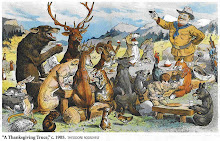

Column IN NEW WEST(ONLINE PAPER ABOUT THE WESTERN STATES)
We Need Wolves To Be Wolves
Unfortunately, most hunters are single minded about what is important and ecological integrity takes a backseat to "getting their elk."By George Wuerthner, 5-11-10
RMEF and other prominent pro hunting organizations are demanding that wolves be "managed" so they will have little effect upon elk numbers which hunters' desire. This is not to suggest that wolves cannot influence ungulate numbers. Thankfully they can. Nor am I worried that wolves will go extinct if managed. But I do worry that wolves may not be permitted to exert their top down ecological footprint upon the land if they are managed to minimize their influence upon ungulate populations.
Here's the rub. If wolves are going to have an ecological influence upon prey species like elk, they will occasionally reduce elk and other prey numbers in some places at some time. Ungulate population will often stabilize at lower numbers. Other times they will--over time--rise again. But far too many hunters are impatient. They remember the "good old days" when they could blast elk without much effort
The presence of wolves has led to a reduction in coyotes. Since coyotes are the main predator on pronghorn fawns, the reduction in coyotes has led to more pronghorn.Wolves also produce carrion throughout the year that supports many scavenger species. Some ecologists have even suggested that extra carrion may help counter somewhat the effects of warmer winters due to climate change (in the past harsh winters killed many more elk and created a lot of carrion). These positive changes and more could only occur if wolves are left to "manage" their own numbers.
Unfortunately, most hunters are single minded about what is important and ecological integrity takes a backseat to "getting their elk." Not only are elk numbers lower in some areas, but research has shown that elk appear to be more alert and wary, and are moving around more than in the past. All of these changes mean it is more difficult to get "your" elk in some parts of the West these days.
I think some hunters resent wolves, bears, cougars and other predators because predators are competition and make them look incompetent. Far too many hunters are out of shape, and lack real hunting skills. They may know how to shoot a rifle, and can debate the merits of various rifle calibers, but that is different from knowing how to hunt. And when you have wolves and other predators on the land, you have to be a good hunter, in shape, and ever alert to be consistently successful.