skip to main | skip to sidebar
Wolves, Wolf Facts, Cougars, Cougar Facts, Coyotes, Coyote Facts - Wolves, Cougars, Coyotes Forever

Learn about Grizzly Bears, Black Bears, Polar Bears, gray wolves/eastern wolves/red wolves,timber wolves, cougars/mountain lions/panthers/painters/pumas, bobcats, lynx, red and gray foxes, wolverines, martens, fishers, coyotes/eastern coyotes/coywolves with pictures, videos, photos, facts, info and news.

Visitor Counter

hitwebcounter web counter
Visitors Since Blog Created in March 2010

Click Below to:

Add Blog to Favorites

Coyotes-Wolves-Cougars.blogspot.com

Grizzly bears, black bears, wolves, coyotes, cougars/ mountain lions,bobcats, wolverines, lynx, foxes, fishers and martens are the suite of carnivores that originally inhabited North America after the Pleistocene extinctions. This site invites research, commentary, point/counterpoint on that suite of native animals (predator and prey) that inhabited The Americas circa 1500-at the initial point of European exploration and subsequent colonization. Landscape ecology, journal accounts of explorers and frontiersmen, genetic evaluations of museum animals, peer reviewed 20th and 21st century research on various aspects of our "Wild America" as well as subjective commentary from expert and layman alike. All of the above being revealed and discussed with the underlying goal of one day seeing our Continent rewilded.....Where big enough swaths of open space exist with connective corridors to other large forest, meadow, mountain, valley, prairie, desert and chaparral wildlands.....Thereby enabling all of our historic fauna, including man, to live in a sustainable and healthy environment. - Blogger Rick

Subscribe via email to get updates

Enter your email address:

Receive New Posting Alerts

(A Maximum of One Alert Per Day)

Sunday, December 27, 2015

The Unity College Black Bear Study of the past three years has revealed a recolonization of Western Maine in the making...........In the late 1800s, there wasn’t even a tree left for a bear to hide in this part of the state as the land had been virtually completed cleared of forest and converted to fields for agriculture....................With woodlands returning and the overall state population of Bears estimated at some 30,000, there is "forward pressure" for yearlings to push out and create new territories of their own, with the middle and western sections of Maine seeing that colonization taking shape.........

https://www.google.com/url?sa=t&rct=j&q=&esrc=s&source=web&cd=4&cad=rja&uact=8&ved=0ahUKEwjHpKzi9P3JAhUX42MKHWHzCGAQFggtMAM&url=http%3A%2F%2Fwww.centralmaine.com%2F2015%2F12%2F20%2Fbears-are-coming-back-to-northwestern-waldo-county%2F&usg=AFQjCNF9BvKofuKqG5EDe569CvtnEQsEYw&bvm=bv.110151844,d.cGc

Bears are coming 

back to 

northwestern

 Waldo County

A three-year Unity College study
shows the bear population, once sparse
 in the agricultural area, is returning as
 agriculture goes away.

BY PETER MCGUIRE STAFF WRITER
pmcguire@centralmaine.com | @PeteL_McGuire
Share
facebook
tweet
email
print
print Comment

A black bear as photographed by Unity College Bear Study team members in 2013. The school’s three-year study shows that bears are returning to the Unity area after more than a century of scarcity.

Unity College Bear Study team members review data points on a map in 2013.


Posted by Coyotes, Wolves and Cougars forever at 10:34 PM 0 comments

The Harvard Forest Dioramas vividly depict the history of eastern forests from the Atlantic seaboard to the Mississippi River(New England is the example depicted below of what occurred from Maine to Florida)................Perhaps 1% of the lower 48 states are virgin woodlands, prairies, chaparral as defined as the land cover that existed at the time of European colonization, circa AD1500

 CLICK ON ALL BOLDED HEADLINES BELOW FOR ADDITIONAL INFORMATION ON THE HISTORY OF LAND USE IN THE EASTERN USA

Download high-res images of the dioramas.

Landscape History of Central New England

Pre-Settlement Forest
1700 A.D.
In the pre-settlement forest, natural variation across sites and ongoing natural and human disturbance processes led to differences in age, density, size, and species of trees across a wide range of sites. Notice the large trees and large fallen trunks on the right in the diorama. Compare them with... Read More >
An Early Settler Clears a Homestead
1740 A.D.
For most of the New England region, European settlement occurred largely during the 18th century. Through forest clearing, hunting, and trapping, the abundance of many species changed rapidly and the wilderness was gradually transformed into a domesticated rural landscape.  Read More >
Height of Forest Clearing and Agriculture
1830 A.D.
The peak of deforestation and agricultural activity across most of New England occurred from 1830 to 1880. Across much of New England, 60 to 80 percent of the land was cleared for pasture, tillage, orchards and buildings. Small remaining areas of woodland were subjected to frequent cuttings for... Read More >
Farm Abandonment
1850 A.D.
Beginning in the mid-1800s and continuing for more than a century, farming declined on a broad scale across New England. Abandoned pastures and fields rapidly developed into forests. In central Massachusetts and across much of central New England these forests were dominated by white pines.  Read More >
"Old-Field" White Pine Forest on Abandoned Farmland
1910 A.D.
As the "old-field" stands of white pine reached middle age, it became evident that they contained a valuable and rapidly growing crop of second-growth timber. As this white pine became marketable portable sawmills appeared across central New England. One of the most common and valuable uses of... Read More >
"Old-Field" White Pine is Succeeded by Hardwoods
1915 A.D.
Clear-cutting of the "old-field" white pines led to the succession of mixed hardwoods across much of the landscape. The inability of white pine to sprout after being cut, in contrast to the prolific sprouting of our hardwood species, facilitated this succession. Patterns of succession enhanced the... Read More >
A Vigorously Growing Forest of Hardwoods
1930 A.D.
One of the characteristic features of the hardwood forest that developed after the clear-cutting of the "old-field" white pines is the predominance of multi-stemmed sprout clumps. Fast-growing species that sprout prolifically -- red oak, red maple, white ash, birches, and black cherry -- are... Read More >
The Modern Forest Landscape (photograph by David Foster)
In the period since the dioramas were constructed, the trends in forest development illustrated in the 1930 model have continued. Remarkable expanses of maturing forest extend across a densely populated landscape in the northeastern United States.As these forests grow and mature and as dead and... Read More >

Conservation Issues in the History of New England Forests

Old Growth Forests
This small stand of old-growth forest on the shore of Harvard Pond survived the regional history of land-use and natural disturbance due to its sheltered position at the base of a rocky slope that was unsuited for agriculture.In their size, variety, and unmistakable antiquity, the overstory trees... Read More >
Old Growth Forests 2
Wildlife Habitat in a Dynamic Landscape
New England's wildlife habitats and food resources have changed dramatically as the landscape has been transformed through time from forest to open fields and woodlots and then back to forest.The shift in our landscape to older, more continuously developing forests may encourage native woodland... Read More >
Accelerated Erosion with Intensive Land Use
In New England, as in many other locations, widespread land clearing and agriculture led to soil erosion.In the pre-settlement era, the thick forest cover prevented erosion by intercepting rain and binding the soil with a dense network of roots. Through evapotranspiration, the forests recycled... Read More >
Forest Fire
The diorama shows a typical fire-fighting scene from the 1930s, in the era of active suppression of all fires.The fire tower is typical of those built by state and federal agencies throughout the northeastern Untied states in the early 1900s, motivated by a widespread concern over the detection and... Read More >
Forest Fire Management

Posted by Coyotes, Wolves and Cougars forever at 8:40 AM 0 comments

How are the re-introduced Lynx faring in Colorado forests hammered by native Spruce Bark Beetles whose periodic natural "explosion" has been spurred to un-natural "borg-like" infestation via climate change?.......... Hundreds of thousands of acres of lynx habitat in the Southern Rocky Mountains was likely reduced in quality as mortality to overstory spruce trees approached 100%...................... However, the subalpine fir component and understory spruce in many of these forests survived the initial insect outbreak, and anecdotal observations indicate lynx and snows.shoe hare are still present.................. Biologists are in the very difficult position of being required to evaluate the consequence of management actions to lynx, such as timber salvage, without a scientific basis to support their decisions relative to recent changes to lynx habitat due to insect infestation............... The key question is how can the expected increase in proposed timber salvage be conducted in ways that also facilitate lynx conservation and species’ persistence on the Rio Grande National Forest

https://www.google.com/url?rct=j&sa=t&url=http://www.chieftain.com/news/region/4259319-120/lynx-beetle-forest-spruce&ct=ga&cd=CAEYACoTMjgxMjg0MDgwNDA4NzY4OTE1NzIaMWZiYWM0NmZiZmUyN2MzODpjb206ZW46VVM&usg=AFQjCNEjNRNEPreH7bUGYHijCg0TCTxzBw

Looking for lynx to a changing habitat

Studies underway to learn how cat is adapting to beetle-killed forests


CREEDE — When state wildlife officials began introducing Canada lynx into the San Juan Mountains in 1999, they were sending the cats into the best available habitat But just a few years after the start of the reintroduction program that would put roughly 185 lynx onto the Rio Grande National Forest, spruce bark beetles, spurred on by drought-weakened trees, would begin chewing their way through the forest, including prime lynx habitat.

Now, with over 500,000 acres of dead spruce in the bugs’ wake, Rio Grande officials are tasked with trying to salvage log the dead stands without harming the cat, which is listed as threatened under the Endangered Species Act.

The U.S. Forest Service implemented a plan in 2008 for the lynx on seven national forests in Colorado that guides whether and how timber salvage can be done.
- See more at: http://www.chieftain.com/news/region/4259319-120/lynx-beetle-forest-spruce#sthash.9LdHBVz0.dpuf

----------------------------------------------------------------------------------------------------

https://www.google.com/url?sa=t&rct=j&q=&esrc=s&source=web&cd=7&cad=rja&uact=8&ved=0ahUKEwi6g9DYvvzJAhUEy2MKHcX2D08QFggxMAY&url=http%3A%2F%2Fwww.fs.fed.us%2Frmrs-beta%2Fprojects%2Flynx-and-snowshoe-hare-response-spruce-beetle-tree-mortality-evaluating-habitat-suitability&usg=AFQjCNGfYtfnnwbtPrzkgfEjxK9MCQzG2Q

Lynx and snowshoe hare response to spruce-beetle tree mortality: Evaluating habitat suitability and timber salvage in spruce-fir forests


Posted by Coyotes, Wolves and Cougars forever at 8:34 AM 0 comments

Friday, December 25, 2015

The 28 year Red Wolf Recovery Program in the Outer Banks of North Carolina moves into 2016 without a YES OR NO decision regarding its continuation...............Without any filter on my mouth, I just have to say "that truly sucks",,,,,,I am a believer that both Coyotes and Red Wolves can co-exist,,,,,,We just have to get a sizeable population into multiple locales so that hybridizing between the two species is minimal(as now is the case with the Eastern Wolves in Algonquin Park(eastern Canada) and the Eastern Coyotes abutting the Park,,,,,,,Still waiting for the Obama Administration to take action on endangered species in a meaningful way................And our Eastern(Red) Wolf would be as high a visible species in which to make a statement positive about----------Mr. President, let us hear from you on this prior to the Summer 2016 date that your Wildlife Agency has "put in place as a "red line", "do not cross" moment

https://www.google.com/url?rct=j&sa=t&url=http://wfae.org/post/2015-brings-no-conclusions-red-wolf-recovery-program-eastern-nc&ct=ga&cd=CAEYAioUMTA1NjYzODQ3NTI1MTE3MTc0MTAyGjNlNTJiNDg3ZTUyODZjZjE6Y29tOmVuOlVT&usg=AFQjCNH7VxjhfI1cOBqPdcT3B3pYkBkoCw

2015 Brings No Conclusions On Red Wolf Recovery Program In Eastern NC


As 2015 comes to a close, uncertainty remains about the fate of a federal program in North Carolina aimed at protecting the Red Wolf from extinction. The U.S. Fish & Wildlife Service has repeatedly delayed a decision on whether to continue or abandon the Red Wolf Recovery program that was started in 1987. WFAE’s Mark Rumsey has a recap of this year’s developments:


North Carolina is home to the world’s only remaining wild population of Red Wolves. They roam a five-county area on the Albemarle Peninsula, between Greenville and the Outer Banks. Wildlife officials say the Red Wolf population in the recovery area peaked at around 130 nearly a decade ago. In October, the U.S. Fish & Wildlife Service estimated the number at between 50 and 75. A group called the Endangered Species Coalition says that since 2012, more than 30 Red Wolves have either been shot to death or struck and killed by vehicles.


Future of Red Wolf Recovery Program is still in question.
CREDIT STEVE HILLEBRAND / U.S. FISH AND WILDLIFE SERVICE
The Fish & Wildlife Service has been studying for more than a year whether to continue the Red Wolf Recovery Program. A decision was postponed twice this year. In late October, the federal agency said it needed more time to study the issue, and named a new "Red Wolf recovery team" for that purpose
. 
During a conference call with reporters, Regional Fish & Wildlife Director Cindy Dohner said the group would examine several questions including the long-term viability of Red Wolves that are kept by about 40 zoos around the U.S. The recovery team will also study cross-breeding between Red Wolves and coyotes, Red Wolf deaths caused by humans in the North Carolina recovery area, and the effects of climate change.

At the October briefing, Dohner said the Fish & Wildlife Service now plans to decide by summer 2016 whether to continue the Red Wolf recovery effort. Kim Wheeler, with the North Carolina-based Red Wolf Coalition, says the animals deserve the continued attention of wildlife officials. "This is going to set a precedent," Wheeler said.   "It's not just something that's going to affect wolves, but their decision is going to affect a lot of endangered species across the board," she added.
The U.S. Fish & Wildlife Service says that even if it decides to discontinue the Red Wolf Recovery program in eastern North Carolina, the federal agency would keep working to sustain the species, so long as it remains on the Endangered List.
Posted by Coyotes, Wolves and Cougars forever at 6:41 PM 0 comments

This time of year, owls are working overtime to find food............And even though we associate the "hooting" of Owls with the evening hours, cold and snowy conditions will have them up and about during the day to find food..............Owls have poor peripheral vision but like other raptors, have the ability to turn their heads up to 270 degrees, assisting with their ability to hear the sounds of prey on the ground and in the trees.........An Owl has the ability to hear a rodent below two feet of snow and through that auditory ability can adjust it's angle of descent from the sky in attacking prey with the deadly silence of a "Klingon Cloaking Device"

http://r20.rs6.net/tn.jsp?f=001qGOdBU0JDshCjy-ssRLsQERLKSYODBeDIyUYC8uWszi6sF6UEh3kQRwPMzC-D3syqHEHoIQASKLme8Ku3AY1iFmVoAz-uGkGhKxS8i0SzxsSyISWxJCdYUOCQ8QA51XwEG_b-olQ6SYWLPndTPWg01W_INeUWJcFpriztEizFd4IaGH-VO2c8exqKst-yTWmciYQiC5kZ4WDfrAPJ8GCzCTcrNvuWkwRZMoJBeMdygE=&c=WVJB4iI-MFYYWuoSOhtYK3RKpaHVskdv-_bNBhFHj5Zecc8M01vp4Q==&ch=2mbJoPCFEdUxF3xJp-bv-LLSv4rF36QIVhOxu-5jekEeHzOIwvzaHg==


Owl’s Winter Hunt

by Meghan McCarthy McPhaul
Outside Story
December 21, 2015
0 Comments
Owl’s Winter Hunt
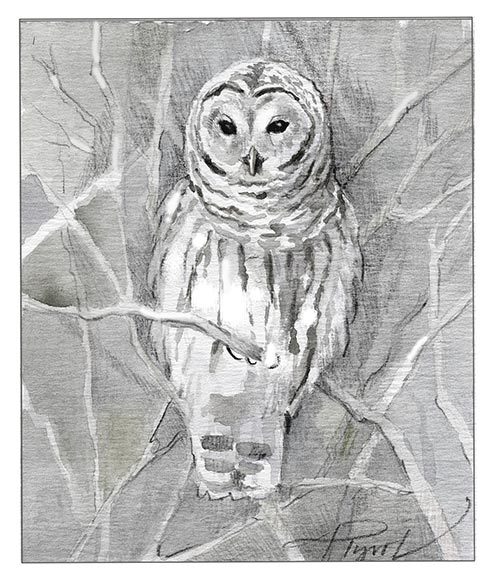
Illustration by Adelaide Tyrol
For several days last winter, a barred owl perched atop a dead white birch tree in our field. As winters go, last year’s was very cold, and the owl puffed up against the stubbornly below-freezing temperatures, its streaky brown and white feathers fluffed and fluttering in the icy breeze. Occasionally the owl would move its head in a slow turn, from east to west to east again, dark eyes gazing at the field blanketed in deep snow.
The owl was most likely listening more than watching, straining to hear the scratching of tiny feet moving under the thick layer of white. Owls are remarkably skilled at finding and catching prey, but even they struggle to survive a long, cold season.
“This time of year, owls are working overtime, since it’s a lot harder to find food,” said Dave Erler, senior naturalist at the Squam Lakes Natural Science Center in Holderness, New Hampshire. “That’s why we see them during the daytime more often in winter.”
Usually nocturnal, owls have eyes designed to be highly sensitive in low light conditions. They also have excellent depth perception. This superior vision is the result of eyes that are more tube-shaped than round, with myriad light-sensitive nerve endings. The trade-off is that owls’ eyes cannot move like ours do, so they have limited peripheral vision.
To compensate, owls are designed to turn their heads up to 270 degrees. Like other raptors, they have 14 vertebrae in their necks, compared to humans’ seven cervical bones. That, combined with a specialized arrangement of blood vessels to ensure the neck rotation does not impede circulation, allows owls their incredible range of head motion.
This head-turning ability helps more than vision; it also aids in hearing, perhaps the owl’s most important predatory feature. Many owls, including barred, saw-whet, and others that hunt in northern New England through the winter, have asymmetrically-placed ear openings pointing in slightly different directions. This means that sounds reach the ears at different times. If an owl hears a mouse scurrying through the snow on the left, it turns its head in that direction and then pinpoints the exact location of its prey based on how the sound reaches each ear. The feathers around an owl’s face and ears also funnel sound efficiently to the ears.
“Owls catch sounds at different angles and probably at a different rate, too. Since they’re hunting more by sound than sight, that’s really an advantage,” said Erler. “That’s what allows them to hear their prey underneath the snow.”
An owl can hear a rodent moving up to two feet below the surface of the snow. And owls are able to hear prey move even as they fly toward it, allowing them to adjust their path in flight as necessary. Basically, owls perform instantaneous trigonometry as they hunt, changing direction based on shifting prey intelligence in mere milliseconds.
This mid-flight adjustment is helped by another feature that makes owls great hunters: silent wings. Compared with other raptors, owls’ wings are broad, rounded, and quite large in relation to their body size, creating a low wing loading: more lift per wing beat. Less flapping means less sound, of course, but the intricate design of an owl’s feathers also muffles noise.
There are three sets of feathers that factor into an owl’s stealth flying. First, the feathers at the leading edge of the wing feature flexible bristles that break up the turbulence – or sound of air moving over wings – into smaller, less noisy currents. Porous fringe along the feathers at the trailing end of the wings muffle the sound of air sliding off the back side. Finally, the dense, velvety down feathers covering the owl’s body and wings absorb sound, comparable to the effect of a heavy carpet.
Once an owl has located and silently approached its prey, it attacks in a sudden, violent swoop, using its talons to break through the snow.
  
When the hunting is good, many owls will cache food in a tree snag or nest. When the hunting is not so good, owls turn opportunistic, for example, staking out birdfeeders in the hopes of catching squirrels, birds and other seed eaters.
According to Erler, owls aren’t particularly intelligent birds, despite their reputation for wisdom. However, as winter predators, they are remarkably well adapted. Look for one fluffed up in a tree near you, and next time you’re out in a field, keep an eye out for evidence of the hunt: wing scrapes in the snow with a hole in the middle, where the talons punched through.
Meghan McCarthy McPhaul is an author and freelance writer. She lives in Franconia, New Hampshire.


Posted by Coyotes, Wolves and Cougars forever at 6:30 PM 0 comments

As any of you who have been to Southern California know, the Los Angeles to San Diego corridor is one unbroken sea of development, making it perilous for all other lifeforms(some would say all lifeforms) except humans to thrive................We have previously discussed the proposed L.A. 101 Freeway wildlife overpass being contemplated to assist Puma, Coyote, Deer, Bobcat, et al. gene flow,,,,,,,,,,Today, we focus on the recent UC Davis study pointing to the fact that only one of the 42 Pumas investigated in the Santa Ana Mountains during 2001-02 had genes characteristic of the those cats in the Peninsular Ranges running east of San Diego...................Wildlife overpass/underpass near Temecula, California would greatly assist in driving down the incidence of interbreeding now very much in evidence in this region

http://www.kcet.org/news/redefine/rewild/mammals/habitat-loss-hurts-mountain-lions-in-santa-ana-mountains-too.html

Habitat Loss Hurts Mountain Lions in the Santa Ana Range, Too

by Chris Clarke 
December 17, 2014 5:11 PM
SHARE
We've written a fair amount here at Rewild about the plight of pumas in the Santa Monica Mountains, cut off from their fellow lions by freeways to and from the San Fernando Valley. Without an easy way to meet and mate with pumas elsewhere, lions in the Santa Monicas are inbreeding, and that's bad for the cats' long-term survival.


And that problem isn't just limited to the Santa Monica Mountains. A study shows that the Santa Ana Mountains have become a similar isolated island for pumas that live there, cut off from their neighbors in the nearby Peninsular Ranges by increasing human development.
The two puma populations, once separated by just 15 or 20 miles of easily navigable foothills near Temecula, are now quite distinct in their genetic makeup -- and the study's authors suggest that much of the reason may be the 10 lanes of high-speed freeway known as Interstate 15.

The study, published recently in the journal Public Library of Science, was conducted by Holly Ernest, T. Winston Vickers, Michael Buchalski, and Walter Boyce of UC Davis, along with Scott Morrison from The Nature Conservancy.

The 101 Freeway in Los Angeles(below) like the 5 and I 15 in Orange County
and San Diego are major impediments to Puma's spreading their genes


The researchers collected DNA from 97 pumas in in San Diego, Orange, Riverside, and San Bernardino counties, either when the cats were captured for radio telemetry studies or in cases when individual pumas were shot due to livestock depredation or public safety reasons. 42 of the samples were collected in the Santa Ana Mountains, and the remainder in the Peninsular Ranges to the east. All the samples were collected between 2001 and 2012.
Study and comparison of different genetic markers in the samples confirmed that, as long suspected, the pumas in the Santa Ana Mountains have been inbreeding for a long time. Of the 42 Santa Ana pumas sampled, just one, dubbed M86 (with the M standing for "male"), had genes characteristic of the Peninsular puma population. He had apparently sired four kittens in the Santa Anas, each of which had a partial complement of Peninsular genes.
Aside from M86's progeny, none of the other mountain lions in the Santa Ana samples showed evidence of having Peninsular pumas in their recent ancestry. The study's authors calculated the length of separation necessary to generate that marked a divergence between two geographically close populations of pumas, and figured that the genetic bottleneck for Santa Ana Mountains pumas started between 40 and 80 years ago.
It was about 40 years ago, of course, that the era of freeway building in Southern California was at its peak.
"It is likely that the potential for connectivity between the Santa Ana Mountains and the Peninsular Range-East region will continue to be eroded by ongoing increases in traffic volumes on I-15," write the authors, "and conversion of unconserved lands along the I-15 corridor by development and agriculture."
"These findings raise concerns about the current status of the Santa Ana Mountains puma population, and the longer-term outlook for pumas across Southern California," the authors conclude. "Indeed, the Santa Ana Mountains pumas may well serve as harbingers of potential consequences throughout California and the western United States if more attention is not paid to maintaining connectivity for wildlife as development progresses."
Posted by Coyotes, Wolves and Cougars forever at 6:16 PM 0 comments
Newer Posts Older Posts Home
Subscribe to: Posts (Atom)

About Me

Coyotes, Wolves and Cougars forever
View my complete profile

Recent Comments

Red Fox fighting Badger

Email Rick Meril

Subscribe To

Posts
Atom
Posts
All Comments
Atom
All Comments

Bobcat in Vermont woodlands

Mother and daughter Puma playing in North Dakota

Find us on Facebook

Find us on Facebook

Christmas morning 2008-Coyote hunting mice

Blog Archive

  • March (5)
  • February (11)
  • January (3)
  • December (7)
  • November (10)
  • October (8)
  • September (4)
  • August (11)
  • July (12)
  • June (9)
  • May (12)
  • April (18)
  • March (23)
  • February (20)
  • January (18)
  • December (19)
  • November (21)
  • October (24)
  • September (22)
  • August (26)
  • July (19)
  • June (17)
  • May (22)
  • April (24)
  • March (27)
  • February (26)
  • January (26)
  • December (29)
  • November (18)
  • October (24)
  • September (19)
  • August (25)
  • July (25)
  • June (23)
  • May (29)
  • April (31)
  • March (28)
  • February (25)
  • January (33)
  • December (32)
  • November (32)
  • October (34)
  • September (30)
  • August (39)
  • July (29)
  • June (34)
  • May (39)
  • April (31)
  • March (34)
  • February (35)
  • January (45)
  • December (42)
  • November (32)
  • October (25)
  • September (33)
  • August (46)
  • July (34)
  • June (48)
  • May (43)
  • April (47)
  • March (43)
  • February (37)
  • January (37)
  • December (45)
  • November (42)
  • October (34)
  • September (36)
  • August (44)
  • July (36)
  • June (45)
  • May (43)
  • April (51)
  • March (48)
  • February (47)
  • January (64)
  • December (63)
  • November (57)
  • October (43)
  • September (45)
  • August (52)
  • July (52)
  • June (48)
  • May (55)
  • April (54)
  • March (77)
  • February (68)
  • January (51)
  • December (61)
  • November (49)
  • October (42)
  • September (62)
  • August (68)
  • July (69)
  • June (42)
  • May (72)
  • April (83)
  • March (77)
  • February (80)
  • January (78)
  • December (90)
  • November (91)
  • October (93)
  • September (94)
  • August (92)
  • July (85)
  • June (90)
  • May (91)
  • April (91)
  • March (93)
  • February (85)
  • January (94)
  • December (90)
  • November (80)
  • October (87)
  • September (96)
  • August (90)
  • July (62)
  • June (54)
  • May (62)
  • April (55)
  • March (27)
  • February (14)

Hiker in Glacier National Park encounters a Puma......The Puma walks "wide" of the hiker

Search This Blog

Lynx capturing a snowshoe hare

Likely Wolf sighting in Colorado

black Bear in the Smokey Mtns berry hunting in the trees

Blog Translation

favorite links

  • Wyoming Untrapped
  • The Natural History of the Urban Coyote
  • western wildlife
  • Wild Dog Foundation
  • Coyotes live in Maine
  • Santa Cruz Puma Project
  • http://www.coyotewatchcanada.com
  • Mexican Wolves.org
  • Greater Yellowstone Science Learning Center
  • Western Wolves
  • Lockwood Animal Rescue Center
  • Wolf and Wildlife Studies
  • Worth a Dam
  • The Wolverine Foundation
  • mountain lion foundation
  • Boulder-Whiteclouds Council
  • Wild Read
  • Big Wildlife
  • Southern Utah Wilderness Alliance
  • Coyote Yipps
  • The Wolverine Blog
  • Craighead research.org
  • Wild Earth Guardians
  • Biodiversity Conservation Alliance
  • Center for Native Ecosystems
  • izilwane.org online Magazine
  • Oregon Wild
  • Ralph Maughan's Wildlife Reports
  • North American Bear Center
  • Wolf and Cat
  • Conservation Northwest
  • Howling for Justice
  • Wilderness Watch
  • Wolf Watcher
  • Endangered Species Coalition
  • My Place By The Pond
  • The Wolverine Foundation
  • Wolf Ecosystem Research
  • canadian Parks and Wilderness Society
  • Earthroots
  • Predator Defense
  • Sightline Institute
  • Downeast Lakes Land Trust
  • Adirondack Council
  • jaguar Conservation Network
  • Bordercats
  • Large Carnivore Conservation Lab-Washington State U.
  • Bat conservation International
  • The human footprint
  • Craighead Beringia South
  • Yellowstone to Yukon Conservation Initiative
  • Canadian Boreal Initiative
  • Northern Rockies Conservation Cooperative
  • Keeping Track
  • Wildlife Conservation Society
  • Native Fish Society
  • Jaguar Habitat Campaign
  • Northern Woodlands Magazine
  • Canadian Wolf Coalition
  • Forest Service Employees
  • Trust for Public Land
  • Rainforest Action Network
  • The Wilderness Society
  • Greater Yellowstone Coalition
  • Keystone Conservation
  • American Wildlands
  • The Nature Conservancy
  • Algonquins to Adirondacks
  • Two Countries, One Forest
  • Vermont Land Trust
  • Center For Biological Diversity
  • Open Space Institute
  • Wildlands and Woodlands
  • Rewilding Institute
  • Cougar Network
  • Cougar rewilding foundation
  • Eastern Coyote Research
  • Project Coyote
  • Restore:The North Woods
  • The Wildlife News
  • N.E. Eco Recovery Society
  • WERC
  • Wildlands Network
  • Outdoor Liasons
  • People and Wolves

Click Below to Follow Us On Twitter

Click Below to Follow Us On Twitter

Northern Ontario, Canad Wolfpack caught on trailcamera

Add Coyotes-Wolves-Cougars Link To Your Igoogle Homepage

Add to Google Reader or Homepage

A New Jersey Eastern Coyote unable to take a fawn

Blogger Rick

Blogger Rick
Strategizing at the WB

Let Rick and other readers know you're a fan of this blog...Become a Follower!

Making a Pitch at the WB

Making a Pitch at the WB

Two Massachusetts Eastern Coyotes at their den site

Eastern Wolf in Algonquin Provincial Park, Ontario, Canada

Gray Foxes(unlike Red Foxes) can climb trees--an advantage when pursued by Coyotes

Aldo Leopold--3 quotes from his SAN COUNTY ALMANAC

"We abuse land because we regard it as a commodity belonging to us. When we see land as a community to which we belong, we may begin to use it with love and respect."


Aldo Leopold

"A thing is right when it tends to preserve the integrity, stability and beauty of the biotic community. It is wrong when it tends otherwise."


Aldo Leopold

''To keep every cog and wheel is the first precaution of intelligent tinkering."


Wildlife Rendezvous

Wildlife Rendezvous
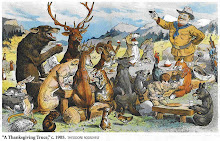
Like so many conscientious hunters and anglers come to realize, good habitat with our full suite of predators and prey make for healthy and productive living............Teddy Roosevelt depicted at a "WILDLIFE RENDEZVOUS"

Recent Posts


Blog Disclaimer

This is a personal weblog. The opinions expressed here represent my own and not those of my employer. In addition, my thoughts and opinions change from time to time…I consider this a necessary consequence of having an open mind. This blog is intended to provide a semi-permanent point in time snapshot and manifestation of my various thoughts and opinions, and as such any thoughts and opinions expressed within out-of-date posts may not be the same, nor even similar, to those I may hold today. All data and information provided on this site is for informational purposes only. Rick Meril and WWW.COYOTES-WOLVES-COUGARS.COM make no representations as to accuracy, completeness, suitability, or validity of any information on this site and will not be liable for any errors, omissions, or delays in this information or any losses, injuries, or damages arising from its display or use. All information is provided on an as-is basis.


Additional disclaimer information can be viewed by clicking here.