Visitor Counter

hitwebcounter web counter
Visitors Since Blog Created in March 2010

Click Below to:

Add Blog to Favorites

Coyotes-Wolves-Cougars.blogspot.com

Grizzly bears, black bears, wolves, coyotes, cougars/ mountain lions,bobcats, wolverines, lynx, foxes, fishers and martens are the suite of carnivores that originally inhabited North America after the Pleistocene extinctions. This site invites research, commentary, point/counterpoint on that suite of native animals (predator and prey) that inhabited The Americas circa 1500-at the initial point of European exploration and subsequent colonization. Landscape ecology, journal accounts of explorers and frontiersmen, genetic evaluations of museum animals, peer reviewed 20th and 21st century research on various aspects of our "Wild America" as well as subjective commentary from expert and layman alike. All of the above being revealed and discussed with the underlying goal of one day seeing our Continent rewilded.....Where big enough swaths of open space exist with connective corridors to other large forest, meadow, mountain, valley, prairie, desert and chaparral wildlands.....Thereby enabling all of our historic fauna, including man, to live in a sustainable and healthy environment. - Blogger Rick

Subscribe via email to get updates

Enter your email address:

Receive New Posting Alerts

(A Maximum of One Alert Per Day)

Wednesday, January 27, 2016

While neighboring Illinois has decided that it is ok to begin to hunt and trap its recovering Bobcat population, next door Indiana has thus far resisted doing so...........While uncertain of the population size in the Hoosier state, wildlife Officials there have noted that since 2010, the annual number of Bobcats killed by motorists has risen 6-fold from 10 in 2010 to 60 in 2015...........Also, "Bobs" have been confirmed to be located in 63 of Indiana’s 92 counties, with the southwestern portion of the state seeing the highest densities of the "cats" because of the mixed woodlots, hills and reclaimed mining sites that the Bobcats find to their liking..............According to Scott Johnson, a nongame mammal biologist with the Indiana Department of Natural Resources (IDNR), “an analysis of over 100 bobcat stomachs has shown their diet is primarily composed of mammals including rabbit, mice, voles, and squirrel.......... Remains of several bird species were also found to be eaten but only in a small percentage of the bobcats autopsied............. Johnson also noted that bobcats, like many predators, are opportunistic and will scavenge deer carcasses during fall-winter months...........As demonstrated in adjacent Illinois, Ohio and in recolonizing populations in New Jersey, NY and New England, Indiana biologists in south central Indiana revealed that bobcats studied there often dispersed distances upwards of 50-100 miles from their natal birthplaces............. This ability to cover long distances allows them to recolonize available habitat and re-establish breeding colonies quickly if not overly hunted, trapped and killed by motorists

https://www.google.com/url?rct=j&sa=t&url=http://www.kokomotribune.com/sports/martino-bobcats-presence-continues-to-increase-in-indiana/article_59562558-c193-11e5-baef-43f42780c244.html&ct=ga&cd=CAEYASoTOTA4NjIzNDg4ODk1MDA2NjA1NjIaZTc5ZTQ4NTgyNjA0Y2RkNTpjb206ZW46VVM&usg=AFQjCNFP7zq_gA1ZfC0ddnjp0gfO5j5RE


MARTINO: Bobcats' presence continues to increase in Indiana

  • By JOHN MARTINO Outdoors columnist
  •  
  •  


                 MORE ABOUT INDIANA              BOBCATS AND IT'S WILD          FAUNA/FLORA Edited byMarion T.
             Jackson ISBN: 978-0-253-33074-1 
 .


The Natural Heritage of Indiana


I

Tuesday, January 26, 2016

With the very healthy Whitetail Deer population existing throughout Virginia, West Virginia, Pennsylvania and all of the states defining the spine of the Appalachian Mountain region, there has been any number of studies indicating that there is suitable core habitat for Puma and Wolf restoration............Lowest human population and road density coupled with continuous and unfragmented forest habitat with a suitable prey base are the three key variables that need to exist to support our top carnivore matrix in the east..................As the following articles posted in today's blog indicate, both West Virginia and Virginia seem to qualify strongly for Puma and Wolf restoration

https://www.google.com/url?sa=t&rct=j&q=&esrc=s&source=web&cd=5&cad=rja&uact=8&ved=0ahUKEwj245LXpMnKAhVjuYMKHSDFDdIQFgg5MAQ&url=http%3A%2F%2Fwildvirginia.org%2Fwp-content%2Fuploads%2F2008%2F07%2Farc_eastern_cougar_habitat_paper.pdf&usg=AFQjCNFBv8T3ABmECmX5nmPU2O7sqWehCA

EASTERN COUGAR (Puma concolor couguar) © 1990 Michael McNelly HABITAT SUITABILITY ANALYSIS FOR THE CENTRAL APPALACHIANS

 Kristin Taverna, Jason E. Halbert, and David M. Hines Appalachian Restoration Campaign A Project of Heartwood

 Abstract: The Appalachian Restoration Campaign (ARC) is dedicated to the restoration and protection of Central Appalachian wildlands by developing an interconnected system of reserves in which human activity is compatible with ecological recovery and health. The core of this project is the Central Appalachian Assessment (CAA), focusing on a regional study area that encompasses portions of six states throughout the Central Appalachians.


 Part I of this Assessment includes an examination of the current landscape within the study area and its suitability for supporting the eastern cougar (Puma concolor couguar). Suitable cougar habitat still exists within the Central Appalachians, yet prior studies have not examined the location or availability of habitat. The cougar stands out as an umbrella species for habitat management due to its extensive home range. If we protect the habitat that falls under this protective “umbrella”, we could effectively provide for the habitat needs of a number of other species throughout the region. 

Using GIS software, this analysis identifies suitable cougar habitat based on the landscape characteristics of prey density, road density, human population density, and land use. The data for each layer was reclassified and ranked from 1 to 10 according to its suitability as cougar habitat. The highest suitability rating (10) was given to the categories of lowest road density, lowest human population density, highest deer density, and forest habitat. 

The reclassified data layers were added using ArcView to create a final composite map, with a total score calculated for each cell of 5.5 mi2 (14.2 km2 ). The composite scores for the CAA study area range from 8 to 40, with 40 being those cells most suitable as cougar habitat. 

The greatest density of high suitability cells within the CAA study area (total score 37 - 40) is located within the central to northwest section of West Virginia. There are also smaller areas of dense cells with a high suitability rating (total score 34-40) located in northeastern West Virginia and in northwest Pennsylvania.

 In addition, a large portion of cells which received a high suitability rating (total score 32-40) are located along the Appalachian mountain chain and within the northern Allegheny plateau. Additional research is necessary to further identify specific areas of suitable habitat on a smaller scale and to examine these areas in terms of property ownership and current protection status.

So both Virginia and West Virginia deer kills are up over a year ago with Virginia's count expected to ultimately grow from the current 168,000 to some 218,000 hunter killed Whitetails in 2015.............Once again, Black Bears and Coyotes taking Spring born fawns are nowhere near the equilibrium agents needed for vibrant forest regeneration to occur................... Only a re-introduction of Pumas and Wolves would accomplish this

https://www.google.com/url?rct=j&sa=t&url=http://www.13newsnow.com/story/news/local/virginia/2016/01/25/virginia-deer-kills-likely-top-last-years-harvest/79290446/&ct=ga&cd=CAEYACoTOTQwMTk2ODQzMjU0MjI5MzcwNDIaZmMyNWRjZGYxNDI0NmQ5MTpjb206ZW46VVM&usg=AFQjCNH0nbdXuyEZe8-qJAbl7Bpt04d6lg


Virginia deer kills likely to top last year's harvest


LINKEDINCOMMENTMORE


HARRISONBURG, Va. (AP) -- Virginia game officials
 say hunters are expected to top last year's deer
 harvest.
Matt Knox of the Virginia Department of Game
 and Inland Fisheries says hunters have checked
 in 167,736 deer online this season. That's an
 increase of 12 percent over last year,
according to The Daily News-Record.
Knox said online check-ins account for
roughly 80 percent of all deer kills in the state.
While the count from traditional paper
 check-ins has not been counted, Knox
said he expects it will add between 30,000
 and 50,000 deer kills.
Last year, hunters statewide checked in
 192,278 deer. The number this year is
likely to top that, perhaps ranging up to 218,000.
Those numbers are still below the 10-year
 average of 230,000 deer.

So do you think that Pumas and Wolves are needed back in West Virginia...........Black Bears and Coyotes exist in the state but obviously are not denting deer numbers with 2015 human deer kills at 130,000, 10% above the previous 5 year average

https://www.google.com/url?rct=j&sa=t&url=http://www.heraldmailmedia.com/news/tri_state/west_virginia/deer-kills-up-percent-in-w-va-in/article_77f988e4-bef8-11e5-8b49-076583750002.html&ct=ga&cd=CAEYAioUMTc0NjQzODQ5MTYxODY0MzEzODgyGmZjMjVkY2RmMTQyNDZkOTE6Y29tOmVuOlVT&usg=AFQjCNFbVNFESkpoQ6x-tu2ffAo5pDbjY

Deer kills up 32 percent in W.Va. in 2015

Print
Font Size:
Default font size
Larger font size
Posted: Tuesday, January 19, 2016 5:03 pm
CHARLESTON, W.Va. (AP) — The number of deer killed in West Virginia last year rose 32 percent compared with 2014.
The state Division of Natural Resources said hunters killed more than 138,000 deer during the bucks-only, antlerless, muzzleloader, archery and youth/Class Q and Class XS deer seasons.
That compares to the nearly 105,000 deer killed in 2014, and is 10 percent greater the five-year average of about 126,000.
Last year's deer total includes nearly 60,814 killed during the buck firearm season, 39,853 during all antlerless firearm hunting opportunities, 32,540 during archery season and 5,179 during muzzleloader season.
Preston County had the most kills at 5,080, followed by Ritchie County at 4,527, Lewis County at 4,506 and Jackson County at 4,333.

Monday, January 25, 2016

The Santa Cruz, California Puma Project reveals and reinforces what we know about Puma courtship and mating behaviour-----Courtship among Pumas tend to occur at scrape sites, raised ground stuffs and soil that males dig up and create and then scent mark via urination...........Females are attracted to these sites and a male/female "hookup can occur there accordingly,,,,,,,,,,,,,,,If Males do not show up when females are at the scrape sites, females may begin alerting males to their availability through caterwauling, a high pitched "meow" that can be heard by males up to 5 miles away.............Once a "hookup occurs, the male and female hang out together for up to 5 days and then part ways with the male out again seeking to mate with other females................90 days after impregnation, cubs are born................click on link below to view some fascinating videos relating to this courtship process

https://www.google.com/url?rct=j&sa=t&url=http://voices.nationalgeographic.com/2016/01/21/courtship-in-pumas-videos-reveal-cryptic-behaviors/&ct=ga&cd=CAEYACoUMTgzNTg2MjIyNjYwMDg0Mzg3OTkyGjUyNTY1Zjg1M2Y0Yzk2Zjk6Y29tOmVuOlVT&usg=AFQjCNGjHWVP2n9eqaLYwrsjlQnBve1l


Courtship in pumas: videos reveal cryptic behaviors


Max Allen – Santa Cruz Puma Project

A male puma looking back (Photograph courtesy of Max Allen)


References:
Allen, M.L., H.U. Wittmer, P. Houghtaling, J. Smith, L.M. Elbroch, and C.C. Wilmers. 2015. The role of scent marking in mate selection by female pumas (Puma concolor). PLoS One 10: e0139087.
Allen, M.L., H.U. Wittmer, and C.C. Wilmers. 2014. Puma scrape and communication behaviors: understanding functional use and variation by sex and age. Behaviour 151: 819–840.
Logan, K., and L. Sweanor. 2001. Desert puma: evolutionary ecology and conservation of an enduring carnivore. Island Press: Covelo, CA.

Sunday, January 24, 2016

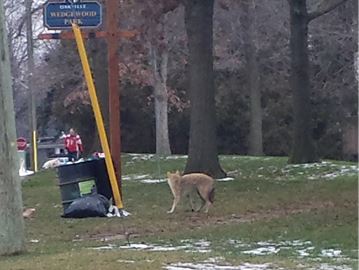
Halfway between Toronto and Hamilton(Ontario, Canada), the town of Oakville is evaluating an intelligent step, that if instituted would lead to optimum Human/Eastern Coyote coexistence..............So as to prevent Coyote habituation to human neighborhoods, a resident is calling on town fathers to have all who reside in Oakville to switch from open metal garbage cans to so-called "enclosed garbage cans"...........Limit Coyotes access to human generated food garbage(same as what Yellowstone Park Officials have done with Grizzly Bears) and you knock out a key "acclimation inducer" to the animals wading into neighborhoods to find an "easy meal"...........Combine this with keeping cats inside and dogs on leashes and you have a "1+1=3" set of actions that go a long way to keeping songdogs fulfilling their ecosystem service function, preying on rodents and small mammals----and not looking to us humans for "handouts"


https://www.google.com/url?rct=j&sa=t&url=http://www.insidehalton.com/news-story/6241739-town-of-oakville-looking-at-enclosing-park-garbage-cans-to-deter-coyotes/&ct=ga&cd=CAEYBSoTODk0MDQyNzY3NDE3Njg4MDc0MDIaZjUwOWE2YjQ0ZTNkYzY4OTpjb206ZW46VVM&usg=AFQjCNG4Qj_vHhAMBo-BsgbnV0uJdv5xnw
Sent from my iPad

Town of Oakville looking at enclosing park garbage cans to deter coyotes

Oakville Beaver
By David Lea 
An Oakville woman, who lives in the vicinity of Wedgewood Park, is calling on the Town to switch to enclosed garbage cans at its outdoor facilities following a close encounter with a coyote.
Elaine Wood said the old style open metal garbage cans, particularly the ones located at the entrance to local parks, are an open invitation for coyotes as they offer an easy food source.
The resident found this out firsthand during a recent mid-day walk near Wedgewood Park.
“I was out for a walk around noon and literally stumbled upon this coyote,” said Wood.
“Needless to say, I backed away when I saw him.”
In pictures provided by Wood, a coyote can be seen apparently investigating an overflowing garbage can in the park.
Wood said enclosed public garbage cans would cut coyotes off from this food source and remove one of the key factors drawing them closer to residential areas.
Resident concerns about coyotes have been on the rise in recent weeks as an outbreak of mange is causing the animals to come closer to residential areas seeking warmth and food.
Last week, a coyote made headlines when it approached students at Oakville Trafalgar High School.


Police were called to the scene, but the coyote ran away as they approached.
Earlier this week, Oakville Beaver Justin Greaves spotted and photographed a coyote strolling down Third Line in the area of the shopping mall, South Oakville Centre.
The Town’s Director of Parks and Open Space Chris Mark said that while the vast majority of park garbage cans are open versions, there are a number of enclosed models throughout the town.
He said there are a few of these enclosed trashcans in Glen Abbey and a couple in the southeast Oakville area, but agreed with Wood there should be more.
“Putting the hoods on these cans is something we should and we can do in the near future especially in the OT (Oakville Trafalgar) area, where we’ve got this coyote right now that is giving us problems,” said Mark.
“We can probably do that in the next week or two weeks.”
Mark said the enclosed garbage cans serve two purposes, in that they keep wildlife out of the garbage and they deter residents from dumping household waste illegally.
Town staffers are also recommending residents refrain from throwing food waste into these park garbage cans.
“It just leads to habituating wildlife. It’s habituating coyotes, squirrels, raccoons, foxes. Putting food out in the garbage cans is just an absolute no-no,” said Mark.
“The wildlife should be in the valleys and the wildlife corridors that we have, instead of being in the neighbourhood park because they’ve got access to food.”
Mark also referenced the overflowing park garbage cans noting that while the garbage in those cans is collected a minimum of once a week, there is a major problem with illegal dumping at these cans throughout the town.
He called on residents to report these overflowing cans when they see them at 905-845-6601 so they can be emptied.
Mark also pointed out when a problem with illegal dumping is found in a neighbourhood, the Town distributes flyers to surrounding residents asking them to refrain from this behaviour.
“The full can is unsightly; secondly, it smells; and thirdly, it creates food for wildlife and especially coyotes,” said Mark.
The Town is holding a coyote information meeting tonight (Wednesday) at 7 p.m. at St. Mildred’s-Lightbourn School at 1080 Linbrook Dr.

"The contentious phenomenon of identity politics isn't limited to Democrats and Republicans"................ "A national survey shows that "cat people" and "bird people" have heated differences of opinion, complicating the challenge of managing more than 50 million free-roaming feral cats while protecting threatened wildlife"............."Bird conservation professionals, whose focus is on protecting species from extinction in the wild, see feral cats as threats to the survival of wild birds"............."Cat colony caretakers, on the other hand, dedicate themselves to caring for neighborhood animals they see as abandoned and neglected by others".................We have to find some way to get these two divergent groups to collaborate on a true solution to Cat wildlife predation............It's a real conundrum and a tough path to collaboration between the two groups as "only 9 percent of cat colony caretakers believed cats harmed bird populations and only 6 percent believed feral cats carried diseases".................. "Colony caretakers supported treating feral cats as protected wildlife and using trap, neuter and release programs to manage feral cat populations"............... "Many bird conservation professionals, meanwhile, saw feral cats as pests and supported removing and euthanizing them".............. "Within both groups, women and older respondents were less likely to support euthanasia"

http://www.sciencedaily.com/releases/2012/09/120906181643.htm#.Vp1j7o4BPEk.mailto


Why claws come out over feral cat management: Finding common ground among 'cat people' and 'bird people'