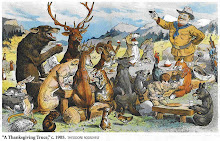
Learn about Grizzly Bears, Black Bears, Polar Bears, gray wolves/eastern wolves/red wolves,timber wolves,
cougars/mountain lions/panthers/painters/pumas, bobcats, lynx, red and gray foxes, wolverines, martens, fishers, coyotes/eastern
coyotes/coywolves with pictures, videos, photos, facts, info and news.
Visitor Counter
Visitors Since Blog Created in March 2010
Click Below to:
Add Blog to Favorites
Coyotes-Wolves-Cougars.blogspot.com
Grizzly bears, black bears, wolves, coyotes, cougars/ mountain lions,bobcats, wolverines, lynx, foxes, fishers and martens are the suite of carnivores that originally inhabited North America after the Pleistocene extinctions.
This site invites research, commentary, point/counterpoint on that suite of native animals (predator and prey) that inhabited The Americas circa 1500-at the initial point of European exploration and subsequent colonization.
Landscape ecology, journal accounts of explorers and frontiersmen, genetic evaluations of museum animals, peer reviewed 20th and 21st century research on various aspects of our "Wild America" as well as subjective commentary from expert and layman alike. All of the above being revealed and discussed with the underlying goal of one day seeing our Continent rewilded.....Where big enough swaths of open space exist with connective corridors to other large forest, meadow, mountain, valley, prairie, desert and chaparral wildlands.....Thereby enabling all of our historic fauna, including man, to live in a sustainable and healthy environment. - Blogger Rick
Biologists: Don't get close to elk that has wandered into South CarolinaOctober 25, 2016
Wildlife biologists are warning Upstate residents and visitors not to closely approach a young bull elk that has wandered into South Carolina from North Carolina.
A young bull elk grazes in a yard near Sunset in northern Pickens County. The elk, one of a herd of about 150 in and around the Great Smoky Mountains National Park in North Carolina, was first seen in South Carolina Oct. 21. Biologists expect the elk to eventually return to the North Carolina herd.
The first official sighting of an elk in South Carolina was made on Friday, Oct. 21 at Camp McCall, a South Carolina Baptist Convention camp on US 178 in northern Pickens County. On Oct. 22, the elk was seen at the Sunset Post Office on SC 11, and on Oct. 23 it was observed in the Nine Times Community, also in northern Pickens County. On Oct. 23, it was seen at The Reserve at Lake Keowee golf course, which is near SC 133 in Sunset. Numerous social media postings have been made with photos of the elk, some with people feeding the animal.
"People get a false sense of security, because elk don't mind being approached," said Justin McVey, a wildlife biologist with the N.C. Wildlife Resources Commission. "But they are still wild animals and can be very dangerous. All it would take is for that elk to swing its antlers, and it could really hurt somebody."
Elk once roamed the southern Appalachian mountains and elsewhere in the eastern United States. They were eliminated from the region by over-hunting and loss of habitat. The last elk in North Carolina was believed to have been killed in the late 1700s. By 1900, the population of elk in North America dropped to the point that hunting groups and other conservation organizations became concerned the species was headed for extinction. Reintroduction of elk into Great Smoky Mountains National Park began in 2001. The population around the Great Smoky Mountains is estimated at 150 elk, and there have been numerous unconfirmed sightings in the Upstate of South Carolina in recent years.
Tammy Wactor, a wildlife biologist with the S.C. Department of Natural Resources (SCDNR), said legislation that was passed five years ago by the S.C. General Assembly protects elk in the Palmetto State, so they cannot be harmed. The legislation was promoted by the Rocky Mountain Elk Foundation, in anticipation of elk migrating into South Carolina.
Wactor said the young bull elk, which may weigh upwards of 700 pounds, was likely pushed out of its territory in Heywood County, North Carolina, by bigger bulls. Once the young elk realizes there are no female elk in South Carolina, it will likely return to North Carolina. In the meantime, Wactor advised motorists to use caution when driving on Upstate roads where the elk might be roaming, especially at sunrise and sunset.
byGreg Lucas
Media Relations Coordinator - Upstate
Office of Media & Outreach
Beavers have long been admired for their dam-building skills, which enable them to create ponds and slow the movement of water. Recently, a team of University of Rhode Island scientists has discovered that their environmental engineering tactics also help mitigate levels of nitrogen in the water.
According to Arthur Gold, URI professor of natural resources science, nitrogen levels have been increasing in northeastern streams for many years, due largely to the increased use of fertilizers. When nitrates travel from watersheds into estuaries, they trigger algal blooms that lead to dead zones, fish kills, and the degradation of marine habitats. Gold has spent his career studying the movement of nitrogen across the landscape to better understand how various habitats either remove or retain nitrogen.
“We found in our earlier studies of nitrogen movement that when a beaver pond was upstream it would confound our results,” Gold said. So he and doctoral student Julia Lazar decided to investigate beaver ponds to see what happens to nitrogen there.
They found that beaver ponds create ideal conditions for nitrogen removal, or denitrification. The organic matter that builds up behind a beaver dam plays a key role. That’s where bacteria transform nitrates into nitrogen gas, which dissipates into the air. Some nitrogen is also absorbed by aquatic plants and becomes stored in the sediments when the plants die. None of this would happen without the beaver dam because for substantial denitrification to occur, the water must remain somewhat still and in place for days or weeks at a time. In fast-moving streams, there is not time for the necessary biological and chemical processes that remove nitrogen.
“The great surprise to us was that beaver ponds are very effective at nitrogen removal,” Gold said. Depending on the pond and the amount of nitrogen present, as much as 45 percent of the nitrogen in a beaver pond is removed from the water. “And most of it goes out as a gas, which is advantageous since beaver ponds are temporary,” he added. “At some point when the dam breaks, the nitrogen stored in the sediments behind the dam moves back into the water, so it’s better when we see it go off as a gas. Then it’s gone for good.”
The researchers hope to continue to track the fate of beaver ponds to see how long the sediments maintain their nitrogen storage capacity. “It would be useful to know what happens to the stored nitrogen when the dam breaches,” Gold said. “It’s possible that it could just move on to the next beaver pond.”
Prey-foraging: The collective search or lone-wolf approach?
Scientists have created a model to identify when the collective search is a valid cooperation strategy
Wolves in Canada, lions in the Serengeti or fishermen in the Southern Ocean, either hunt alone keeping the spoils to themselves or in packs sharing the bounty with others. Deciding whether to tell fellow predators about some tasty prey is not an easy decision and requires the predator to weigh up many pros and cons.
Pack cooperation
But when is it useful to share information about the location of a buffalo or rich fishing and when is it foolish? Researchers from Princeton University and the Stockholm Resilience Centre looked for clues for cooperation. The paper, published in PLOS Computational Biology shows a simple "rule of thumb" that may help unravel this complex behavior.
The findings are potentially relevant for ecological conservation work but also anywhere there is a limited resource and a group of consumers wanting access whether it be oil or mineral resources, fishing grounds or stockbrokers in financial markets.
Lone Wolf
Author James Watson from the Stockholm Resilience Centre explains, "Fishermen tend to share information about salmon or other migratory species. But they're more secretive and even territorial about fish stocks that remain more or less in the same place. In Scandinavia mushroom hunters are quite secretive about the location of wild mushrooms in forests, for example."
Using mathematical models of the behavior of predators and prey, the authors found the lone wolf search strategy is most attractive when the time to find prey and the time taken to consume prey are both short. Cooperation, though, is a better strategy when it takes longer to find and consume prey, for example a large buffalo or rich fishing ground.
"This boils down to one central trade-off: the benefit of acquiring information about prey location, and the cost of sharing prey with other predators."
The team identified three essential timescales that control the rate at which predators consume prey: how quickly prey move, how quickly prey are found by searching predators, and how quickly prey are consumed by predators once they've been found. "A large buffalo takes a long time to consume, so over this time period, other predators might move in and share the meat" says Watson.
The next step for the research is to use the new general mathematical formulae to calculate the payoff of sharing information, for different environments. "We want to identify evolutionary stable strategies in social groups. This will help us understand how animals, people and businesses collectively organize around resources," says Watson.
Story Source:
Materials provided by PLOS. Note: Content may be edited for style and length.
Journal Reference:
Matthieu Barbier, James R. Watson. The Spatial Dynamics of Predators and the Benefits and Costs of Sharing Information. PLOS Computational Biology, 2016; 12 (10): e1005147 DOI: 10.1371/journal.pcbi.1005147
Recently I’ve observed two incidents of a coyote using its strong sense of smell. In the first incident, the coyote appeared to be looking for something. This coyote trotted back and forth, looking around. Finally, it stuck its nose up high, as if reading the wind, and headed off to where the trees become thick. The coyote disappeared into this area for a few minutes, and then, two coyotes emerged! So the coyote had been looking for its friend! After finding him, the coyote waited for the other to come with him.
Most domestic dogs have an extremely strong sense of smell, and a coyote’s appears to be stronger. I was told that part of the nose smelling system of these animals is really much closer to our human tongues: that the animals almost “lick” the air to pick up a scent that we humans would not be able to detect at all. I once sat about 70 feet off of a path in a wooded area where a number of dogs came to check me out — they could only have found me by smell. The first six photos belong to this first instance of a coyote using its sense of smell.
The second incident was more interesting. A coyote evaded a woman and her leashed dog coming down the path that the coyote was on by moving off the path about 30 feet into an area protected by bushes. The coyote did not hide — we all could see it; and the coyote kept its eyes glued on the dog and walker. After the walkers had moved on about 150 feet, the coyote came back to the path where it watched them walk off into the distance. Then the coyote proceeded to “sniff” the ground where the walkers had trod, as if seeing them walk by had not been enough — it needed to gather more information about them through smell. After a substantial amount of time doing this, the coyote walked in the opposite direction in which the walkers had gone. I’ve put in enough photographs to show how intently the coyote smelled the area.
I wonder what kind of information the coyote was after? Possibly gender, reproductive status, dominance?? Or even if a “message” had been left for the coyote??
That a coyote might want to “perfume” itself by rolling on a smelly dead animal such as a snake, lizard or vole makes sense. If other animals can detect a coyote’s presence simply by its smell, masking its own smell with a much stronger odor would serve the coyote well by allowing him to parade around incognito as he goes about hunting!!
Wolves Rely On Some Stinky Activities For Survival
The sense of smell is a wolf's essential sense. Wolves use their nose to identify individuals and species and to determine age, gender, diet, social rank, emotional state, and breeding condition, according to Fred Harrington and Cheryl Asa in "Wolves: Behavior, Ecology, and Conservation." "To have a wolf's nose for only one day would surely reveal a whole new world," they add.
Wolf rolling on dead ungulate
To estimate just how strong a wolf's sense of smell is, the author's compare wolves with dogs, a much more studied animal. They assume that a wolf's sense of smell is at least as strong as that of a dog. And dogs, they say, "are a hundred to millions of times more sensitive than humans in perceiving odors."
The odors that wolves perceive so well are honest communication that can't be faked, since a wolf has little control over the odors it leaves. Those revealing scents are also much longer lasting communication than howling, the topic of part one in this three-part series on how wolves communicate.
Harrington and Asa list a number of sources from which wolves produce scents:
Urine: Wolves mark with urine frequently along the edges of their territory, creating what David Mech and Luigi Boitani call an "olfactory bowl." They mark more often when other wolves or coyotes intrude into their territory. Wolves raise their leg when urinating, possibly to give the urine more chance to be found. The height of the urine may also send a message about the stature of the animal leaving it. Only dominant male and female wolves mark with urine. Males mark more often than females.
Feces: Wolves also mark territory with their feces. They may leave feces on conspicuous objects and along trails and roads, often at junctions.
Saliva: A male can obtain information about a female's reproductive state by licking the saliva on a female's muzzle.
Anal sacs: Because anal sacs are surrounded by muscles that a wolf can control, a wolf can secrete on command. "The common greeting position, in which two individuals stand head to tail, suggests an interest in anal sac odors," say Harrington and Asa. The dominant wolf holds its tail away from the body, revealing the anal sac area. The subordinate animal holds its tail close.
Feet: Wolves have sweat glands in the webs of their paws that leave a scent when a wolf scratches the ground.
Skin glands: Wolves leave "distinctive odor fingerprints" that other wolves recognize.
Back and tail: Wolves have glands in these areas that may produce scents that reveal a wolf's emotional state.
Vagina: The vagina and uterus secrete odors that play a part in reproductive communication.
Harrington and Asa add that a wolf's sense of smell can work in conjunction with its sense of hearing to improve communication. A male wolf, for example, may smell a female's urine and conclude that her body is ready to mate. But her growls may tell him to back off. He better listen.
Rick Lamplugh is a wolf advocate and author of the Amazon Bestseller "In the Temple of Wolves: A Winter's Immersion in Wild Yellowstone."
On the north end of my home is a nest site favored by eastern phoebes. Every year a pair shows up, sets up house, and raises a family. They arrive early in the spring, and I spend the long days of spring and summer watching them. At some point, the nest empties out, and then I know that summer will soon end and the phoebes will be on their way.
But exactly when they will be on their way is hard to predict. Fall’s migration tends to be a more open-ended process compared to spring’s, when the urgency to reproduce drives birds to arrive in the Northeast during a relatively short window of time. There is an almost explosive quality to the arrival of songbirds in March and April. One day we wake to the usual quiet of winter, and then the next there is a riot of trilling, chirping, calling, and singing.
As summer winds down, however, the volume diminishes slowly. In August, I still wake to bird songs, but there are fewer voices; the chorus isn’t as frenetic and rich.
While the urge to reproduce is the primary driver of spring migration, there are many factors that dictate when songbirds migrate south. One of them is diet. Many species of flycatchers and warblers are insectivores – they generally leave first, because the bug population dwindles as summer ends. Sparrows and other omnivores that eat fruits and seeds as well as bugs have more dietary choices, so they have the option to stick around well into the fall. Phoebes belong to a third category of birds that switch from being insectivores during the breeding season to being omnivores later in the year; other species that transition include the hermit thrush, the yellow-rumped warbler, and the red-eyed vireo.
Eating only insects during the breeding season makes sense, because they are plentiful and the rich protein is just what growing baby birds need. All spring and summer I watch the phoebes swoop, dart, and dip as they snatch bugs out of the air and bring them to the nest. Fruits and seeds, on the other hand, tend to be scarce when nestlings first hatch but abundant as fall begins and the birds prepare to migrate.
But what’s to be gained by sticking around and changing your diet? Why not head south immediately, given that the season’s main objective – reproduction – has been accomplished?
Because waiting has its advantages, explained Frank La Sorte, a researcher at the Cornell Lab of Ornithology. “There is evidence that changes in diet for these species are associated with changes in how fat is stored and transported to the muscles and how protein is used and replenished,” La Sorte said. Flying hundreds or thousands of miles is an enormous task for an animal that weighs about six ounces; sticking around into the fall and feasting on seeds and fruit allows them to store more fat and energy, which makes it more likely that they will survive the journey.
Having a broader migration window has other benefits, too. “Migration conditions could potentially be more favorable early in the fall, but if a migrant must depart early, the range of options is likely to be more limited,” La Sorte said. In other words, if phoebes had to leave as soon as the bug population dwindled, they might not have the option of waiting for the dry, windless conditions that many migrating birds prefer. But because of their adaptable digestive systems, they can wait.
As we slip into October, the mornings have grown cool and quiet. The days no longer feel endless, and the air no longer hums with insects. But the phoebes remain. I don’t know when they will leave, only that one day the bugs and seeds and fruit will grow scarce, and they will be on their way.
Carolyn Lorié lives with her two rescue dogs and very large cat in Thetford, Vermont.
LONDONDERRY — A lone Canada lynx was photographed in the southern Vermont town of Londonderry this June, marking the first confirmed evidence of lynx in Vermont outside the Northeast Kingdom in decades. Lynx are listed as ‘threatened’ under the federal Endangered Species Act and ‘endangered’ in the state of Vermont
The lynx was photographed in the back yard of a rural Londonderry home. Biologists with the Vermont Fish & Wildlife Department confirmed the identification of the animal from the photos and visited the site to confirm the location of the photos.
Since that time, a wildlife camera photo has emerged that biologists suspect is also of a lynx in nearby Searsburg, Vermont. The photo was taken in May shortly before the Londonderry sighting, but was only recently noticed by the University of Vermont student who had set the camera trap out as part of her wildlife research.
Londonderry affords cover for Lynx
The animal was photographed while it was passing under Route 9 using a wildlife underpass.
Londonderry in southern Vermont
“This was very exciting news for Vermont,” said Chris Bernier, a wildlife biologist for the Vermont Fish & Wildlife Department who is in charge of lynx conservation. “The fact that this animal chose to travel such a long distance demonstrates why it is vitally important to maintain healthy and well-connected habitat in Vermont. We were thrilled to see the animal using a wildlife underpass that was created for the express purpose of allowing animals to pass safely under the road.”
Male lynx are known to disperse long distances, so Bernier believes that there is a strong chance this may be the same lynx in both sightings. Biologists regularly monitor lynx habitat in the area and have not picked up other evidence of the animals locally, indicating that it is unlikely that lynx have established a resident population in southern Vermont.
Lynx are strongly tied to large, unbroken forests of spruce and fir trees with high numbers of snowshoe hares, their primary prey species. Forests of this type are mostly found in Vermont in Essex County, and are less common elsewhere in the state.
Suspected same Lynx as that seen in Londonderry,
first spotted in nearby Searsburg
Little Ice Age
1400 — 1850
During the Little Ice Age (ca. 1400–1850), dramatic global climate change occurred, with temperatures declining precipitously. The date for the onset of this shift was once thought to be 1550, but new evidence shows that it had already begun as early as 1150 and became severe enough in northern latitudes to cause significant population shifts as early as the mid-fourteenth century. At its height, growing seasons in the northern regions of North America and Europe were shortened by as much as 20 percent, leading to frequent crop failures and forcing both human migration and increased hunting/gathering activities in affected regions. Estimates differ as to when this phenomenon ended, but most experts agree that it lasted until about 1850.
--------------------------------------------------------------------------------------------------------------------------
As cars whiz by below, Wyoming’s pronghorn antelope migrate safely across bridges built just for them. Underneath the Florida Everglades’ “Alligator Alley,” tunnels offer a low-lying route for Florida’s elegant and endangered panthers.
And by the end of this decade, mountain lions, deer and other wildlife that live in the Santa Cruz Mountains will have their own protected passage across notoriously dangerous Highway 17 when Northern California’s first major “wildlife corridors” are constructed to cut down on road kills and enhance driver safety
Deer investigate a culvert near Trout Creek in Los Gatos.
But it is too dark and narrow to allow safe passage under
Highway 17. Tanya Diamond, Pathways For Wildlife
Two new tunnels under the serpentine highway — one near Lexington Reservoir in Santa Clara County, the other near Laurel Curve in Santa Cruz County — will provide much-needed links in an area where home construction and asphalt have fragmented once-continuous habitat, connecting two major wilderness areas where animals roam for food, mates and new territory.
The recently unveiled construction projects — which will cost up to $32 million and be funded by a grab bag of private, county and state sources — are among the most ambitious in an expanding national effort to reduce roadside carnage.
“We’ve identified the huge hotspots” of wildlife routes, said wildlife ecologist Tanya Diamond, of Los Gatos-based Pathways for Wildlife, who helped initiate the project research after witnessing the death of a cougar on southbound 17 seven years ago.
“There are so many wonderful preserves on either side of Highway 17, but it’s heartbreaking to see animals unable to connect,” she said.
Every year, about 200 Americans are killed in as many as 2 million collisions between wildlife and vehicles, according to the Western Transportation Institute. And the numbers are expected to increase as development expands into rural regions. In the past two decades, by one estimate, almost 40 percent of the new homes built in the West are in the “urban wildland interface.”
Steve Mandel, of Soquel, still aches over his fatal collision with a young male mountain lion on Highway 17 on Dec. 23. Mandel, a management consultant and wildlife photographer who volunteers his work to the Land Trust of Santa Cruz, was driving home from San Jose with his wife and two sons in the car. It was dusk, and they were approaching the summit.
“I saw it sitting on the side of the road. In a split second, it dashed out and was immediately hit by the car on my right,” he recalled.
The puma was flung forward, right in front of Mandel’s car. “All I could do was hold the steering wheel steady and run over it,” he said. “I had to keep going. If I veered to the right, I’d hit the other car; if I veered to the left, I’d hit the center divide. If I hit the brakes, there would have been an accident behind me.”
“We were traumatized,” said Mandel, who now works to help raise funds for the Laurel Curve tunnel. “To hit this beautiful animal on 17 was so upsetting.”
The goal of the Santa Cruz Mountains projects is not just to save lives. Advocates envision a future landscape in which large populations of wildlife can thrive, avoiding the genetic perils of isolated clusters trapped in shrinking and fragmented habitats.
Caltrans has been involved in other — albeit smaller — projects in other regions of California.
Endangered California tiger salamanders wend their way through a series of three small tunnels, constructed with 35-foot steel pipes, under Stony Point Road in the Sonoma County town of Cotati. They’re also helped near Lompoc, where Caltrans has installed several 7-foot diameter pipes, each with a dirt path, under Highway 246. In Tahoe National Park, mule deer travel through a new pair of undercrossings, completed last spring, along a busy 25-mile stretch of state Highway 89, between Sierraville and Truckee.
The world’s largest wildlife corridor is under consideration in Southern California, where a bridge may traverse the eight-lane Highway 101 in Agoura Hills, connecting the Santa Monica Mountains and the Santa Susana Mountains.
A key part of the Highway 17 projects was identifying exactly where animals cross. Diamond and her team analyzed data from three sources: roadkill, collected by Caltrans; radio signals, from collars worn by pumas; and motion-detecting cameras, along existing culverts. Then they they overlaid the crossing points onto highway maps to select the ideal spots for constructing the tunnels.
The highway presents unique challenges to excavation. It is a busy, winding and narrow state road with steep topography and unstable geology, traversing two different counties.
The tunnels must be wide enough to be inviting to animals. The Santa Clara County tunnel could measure up to 400 feet long; the Santa Cruz County tunnel, where the route is a bit narrower, could be as short as 120 feet. They’ll require wire fencing to funnel wildlife into safe passage.
A wide range of species are expected to be helped by the tunnels and fences, which will need to be both tall and deep. In addition to mountain lions and deer, the new corridors will aid animals such as bobcats, gray foxes, coyotes, skunks, raccoons and even Western pond turtles.
A map of Highway 17 through Santa Clara
County shows the many animals killed along
the route. It was created by Pathways For
Wildlife, using 2007-2015 data provided by
Caltrans, the UCSC Puma Project and
Pathways for Wildlife. Tanya Diamond,
Pathways for Wildlife
Deer are frequently hit by vehicles on Highway 17
through the Santa Cruz Mountains, particularly during
the autumn mating season. Every year, roughly 200
people are killed in as many as 2 million wildlife-
vehicle collisions at a cost of more than $8 billion,
according to the Western Transportation Institute.
Tanya Diamond, Pathways for Wildlife
to the MidPeninsula Open Space District to the Peninsula Open Space Trustand the Land Trust of Santa Cruz. Full funding is already in place for the Santa Clara County project. Funding is not yet completely secured for the Santa Cruz County project, which has been dependent on private donations, but it could get a boost if Measure D, a half-cent sales tax for transportation projects in Santa Cruz County, passes on Nov. 8. Both projects are expected to be completed by 2020.
As Bay Area traffic grows, crossing Highway 17 has become increasingly difficult. Up to 6,000 vehicles an hour travel the route, making it impenetrable most of the time, even to the fastest cougars. More than 350 animals of 82 different species, including 13 pumas, have been hit on Highway 17 in the last eight years, according to Caltrans data.
Cameras show that animals frequently approach the entrances to the highway’s dark and narrow culverts but then turn away, choosing instead to climb up the bank and cross the highway.
Autumn is peak season for collisions with deer because it is mating season, when they are distracted and on the move. The end of Daylight Saving Time on Nov. 6 will make things worse because more commuters are on the roads at dusk, when animals are active but often find it difficult to see.
Many mountain commuters, who say they’d welcome the tunnels, tell tales of harrowing near-misses.
Cherri Nelson, of the Aldercroft Heights area of Los Gatos, witnessed a fellow driver slow down]just in time to spare a large buck, with antlers. The animal jumped two cement dividers and crossed both north and southbound lanes of Highway 17.
“My heart was pounding, for the deer and the driver,” she said. “Had it been just as commute or beach traffic times were beginning, there would have been a horrific accident.”
Mandel, the trauma of his impact with a mountain lion still fresh in his mind, hopes the planned tunnels will spare others the same tragedy.
“The wildlife crossings will go a long way to solve this problem,” he said. “The death of the mountain lion wasn’t in vain.”
“They’ll help people, and they’ll help animals.”
Sonoma State University graduate student Tracy Bain in
2013 checks netting that leads into a tiger salamander
tunnel crossing in southwest Sonoma County near
Petaluma. Bain’s thesis was to study whether or not the
salamanders were using the tunnels to migrate on rainy
nights. Bain also set up infrared cameras to capture
Northern Ontario, Canad Wolfpack caught on trailcamera
Add Coyotes-Wolves-Cougars Link To Your Igoogle Homepage
A New Jersey Eastern Coyote unable to take a fawn
Blogger Rick
Strategizing at the WB
Let Rick and other readers know you're a fan of this blog...Become a Follower!
Making a Pitch at the WB
Two Massachusetts Eastern Coyotes at their den site
Eastern Wolf in Algonquin Provincial Park, Ontario, Canada
Gray Foxes(unlike Red Foxes) can climb trees--an advantage when pursued by Coyotes
Aldo Leopold--3 quotes from his SAN COUNTY ALMANAC
"We abuse land because we regard it as a commodity belonging to us. When we see land as a community to which we belong, we may begin to use it with love and respect."
Aldo Leopold
"A thing is right when it tends to preserve the integrity, stability and beauty of the biotic community. It is wrong when it tends otherwise."
Aldo Leopold
''To keep every cog and wheel is the first precaution of intelligent tinkering."
Wildlife Rendezvous
Like so many conscientious hunters and anglers come to realize, good habitat with our full suite of predators and prey make for healthy and productive living............Teddy Roosevelt depicted at a "WILDLIFE RENDEZVOUS"


 Posts
Posts