Visitor Counter

hitwebcounter web counter
Visitors Since Blog Created in March 2010

Click Below to:

Add Blog to Favorites

Coyotes-Wolves-Cougars.blogspot.com

Grizzly bears, black bears, wolves, coyotes, cougars/ mountain lions,bobcats, wolverines, lynx, foxes, fishers and martens are the suite of carnivores that originally inhabited North America after the Pleistocene extinctions. This site invites research, commentary, point/counterpoint on that suite of native animals (predator and prey) that inhabited The Americas circa 1500-at the initial point of European exploration and subsequent colonization. Landscape ecology, journal accounts of explorers and frontiersmen, genetic evaluations of museum animals, peer reviewed 20th and 21st century research on various aspects of our "Wild America" as well as subjective commentary from expert and layman alike. All of the above being revealed and discussed with the underlying goal of one day seeing our Continent rewilded.....Where big enough swaths of open space exist with connective corridors to other large forest, meadow, mountain, valley, prairie, desert and chaparral wildlands.....Thereby enabling all of our historic fauna, including man, to live in a sustainable and healthy environment. - Blogger Rick

Subscribe via email to get updates

Enter your email address:

Receive New Posting Alerts

(A Maximum of One Alert Per Day)

Thursday, August 24, 2017

Gray and Eastern(Red) Wolves and their "dance partners"----- Deer, Elk, Moose, Caribou and Bison---- have successfully thrived together for over 10,000 years, since the last Ice Age..........Sometimes the Wolves win and sometimes their hoofed prey dance partners win in their beautifully orchestrated predator and prey "tango"...........The bottom line is that the ultimate animal predator, us humans, are the only species that is capable of exterminating any one of the predator/prey species I have just mentioned.............Left to their own devices in unaltered, healthy habitat, Wolves, Deer, Elk, Caribou, Moose and Bison will pendulum up and down in rough equilibrium,,,,,,,,,,,,,,The wild cards in this up and down population flow (for those mentioned predator and prey) is the impact of severe weather(heavy snow Winters, drought, etc) and human hunting.................In Wisconsin, the past four Winters have been relatively mild,,,,,,,,,,,Combined with Wildlife Mangers limiting the number of antlerless(females)deer permits and Endangered Species protection being re-instated for Great Lakes Wolves, there are a record 480,000 deer in the 18 county Wisconsin management zone along with an all-time high wolf population of 925..................And all of this dual population growth going on with the other deer predators in the State(Black Bears, Coyotes and Bobcats) annually killing 54,000 deer along with the wolves dining on another 13,000 deer........The bottom line of all of this is simple-----DO NOT BELIEVE THE FAKE NEWS REPORTS ABOUT PREDATORS DECIMATING THEIR PREY POPULATIONS.......Deer need Wolves chasing them(and killing a % of them) to be the beautifully alert and fleet-of -foot animals they are......Otherwise, we will have something other than deer in our woodlands---- "bloated cows"


 Hunters and severe 

winters — not wolves —

 key to Wisconsin's 

deer number


August 23, 2017 Paul Smith


When it comes to gray wolves and white-tailed deer, there are enough
 deep-seated beliefs to fill the Dells of the Wisconsin River.
Some of them, like many of the acts in the nearby town, are based 
more on fiction than fact.—
Here's one: The wolves are killing all the deer in northern Wisconsin.
It's not a new refrain, but it's one I continue to hear from some of my
 hunting colleagues each year.

Great Lakes Wolves tend to be Admixes of Eastern
and Gray Wolves


Now in late summer 2017, as bucks begin to lose their velvet and
 wolf pups start to venture out more with adults, conditions are 
ripe to discuss trends in both species.
In a word, both are "up."
There are 480,273 deer in the 18-county northern forest
 management zone, according to the 2017 pre-hunt population
 estimate from the Department of Natural Resources.
The 2017 number represents an 18% year-over-year increase.
The population of wolves, as you may know, is at an all-time 
high in Wisconsin. The DNR in June reported a record high of
 at least 925 wolves, most of which are in northern Wisconsin.
The latest wolf report represents a 6% increase from 2015-'16 
and a 24% rise from 2014-'15.

White-tail Deer


So the two iconic wildlife species have been increasing in
 number across Wisconsin's Northwoods.
Why? And how can it be? If wolves are at an all-time high - 
and if they "eat all the deer" - shouldn't the deer herd at 
least be falling?
A look at the data and management related to each 
species can be illuminating.
The wolf population has increased largely due to a 
December 2014 federal judge's decision that placed
 the western Great Lakes population under protections 
of the Endangered Species Act. The ruling has
prevented state officials from holding public hunting 
and trapping seasons or using other lethal means to
 manage the species.

The millenia-old "dance of Wolves and White-tails


Deer have been increasing partly due to protection, 
too. For the last several years, the number of antlerless
 deer permits has been significantly reduced in northern 
units. Some counties have allowed zero.
With more female deer allowed to live and reproduce, 
the population assumed an upward trajectory.
Mother Nature is the other primary factor allowing deer
 herd growth in the north. The last three years have
 been marked by "soft" winters, including the fourth 
(2015-'16) and sixth (2016-'17) mildest on record since
 1960, according to the DNR's Winter Severity Index.
In contrast, two very rough winters took a toll on the 
deer herd in 2011-'12 and 2012-'13. The 2011-'12 
winter was the third most severe on record; the following
 year was especially tough on deer since winter conditions 
lasted into May.


The milder winters have been reflected in recent years 
in higher fawn-doe ratios and a higher proportion of 
yearling bucks with forked antlers, according to DNR 
big game ecologist Kevin Wallenfang.
Another factor - habitat - likely has improved
 marginally in northern Wisconsin in recent years
 due to some changes in forestry practices. But it's 
harder to quantify and likely takes longer to show
 its effects on the deer herd.
I find the status of both species particularly interesting 
now, as wolf numbers have climbed to a record high.
Wolves obviously eat deer. According to most experts,
 an adult wolf will consume the equivalent of 20 
adult-sized deer annually.


But when compared to other sources of deer mortality 
in Wisconsin, wolves rank down the list.
I ran the numbers and trends past David Mech, 
senior research scientist with the U.S. Geological 
Survey in St. Paul, Minn. Mech has studied wolves 
for 59 years and is considered an expert on the 
species and its effect on plant and animal communities.
"Under these current Wisconsin regulations and 
conditions, wolves are apparently not a competitor,
 or aren't really having that much of an impact 
(on deer)," Mech said.
The leading causes of deer mortality in the state, 
as Wisconsin wildlife managers have long said, 
are human hunters and severe winters.
A 2009 DNR document ranked the deer kill in
 Wisconsin's northern and central forest regions
 this way: 122,000 deer killed by hunters 
(bow and gun), about 50,000 due to winter
stress (the range could vary widely), 
33,000 to black bears, 16,000 to coyotes, 
13,000 to motor vehicles, 13,000 to wolves 
and 6,000 to bobcats.


The trends over the last few years in northern 
Wisconsin are clear.

When I was in Bayfield and Sawyer counties in 
May for the Governors Fishing Opener, I counted 
72 deer on an evening drive from Cable to Hayward.
The conditions reminded me of the plethora of deer
 I used to see in the area in the mid to late 1990s. 
Wolves are up in number. Deer are too.
Humans and Mother Nature have far more control
 over deer populations than wolves ever will.
I'm hoping my hunting buddies read this. But as 
always, I'll be happy to tell them in person.
Pass it along to your friends, too.
As we move forward with management plans
 on both species, it's important to bring as many
 facts to the debate as possible.

Wednesday, August 23, 2017

"Biophilia" is the term coined by Edward O. Wilson to describe what he believes is humanity's innate affinity for the natural world"......... "In his landmark book Biophilia, he examined how our tendency to focus on life and lifelike processes might be a biologically based need, integral to our development as individuals and as a species"..................The question is: Can enough of us focus on the beauty of nature on a day to day basis to perpetuate biodiversity, the genetic threads of life?,,,,,,,,,,Or, is it just the mega-natural moments, the 1 every 100 year events like this week's Solar Eclipse, that is able to get us to marvel at the species richness of our only home--Planet Earth?-----The answer to this question will define just what kind of Planet we and our children come to inhabit over the millenia ahead


Even in Sunlight, Nature Is Spectacular

Enjoy the eclipse. Then appreciate the surroundings when the moon has moved on


When thousands of Americans gaze up Monday as the moon blocks the sun, they’d do well to follow the example of Annie Dillard, who could be regarded as the nation’s poet laureate of solar eclipses.
On Feb. 26, 1979, Ms. Dillard was near Yakima, Wash., as an eclipse darkened a sliver of the planet. She was already famous by that time for “Pilgrim at Tinker Creek,” a Pulitzer Prize-winning book about her walks in the woods, fields, creeks and mountains around Roanoke, Va. Now she would use the same lyrical prose to describe the dance between the sun and the moon.
“At once this disk of sky slid over the sun like a lid,” Ms. Dillard wrote in “Total Eclipse,” an essay published in 1982. “The sky snapped over the sun like a lens cover. The hatch in the brain slammed.” Ms. Dillard’s account is mythic and memorable. But what’s really striking about the essay, which is getting renewed attention this month, is what Ms. Dillard notices in the surrounding landscape, both before and after her world goes dark.


The eclipse, as it turns out, isn’t the only or even the most impressive vision of the day. Beyond a hill, Ms. Dillard spots Yakima Valley, a view available all the time, regardless of celestial movements: “Through the valley wandered a thin, shining river, and from the river extended fine, frozen irrigation ditches. Distance blurred and blued the sight, so that the whole valley looked like a thickness or sediment at the bottom of the sky.”
As the media coverage of Monday’s eclipse makes clear, popular culture conditions us to think of nature as a series of cinematic blockbusters: the Northern Lights, the 100-year comet, the once-in-a-lifetime chance to see the sun vanish in the middle of the day. But seeing nature as a kind of amusement arcade, worthy of note only when it dazzles, blinds us to the basic wonder of the land, sea and sky on any given day.
In 1956, E.B. White suggested that in a more enlightened world, the arrival of migratory birds would be covered as closely by the newspaper as the comings and goings of commerce.
No doubt President Theodore Roosevelt, a generation before White, would have agreed. As historian Douglas Brinkley notes in “The Wilderness Warrior,” Roosevelt once charged into a cabinet meeting with such urgency that his department secretaries knew something truly momentous had occurred. The president’s news: “Just now I saw a chestnut-sided warbler—and this is only February!”


That kind of unguarded exuberance may come easily for a naturalist, but anyone can learn it with practice. It’s a matter of reading not only the headlines of creation but also the fine print: a summer tomato, a winter’s first snow, a billowing cloud in a Michelangelo sky.
I plan to be in Tennessee on Monday, joining many others to witness the day darken long before dusk. But the real trick will be to connect with nature after the news crews have moved on. As Ms. Dillard wrote, “beauty and grace are performed whether or not we will or sense them. The least we can do is try to be there.”
Mr. Heitman, a columnist for the Advocate newspaper in Louisiana, is the author of “A Summer of Birds: John James Audubon at Oakley House.”
----------------------------------------------------------------

The Biophilia Hypothesis

"Biophilia" is the term coined by Edward O. Wilson to describe what he believes is humanity's innate affinity for the natural world. In his landmark book Biophilia, he examined how our tendency to focus on life and lifelike processes might be a biologically based need, integral to our development as individuals and as a species. That idea has caught the imagination of diverse thinkers.


The Biophilia Hypothesis brings together the views of some of the most creative scientists of our time, each attempting to amplify and refine the concept of biophilia. The variety of perspectives -- psychological, biological, cultural, symbolic, and aesthetic -- frame the theoretical issues by presenting empirical evidence that supports or refutes the hypothesis. Numerous examples illustrate the idea that biophilia and its converse, biophobia, have a genetic component:
  • fear, and even full-blown phobias of snakes and spiders are quick to develop with very little negative reinforcement, while more threatening modern artifacts -- knives, guns, automobiles -- rarely elicit such a response
  • people find trees that are climbable and have a broad, umbrella-like canopy more attractive than trees without these characteristics
  • people would rather look at water, green vegetation, or flowers than built structures of glass and concrete
The biophilia hypothesis, if substantiated, provides a powerful argument for the conservation of biological diversity. More important, it implies serious consequences for our well-being as society becomes further estranged from the natural world. Relentless environmental destruction could have a significant impact on our quality of life, not just materially but psychologically and even spiritually.
---------------------------------------------------------------------------------
https://www.google.com/url?sa=t&rct=j&q=&esrc=s&source=web&cd=10&cad=rja&uact=8&ved=0ahUKEwiRu5f3uenVAhVHl1QKHQd3AJ8QFghUMAk&url=http%3A%2F%2Fwww.smithsonianmag.com%2Fscience-nature%2Fcan-world-really-set-aside-half-planet-wildlife-180952379%2F&usg=AFQjCNHNw_7hKr-j07WC2akTqVWeR0PG8g

Can the World Really Set Aside Half of the Planet for Wildlife?

The eminent evolutionary biologist E.O. Wilson has an audacious vision for saving Earth from a cataclysmic extinction event


-----------------------------------------------------------------

https://www.google.com/url?sa=t&rct=j&q=&esrc=s&source=web&cd=6&cad=rja&uact=8&ved=0ahUKEwiRu5f3uenVAhVHl1QKHQd3AJ8QFgg4MAU&url=http%3A%2F%2Fwww.turnerfoundation.org%2Four-story%2F&usg=AFQjCNHWsQcExfx60DQXMEqgIAFn5qkUvg

Safeguarding Habitat Program-THE (TED) 

TURNER FOUNDATION

If you ask our Founder and Chairman, Ted Turner, what his favorite natural place is - you'll get a response that really hits home.

"It's Planet Earth. The whole place. I've been from the Arctic to the rainforest to the equator to the desert. I've been in over 70 countries. I love this world. I want to see humanity succeed, and learn to live in peace and harmony with the environment and each other." Turner has always been interested in the totality of the planet.
The goal of this program is to protect terrestrial and marine habitats and wildlife critical for the preservation of biodiversity. Focus is placed on protecting functioning ecosystems, including core, intact habitats, buffer zones, and wildlife corridors on both private and public lands. Wildlife communities of interest include far-ranging carnivores, fish, migratory birds, pollinators, and other keystone indicators of ecosystem health. Projects of interest include both ecosystem-based management solutions and local projects that serve as real-world case studies.
The Turner Foundation invests in select national and priority state level efforts to conserve wildlife and habitat. States with priority consideration include South Carolina, Georgia, Florida, Montana, New Mexico, and Alaska. In addition, the foundation prioritizes the following regions for wildlife and habitat conservation grantmaking: the Southeastern Coastal Plain (specifically GA and SC); the Florida Panhandle and the Red Hills Region of north Florida and southwest Georgia; the Sky Islands region of southwestern NM, southeastern Arizona, and northern Mexico; the Greater Yellowstone Ecosystem north to the transboundary Flathead; and south central/southeastern Alaska.

Internationally, the Turner Foundation supports salmon and marine conservation in the Russian Far East and along the central coast of British Columbia.

Tuesday, August 22, 2017

One of these days I would like to purchase an existing home in the woods,,,,,,,,,,,Have my square mile( one square mile=660 acres or 267 hectares) of woodland, meadow, stream and pond, donate a conservation easement on the property so that it would never be further developed than it already is,,,,,,,,,,,,Then, install a half dozen TRAIL CAMERAS at points where game trails exist,,,,,,,,,,,,,,,And chronicle the comings and goings of the creatures who share the land with me.................The Trail Camera is being used more and more by biologists to supplement GPS collars, and hair DNA snares as viable means of studying animal populations...........Should you be thinking that you would like to become a WILDLIFE AUTEUR, note that your camera(s) should sit lower than you might think, at the height of the core body mass of the animals you’re most interested in photographing or filming – not more than a foot or so off the ground, if you want to get fishers as well as moose..........."Leaves or tall grass growing in front of the camera can twist in the breeze and trigger thousands of empty photos or videos, so clear out these plants and loose branches after you’ve mounted the camera"............... "Even the rising or setting sun can cause false triggers; avoid pointing the lens directly east or west"............"If you’re trying to get the most pictures of wildlife, point the camera down the trail at an oblique angle, which gives the subjects of your photographs more opportunity to trigger the camera"..................."To avoid a gigabyte’s worth of pictures of deer munching twigs in the same spot, set a delay between photographs"............... "Even five seconds between shots can prevent a flood of images representing slight variations on the same theme"..............."Speculating about why the animals behave as they do might be the most interesting part of camera trapping".............. "The photographs offer more than simply an inventory of what animals live on our land; they give us insights into animal behavior"


2
A Summer’s Worth of Shots
The game camera location.
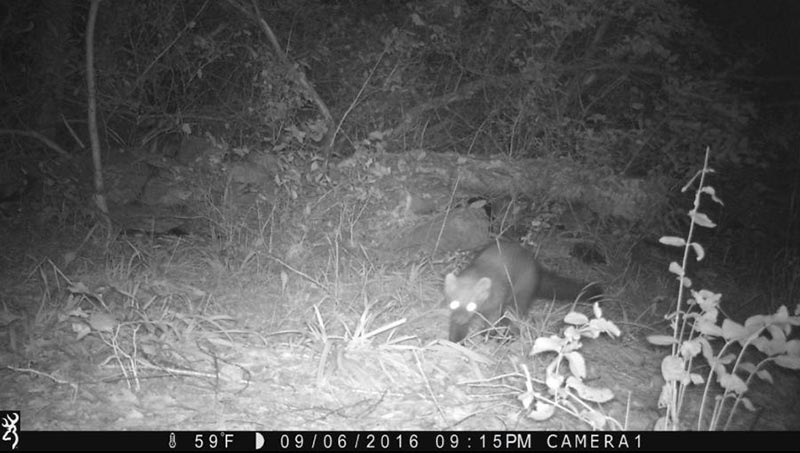
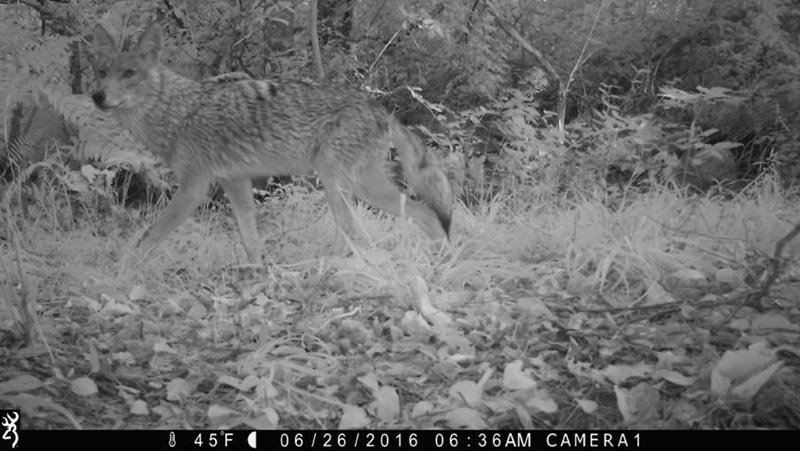
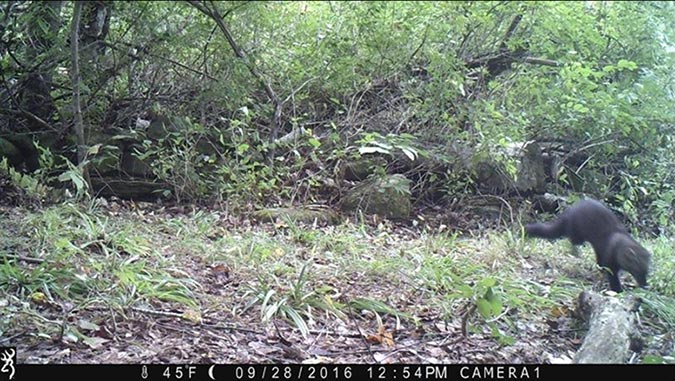
The fisher darted through the trees from one overgrown field to another. The narrowest sliver of moon had set: a perfect night for hunting. Three hours later, just before midnight, it bounded back the way it had come, fresh prey dangling from its mouth. Two hours after that, a coyote trotted over the same path, sniffing the ground where the fisher had passed. The time was 1:45 a.m. on September 1, 2016. One hundred miles away, I was sound asleep.
So how do I know all of this? Because I’d tied a game camera to a tree in just the right place.
Last summer, as a graduate student researching 130 acres of privately owned land in southern Vermont, I got to peer into the lives of the animals on the property – in one spot, at any rate.
 On a warm, sunny day in midsummer, a bobcat strolled to the edge of the field and paused, perhaps eyeing the farmhouse in the distance where I stayed during my site visits; then it changed course to follow the band of trees along an ephemeral stream edging the meadow. 
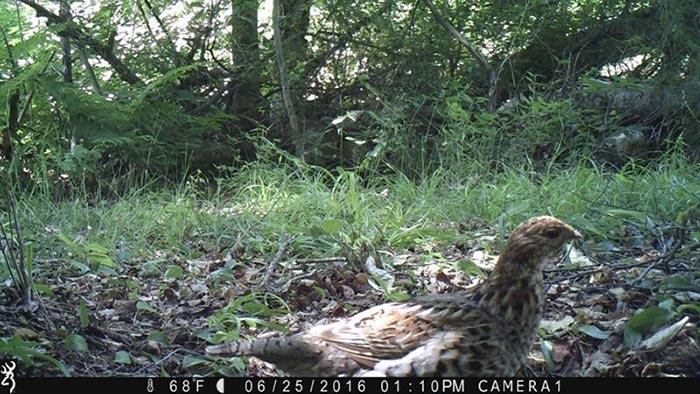
A black bear turned up with her cub on the fourth of July and snuffled around for a few minutes. A fisher, a rare visitor for the first two months of camera trapping, became a regular in the fall, appearing on 24 different days: bounding, sniffing, pouncing. Between June and October, the camera took over 800 photographs of wildlife, capturing 18 species of mammals and birds, from an elusive long-tailed weasel to a wide-eyed American woodcock.


Use of camera traps, as biologists call them, for wildlife research has exploded in the last decade or so, and they have become far more reliable and affordable, even allowing video footage. Still, a high-end Reconyx camera used by scientists with plenty of funding might cost over $500. I didn’t have access to fancy equipment. I borrowed a friend’s $100 Browning camera instead, and it worked fine. In fact, it succeeded beyond my wildest dreams.
I set my camera up at the intersection of two habitat types: a trail between meadows running through a wooded corridor. An obvious north-south path through a gap in the band of trees – actually an earthen bridge over a culvert – was appealing to animals cruising between the two open fields, as a predator on the move might do. 
The band of trees itself, a hedgerow running east-west, offered cover to other animals who were journeying from one swath of forest to another. I recorded the same species using both these routes throughout the season – bear, raccoon, fisher, and bobcat sometimes sped through the gap, other times crossed it as they traveled along the stream.
Surprisingly – given that, as my department chair likes to say, “ecologists quantify the obvious” – very little research has analyzed exactly where best to place a camera in order to maximize the number of species detected. Biologists seem to pick locations based on common sense – not typically a trusted commodity in science. Research on camera placement has instead focused on determining the best way to mount a camera at a chosen spot.

Photo Gallery--CLICK ON LINK ABOVE TO GO TO ARTICLE-AT BOTTOM 

OF ARTICLE ARE THESE AND MANY OTHER PHOTOS OF THE WILDLIFE MENTIONED
  •  Photo: Sonia DeYoung
  •  Photo: Sonia DeYoung
  •  Photo: Sonia DeYoung
  •  Photo: Sonia DeYoung
  •  Photo: Sonia DeYoung
  •  Photo: Sonia DeYoung
  •  Photo: Sonia DeYoung
  •  Photo: Sonia DeYoung
  •  Photo: Sonia DeYoung
  •  Photo: Sonia DeYoung
  •  Photo: Sonia DeYoung
  •  Photo: Sonia DeYoung
  •  Photo: Sonia DeYoung
  •  Photo: Sonia DeYoung
  •  Photo: Sonia DeYoung


Some general rules: A stout tree trunk, one that will not sway in the wind and set off the camera, makes a good mount. In a place without a mount, use a pole or stake, but keep in mind that some animals could be wary of obvious foreign objects. The camera should sit lower than you might think, at the height of the core body mass of the animals you’re most interested in photographing or filming – not more than a foot or so off the ground, if you want to get fishers as well as moose.

Leaves or tall grass growing in front of the camera can twist in the breeze and trigger thousands of empty photos or videos, so clear out these plants and loose branches after you’ve mounted the camera. Even the rising or setting sun can cause false triggers; avoid pointing the lens directly east or west.
Aiming the camera matters as much as locating it. Scientists trying for individually identifiable images of animals’ bodies, say to capture a distinctive stripe or scar, must face their camera traps perpendicular to the trail. If you’re trying to get the most pictures of wildlife, point the camera down the trail at an oblique angle, which gives the subjects of your photographs more opportunity to trigger the camera. Most cameras have a “walk test” feature, so you can get down on your hands and knees and pretend to be an animal walking past; a light flashes when you’ve triggered the sensor. These infrared sensors aren’t perfect. Pictures of canine rear ends crop up throughout my collection, because coyotes and foxes sometimes trot by too fast for the camera to respond in time. Even so, I enjoyed learning to identify animals by the tips of their tails.


Some animals overstay their welcome, triggering many hundreds of photos. To avoid a gigabyte’s worth of pictures of deer munching twigs in the same spot, set a delay between photographs. Even five seconds between shots can prevent a flood of images representing slight variations on the same theme. Although a memory card can record thousands of photos or hours of video, looking through all of them can be daunting.
As I sorted through my images, I searched for patterns. I wondered about that fisher who appeared over and over in the same spot. A state biologist who looked at the pictures identified it as a male. Why did he suddenly show up and stick around in the fall? Young male fishers disperse in autumn to claim their own territories. Perhaps this fisher settled in the area and made the path between the fields part of his hunting routine.
Speculating about why the animals behave as they do might be the most interesting part of camera trapping. The photographs offer more than simply an inventory of what animals live on our land; they give us insights into animal behavior.
But the camera does not record such behavior entirely passively. I haven’t addressed baits or scent lures here, mostly because I believe that the right location beats an artificial attractant for the most natural photos. But remember that, even without bait, photographing wildlife remotely is like measuring an elementary particle: you can’t observe the animals without the risk of changing their behavior.
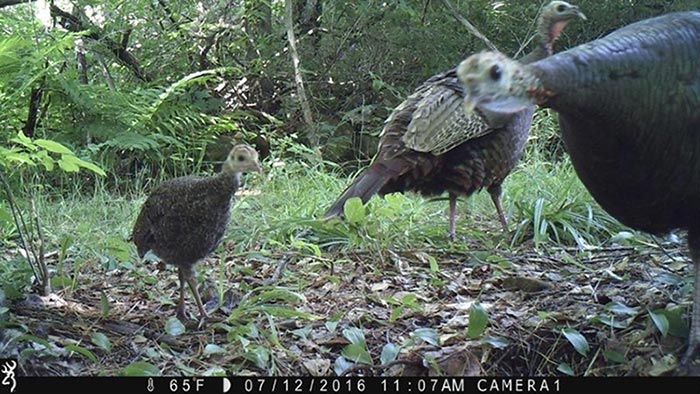
The camera is an unfamiliar object in their territory, and they usually know it’s there. Again and again, as I scroll through the 800 photos I obtained at my study site, I see animal faces staring into the lens: a fox dashing past, looking back over its shoulder; a family of turkeys gathered around the camera, then one chick lingering behind in apparent fascination after the others have moved on; 64 pictures in a row, over the course of seven minutes, of a doe walking back and forth in front of the camera, approaching it, bending down to peer at it closely, leaving, circling back for another look, clearly baffled as to what this strange contraption could be. Her bewilderment makes for some entertaining photos. But it’s not just an event I’ve recorded; it’s one I’ve created.
Sonia DeYoung is a recent graduate of the University of Vermont’s Field Naturalist program.  She currently works for the Lake Champlain Basin Program.
-----------------------------------------------------------------------------------------


Finding the Best Trail Camera In 2017 – Reviews and Comparison of the 14 best cameras available today(click link above to review all of them)


#1 choice-Stealth Cam G30 Triad Armed 8mp Trail Camera

The Stealth Cam G30 is one of the best trail cameras you can go for and it gets our highest rating with an impressive 4.7 out of 5. The camera has great video quality, is durable and it amazing when it comes to performance and battery life.

It can take great pictures of either 2, 4 or 8 megapixels and can take an HD video with sound from 5-180 seconds.
Its 30 IR emitters which have a reach of 80 feet and its reflex trigger of half a second along with its advanced blur reduction technology give this camera the ability to capture images or video in amazingly fine details at any lighting condition (e.g. daylight, low light or at night) without any issues or problem.
The camera is even secured in its shell that is both sturdy yet easy to open. The port and SD card slot is strategically positioned, too, to allow easy and convenient access. It can support an SD card of up to 32GB of capacity and features password encryption to protect your data.