skip to main | skip to sidebar
Wolves, Wolf Facts, Cougars, Cougar Facts, Coyotes, Coyote Facts - Wolves, Cougars, Coyotes Forever

Learn about Grizzly Bears, Black Bears, Polar Bears, gray wolves/eastern wolves/red wolves,timber wolves, cougars/mountain lions/panthers/painters/pumas, bobcats, lynx, red and gray foxes, wolverines, martens, fishers, coyotes/eastern coyotes/coywolves with pictures, videos, photos, facts, info and news.

Visitor Counter

hitwebcounter web counter
Visitors Since Blog Created in March 2010

Click Below to:

Add Blog to Favorites

Coyotes-Wolves-Cougars.blogspot.com

Grizzly bears, black bears, wolves, coyotes, cougars/ mountain lions,bobcats, wolverines, lynx, foxes, fishers and martens are the suite of carnivores that originally inhabited North America after the Pleistocene extinctions. This site invites research, commentary, point/counterpoint on that suite of native animals (predator and prey) that inhabited The Americas circa 1500-at the initial point of European exploration and subsequent colonization. Landscape ecology, journal accounts of explorers and frontiersmen, genetic evaluations of museum animals, peer reviewed 20th and 21st century research on various aspects of our "Wild America" as well as subjective commentary from expert and layman alike. All of the above being revealed and discussed with the underlying goal of one day seeing our Continent rewilded.....Where big enough swaths of open space exist with connective corridors to other large forest, meadow, mountain, valley, prairie, desert and chaparral wildlands.....Thereby enabling all of our historic fauna, including man, to live in a sustainable and healthy environment. - Blogger Rick

Subscribe via email to get updates

Enter your email address:

Receive New Posting Alerts

(A Maximum of One Alert Per Day)

Sunday, October 22, 2017

How do Black Bears decide where and when to den up for the Winter?.........."Bear biologist Ben Kilham, author of the recently published IN THE COMPAY OF BEARS, tells us that the bears may investigate denning sites as they travel throughout the year".............”Bears will remain out and about as long as good food sources remain available"...... "But once cold weather settles in and snow blankets the ground – or there’s simply nothing left to eat – they take to dens they’ve already prepared for the winter"............"When choosing a den, security is the most important thing"..... “It has nothing to do with warmth"............... "They carry their warmth with them"..... "Favored denning sites include hollow trees, if a bear can find one big enough – about three feet in diameter".............. "Bears will also excavate dens under tree stumps, below the root mass of a blown-over tree, and beneath brush piles"............ "Sometimes they use rock dens, typically along the base of a ledge"...... "Some bears simply create ground nests, usually in areas of dense softwood, where there is some shelter from falling snow"..............Do bears actually hibernate or just "den up'?"....... ."Whatever you want to call it, the following occurs: Their body temperature drops a few degrees below normal, and their metabolism slows considerably, but not to the extent to qualify bears as “true hibernators"...... "They do not defecate or urinate while they are in their dens"....... "By twitching their muscles through the winter, bears maintain strength, and they’re able to transform fat and urea to protein"............. "Their fat cells also release leptin, a hormone that prevents loss of bone mass".............."Bottom line is that Bears go to bed fat and strong and wake up skinny and strong"

https://adirondackexplorer.us5.list-manage.com/track/click?u=f2786fbb7862339a0b90113d7&id=96d0cb14ef&e=46b8d98c61


FRIDAY, OCTOBER 20, 2017

Bear Denning: Bears Are Making Their Beds

by Guest Contributor

bear den The fields around our home are something of a bear buffet from mid-summer through fall: wild blueberries in July followed by blackberries, then apples come September, with beechnuts falling from the trees skirting the mown area. In our 13 years here, we’ve seen a mother bear noshing on fallen apples while her cubs scampered around in the tree above her, heard bears climbing and snapping the occasional apple branch while we lay in tents 20 yards away during a backyard campout, and even witnessed two cubs playing in our kids’ sandbox.
I’ve often wondered where the neighborhood bruins – otherwise known as American black bears (Ursus americanus) – den up for the winter. How do they decide where – and when – to hunker down for the cold season?

Mother bear with cugs in hollow tree den


“It varies by the individual bear and by the individual year,” explained bear biologist Ben Kilham, author of several books on bear behavior, most recently In the Company of Bears. He has reinstated some 150 bears, mostly orphaned cubs, to the wild during his nearly three decades as a bear rehabilitator. “They may investigate denning sites as they travel throughout the year.” Bears will remain out and about as long as good food sources remain available. But once cold weather settles in and snow blankets the ground – or there’s simply nothing left to eat – they take to dens they’ve already prepared for the winter.
When choosing a den, “security is the most important thing,” said Kilham. “It has nothing to do with warmth. They carry their warmth with them.”
Favored denning sites include hollow trees, if a bear can find one big enough – about three feet in diameter. Bears will also excavate dens under tree stumps, below the root mass of a blown-over tree, and beneath brush piles. Sometimes they use rock dens, typically along the base of a ledge. Some bears simply create ground nests, usually in areas of dense softwood, where there is some shelter from falling snow.


Black Bear in rock ledge den


In poor food years, female bears may travel outside of their home range, which Kilham said is generally between 3 and 15 square miles, to find nourishment before winter. But they always return to their home area to den. Pregnant females and mothers of young cubs (which stay with their mothers until they are about 18 months old) use leaves, grass, moss, ferns, and softwood boughs to create nests within their dens.
Pregnant bears are the first to den up, usually starting in early October. These mothers-to-be add 50 percent or more of body weight in the fall, stores they’ll need to nourish cubs in utero and nurse them once they’re born, as tiny as chipmunks, in January or February.
Females with cubs are next to retreat to their dens, curling up with their young to share warmth. These mothers don’t manage to store away as much fat as pregnant bears because they exert so much energy tending to their cubs.
Last to go are males, which stay active as long as they can find food. Since the largest males are the ones that breed, there is often a trade-off in staying out later into the fall or even into winter. “If there’s food accessible, they’ll stay out,” Kilham said. “Their goal in life is to get big enough to breed. There’s been evidence of male bears that wake up in a warm spell in winter, hit a bird feeder, and then go back to den.”


Brush pile den


Which brings up the argument about whether or not bears hibernate. Their body temperature drops a few degrees below normal, and their metabolism slows considerably, but not to the extent to qualify bears as “true hibernators.” They do not defecate or urinate while they are in their dens. By twitching their muscles through the winter, bears maintain strength, and they’re able to transform fat and urea to protein. Their fat cells also release leptin, a hormone that prevents loss of bone mass.
“Hibernation is a nice word. It describes what they do. If you get technical about it, you can’t have a word for how every animal spends the winter, because you’d have to have a different word for every animal,” said Kilham. “Bears go to bed fat and strong and wake up skinny and strong.”
Denning up, hibernating – whatever you choose to call it – allows bears to conserve energy during the long, cold months when there is little to eat. This year, with an extended warm spell following a summer of plentiful berries and an autumn abundant with apples, beech nuts, acorns, and mountain ash berries, the bears should be fat and happy as they withdraw from the buffet and nestle down for that long winter’s rest.
Meghan McCarthy McPhaul is an author and freelance writer. She lives in Franconia, New Hampshire. The illustration for this column was drawn by Adelaide Tyrol. The Outside Story is assigned and edited by Northern Woodlands magazine, and sponsored by the Wellborn Ecology Fund of New Hampshire Charitable Foundation.
Posted by Coyotes, Wolves and Cougars forever at 10:18 PM 0 comments

Thursday, October 19, 2017

The busiest Freeways in the USA are in Los Angeles and the 101 Freeway that traverses my community is now on record to have seen Puma-55(P55) do something that no one has ever seen happen---He crossed the highway twice within the past three months, once in August successfully going north into the Santa Susana Mountains and last week again, this time just north of me in 1000 Oaks, now back in the Santa Monica Mountains looking for a mate in his natal birthplace..............So essential to get the Wildlife Overpass constructed at the Liberty Canyon/Chesbrough exit in Agoura Hills so that genetic inbreeding can be halted via new Pumas coming and going to spread revitalizing genes to the dozen or so "Cats" left in the City of Angels


https://www.google.com/url?rct=j&sa=t&url=https://patch.com/california/malibu/mountain-lion-makes-history-crossing-101-freeway-twice&ct=ga&cd=CAEYAyoUMTE2ODUyODQ1NTczNDc2NTQ0OTcyGjQ2OTIwYTk2ZWZjMTE1ODg6Y29tOmVuOlVT&usg=AFQjCNGiJQSmIJ4n7lb0-ZPiMvhR2I_KTA

Mountain Lion Makes History By Crossing 101 Freeway Twice

There have been only four National Park Service​ documented cases of a lion successfully crossing the freeway a single time.

By Emily Holland(Patch Staff) - Updated Oct 17, 2017 

P-55 in the Santa Monica Mountains, caught by a trail camera


MALIBU, CA – Santa Monica Mountains National Recreation Area officials confirmed Tuesday that a roughly 2-year-old male lion known as P-55 made history by successfully crossed the Ventura (101) Freeway last week for his second time – he's the first mountain lion to successfully cross the freeway twice in the 15 years the National Park Service has been tracking lions in the area. There have been only four National Park Service documented cases of a lion successfully crossing the freeway a single time.

The red dots indicate where Pumas have been
killed crossing the myriad of Freeways ringing
Los Angeles


Kate Kuykendall of the National Park Service wrote in a Facebook post that P-55 is "full of surprises." The lion crossed the 101 Freeway to the north in August, then went on to successfully cross the 23 and 118 freeways to roam into the Santa Susana Mountains.

Artist rendition of the proposed Liberty Canyon/Chesbrough
Wildlife Overpass, hoped to be built by 2022


"Last week he came BACK to the Santa Monica Mountains and cross the 101 Freeway again," Kuykendall wrote. "We've never seen a mountain lion cross the 101 twice. And this time when he crossed, we believe he did so in a relatively developed part of Thousand Oaks just west of state Route 23.

Insanely busy 24 hours around the clock, the 101 Freeway
runs from downtown L.A.West and North all the way up to
Santa Barbara and beyond


The one single spot on that entire stretch of highway from
downtown L.A. on up to Santa Barbara that is not
developed with homes and industry  is at the Liberty
Canyon/Chesbrough exit in Agoura Hills, adjacent to where I
live


Room to roam across the 101 Freeway only exists
in this spot--the Liberty Canyon/Chesbrough exit


"He is now back to roaming
the western end of the Santa Monica Mountains, likely looking to avoid other males so that he can one day establish his own territory."

Another Artist drawing of proposed 101 Wildlife Overpass


Officials and activists hoping to protect the lions -- and bolster their genetic diversity to improve their chance of survival -- are advocating for construction of a landscaped wildlife crossing over the 101 Freeway in the Agoura Hills area.

A study released last year concluded that without an increase in genetic diversity, the mountain lions in the Santa Monica range are facing possible extinction within 50 years. Thanks to being land-locked by freeways, the lion population is hampered by inbreeding.
The problem was highlighted in August when NPS officials announced the birth of two mountain lion kittens believed to have been sired by a lion that is also their grandfather, great-grandfather and great-great-grandfather.

Posted by Coyotes, Wolves and Cougars forever at 7:02 PM 0 comments

Wednesday, October 18, 2017

It is not surprising that a recent study of indigenous people in the Jurua and Uatuma regions of the Amazonas, Brazil reveals that large primates and mammals are virtually absent in and around native communities.............Lewis and Clark observed during their epic exploration of the American West in the first years of the 19th century that Wildlife seemed to be absent in the regions where Indian tribes lived and(conversely) thrived in the "no-mans-zone" between tribes who were at war with each other.............Bill Ripple(Co-Author of THE LANDSCAPE OF FEAR paradigm with John Laundre) and Andrea Laliberte put forth in their 2003 WILDLIFE ENCOUNTERS BY LEWIS AND CLARK: A SPATIAL ANALYSIS OF INTERACTIONS BETWEEN NATIVE AMERICANS AND WILDLIFE----"We believe that overhunting before Euro-American contact and the introduction of the horse, which heightened the effects of hunting, may have been major contributors to the historical absence of some species that are present in the archaeological record"............. "The results show considerable human influence on wildlife even under relatively low human population densities"............."In a buffer zone between the Chippewa and Sioux Indians in Minnesota, deer were plentiful in the area between the warring tribes; however, once a truce had been established, the buffer ceased to exist"................. "Deer were hunted extensively again, their numbers declined rapidly, and a famine ensued (Hickerson 1965)".................. "Another example of an ecological buffer zone is the demilitarized zone that separates North and South Korea".................. "Numerous plant and animal species that were previously considered extirpated, endangered, or threatened thrive in this heavily fortified 4-kilometer (km) by 250-km-long corridor, although they are absent on either side (Kim 1997)".................. "Areas between territories of warring native groups, which served as animal preserves, existed on the central plains of North America in the 1820s and 1830s"......... "Different tribes hunted in these areas, but none was strong enough to control them"....... "Therefore, most of those areas were not occupied year-round, and animals sought them out as refuges"................ "With the disappearance of these “neutral zones,” the bison decreased in numbers (West 1995)"...................So are Indigenous peoples past and present really the environmentalists that have been put forth by Hollywood, Left leaning Professors and Politicians or were their understanding and use of the resources around them tied into their "Druid" spiritual beliefs, simply believing that the "resources they depended on for life would always be there?...........You might want to invest in a copy of THE ECOLOGICAL INDIAN by Sheppard Krech III.............Excellent book for debating this topic(below some information from that book)

http://feedproxy.google.com/~r/sciencedaily/plants_animals/~3/tyvX7wz8vss/171017153148.htm?utm_source=feedburner&utm_mediu

Amazonian hunters deplete wildlife but don't empty forests

10/17/2017; University of East Anglia


Human exploitation of natural resources is a key driver of global biodiversity loss. In tropical forests, overhunting has been implicated in widespread local species extinction and the creation of 'empty forests'.
But a new study published in PLOS ONE reveals that subsistence hunters from small communities in large areas of intact forest and with access to healthy fish stocks do not appear to be emptying their forests.


This finding only rings true for smaller species and those less sensitive to hunting pressure, however. Numbers of large primates and other large mammals were still found to be depleted near to communities.
Lead author Dr Mark Abrahams, from UEA's School of Environmental Sciences, said: "Understanding the impacts of subsistence hunting in tropical forests is crucial not only to safeguard the world's most biodiverse terrestrial ecosystems, but also to secure a sustainable future for forest-dependent communities."
The research team used novel camera trapping and interview methods to study species in the Amazon.
Working with 60 Amazonian communities in the Juruá and Uatumã regions of Amazonas, Brazil, they deployed 383 motion-activated camera traps and conducted 78 interviews with subsistence hunters.
Hiking for miles through trackless forests to deploy cameras at varying distances from communities, the study sought to understand which species are depleted by hunting and where.
Key findings:
    - Large-bodied species and species forming large groups, are depleted near Amazonian communities.
    - The biomass of the entire species assemblage is greatly reduced close to Amazonian towns.
    - Subsistence hunting did not empty the forest of game vertebrates in the study regions, which retain high forest cover, sources of alternative protein and low human population densities


    The camera trap and interview data showed that large-bodied species and species forming large groups, such as white lipped peccaries, woolly monkeys and tapirs, are indeed depleted near to communities.
Smaller species and those less sensitive to hunting pressure, did not show evidence of depletion near to communities.
By contrast, the biomass of the entire species assemblage was greatly reduced close to towns.
Dr Abrahams said: "Our results imply that conservationists can be cautiously optimistic about the prospect of sustainable subsistence hunting by Amazonian communities. Small communities, living in large areas of intact forest and with access to healthy stocks of fish, do not appear to be emptying their forests.
"But this is clearly no excuse for complacency. Large primates and large ungulates, which are depleted by hunting, play vital ecological roles such as seed dispersal and are crucial to the health of the forest.
"Also, areas where human populations are larger, fish stocks are less abundant and remaining forest cover is less extensive, are likely to experience a far more severe depletion of game animals."
Prof Carlos Peres, also from UEA's School of Environmental Sciences, said: "Our analysis shows that the sustainability of protein acquisition in tropical forests is primarily governed by the spatial context of mortality sinks, human population density, and availability of alternative protein.":
------------------------------------------------------------------------
http://bioscience.oxfordjournals.org/content/53/10/994.full

Wildlife Encounters by Lewis and Clark: A Spatial Analysis of Interactions between Native Americans and Wildlife 

Andrea S. Laliberte William J. Ripple 

Abstract


The Lewis and Clark journals contain some of the earliest and most detailed written descriptions of a large part of the United States before Euro-American settlement. We used the journal entries to assess the influence of humans on wildlife distribution and abundance. Areas with denser human population, such as the Columbia Basin and the Pacific Coast, had lower species diversity and a lower abundance of large mammals. The opposite effect was observed on the Plains.

 We believe that overhunting before Euro-American contact
and the introduction of the horse, which heightened the effects of hunting, may have been major contributors to the historical absence of some species that are present in the archaeological record. The results show considerable human influence on wildlife even under relatively low human population densities. This finding has major implications for conservation biology and ecological restoration, as human influence is often underestimated when considering presettlement conditions.


BioScience, Volume 53, Issue 10, 1 October 2003, Pages 994–1003
--------------------------------------------------------------------

https://www.google.com/url?sa=t&rct=j&q=&esrc=s&source=web&cd=6&cad=rja&uact=8&ved=0ahUKEwib4In3z_vWAhVh7YMKHZXpCrAQFghJMAU&url=http%3A%2F%2Fwww.h-net.org%2Freviews%2Fshowrev.php%3Fid%3D5068&usg=AOvVaw0rCFI7qjwcyAqLRL5fcbZE

Shepard Krech, III. The Ecological Indian. Myth and History. New York: W.W. Norton & Company, 1999


Indian History and Environmental Myth

Sheppard Krech III's book The Ecological Indian sets out to probe the basis and historical validity of the idea that people of native descent are, and always have been, caring towards the environment, a characteristic commonly claimed by or attributed to them. With a series of empirical case studies he investigates whether their ideas and actions were always those of ecologists and conservationists. He finds that the Ecological Indian proposition is of doubtful validity, concluding that, for example, Indians needlessly killed many buffalo, set fires that got out of control, and over-exploited deer and beaver for their skins.


The author examines whether Indians over-hunted, respectively, the buffalo, the white-tailed deer and the beaver. All these species were used aboriginally for subsistence, and after contact they continued to be sources of subsistence food at the same time as they provided market commodities. Krech thinks the commercialisation of deer and beaver hides lead to their overexploitation, but he also believes Indians were wasting buffalo even when the species was being hunted only for subsistence.

For me, this chapter provides the book's most serious challenge to The Ecological Indian. While Indians had uses for every part of the buffalo, their practice of slaughtering whole herds, at a buffalo jump or in an enclosure, sometimes produced more carcasses than a group could possibly use. As a result, waste occurred. He documents instances of Indians leaving animals to rot, utilising only the cows, or taking only the tongues and the humps. However, the overkilling did not cause the extermination of the species, which only came after non-Indians and Metis hunted them commercially for fresh meat, pemmican and hides.


Krech proposes two 'religious' reasons for the earlier over-killing. It was believed (by the Piegan and Cree) that any buffalo that escaped while being rounded up in the hunt would warn other buffalo, who would then avoid hunters, so that it was necessary to chase and kill these escapees, whether they were needed or not. Other Indians (specifically the Cheyenne and Arapaho) believed that when hunters were unable to find buffalo it was because the animals had retreated to a land underneath a large lake, from which they would eventually reappear in endless numbers. Krech concludes that, given these beliefs, the Indians did not see overhunting as a cause of any shortage of animals or the need to conserve.


The next chapter concerns the white-tailed deer. Between about 1670 and 1800 the skins of these animals, previously the major subsistence species for Indians in the Southern and Eastern United States, became their main item of trade with Europeans. Deer were hunted in increasing numbers, in part, according to Krech, to satisfy the Indian's craving for alcohol. By the end of the period deer were scarce or locally absent, which Krech concludes was due to overhunting by Indians. The population did not recover until many years later.


While Krech acknowledges the trade in deer skins occurred during a period of intense disruption, he does not see that dislocation and warfare resulting from European settlement may have rendered the Indian's conservationist practices ineffective. Instead, as with the buffalo example, he explains the willingness to overkill deer by reference to the pre-Christian spiritual beliefs of the tribes of the region. He notes, for instance, that the Cherokee believed in the reincarnation of deer, some of them believing this could recur four or seven times. From this he concludes that conservation would have made no sense to them.
Posted by Coyotes, Wolves and Cougars forever at 8:12 PM 0 comments

Tuesday, October 17, 2017

Remember that South Dakota Puma who wandered clear across the Country in 2011 and ended up dead, hit by a car on a Connecticut Highway.................Well, now we have confirmation that a year ago, in June 2016, in Petersham, Massachusetts, a Puma attacked a horse.............Two reputable Wildlife Labs have confirmed the DNA from the hair and blood at the scene of the attack was indeed from a Puma of North American Origen.................Now we are wating to see where the DNA points in terms of the Puma's natal birthplace.............There is still no evidence of a breeding population of Pumas(outside of the 100-200 in Florida and an undisclosed number in the Big Bend section of West Texas) east of the South Dakota Black Hills and the Nebraska hill country.................However even with liberal Puma hunting quotas in these easternmost colonies, "Prospectors" from those populations continue to show up in Michigan, Wisconsin, Minnesota, Iowa, Illinois, Kentucky, Tennessee and elsewhere in the East..................We have the room for them to roam up and down the Appalachians, in our Upper Midwest forests and the "river highways" of our "Bread Basket" states.............Will we ever have the will to re-introduce them above and beyond waiting a 100 more years for some chance male/female prospector "hookup" in our eastern woodlands?

Reports

On The Trail: Cougar confirmation

in Massachusetts
Wednesday, October 04, 2017
  •  
Although it seems like old news by now, really, it’s not that old. Plus, there’s an exciting new “breaking” element, which, frankly, is not all that surprising.
First, a little background. On the morning of June 28, 2016, Petersham horse owner Anne Marie Zukowski went out to feed her 16-year-old German Hanoverian named Summit and was immediately suspicious that something wasn’t right when the horse was in the wrong stall. Upon closer inspection, she found deep, ugly claw-mark gouges on the horse’s shoulder, then blood and hair around stable and barnyard. She pondered possible culprits and thought, “Gee, could it have been a mountain lion?”
Hmmmm? Scary indeed.

The Puma that ultimately wandered to Connecticut in 2011
out of the Saouth Dakota Black Hills, here caught on trailcam
in the upper midwest in 2010


Concerned about her horse’s well-being, Zukowski brought him for medical treatment to the Tufts University animal hospital and alerted law-enforcement officials to her problem. Among the agencies to visit the site and review the evidence were police, game wardens and MassWildlife, which concluded that her horse had injured itself by rushing through a gate and catching a shoulder on its open latch. Furious at what she interpreted as an insulting, condescending, clueless hypothesis, and with the resources to pay for independent analysis, she gathered blood and hair samples left on the scene and sealed them in a plastic bag. Then she searched for a reputable lab to identify the animal that had left the biological calling cards around her stables.
The samples wound up at the University of Florida at Gainsville’s Maples Center for Forensic Medicine, which tested them and determined in November that they had been left by a cougar or mountain lion or puma or whatever you choose to call it. The long and the short of this finding was that her horse had not been attacked by a bear, a big bobcat or a sharp, open gate latch. No sir. It was a mountain lion, rare indeed in these parts, with females and thus reproductive populations said to be extinct east of the Mississippi River. Some question that assessment
Petersham, Massachusetts


When MassWildlife officials criticized Zukowski’s method of specimen collection and said they knew nothing of the lab she had used and thus had issues with the finding, she grew more
 incensed and felt disrespected. At that point, a watchdog group called “Cougars of the Valley,” which investigates New England cougar sightings and the sites of reported incidents like Zukowski’s, jumped in, paying to send what was left of the biological materials in Florida to Melanie Culver, one of the nation’s most respected cougar researchers. When MassWildlife officials claimed they were unfamiliar with Ms. Culver as well, 

Path of the Puma from the Black Hills to Connecticut


Cougars of the Valley spokesman Ray Weber begged to differ. MassWildlife had sent 1990s Quabbin scat samples to Culver’s Arizona lab, which ruled they had been left by a cougar.
Stationed at the University of Arizona, Culver is an assistant Wildlife and Fisheries Science professor in the School of Natural Resources and the Environment, and assistant leader of the Arizona Cooperative Fish and Wildlife Research Unit. Her Culver Lab there analyzed Zukowski’s biological data and confirmed the University of Florida’s findings. Yes, that’s right, the Petersham horse had been attacked by a cougar. Not only that, but a cougar of North American origin. So, howdya like them apples, Ant Martha?
Petersham, Massachusetts is the locale of the Quabbin Reservoir,
that provides drinking water for Boston, Mass.,,,,,Large quantities
of protected Open Space for Pumas to roam in


The quinessential, New England Village of Petersham


Culver took it a step farther that the Florida lab by identifying the cougar’s gender. It was a male, which may have come as a disappointment to Weber, who was heard wondering aloud on the phone one day what would happen if the beast turned out to be a female, far east of where there are said to be none.

“Can you imagine the reaction of wildlife officials if the Arizona lab finds that the cougar was female?” he enthusiastically asked in June, after the Arizona lab had blood and hair samples in hand. “Wouldn’t that be something, considering officials’ total refusal to admit the possibility that cougars are coming back, and that some of the reported New England sightings are real?”
Well, although the Petersham cat was a male, how long do you suppose it’ll take for a female to make an appearance in Great Lakes country or expansive ranges like the Adirondacks, Catskills, Poconos, Green and White Mountains? Or how about the Berkshires and Appalachians, or even Conway or Colrain?
 Some say it’s impossible, that too many cougars are killed under liberal hunting quotas in Western states like the Dakotas and Montana, which produce wandering dispersers from overpopulated habitats. Then you have overzealous law-enforcement officers in Minnesota or Illinois or Iowa, who shoot first and ask questions later, killing cougars in the name of public safety before they get close to the Eastern Seaboard. But don’t forget that wayward males have already found their way here, including the first confirmed case killed on a Milford, Conn., highway on June 11, 2011, just weeks after the United States Fish and Wildlife Service declared Eastern cougars extinct instead of endangered. Now this in Petersham. What’s next? Fact is, Northeastern cougar rewildling is looking more and more possible, perhaps even probable, as the years pass and the forests continue to grow — no matter how long the odds, what the chorus of detractors says or how loud they scream it.
In the meantime, there’s still loose ends in Arizona. Culver, a Ph.D geneticist, is trying to match the Petersham cougar’s DNA to samples in a national database. She’ll likely soon know what gene pool this big cat came from. Is it a North Dakota cat? South Dakota? Montana? Idaho? How interesting!
Remember when that Milford, Conn., cat was killed by a motorist and the initial response from state and federal wildlife officials was that it was probably a released pet that had been set free after growing too big and dangerous to care for. Examination and biological analysis proved that skeptical knee-jerk opinion to be dead wrong. Not only did that 3-year-old, 140-pound male disperser hail from the Black Hills of South Dakota, it had traveled 2,000 miles in just less than two years, depositing a documented DNA trail through Minnesota, Wisconsin, Michigan and New York before meeting his maker in the evening shadows of New York City. The Petersham cat likely followed a similar path and is possibly still lurking somewhere in the Norhteastern neighborhood.
After months of anxious anticipation, Weber finally alerted me to Culver’s finding last Thursday afternoon by email. I had eagerly awaited the Arizona lab’s confirmation all summer and had checked with Weber several times in an effort to stay in front of the story. When I placed a follow-up phone call to Weber Thursday, I was concerned to learn he had forwarded Culver’s findings to MassWildlife, which has from the start tried to discredit the story with its familiar deny-and-distract song and dance routine. Knowing from experience that the state agency doesn’t like to acknowledge the presence of cougars, I gambled, figuring they’d rather sweep it under the rug than make a media splash.
Well, now the cat’s out of the bag, so to speak. There’s no denying that a cougar attacked a horse in the Quabbin community of Petersham. At this point, I’m not sure what intrigues me more — the cat’s gene pool or the state’s impending response.
Stay tuned. It could get humorous.

Posted by Coyotes, Wolves and Cougars forever at 7:57 PM 0 comments

Monday, October 16, 2017

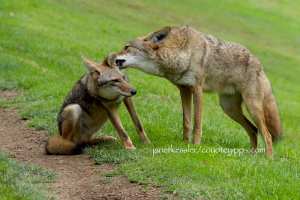
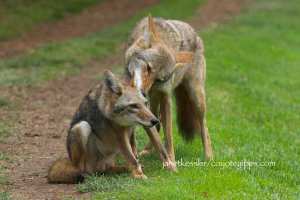
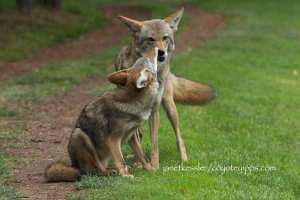
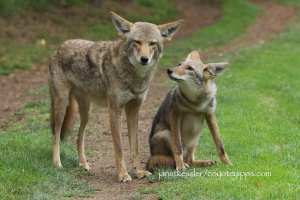
"Coyote fathers are totally involved in the raising of their youngsters".................."Below, dad and five-month-old son spend a few moments watching the goings-on around them before Dad then grooms the pup -- probably removing ticks -- and then son prods Dad for some food, unsuccessfully"---Thanks to the great Coyote Yipps blog for this entry


WordPress.com
yipps:janetkessler posted: " Coyote fathers are totally involved in the raising of their youngsters. Here, Dad and five-month-old son spend a few moments watching the goings-on around them before Dad then grooms the pup -- probably removing ticks -- and then son prods Dad for"
CLICK ON "FATHER AND SON" TO SAMPLE OTHER COYOTE YIPPS BLOG POSTS

New post on Coyote Yipps

Father and Son

by yipps:janetkessler


Trouble clicking? Copy and paste this URL into your browser:
http://coyoteyipps.com/2017/10/14/father-and-son/


Posted by Coyotes, Wolves and Cougars forever at 7:22 PM 0 comments
Newer Posts Older Posts Home
Subscribe to: Posts (Atom)

About Me

Coyotes, Wolves and Cougars forever
View my complete profile

Recent Comments

Red Fox fighting Badger

Email Rick Meril

Subscribe To

Posts
Atom
Posts
All Comments
Atom
All Comments

Bobcat in Vermont woodlands

Mother and daughter Puma playing in North Dakota

Find us on Facebook

Find us on Facebook

Christmas morning 2008-Coyote hunting mice

Blog Archive

  • March (5)
  • February (11)
  • January (3)
  • December (7)
  • November (10)
  • October (8)
  • September (4)
  • August (11)
  • July (12)
  • June (9)
  • May (12)
  • April (18)
  • March (23)
  • February (20)
  • January (18)
  • December (19)
  • November (21)
  • October (24)
  • September (22)
  • August (26)
  • July (19)
  • June (17)
  • May (22)
  • April (24)
  • March (27)
  • February (26)
  • January (26)
  • December (29)
  • November (18)
  • October (24)
  • September (19)
  • August (25)
  • July (25)
  • June (23)
  • May (29)
  • April (31)
  • March (28)
  • February (25)
  • January (33)
  • December (32)
  • November (32)
  • October (34)
  • September (30)
  • August (39)
  • July (29)
  • June (34)
  • May (39)
  • April (31)
  • March (34)
  • February (35)
  • January (45)
  • December (42)
  • November (32)
  • October (25)
  • September (33)
  • August (46)
  • July (34)
  • June (48)
  • May (43)
  • April (47)
  • March (43)
  • February (37)
  • January (37)
  • December (45)
  • November (42)
  • October (34)
  • September (36)
  • August (44)
  • July (36)
  • June (45)
  • May (43)
  • April (51)
  • March (48)
  • February (47)
  • January (64)
  • December (63)
  • November (57)
  • October (43)
  • September (45)
  • August (52)
  • July (52)
  • June (48)
  • May (55)
  • April (54)
  • March (77)
  • February (68)
  • January (51)
  • December (61)
  • November (49)
  • October (42)
  • September (62)
  • August (68)
  • July (69)
  • June (42)
  • May (72)
  • April (83)
  • March (77)
  • February (80)
  • January (78)
  • December (90)
  • November (91)
  • October (93)
  • September (94)
  • August (92)
  • July (85)
  • June (90)
  • May (91)
  • April (91)
  • March (93)
  • February (85)
  • January (94)
  • December (90)
  • November (80)
  • October (87)
  • September (96)
  • August (90)
  • July (62)
  • June (54)
  • May (62)
  • April (55)
  • March (27)
  • February (14)

Hiker in Glacier National Park encounters a Puma......The Puma walks "wide" of the hiker

Search This Blog

Lynx capturing a snowshoe hare

Likely Wolf sighting in Colorado

black Bear in the Smokey Mtns berry hunting in the trees

Blog Translation

favorite links

  • Wyoming Untrapped
  • The Natural History of the Urban Coyote
  • western wildlife
  • Wild Dog Foundation
  • Coyotes live in Maine
  • Santa Cruz Puma Project
  • http://www.coyotewatchcanada.com
  • Mexican Wolves.org
  • Greater Yellowstone Science Learning Center
  • Western Wolves
  • Lockwood Animal Rescue Center
  • Wolf and Wildlife Studies
  • Worth a Dam
  • The Wolverine Foundation
  • mountain lion foundation
  • Boulder-Whiteclouds Council
  • Wild Read
  • Big Wildlife
  • Southern Utah Wilderness Alliance
  • Coyote Yipps
  • The Wolverine Blog
  • Craighead research.org
  • Wild Earth Guardians
  • Biodiversity Conservation Alliance
  • Center for Native Ecosystems
  • izilwane.org online Magazine
  • Oregon Wild
  • Ralph Maughan's Wildlife Reports
  • North American Bear Center
  • Wolf and Cat
  • Conservation Northwest
  • Howling for Justice
  • Wilderness Watch
  • Wolf Watcher
  • Endangered Species Coalition
  • My Place By The Pond
  • The Wolverine Foundation
  • Wolf Ecosystem Research
  • canadian Parks and Wilderness Society
  • Earthroots
  • Predator Defense
  • Sightline Institute
  • Downeast Lakes Land Trust
  • Adirondack Council
  • jaguar Conservation Network
  • Bordercats
  • Large Carnivore Conservation Lab-Washington State U.
  • Bat conservation International
  • The human footprint
  • Craighead Beringia South
  • Yellowstone to Yukon Conservation Initiative
  • Canadian Boreal Initiative
  • Northern Rockies Conservation Cooperative
  • Keeping Track
  • Wildlife Conservation Society
  • Native Fish Society
  • Jaguar Habitat Campaign
  • Northern Woodlands Magazine
  • Canadian Wolf Coalition
  • Forest Service Employees
  • Trust for Public Land
  • Rainforest Action Network
  • The Wilderness Society
  • Greater Yellowstone Coalition
  • Keystone Conservation
  • American Wildlands
  • The Nature Conservancy
  • Algonquins to Adirondacks
  • Two Countries, One Forest
  • Vermont Land Trust
  • Center For Biological Diversity
  • Open Space Institute
  • Wildlands and Woodlands
  • Rewilding Institute
  • Cougar Network
  • Cougar rewilding foundation
  • Eastern Coyote Research
  • Project Coyote
  • Restore:The North Woods
  • The Wildlife News
  • N.E. Eco Recovery Society
  • WERC
  • Wildlands Network
  • Outdoor Liasons
  • People and Wolves

Click Below to Follow Us On Twitter

Click Below to Follow Us On Twitter

Northern Ontario, Canad Wolfpack caught on trailcamera

Add Coyotes-Wolves-Cougars Link To Your Igoogle Homepage

Add to Google Reader or Homepage

A New Jersey Eastern Coyote unable to take a fawn

Blogger Rick

Blogger Rick
Strategizing at the WB

Let Rick and other readers know you're a fan of this blog...Become a Follower!

Making a Pitch at the WB

Making a Pitch at the WB

Two Massachusetts Eastern Coyotes at their den site

Eastern Wolf in Algonquin Provincial Park, Ontario, Canada

Gray Foxes(unlike Red Foxes) can climb trees--an advantage when pursued by Coyotes

Aldo Leopold--3 quotes from his SAN COUNTY ALMANAC

"We abuse land because we regard it as a commodity belonging to us. When we see land as a community to which we belong, we may begin to use it with love and respect."


Aldo Leopold

"A thing is right when it tends to preserve the integrity, stability and beauty of the biotic community. It is wrong when it tends otherwise."


Aldo Leopold

''To keep every cog and wheel is the first precaution of intelligent tinkering."


Wildlife Rendezvous

Wildlife Rendezvous
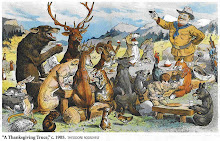
Like so many conscientious hunters and anglers come to realize, good habitat with our full suite of predators and prey make for healthy and productive living............Teddy Roosevelt depicted at a "WILDLIFE RENDEZVOUS"

Recent Posts


Blog Disclaimer

This is a personal weblog. The opinions expressed here represent my own and not those of my employer. In addition, my thoughts and opinions change from time to time…I consider this a necessary consequence of having an open mind. This blog is intended to provide a semi-permanent point in time snapshot and manifestation of my various thoughts and opinions, and as such any thoughts and opinions expressed within out-of-date posts may not be the same, nor even similar, to those I may hold today. All data and information provided on this site is for informational purposes only. Rick Meril and WWW.COYOTES-WOLVES-COUGARS.COM make no representations as to accuracy, completeness, suitability, or validity of any information on this site and will not be liable for any errors, omissions, or delays in this information or any losses, injuries, or damages arising from its display or use. All information is provided on an as-is basis.


Additional disclaimer information can be viewed by clicking here.