skip to main | skip to sidebar
Wolves, Wolf Facts, Cougars, Cougar Facts, Coyotes, Coyote Facts - Wolves, Cougars, Coyotes Forever

Learn about Grizzly Bears, Black Bears, Polar Bears, gray wolves/eastern wolves/red wolves,timber wolves, cougars/mountain lions/panthers/painters/pumas, bobcats, lynx, red and gray foxes, wolverines, martens, fishers, coyotes/eastern coyotes/coywolves with pictures, videos, photos, facts, info and news.

Visitor Counter

hitwebcounter web counter
Visitors Since Blog Created in March 2010

Click Below to:

Add Blog to Favorites

Coyotes-Wolves-Cougars.blogspot.com

Grizzly bears, black bears, wolves, coyotes, cougars/ mountain lions,bobcats, wolverines, lynx, foxes, fishers and martens are the suite of carnivores that originally inhabited North America after the Pleistocene extinctions. This site invites research, commentary, point/counterpoint on that suite of native animals (predator and prey) that inhabited The Americas circa 1500-at the initial point of European exploration and subsequent colonization. Landscape ecology, journal accounts of explorers and frontiersmen, genetic evaluations of museum animals, peer reviewed 20th and 21st century research on various aspects of our "Wild America" as well as subjective commentary from expert and layman alike. All of the above being revealed and discussed with the underlying goal of one day seeing our Continent rewilded.....Where big enough swaths of open space exist with connective corridors to other large forest, meadow, mountain, valley, prairie, desert and chaparral wildlands.....Thereby enabling all of our historic fauna, including man, to live in a sustainable and healthy environment. - Blogger Rick

Subscribe via email to get updates

Enter your email address:

Receive New Posting Alerts

(A Maximum of One Alert Per Day)

Friday, February 21, 2020

"Apart from the snowshoe hare, Short and Long-tailed weasels are the only animals whose coats turn white in preparation for winter".........."Both the Long-tailed and Short-tailed(short-tailed also known as Ermine) species ranges overlap with the larger Long-tailed Weasel able to out-compete the smaller Short-tailed"............"As a result, the Short-tailed life-paradigm has a range farther to the north where the the Long-tailed ranges farther to the south(see maps below)"..................."Both Weasel species are generalists, able to swim, climb trees and dig under snow in pursuit of voles, mice, rabbits, rats, lemmings, muskrats, pocket gophers, shrews, moles, squirrels,chipmunks, bats, bird eggs, snowshoe hare, snakes, frogs, and insects"..............."Deer, beaver, and woodchuck carrion is also on their menu with berries of any kind also sought out"............... "Long-haired Weasels will also prey on Short-tails should they cross paths"........."The main source of mortality for both weasel species are foxes, coyotes, owls, large snakes"

R
Read Full Article


Winter Weasels – White on White

by Susan Shea
February 17, 2020
4 Comments

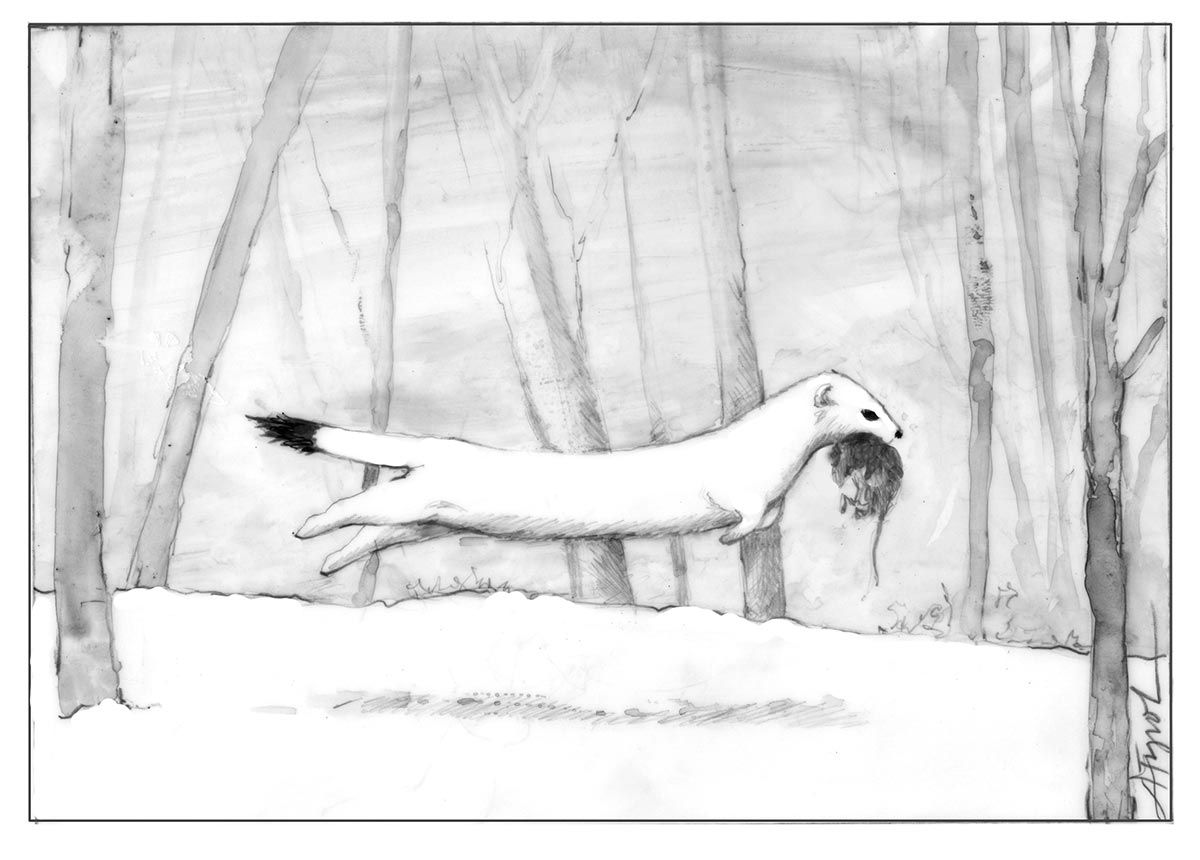
Illustration by Adelaide Tyrol
Winter Weasels – White on White Image


On a walk one winter afternoon, I spotted two white objects darting across a snow-covered field. White on white, they were difficult to identify at first. It was a short-tailed weasel chasing a snowshoe hare!
Apart from the snowshoe hare, short- and long-tailed weasels are the only animals in the Northeast whose coats turn white in preparation for winter. The smaller short-tailed weasel, also known as an ermine, is more common than the long-tailed weasel. It lives in a variety of habitats, is an adept hunter, and has a reputation for being curious and bold.

The Short-tailed Weasel in Winter White and Summer Brown(range map)


In summer, the short-tailed weasel is brown with a cream-colored chest and belly, and a black tail tip. In the fall, in northern latitudes, the ermine sheds its summer fur and grows a white winter coat. This amazing adaptation camouflages the weasel as it hunts, and hides it from predators such as hawks, owls, foxes and coyotes. The black tail tip, which remains in winter, diverts predators. A raptor attracted to a weasel’s movement will dive at the black tip, missing the weasel’s body.
In the spring, the ermine loses its white coat and turns brown again. Both molts are triggered by photoperiod, or length of daylight. Vermont naturalist Susan Morse once raised an orphaned weasel for release back into the wild. She enjoyed watching the ermine’s coat turn white, which began on lower parts of the body first and took seventeen days. However this adaptation may become a problem for weasels as the climate warms, and snow cover becomes inconsistent in our region. White weasels will be much easier to spot against a brown background and will be more vulnerable to predators.

The Long-tailed Weasel in Winter white and Summer brown(range map)


Researchers in Poland found that populations of the white subspecies of the least weasel (cousin to our short-tailed weasel) dropped with a decrease in number of days of snow cover. Experiments showed predators detected weasels with contrasting colors at a significantly higher rate than those that blended in with the landscape. If our northern weasels can adapt through natural selection, where snow is brief or erratic, they may develop patchy coats. Alternatively, populations may include both white and winter brown animals, as is already the case in mid-Atlantic weasel populations.
Short-tailed weasels feed primarily on voles and mice, and occasionally on larger prey such as chipmunks, squirrels, or even hares – which explains the snowy chase I observed. In summer they prey on nesting birds and their eggs, frogs, and insects; they also eat berries. Some ermines will kill chickens, though a weasel will often visit a chicken coop only to prey on the rats and mice attracted to the chicken feed.

Short-tailed(top picture) and Long-tailed weasel(bottom picture with 
mouse kill


Their long, thin shape enables weasels to travel through rodent tunnels and kill their prey in their underground burrows – or, sometimes, within a human dwelling. My sister once lived in an old farmhouse that became infested with mice. She and her roommates had a contest going to see who could devise the most ingenious mousetrap, and they kept a tally of how many mice were killed. Then an ermine moved in with them for a month. “We didn’t have much of a mouse problem after that,” she recalled. “The ermine would come up from the cellar under the door and slither along the kitchen countertops.”
Sometimes a weasel will live in a mouse den until all the occupants are consumed. Weasels often kill more than they can eat and cache dead prey for later use. “They strive to always have something in the pantry,” said Morse. “People routinely find stored mice in the crevices of their wood piles.”
While the weasel’s shape contributes to its hunting prowess, it also causes the animal to lose heat more quickly than a more rotund creature. To compensate, the ermine has a high metabolic rate and must eat one-third to one-half of its body weight a day, making it perpetually hungry. For this reason, ermines are active even in the coldest weather, especially at night. Weasels hunt primarily by scent, zig-zagging back and forth, investigating every hole and cranny.  
This winter, look for weasel tracks in the snow – small, paired tracks with five claws on each foot. Since weasels travel by bounding, their hind tracks fall directly on top of their front tracks. Also, keep an eye out for the weasel’s long, spiral-shaped, blackish-brown scat on rocks in the center of the trail, scent posts to communicate with other weasels.
A version of this article was originally published in the Long Trail News. Susan Shea is a naturalist, conservationist, and freelance writer who lives in Brookfield, Vermont.

Posted by Coyotes, Wolves and Cougars forever at 4:12 PM 0 comments

Wednesday, February 19, 2020

"Similar to a human family where kids tend to thrive when Mom and Dad stay together and avoid divorce, a new University of Idaho Study reveals that for each year a wolf pair stays together, the odds of their pups surviving into adulthood increased 20%"..............."Unlike Coyotes, where male and females bond for life and remain monogamous, wolf pair bonds are super short" ............"They only last a couple years”.............."On average, wolf pairs stayed together for 2.2 years, although there was wide variance"..............."For instance, one wolf couple in the Idaho Study stayed together for at least nine years, basically an eternity for an animal that is considered ancient at 13"................"The average of 2.2 years found in Idaho aligned with rates measured in a recolonizing wolf population in Sweden".............."The longer wolf pairs remain monogamous, the more stability in the overall wolf pack"..........."Monogamy reduces the occurrence of 'sneaker males', those who come in and mate with females and take off, leaving pup rearing solely to the female and other cohorts".............."Another interesting observation and perhaps also similar to human couples is that when an older wolf mated with a younger wolf, the older appeared to teach the younger how to parent"................. "Pups born to those pairings were more likely to survive than pups born to two first-time parents"


https://www.spokesman.com/stories/2019/sep/15/study-suggests-monogamous-wolves-make-better-paren/


Study suggests monogamous wolves make better parents

Sun., Sept. 15, 2019
In the rugged, sometimes violent world of the wolf, it pays to have mom and dad around.

A male and female wolf, along with their pups, are photographed near Salmon, Idaho in 2017. (Idaho Department of Fish and Game) 


The longer wolf couples are together, the more likely their offspring are to survive into adulthood, according to new research from the University of Idaho.
According to the study, which will be published in the journal Behavioral Ecology, for each year a wolf pair stays together, the odds of their pups surviving into adulthood increased 20%.

Put another way, “they get 20% better at what they do every year,” study author David Ausband said. The study used nine years of scat data collected by Ausband and others from wolves throughout Idaho.

Ausband started collecting the data as a graduate student at the University of Montana. He then worked for the Idaho Department of Fish and Game before taking a job at the University of Idaho last year. His research examines a relatively understudied area: the impact of monogamy in mammals.

“Remarkably, I could not find a study that measured pair bond duration and its effects on reproduction in a mammalian cooperative breeder,” Ausband writes in the study. In particular, he wanted to see how legal hunting impacted monogamy in wolves, how monogamy impacted pup rearing and how monogamous relationships changed the overall social structure of a pack.
He expected to find that hunting reduced monogamy, possibly fraying pack dynamics.

A male and female wolf play near Kelly Creek on the Idaho/Montana border in 2017. (Idaho Department of Fish and Game)


“I thought … harvest would reduce pair bonds. And that’s not what I found,” he said. “And it’s because pair bonds are super short. They only last a couple years.”
On average, wolf pairs stayed together for 2.2 years, although there was wide variance. For instance, one wolf couple documented by Ausband stayed together for at least nine years, basically an eternity for an animal that is considered ancient at 13. The average of 2.2 years found in Idaho aligned with rates “measured in a recolonizing wolf population in Sweden that experienced relatively high rates of human-caused mortality.”

“Wolf packs are dynamic,” he said. “There is more drama in a wolf pack than in a middle school dance. There is always stuff going.”

Overall, wolves were monogamous about 72% of the time, he found.
In addition to increasing pup survival, monogamy also stabilized pack dynamics. Monogamous pairs reduced the occurrence of “sneaker males” and decreased polygamy in the group.

Sneaker males are males who mate and then leave the hard work of rearing offspring to others.


Monogamous wolf pairs were, overall, better at maintaining control of their packs, although pack size played a big role. Possibly, smaller wolf packs (partially caused by hunting) are easier for an alpha male and female to maintain control over, he said.

“If a pair is together, and their group size is large, it’s harder to police sneaker males. If you have 20 wolves to keep track of, it’s really hard to keep sneaker males out,” he said. “It’s a lot like human families. Or a big classroom at an elementary school. If you have a lot of kids, it’s harder to police.”

The study builds on, and adds to, research done in Minnesota’s Voyageurs National Park suggesting that wolves learn, rather than relying solely on instinct.
There, scientists observed wolves lying in wait along known beaver paths, often picking their ambush site far from the water. In fact, according to National Geographic, some wolves appeared to specialize in killing beavers.


In Idaho, Ausband found that when an older wolf mated with a younger wolf, the older appeared to teach the younger how to parent. Pups born to those pairings were more likely to survive than pups born to two first-time parents.

Understanding how wolves live and breed is important information for scientists and managers.

“If we don’t understand the truth about how an animal breeds, we’re not going to be very good at managing and conserving them,” Ausband said.
Posted by Coyotes, Wolves and Cougars forever at 6:04 PM 0 comments

Sunday, February 16, 2020

Scientists are working on Fusion and Beaming Solar Power from the Sun to existing Power Stations on Earth—Both sources would power us up without burning carbon and therefore truly be clean and renewable energy sources......Conversely, there are currently 57,000 Giant 500-foot Windmills defacing what once was truly green forest, farm and Desert environs......Yes, when the wind is blowing, they can power up 32 million American homes........With 350 million Americans living here currently, we would need to have 635,000 Windmills up and running without a glitch to power our homes and industry.........Is that what certain Politicians, Academics and Enviros are trying to sell us?,,,,,...More purposely fake news trying to brainwash and delude us about what this so-called “green energy would actually be doing—- Destroying our last remaining open spaces............And let us not forget the extensive digging up the ground to run pipelines to get the energy to us.......And the fact that a ton of oil and precious minerals are required to manufacture the “Mills”.......Is this truly green?.......As my Dad once told me, “you do not get rid of something because it is old”........”You do not start to use something simply because it is new”......”You start doing something new only if is good”——WINDMILLS AND LARGE SCALE SOLAR FARMS—-NOT GOOD!!!!!!


https://www.wsj.com/articles/whats-next-for-the-energy-grid-11581645094

Friday, February 14, 2020-Wall Street Journal
WHAT’S NEXT FOR THE ENERGY GRID 

Living solar power cells, household microgrids and more projects in the works for the decentralized grid of the future.


In the tokamak version of reactors, injectors fire particle beams to heat plasma. Magnets keep plasma contained and squeeze it to achieve fusion. Water is heated by the plasma and converted to steam that turns a generator.


In a solar satellite, mirrors reflect light onto a central reflector. The light is turned into power with solar cells.

Posted by Coyotes, Wolves and Cougars forever at 5:26 PM 1 comments

Thursday, February 13, 2020

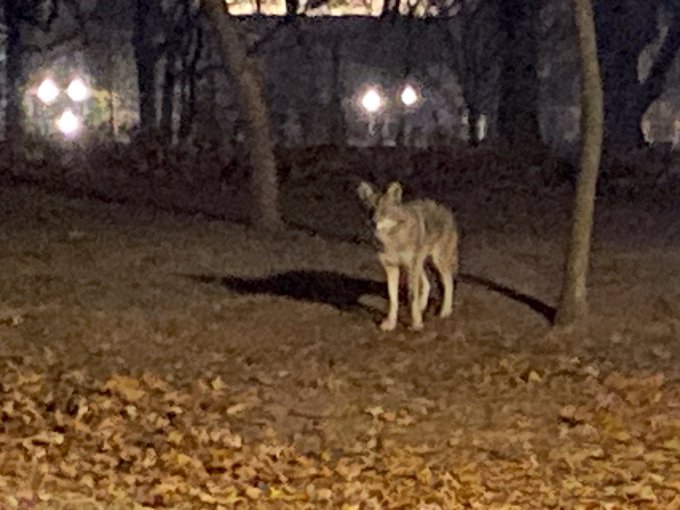
THE GOTHAM URBAN COYOTE PROJECT has been evaluating and studying the Eastern Coyotes that now call New York City and surrounding environs home........They have been following one of the first NYC Eastern Coyotes to make a permanent home in Queens, New York City--- view on video(below)................"As determined by scat analysis, he(male) is at least 10 years old now, old for a wild coyote"

One of the first NYC Eastern Coyotes coyote to make a permanent home in Queens is pictured on the video below:

He is at least 10 years old now, old for a wild coyote.

Queens Coyote video
https://www.facebook.com/gothamcoyote/videos/374819833398507/?t=5

THE GOTHAM URBAN COYOTE PROJECT in the NYC Metropolitan area has been able to get DNA from his scat, which identifies him as a male, related to the coyotes living in the Pelham Bay Park in the northeast Bronx.

As far as we know, no other coyotes have penetrated the urban jungle into Queens as far as he has and made a permanent home there.


He's lived quietly in a small wooded area for a long time now, alone. Nearly every spring we find a den that he has dug, but no females have shown up yet to join him.

Coyotes in NYC urban woodlands-video
https://www.facebook.com/gothamcoyote/videos/1336534546512431/?t=9


Connectivity between patches of habitat are very important for wildlife populations in suburban and urban environments.
This guy managed to travel, we believe, along railroad tracks through NYC to find his current home.

It was a long shot for him to make it, and for a second coyote to survive the same journey (and happen to be the opposite sex) is even more unlikely.

This is why things like habitat corridors, wildlife crossings over or under highways, and undeveloped green spaces are so important for urban wildlife.

Eastern Coyotes under the George Washington Bridge in Washington Heights, Manhattan, NYC


Eastern Coyotes photographed in NYC and surrounding suburbs


Posted by Coyotes, Wolves and Cougars forever at 4:37 PM 0 comments

Thursday, February 6, 2020

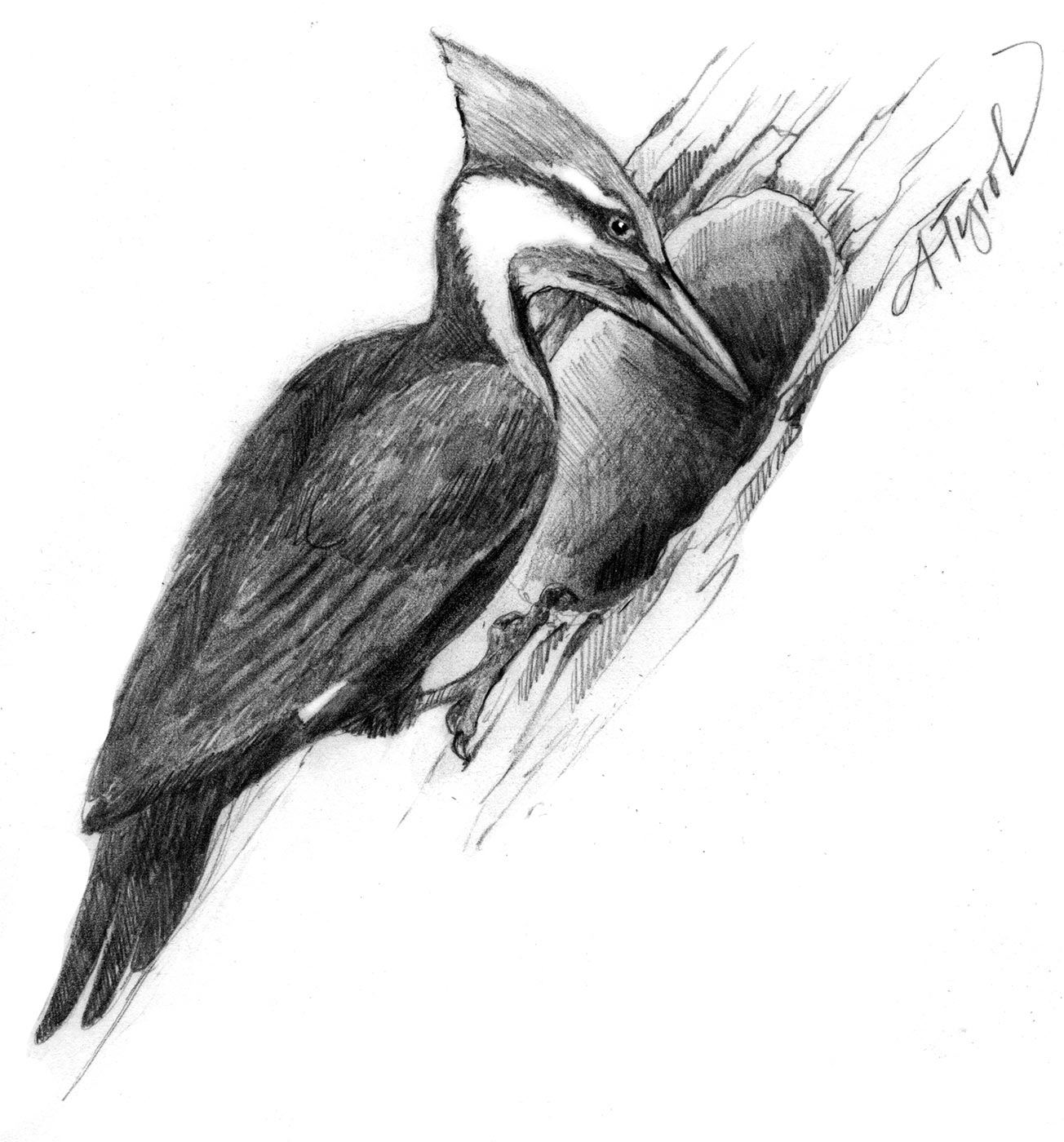
Ranging from the eastern half of the United States across southern portions of Canada and into the Pacific Northwest, the large, Crow-sized 18 inch long Pileated Woodpecker is a year-round resident, braving Winter cold and snow...............“They tend to use deciduous trees more than conifers"...........“Most of their foraging is on dead, dying, or downed trees, but they will utilize trees that aren’t compromised if there’s food there"..........."Omnivorous, they are a key predator of Carpenter Ants".........."Fall and Winter have these woodpeckers dining on nuts, fruits,larvae of beetles and other bugs that excavate into the bark of trees".............."Typically monogamous, both male and female remain within their home territory throughout the year, even when not breeding"

Pileated Woodpeckers: Winter Excavators


Pileated Woodpeckers: Winter Excavators

by Meghan McCarthy McPhaul
February 3, 2020
0 Comments
Pileated Woodpeckers: Winter Excavators ImageIllustration by Adelaide Tyrol


Whenever I spy a pileated woodpecker traversing the sky, I pause to watch its weird undulating flight. The jerky rise-and-drop movement of this large woodpecker is endearingly gawky – like a mini pterodactyl visiting from the Cretaceous period. This time of year, the bird’s bold crimson crest flashes in stark contrast to the mostly-muted colors of winter.


Pileated woodpeckers – Dryocopus pileatus – take their common and scientific names from the Latin word for “capped.” Both male and female sport the namesake red crest, as well as black streaks across the eyes. Measuring about 18 inches long, they have wingspans that can stretch past two feet.


These crow-sized woodpeckers live throughout the eastern half of the United States, across southern portions of Canada, and in the Pacific Northwest. They prefer mature forests with large trees, but also live in places from young forests containing snags and decaying wood to suburban areas with patches of forested land.
Wherever they call home, pileated woodpeckers stick around through the winter. On a walk through the woods, you may hear their distinctive high-pitched calls – some liken it to more of a jungle noise than something that belongs in a New England forest. More likely, though, you’ll hear the deep thudding of woodpecker beak on wood. Woodpeckers drum on trees as a means of communication, to excavate nesting and roosting sites, and – of course – to find food.
Their heavy, chisel-like bills are roughly the same length as their heads, which adds to the pterodactyl appearance, and are designed for pounding through the bark and outer layers of a tree to reach its core. Pileated woodpeckers dig out insects crawling around – or, this time of year, overwintering in larval stage. Excavations can be more than a foot long and leave piles of woodchips heaped around the tree’s trunk.


“They tend to use deciduous trees more than conifers,” said Pamela Hunt, avian conservation biologist at New Hampshire Audubon. “Most of their foraging is on dead, dying, or downed trees, but they’ll still used trees that aren’t compromised if there’s food there.”
Pileated woodpeckers’ meal of choice is carpenter ants (another common sign of their feeding: black poop at the base of trees comprised mostly of indigestible ant bits), but the birds are omnivorous, noshing on fruits and nuts when they’re in season and on an array of insects year-round. While we humans may think of insects as being primarily warm-weather creatures, these woodpeckers seek out the larvae of ants, beetles, and other bugs hidden within trees for the winter.
After excavating a hole, a pileated woodpecker will use its long, barbed tongue to reach and scrape out the buggy delicacy within. Hunt noted these woodpeckers, like all birds that weather the winter cold, spend much of their time during this season refueling on whatever food they can find. They’ll often make multiple large holes in a single snag during a feeding frenzy.
“If a tree is full of yummy larvae, the woodpecker can literally excavate the tree until there’s almost nothing left,” said Hunt.


While some of the bird species we see in winter have migrated short distances, pileated woodpeckers stick close to their nesting sites throughout the year. They are typically monogamous, and while Hunt said the woodpeckers are not necessarily “socially cohesive” during the winter, both male and female remain within their home territory.
During breeding and chick-raising season, pileated woodpeckers, like many other birds, defend their territories from interlopers. In winter, however, they often tolerate other pileated woodpeckers within their own range. The trespassers are generally young birds searching for their own territories to claim.
I will probably never be able to identify any specific chickadee from the myriad who frequent the bird feeder, or pick out one slate-colored junco from the flock hopping around the yard. But I can have some confidence that the big bird with the red-capped head and the undulating flight passing through the winter sky is the same one – or at least one of the same two – I sometimes spy in warmer months, flitting into the woods or perched on the side of a tree, pounding away.
Meghan McCarthy McPhaul is the assistant editor of Northern Woodlands magazine.
Posted by Coyotes, Wolves and Cougars forever at 4:49 PM 0 comments

Tuesday, February 4, 2020

"Coyotes and badgers are known to hunt together and can even be more successful hunting prairie dogs and ground-squirrels when they work in tandem"............"Studies have shown that this unusual relationship is beneficial for both species"..............."The coyote can chase down prey if it runs and the badger can dig after prey if it heads underground into its burrow systems"


CLICK ON THIS LINK TO WATCH THE VIDEO

🎥Peninsula Open Space Trust pic.twitter.com/oS9BL5JOoK


Spotted! A Coyote and Badger Hunting Together


Official Web page of the U S Fish and Wildlife Service
November 2, 2016

Recent sightings of a coyote and badger on the prairie surrounding the National Black-footed Ferret Conservation Center brought attention to a fascinating example of partnership.

Coyotes and badgers are known to hunt together and can even be more successful hunting prairie dogs and ground-squirrels when they work in tandem.

Coyote and badger at Black-footed Ferret Conservation Center. Kimberly Fraser, USFWS 


Studies have shown that this unusual relationship is beneficial for both species. The coyote can chase down prey if it runs and the badger can dig after prey if it heads underground into its burrow systems. 

Coyote and badger at Black-footed Ferret Conservation Center.


Each partner in this unlikely duo brings a skill the other one lacks. Together they are both faster and better diggers than the burrowing rodents they hunt.
These partnerships tend to emerge during the warmer months. In the winter, the badger can dig up hibernating prey as it sleeps in its burrow. It has no need for the fleet-footed coyote.

Coyote and badger at Black-footed Ferret Conservation Center. Kimberly Fraser, USFWS


Coyotes and badgers have a sort of open relationship. They will sometimes hunt together; but they also often hunt on their own.

Coyote and badger at Black-footed Ferret Conservation Center. Kimberly Fraser, USFWS


Each species is a treat to see, but together is even more fascinating and special!


 Just a few of the studies on this pairing:

Minta, Steven C., Kathryn A. Minta, and Dale F. Lott. "Hunting associations between badgers (Taxidea taxus) and coyotes (Canis latrans)." Journal of Mammalogy 73.4 (1992): 814-820.

Macdonald, David W. "The ecology of carnivore social behaviour." Nature 301.5899 (1983): 379-384.

Cahalane, Victor H. "Badger-coyote “partnerships”." Journal of Mammalogy 31.3 (1950): 354-355.
# Posted By | 11/6/16 6:40 AM


 Review article here http://www.ecology.info/badger-coyote.htm


2/3/20, 8:11 PM
A coyote and a badger use a culvert as a wildlife crossing to pass under a busy California highway together. Coyotes and badgers are known to hunt together.

🎥Peninsula Open Space Trust pic.twitter.com/oS9BL5JOoK

Posted by Coyotes, Wolves and Cougars forever at 4:56 PM 0 comments

Sunday, February 2, 2020

Coyote Sightings Bring Cameras To Inwood Hill Park in northern Manhattan and also in Central Park-36 sightings over the past 30 years


Coyote Sightings 

Bring Cameras 

To Inwood Hill 

Park 

Parks officials set up cameras and sent out tips 

after rare sightings of coyotes, and reportedly 

coyote pups, at the Uptown park. 


By Anna Quinn, Patch Staff 
Jan 28, 2020 9:13 am ET | Updated Jan 28, 2020 11:43 am ET
https://patch.com/new-york/washington-heights-inwood/coyote-sightings-bring-cameras-inwood-hill-park-city-says
This past week, NYC Parks officials set up cameras 

and sent out tips after rare sightings of coyotes, 

and reportedly coyote pups, at the Inwood Hill Park(picture below),


View image on Twitter
Coyotes live mostly in the Bronx 
and have more recently been spotted 
in the north end of Central Park and 
Pelham Bay and Van Cortlandt Parks
 in the Bronx, among other places.....
breeding in the Bronx and now, on the 
verge of doing so in Manhattan
INWOOD, NY — Coyotes more
typically found in Queens or The
Bronx might have made their way
to Inwood Hill Park, and prompted
a new set-up of cameras to track the
wild animals, parks officials said this week. 
The city's Parks Department sent out
a notice Saturday warning residents to
not get too close and to protect their
pets from coyotes that residents sahave
been spotted in the 196-acre park,
which borders the Bronx, where the
animals are more typically known to live.
The Parks Department didn't say how
many sightings there have been, but
at least five residents had discussed
spotting the coyotes on a Facebook
group set up for Inwood dog owners.
"...At first I saw only one and thought, '
Oh my god that's a stray dog, should
we go after it?'" Samantha Arbuiso
wrote on the group on Jan. 19. "We
started walking up the hill towards
the baseball field and then right there
at the top to the right were 2 more!!"


Parks officials set up cameras and sent out tips to residents after sightings of coyotes, and reportedly coyote pups, at the Uptown park
Parks officials set up cameras and sent 
out tips to residents after sightings of 
coyotes, and reportedly coyote pups, 
at the Uptown park (Shutterstock / Prakash Mandalia) 

Posted by Coyotes, Wolves and Cougars forever at 10:46 PM 0 comments
Newer Posts Older Posts Home
Subscribe to: Posts (Atom)

About Me

Coyotes, Wolves and Cougars forever
View my complete profile

Recent Comments

Red Fox fighting Badger

Email Rick Meril

Subscribe To

Posts
Atom
Posts
All Comments
Atom
All Comments

Bobcat in Vermont woodlands

Mother and daughter Puma playing in North Dakota

Find us on Facebook

Find us on Facebook

Christmas morning 2008-Coyote hunting mice

Blog Archive

  • March (5)
  • February (11)
  • January (3)
  • December (7)
  • November (10)
  • October (8)
  • September (4)
  • August (11)
  • July (12)
  • June (9)
  • May (12)
  • April (18)
  • March (23)
  • February (20)
  • January (18)
  • December (19)
  • November (21)
  • October (24)
  • September (22)
  • August (26)
  • July (19)
  • June (17)
  • May (22)
  • April (24)
  • March (27)
  • February (26)
  • January (26)
  • December (29)
  • November (18)
  • October (24)
  • September (19)
  • August (25)
  • July (25)
  • June (23)
  • May (29)
  • April (31)
  • March (28)
  • February (25)
  • January (33)
  • December (32)
  • November (32)
  • October (34)
  • September (30)
  • August (39)
  • July (29)
  • June (34)
  • May (39)
  • April (31)
  • March (34)
  • February (35)
  • January (45)
  • December (42)
  • November (32)
  • October (25)
  • September (33)
  • August (46)
  • July (34)
  • June (48)
  • May (43)
  • April (47)
  • March (43)
  • February (37)
  • January (37)
  • December (45)
  • November (42)
  • October (34)
  • September (36)
  • August (44)
  • July (36)
  • June (45)
  • May (43)
  • April (51)
  • March (48)
  • February (47)
  • January (64)
  • December (63)
  • November (57)
  • October (43)
  • September (45)
  • August (52)
  • July (52)
  • June (48)
  • May (55)
  • April (54)
  • March (77)
  • February (68)
  • January (51)
  • December (61)
  • November (49)
  • October (42)
  • September (62)
  • August (68)
  • July (69)
  • June (42)
  • May (72)
  • April (83)
  • March (77)
  • February (80)
  • January (78)
  • December (90)
  • November (91)
  • October (93)
  • September (94)
  • August (92)
  • July (85)
  • June (90)
  • May (91)
  • April (91)
  • March (93)
  • February (85)
  • January (94)
  • December (90)
  • November (80)
  • October (87)
  • September (96)
  • August (90)
  • July (62)
  • June (54)
  • May (62)
  • April (55)
  • March (27)
  • February (14)

Hiker in Glacier National Park encounters a Puma......The Puma walks "wide" of the hiker

Search This Blog

Lynx capturing a snowshoe hare

Likely Wolf sighting in Colorado

black Bear in the Smokey Mtns berry hunting in the trees

Blog Translation

favorite links

  • Wyoming Untrapped
  • The Natural History of the Urban Coyote
  • western wildlife
  • Wild Dog Foundation
  • Coyotes live in Maine
  • Santa Cruz Puma Project
  • http://www.coyotewatchcanada.com
  • Mexican Wolves.org
  • Greater Yellowstone Science Learning Center
  • Western Wolves
  • Lockwood Animal Rescue Center
  • Wolf and Wildlife Studies
  • Worth a Dam
  • The Wolverine Foundation
  • mountain lion foundation
  • Boulder-Whiteclouds Council
  • Wild Read
  • Big Wildlife
  • Southern Utah Wilderness Alliance
  • Coyote Yipps
  • The Wolverine Blog
  • Craighead research.org
  • Wild Earth Guardians
  • Biodiversity Conservation Alliance
  • Center for Native Ecosystems
  • izilwane.org online Magazine
  • Oregon Wild
  • Ralph Maughan's Wildlife Reports
  • North American Bear Center
  • Wolf and Cat
  • Conservation Northwest
  • Howling for Justice
  • Wilderness Watch
  • Wolf Watcher
  • Endangered Species Coalition
  • My Place By The Pond
  • The Wolverine Foundation
  • Wolf Ecosystem Research
  • canadian Parks and Wilderness Society
  • Earthroots
  • Predator Defense
  • Sightline Institute
  • Downeast Lakes Land Trust
  • Adirondack Council
  • jaguar Conservation Network
  • Bordercats
  • Large Carnivore Conservation Lab-Washington State U.
  • Bat conservation International
  • The human footprint
  • Craighead Beringia South
  • Yellowstone to Yukon Conservation Initiative
  • Canadian Boreal Initiative
  • Northern Rockies Conservation Cooperative
  • Keeping Track
  • Wildlife Conservation Society
  • Native Fish Society
  • Jaguar Habitat Campaign
  • Northern Woodlands Magazine
  • Canadian Wolf Coalition
  • Forest Service Employees
  • Trust for Public Land
  • Rainforest Action Network
  • The Wilderness Society
  • Greater Yellowstone Coalition
  • Keystone Conservation
  • American Wildlands
  • The Nature Conservancy
  • Algonquins to Adirondacks
  • Two Countries, One Forest
  • Vermont Land Trust
  • Center For Biological Diversity
  • Open Space Institute
  • Wildlands and Woodlands
  • Rewilding Institute
  • Cougar Network
  • Cougar rewilding foundation
  • Eastern Coyote Research
  • Project Coyote
  • Restore:The North Woods
  • The Wildlife News
  • N.E. Eco Recovery Society
  • WERC
  • Wildlands Network
  • Outdoor Liasons
  • People and Wolves

Click Below to Follow Us On Twitter

Click Below to Follow Us On Twitter

Northern Ontario, Canad Wolfpack caught on trailcamera

Add Coyotes-Wolves-Cougars Link To Your Igoogle Homepage

Add to Google Reader or Homepage

A New Jersey Eastern Coyote unable to take a fawn

Blogger Rick

Blogger Rick
Strategizing at the WB

Let Rick and other readers know you're a fan of this blog...Become a Follower!

Making a Pitch at the WB

Making a Pitch at the WB

Two Massachusetts Eastern Coyotes at their den site

Eastern Wolf in Algonquin Provincial Park, Ontario, Canada

Gray Foxes(unlike Red Foxes) can climb trees--an advantage when pursued by Coyotes

Aldo Leopold--3 quotes from his SAN COUNTY ALMANAC

"We abuse land because we regard it as a commodity belonging to us. When we see land as a community to which we belong, we may begin to use it with love and respect."


Aldo Leopold

"A thing is right when it tends to preserve the integrity, stability and beauty of the biotic community. It is wrong when it tends otherwise."


Aldo Leopold

''To keep every cog and wheel is the first precaution of intelligent tinkering."


Wildlife Rendezvous

Wildlife Rendezvous
Like so many conscientious hunters and anglers come to realize, good habitat with our full suite of predators and prey make for healthy and productive living............Teddy Roosevelt depicted at a "WILDLIFE RENDEZVOUS"

Recent Posts


Blog Disclaimer

This is a personal weblog. The opinions expressed here represent my own and not those of my employer. In addition, my thoughts and opinions change from time to time…I consider this a necessary consequence of having an open mind. This blog is intended to provide a semi-permanent point in time snapshot and manifestation of my various thoughts and opinions, and as such any thoughts and opinions expressed within out-of-date posts may not be the same, nor even similar, to those I may hold today. All data and information provided on this site is for informational purposes only. Rick Meril and WWW.COYOTES-WOLVES-COUGARS.COM make no representations as to accuracy, completeness, suitability, or validity of any information on this site and will not be liable for any errors, omissions, or delays in this information or any losses, injuries, or damages arising from its display or use. All information is provided on an as-is basis.


Additional disclaimer information can be viewed by clicking here.